John Lennon’s Victorian Circus Poster Lovingly Remade by Artists and Engravers
This wondrous little video is, as they say, guaranteed to raise a smile. According to Beatles legend, John Lennon was shooting a promotional film for “Strawberry Fields Forever” in early 1967 when he passed by an antique shop and discovered a poster from 1843 trumpeting the arrival of Pablo Fanque’s Circus. The circus, the poster proclaimed, was to be “for the benefit of Mr. Kite.” Intrigued, Lennon bought the quirky Victorian poster, hung it on his wall at home, and then proceeded to write “Being for the Benefit of Mr. Kite!,” the seventh track on Sgt. Pepper’s Lonely Hearts Club Band.
Almost 45 years later, Beatles fans still can’t shake the poster from their minds. And, just recently, Peter Dean and a team of artists decided to recreate the poster using traditional methods of wood engraving and letterpress printing. They share their experience in the elegant video above. Your can buy your own copy of the limited edition print here.
via Kottke
If you would like to support the mission of Open Culture, consider making a donation to our site. It’s hard to rely 100% on ads, and your contributions will help us continue providing the best free cultural and educational materials to learners everywhere. You can contribute through PayPal, Patreon, and Venmo (@openculture). Thanks!
Related Content:
The Strawberry Fields Forever Demos: The Making of a Beatles Classic (1966)
Here Comes The Sun: The Lost Guitar Solo by George Harrison
Guitarist Randy Bachman Demystifies the Opening Chord of ‘A Hard Day’s Night’
Read More...A Short History of Romanian Computing: From 1961 to 1989
The “Politehnica” University of Timisoara, Romania, an engineering school established in 1920, takes its motto from Ferdinand I: “It’s not the walls that make a school, but the spirit living inside.” While the walls of “Politehnica” are as stately as anyone could ask for, what’s inside, according to the short documentary above, is also pretty spiffy—the spirit of computing history, Romanian style. With a score that sounds a little like an outtake from Logan’s Run, this video gives us a tour of the university’s Museum of Information Technology and Communications, opened November 16, 2001.
We meet a number of ancient machines, many of which were responsible for designing buildings and hydroelectric dams and some of which still function. There’s the Mecipt 1, a massive 1961 mainframe system covered in dials, switches, and routing systems and looking somewhat more industrial than the machines built by Fairchild and IBM at the same time. Next comes Mecipt 2 in 1963, which was in operation for sixteen years and did much of the building design. The microcomputers TIMS and MS-100 resemble the original business machines made in the sixties by companies like Hewlett-Packard and Data General Corp. Overall, the short doc takes us through the experimental course of Romanian computing from 1961 to 1989. The reader who brought this to our attention points out that there’s little material out there on Romanian computer engineering. This short doc offers a rare look at a very little-known and fascinating history.
h/t Alin
Related Content:
“They Were There” — Errol Morris Finally Directs a Film for IBM
How Film Was Made: A Kodak Nostalgia Moment
Josh Jones is a doctoral candidate in English at Fordham University and a co-founder and former managing editor of Guernica / A Magazine of Arts and Politics.
Read More...Art.sy Rolls Out Huge Archive of Fine-Art Images and an Intelligent Art Appreciation Guide

Yesterday saw the launch of what you’ll surely find the most intriguing use of Syria’s domain name extension yet, especially if you follow the visual arts. It serves the punning site Art.sy, to which you’ll soon point your browser whenever you want to discover new imagery that appeals to your aesthetic sensibility. Thus holds the theory, in any case, behind this service created by the Art Genome Project. It aims to become to visual art what Pandora has become to music: a virtual mind that can take your tastes, turn right back around to recommend works that please those tastes, and — in the best of all possible outcomes, little by little — broaden those tastes as well. Tell Art.sy what has recently captivated you in the museums, and it will dig through pieces from Washington’s National Gallery, the Los Angeles Museum of Contemporary Art, the Cooper-Hewitt National Design Museum, the British Museum, and elsewhere, trying its best to find something else that will do the same. In total, Art.sy hosts “17,000+ artworks by 3,000+ artists” from “300+ of the world’s leading galleries, museums, private collections, foundations, and artist estates from New York to London, Paris to Shanghai, Johannesburg to São Paulo.”
Melena Ryzik in The New York Times describes Art.sy’s elaborate system of code-based aesthetic classification as developed by “a dozen art historians who decide what those codes are and how they should be applied,” in which “some labels (Art.sy calls them “genes” …) denote fairly objective qualities, like the historical period and region the work comes from and whether it is figurative or abstract, or belongs in an established category like Cubism, Flemish portraiture or photography,” while others “are highly subjective, even quirky.” Ryzik lists the possible codes for a Picasso as including “Cubism,” “abstract painting,” “Spain,” “France” and “love,” and those for a Jackson Pollock as “abstract art,” “New York School,” “splattered/dripped,” “repetition” and “process-oriented.” Here we have yet another reason to maintain a high artistic awareness in our high-tech time. Still, I can’t help but recall the wise counsel Stephen Fry offered in an interview we featured back in August: a truly life-enriching recommendation engine wouldn’t give you the same art you’ve always enjoyed; it would give you the exact opposite.
You can learn more about the ins-and-outs of Art.sy here.
Colin Marshall hosts and produces Notebook on Cities and Culture. Follow him on Twitter at @colinmarshall.
Read More...
What If Money Was No Object?: Thoughts on the Art of Living from Eastern Philosopher Alan Watts
Alan Watts came to San Francisco during the early 1950s, wrote his bestseller Way of Zen, and became one of the foremost popularizers of Zen Buddhism, Hinduism, Taoism and various forms of Eastern philosophy. His TV show, Eastern Wisdom and Modern Life (1960), introduced Americans to the seemingly exotic concept of meditation (watch here). And his radio show and lectures forced listeners to pause and look at their lives from a fresh perspective. Again and again, Watts challenged the Western emphasis on money-making to the exclusion of all else. We’ve heard Watts rail against this soul-crushing value in a lecture animated by the creators of South Park. (I’m not kidding you.) And, in the newly-produced video above, he continues along the same trajectory. So, as you drink your morning coffee and ponder your day, ask yourself: Are you putting money-making before happiness itself? Or are you pursuing the passions that bring happiness, achieving excellence, and then letting the money follow? With that, I’ll let you continue with your day.
If you would like to support the mission of Open Culture, consider making a donation to our site. It’s hard to rely 100% on ads, and your contributions will help us continue providing the best free cultural and educational materials to learners everywhere. You can contribute through PayPal, Patreon, and Venmo (@openculture). Thanks!
Related Content:
The Art of Living: A Free Stanford Course Explores Timeless Questions
Alan Watts On Why Our Minds And Technology Can’t Grasp Reality
The Wisdom of Alan Watts in Four Thought-Provoking Animations
Read More...How Political Commitment Led Lucy Lawless (AKA Xena, the Warrior Princess) to Study Philosophy
It’s certainly not uncommon for celebrities to take up political causes, though this does not usually lead to them getting arrested for holing up in a high tower oil-drilling ship for four days. What’s less common is for this interest to burgeon into a full-on obsession with all things philosophical, but that’s exactly what happened to Lucy Lawless (best known as Xena, the Warrior Princess).
“I went to the UN summit on sustainable development after getting involved in the whole… big oil protest… and I saw all of these people working very hard but seemingly at cross-purposes about how do we create a just society.” On a full two-hour episode of The Partially Examined Life Philosophy Podcast (which she claims was largely responsible for turning her on to philosophy), she describes how this political interest drove her to look at the foundations and histories of theories of justice, and eventually decide to go back to school to study philosophy, which she’s now doing in New Zealand between flights to the states to film TV spots such as her recent appearance on NBC’s Parks and Recreation.
The Partially Examined Life interview with Lawless is a five-person, roundtable discussion of Tom Payne’s 2010 book, Fame: What the Classics Tell Us About Our Cult of Celebrity. You can listen here:
The thesis of the book is that celebrities serve as an outlet for society’s aggressive instincts. Drawing on canonical texts about religious anthropology like James Frazer’s The Golden Bough, the author compares the treatment of modern celebrities to ancient rites where young maidens were lavishly bestowed with fineries and then sacrified. Lucy thinks this well matches her own experiences, and talks about the existential weirdness involved with being and dealing with the famous.
The Partially Examined Life has also covered related topics of Freud’s Civilization and its Discontents and Nietzsche’s Genealogy of Morals. You can subscribe to the podcast on iTunes.
Mark Linsenmayer runs the Partially Examined Life philosophy podcast and blog.
Read More...Marginal Revolution University Launches, Bringing Free Online Courses in Economics to the Web
A great year for open education got even better with the launch of Marginal Revolution University. Founded by Tyler Cowen and Alex Tabarrok, two econ professors at George Mason University, MRUniversity promises to deliver free, interactive courses in the economics space. And they’re getting started with a course on Development Economics, a subdiscipline that explores why some countries grow rich and others remain poor. In short, issues that have real meaning for everyday people worldwide.
In an announcement on the Marginal Revolution blog last month, Cowen outlined a few of the principles guiding the project:
1. The product is free, and we offer more material in less time.
2. Most of our videos are short, so you can view and listen between tasks, rather than needing to schedule time for them. The average video is five minutes, twenty-eight seconds long. When needed, more videos are used to explain complex topics.
3. No talking heads and no long, boring lectures. We have tried to reconceptualize every aspect of the educational experience to be friendly to the on-line world.
4. It is low bandwidth and mobile-friendly. No ads.
5. We offer tests and quizzes.
6. We have plans to subtitle the videos in major languages. Our reach will be global, and in doing so we are building upon the global emphasis of our home institution, George Mason University.
7. We invite users to submit content.
8. It is a flexible learning module. It is not a “MOOC” per se, although it can be used to create a MOOC, namely a massive, open on-line course.
9. It is designed to grow rapidly and flexibly, absorbing new content in modular fashion — note the beehive structure to our logo. But we are starting with plenty of material.
10. We are pleased to announce that our first course will begin on October 1.
Bookmark MRUniversity and look out for its curriculum to expand. In the meantime, you can explore more Free Online Economics Courses, a subset of our meta collection, 1,700 Free Online Courses from Top Universities.
Related Content:
MIT’s Introduction to Economics: A Free Online Course
Free Online Economics & Finance Courses
Mastering Econometrics: A Free Online Course
Read More...University Presses & Libraries Turn to Pinterest to Promote Books
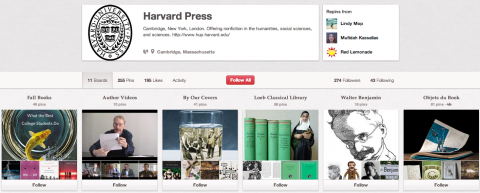
I’ll admit it: I’m not a big Pinterest user. Until very recently I thought the social networking site was a bit twee—too much about cute clothes and crafts, not enough about ideas.
Turns out the web’s 15th largest site has a lot more to offer.
Open Culture has its own embryonic Pinterest page. But, more importantly, university presses are making widespread use of Pinterest to promote new book titles. Likewise, academic libraries are using their Pinterest pages to promote events and help fund major capital improvements. For libraries and archives, a major ongoing mission is to keep the collections visible. It’s not easy to let the world know about your one-of-a-kind holdings, and Pinterest potentially offers a great way to bring these materials to new and younger audiences.
Big retailers haven’t figured out how to make real money off of Pinterest yet, though one theory holds that the site’s highly visual nature puts people in the mood to click and buy. True or not, university presses and libraries need all the help they can get to gin up sales, so they’re wading into the Pinterest waters and seeing what happens.
Alice Northover has created a Tumblr that catalogues a few of the best university presses that have Pinterest pages. The list is a handy map of treasures to be found online.
There are the usual, and completely worth checking out, suspects: Of course, Harvard University Press has a page that features, among other things, interviews with Harvard Press authors. Watch mathematician Paul Lockhart, author of Measurement, trip out on parallelograms.
The University of Mississippi has a robust presence that features an extensive collection of Faulkner criticism and appreciation.
Syracuse University’s page links to its audio archive, which includes a fun, episodic program called “Wait? They Banned What?”. You might be surprised to find out that Bing Crosby song was banned during World War II for being too catchy.
One of the best may be one of the most unsung, however. New Zealand’s Victoria University of Wellington’s library houses a major collection of Samoan historical objects. Check out the library’s repository of amazing South Pacific history.
These sites offer very few decorating tips for your Air Stream trailer, and I found no links to locavore jam-making businesses, but Alice, whomever she may be, has created a great curatorial tool for exploring a new trend in book promotion.
But wait. Cambridge University Press has a pin on its page called “Librianista” that links to short-hemline clothes modeled by bespectacled cuties. I guess even the world’s oldest publisher gets to have a little fun.
Thanks to Kirstin Butler for sending Alice’s Tumblr our way.
Kate Rix is an Oakland-based freelance writer. See more of her work at .
Read More...Miranda July Teaches You How to Avoid Procrastination
I’ve always thought of writer, actor and filmmaker Miranda July as someone who creates her own opportunities. Long before her stories in The New Yorker, and before Me and You and Everyone We Know, the award-winning first feature that cemented her indie darling status, she was circulating video chain letters featuring her own work and that of other young, female filmmakers. She recorded LPs and toured original performance art pieces.
What a relief to find out she’s a procrastinator, too.
July insists that her chattering monkey mind nearly deprived her of the concentration necessary to finish writing The Future, her second full-length film. One of its most compelling parts actually wound up on the cutting room floor. In it (above), we see Sophie, the under-employed would-be dancer played by July, coming to grips with her own self-sabotaging tendency toward procrastination.
Of course, the reason we’re able to see it at all is that July, whose industriousness surely has earned her the right to spend a decade or so doing nothing but watching YouTube and Googling her own name, repurposed it as a short, instructional film (A Handy Tip for the Easily Distracted), which offers an antidote for those of us who share her affliction.
(Admit it. You’re procrastinating now, aren’t you?)
In addition to the soundness of her advice, her methodology is endearingly low-tech. As one who’s been known to attribute a lack of creative output to a less than ideal workspace, I found the cluttered, shabby apartment set both familiar and galvanizing. If we’re going to make excuses, we may as well own them. July takes yet another step by harnessing them and forcing them to work for her.
Related Content:
Ayun Halliday is the author of any number of books including The Zinester’s Guide to NYC and No Touch Monkey! And Other Travel Lessons Learned Too Late.
Read More...What an Astronaut’s Camera Sees (and What a Geographer Learns About Our Planet) from the ISS
Justin Wilkinson has a pretty cool sounding gig. He’s the chief geoscientist at NASA, and he learns all about planet Earth from space. When astronauts head to the International Space Station (ISS), Wilkinson asks them to snap pictures of various geographical locations. And, from this vantage point 250 miles above the planet’s surface, he learns many things — for example, he tells Slate, “there are a lot more examples of a geographical phenomenon called an inland delta or megafan—that is, deltas formed far from coastlines—than was once thought.”
Out of Wilkinson’s research comes some great pictures and videos, and today we’re featuring two clips. The first video above shows you what an astronaut sees at night, giving you an aerial tour of cities and coastlines in the Americas, the Middle East and Europe. The equally impressive video below gives you stellar shots (in daylight) of Namibia, Tunisia, Madagascar, Sicily, China, Iran, and Utah. You’ll find these videos added to our collection of Great Science Videos. Courses on astronomy can be found in our collection of Free Courses Online. h/t @stevesilberman
Christopher Lee Narrates a Beautiful Animation of Tim Burton’s Poem, Nightmare Before Christmas
Almost nineteen years ago, the ideal fall-holiday animated film first opened: The Nightmare Before Christmas, directed by stop-motion master Henry Selick and produced by Tim Burton, possessor of one of the best-known imaginations of our time. Over a decade before that, in 1982, Burton wrote a poem of the same name, telling essentially the same story as would the film. Working at the time as an animator at Disney, he managed to catch his employer’s attention by turning these verses into concept art, storyboards, and character models for adaptation into a potential half-hour television special featuring Vincent Price. But the world, much less Disney, didn’t yet seem ready for the Burtonian sensibility, much less the particular note of jolly grimness struck by The Nightmare Before Christmas. Years would pass, both in terms of getting the project into the right hands and in terms of the painstaking production itself, before we could enjoy Jack Skellington’s accidental journey into Christmas Town and his well-meaning but ill-fated attempt to take that holiday for himself.
But when we got to enjoy it, boy, did we ever enjoy it: in its nearly two decades of existence, The Nightmare Christmas has, with its distinctive intricate dark-yet-light aesthetics, askew humor, and surprising intelligence, spawned a vast international subculture of enthusiasts. But you can still experience the core of everything the film is, and everything it has become in the zeitgeist, in Burton’s original poem. So why not also see it animated and read aloud by Christopher Lee, as you can in the video above? “It was late one fall in Halloween Land, and the air had quite a chill,” the horror veteran intones. “Against the moon a skeleton sat, alone upon a hill.” Nightmare Before Christmas fans know where this is going, but they’ll still want to hear the rest; though clearly the direct source of so much in their beloved movie, the poem looks on Skellington and his misadventures from a few angles they wouldn’t quite expect.
Related content:
Six Early Short Films By Tim Burton
Tim Burton: A Look Inside His Visual Imagination
Tim Burton’s The World of Stainboy: Watch the Complete Animated Series
Colin Marshall hosts and produces Notebook on Cities and Culture. Follow him on Twitter at @colinmarshall.
Read More...Support Us
We're hoping to rely on loyal readers, rather than erratic ads. Please click the Donate button and support Open Culture. You can use Paypal, Venmo, Patreon, even Crypto! We thank you!

About Us

Open Culture scours the web for the best educational media. We find the free courses and audio books you need, the language lessons & educational videos you want, and plenty of enlightenment in between.
Advertise With Us

FREE UPDATES!
GET OUR DAILY EMAIL
Get the best cultural and educational resources on the web curated for you in a daily email. We never spam. Unsubscribe at any time.
FOLLOW ON SOCIAL MEDIA

Open Culture editor Dan Colman scours the web for the best educational media. He finds the free courses and audio books you need, the language lessons & movies you want, and plenty of enlightenment in between.
Advertise With Us


