Leo Strauss: 15 Political Philosophy Courses Online

In 1949, Leo Strauss, the German-Jewish emigré, landed at The University of Chicago, where he spent decades teaching and writing on political philosophy, especially the political thought of the Ancients. Strauss’ thinking skewed conservative, and if he was sometimes controversial while alive, he has become only more so in death (1973). Nowadays he’s considered rightly or wrongly the “intellectual godfather of the neo-conservative political movement,” if not an “intellectual force behind the Bush administration’s plan to invade Iraq.” Although Strauss commented occasionally on contemporary politics (Harper’s has more on that), he spent most of his time working through major philosophical texts, and through his commentaries, developing his own philosophical positions, which were generally hostile to the Enlightenment project and modern individualism/liberalism.
Strauss was unquestionably an influential figure even if he still divides us, and now, courtesy of U. Chicago, you can listen to 15 of his philosophy seminars online. They were recorded between 1959 and 1973, and some representative titles include Montesquieu’s The Spirit of the Laws (a course that Paul Wolfowitz took during the early 70s), Nietzsche’s Beyond Good and Evil, Hobbes’ Leviathan, and Hegel’s The Philosophy of History.
More seminars will be coming online. For now, we have catalogued all 15 existing seminars in the Philosophy section of our big collection of 1100 Free Online Courses.
Related Content:
Walter Kaufmann’s Lectures on Nietzsche, Kierkegaard and Sartre (1960)
Philosophy with John Searle: Three Free Courses
Existentialism with Hubert Dreyfus: Four Free Philosophy Courses
Read More...3 Dreams of Black: A Mind-blowing Interactive Music Video
So this is definitely not your grandma’s MTV. The clip we’ve posted above explains the making of “3 Degrees of Black,” an interactive video made for your browser, which was the product of a collaboration between the multi-hyphenated artist/filmmaker Chris Milk and a group of 20-something geniuses at Planet Google. But before you delve into the (admittedly fascinating) backstory, be sure to experience the video for yourself and move your mouse around a bit.
“Three Dreams of Black” is a song from the new album “Rome,” itself a collaboration between American producer Danger Mouse and Italian composer Daniel Luppi, featuring Jack White and Norah Jones. The song is a perfect choice for a trippy, multi-faceted project like this, which combines video, 2D and 3D graphics, and the user herself. And yes, we know the whole “experiment” is basically just an advertisement for Google Chrome, but after spending some time in their dreamscape, we’re cool with that.
via Metafilter
Sheerly Avni is a San Francisco-based arts and culture writer. Her work has appeared in Salon, LA Weekly, Mother Jones, and many other publications. You can follow her on twitter at @sheerly
Read More...The Climate Scientist Rap (Warning: Offensive Language)
In this highly NSFW video produced by the Australian television show Hungry Beast, a posse of bona fide, degree-holding climate scientists put the ultimate smackdown on climate change deniers. By NSFW, we mean that the rap is “more expletive-ridden than the latest Lil’ Wayne single.” Still, after a few listens we did find a couplet clean enough to quote:
We’re scientists/What we speak is true
Unlike Andrew Bolt/Our work is PEER REVIEWED!
If you feel like dropping $1.69, you can also buy the extended single on iTunes.
Related Content:
Sheerly Avni is a San Francisco-based arts and culture writer. Her work has appeared in Salon, LA Weekly, Mother Jones, and many other publications. You can follow her on twitter at @sheerly.
Read More...The National Jukebox: Play 10,000 Songs Released Between 1901 and 1925

The National Jukebox, the new digital musical player of the Library of Congress, features more than 10,000 songs released by the Victor Talking Machine Company between 1901 and 1925 (with the promise of more to come). You can build your own playlist from the many genres of music available, which include some extremely rare recordings from different genres including 0pera, blues, yodeling, jazz, and much, much more.
We also love the disclaimer on the website’s front page: WARNING: Historical recordings may contain offensive language. It’s quite easy to see why the warning is necessary, especially after some time spent listening to the comedy section.
If you want to see a Victor Talking Machine in action, you can watch one getting demoed here.
via @kirstinbutler
Sheerly Avni is a San Francisco-based arts and culture writer. Her work has appeared in Salon, LA Weekly, Mother Jones, and many other publications. You can follow her on twitter at @sheerly
Read More...Kepler, Galileo & Nostradamus in Color, on Google

To date, Google Books has scanned 50,000 books from the 16th and 17th centuries. And by working with great European libraries (Oxford University Library and the National Libraries of Florence and Rome, to name a few), the Mountain View-based company expects to index hundreds of thousands of pre-1800 titles in the coming years.
Traditionally, most historical texts have been scanned in black & white. But these newfangled scans are being made in color, giving readers anywhere the chance to read older books “as they actually appear” and to appreciate the “great flowering of experimentation in typography that took place in the 16th and 17th centuries.”
Some of the foundational texts now available in color include Nostradamus’ Prognostication nouvelle et prediction portenteuse (1554), Johannes Kepler’s Epitome Astronomiae Copernicanae from 1635, and Galileo’s Systema cosmicum from 1641. All texts can be viewed online, or downloaded as a PDF (although the PDF’s lack color)…
Related Content:
Google “Art Project” Brings Great Paintings & Museums to You
Google to Provide Virtual Tours of 19 World Heritage Sites
Read More...Collision: Award-Winning Film Explores Politics Through Shapes
The German multi-media artist Max Hattler describes his award-winning short film “Collision” (2005) as “Islamic patterns and American quilts and the colors and geometry of flags as an abstract field of reflection,” which will make no sense whatsoever until you watch the video. It’s barely over two minutes long, so just give it a shot and let the images do their own explaining. Be sure to wear headphones, or at least keep the volume low … but not off. The experience is definitely equal parts sound and sight.
via @matthiasrascher
Sheerly Avni is a San Francisco-based arts and culture writer. Her work has appeared in Salon, LA Weekly, Mother Jones, and many other publications. You can follow her on twitter at @sheerly.
Read More...The Wild Kingdom: Brought to You by Mutual of Omaha (and It’s Now on YouTube)
If you’re a Gen-X’er or older, this will likely dust off some old memories, unleashing one of those “Yes, I remember that” moments.
From 1963 through 1988, Marlin Perkins and Jim Fowler hosted Mutual of Omaha’s Wild Kingdom, a 30 minute program that aired Sunday nights on NBC. An early precursor to Animal Planet and The Discovery Channel, Wild Kingdom let American audiences travel (at least virtually) to exotic destinations and observe wild animals in their natural habitats. It all happened during prime time with millions watching. And the show, otherwise credited with raising ecological and environmental awareness, won 41 major awards, including four Emmys.
There are two ways to revisit Wild Kingdom. One is to purchase The Definitive 50 Episode Collection on DVD. The cheaper option (actually, it’s free) is to visit Wild Kingdom’s Channel on YouTube, which hosts hours and hours of free programming. The episode above takes you into the mysteries of the Amazon. Enjoy…
via metafilter
Read More...How TV Ruined Your Life
The world is in shambles. Civilization is in free fall. And it’s all because of that ubiquitous electronic box spewing Snooki and Ozzy and The Donald into the homes of innocent people, polluting their minds and corrupting their souls. Or anyway, that’s what British comedian Charlie Brooker thinks.
Brooker is in a position to know. He makes his living off the offending medium, writing and appearing on such caustic programs as Charlie Brooker’s Screenwipe, his hilarious and merciless biting of the hand that feeds. Earlier this year BBC Two presented its follow-up to Screenwipe, a six-part series titled How TV Ruined Your Life. The result is one part social satire, two parts raving lunacy, as the misanthropic Brooker—remote control clenched furiously in hand—takes us on a manic channel-surfing tour of the depravity.
In the window above we feature Episode 3: “Aspiration.” The other five installments can be accessed through the links below. Warning: How TV Ruined Your Life contains harsh language that would not be safe for work. (But then, if you’re watching half-hour comedy shows at the office you’re probably skating on thin ice anyway.)
Episode 1: “Fear”
Episode 2: “The Lifecycle”
Episode 4: “Love”
Episode 5: “Progress”
Episode 6: “Knowledge”
Richard Dawkins to Publish Children’s Book This Fall
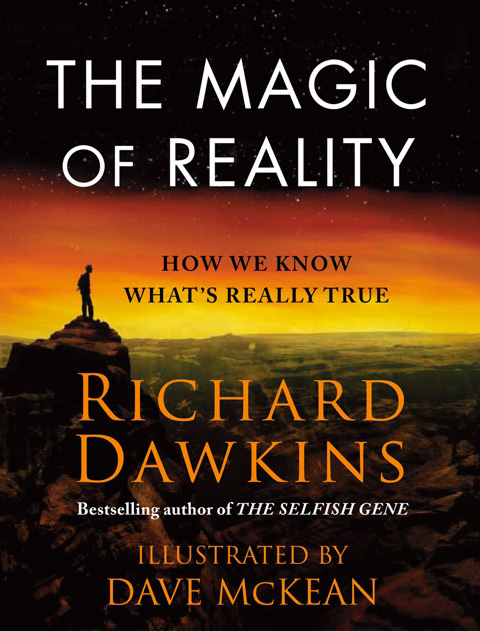
Richard Dawkins, the Oxford evolutionary biologist, has a new book coming out this fall. This time, it’s a children’s book called The Magic of Reality: How We Know What’s Really True. Interviewed in Der Spiegel in March, Dawkins talked a little about what he hoped to accomplish here, saying:
Each chapter is a question like: What is an earthquake? What is a rainbow? What is the sun? Each chapter begins with a series of myths seemingly answering those questions, and then I counter that with explanations about the true nature of things. There is something very cheap about magic in the supernatural sense, like turning a frog into a prince with a magic wand. Reality has a grander, poetic magic of its own, which I hope I can get across.
Already you can see some preliminary artwork for the book. We have one cover design above, and another one here. We’ll have more on the book when it comes out…
Read More...Jacques Demy’s Lyrical Masterpiece, The Umbrellas of Cherbourg
Romance and realism are mixed together in surprising and unforgettable ways in Jacques Demy’s 1964 masterpiece, The Umbrellas of Cherbourg. At first glance the film appears to be another piece of escapist fluff—a brightly colored musical about a beautiful girl who falls in love with a handsome young man. But as the story unfolds, those fairy tale trappings—the colors, the melodies, the impossibly beautiful faces—carry a gathering weight of irony.
As film critic A.O. Scott of the New York Times says in the video above, the film is one of the most romantic ever made, yet at the same time the story is “pure kitchen sink realism, suitable maybe for a Raymond Carver story or a Bruce Springsteen song.” It features Catherine Deneuve as a 17-year-old girl who works in her mother’s umbrella shop and falls in love with a 20-year-old garage mechanic, played by Nino Castelnuovo. “All of the characters face very difficult, very real problems,” says Scott, “and all of them try to do the right thing, which turns out to be pretty definitively unromantic.”
Unlike Hollywood musicals, in which the characters speak dialogue and periodically break into song, every word in The Umbrellas of Cherbourg is sung. The film received the Palme d’Or at the 1964 Cannes Film Festival, and was an international hit. Despite all the success, the film has been widely misunderstood, as Pauline Kael lamented during a 2000 interview. “One of the sad things about our time, I think,” Kael said, “is that so many people find a movie like that frivolous and negligible. They don’t see the beauty in it, but it’s a lovely film—original and fine.”
The Umbrellas of Cherbourg has recently become available for free viewing on the Internet, and we have added it to our archive of free movies. You can watch it here.
Read More...Support Us
We're hoping to rely on loyal readers, rather than erratic ads. Please click the Donate button and support Open Culture. You can use Paypal, Venmo, Patreon, even Crypto! We thank you!

About Us

Open Culture scours the web for the best educational media. We find the free courses and audio books you need, the language lessons & educational videos you want, and plenty of enlightenment in between.
Advertise With Us

FREE UPDATES!
GET OUR DAILY EMAIL
Get the best cultural and educational resources on the web curated for you in a daily email. We never spam. Unsubscribe at any time.
FOLLOW ON SOCIAL MEDIA

Open Culture editor Dan Colman scours the web for the best educational media. He finds the free courses and audio books you need, the language lessons & movies you want, and plenty of enlightenment in between.
Advertise With Us


