A Digital Reconstruction of Washington D.C. in 1814
What did the U.S. capital look like 200 years ago? Finding a satisfactory answer to this question is very difficult since there are very few reliable images, maps and written accounts from Washington’s early days. This is why Dan Bailey, director of the Imaging Research Center (IRC) at the University of Maryland, Baltimore, has approached architectural historians, cartographers, engineers, and ecologists to “recreate a ‘best guess’ glimpse of the early city.” The video above is the result of the IRC’s work, showing a city that was, they say, “a rough work in progress.”
Nothing was polished. The scale of the federal city was that of a person, not of immense marble bureaucracy. There were cabins and barns on the Capital Lawn. The first fence around the Capitol was to keep the cows out. Congressmen came to town for the legislative sessions, many times sleeping 3 to a room in a boarding house, and working in unfinished buildings.
An in-depth article about the ongoing project was published in The Washington Post.
By profession, Matthias Rascher teaches English and History at a High School in northern Bavaria, Germany. In his free time he scours the web for good links and posts the best finds on Twitter.
Read More...Chemistry on YouTube: “Periodic Table of Videos” Wins SPORE Prize
A few years ago, we posted about an ambitious project out of the University of Nottingham called The Periodic Table of Videos. The project is pretty much exactly what it sounds like – an online periodic table in which each and every element gets its own brief introductory video, “starring” the researchers and faculty of the university’s chemistry department. Video journalist Brady Haran has kept each episode loose and unscripted, and the scientists’ enthusiasm for their subject is infectious, even — or perhaps especially — when their experiments go awry (Keep an eye out especially for the wonderfully wooly Professor Poliakoff, whose hair alone should earn him first billing).
We were delighted to learn that the PTOV has just been awarded a very well-deserved Science Prize for Online Resources by the American Association for the Advancement of Science. In fact, the project has proven so successful overall that Haran has embarked on a similar collaboration with the university’s physics department, and he’s also brought the chemists back for a new series about molecules. The most popular video from that series, which we’ve posted above, addresses a question that has kept us all up till dawn at least once in our lives: What happens when a cheeseburger is dunked in hydrochloric acid?
Don’t miss the free chemistry courses listed in our collection of 380 Free Online Courses.
via ArsTechnica
Sheerly Avni is a San Francisco-based arts and culture writer. Her work has appeared in Salon, LA Weekly, Mother Jones, and many other publications. You can follow her on twitter at @sheerly
Read More...City of Eight Million Soundtracks
“Solitude,” wrote Henry David Thoreau in Walden, “is not measured by the miles of space that intervene between a man and his fellows. The really diligent student in one of the crowded hives of Cambridge College is as solitary as a dervish in the desert.” If you’re searching for solitude these days, even in Times Square, you won’t need much diligence–just an iPod and a pair of earbuds. But watch out! Your solitude might be shattered by Tyler Cullen, a student filmmaker at the School of Visual Arts, who recently had the audacity to say to his fellow New Yorkers: Hey You! What Song Are You Listening To?
Via Kottke.org
Read More...The Musalman: The Last Handwritten Newspaper in the World
Tucked away in the crowded southern Indian city of Chennai, in the shadow of the Wallajah Mosque, is an unflattering building. But what happens inside the building is remarkable. Every day since 1927, a dedicated team has worked tirelessly to create a handwritten newspaper, The Musalman (in Urdu: مسلمان). Today, there’s a team of six workers who work on the newspaper daily. Four of the workers are known as katibs, writers dedicated to the ancient art of Urdu calligraphy. They have the most modest of facilities: two wall fans, three light bulbs, and one tube light in an 800-square-foot building. But watching the video, you learn how this newspaper has survived for three generations — everyone who works there is absolutely devoted to the task. In fact, they are prepared to work on The Musalman until their “last breath,” an undeniable passion.
In the modern era where almost every published work is created digitally, it is refreshing to see the tradition of calligraphy endure with The Musalman. We can only hope the rest of us can appreciate The Musalman’s history and its efforts to survive as much as its dedicated readers do.
To learn more about The Musalman, read this Times of India story. For more about the world’s handwritten newspapers, please see this post on BrainPickings.
Eugene Buchko is a blogger and photographer living in Atlanta, GA. He maintains a photoblog, Erudite Expressions, and writes about what he reads on his reading blog.
Read More...The Guitar Prodigy from Karachi
Usman Riaz began playing classical piano at 6, then took up the guitar at 16. Fast forward four years, and you have this — the 20-year old Riaz playing his song “Firefly” in a music video that’s more like a mini indie arts film than anything else. At times, Riaz plays his Martin XC1t like a piano keyboard, but, all along, you can hear his acknowledged influences — Kaki King, Michael Hedges, Don Ross and, of course, Jimmy Page. (Don’t miss these related videos.) You can learn more about the Karachi musician in this two-part interview here and here, and also find his short album, Flashes and Sparks, on Amazon here.
via 3 Quarks Daily
If you would like to support the mission of Open Culture, consider making a donation to our site. It’s hard to rely 100% on ads, and your contributions will help us continue providing the best free cultural and educational materials to learners everywhere. You can contribute through PayPal, Patreon, and Venmo (@openculture). Thanks!
Read More...Don’t Dance at the Jefferson Memorial: A Quick PSA
Anyone know what law these dancers were violating, since the arresting officer apparently doesn’t know (or won’t say)?
Update: This article/post gives you the backstory. It explains that the dancers were “there protesting a … court decision [handed down] earlier this month that upheld a ban on dancing within the memorial.” The members of the “civil danceobedience” were charged with demonstrating without a permit, and then released a short time after. That’s the answer to the question, in short…
via BoingBoing
Read More...Paulo Coelho on How to Handle the Fear of Failure
The road to success runs right through failure. It’s an idea that’s getting a lot of attention lately. Earlier this month, the Berghs School of Communication in Stockholm organized an exhibition around the whole premise that “success never happens without taking risks. And risks are what you’re capable of taking when you overcome the fear of failing.” But how to do that? How to take that leap? The exhibition put that question to artists and thinkers who know success in a very intimate way. (See full list on BrainPickings here.) That includes Paulo Coelho, the author of The Alchemist, a book that has sold 65 million copies across 150 countries, and he had this to say:
I’m never paralyzed by my fear of failure… I say “Ok, I’m doing my best… ” And, from the moment that I can say that I’m doing my best … I sit down, I breathe, and I say “I put all of my love into it, I did it with all my heart.” … And whether they like [the book] or not is irrelevant, because I like it. I’m committed to the thing that I did. And so far nobody has criticized or refused it. When you put love and enthusiasm into your work, even if people don’t see it, they know it’s there, that you did this with all of your body and soul, so that is what I encourage you to do.
It’s a good thought, which gets pursued on a parallel track by Tim Harford. In 2005, Harford wrote the bestselling book, The Undercover Economist, and now he returns with Adapt: Why Success Always Starts with Failure. Speaking yesterday on KQED in San Francisco, the writer, sometimes likened to Malcolm Gladwell, talked about the importance of experimentation, taking calculated risks, and creating room for failure, something that matters as much to individuals as it does to corporations or nations trying to solve difficult problems. You can listen to the full interview here.
If you would like to support the mission of Open Culture, consider making a donation to our site. It’s hard to rely 100% on ads, and your contributions will help us continue providing the best free cultural and educational materials to learners everywhere. You can contribute through PayPal, Patreon, and Venmo (@openculture). Thanks!
Read More...Endeavour’s Launch Viewed from Booster Cameras
Here’s the good stuff that nerdgasms are made of. NASA has released a video that lets you hitch a ride on the May 16th launch of the Space Shuttle Endeavour. The video runs 37 minutes; it’s narrated by a NASA official; and it loops around and lets you see the launch from several different vantage points.
You start with liftoff, traveling at 1300 miles per hour. Then, about two minutes later, the rocket boosters separate from the shuttle, and you then twist with them. The second loop starts around the 7:20 mark, and don’t miss the splendid view at 9:40 …
Related Content:
The Best of NASA Space Shuttle Videos (1981–2010)
NASA Captures Giant Solar Storm
NASA Zooms into Spiral Galaxy
Read More...Kubrick’s A Clockwork Orange: Malcolm McDowell Looks Back
A few days ago, we linked to the recent Collider interview with Malcolm McDowell, the star of Stanley Kubrick’s 1971 classic, A Clockwork Orange. One of the highlights of the piece is a short video clip in which the now 68-year-old actor describes the origins of the film’s iconic — and horrifically violent — “Singing in the Rain” scene.
You can catch a much younger McDowell discussing that same scene in 1972, starting at minute 6:30 of the interview below. For kicks, slide back to minute 4:15, and watch the cocky 28-year-old give his interlocutor a sharp dressing down for daring to suggest that Mr. Kubrick could be “difficult” to work with:
Related content:
Stanley Kubrick’s Filmography Animated
Killer’s Kiss: Where Stanley Kubrick’s Filmmaking Career Really Begins
Kubrick vs. Scorsese Montage
Sheerly Avni is a San Francisco-based arts and culture writer. Her work has appeared in Salon, LA Weekly, Mother Jones, and many other publications. You can follow her on twitter at @sheerly.
Read More...Lost Films: Identify Missing Cinema Through Crowdsourcing
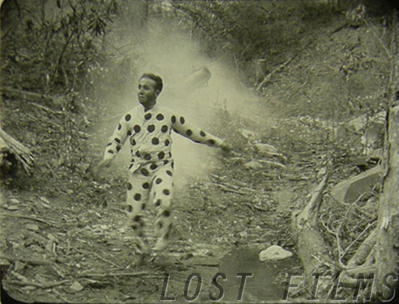
Can you identify the man in this picture? The archivists at Lost Films hope you can. The image is taken from footage of a vintage film that no one has been able to identify. According to the description that goes with the still, all we know now is that this oddly-dressed character is an escaped convict named “Hem Lock.” The movie is probably American, and it was most likely shot somewhere around 1923. If you think you can add some more information, it’s time for you to sign up.
More than 80 percent of silent films and a high percentage of old sound films have been lost or are now unaccounted for. Lost Films is a collaborative effort among film societies in Germany, France, Poland, New Zealand, and several other countries to help identify and locate some 3,500 lost or missing films through crowdsourcing. Anyone can become a member and then upload clips and images from “mystery movies” to the site, and also comment on the as-yet-untitled stills and images that have already been uploaded. The site also contains a heartening list of films that have been recently been recovered.
The project is funded by the German Federal Cultural Association.
Be sure to find many silent and early sound movies (among other things) in our collection of Free Movies Online.
Sheerly Avni is a San Francisco-based arts and culture writer. Her work has appeared in Salon, LA Weekly, Mother Jones, and many other publications. You can follow her on twitter at @sheerly.
Read More...Support Us
We're hoping to rely on loyal readers, rather than erratic ads. Please click the Donate button and support Open Culture. You can use Paypal, Venmo, Patreon, even Crypto! We thank you!

About Us

Open Culture scours the web for the best educational media. We find the free courses and audio books you need, the language lessons & educational videos you want, and plenty of enlightenment in between.
Advertise With Us

FREE UPDATES!
GET OUR DAILY EMAIL
Get the best cultural and educational resources on the web curated for you in a daily email. We never spam. Unsubscribe at any time.
FOLLOW ON SOCIAL MEDIA

Open Culture editor Dan Colman scours the web for the best educational media. He finds the free courses and audio books you need, the language lessons & movies you want, and plenty of enlightenment in between.
Advertise With Us

