9‑Year-Old Henry Thomas Delivers a Remarkable Screen Test for E.T.
I can guarantee almost every day I get someone going, ‘Hey, you’re the guy from E.T.’, usually followed by, ‘What are you doing now?’ And not a day has gone by when someone hasn’t shouted ‘E.T. phone home’ at me.” — Actor Henry Thomas
Should I ever bump into Henry Thomas, I may exclaim, “Okay, kid, you got the job,” just like director Steven Spielberg does at the end of the remarkable screen test, above.
Thomas, now — brace yourself — 50, was just 9 when Spielberg flew him in from Texas to audition for the role of Elliot in E.T. the Extra-Terrestrial on the strength of his single screen credit, playing Sissy Spacek’s son in Raggedy Man.
Before we go further, a cautionary tale.
Another youngster had the part of Elliot all sewn up until screenwriter Melissa Mathison hosted a Dungeons and Dragon game to get a feel for the chemistry between the film’s child actors.
“In about three minutes it became very clear that nobody liked this little boy,” casting director Marci Liroff recalls. Ouch.
That would be a heavy burden to carry through life, knowing that youthful bossiness cost you the role of a lifetime.
Enter Henry Thomas.
Spielberg’s longtime collaborator, producer Kathleen Kennedy, recalled that he was no great shakes reading from prepared sides of the script, but then came an improv with legendary casting director Mike Fenton.
If only every aspirant method actor shared Thomas’ knack for emotional recall. During the improv, as the pressure to give up the beloved alien creature hidden in his closet mounted, he drew on memories of his pet chihuahua, Urso, who had been killed by a neighbour’s dog in front of him.
“Poor Urso, it may have won me the role but it was a sad price to pay,” Thomas told The Mirror some 30 years later.
His performance reduced every adult in the room to tears.
It was also remarkable for its subtlety. As Spielberg remarked in a 1982 interview with Premiere magazine:
He’s a very controlled, methodical performer who measures what he does and feels what he does and yet broadcasts it in a totally subtle way. His performance is so controlled, unlike most kid performers, who seem to be giving you 150 percent on every shot. Henry’s performance is just a bread crumb at a time, but he takes you in a wonderful direction to a very, very rousing catharsis. He’s just a “once in a lifetime” kid.
The director likened Thomas’ tears in the final moments of E.T. to the arrival of the mother ship in Close Encounters of the Third Kind — “a super-colossal special effect” rooted in human emotion.
By then, Thomas no longer needed an assist from Urso:
I couldn’t stop crying because I worked with E.T. every day and he was real to me.
The connection was not immediate. Thomas’ laughing response to his first gander at the alien reassured Spielberg that the child actor could handle comedy but Thomas, a huge Raiders of the Lost Ark fan, had been hoping for something a bit more swashbuckling. As he told Esquire’s Paul Schrodt:
When I saw this alien with the weird feet and the telescopic neck, I was like, ‘What the hell is this? Where is my lightsaber?’ But I guess I got a flying bicycle, so I can’t complain.
It’s wasn’t exactly a Hollywood ending, perhaps because Thomas didn’t stay in Hollywood, but rather returned to school in San Antonio, where he fell prey to kids who resented the overnight sensation in their midst.
On the other hand, he has worked steadily as an actor since leaving home at 17, and abided by his resolution to avoid drugs and other pitfalls that plague some other child stars. (“I never wanted to give anyone the satisfaction of getting that picture of me robbing a liquor store.”)
In his interview with The Mirror, tongue firmly in cheek, he speculated about possible E.T. sequels and admitted that he’d hate to see someone other than himself playing Elliott:
It could be like an intergalactic reunion with Elliott and E.T. at a beach resort… I don’t think Spielberg will touch it, although I’d love to see Elliott and E.T. sitting at the end of the bar: “How’s it been for you man?” “Good, man, another beer?”
A few years later, the stars did indeed reunite for a holiday advert that owes a large debt to Peter Pan, and puts its thumb on the scale with a clip of Bing Crosby crooning “White Christmas.”
As if Henry Thomas needs help making us cry.
Related Content:
Watch the Original Audition Tapes for Breaking Bad Before the Final Season Debuts
Audrey Hepburn’s Moving Screen Test for Roman Holiday (1953)
Bruce Lee Auditions for The Green Hornet (1964)
Ayun Halliday is the Chief Primaologist of the East Village Inky zine and author, most recently, of Creative, Not Famous: The Small Potato Manifesto. Follow her @AyunHalliday.
Read More...Behold 84 Great Novels Reinterpreted as Modernist Postage Stamps
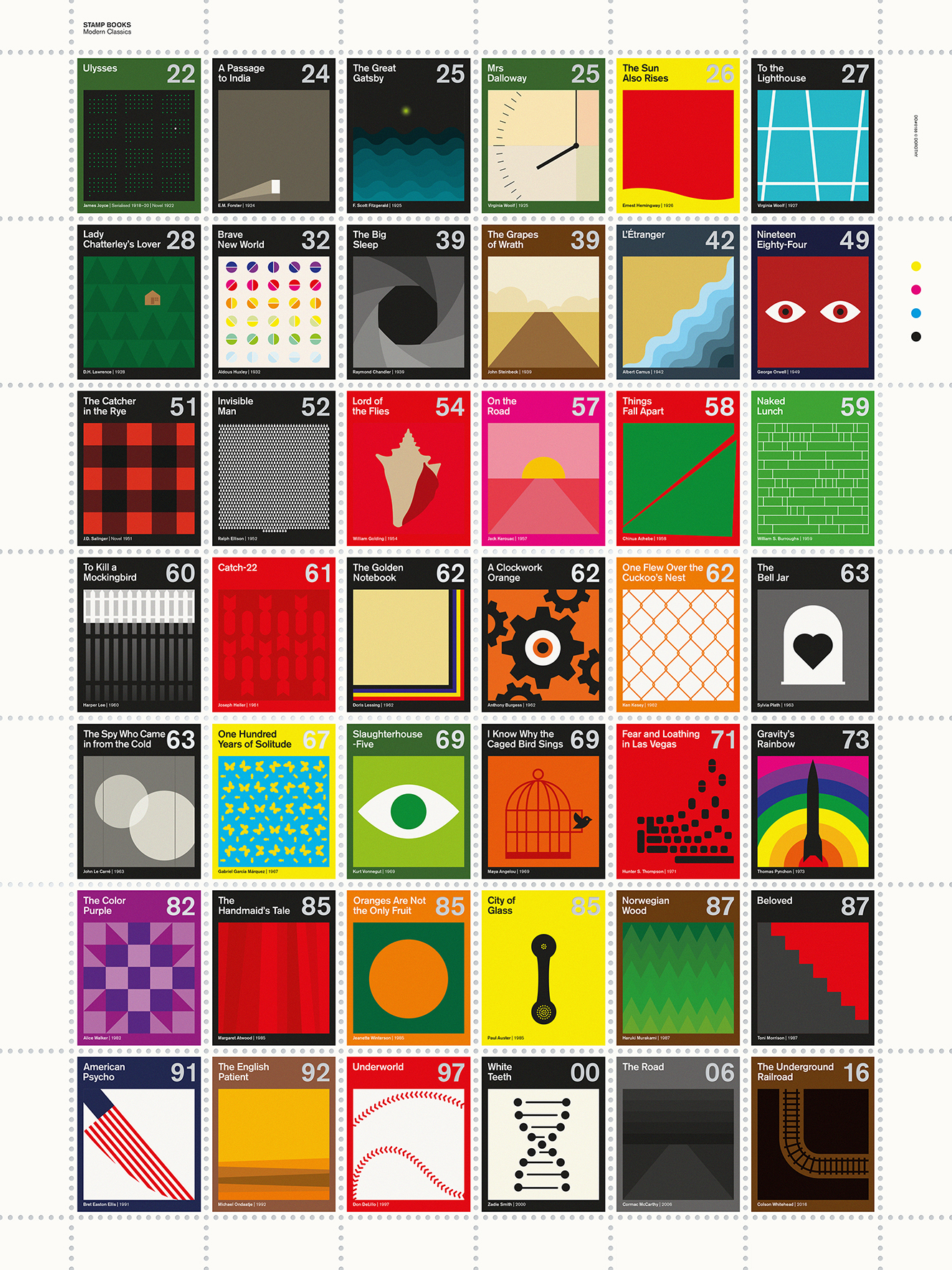
Ali Johnson and Jim Quail of Liverpool-based design studio Dorothy had a hit with their music-based graphics, which recast seminal alternative, psychedelic, electronic, and post-punk albums as oversized postage stamps.
Now, they’ve turned their attention and knack for highly condensed visual responses to the realms of literature.
Their Modern Classics collection, above, synthesizes 42 titles into something emblematic and essential.
How many have you read?
How many would you be able to identify based on image alone?

It’s easy to grasp why the horizon figures prominently in On The Road, The Grapes of Wrath, and The Road.
And understandably, the eyes have it when it comes to 1984, A Clockwork Orange, and Slaughterhouse-Five.
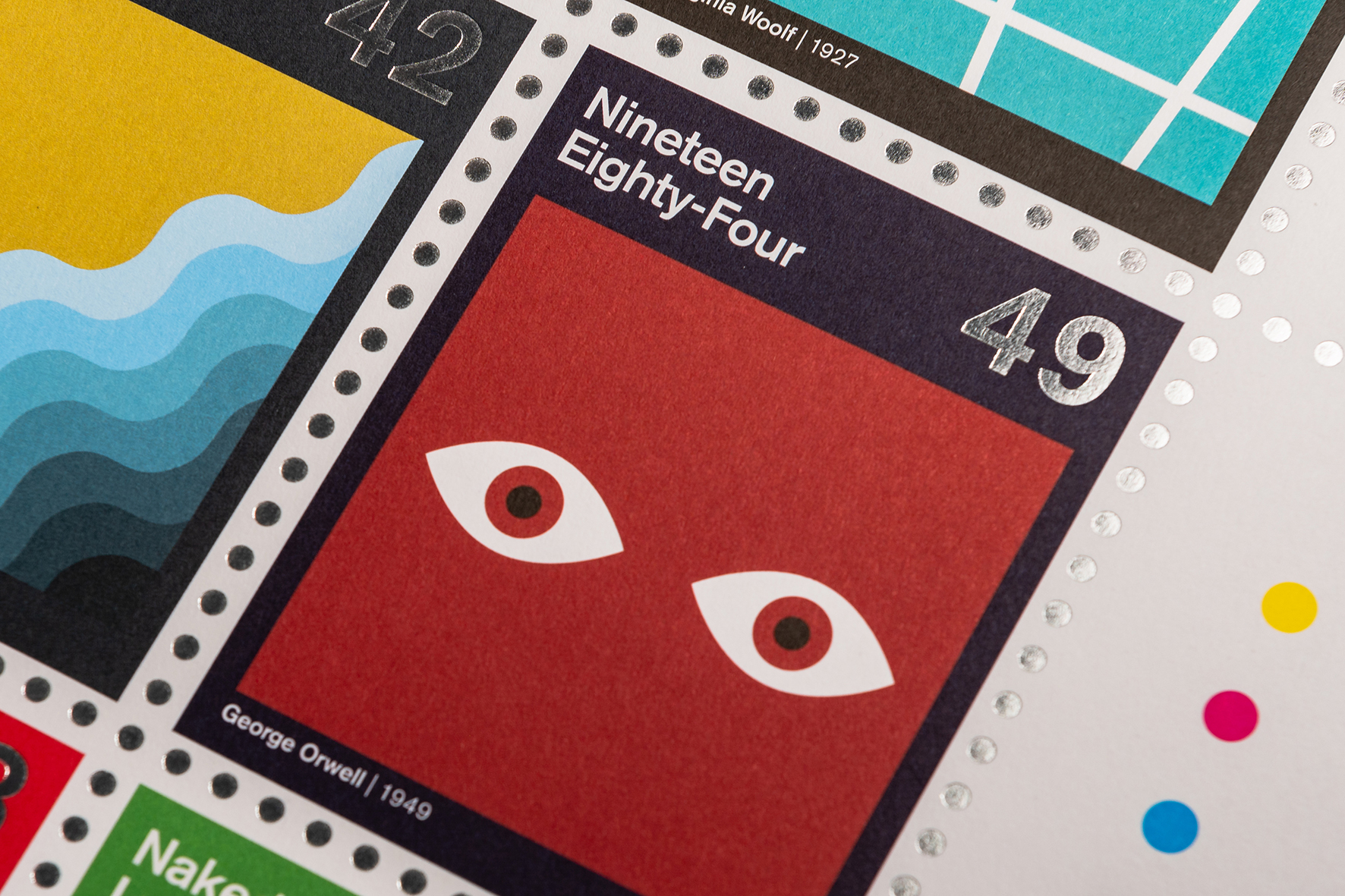
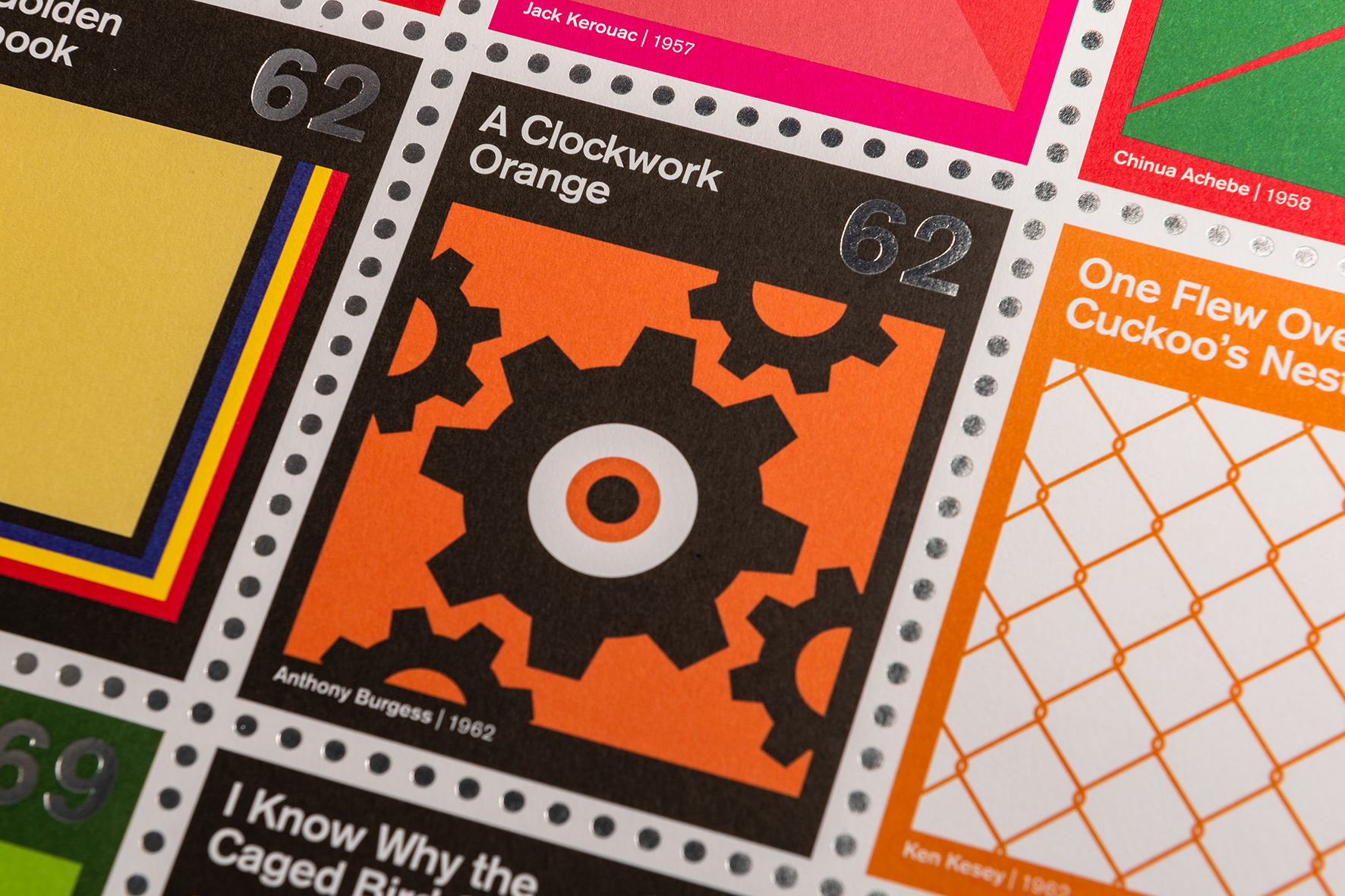
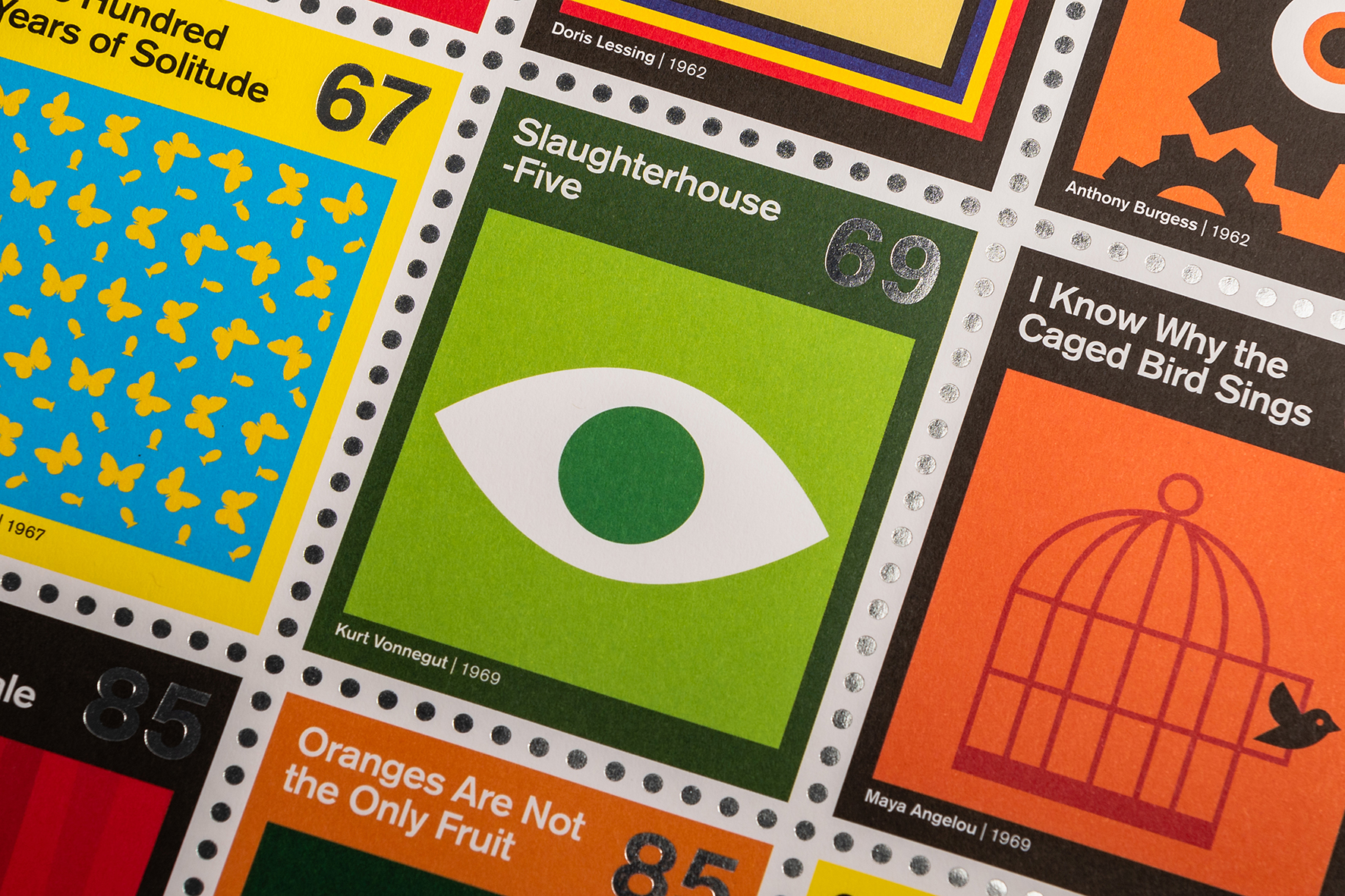
Elsewhere, the visual representations create connections that may take readers by surprise.
(Stay tuned for a master’s thesis that teases out thematic parallels between The Color Purple’s quilts and Holden Caulfield’s red hunting hat in The Catcher in the Rye.)
According to Johnson, she and Quail, avid readers both, fell out several times over which titles to include (and, by extension, exclude).
English teachers at middle and high school level will rejoice at the number of syllabus favorites that made the cut.
Potential stamp-themed creative assignments abound.
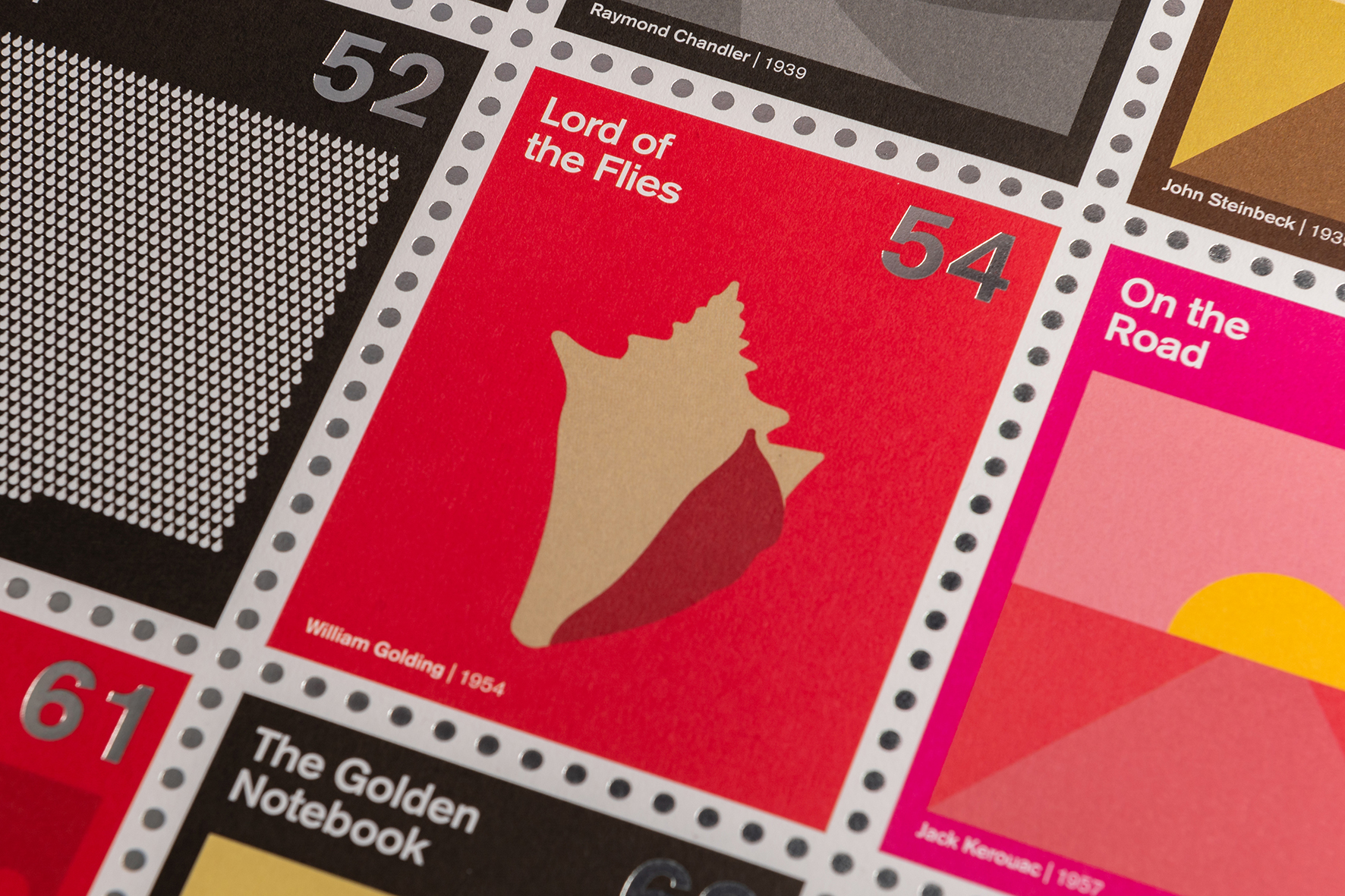
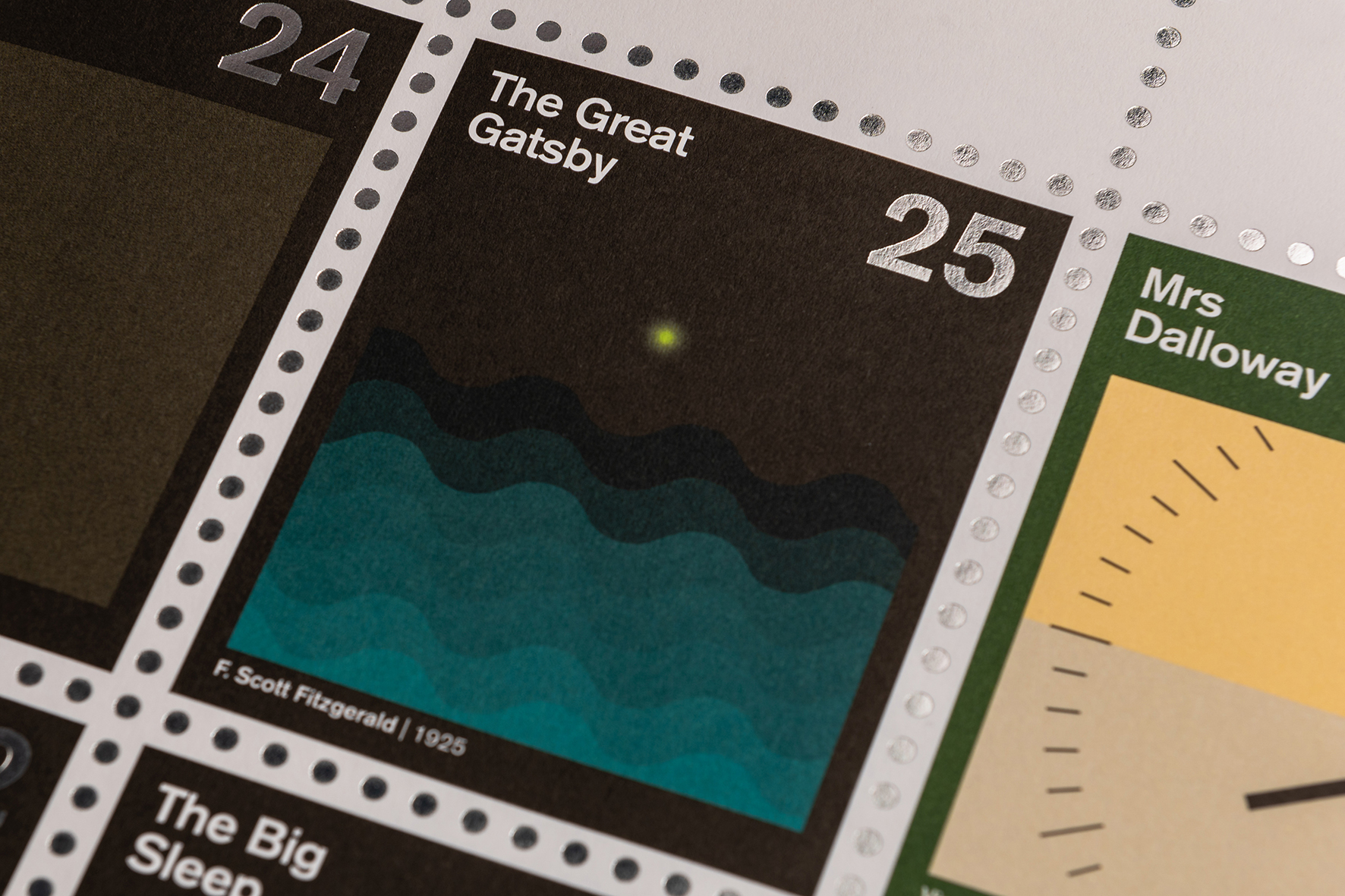
The conch may be an obvious choice for Lord of the Flies, but what of The Great Gatsby’s green light?
Why not the eyes of Doctor T. J. Eckleburg?
Or one of those beautiful shirts?
Discuss!
Then make your own stamp!
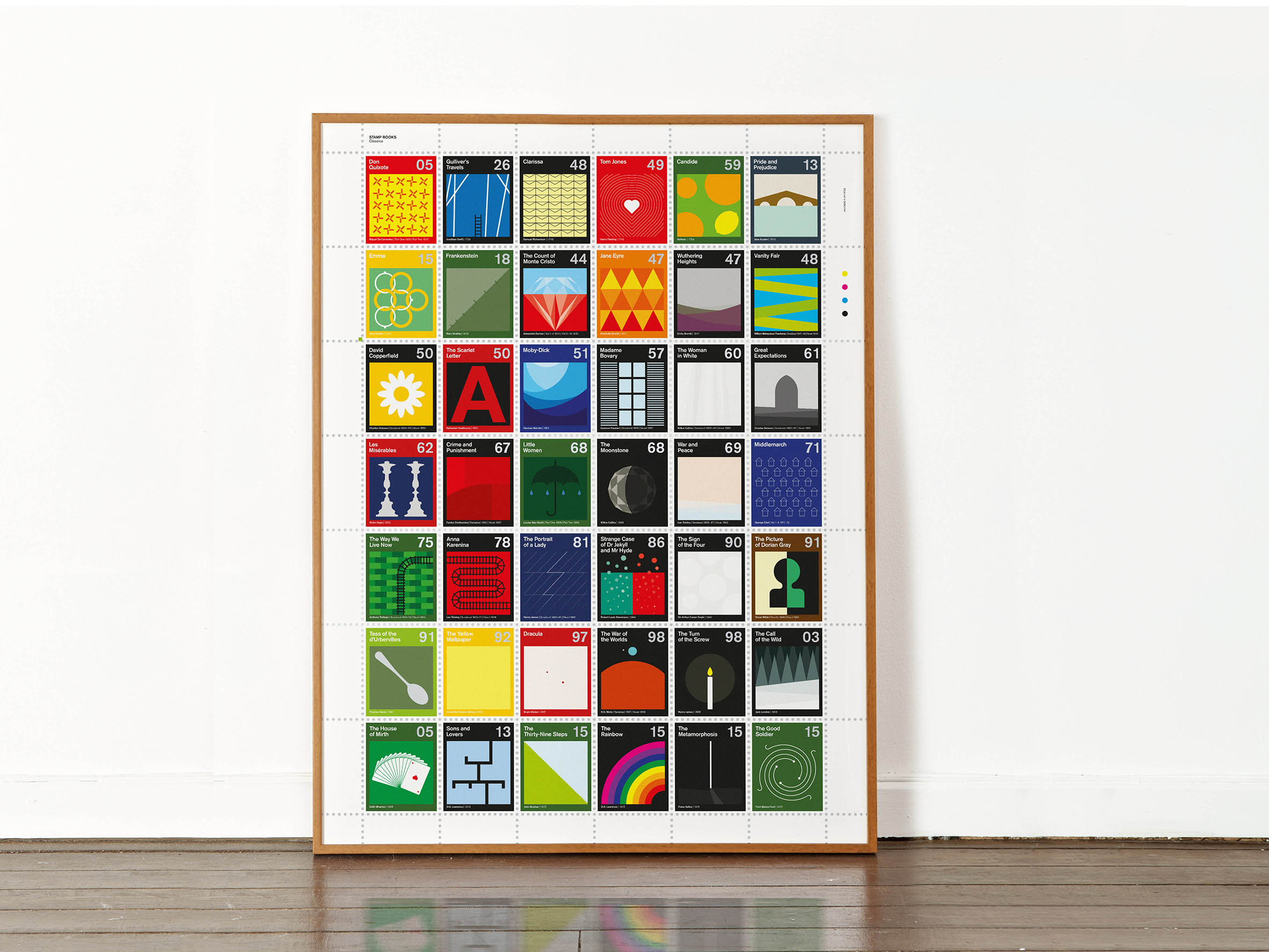
Students are far less likely to be conversant in the 42 earlier works comprising Dorothy’s literary Classics stamps, though musical and movie adaptations of Little Women, Dracula, and Les Miserables should provide a toehold.
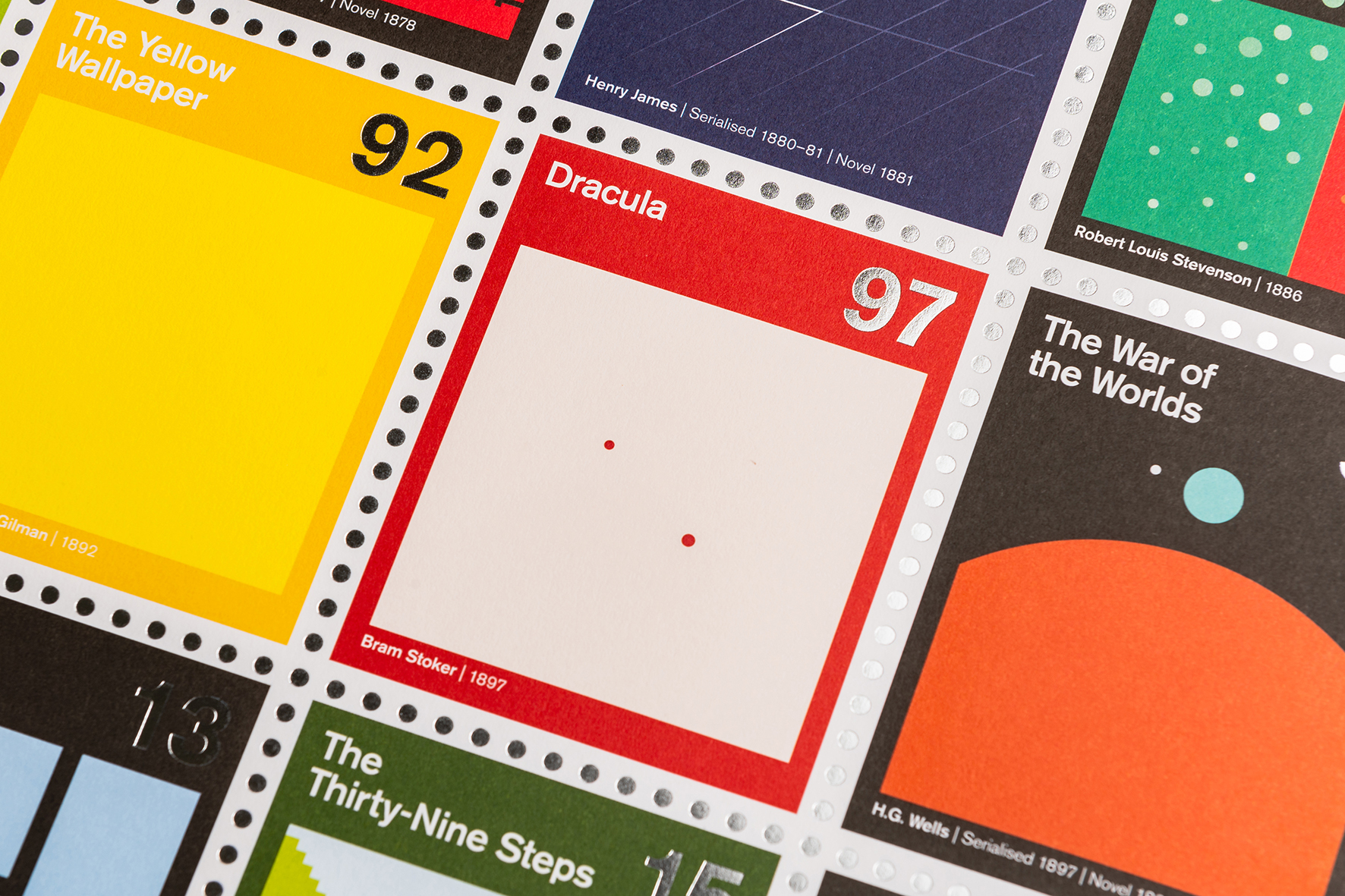
Our ignorance is such, we may need to reread Tess of the d’Urbervilles and Jane Eyre … or at least Google the significance of a spoon and all those orange and red triangles.
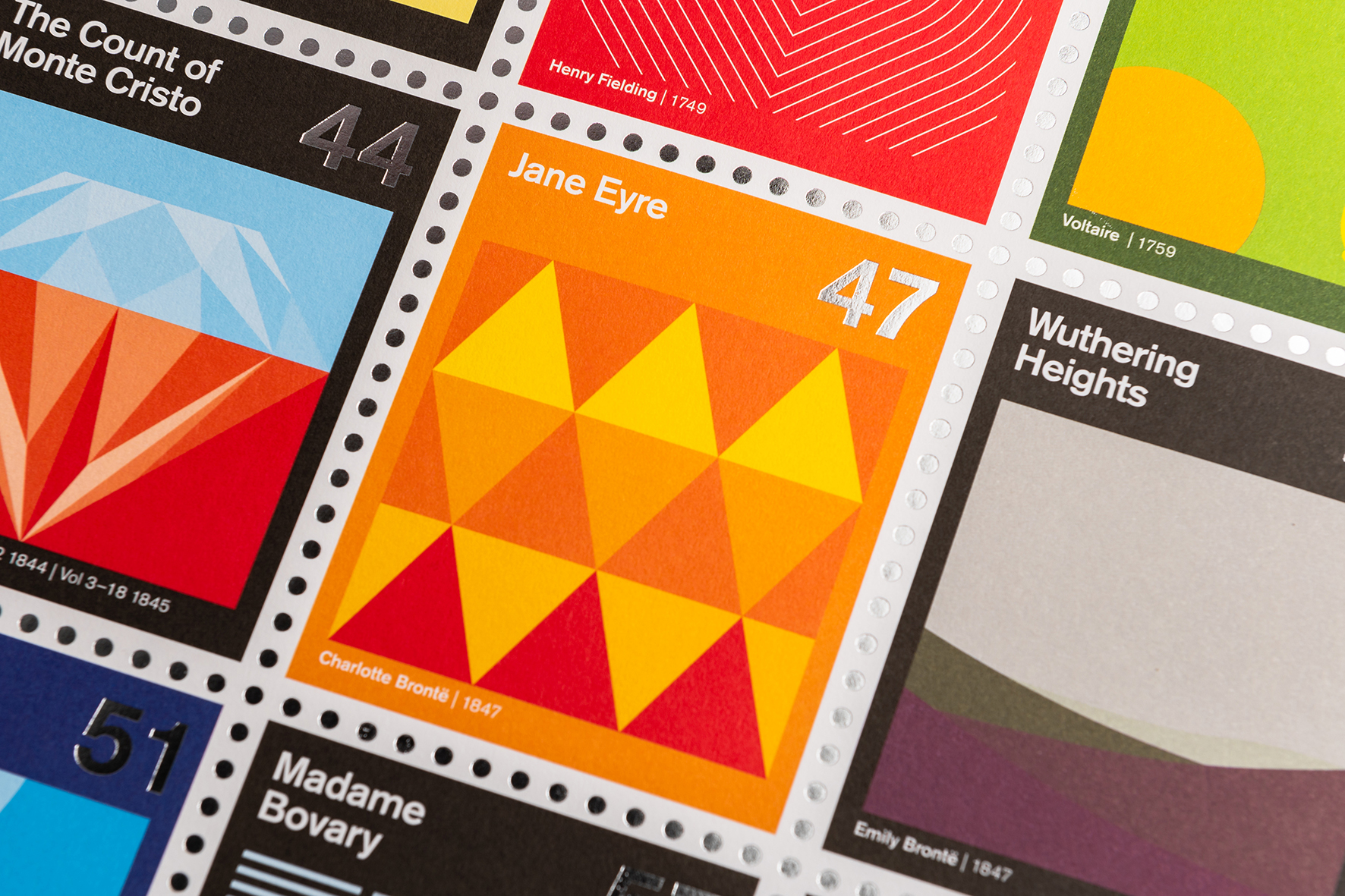
(Back in our pre-digital youth, Cliff’s Notes were the preferred Philistine option…)
Dorothy’s stamp prints of Classics and Modern Classics are available for purchase on their website.
Related Content:
Good Movies as Old Books: 100 Films Reimagined as Vintage Book Covers
157 Animated Minimalist Mid-Century Book Covers
Ayun Halliday is the Chief Primaologist of the East Village Inky zine and author, most recently, of Creative, Not Famous: The Small Potato Manifesto. Follow her @AyunHalliday.
Read More...The 10 Paradoxical Traits of Creative People, According to Psychologist Mihaly Csikszentmihalyi (RIP)
Despite decades of research, scientists still know little about the source of creativity. Nonetheless, humans continue to create things. Or, at least, we continue to be fascinated by creativity; now more than ever, it seems. There may be as many best-selling books on creativity as there are on dieting or relationships. The current focus on creativity isn’t always a net positive. Anyone who does creative work may be labeled a “Creative” (used as a noun) at some point in their career. The term lumps all working artists together, as though their work were interchangeable deliverables measured in billable hours. The word suggests that those who don’t work as “Creatives” have no business in the area of creativity. As psychologist Mihaly Csikszentmihalyi put it:
Not so long ago, it was acceptable to be an amateur poet…. Nowadays if one does not make some money (however pitifully little) out of writing, it’s considered to be a waste of time. It is taken as downright shameful for a man past twenty to indulge in versification unless he receives a check to show for it.
Csikszentmihalyi, who passed away this month, deplored the instrumentalization of creativity. He wrote, Austin Kleon notes, “about the joys of being an amateur” — which, in its literal sense, means being a devoted lover. Like Carl Jung, Csikszentmihalyi believed that creation proceeds, in a sense, from falling in love with an activity and losing ourselves in a state beyond our preoccupations with self, others, or the past and future. He called this state “flow” and wrote a national bestseller about it while founding the discipline of positive psychology and co-directing the Quality of Life Research Center at Claremont Graduate University .
You can see an animated summary of Csikszentmihalyi’s book, Flow: The Psychology of Optimal Experience above (including a pronunciation of Csikszentmihalyi’s name). Creativity should not only refer to skills we sell to our employers. It is the practice of doing things that make us happy, not the things that make us money, whether or not those two things are the same. This is a subject close to Austin Kleon’s heart. The writer and designer has been offering tips for training and honing creativity for years, in books like Show Your Work, a guide “not just for ‘creatives’!” but for anyone who wants to create. Like Csikszentmihalyi, he refutes the idea that there’s such a thing as a “creative type.”
Instead, in his book Creativity: Flow and the Psychology of Discovery and Invention, Csikszentmihalyi notes that people who spend their time creating exhibit a list of 10 “paradoxical traits.”
- Creative people have a great deal of physical energy, but they’re also often quiet and at rest.
- Creative people tend to be smart yet naive at the same time.
- Creative people combine playfulness and discipline, or responsibility and irresponsibility.
- Creative people alternate between imagination and fantasy, and a rooted sense of reality.
- Creative people tend to be both extroverted and introverted.
- Creative people are humble and proud at the same time.
- Creative people, to an extent, escape rigid gender role stereotyping.
- Creative people are both rebellious and conservative.
- Most creative people are very passionate about their work, yet they can be extremely objective about it as well.
- Creative people’s openness and sensitivity often exposes them to suffering and pain, yet also to a great deal of enjoyment.
We may well be reminded of Walt Whitman’s “Do I contradict myself? Very well then I contradict myself,” and perhaps it is to Whitman we should turn to resolve the paradox. Creativity involves the willingness and courage to become “large,” the poet wrote, to get weird and messy and “contain multitudes.” Maybe the best way to become a more creative person, to lose oneself fully in the act of making, is to heed Bertrand Russell’s guidance for facing death:
[M]ake your interests gradually wider and more impersonal, until bit by bit the walls of the ego recede, and your life becomes increasingly merged in the universal life. An individual human existence should be like a river: small at first, narrowly contained within its banks, and rushing passionately past rocks and over waterfalls. Gradually the river grows wider, the banks recede, the waters flow more quietly, and in the end, without any visible break, they become merged in the sea…
This eloquent passage — Csikszentmihalyi might have agreed — expresses the very essence of creative “flow.”
via Austin Kleon
Related Content:
Slavoj Žižek: What Fullfils You Creatively Isn’t What Makes You Happy
Josh Jones is a writer and musician based in Durham, NC. Follow him at @jdmagness
Read More...Scenes of New York City in 1945 Colorized & Revived with Artificial Intelligence
Are you irked when a movie or video you’re attempting to enjoy is constantly interrupted by the commentary of a chatty fellow audience member?
If so, don’t watch archivist Rick Prelinger’s 2017 assemblage, Lost Landscapes of New York, in the company of a New Yorker.
Unlike Open Culture favorite NASS’s five minute sample of Lost Landscapes of New York, above, which adds color and ambient audio to the unvarnished found footage, Prelinger — described by the New York Times’ Manohla Dargis as a “collector extraordinaire…one of the great, undersung historians of 20th century cinema” — relishes such mouthiness from the audience. His black and white compilations are mostly silent.
If you are a New Yorker, view that as an invitation here.
For everyone else, on behalf of New Yorkers everywhere, we concede that our confident utterances may indeed drive you out of your gourd…
Tourists with just one visit to their name can be forgiven for flaunting their personal brushes with such hall of famers as the Brooklyn Bridge and the Washington Square Arch, but there’s no competing with long time residents’ intimate knowledge of the city’s geography.
It’s snobbery of a type, but have pity on us long time residents, who know we will be viewed as subordinates by those who were born within the five Boroughs.
(We submit that there are layers to this…a native of, say, the Hoosier State, who can remember the original Penn Station should be considered to have at least as much street cred as a millennial whose birth in Brooklyn, Harlem or the West Village confers native New Yorker status.)
However you slice it, consider this fair warning that some of us, viewing Lost Landscapes of New York in your company, will not be able to stop ourselves from triumphantly crowing, “That’s 8th between 43rd and 44th!”
Again, it’s something Prelinger courts in local live screenings of his Lost Landscapes series.
The phenomenon is not limited to New York.
Be the setting San Francisco, Los Angeles, or Detroit, he views audience outbursts as the soundtracks to his mostly silent, non-narrative pastiches drawn from his vast archive of vintage home movies, government-produced films, and background footage shot with an eye toward compositing into a feature film.
In a conversation with The Essay Review’s Lucy Schiller, he remarked:
I’ve discovered that home movies become something else when blown up to theater-screen size. The change of scale provokes a role change in the audience, who without necessarily expecting it become more than simple commentators. They turn into ethnographers, noticing and often remarking on every visible detail of kinship, word and gesture and every interpersonal exchange. They also respond as cultural geographers, calling out streets and neighborhoods and buildings, reading signs aloud, repeating tradenames and brands and marking extinct details in the cityscape. If I could capture them (and I generally cannot, because it is hard to intelligibly record the voices of hundreds of people in one room), it would play back like an urban research project distributed through a crowd of investigators. Each successful identification, each naming achieved, is an endorphin trigger.
Prelinger is happy to play fast and loose with chronological order, scrambling period fashions, and color and black-and-white stock. This crazy quilt approach is in step with his resistance to constructing narratives (“the curse of contemporary documentary”) and admiration for the way enthusiastic amateurs’ footage renders “caste distinctions between animals and humans, between places and their inhabitants” moot:
I am much less interested in the minutiae of local history than I am in the process of daylighting it, in the relationship of history and contemporary life.
His approach allows those of us who live or have lived here to revel in New York City’s long standing capacity for reinvention.
Like the anonymous tide of humanity bustling along our sidewalks (and darting into traffic, mid-block), the marquees, restaurant names and words on the delivery trucks aren’t fixed. We claim to hate it, but philosophers might suggest it’s what keeps us engaged.
You won’t find many street vendors hawking frumpy cotton undies these days, but there are plenty of corners where you can buy fruit and veg… and iPhone cases, earbuds, and COVID-19 era face masks.
As exciting as it is to successfully peg the quintessentially New York things that remain, there’s an equal thrill to recognizing and shouting out the things that don’t, especially if there’s a significant personal connection.
It makes us feel like we’re notable, contributing in some way.
You contribute, too, by watching Lost Landscapes of New York (2017) here, while simultanously keeping your eyes peeled for gratifyingly well attended, highly participated live screenings.
If vintage amateur footage you’re in possession of is gathering dust, consider donating it to expand Prelinger’s archive, already some 60,000 films strong.
Watch Prelinger’s Lost Landscapes compilations of other cities here and here (see episode 7 of his San Francisco series above).
Explore his massive archive on the Internet Archive.
And if you want to practice sounding like a “real New Yorker,” head back up to the top of the page, skip to the end, and inform everyone within earshot that that building is the old James A. Farley Post Office at 32nd and 8th:
“Now it’s Moynihan Train Hall! It opened on January 1! It’s part of Penn Station! Don’t forget to look up inside the 33rd street entrance, or you’ll miss Kehinde Wiley’s incredible stained-glass ceiling! And if you want a snack for the ride, you should hit H‑Mart on 32nd just east of Greeley Square!”
Related Content:
Immaculately Restored Film Lets You Revisit Life in New York City in 1911
An Online Gallery of Over 900,000 Breathtaking Photos of Historic New York City
Ayun Halliday is an author, illustrator, theater maker and Chief Primatologist of the East Village Inky zine. Follow her @AyunHalliday.
Read More...How Radiohead Wrote the Perfect James Bond Theme Song
Over the past 59 years, the duty of performing a James Bond movie theme has fallen to the likes of Tom Jones, Paul McCartney, Carly Simon, Bono, Madonna — and most recently, for the latest installment, No Time to Die, Billie Eilish. But one of the greatest Bond themes ever written has never been heard in any of the movies. This, in any case, is the contention of the video essay above, “How Radiohead Wrote the Perfect Bond Theme.” Commissioned for 2015’s Spectre, the second-most recent film in the series, Thom Yorke and company came up with a song that moves Listening In creator Barnaby Martin to declare, “This is Bond, but it’s also unmistakably Radiohead.”
Like many Bond title themes, Radiohead’s “Spectre” is in a minor key with “added blues notes,” working off the distinctive chord progression composer John Barry employed in the series’ original instrumental theme. And while, like most Bond title-theme performers, Radiohead are popular musicians, their actual work has always refused to align perfectly with straightforward pop-music expectations.
“Spectre” embodies both the band’s “love of rhythmical ambiguity” and their “trademark harmonic ambiguity.” The “beauty and simplicity of the music contrast painfully with the words,” reflecting “perfectly that dichotomy in contemporary Bond: a man struggling to reconcile love and duty.”
As if that weren’t enough, Radiohead’s song also includes unexpected but consummately Bond-esque compositional and instrumental moves. “It’s jazzy but discordant,” says Martin. “It’s a modern re-imagining of John Barry’s big-band orchestrations.” In every section the piece exquisitely maintains the tension between Radiohead and Bond, creating “an instantly compelling and dark musical world. Alas, it was ultimately replaced, ostensibly because the mood of the music and lyrics didn’t fit properly with that of the film: “We had this beautiful song,” lamented director Sam Mendes, “and we weren’t able to use it.” But that hasn’t stopped Bond aficionados from imagining what could have been, and you can get a sense of it in a fan video, previously featured here on Open Culture, that reunites “Spectre” with Spectre.
Related Content:
Radiohead’s “Spectre” Played Against the Title Sequence of the 2015 James Bond Film, Spectre
James Bond: 50 Years in Film (and a Big Blu-Ray Release)
Radiohead’s Thom Yorke Performs Songs from His New Soundtrack for the Horror Film, Suspiria
The Secret Rhythm Behind Radiohead’s “Videotape” Now Finally Revealed
Based in Seoul, Colin Marshall writes and broadcasts on cities, language, and culture. His projects include the Substack newsletter Books on Cities, the book The Stateless City: a Walk through 21st-Century Los Angeles and the video series The City in Cinema. Follow him on Twitter at @colinmarshall or on Facebook.
Read More...“The Hippie Temptation”: An Angst-Ridden CBS TV Show Warns of the Risks of LSD (1976)
To lysergic acid diethylamide, better known as LSD, we owe much of what has endured from Western popular culture of the mid-20th century: consider, for instance, the latter half of the Beatles’ oeuvre. In Revolution in the Head: The Beatles’ Records and the Sixties, Ian MacDonald describes LSD as “a powerful hallucinogen whose function is temporarily to dismiss the brain’s neural concierge, leaving the mind to cope as it can with sensory information which meanwhile enters without prior arrangement — an uncensored experience of reality which profoundly alters one’s outlook on it.”
So profound is that alteration that some came to believe in a utopia achievable through universal ingestion of the drug: “If there be necessary revolution in America,” declared Allen Ginsberg, “it will come this way.” But most Americans didn’t see it quite the same way. It was for them that CBS made its broadcast “The Hippie Temptation.” Aired in August 1967, three months after the release of Sgt. Pepper’s Lonely Heart’s Club Band, it constitutes an exposé of LSD-fueled youth culture as it effervesced at the time in and around San Francisco’s countercultural mecca of Haight-Ashbury.
“The hippies present a strange problem,” says correspondent Harry Reasoner, later known as the host of 60 Minutes. “Our society has produced them. There they are, in rapidly increasing numbers. And yet there seem to be very few definite ideas behind the superficial glitter of their dress and behavior.” In search of the core of the hippie ideology, which seems outwardly to involve “standing apart from society by means of mutual help and love,” Reasoner and his collaborators delve into the nature of LSD, whose users “may see a wild complexity of images, hear a multiplicity of sounds. This is called ‘taking an acid trip.’ ”
Alas, “for many, the price of taking the shortcut to discovery the hippies put forward turns out to be very high.” A young doctor from UCLA’s neuropsychiatric institute named Duke Fisher argues that most LSD users “talk about loving humanity in general, an all-encompassing love of the world, but they have a great deal of difficulty loving one other person, or loving that specific thing.” Also included in “The Hippie Temptation” are interviews with young people (albeit ones cleaner-cut than the average denizen of late-60s Haight-Ashbury) placed into medical facilities due to hallucinogen-related mishaps, including suicide attempts.
“There is the real danger that more and more young people may follow the call to turn on, tune in, drop out,” Reasoner declares, in keeping with the broadcast’s portentous tone. Even then there were signs of what MacDonald calls “the hippie counterculture’s incipient commercialization and impending decline into hard drugs.” But to this day, “that there was indeed something unusual in the air can still be heard from many of the records of the period: a light, joyous optimism with a tangible spiritual aura and a thrillingly fresh informality” — a quality MacDonald finds concentrated in the work of not just The Beatles but the Grateful Dead, who sit for an interview in “The Hippie Temptation.” LSD may no longer be as tempting as it was half a century ago, but many of the creations it inspired then still have us hooked today.
via Laughing Squid
Related Content:
Watch The Bicycle Trip: An Animation of The World’s First LSD Trip in 1943
Aldous Huxley Trips on Acid; Talks About Cats & the Secret of Life (1962)
R. Crumb Describes How He Dropped LSD in the 60s & Instantly Discovered His Artistic Style
Based in Seoul, Colin Marshall writes and broadcasts on cities, language, and culture. His projects include the Substack newsletter Books on Cities, the book The Stateless City: a Walk through 21st-Century Los Angeles and the video series The City in Cinema. Follow him on Twitter at @colinmarshall or on Facebook.
Read More...Demystifying Nick Cave and the Bad Seeds’ “Red Right Hand,” and How It Was Inspired by Milton’s Paradise Lost
Youtuber Polyphonic has done a good job of looking at some hoary old classics of ‘60s rock, but he doesn’t always dip his toe in taking on contemporary music, or even considering a modern canon. Pronouncing what is essential listening of the last few decades is a minefield, especially among the ranks of Commentus YouTubus.
So their choice to explore Nick Cave and the Bad Seeds’ “Red Right Hand” is a deft one. It’s not Cave’s most well-known song—-that would be “The Mercy Seat”—-but it’s one that many non-Cave fans know regardless. Though released in 1994, it’s now best known as the theme song from Peaky Blinders, though it also showed up in all three of the first Scream films. It’s been used to sell tequila and tourism as well.
Polyphonic first delves into the source of the title—the “Red Right Hand”—as coming from Milton’s Paradise Lost, spoken by fallen angel Belial:
“What if the breath that kindled those grim fires,
Awaked, should blow them into sevenfold rage,
And plunge us in the flames; or from above
Should intermitted vengeance arm again
His red right hand to plague us?”
This is the hand of God, and a vengeful, Old Testament one at that. But that will only get you so far into the lyrics of this creepy song. As Polyphonic peels back the layers of Cave’s verses, the man with the red right hand could be God, could be the Devil, could be a man, could be a ghost. He could offer you a Faustian pact, or they could take everything away immediately. It could be government, or capitalism, or the media, or materialism.
Cave, to the song’s credit, leaves everything in a liminal space (as Polyphonic illustrates with the kind of crossroads blues players love to sing about). What’s left is a warning, a sense of unease, a feeling that maybe it’s already too late. Maybe we really are just all fallen angels with no idea how to get back home to paradise.
That’s why Cave includes it in most of his live sets. He can improvise on the lines, adding, as he has been doing, references to Twitter and social media. Cave might have left his religious upbringing in his youth, but he knows that the best way to express the unease of the modern condition is to get biblical. And part of that is mystery. Even fellow Bad Seed Mick Harvey knows not to go looking for answers from his friend about this particular song.
“I still find it mysterious,” he told the New York Post. “I don’t want to know the details, and I’d never ask Nick. Sometimes it’s better to think ‘What the hell’s that all about?’ It’s better that it’s unknowable and spooky.”
As a bonus, here’s Snoop Dogg’s quizzical cover version where he pushes and is pulled between his own style and Cave’s.
Related Content:
Nick Cave’s Online Store: Pencils Adorned with Lyrics, Mugs, Polaroids & More
Ted Mills is a freelance writer on the arts who currently hosts the Notes from the Shed podcast and is the producer of KCRW’s Curious Coast. You can also follow him on Twitter at @tedmills, and/or watch his films here.
Read More...William Shatner in Tears After Becoming the Oldest Person in Space: ‘I’m So Filled with Emotion … I Hope I Never Recover from This”
Yesterday Star Trek’s William Shatner, now 90 years old, finally became a Rocket Man, taking a trip to space. And upon his return he said: “I hope I never recover from this.” “I’m so filled with emotion about what just happened. It’s extraordinary, extraordinary. It’s so much larger than me and life. It hasn’t got anything to do with the little green men and the blue orb. It has to do with the enormity and the quickness and the suddenness of life and death.” “To see the blue color whip by you, and now you’re staring into blackness … everybody in the world needs to do this. Everybody in the world needs to see this.” What. A. Trip.
If you would like to support the mission of Open Culture, consider making a donation to our site. It’s hard to rely 100% on ads, and your contributions will help us continue providing the best free cultural and educational materials to learners everywhere. You can contribute through PayPal, Patreon, and Venmo (@openculture). Thanks!
Related Content
A Cult Classic: William Shatner Sings Elton John’s “Rocket Man” at 1978 SciFi Awards Show
Watch City Out of Time, A Short Tribute to Venice, Narrated by William Shatner in 1959
William Shatner Narrates Space Shuttle Documentary
Read More...Archaeologists Discover 1300-Year-Old Pair of Skis, the Best-Preserved Ancient Skis in Existence
Surfing is generally believed to have originated in Hawaii and will be forever associated with the Polynesian islands. Yet anthropologists have found evidence of something like surfing wherever humans have encountered a beach — on the coasts of West Africa, in the Caribbean, India, Syria, and Japan. Surfing historian Matt Warshaw sums up the problem with locating the origins of this human activity: “Riding waves simply for pleasure most likely developed in one form or another among any coastal people living near warm ocean water.” Could one make a similar point about skiing?
It seems that wherever humans have settled in places covered with snow for much of the year, they’ve improvised all kinds of ways to travel across it. Who did so with the first skis, and when? Ski-like objects dating from 6300–5000 BC have been found in northern Russia. A New York Times article recently described evidence of Stone Age skiers in China. “If skiing, as it seems possible,” Nils Larsen writes at the International Skiing History Association, “dates back 10,000 years or more, identifying a point of origin (or origins) will be difficult at best.” Such discussions tend to get “bogged down in politics and national pride,” Larsen writes. For example, “since the emergence of skiing in greater Europe in the late 1800s” — as a sport and purely recreational activity — “Norway has often been considered the birthplace of skiing. Norway has promoted this view and it is a point of national pride.”
Despite its earliest records of skiing dating millennia later than other regions, Norway has some claim. The word ski is, after all, Norwegian, derived from Old Norse skíð, meaning “cleft wood” or “stick.” And the best-preserved ancient skis ever found have been discovered in a Norwegian ice field. “Even the bindings are mostly intact,” notes Kottke. The first ski, believed to be 1300 years old, turned up in 2014, found by the Glacier Archeology Program (GAP) in the mountains of Innlandet County, Norway. The archaeologists decided to wait, let the ice melt, and see if the other ski would appear. It did, just recently, and in the video above, you can watch the researchers pull it from the ice.

Photo: Andreas Christoffer Nilsson, secretsoftheice.com
“Measuring about 74 inches long and 7 inches wide,” notes Livia Gershon at Smithsonian, “the second ski is slightly larger than its mate. Both feature raised footholds. Leather straps and twisted birch bark bindings found with the skis would have been attached through holes in the footholds. The new ski shows signs of heavy wear and eventual repairs.” The two skis are not identical, “but we should not expect them to be,” says archaeologist Lars Pilø. “The skis are handmade, not mass-produced. They have a long and individual history of wear and repair before an Iron Age skier used them together and they ended up in the ice.”
The new ski answered questions the researchers had about the first discovery, such as how the ancient skis might have maintained forward motion uphill. “A furrow on the underside along the length of the ski, as you find on other prehistoric skis (and on modern cross-country skis), would solve the question,” they write, and the second ski contained such a furrow. While they may never prove that Norway invented skiing, as glacier ice melts and new artifacts appear each year, the team will learn much more about ancient Norwegian skiers and their way of life. See their current discoveries and follow their future progress at the Secrets of the Ice website and on their YouTube channel.
Related Content:
Archaeologists Find the Earliest Work of “Abstract Art,” Dating Back 73,000 Years
Medieval Tennis: A Short History and Demonstration
Josh Jones is a writer and musician based in Durham, NC. Follow him at @jdmagness
Read More...An Animated History of the Ottoman Empire (1299 — 1922)
History is selective. Or, rather, it’s selected by those in power for their own uses. Nowhere do we see this more than in nationalist re-imaginings of an imperial past, whether it be British, Roman, or, in the case of modern Turkey, Ottoman. “Much has been written,” notes Time magazine’s Alan Mikhail, “about [Turkish president Recep Tayyip] Erdogan’s attempts to ‘resurrect’ the Ottoman Empire or to style himself a sultan.” Erdogan’s turn to hardline Islam has been inspired by one particular sultan, Selim I, under whose rule, “the Ottoman Empire grew from a strong regional power to a gargantuan global empire.” Mikhail compares Selim to another historical figure famed for single-minded intolerance: Andrew Jackson, a hero of the former United States president.
Erdogan’s characterization of the Ottoman Empire sometimes seems to have more in common with early European ideas about the empire than its ideas about itself. European writers in the 16th and 17th century linked the Ottomans with Islamist repression, an Orientalist take on Turkish power as a dangerous yet seductive new enemy. “The glorious Empire of the Turkes, the present terrour of the world,” wrote Richard Knolles in his 1603 Generall Historie of the Turkes, “hath amongst other things nothing in it more wonderful or strange, than the poore beginning of itselfe….” These same sentiments were echoed in 1631 by English writer John Speed, who described the “sudden advancement” of the Empire as “a terrour to the whole world.” Likewise, Andrew Moore in 1659 wrote of “this barbarous Nation, the worlds present terrour,” a nation with a “small & obscure beginning.”
All empires have small beginnings. In the case of the Ottomans, the story begins with Osman I, a tribal leader of obscure origins who founded the Empire in Anatolia some 300 years before the authors above put pen to paper. (The word “Ottoman” derives from his name.) A series of conquests followed, the most dramatic occurring in 1453 when Mehmed the Conquerer entered Constantinople, effectively ending the Byzantine Empire, an event you can see highlighted in the video above, an “entire history of the Ottoman Empire” — all 600 years of it — from 1299 to 1922. Such an extended period of conquest and influence led, of course, to a variety of views about the nature of the Ottomans, not least among the Ottomans themselves, who saw themselves not as Muslim invaders of Europe but as the rightful heirs of Rome. Indeed, educated Ottomans referred to themselves not as “Turks,” a word for the peasantry, but as Rūmī, “Roman.”
In many ways, the Ottomans — bloody conquests, slavery, genocides and all — took after the Romans. “Obviously they saw value in spreading religion,” says David Lesch, professor of Middle East history at Trinity University in San Antonio. But they did not share the narrative of a “clash of civilizations” favored by European writers of the time, and certain revisionists today. “The Ottoman Empire saw itself as very much, even more so a European empire than a Middle Eastern empire. And they took a very tolerant view toward non-Muslims since for most of the Ottoman Empire — especially when it was at its largest — most of its population was non-Muslim. It was in fact Christian.” The observation brings to mind the central claim of Turkish scholar Namık Kemal’s influential essay “Europe Knows Nothing about the Orient,” in which he writes that European scholars have failed to understand the “true character such as ours, which is so close to them that … it might as well be touching their eyelashes.”
Related Content:
Free: Download Thousands of Ottoman-Era Photographs That Have Been Digitized and Put Online
The Rise and Fall of Western Empires Visualized Through the Artful Metaphor of Cell Division
Josh Jones is a writer and musician based in Durham, NC. Follow him at @jdmagness
Read More...Support Us
We're hoping to rely on loyal readers, rather than erratic ads. Please click the Donate button and support Open Culture. You can use Paypal, Venmo, Patreon, even Crypto! We thank you!

About Us

Open Culture scours the web for the best educational media. We find the free courses and audio books you need, the language lessons & educational videos you want, and plenty of enlightenment in between.
Advertise With Us

FREE UPDATES!
GET OUR DAILY EMAIL
Get the best cultural and educational resources on the web curated for you in a daily email. We never spam. Unsubscribe at any time.
FOLLOW ON SOCIAL MEDIA

Open Culture editor Dan Colman scours the web for the best educational media. He finds the free courses and audio books you need, the language lessons & movies you want, and plenty of enlightenment in between.
Advertise With Us

