Read 1,000+ Thanksgiving Books Free at the Internet Archive
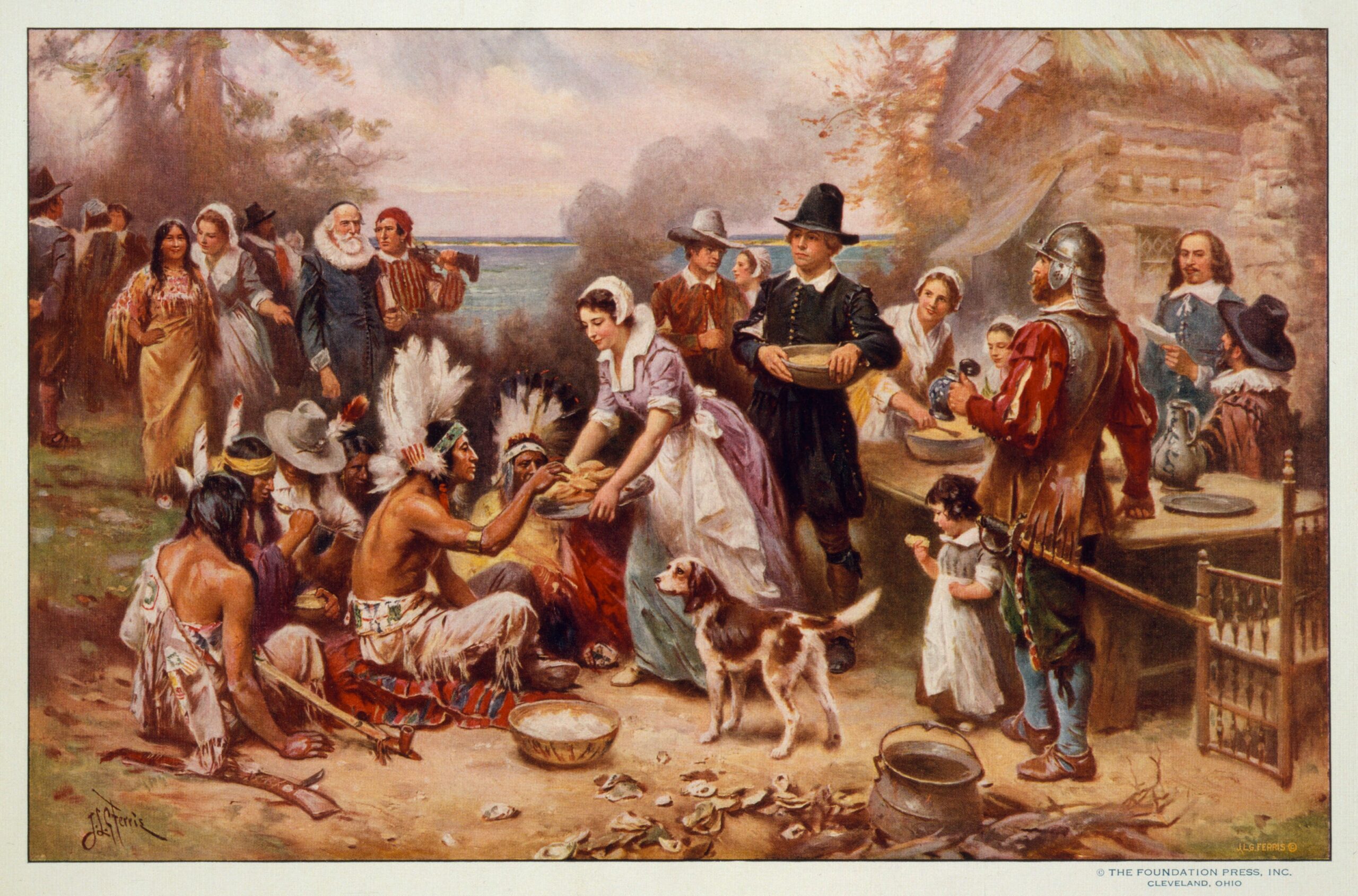
On Thanksgiving Day, Americans make the (sometimes arduous) effort to gather for an enormous traditional meal and for many, a now equally traditional viewing of televised football. But even when stretched to their maximum length, these activities occupy only so many hours. What to do with the rest of the day? You might consider heading over to the Internet Archive and filling it with some holiday-appropriate reading. Last year that site’s librarian Brewster Kahle tweeted a suggestion to “check out 700 Thanksgiving books! (from delightful to dated to a little weird)” in their online collection, a collection that has since risen to more than 1,000 digitized volumes.
There, especially if you sort by popularity, you’ll find a wealth of Thanksgiving-themed children’s books, from Wendi Silvano’s Turkey Trouble and Mark Fearing’s The Great Thanksgiving Escape to Charles Schulz’s A Charlie Brown Thanksgiving and Norman Bridwell’s Clifford’s Thanksgiving Visit (whose titular big red dog features at this very moment in his own major motion picture).
But there are also selections for grown-up readers. Take, for example, Laurie Collier Hillstrom’s The Thanksgiving Book: a Companion to the Holiday Covering its History, Lore, Traditions, Foods, and Symbols, Including Primary Sources, Poems, Prayers, Songs, Hymns, and Recipes: Supplemented by a Chronology, Bibliography with Web Sites, and Index — the length of whose title belies its publication in not the 19th century, but 2008.
Or perhaps you’d prefer to accompany the digestion of your Thanksgiving feast with a holiday-appropriate work of fiction. In that case your choices include Thanksgiving Night by literary examiner of modern family life Richard Bausch; Thankless in Death by murderous-thriller powerhouse J.D. Robb (alter-ego of prolific romance novelist Nora Roberts); and even Truman Capote’s “The Thanksgiving Visitor,” collected in one volume along with his stories “A Christmas Memory” and “One Christmas.” That last book will give you a head start on the rest of the holiday season to come, wherever in the world you may live. And if that happens to be Canada, you can give your kids a head start on next year’s Canadian Thanksgiving while you’re at it. Enter the collection here.
Related Content:
William S. Burroughs Reads His “Thanksgiving Prayer” in a 1988 Film By Gus Van Sant
Bob Dylan’s Thanksgiving Radio Show: A Playlist of 18 Delectable Songs
Marilyn Monroe’s Handwritten Turkey-and-Stuffing Recipe
F. Scott Fitzgerald’s 13 Tips for What to Do with Your Leftover Thanksgiving Turkey
Based in Seoul, Colin Marshall writes and broadcasts on cities and culture. His projects include the book The Stateless City: a Walk through 21st-Century Los Angeles and the video series The City in Cinema. Follow him on Twitter at @colinmarshall or on Facebook.
Read More...Albert Einstein in Color Films
We all think we know just what Albert Einstein looked like — and broadly speaking, we’ve got it right. At least since his death in 1955, since which time generation after generation of children around the world have grown up closely associating his bristly mustache and semi-tamed gray hair with the very concept of scientific genius. His sartorial rumpledness and Teutonically hangdog look have long been the stuff of not just caricature, but (as in Nicolas Roeg’s Insignificance) earnest tribute as well. Yet how many of us can say we’ve really taken a good look at Einstein?
These three pieces of film get us a little closer to that experience. At the top of the post we have a colorized newsreel clip (you can see the original here) showing Einstein in his office at Princeton’s Institute for Advanced Study, where he took up a post in 1933.
Even earlier colorized newsreel footage appears in the video just above, taken from an episode of the Smithsonian Channel series America in Color. It depicts Einstein arriving in the United States in 1930, by which time he was already “the world’s most famous physicist” — a position then meriting a welcome not unlike that which the Beatles would receive 34 years later.
Einstein returned to his native Germany after that visit. The America in Color clip also shows him back at his cottage outside Berlin (and in his pajamas), but his time back in his homeland amounted only to a few years. The reason: Hitler. During Einstein’s visiting professorship at Cal Tech in 1933, the Gestapo raided his cottage and Berlin apartment, as well as confiscated his sailboat. Later the Nazi government banned Jews from holding official positions, including at universities, effectively cutting off his professional prospects and those of no few other German citizens besides. The 1943 color footage above offers a glimpse of Einstein a decade into his American life.
A couple of years thereafter, the end of the Second World War made Einstein even more famous. He became, in the minds of many Americans, the brilliant physicist who “helped discover the atom bomb.” So declares the announcer in that first newsreel, but in the decades since, the public has come to associate Einstein more instinctively with his theory of relativity — an achievement less immediately comprehensible than the apocalyptic explosion of the atomic bomb, but one whose scientific implications run much deeper. Many clear and lucid précis of Einstein’s theory exist, but why not first see it explained by the man himself, and in color at that?
Related Content:
Newly Unearthed Footage Shows Albert Einstein Driving a Flying Car (1931)
Hear Albert Einstein Read “The Common Language of Science” (1941)
Marilyn Monroe Explains Relativity to Albert Einstein (in a Nicolas Roeg Movie)
When Albert Einstein & Charlie Chaplin Met and Became Fast Famous Friends (1930)
Based in Seoul, Colin Marshall writes and broadcasts on cities, language, and culture. His projects include the Substack newsletter Books on Cities, the book The Stateless City: a Walk through 21st-Century Los Angeles and the video series The City in Cinema. Follow him on Twitter at @colinmarshall or on Facebook.
Read More...Watch 30+ Exceptional Short Films for Free in The New Yorker’s Online Screening Room
For short films, finding an audience is an often uphill battle. Even major award winners struggle to reach viewers outside of the festival circuit.
Thank goodness for The Screening Room, The New Yorker’s online platform for sharing short films.
It’s a magnificent free buffet for those of us who’d like nothing better than to gorge ourselves on these little gems.
If you’re not yet a fan of the form, allow us to suggest that any one of the 30 fictional shorts posted in The Screening Room could function as a superb palate cleanser between binge watches of more regular fare.
Take co-directors Amina Sutton and Maya Tanaka’s hilarious The Price of Cheap Rent, clocking in at 6 1/2 minutes, above.
A community-supported project, starring Sutton and shot in Tanaka’s Brooklyn apartment, it’s a comedy of manners that brings fresh meaning to the semi-controversial phrase “Bed Stuy, Do or Die.”
Sutton plays a young Black artist with a masters from Yale, a gig behind the bar at Applebee’s, and a keen interest in positioning herself as an influencer, an ambition the filmmakers lampoon with glee.
When she discovers that her new apartment is haunted, she is “so freaked the f&ck out,” she spends a week sleeping in the park, before venturing back:
And it’s a studio, so it’s like living in a clown car of hell.
But once she discovers (or possibly just decides) that the majority of the ghosts are Black, she begins planning a podcast and makes her peace with staying put.
Pros: the rent’s a lot less than the 1‑bathroom dump she shared with five roommates, there’s laundry in the basement, and the ghosts, whom she now conceives of as ancestors, share many of her interests — history, the arts, and the 1995 live action/CGI adaptation of Casper the Friendly Ghost. (They give Ghostbusters a thumbs down.)
Cons: the ghost of an 18th-century Dutch Protestant settler whose white fragility manifests in irritating, but manageable ways.
Those with 18 minutes to spare should check out Joy Joy Nails, another very funny film hinging on identity.
Every day a group of salty, young Korean women await the van that will transport them from their cramped quarters in Flushing, Queens, to a nail salon in a ritzier — and, judging by the customers, far whiter — neighborhood.
Writer-director Joey Ally contrasts the salon’s aggressively pink decor and the employees’ chummy deference to their regular customers with the grubbiness of the break room and the transactional nature of the exchange.
“Anyone not fired with enthusiasm… will be!” threatens a yellowed notice taped in the employees only area.
Behind the register, the veil is lifted a bit, narrowing the upstairs/downstairs divide with realistically homemade signs:
“CASH! FOR TIP ONLY”
Like Sutton and Tanaka, Ally is versed in horror tropes, inspiring dread with close ups of pumice stones, emory boards, and cuticle trimmers at work.
When a more objective view is needed, she cuts to the black-and-white security feed under the reception counter.
When one of the customers calls to ask if her missing earring was left in the waxing room, the story takes a tragic turn, though for reasons more complex than one might assume.
Ally’s script punctures the all-too-common perception of nail salon employees as a monolithic immigrant mass to explore themes of dominance and bias between representatives of varied cultures, a point driven home by the subtitles, or absence thereof.
The 2017 film also tapped into its release year zeitgeist with a plot point involving the boss’ son.
On a tight schedule? You can still squeeze in Undiscovered, director Sara Litzenberger’s 3‑minute animation from 2014.
Identity factors in here, too, as a Sasquatch-like creature terrifies a string of camera wielding humans in its attempt to get a photograph that will show it as it wishes to be perceived.
It’s an easily digested delight, suitable for all ages.
Explore all 30+ fictional shorts in the Screening Room for free here or on The New Yorker’s YouTube playlist. You can find them all embedded and streamable below.
Related Content:
Watch the Oscar-Winning Animated Short “Hair Love”
Ayun Halliday is the Chief Primatologist of the East Village Inky zine and author, most recently, of Creative, Not Famous: The Small Potato Manifesto. Follow her @AyunHalliday.
Read More...How Kraftwerk Made the Rock and Roll Hall of Fame
The word “seminal” does a lot of work in expressions like “seminal band/album/track, etc.” Yes, it’s an adjective denoting “majorly influential,” even “essential.” It’s also an adjective relating directly to the male reproductive system. The conceptual use of the term does not necessarily exclude women, who can perfectly well be said to “seed” artistic movements. But it does suggest that creativity is an inherently masculine act. To take a broader view, we could say that art is non-binary; it includes all of the generative principles involved in the act of creation, including gestation, birthing, and nurturing new art forms.
In this vein, we might call German electronic pioneers Kraftwerk a “seminal matrix” of musical activity, an economy of creative work led by two fathers — Florian Schneider and Ralf Hütter — who midwived a techno/electro revolution, and — indirectly — through early spin-off projects like NEU!, an experimental post-punk/New Wave revolution.
The best known of the “Krautrock” bands to emerge in the 1970s, early versions of Kraftwerk included in its ranks German producer Conny Plank (unofficially) as well as drummer Klaus Dinger, and guitarist Michael Rother, both of whom went on to play in the aforementioned NEU! and “seminal” avant-garde bands like Harmonia and La Düsseldorf.
In its early, anarchic phase, “Kraftwerk’s music neither referenced nor evoked the robotic,” writes Simon Reynolds at NPR. “They started, in the final years of the 1960s, as post-psychedelic progressives — long hair and all. (Watch their first recorded gig in 1970 here.) In 1968, Hütter and Schneider met at the Academy of Arts in Remscheid, near Düsseldorf, where they studied piano and flute, respectively. Sharing an interest in improvisation and avant-garde electronics, as well as a fondness for The Velvet Underground, the Doors and the multimedia provocations of Fluxus, they joined with three other musicians and recorded the album Tone Float under the name Organisation.”
This early avant-garde phase continued for a time, but once Dinger and Rother left and were replaced by Wolfgang Flür and Karl Bartos, Kraftwerk began its unlikely climb up the charts, and into the hands of remixers and DJs everywhere, with 1975’s Autobahn. “That is the point at which they went from a krautrock curio to a world-historical force,” Reynolds writes, “when the single edit of the 24-minute title track became an international hit in 1975.” The song retains some instrumental elements from the band’s previous incarnations — “twinkling guitar and wafting flute feature alongside synth pulses and drum machine.”
But the melding of man and machine was well underway. “Crucially, it was music stripped of individualized inflection and personality” — not only were Kraftwerk beyond 70s gender stereotypes, they were charting the course for the post-human before the term had any currency. “We go beyond the individual feel,” Schneider told Sounds magazine. “We are more like vehicles, a part of our mensch machine, our man-machine. Sometimes we play the music, sometimes the music plays us, sometimes… it plays.” Kraftwerk may have played German stereotypes for humor in music videos and live performances, but their detachment was no act — their approach from the late 1970’s onward was entirely the opposite of rock and roll’s self (indulgent)-expression.
Why, then, does Kraftwerk belong in the Rock and Roll Hall of Fame? Just inducted this year, their presence is truly indisputable. It’s not much of an exaggeration to say, as the Hall of Fame does, that they “are the foundation upon which all synthesizer-based rock and electronic dance music is built.… Kraftwerk’s influence can be heard in the work of David Bowie and Brian Eno, the synth-pop of Depeche Mode, the electronic-rock integration of U2, the ‘robot rock’ of Daft Punk, the production techniques of Kanye West, and in countless EDM and dubstep artists.”
This is just to name a tiny sampling of the musicians influenced by the perfectionistic German foursome. The case can and has been made that for the sheer breadth of their influence, Kraftwerk is more important than even the Beatles to the history of popular music, for rather than mastering and transforming the music of the 20th century’s first half, they invented the rock and roll of the future. See many more classic Kraftwerk videos at this YouTube channel.
Related Content:
The Psychedelic Animated Video for Kraftwerk’s “Autobahn” from 1979
Kraftwerk’s First Concert: The Beginning of the Endlessly Influential Band (1970)
The Case for Why Kraftwerk May Be the Most Influential Band Since the Beatles
Kraftwerk’s “The Robots” Performed by German First Graders in Adorable Cardboard Robot Outfits
Josh Jones is a writer and musician based in Durham, NC. Follow him at @jdmagness
Read More...What Makes Caravaggio’s The Taking of Christ a Timeless, Great Painting?
Michelangelo Merisi da Caravaggio had many followers. He was, after all, the most revered painter in Rome before he was exiled for murder. After his own death, his work fell into a period of obscurity and might have disappeared were it not for his many imitators. Called Caravaggisti or tenebrosi (“shadowists”), those who adopted Caravaggio’s high-contrast hyperrealism, including Dutch masters like Rembrandt, produced the finest work of the Baroque period. Some of Caravaggio’s disciples were so good they produced copies of his work that could fool experts. And sometimes experts could be fooled into thinking a Caravaggio was actually the work of a copyist.
Such was the case with Caravaggio’s striking canvas, The Taking of Christ, a depiction of the New Testament story of Jesus’ arrest and betrayal by his first disciple, Peter. Commissioned by Roman nobleman Ciriaco Mattei in 1602, the painting disappeared and was thought to have been lost until 1993, when it was found hanging in a Jesuit house in Ireland. The Jesuits had thought it to be the work of Dutch artist Gerard van Honthorst, a painter who acquired the Italian nickname Gherardo delli Notti (“Gerard of the nights”) after a visit to Rome inspired him to take up Caravaggio’s dramatically lit style.
“Caravaggio’s approach to religious art was shocking and controversial in his time,” notes the video. “His work was censored, dismissed and criticized, but it would lead to an entirely new kind of Christian art.” The violent dynamism of his paintings “was matched only by his tempestuous lifestyle.” Dead at age 38, the painter left behind only around 90 paintings and drawings, and these intimately reveal the marks of the artist. “Caravaggio’s technique was as spontaneous as his temper,” notes the National Gallery. “He painted straight onto the canvas with minimal preparation.”
Such is the case in The Taking of Christ. The National Gallery of Ireland, which houses the revolutionary work, point out that “numerous pentimenti (changes of mind)” on the canvas, “now visible due to changes over time in the paint layer, are a reminder of the artist’s unconventional way of posing models in tableaux and altering details as he worked.” He also seems to have literally painted himself into the scrum: “Only the moon lights the scene. Although the man at the far right is holding a lantern, it is, in reality, an ineffective source of illumination. In that man’s features Caravaggio portrayed himself, aged 31.”
Caravaggio’s face and distinctively rapid technique show up frequently in his work, but so little was known about him for so long that scholars seemed to have a difficult time telling an original from a copy. The Taking of Christ has 12 such known copies, some believed to be by Caravaggio himself. One hung in the Odessa Museum of Western and Eastern Art in Ukraine. It was later claimed that the painting was a faithful rendition by an obscure Italian painter, made at the request of Asdrubale Mattei, brother of the original painter’s owner. Caravaggio’s many imitators paid him the highest of compliments, and made certain his influence survived his untimely death.
Related Content:
A Short Introduction to Caravaggio, the Master Of Light
How Caravaggio Painted: A Re-Creation of the Great Master’s Process
Living Paintings: 13 Caravaggio Works of Art Performed by Real-Life Actors
Josh Jones is a writer and musician based in Durham, NC. Follow him at @jdmagness
Read More...A Fascinating 3D Animation Shows the Depths of the Ocean
Deep sea exploration and the science of oceanography began 150 years ago when British survey ship HMS Challenger set off from Portsmouth with 181 miles of rope. The Royal Society tasked the expedition, among other things, with “investigat[ing] the physical conditions of the deep sea… in regard to depth, temperature circulation, specific gravity and penetration of light.” It was the first such voyage of its kind.
To accomplish its objectives, Challenger swapped all but two of its guns for specialized equipment, including — as assistant ship’s steward Joseph Matkin described in a letter home — “thousands of small air tight bottles and little boxes about the size of Valentine boxes packed in Iron Tanks for keeping specimens in, insects, butterflies, mosses, plants, etc… a photographic room on the main deck, also a dissecting room for carving up Bears, Whales, etc.”
Findings from the four-year voyage totaled almost thirty-thousand pages when published in a report. But the Challenger’s most famous legacy may be its discovery of the Mariana Trench. The ship recorded a sounding of 4,475 fathoms (26,850 ft.) in a southern part of the trench subsequently called Challenger Deep, and now known as the deepest part of the ocean and the “lowest point on Earth.” The most recent soundings using advanced sonar have measured its depth at somewhere between 35,768 to 36,037 feet, or almost 7 miles (11 kilometers).
Challenger Deep is so deep that if Everest were submerged into its depths, the mountain’s peak would still be roughly a mile and a half underwater. In 1960, a manned crew of two descended into the trench. Dozens of remote operated vehicles (ROVs) have explored its depths since, but it wouldn’t be until 2012 that another human made the 2.5 hour descent, when Avatar and The Abyss director James Cameron financed his own expedition. Then in 2019, explorer Victor Vescoso made the journey, setting the Guinness world record for deepest manned submarine dive when he reached the Eastern Pool, a depression within Challenger Deep. Just last year, he bested the record with his mission specialist John Rost, exploring the Eastern Pool for over four hours.
Last year’s descent brings the total number of people to visit Challenger Deep to five. How can the rest of us wrap our heads around a point so deep beneath us it can swallow up Mount Everest? The beautifully detailed, 3D animation at the top of the post does a great job of conveying the relative depths of oceans, seas, and major lakes, showing undersea tunnels and shipwrecks along the way, with manmade objects like the Eiffel Tower (which marks, within a few meters, the deepest scuba dive) and Burj Khalifa placed at intervals for scale.
By the time the animation — created by MetaBallStudios’ Alvaro Gracia Montoya– submerges us fully (with booming, echoing musical accompaniment) in the Mariana Trench, we may feel that we have had a little taste of the awe that lies at the deepest ocean depths.
Related Content:
A Radical Map Puts the Oceans–Not Land–at the Center of Planet Earth (1942)
What the Earth Would Look Like If We Drained the Water from the Oceans
Climate Change Gets Strikingly Visualized by a Scottish Art Installation
Filmmaker James Cameron Going 36,000 Feet Under the Sea
Josh Jones is a writer and musician based in Durham, NC. Follow him at @jdmagness
Read More...When Nikola Tesla Claimed to Have Invented a “Death Ray,” Capable of Destroying Enemies 250 Miles Away & Making War Obsolete
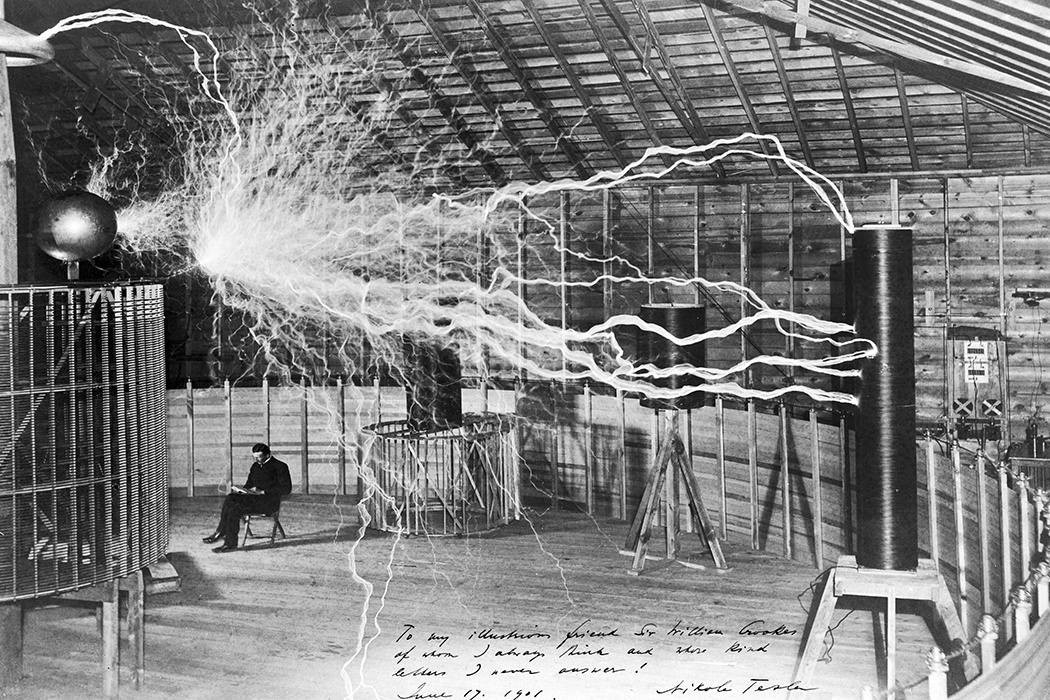
Just last week I visited Niagara Falls and beheld the noble-looking statue of Nikola Tesla installed there. It struck me as a fitting tribute to the inventor of the Death Ray. But then, its presence probably had more to do with Tesla’s having advised the builders of the falls’ power plant to use two-phase alternating current, the form of electricity of which he’s now remembered as a pioneer. And in any case, Tesla never actually invented a death ray, or at least he never demonstrated one. He did, however, claim to have been working on a system he called “teleforce,” which shot what he described as a “death beam” — rays, he insisted, would never be feasible — both “thinner than a hair” and powerful enough to “destroy anything approaching within 200 miles,” making warfare effectively obsolete.
These pronouncements attracted special media attention in the 1930s. “Hype about the weapon really took off in the run-up to World War II as Nazi Germany assembled a fearsome air force,” writes Sam Kean at the Science History Institute. “People in Tesla’s homeland, then called Yugoslavia, begged him to return home and install the rays to protect them from the Nazi menace.” But no known evidence suggests that the elderly Tesla had figured out how to actually make teleforce work.
At that point he had more pressing problems, not least the cost of the hotels in which he lived. “In 1915, his famous Wardenclyffe tower plant was sold to help pay off his $20,000 debt at the Waldorf-Astoria,” writes Mental Floss’ Stacy Conradt, and later he racked up a similarly large bill at the Governor Clinton. “He couldn’t afford the payment, so instead, Tesla offered the management something priceless: one of his inventions.”
That “invention” may have been the box examined after Tesla’s death in 1943 by physicist John G. Trump (uncle of former President Donald Trump). Left in a hotel vault, it was rumored to be “a prototype of his death ray.” Tesla had included a note, writes Kean, that “claimed the prototype inside was worth $10,000. More ominously, it said the box would detonate if opened incorrectly.” But when “the physicist steeled himself and began tearing off the brown paper,” he “must have laughed at what he saw underneath: a Wheatstone bridge, a tool for measuring electrical resistance. It was a common, mundane device — some old junk, really. It was certainly not a death ray, not even close.”
Though it must have been as powerful a disappointment as it was a relief, did that discovery prove that Tesla never invented a death ray? The U.S. government didn’t take its chances on the matter: as History.com’s Sarah Pruitt tells it, agents “swooped in and took possession of all the property and documents from his room at the New Yorker Hotel” right after Tesla’s death. And “while the FBI originally recorded some 80 trunks among Tesla’s effects, only 60 arrived in Belgrade,” home of the Nikola Tesla Museum, nearly a decade later. The idea of death rays has long survived Tesla himself, taking on forms from the Reagan administration’s “Star Wars” nuclear defense program to the military laser weapons tested in recent years. Few such technologies seem capable of ending all war, as Tesla promised. But if one ever does, we could honor his memory by referring to it, in the manner he preferred, as not a death ray but a death beam.
Related Content:
In 1926, Nikola Tesla Predicts the World of 2026
The Electric Rise and Fall of Nikola Tesla: As Told by Technoillusionist Marco Tempest
Nikola Tesla Accurately Predicted the Rise of the Internet & Smart Phone in 1926
Mark Twain Plays With Electricity in Nikola Tesla’s Lab (Photo, 1894)
Based in Seoul, Colin Marshall writes and broadcasts on cities, language, and culture. His projects include the Substack newsletter Books on Cities, the book The Stateless City: a Walk through 21st-Century Los Angeles and the video series The City in Cinema. Follow him on Twitter at @colinmarshall or on Facebook.
Read More...Richard Pryor & George Carlin Appear Together on a Classic Episode of The Tonight Show Starring Johnny Carson
George Carlin and Richard Pryor never got to star in a film together, so this appearance of the two on this 1981 Tonight Show clip is a great, rare chance to see two giants together. Actually, make that three, because host Johnny Carson shows why he set the standard in that very American genre, the late night talk show. It’s also an opportunity to see how much has changed in the world of late night.
Late night talk shows are almost exclusively a political affair these days. For many Americans, this is the place to get their satirical take on the news in the opening monologue, possibly their only take. Some nights you can watch the three main networks and several premium cable/streaming channels and find the same news item, riffed on a dozen different ways.
The Tonight Show with Johnny Carson wasn’t a “simpler time,” but it was very different. More casual, definitely, and more personable. I think that’s what comes across in this clip. Carson knows both Carlin and Pryor and their particular talents.
Carlin’s routine is purely observational. Currently he is a meme on many a boomer’s feed, but always late-stage Carlin, the angry, nihilistic political comedian. (That’s not a bad thing, and interesting that he’s being claimed these days by both the Left and the Right). Here he’s still Class Clown Carlin, with an elastic face, delivering a version of his “stuff vs. crap” routine, capped off with an out-of-nowhere abortion joke. It’s political in the vaguest sense.
His sit down with Carson is more of a chance to riff on charity organization names, and Carson lets him at it.
Pryor is on to promote Bustin’ Loose, his oddly sentimental 1981 comedy. But all that’s on Carson’s and the audience’s mind is the aftermath of the freebasing incident, where he doused himself with rum and set himself on fire while high on cocaine. He nearly died.
The delicate interchange between Carson—who legitimately wants to know how Pryor is doing—and Pryor, who both mocks himself, admits too much, and retreats behind a wall of humor, makes this essential viewing. Pryor reminisces about his father and his time coming up through standup with Carlin at Greenwich Village’s Cafe au Go-Go. He even admits, because why not, to lifting his early jokes as a comic from Bill Cosby and Dick Gregory. The latter “used to have stuff in Jet Magazine, you know, and that’s how I started, reading his material. I’d do it on stage. And that was my first breakthrough. I got a lot of laughs with his material.”
Pryor rides that line between telling on yourself and telling a fib.
And that last fascinating shot: credits rolling over Carson, the guests, and Ed McMahon, standing around, having a chat, as if they’re waiting for the coat check attendant in the lobby.
Ramsey Ess, who wrote about the whole episode—including Carson’s decidedly non-political monologue— on Vulture in 2012, noted about the Pryor interview:
When Johnny asks Richard about his dreams, you forget about the audience, you forget about George Carlin sitting over there and you suddenly are brought into a place where this is an important question and you need to hear that answer, even though you never would have thought to wonder about such a thing on your own. This intimacy, for me, is what made Carson different.
If you would like to support the mission of Open Culture, consider making a donation to our site. It’s hard to rely 100% on ads, and your contributions will help us continue providing the best free cultural and educational materials to learners everywhere. You can contribute through PayPal, Patreon, and Venmo (@openculture). Thanks!
Related Content:
George Carlin’s “Modern Man” Rap
George Carlin Performs His “Seven Dirty Words” Routine: Historic and Completely NSFW
Ted Mills is a freelance writer on the arts who currently hosts the Notes from the Shed podcast and is the producer of KCRW’s Curious Coast. You can also follow him on Twitter at @tedmills, and/or watch his films here.
Read More...What Makes the Mona Lisa a Great Painting: A Deep Dive
This past summer we featured a short video introduction to the Mona Lisa here on Open Culture. You’d think that if any painting didn’t need an introduction, that would be the one. But the video’s creator James Payne showed many of us just how much we still have to learn about Leonardo’s most famous work of art — and indeed, perhaps the most famous work by any artist. On his Youtube channel Great Art Explained, Payne offers clear and powerful analyses of paintings from van Gogh’s The Starry Night and Hopper’s Nighthawks to Warhol’s Marilyn Diptych and Picasso’s Guernica. But there are some images to which a fifteen-minute video essay can’t hope to do justice.
In those cases, Payne has been known to follow up with a deluxe expanded edition. Taking on Hieronymus Bosch’s The Garden of Earthly Delights, he followed up three individual fifteen-minute videos — for a triptych, a neat union of form and substance — with a full-length treatment of the whole work.
Payne’s full-length version of his Mona Lisa video more than doubles the length of the original. “This is the more comprehensive version I always wanted to do,” he notes, adding that it “uses some of the information from the first film (but in higher resolution with better sound and with clearer graphics), as well as answering the hundreds of questions: Why doesn’t she have eyebrows? Is it a self-portrait? Is she only famous because she was stolen? How do we know what he was thinking?”
This time around, Payne has more to say about how Leonardo created such a compelling portrait on a technical level, but also why he came to paint it in the first place. On top of that, the expanded format gives him time to examine the much more conventional portraits Leonardo’s contemporaries were painting at the time, as well as what’s known as the Prado Mona Lisa. A depiction of the same sitter that may even have been painted simultaneously by one of Leonardo’s students, it makes for an illuminating object of comparison. Payne also gets into the 1911 theft and recovery that ultimately did a great deal for the painting’s reputation, as well as its 1963 exhibition in America that, thanks to television, turned it into a mass-media icon. By now we’ve all had more glimpses of the Mona Lisa more times than we can remember, but it takes enthusiasm like Payne’s to remind us of all the ways we can truly see it.
Related Content:
What Makes Leonardo’s Mona Lisa a Great Painting?: An Explanation in 15 Minutes
Why Leonardo da Vinci’s Greatest Painting is Not the Mona Lisa
Original Portrait of the Mona Lisa Found Beneath the Paint Layers of da Vinci’s Masterpiece
Based in Seoul, Colin Marshall writes and broadcasts on cities, language, and culture. His projects include the Substack newsletter Books on Cities, the book The Stateless City: a Walk through 21st-Century Los Angeles and the video series The City in Cinema. Follow him on Twitter at @colinmarshall or on Facebook.
Read More...Why Leonardo da Vinci’s Greatest Painting is Not the Mona Lisa
Despite creating two of the most famous paintings in the history of Western art, The Last Supper and the Mona Lisa, Leonardo da Vinci did not particularly think of himself as a painter. Sigmund Freud may have devoted several hundred words to showing that the Renaissance man par excellence rarely finished an artwork because of infantile psychosexual conflicts, but it seems more fitting to look at Leonardo’s approach to painting as of a piece with his approach to everything: He was simply far more interested in process than product. Even when the product was a masterpiece-in-the-making, and Leonardo’s patrons awaited, the artist’s restless mind was ready to move on before he finished a commission.
Such was the case with the Mona Lisa, which Leonardo never delivered to his client and instead brought with him to France. This painting, in all its unfinished mystery, may be Leonardo’s best-known work, but it is not — as Evan Puschak, a.k.a. The Nerdwriter, argues above — his best.
That honor should be reserved for a painting Leonardo began in the same year as the Mona Lisa, 1503: The Virgin and Child with St. Anne, which he worked on for seven years, never delivered to his client (most likely the King of France), and left unfinished at the time of his death in 1519.
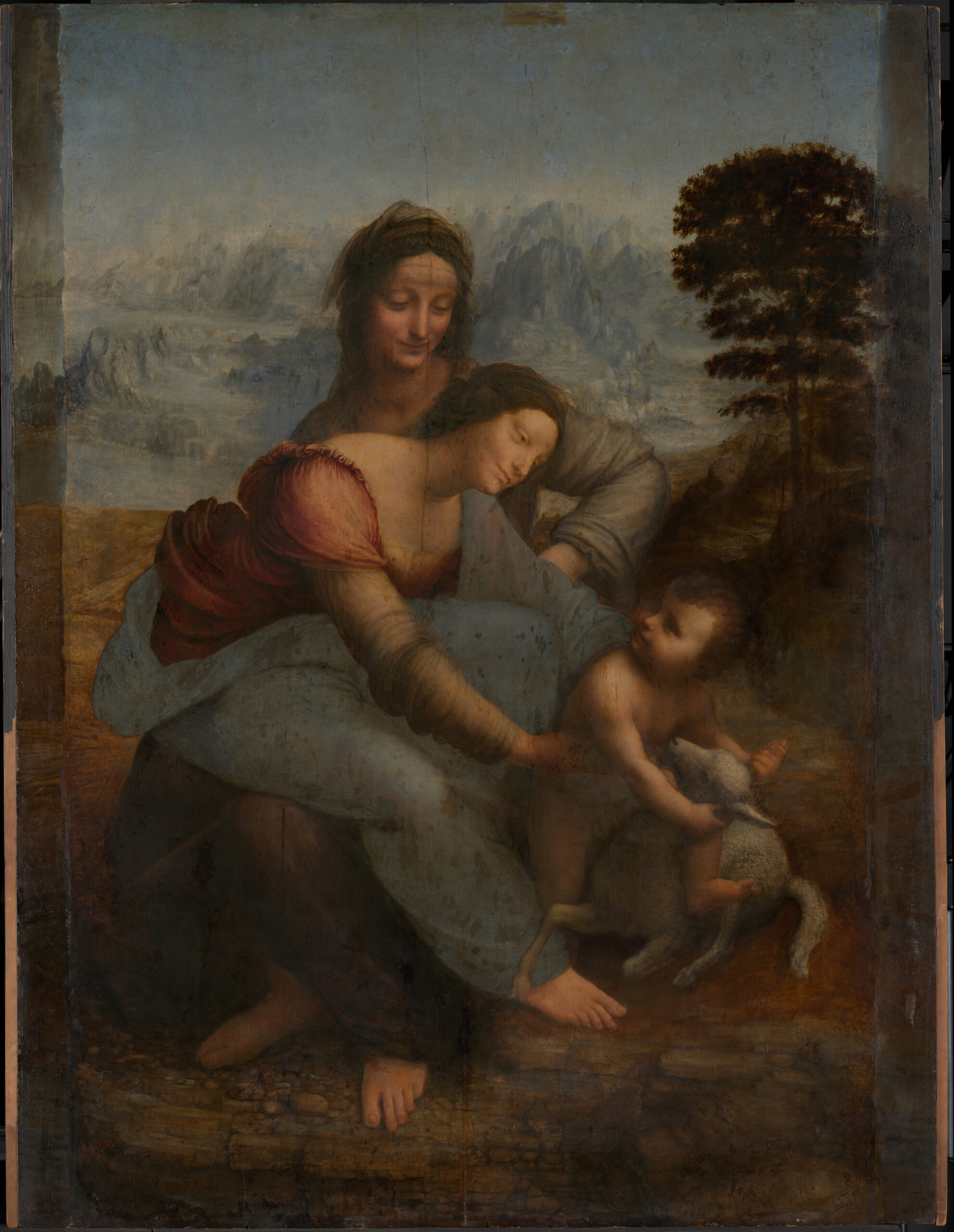
The painting depicts a grouping of three figures: the infant Christ, wrestling a lamb, his mother, attempting to pull him away, and her mother, the apocryphal St. Anne, forming the stable base and apex of the triad. Behind her head towers a dense mountain range, a symbol of deep ecological time, says Puschak, just as the lamb in the foreground symbolizes the Passion to come. This transition from a pre-historic past (one far more ancient than the Biblical stories) to a redeemed future does not terminate with the lamb, says Puschak, but with us, the viewer.
The pyramidal composition recalls Leonardo’s The Virgin of the Rocks from 1483. Such groupings were common in early Renaissance paintings, but The Virgin and Child with St. Anne represented a masterful refinement of the composition and of Leonardo’s famed sfumato technique. As Artdaily notes:
In Florence, where it was conceived, the Saint Anne quickly drew considerable attention and can be seen as a watershed moment in the evolution of artistic language, inspiring many disciples and colleagues who sought to emulate Leonardo’s style and technique in this work. Florentines were fascinated by the various cartoons executed by Leonardo and by the painted work, even in its rough outlines.
One preparatory work, the so-called “Burlington House Cartoon” (below), shows “the full expression of Leonardo’s first vision of the Saint Anne theme upon being awarded the commission.”
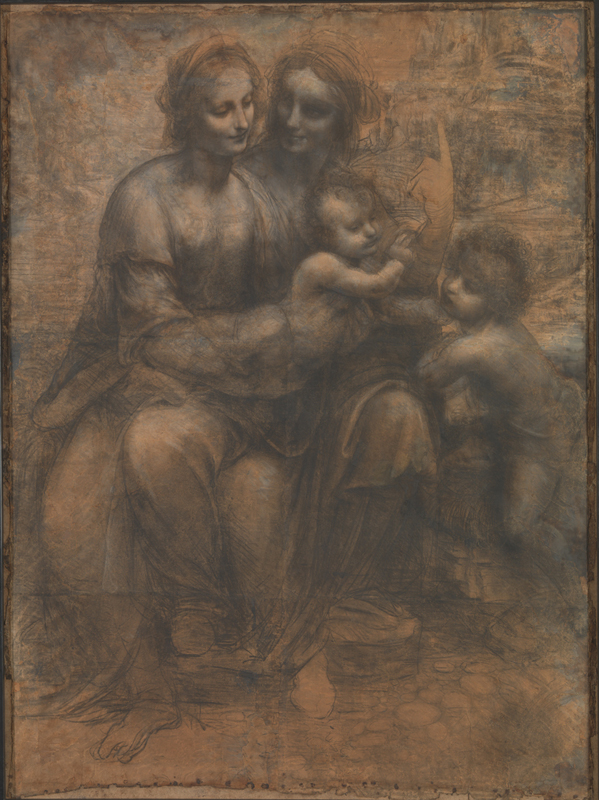
Image via the National Gallery
The work also shows the continued development of a theme that absorbed the artist throughout his life, expressed in earlier works such as The Virgin and Child with Cat and The Virgin of the Rocks. “These Virgin and Child compositions testify to Leonardo’s question to render in the most compelling manner the tenderness of the relationship between Jesus and the Virgin Mary,” and thus, between mother and son. Most of Freud’s observations in his Leonardo essay are nonsense, based on a mistranslation into German of the word “vulture” for a word that actually means “kite” (an error he later found particularly embarrassing). But his discussion of Leonardo’s childhood and his best, unfinished painting may strike us with particular poignancy.
[T]he smile which is playing on the lips of both women, although unmistakably the same as in the picture of Mona Lisa, has lost its sinister and mysterious character; it expresses a calm blissfulness.… Leonardo’s childhood was precisely as remarkable as this picture. He has had two mothers, the first his true mother, Caterina, from whom he was torn away between the age of three and five years, and a young tender step-mother, Donna Albiera, his father’s wife. By connecting this fact of his childhood… and condensing them into a uniform fusion, the composition of Saint Anne, Mary and the Child, formed itself in him.
Perhaps Freud was right, and The Virgin and Child with St. Anne was truly Leonardo’s most personal work, the apotheosis of a quest to integrate his personality through art. Whatever the case, we can say, along the psychoanalyst, that “on becoming somewhat engrossed in this picture it suddenly dawns upon the spectator that only Leonardo could have painted this picture.”
On a side note, Nerdwriter, the creator of the video above, has a new book coming out, Escape into Meaning: Essays on Superman, Public Benches, and Other Obsessions. You can pre-order it now.
Related Content:
Leonardo Da Vinci’s To-Do List from 1490: The Plan of a Renaissance Man
Josh Jones is a writer and musician based in Durham, NC. Follow him at @jdmagness
Read More...Support Us
We're hoping to rely on loyal readers, rather than erratic ads. Please click the Donate button and support Open Culture. You can use Paypal, Venmo, Patreon, even Crypto! We thank you!

About Us

Open Culture scours the web for the best educational media. We find the free courses and audio books you need, the language lessons & educational videos you want, and plenty of enlightenment in between.
Advertise With Us

FREE UPDATES!
GET OUR DAILY EMAIL
Get the best cultural and educational resources on the web curated for you in a daily email. We never spam. Unsubscribe at any time.
FOLLOW ON SOCIAL MEDIA

Open Culture editor Dan Colman scours the web for the best educational media. He finds the free courses and audio books you need, the language lessons & movies you want, and plenty of enlightenment in between.
Advertise With Us

