A Brilliant Demonstration of Magnets & the Promise of Levitating Trains (1975)
For a brief time in the 1980s, it seemed like trains powered by maglev — magnetic levitation — might just solve transportation problems everywhere, maybe even replacing air travel, thereby eliminating one of the most vexing sources of carbon emissions. Maglev trains don’t use fuel; they don’t require very much power by comparison with other sources of high speed travel; they don’t produce emissions; they’re quiet, require less maintenance than other trains, and can travel at speeds of 300 mph and more. In fact, the fastest maglev train to date, unveiled this past summer in Qingdao, China, can reach speeds of up to 373 miles per hour (600 kph).
So, why isn’t the planet criss-crossed by maglev trains? asks Dave Hall at The Guardian, citing the fact that the first maglev train was launched in the UK in 1984, after which Germany, Japan, and China followed suit. It seems to come down, as such things do, to “political will.” Without significant commitment from governments to reshape the transportation infrastructure of their countries, maglev trains remain a dream, the monorails of the future that never materialize. Even in China, where government mandate can institute mass changes at will, the development of maglev trains has not meant their deployment. The new train could, theoretically, ferry travelers between Shanghai to Beijing in 2.5 hours… if it had the track.
Perhaps someday the world will catch up with maglev trains, an idea over a century old. (The first patents for maglev technology were filed by a French-born American engineer named Emile Bachelet in the 1910s.) Until then, the rest of us can educate ourselves on the technology of trains that use magnetic levitation with the 1975 video lesson above from British engineer and professor Eric Laithwaite (Imperial College London), who “deconstructs the fascinating physics at work behind his plans for a maglev trains, which he first modelled in the 1940s and perfected in the 1970s,” notes Aeon. “Well-regarded in his time as both a lecturer and an engineer, Laithwaite presents a series of demonstrations that build, step by step, until he finally unveils a small maglev train model.”
Laithwaite’s small-scale demonstration would eventually culminate in the first commercial maglev train almost a decade later at Birmingham Airport. Here, he begins where science begins, with an admission of ignorance. “Permanent magnets are difficult things to understand,” he says. “In fact, if we’re absolutely honest with ourselves, we don’t understand them.” The good professor then briskly moves on to demonstrate what he does know — enough to build a levitating train. Learn much more about the history and technology of maglev trains at How Stuff Works, and keep your eyes on the Northeast Maglev project, a developing Superconducting Maglev train that promises travel between New York and Washington, DC in one hour flat.
via Aeon
Related Content:
The Flying Train: A 1902 Film Captures a Futuristic Ride on a Suspended Railway in Germany
Josh Jones is a writer and musician based in Durham, NC. Follow him at @jdmagness
Read More...The Beach Boys’ Lost Concert: Watch the Band Perform Their Classics at Their Zenith (1964)
In early 1964, there could hardly have been an American teenager ignorant of the Beach Boys. Singing in immaculate harmonies about surfing, hot rods, girls, and root beer — as well as various combinations and permutations thereof — they soon found themselves riding an unprecedentedly high wave, so to speak, of postwar teen culture. On the other side of the pond, the Beatles had been hard at work playing to demographically similar, also-enraptured audiences. In February of 1964 the Fab Four arrived in America, and their performance on The Ed Sullivan Show alone put them on at least an equal footing there with the Beach Boys.
“The next opportunity for your average American Beatlemaniac to see the Beatles perform would have been at the movie theater watching the Beatles’ Washington D.C. concert at the Coliseum on a closed circuit broadcast on March 14 or 15, 1964,” says the blog Meet the Beatles for Real. “This was the first time in history that the closed-circuit was used for a concert. Previously, it had only been used to show boxing matches.”
The direct-to-theaters broadcast also included shorter opening acts Lesley Gore and the Beach Boys, the latter of whose performance was thought lost until its rediscovery in 1998. In the video above, you can see its entire 22 minutes at an audiovisual quality well exceeding most concert films of its era.
Beginning with “Fun, Fun, Fun,” the Beach Boys play a variety of early numbers that would turn out to rank among their most beloved songs, also including “Little Deuce Coupe,” “Surfer Girl,” “Surfin’ U.S.A.,” and “Shut Down.” (“Long Tall Texan” would only be properly recorded 32 years later, with the late country singer Doug Supernaw.) The set even features “In My Room,” whose melancholic break from the surfing-cars-girls spectrum offered a sign of things to come from the group’s musical mastermind Brian Wilson. Unsuited to the stress of stardom, he would recuse himself from live performance the following year. This show thus marks the onstage zenith of the Beach Boys’ classic lineup of the Wilson brothers Brian, Carl, and Dennis with Al Jardine and Mike Love. But as makers of classic albums — and classic albums pushed to heights of ambition by competition with the Beatles — they’d only just begun.
Related Content:
How the Beach Boys Created Their Pop Masterpieces: “Good Vibrations,” Pet Sounds, and More
Based in Seoul, Colin Marshall writes and broadcasts on cities, language, and culture. His projects include the Substack newsletter Books on Cities, the book The Stateless City: a Walk through 21st-Century Los Angeles and the video series The City in Cinema. Follow him on Twitter at @colinmarshall or on Facebook.
Read More...Medieval Tennis: A Short History and Demonstration
British You Tuber Nikolas “Lindybiege” Lloyd is a man of many, many interests.
Wing Chun style kung fu…
Children’s television produced in the UK between 1965 and 1975…
Ancient weaponry, chainmail, and historically accurate WWII model miniatures…
Actress Celia Johnson, star of the 1945 romantic drama Brief Encounter…
Evolutionary psychology…
…and it would appear, tennis.
But not the sort you’ll find played on the grass courts of Wimbledon, or for that matter, the hard courts of the US Open.
Lloyd is one of a select few who gravitate toward the version of the game that was known as the sport of kings.
It was, according to a 1553 guide, created, “to keep our bodies healthy, to make our young men stronger and more robust, chasing idleness, virtue’s mortal enemy, far from them and thus making them of a stronger and more excellent nature.”
Henry VIII was a talented and enthusiastic player in his youth, causing the Venetian Ambassador to rhapsodize, “it was the prettiest thing in the world to see him play; his fair skin glowing through a shirt of the finest texture.”
Henry’s second wife, the ill-fated Anne Boleyn, was also a fan of the sport, with money riding on the match she was watching when she was summoned to the Privy Council “by order of the King,” the first stop on her very swift journey to the Tower of London.
The sport’s roots reach all the way to the 11th and 12th centuries when monks and villagers in southern France were mad for jeu de paume, a tennis-like game predating the use of racquets, whose popularity eventually spread to the royals and aristocrats of Paris.
The game Lloyd tries his hand at above is now known as Real Tennis, a term invented in the 19th-century to distinguish it from the then-new craze for lawn tennis.
Mention “the sport of kings” these days and most folks will assume you’re referring to fox hunting or horse-racing.
Mind you, real tennis is just as rarified. You won’t find it being played on any old (which is to say new) indoor court. It requires four irregularly sized walls, an asymmetrical layout, and a sloping penthouse roof. Behold the layout of a Real Tennis court by Atethnekos, compliments of English Wikipedia:

Compared to that, the Tennis Department’s diagram of the familiar modern set up seems like child’s play:

Other cognitive challenges for those whose version of tennis doesn’t extend back to medieval days: a slack net; lopsided, tightly strung, small raquets; and a gallery of waist-high screened “hazards,” that are spiritually akin to pinball targets, especially the one with the bell.
The handmade balls may look similar to your average mass-produced Penn or Wilson, but expect that each will be “unique in its particular quirks”:
They are not perfectly spherical and these seams stick out a little bit more here and there, which means that the bounce can be rather unpredictable. Because these are heavier and harder, they don’t swerve when you spin them in the air very much, but when they hit a wall and get a decent grip, the swerve can send them zinging off along the wall to great effect.
Once Lloyd has oriented viewers and himself to the court and equipment, Real Tennis pro Zak Eadle walks him through serving, scoring, and strategy in the form of chases.
Quoth Shakespeare’s Henry V:
His present, and your pains, we thank you for:
When we have match’d our rackets to these balls,
We will, in France, by God’s grace play a set,
Shall strike his father’s crown into the Hazard:
Tell him, he made a match with such a wrangler,
That all the Courts of France will be disturb’d with chases.
Even non-athletic types could find themselves fascinated by the historical context Lindybeige provides.
If you’re moved to take racquet in hand, there are a handful of Real Tennis courts in the USA, UK, Australia, and France where you might be able to try your luck.
The sport could use you. Estimates indicate that the number of players has dwindled to a mere 10,000. Surely someone is desperate for a partner.
Delve further into the world of Real Tennis on the International Real Tennis Professionals Association’s website.
Check out some of Lindybeige’s other interests on his YouTube channel.
Related Content:
What It’s Like to Actually Fight in Medieval Armor
Ayun Halliday is an author, illustrator, theater maker and Chief Primatologist of the East Village Inky zine. Follow her @AyunHalliday
Read More...Footage of the Last Known Tasmanian Tiger Restored in Color (1933)
Last month, the U.S. Fish and Wildlife Service announced that nearly two dozen wildlife species would be removed from the endangered species list, as CNN reported, including the ivory-billed woodpecker, “the Bachman’s warbler, two species of freshwater fishes, eight species of Southeastern freshwater mussels and 11 species from Hawaii and the Pacific Islands.” This is not good news. The animals have been delisted because they’ve been added to a list of extinct creatures, one that grows longer each year.
Most of us have seen few, if any, of these animals and cannot grasp the scope of their loss. What does it mean to say there are no more Bachman’s warblers left on Earth? Species wiped out by climate change, overfarming, overfishing, or the encroachment of humans and invasive species can feel far away from us, their loss a distant tragedy; or extinction can seem inevitable, like that of the Dodo or Sicilian wolf, creatures that seem too fantastic for the world we now inhabit. So too, the dog-like marsupial Tasmanian tiger — or thylacine — an animal that lived as recently as 1936 when the last representative of its species, named Benjamin, died in captivity in Australia.
The thylacine looks like an evolutionary oddity, too weird to survive. But this judgment is a misapplication of Darwinism as egregious as the idea that only the “fittest,” i.e. those who can take good beating, survive. The day Benjamin died, September 7, has been commemorated in Australia as National Threatened Species Day, which raises awareness about the hundreds of plant and animal species close to extinction. The day also celebrates the hundreds of species found nowhere else in the world, animals that could come to seem to us in the near future as strange and exotic as the thylacine — a fascinating example of convergent evolution: a marsupial canid that evolved completely independently of wolves, dogs, and other canine species with which it had no contact whatsoever until the British arrived.
Found only on the island of Tasmania by the time of European settlement, thylacine populations were destroyed by disease, dogs, and, primarily, human hunters. Before the final member of the species died, they were kept in zoos and captured on silent film by naturalists like David Fleay, who shot the black-and-white footage just above of Benjamin at Beaumaris Zoo in Hobart, Tasmania. In the video at the top, we can see the same footage in vivid color — and full digital restoration — thanks to Samuel François-Steininger and his Paris-based company Composite Films.
Sent an HDR (High Dynamic Range) scan of the film by the National Film and Sound Archive of Australia (NFSA), François-Steininger had to make a lot of interpretive choices. Next to “original skins preserved in museums,” the NFSA notes, his team “had to rely on sketches and paintings because of the lack of original color pictures or footage that could be used for research.” While there are 9 short film clips of the animals from the London and Hobart zoos, these are all, of course, in black and white. “Written descriptions of the thylacine’s coat gave them a general idea of the tints and shades present in the fur, information they supplemented with scientific drawings and recent 3D color renderings of the animal.” The results are incredibly natural-looking and startlingly immediate.
Are the thylacine, Bachman’s warbler, and other extinct species victims of the Anthropocene? Will our children’s children children watch films of polar bears and koalas and wonder how our planet could have contained such wonders? Geological epochs deal with “mile-thick packages of rock stacked up over tens of millions of years,” Peter Brannen writes at The Atlantic, and thus it overstates the case to call the last four centuries of climate change and mass extinction an “Anthropocene.” The word names “a thought experiment” rather than a span of deep time in Earth’s history. But from the perspective of critically endangered species — maybe to include, eventually, humans themselves — the transformations of the present seem squarely focused on our reckless behavior and its effects on habitats we never see.
We are far less important to geological time than we think, Brannen argues, but it does, indeed, seem up to us at the moment whether there is a future on Earth filled with plant, animal, and yes, human, life:
We haven’t earned an Anthropocene epoch yet. If someday in the distant future we have, it will be an astounding testament to a species that, after a colicky, globe-threatening infancy, learned that it was not separate from Earth history, but a contiguous part of the systems that have kept this miraculous marble world habitable for billions of years.
Related Content:
Two Million Wondrous Nature Illustrations Put Online by The Biodiversity Heritage Library
Are You Ready for the Return of Lost Species?: Stewart Brand on the Dawn of De-Extinction
Josh Jones is a writer and musician based in Durham, NC. Follow him at @jdmagness
Read More...Monet’s Water Lilies: How World War I Inspired Monet to Paint His Final Masterpieces & Create “the World’s First Art Installation”
When one considers which artists most powerfully evoke the horrors of trench warfare, Claude Monet is hardly the first name to come to mind. And yet, once viewed that way, his final Water Lilies paintings — belonging to a series that, in reproduction, speaks to many of no more harrowing a setting than a doctor’s waiting room — can hardly be viewed in any other. These eight large-scale canvasses constitute “a war memorial to the millions of lives tragically lost in the First World War,” argues Great Art Explained creator James Payne. Monet declined to include a horizon line in any of them, leaving viewers in “a vast field of unfathomable nothingness, of light, air, and water,” at once peaceful and reminiscent of “the battle-ravaged landscape along the western front.”
Those battlefields “had no beginning or end, and no horizons. Time and space was forgotten, as soldiers were enveloped in a sea of mud, surrounded by waterlogged and surreal landscapes, which covered their field of vision.” The Great War, as it was then known, still raged on when the septuagenarian Monet began these works. (“He could hear the sound of gunfire from 50 kilometers away from his house in Giverny as he painted,” notes Payne.)
By the time he finished them, in the last year of his life, the fighting had been over for eight years. In a sense, these paintings may have kept him alive: “He was constantly ‘reworking’ them and seemed incapable of finishing,” even though, by his own admission, “he could no longer see the details or make out colors.”
When these Water Lilies were revealed to the public, mounted in their own specially designed gallery in Paris’ Musée de l’Orangerie (arranged by close personal friend Georges Clemenceau), Monet was dead — which may, in part, explain the critics’ willingness to deride them as the work of an artist who had lost his powers. “Monet, rejected by critics in the 19th century for being too radical, was now being criticized in the 20th century for not being radical enough.” It would take a later generation of artists — including American painters like Mark Rothko and Jackson Pollock — to see his last works as “a logical jumping-off point for abstraction,” and the space that houses them as “the Sistine Chapel of impressionism.” World War I has passed out of living memory, but “the world’s first art installation” it inspired Monet to create has lost none of its power.
Related Content:
How to Paint Water Lilies Like Monet in 14 Minutes
Rare 1915 Film Shows Claude Monet at Work in His Famous Garden at Giverny
1923 Photo of Claude Monet Colorized: See the Painter in the Same Color as His Paintings
1,540 Monet Paintings in a Two Hour Video
Based in Seoul, Colin Marshall writes and broadcasts on cities, language, and culture. His projects include the Substack newsletter Books on Cities, the book The Stateless City: a Walk through 21st-Century Los Angeles and the video series The City in Cinema. Follow him on Twitter at @colinmarshall or on Facebook.
Read More...Jim Henson’s Farewell: Revisit the “Nice, Friendly” Memorial Service at St. John the Divine (1990)
Please watch out for each other and love and forgive everybody. It’s a good life, enjoy it. — Jim Henson
Born in Greenville, Mississippi, Jim Henson spent his youth practicing the tenets of Christian Science, a faith he would officially renounce in 1975. But the power of positive thinking his early religion years instilled would persist, romanticized by his alter-ego, Kermit the Frog, and tempered by foils like the earthy, irascible Ms. Piggy. For every foul-mouthed Oscar the Grouch, there was always a lovable Big Bird, “Jim taught us many things: to save the planet, be kind to each other, praise God, and be silly,” said Muppet writer Jerry Juhl at Henson’s 1990 New York City memorial service. “That’s how I’ll remember him — as a man who was balanced effortlessly and gracefully between the sacred and the silly.”
Henson’s first memorial, held at the cavernous Cathedral of St. John the Divine bore witness to Juhl’s portrait of the late, brilliant creator’s legacy. In true Henson fashion, the puppeteer directed the event himself from beyond the grave, a final lighthearted joke, as he had written in a letter to his family four years earlier: “It feels strange writing this while I am still alive, but it wouldn’t be easy after I go …. This all may seem silly to you guys, but what the hell, I’m gone and who can argue with me?”
By “this all,” Henson meant a funeral service in which guests were forbidden to wear black and asked to mourn and celebrate to the tunes of a Dixieland brass band: “A nice, friendly little service,” he wrote in his instructions, with a “rousing” soundtrack.
To the sounds of jazz, his friends and family added — of course — the songs that defined Henson’s career, including “Sunny Day,” the Sesame Street theme song, Muppets anthem “The Rainbow Connection,” and — in a second memorial service held two months later at St. Paul’s in London — Kermit the Frog’s anthem, “It’s Not Easy Being Green” (above) sung by Big Bird and Oscar puppeteer Caroll Spinney. (Spinney passed away in 2019.) Both Henson memorials were solemn (unavoidable given the occasion and the venues) but also decidedly silly, as story after story about the man poured forth from those who knew him best.
In the Defunctland video at the top, you can see Henson’s friend and frequent collaborator Juhl take the pulpit at St. John the Divine to tell his favorite Henson story of working on their first show in 1955, Sam and Friends, a local Washington, D.C. live-action/puppet program that gave birth to Kermit. Doubting the joke at the heart of a sketch, Juhl went to Henson with his misgivings; and Henson replied, “It’s a terrible joke, but it’s worthy of us.” The laughter that rumbles through the crowd is characteristic of both funeral services, which feel far more intimate than they are. Or as Henson’s son Brian says in his tribute, “Sorry Dad. Little service, big place.” See the full New York funeral service for Henson just below.
Related Content:
Witness the Birth of Kermit the Frog in Jim Henson’s Live TV Show, Sam and Friends (1955)
Jim Henson Creates an Experimental Animation Explaining How We Get Ideas (1966)
The Creative Life of Jim Henson Explored in a Six-Part Documentary Series
Josh Jones is a writer and musician based in Durham, NC. Follow him at @jdmagness
Read More...How New Yorkers Dodged Pre-Prohibition Drinking Laws by Inventing the World’s Worst Sandwich
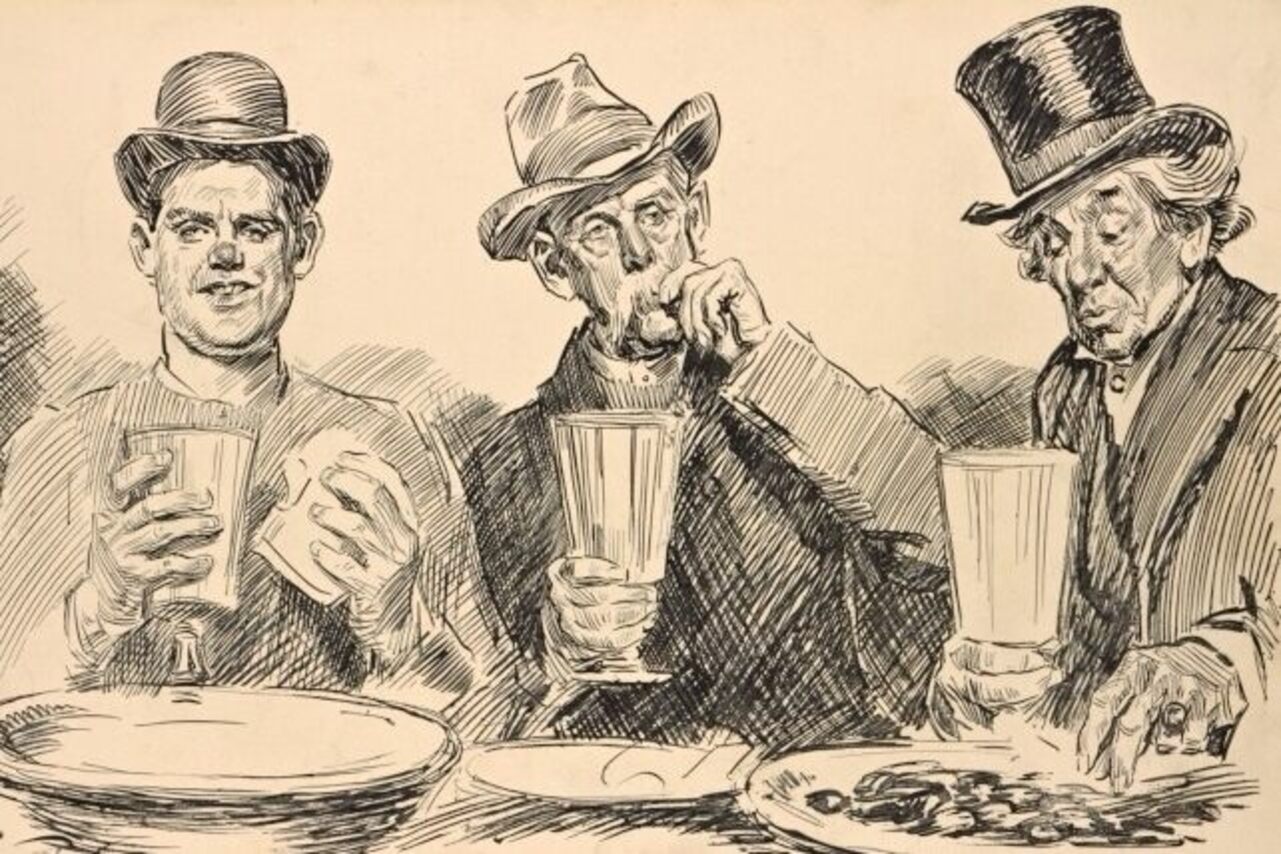
Three men feast on free lunch in a drawing by Charles Dana Gibson
In one of my favorite episodes of The Simpsons, beer-swilling Homer falls in love with a sandwich. He spends his days nibbling away at the “sickening, festering remains of a 10-foot hoagie,” Nathan Rabin writes, “long after decency, self-respect, and survival would all seem to dictate throwing it out.” The sandwich may be yet another instance of the show pulling some obscure detail from American history for comic effect — or maybe writer David M. Stern read Eugene O’Neill’s The Iceman Cometh, in which the playwright describes “an old desiccated ruin of dust-laden bread and mummified ham or cheese.”
O’Neill’s sandwich is so historical, it has a name, the Raines Sandwich, named after New York State Senator John Raines, the author of an 1896 law that raised the cost of liquor licenses substantially, upped the drinking age from sixteen to eighteen, and banned alcoholic beverages on Sundays except in large hotels and lodging houses which served a complimentary meal with their drinks. The law targeted working people and their one day of respite, and it hit bar owners hard. “After all,” writes the Irish Examiner, “labourers mostly worked six days a week, with Sunday their only full day for drinking, and Sunday was the most profitable day for saloons.”
The complimentary-meal-with-drinks mandate, as it were, was designed so that wealthy patrons at luxury hotels could drink on Sundays, but low-rent saloon owners seized on the loophole, transforming dive bars into rooming houses overnight with tablecloths and “alleged bedrooms” made from attics and basements. “It was then that the loosest possible definition of a ‘substantial meal’ became the Raines Sandwich.” The sandwich might be made of anything, even a brick between two slices of bread; it was rarely eaten. Sometimes, it would be served to a guest with their beer or whiskey, then whisked away and given to someone else. A single Raines Sandwich might last the day, or even the whole week.
Some establishments tried to get away with serving crackers and moldy cheese alone (stalwart New York Irish pub McSorley’s gave away crackers, cheese, and onions — a dish for which they now charge). But the courts required a sandwich, at the very least to be served, and the city enforced the law with righteous vigor — thanks in large part to a young Theodore Roosevelt. As Darrell Hartman writes at Atlas Obscura, New York Republicans in Albany “spoke for a constituency largely comprised of rural small-town churchgoers” worried about urban vice. But Raines had a city ally in Roosevelt, then a “37-year-old firebrand… pushing a law-and-order agenda as president of the city’s newly organized police commission.”
Roosevelt canvassed the Lower East Side with patrolman Frank Rathgeber, sending him into saloons in plain clothes to investigate. “Rathgeber said he saw many sandwiches but only one bed,” writes author Richard Zacks in Island of Vice. The sandwiches were moldy, and were taken away uneaten. “He never was asked to buy a second sandwich” with subsequent drinks, “or even to eat the first one.” Despite the reform crackdowns, the shady business of the Raines Sandwich let saloon owners skirt the law until it was repealed, finally, in 1924. As Hartman notes, behind the purported good intentions of the Temperance movement lay a determined culture war:
Those in favor of the Sunday ban, generally middle-class and Protestant, saw it as a cornerstone of social improvement. For those against, including the city’s tide of German and Irish immigrants, it was an act of repression—an especially spiteful one because it limited how the average laborer could enjoy himself on his one day off. The Sunday ban was not popular, to say the least, among the city’s Jews, who’d already observed their Sabbath the day before.
The Raines Law was as much about enforcing religious observance and cultural conformity on immigrants as it was an attempt to combat crime, poverty, and violence in the city. Those whose beliefs did not prevent them from enjoying themselves on Sunday saw no reason to take the law any more seriously than they would a rotting week-old sandwich or a brick between two slices of moldy bread.
via Atlas Obscura
Related Content:
Explore Thousands of Free Vintage Cocktail Recipes Online (1705–1951)
The First Known Photograph of People Sharing a Beer (1843)
Josh Jones is a writer and musician based in Durham, NC. Follow him at @jdmagness
Read More...How England First Became England: An Animated History
Once you pay the Danegeld, you never get rid of the Dane. So discovered the rulers of the kings of the Anglo-Saxon era, during which England became subject to the threat of Viking invasions. It wasn’t, of course, the England we know today, but it wasn’t exactly not the England we know today either. The fact of the matter, according to the animated Knowledgia video above, is that England didn’t take its full form until 927 A.D.. In ten minutes, it goes on to encapsulate what happened in the foregoing century and a half to make England as we know it a viable geographical and political entity — a process that wasn’t without its complications.
“As the Roman Empire began to fade from the British isles,” explains the video’s narrator, “the area of modern-day England started to see a wave of migration from Anglo-Saxon Germanic tribes.” Then came attacks from the other direction, mounted by the Picts and Scots, whom the Germanic peoples eventually expelled — before taking power from the native Britons themselves. After a few centuries of division into various Anglo-Saxon kingdoms, along came the Vikings. By the year 875, only the kingdom of Wessex hadn’t been overtaken by the Danes. Its king, Alfred, started the custom of paying them off before engaging and finally defeating them in the Battle of Edington.
The following generations of rulers of Wessex and the retaken kingdom of Mercia pushed north, taking back territory from the Danes a piece at at time. It was Æthelstan, who ruled from 925 to 939, who finally made it all the way up through Northumbria. “This is generally the time that most historians view the Kingdom of England as having been created,” but Æthelstan’s domain “was still not quite what we know as England today.” The king’s 937 invasion of Scotland, culminating in his victory in the Battle of Brunanburh, “may have truly solidified the unity of England, and stirred up a new sense of nationalism and pride amongst the English people.”
Not that the troubles ended there. After Æthelstan’s death, the Vikings returned to do a bit of reconquering, subsequently un-reconquered by the English under Edmund. Later came Eric Bloodaxe of Norway, who made inroads into England as fearsomely as his name would suggest, only to lose his conquered territories to the locals. The bloody conflicts involved in all this didn’t come to a pause until the reign of the aptly named Edgar the Peaceful, which began in late 959. Under Edgar “the true foundations of the English kingdoms could finally be established,” and he passed many reforms — but made sure to uphold the Danish law where it had been established. If recent history had offered any lesson, it was that one should never upset the Danes.
Related Content:
The Entire History of the British Isles Animated: 42,000 BCE to Today
The Roman Roads of Britain Visualized as a Subway Map
The Evolution of London: 2,000 Years of Change Animated in 7 Minutes
The History of the English Language in Ten Animated Minutes
Based in Seoul, Colin Marshall writes and broadcasts on cities, language, and culture. His projects include the Substack newsletter Books on Cities, the book The Stateless City: a Walk through 21st-Century Los Angeles and the video series The City in Cinema. Follow him on Twitter at @colinmarshall or on Facebook.
Read More...The Strange Magic of Jimi Hendrix’s “Voodoo Chile”
Poor Polyphonic. He was just about to deliver another perfectly mixed treatise on a classic rock magnum opus when the YouTube algorithm and the Jimi Hendrix Estate stepped in to stop him before publishing. So while you can watch this real-time explication of Hendrix’s more-than-just-a-jam “Voodoo Chile” with just the the graphics and the narration, you should cue up the 15 minute track however you can (for example on Spotify), and then press play when when the video gives the signal. (This might be the first YouTube explainer video to ask for copyright-skirting help.)
And anyway, you should have a copy of Electric Ladyland, right? It’s the one where Hendrix and the Experience really push all the boundaries, taking rock, blues, jazz, psychedelia, sci-fi, everything…all out as far as possible in the studio. It’s the one that introduced future members of the Band of Gypsies. And it’s the one that hints of everything that might have been, if Hendrix hadn’t passed away soon after.
Now, classic rock radio usually plays the much shorter and less laid back “Voodoo Child (Slight Return)” that closes the album. But this essay is about the longest track on Electric Ladyland, the one that ends side one. This is the track that Hendrix wanted to sound like a light night jam at New York club The Scene—and which he recorded after one particular night doing just that. He taped the audience effects soon after. Steve Winwood is on keyboards. Jack Casady from Jefferson Airplane plays bass. And Mitch Mitchell turns in one of his greatest performances and solos.
In the lyrics, Polyphonic notes, Hendrix connects the blues to his Cherokee heritage and to voodoo, to sex, and then beyond into science fiction landscapes. The song is a self-portrait, showing the past, the influence, the training, and then the potential that music, magic, and (let’s face it) LSD could bring. The band is vibing. Winwood drops riffs that are more British folk than Chicago blues. Hendrix strays far beyond the orbit of blues, swings past it one more time on his own slight return, and then explodes into stardust.
Polyphonic’s video also looks beautiful and perfectly intersperses his critique with the song’s main sections. It may have sounded like a jam, but Hendrix carefully designed it to flow the way it does. And Polyphonic follows suit. It is a highly enjoyable walk through a track (again find it on Spotify here) many already know, reawakening a sense of wonder about all its inherent, strange genius.
Related Content:
How Science Fiction Formed Jimi Hendrix
Jimi Hendrix’s Home Audio System & Record Collection Gets Recreated in His London Flat
Behold Moebius’ Many Psychedelic Illustrations of Jimi Hendrix
Ted Mills is a freelance writer on the arts who currently hosts the Notes from the Shed podcast and is the producer of KCRW’s Curious Coast. You can also follow him on Twitter at @tedmills, and/or watch his films here.
Read More...Why Do We Dream?: An Animated Lesson
Why do we dream? It’s a question science still can’t answer, says the TED-Ed lesson above by Amy Adkins. Many neuroscientists currently make sense of dreaming as a way for the brain to consolidate memory at night. “This may include reorganizing and recoding memories in relation to emotional drives,” writes computational neuroscientist Paul King, “as well as transferring memories between brain regions.” You might imagine a defragging hard drive, the sorting and filing process happening while a computer sleeps.
But the brain is not a computer. Important questions remain. Why do dreams have such a powerful hold on us, not only individually, but — as a recent project collecting COVID dreams explores — collectively? Are dreams no more than gibberish, the mental detritus of the day, or do they convey important messages to our conscious minds? Several millennia before Freud’s The Interpretation of Dreams, “Mesopotamian kings recorded and interpreted their dreams on wax tablets.” A thousand years later, Egyptians catalogued one hundred of the most common dreams and their meanings in a dream book.
The ancients were convinced their dreams carried messages from beyond their consciousness. Many modern theorists beginning with Freud have seen dreams as purely self-referential, and neurotic. “We dream,” the lesson notes, “to fulfill our wishes.” Instead of messages from the gods, dreams are symbolic communication from unconscious repressed drives. Or, “we dream to remember,” as some contemporary neuroscientists claim, or “we dream to forget” as a neurobiological theory called “reverse learning” argued in 1983. Dreams are exercises for the brain, rehearsals, nighttime problem solving … the lesson touches briefly on each of these theories in turn.
But whatever answers science provides will hardly satisfy human curiosity about the content of our dreams. For this, perhaps, we should look elsewhere. We might turn, for example, to the Museum of Dreams, “a hub for exploring the social and political significance of dream-life.” Philosophical and scientific theories of dreaming are all speculative. “Rather than seek a definitive explanation, the Museum’s goal is to explore the generative and performative nature of dream-life — all the remarkable ways people have put their dreams to work.” Before we share and, yes, interpret our dreams with others, they remain, in Toni Morrison’s words, “unspeakable things unspoken.”
Related Content:
Do Octopi Dream? An Astonishing Nature Documentary Suggests They Do
Josh Jones is a writer and musician based in Durham, NC. Follow him at @jdmagness
Read More...Support Us
We're hoping to rely on loyal readers, rather than erratic ads. Please click the Donate button and support Open Culture. You can use Paypal, Venmo, Patreon, even Crypto! We thank you!

About Us

Open Culture scours the web for the best educational media. We find the free courses and audio books you need, the language lessons & educational videos you want, and plenty of enlightenment in between.
Advertise With Us

FREE UPDATES!
GET OUR DAILY EMAIL
Get the best cultural and educational resources on the web curated for you in a daily email. We never spam. Unsubscribe at any time.
FOLLOW ON SOCIAL MEDIA

Open Culture editor Dan Colman scours the web for the best educational media. He finds the free courses and audio books you need, the language lessons & movies you want, and plenty of enlightenment in between.
Advertise With Us

