The Black Film Archive: A New Site Highlights 200+ Noteworthy Black Films Made Between 1915–1979
The just launched Black Film Archive is a labor of love for the Criterion Collection, thanks to audience strategist, Maya Cade.
Beginning in June 2020, she began researching films produced between 1915 to 1979 that are available for streaming, and “have something significant to say about the Black experience; speak to Black audiences; and/or have a Black star, writer, producer, or director.”
Thus far, she’s collected over 200 films, spanning the period between 1915’s Black-produced silent slapstick short, Two Knights of Vaudeville and 1978’s starry big budget musical, The Wiz, a commercial flop that “major Hollywood studios used … as a reason to stop investing in Black cinema.”
Cade reasons that the rise of Black independent film in the 80s makes 1979 “feel like a natural stopping point” for the archive. She’s also pushing back against the notion of Black Films as trauma porn:
As debates about Black film’s association with trauma rage on, I hope Black Film Archive can offer a different lens through which to understand Black cinematic history, one that takes into consideration the full weight of the past. Through this lens, it is easy to see that the notion that “Black films are only traumatic” is based on generalizations and impressions of recent times (often pinned to the success of films like 12 Years a Slave) rather than a deeper engagement with history, which reveals that “slave films” constitute only a small percentage of the Black films that have been made. I hope conversations evolve to consider the expansive archive of radical ideas and expression found in Black films’ past.
The collection, which Cade will be updating monthly, has something for everyone — comedy, drama, documentaries, musicals, silent films, foreign films, and yes, Blaxploitation.
Some of the titles — To Sir with Love, A Raisin in the Sun, Shaft — are far from obscure, and you’ll find appearances by many Black performers and documentary subjects whose legacies endure: Paul Robeson, Cicely Tyson, Sidney Poitier, Josephine Baker, Dorothy Dandridge, Billy Dee Williams and Richard Pryor, Muhammad Ali, Malcolm X, Lightnin’ Hopkins.…
But the archive is also a wonderful opportunity to discover directors, performers, and films with which you may be utterly unfamiliar.
Black Girl, 1966, was the first feature of Ousmane Sembène, the father of African cinema, and the first feature made in Africa by a sub-Saharan African to attract international notice. It follows a Senegalese domestic worker serving a wealthy white family on the Côte d’Azur. Early on Diouana is seen working in the kitchen, naively dreaming of adventures that surely await once she’s finished preparing “a real African dish” for her employer’s dinner guests:
Maybe we’ll go to Cannes, Nice, Monte Carlo. We’ll look in all the pretty stores and when the mistress pays me, I’ll buy pretty dresses, shoes, silk undies, and pretty wigs. And I’ll get my picture taken on the beach, and I’ll send it back to Dakar, and they’ll all die of jealousy!
One of several adaptations of Timothy Shay Arthur’s popular 1854 temperance novel, The Colored Players Film Corporation of Philadelphia’s 1926 melodrama, Ten Nights in a Bar Room, features a star turn by the multi-talented Charles Gilpin, the most successful Black stage performer of the early 20th Century.
The Emperor Jones may have provided Paul Robeson with his iconic, breakthrough role, but the part was first played onstage by Gilpin, who was fired by playwright Eugene O’Neill after it was discovered he was repeatedly swapping out the script’s many instances of the N‑word for gentler terms like “Black boy.”
As Indy Week’s Byron Woods notes in a preview of N, Adrienne Earle Pender’s play about O’Neill and Gilpin:
A 1921 review in Negro World concluded, “We imagine if Mr. Gilpin is an intelligent and loyal Negro, his heart must ache and rebel within him as he is forced to belie his race.” When the work was staged in Harlem, Langston Hughes recalled that the audience “howled with laughter.”
The Oscar nominated The Quiet One, from 1948, was the first major American film to position a Black child — 10-year old non-actor Donald Thompson — front and center.
Ostensibly a documentary, it took an unflinching look at the emotionally turbulent existence of a neglected Harlem boy, and offered no easy solutions, even as he begins to come out of his shell at the Wiltwyck School for Boys.
The cast, including a number of students from the Wiltwyck School, is almost entirely Black, with Ulysses Kay’s jazz score providing an urgent pulse to real life scenes of mid-century Harlem.
The white production team featured several high profile, socially conscious names — novelist and film critic James Agee contributed poetic commentary and photographer Helen Levitt was one of two principal camera people.
Currently, the Black Film Archive is organized by decade, though we hope one day this might be expanded to encompass genres, as well as a search option that would allow viewers to discover work by director and performers.
For now, Cade’s curator picks are an excellent place to begin your explorations.
This mammoth undertaking is a self-funded one-woman operation. Donations are welcome, as are paid subscriptions to the Black Film Archive Substack.
Related Content:
Watch the Pioneering Films of Oscar Micheaux, America’s First Great African-American Filmmaker
Ayun Halliday is an author, illustrator, theater maker and Chief Primatologist of the East Village Inky zine. Follow her @AyunHalliday.
Read More...A Harp Played with a Heavy Distortion Pedal
You’ve had the thought experiment in your head. What would happen if you run a harp through a heavy distortion pedal? Now you can see how it all plays out. Emily Hopkins has been playing the harp for over 20 years and has recently taken to experimenting with harp distortion. Above, you can watch her experiment with the Nepenthes by Electrofoods, the heaviest distortion pedal she could find. Other pedal distortion experiments can be found here.
If you would like to support the mission of Open Culture, consider making a donation to our site. It’s hard to rely 100% on ads, and your contributions will help us continue providing the best free cultural and educational materials to learners everywhere. You can contribute through PayPal, Patreon, and Venmo (@openculture). Thanks!
Related Content:
Two Guitar Effects That Revolutionized Rock: The Invention of the Wah-Wah & Fuzz Pedals
Visualizing Bach: Alexander Chen’s Impossible Harp
Read More...Dying in the Name of Vaccine Freedom
Here’s the context to a sobering newly-released video from The New York Times:
In the video above, Alexander Stockton, a producer on the Opinion Video team, explores two of the main reasons the number of Covid cases is soaring once again in the United States: vaccine hesitancy and refusal.
“It’s hard to watch the pandemic drag on as Americans refuse the vaccine in the name of freedom,” he says.
Seeking understanding, Mr. Stockton travels to Mountain Home, Ark., in the Ozarks, a region with galloping contagion and — not unrelated — abysmal vaccination rates.
He finds that a range of feelings and beliefs underpins the low rates — including fear, skepticism and a libertarian strain of defiance.
This doubt even extends to the staff at a regional hospital, where about half of the medical personnel are not vaccinated — even while the intensive care unit is crowded with unvaccinated Covid patients fighting for their lives.
Mountain Home — like the United States as a whole — is caught in a tug of war between private liberty and public health. But Mr. Stockton suggests that unless government upholds its duty to protect Americans, keeping the common good in mind, this may be a battle with no end.
Sobering indeed…
Related Content
MIT Presents a Free Course on the COVID-19 Pandemic, Featuring Anthony Fauci & Other Experts
Mattel’s Barbie Turns Women of Medicine, Including COVID Vaccine Developer, Into Dolls
Read More...An Interactive Map of 530 Female Composers from Across the Globe
Self-proclaimed traditionalists love to talk about how allowing women in the workforce precipitated social decline. This is a delusion. “Women have always worked,” as American labor historian Alice Kessler-Harris argued in her book of the same name. “In preindustrial societies,” she writes, “nearly everybody worked” in cooperative endeavors, “and almost nobody worked for wages.” And in industrial societies, women have always worked, and they were often the primary earners in their families. But since their stories do not fit a traditional narrative, they’ve been ignored. 
Moving goalposts and narrow definitions of what counts as “work” have marginalized women’s contributions in hundreds of fields, including music. But women have always written music, whether or not they’ve been compensated or recognized as professional composers.
In some cases, their careers were cut short before they could begin. Such was the fate of Mozart’s sister, Maria Anna, who was also a child prodigy, traveling Europe with her brother and dazzling the aristocracy in the 1700s. Her accomplishments “were quickly forgotten,” writes Ashifa Kassam at The Guardian, “after she was forced to halt her career when she came of age.”

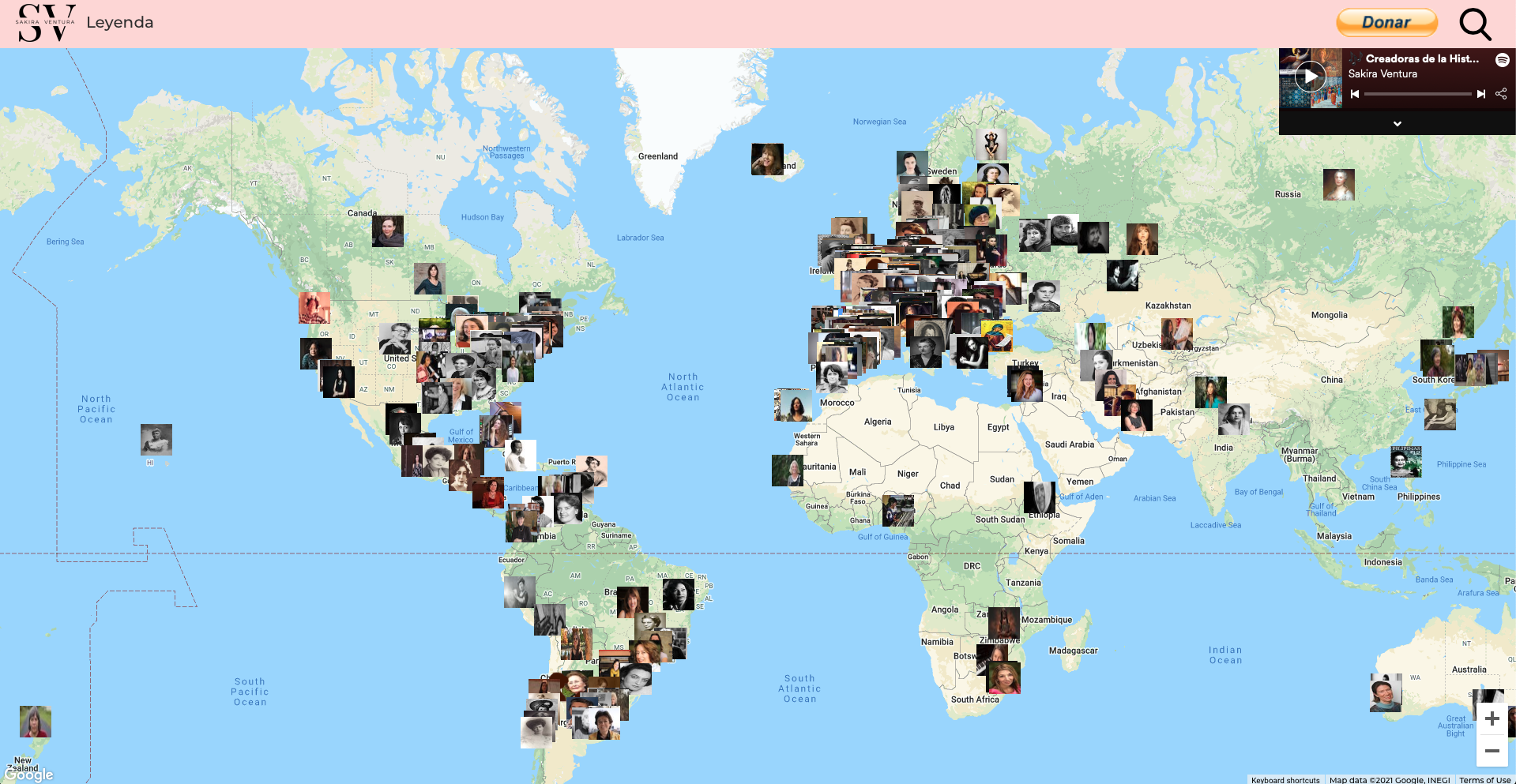
Maria Anna Mozart is one of hundreds of women composers you’ll find in the interactive map created by Sakira Ventura, a music teacher from Valencia, Spain, who has collected 530 composers, placed them geographically on the map, and included links to Wikipedia pages, websites, and Spotify. The map is in Spanish, as are all of the short biographies in each composer’s window, but Ventura links to their English-language Wikipedia pages, making this an excellent resource for English speakers as well, and a much-needed one, Ventura found out when she began her research.

When Mozart’s sister was writing music, “It was taken for granted that a work composed by a woman wouldn’t be of the same quality as that composed by a man,” Ventura says. Not much has changed. When critics have asked why she doesn’t include men on her map, “I have to explain to them that if they want to find out about male composers, they can open any book on music history, go to any concert or tune into any radio station. But if I’m putting together a map of female composers, it is because these women don’t appear anywhere else.” Visit the interactive map, Creadoras de la Historia Música, here.

Related Content:
Josh Jones is a writer and musician based in Durham, NC. Follow him at @jdmagness
Read More...Eye of the Pangolin: The Search for an Animal on the Edge
Eye of the Pangolin is the story of two men on a mission to share the wonder of all four species of African pangolin on camera for the first time ever.
Follow their extraordinary journey to remote locations on the African continent, from arid savannah to exotic jungles. Become captivated by these extraordinary creatures as the filmmakers meet the people who are caring for and studying pangolins in a desperate attempt to save them from being poached and traded into extinction.
Filmed in Ultra High Definition, this ambitious documentary is freely available online for commercial-free viewing.
Eye of the Pangolin will be added to our list of Free Documentaries, a subset of our collection 4,000+ Free Movies Online: Great Classics, Indies, Noir, Westerns, Documentaries & More.
If you would like to support the mission of Open Culture, consider making a donation to our site. It’s hard to rely 100% on ads, and your contributions will help us continue providing the best free cultural and educational materials to learners everywhere. You can contribute through PayPal, Patreon, and Venmo (@openculture). Thanks!
Read More...Listen to Plato Invent the Myth of Atlantis (360 B.C)
Myths emerge from the murky depths of human prehistory, leaving their sources shrouded in mystery. But on rare occasions, we can trace them to a single point of origin. The myth of Atlantis, for example, the ancient civilization that supposedly sank into the sea, has one and only one source — Plato — who told the story in both the Timaeus and Critias, sometime around 360 BC, as an allegory for corruption and civilizational decay.
Plato puts the tale of Atlantis nesos, the “island of Atlas,” in the mouth of the aged Critias, a character in both dialogues, who says he heard the story second-hand from Solon — “not only the wisest of men, but also the noblest of poets” — who in turn brought it from Egypt, where he supposedly heard it from a priest in a city called Sais.
As you can hear in the dialogue that bears his name, read above in the Voices of the Past video, Critias gives a lengthy description of the island’s size (in Timaeus it is “larger than Libya and Asia put together”), its location (“the Pillars of Heracles”), and its geography, cities, peoples, and so forth. In Timaeus, Socrates declares that this tale (unlike his imaginary republics) “has the very great advantage of being fact not fiction.”
But there was never such a place in the ancient world. While islands have disappeared after earthquakes or volcanoes, “I don’t think there’s any question,” says geologist Patrick Nunn, “that the story of Atlantis is a myth.” Plato made up the lost civilization and formidable rival to Athens, who soundly defeated the Atlanteans, as a dramatic foil. “It’s a story that captures the imagination,” says Bard College professor of classics James Romm. Its purpose is illustrative, not historical.
[Plato] was dealing with a number of issues, themes that run throughout his work. His ideas about divine versus human nature, ideal societies, the gradual corruption of human society — these ideas are all found in many of his works. Atlantis was a different vehicle to get at some of his favorite themes.
Why has there been so much desire to find Plato’s account credible? Early modern European readers of Plato like Francis Bacon and Thomas More — authors of The New Atlantis and Utopia, respectively — treated Atlantis as philosophical allegory, a fiction like their own invented societies. But later interpreters believed it, from amateur scholars to colonial adventurers, explorers, and treasure hunters. Atlantis, wherever it is, some thought, must be full of sunken gold.
National Geographic quotes Charles Orser, curator of history at the New York State Museum in Albany, who says, “Pick a spot on the map, and someone has said that Atlantis was there. Every place you can imagine.” Yet whatever similarities it may have had to a real place, Plato’s yarn was strictly parable: Its inhabitants were once divine. “Sired and ruled over by Poseidon, and thus half-gods and half-mortals,” writes Aeon, they “despised everything but virtue.”
But Atlantis grew corrupt in time, Critias tells us, “when the divine portion began to fade away, and became diluted too often and too much with the mortal admixture, and the human nature got the upper hand, they then, being unable to bear their fortune, behaved unseemly, and to him who had an eye to see grew visibly debased, for they were losing the fairest of their precious gifts; but to those who had no eye to see the true happiness, they appeared glorious and blessed at the very time when they were full of avarice and unrighteous power.”
Related Content:
Mythos: An Animation Retells Timeless Greek Myths with Abstract Modern Designs
Ancient Philosophy: Free Online Course from the University of Pennsylvania
What is the Good Life? Plato, Aristotle, Nietzsche, & Kant’s Ideas in 4 Animated Videos
Josh Jones is a writer and musician based in Durham, NC. Follow him at @jdmagness.
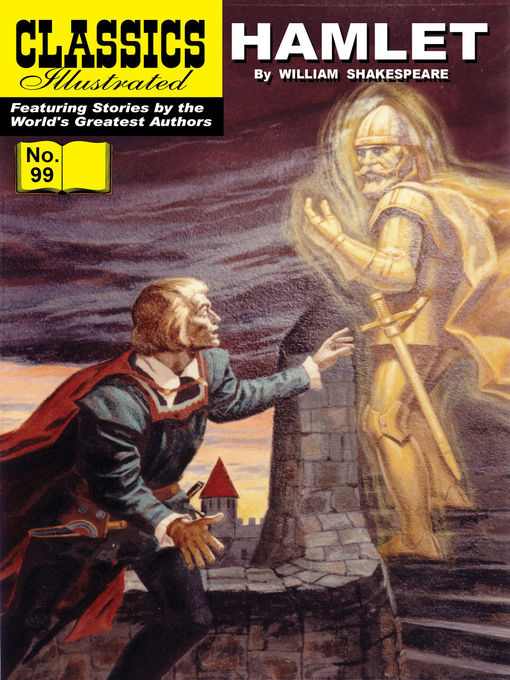
Read More...200 Comic Book Adaptations of Classic Novels Created (1941–1971): Frankenstein, Moby Dick, Hamlet & More
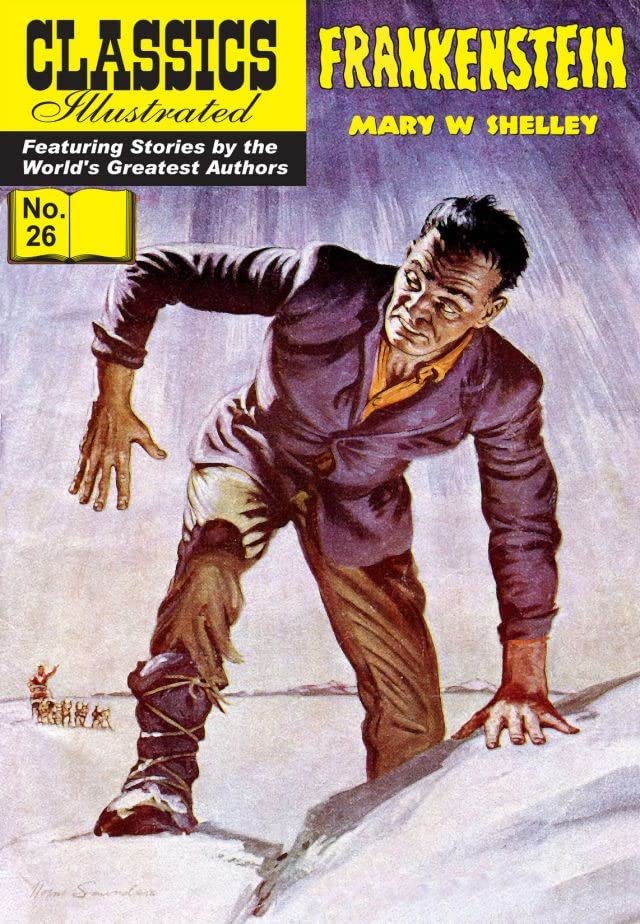
Thanks to “the rise of comics as a ‘respectable’ medium,” Ross Johnson writes at Barnes and Noble, graphic novel adaptations now constantly reimagine literary classics for young readers. One Goodreads list collects over 200 recent graphic adaptations of classics from Austen to Kafka. These adaptations “aim to honor and embellish rather than replace the books on which they are based,” writes Johnson, “because how could they?” They do, however, allow us to “see, literally and figuratively, the stories we love from new angles.” They also give kids and adults who may not fancy themselves readers new ways to access and enjoy literary classics.
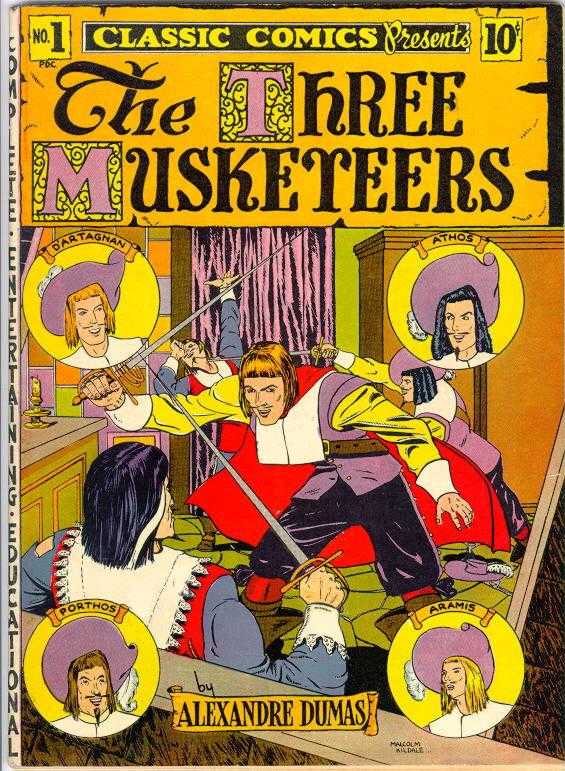
But are graphic adaptations really a new phenomenon? They may be newly respectable, but they’ve been around since the very dawn of comic books as a medium. Superman debuted in 1938, Batman in 1939, and in 1941, the first issue of Classics Illustrated appeared — an adaptation of The Three Musketeers, followed by Ivanhoe and The Count of Monte Cristo. The series was founded by Russian-born publisher Albert Kanter, who immediately seized on the potential of comic books as educational tools during what is now known as the Golden Age of Comics.
Even as a prestige series supposedly promoting “great literature,” Classics Illustrated did not escape the notice of Dr. Fredric Wertham, whose book Seduction of the Innocent began the moral panic over comic books in the 1950s. Wertham found fault with the graphic adaptations of Dr. Jekyll and Mr. Hyde and Uncle Tom’s Cabin for reducing the novels to their most stereotypical and sensationalist elements. It’s the kind of criticism we might find levied against graphic adaptations of literature today, and in many cases, it may be warranted.
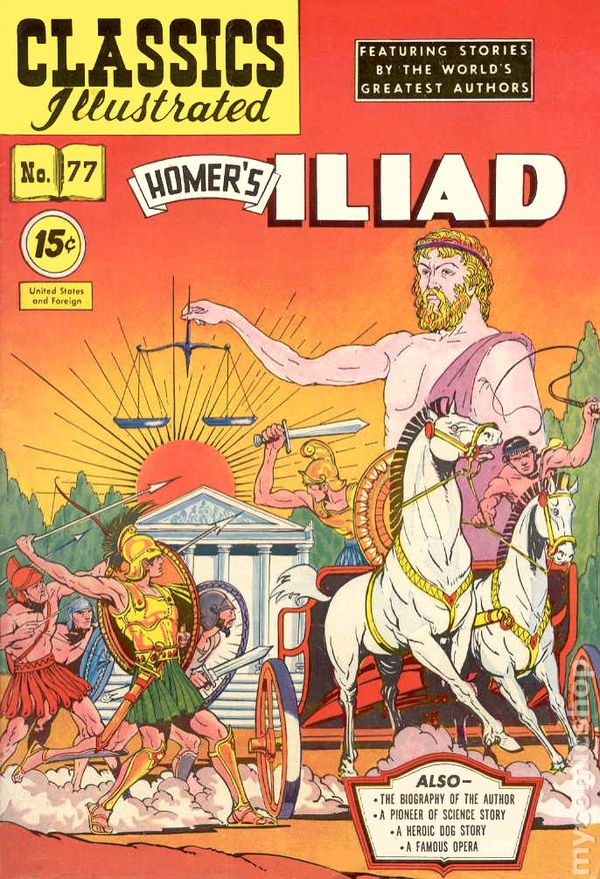
Few accused these graphic literary adaptations of being great art in their own right. But they accomplished Kanter’s purpose of getting comics readers excited about classic novels. The series ran for 30 years, ending in 1971, and became an international phenomenon. In Brazil and Greece, it published adaptations of authors from those countries.
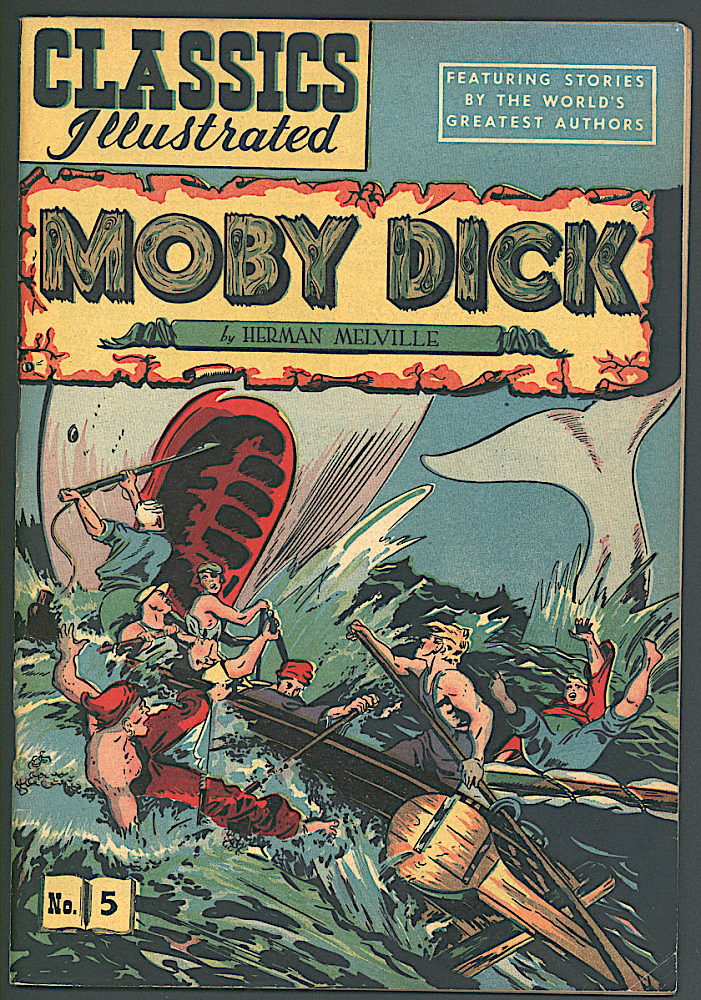
A Classics Illustrated Junior series appeared in 1953, bringing children comics versions of folktales and myths. After the series first run, special issues, reprints, and revivals appeared in later decades, as well a series of television films in the 70s and 80s. You can peruse over 200 of these adaptations digitally scanned at the Internet Archive, artifacts of the Golden Age and ancestors of our current explosion of graphic novel adaptations of classic literature. For a deeper study of this publication, you can purchase the 2017 book, Classics Illustrated: A Cultural History.
Related Content:
Free: Download 15,000+ Free Golden Age Comics from the Digital Comic Museum
Free Comic Books Turns Kids Onto Physics: Start With the Adventures of Nikola Tesla
Josh Jones is a writer and musician based in Durham, NC. Follow him at @jdmagness
Read More...Hear Sherlock Holmes Stories Read by The Great Christopher Lee
The extended Sherlock Holmes Universe, as we might call it, has grown so vast in the last century (as with other franchises that have universes) that it’s possible to call oneself a fan without ever having read the source material. Depending on one’s persuasion, this is either heresy or the inevitable outcome of so much mediation by Holmesian high priests, none of whom can resist writing Holmes fan fiction of their own. But Sherlockians agree: the true Holmes Canon (yes, it’s capitalized) consists of only 60 works — 56 short stories and four novels, excluding apocrypha. No more, no less. (And they’re in the public domain!)
The Canon safeguards Arthur Conan Doyle’s work against the extra-voluminous flood of pastichists, parodists, and imposters appearing on the scene since Holmes’ first appearance in 1892. (Doyle personally liked Peter Pan author J.M. Barrie’s Holmes parody, “The Adventure of the Two Collaborators,” so much he included it in his autobiography.) The Holmes Canon remains untouchable for its wit, ingenuity, and the true strangeness of its detective — a portrait of perhaps the most emotionally avoidant protagonist in English literature when we first meet him:
All emotions, and [love] particularly, were abhorrent to his cold, precise but admirably balanced mind. He was, I take it, the most perfect reasoning and observing machine that the world has seen, but as a lover he would have placed himself in a false position. He never spoke of the softer passions, save with a gibe and a sneer. They were admirable things for the observer—excellent for drawing the veil from men’s motives and actions. But for the trained reasoner to admit such intrusions into his own delicate and finely adjusted temperament was to introduce a distracting factor which might throw a doubt upon all his mental results. Grit in a sensitive instrument, or a crack in one of his own high-power lenses, would not be more disturbing than a strong emotion in a nature such as his.
How to make such a cold fish compelling? With a host of quirks, an ingenious mind, a “Bohemian soul,” some unsavory qualities, and at least one or two human attachments, if you can call them that. Sherlock’s cold, logical exterior masks considerable passion, inspiring fan theories about an ancestral relationship to Star Trek’s Spock.
But of course, we see Holmes almost entirely through the eyes of his sidekick and amanuensis, James Watson, who has his biases. When Holmes stepped out of the stories and into radio and screen adaptations, he became his own man, so to speak — or a series of leading men: Basil Rathbone, John Gielgud, Ian McKellen, Michael Caine, Robert Downey, Jr., Benedict Cumberbatch, and the late Christopher Lee, who played not one of Doyle’s characters, but four, beginning with his role as Sir Henry Baskerville, with Peter Cushing as Holmes, in a 1959 adaptation.
In 1962, Lee took on the role of Holmes himself in a German-Italian production, Sherlock Holmes and the Deadly Necklace, an original story based on Doyle’s work. He played Holmes’ smarter but unmotivated older brother, Mycroft, in 1970, then played a much older Holmes twice more in the 90s, pausing along the way for the role of Arnaud, a character in another Doyle adaptation, The Leather Funnel, in 1973 and the narrator of a 1985 Holmes documentary, The Many Faces of Sherlock Holmes. In an extraordinary career, Lee became an icon in the worlds of horror, science fiction, fantasy, and Sherlock Holmes, a genre all its own, into which he fit perfectly.
In the videos here, you can hear Lee read four of the last twelve Holmes stories Doyle wrote in the final decade of his life. These were collected in 1927 in The Case-Book of Sherlock Holmes. We begin, at the top, with the very last of the 56 canonical stories, “The Adventure of Shoscombe Old Place.” Lee may never have played Dr. Watson, but we can imagine him bringing his familiar gravitas to that role, too, as he narrates in his deep mellifluous voice. Find links to 7 more stories from Doyle’s last collection, read by Lee, on Metafilter, and hear him narrate The Many Faces of Sherlock Holmes, just below.
Related Content:
Arthur Conan Doyle Names His 19 Favorite Sherlock Holmes Stories
Horror Legend Christopher Lee Reads Bram Stoker’s Dracula
Sherlock Holmes Is Now in the Public Domain, Declares US Judge
Read the Lost Sherlock Holmes Story That Was Just Discovered in an Attic in Scotland
Josh Jones is a writer and musician based in Durham, NC. Follow him at @jdmagness
Read More...Watch Venice’s New $7 Billion Flood Defense System in Action
There are capitals unlikely to be much afflicted by rising sea levels — Indianapolis, say, or La Paz — but Venice looks set for a much more dire fate. Still, there is hope for the Floating City, a hope held out by large-scale engineering projects like the one profiled in the Tomorrow’s Build video above. Called MOSE (an acronym standing for MOdulo Sperimentale Elettromeccanico), the system consists of “78 gates, each 20 meters wide, that rise up out of the water when flooding is imminent.” This sounds like just the ticket for a city that, “built in the middle of a lagoon,” has “been susceptible to a natural phenomenon known as acqua alta, or ‘high water,’ since its founding in the fifth century.”
MOSE is now “finally up and running, eighteen years after construction began” — and a decade after its original completion deadline. This was too late, unfortunately, to spare Venice from the 2019 flood that ranked as its worst in 50 years, leaving 80 percent of the city underwater.
“The good news is, it passed the first major test,” successfully protecting the city in October of last year “from a 1.3‑meter high tide, and it’s performed multiple times since. But this doesn’t mean that flooding’s been stopped entirely. In December, it was unable to prevent an unexpectedly high tide from sweeping in and drenching the city once again.” Technically, that incident wasn’t MOSE’s fault: “Weather forecasters underestimated how high the water would get, so authorities kind of didn’t think to switch it on.”
This speaks to the difficulty of not just designing and installing a complex mechanical defense mechanism, but also of getting it to work in concert with the other systems already performing functions of their own (and at various levels of reliability). At a cost of over €6 billion (or $7 billion), MOSE has become “far more expensive than first predicted,” and thus faces that much higher a burden of self-justification, especially given the cloud of “corruption, environmental opposition, and questions about its long-term effectiveness” hanging over it. Seen in action, MOSE remains an unquestionably impressive work of engineering, but its associated headaches have surely converted some to the position on Venice once advanced by no less a scholar and lover of that storied city than Jan Morris: “Let her sink.”
Related Content:
How Venice Works: 124 Islands, 183 Canals & 438 Bridges
Watch City Out of Time, a Short Tribute to Venice, Narrated by William Shatner in 1959
Venice in a Day: From Daybreak to Sunset in Timelapse
Based in Seoul, Colin Marshall writes and broadcasts on cities, language, and culture. His projects include the Substack newsletter Books on Cities, the book The Stateless City: a Walk through 21st-Century Los Angeles and the video series The City in Cinema. Follow him on Twitter at @colinmarshall or on Facebook.
Read More...Hear Vincent Price Star in a Classic Radio Adaptation of George Orwell’s 1984
Here are some things you may not know about Vincent Price:
He was once a young man.
Before becoming a horror icon in the 1950s, he was a successful character actor. “Only a third of his movies that he made were actually horror films,” says his daughter, Victoria Price. “He made 105 films. People don’t realize he had an extensive career in theater and radio.”
He came from a wealthy St. Louis family and harbored early anti-semitic views and a misguided admiration for Hitler in the 1930s.
He completely changed his views after moving to New York and was placed on Sen. Joseph McCarthy’s “Premature Anti-Nazi Sympathizer list” in the 1950s, along with Eleanor Roosevelt, notes Susan King at the L.A. Times, a list that “raised questions about those who had been against the Nazis before the U.S. went to war with Germany.”
He was a gourmet cook, had a degree in art history, and worked for nine years in the sixties as an art consultant for Sears….
He was blacklisted for being anti-Nazi too early….
After being denied work for almost a year, as Price’s daughter writes in her 1999 memoir, Vincent Price: A Daughter’s Biography, he chose to sign a “secret oath” offered by the FBI to salvage his career. Perhaps not coincidentally, he took a radio part soon afterward in Australia, as a split narrator/Winston Smith in a 1955 Lux Radio Theater adaptation of George Orwell’s 1984, perhaps fearful of a future in which secret oaths became the norm.
Orwell himself had made it perfectly clear what he feared. “Radical in his politics and in his artistic tastes,” Lionel Trilling wrote in a New Yorker review the year the book came out, “Orwell is wholly free of the cant of radicalism”; his talent as a writer of fiction is to make “common sense” political observations serve plot and character. Perhaps the most chilling of these arrives in the first few paragraphs of 1984:
In the far distance a helicopter skimmed down between the roofs, hovered for an instant like a bluebottle, and darted away again with a curving flight. It was the police patrol, snooping into people’s windows. The patrols did not matter, however. Only the Thought Police mattered.
We may be reminded of the distinctions between what “Orwellian” means and what it does not, as Noah Tavlin describes in a recent explainer: if someone’s “talking about mass surveillance and intrusive government, they’re describing something authoritarian, but not necessarily Orwellian.” Authoritarianism is pure brute force. The Orwellian requires a constant misuse of language, a violent twisting of conscience, a perpetual shouting of lies as truth until the two are indistinguishable. No one is served by this but nihilistic oligarchs, Trilling writes:
The rulers of Orwell’s State know that power in its pure form has for its true end nothing but itself, and they know that the nature of power is defined by the pain it can inflict on others. They know, too, that just as wealth exists only in relation to the poverty of others, so power in its pure aspect exists only in relation to the weakness of others, and that any power of the ruled, even the power to experience happiness, is by that much a diminution of the power of the rulers.
Orwellian societies exist solely to spread hatred and misery, even to their detriment, a point Price made at the end of another radio broadcast, a 1950 episode of NBC’s The Saint, in which the actor denounced racism and religious prejudice. Not long afterward, his name appeared on McCarthy’s list.
Price learned that the government could deprive him of his happiness unless he swore fealty to an insanely nonsensical political morality. His daughter offers the experience as one reason for his love of playing villains. “Most of the villains that he played had been wronged in some way. There was a reason for their villainy.”
Related Content:
What “Orwellian” Really Means: An Animated Lesson About the Use & Abuse of the Term
Huxley to Orwell: My Hellish Vision of the Future is Better Than Yours (1949)
George Orwell Explains in a Revealing 1944 Letter Why He’d Write 1984
Josh Jones is a writer and musician based in Durham, NC. Follow him at @jdmagness
Read More...Support Us
We're hoping to rely on loyal readers, rather than erratic ads. Please click the Donate button and support Open Culture. You can use Paypal, Venmo, Patreon, even Crypto! We thank you!

About Us

Open Culture scours the web for the best educational media. We find the free courses and audio books you need, the language lessons & educational videos you want, and plenty of enlightenment in between.
Advertise With Us

FREE UPDATES!
GET OUR DAILY EMAIL
Get the best cultural and educational resources on the web curated for you in a daily email. We never spam. Unsubscribe at any time.
FOLLOW ON SOCIAL MEDIA

Open Culture editor Dan Colman scours the web for the best educational media. He finds the free courses and audio books you need, the language lessons & movies you want, and plenty of enlightenment in between.
Advertise With Us

