When Mahatma Gandhi Met Charlie Chaplin (1931)
Mahatma Gandhi and Charlie Chaplin were both forged in the 19th century, and both went on to become icons of the 20th. History has remembered one as a tireless liberator and the other as a tireless entertainer; decades after their deaths, both continue to command the respect of many in the 21st century. It’s understandable then, that a meeting between Gandhi and Chaplin at the peak of their fame would cause something of a fuss. “East-Enders, in the thousands, turn out to greet the two famous little men,” announces the title card of the British Pathé newsreel clip above. Cries of “Good old Charlie!” and “Good old Gandhi!” were heard.
The occasion for this encounter was the Round Table Conferences, a series of meetings between the British government and political representatives of India held with an eye toward constitutional reform. “The buzz was that Mahatma Gandhi would be coming to Britain for the first time since he joined the Freedom movement,” writes blogger Vijayamadhav. The buzz proved correct, but more historic than the results of that particular conference session was what transpired thereafter. “Gandhi was preparing for his departure when a telegram reached him. A certain Charles Chaplin, who was in Britain at that time, had requested permission to be granted an audience with him.”
Gandhi, said to have seen only two films in his life (one of them in Hindi), “did not know who this gentleman was,” and so “replied that it would be hard for him to find time and asked his aides to send a reply declining the request.” But it seems that Gandhi’s circle contained Chaplin fans, or at least advisors aware of the political value of a photo opportunity with the most beloved Englishman alive, who prevailed upon him to take the meeting. And so, on September 22, 1931, “hundreds of people crowded around the house” — the characteristically humble lodgings off East India Dock Road — “to catch a glimpse of the famous visitors.” Some “even clambered over garden fences to look through the windows.”
Chaplin opened with a question to Gandhi about his “abhorrence of machinery.” Gandhi’s reply, as recorded in The Print: “Machinery in the past has made us dependent on England, and the only way we can rid ourselves of that dependency is to boycott all goods made by machinery,” especially those machines he saw as robbing Indians of their livelihoods. Chaplin later wrote of having received in this conversation “a lucid object lesson in tactical maneuvering in India’s fight for freedom, inspired, paradoxically, by a realistic, virile-minded visionary with a will of iron to carry it out.” He might also have got the idea for 1935’s Modern Times, a comedic critique of industrialized modernity that now ranks among Chaplin’s most acclaimed works. The abstemious Gandhi never saw it, of course, and whether it would have made him laugh is an open question. But apart, perhaps, from its glorification of drug use, he could hardly have disagreed with it.
Related Content:
Watch Gandhi Talk in His First Filmed Interview (1947)
Mahatma Gandhi’s List of the 7 Social Sins; or Tips on How to Avoid Living the Bad Life
Charlie Chaplin Does Cocaine and Saves the Day in Modern Times (1936)
Watch 85,000 Historic Newsreel Films from British Pathé Free Online (1910–2008)
Based in Seoul, Colin Marshall writes and broadcasts on cities, language, and culture. His projects include the Substack newsletter Books on Cities, the book The Stateless City: a Walk through 21st-Century Los Angeles and the video series The City in Cinema. Follow him on Twitter at @colinmarshall or on Facebook.
Read More...A Gallery of 1,800 Gigapixel Images of Classic Paintings: See Vermeer’s Girl with the Pearl Earring, Van Gogh’s Starry Night & Other Masterpieces in Close Detail

Far be it from me, or anyone, to know the future, but several signs point toward another season or two of staying indoors — and maybe putting travel plans on hold again. If, like me, you find yourself itching to get away, maybe to finally make the journey to see the art you’ve only seen in small-scale reproductions, don’t despair just yet. The art is coming to you, in ultra-high resolution, gigapixel images from Google Cultural Institute.
See extraordinary levels of detail in famous works of art like Vermeer’s Girl with the Pearl Earring and Van Gogh’s Starry Night. “So much of the beauty and power of art lives in the details,” writes Google Cultural Institute Engineer Ben St. John.
“You can only fully appreciate the genius of artists like Monet or Van Gogh when you stand so close to a masterpiece that your nose almost touches it.” This kind of intimacy is nearly impossible to achieve in a crowded gallery.

Google’s enormous art photographs are, in some ways, superior to observation with the eye: “Zooming into these images is the closest thing to walking up to the real thing with a magnifying glass.” Even when painted on flat canvases, works of art exist in three dimensions, and there’s still the matter of color reproduction on your screen…. Yet the point remains: there’s no way you’d be able to get as close to Monet or Van Gogh’s work in person unless you were a conservator or maybe a museum guard.
Creating these images has hitherto been an extremely time-consuming affair that required the expert know-how of technicians, a process that has hampered the wide adoption of gigapixel images for the study of art. “In the first five years of the Google Cultural Institute,” Google admits, “we’ve only been able to share about 200 gigapixel images.” The process can now be automated, however, expanding the gallery to 1800+ images and counting, with the invention of a sophisticated machine called the Art Camera:
A robotic system steers the camera automatically from detail to detail, taking hundreds of high resolution close-ups of the painting. To make sure the focus is right on each brush stroke, it’s equipped with a laser and a sonar that—much like a bat—uses high frequency sound to measure the distance of the artwork. Once each detail is captured, our software takes the thousands of close-up shots and, like a jigsaw, stitches the pieces together into one single image.
The technological breakthrough inarguably enhances our experience of art, whether we ever get to see these works in person, and it preserves a cultural legacy for posterity. “Many of the works of our greatest artists are fragile and sensitive to light and humidity,” Google Arts & Culture notes. “With the Art Camera, museums can share these priceless works with the global public while they’re ensuring they’re preserved for future generations.”
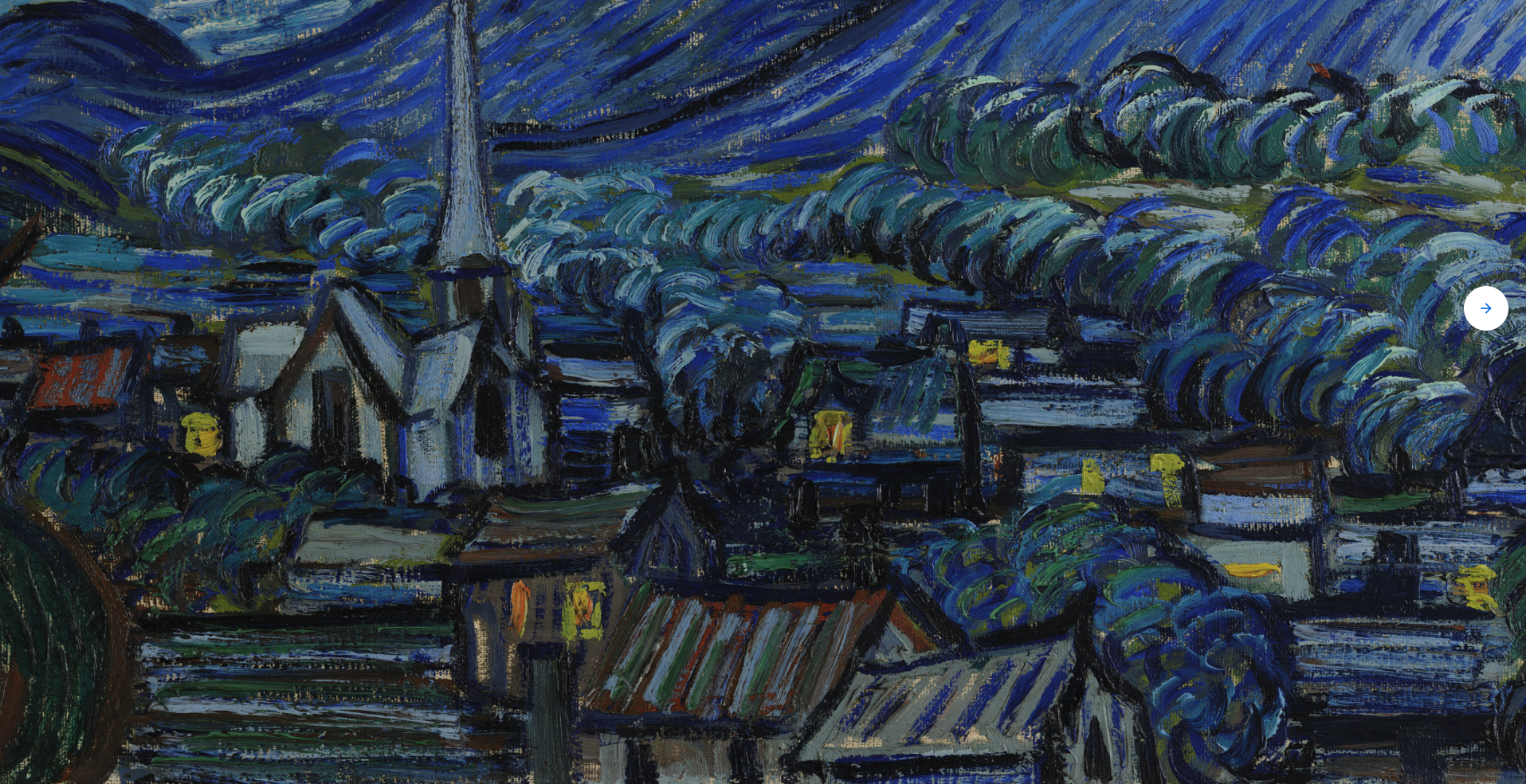
They are preserved in multiple views that give the illusion of a three-dimensional experience, including a “street view” option that places viewers inside the gallery and an augmented reality app called Art Projector that “lets you see how artworks look in real size in front of you.” Viewing art this way goes miles beyond my art history education spent staring at the pages of Janson’s History of Art, trying to imagine what it would be like if I could actually see what was happening on the canvas.
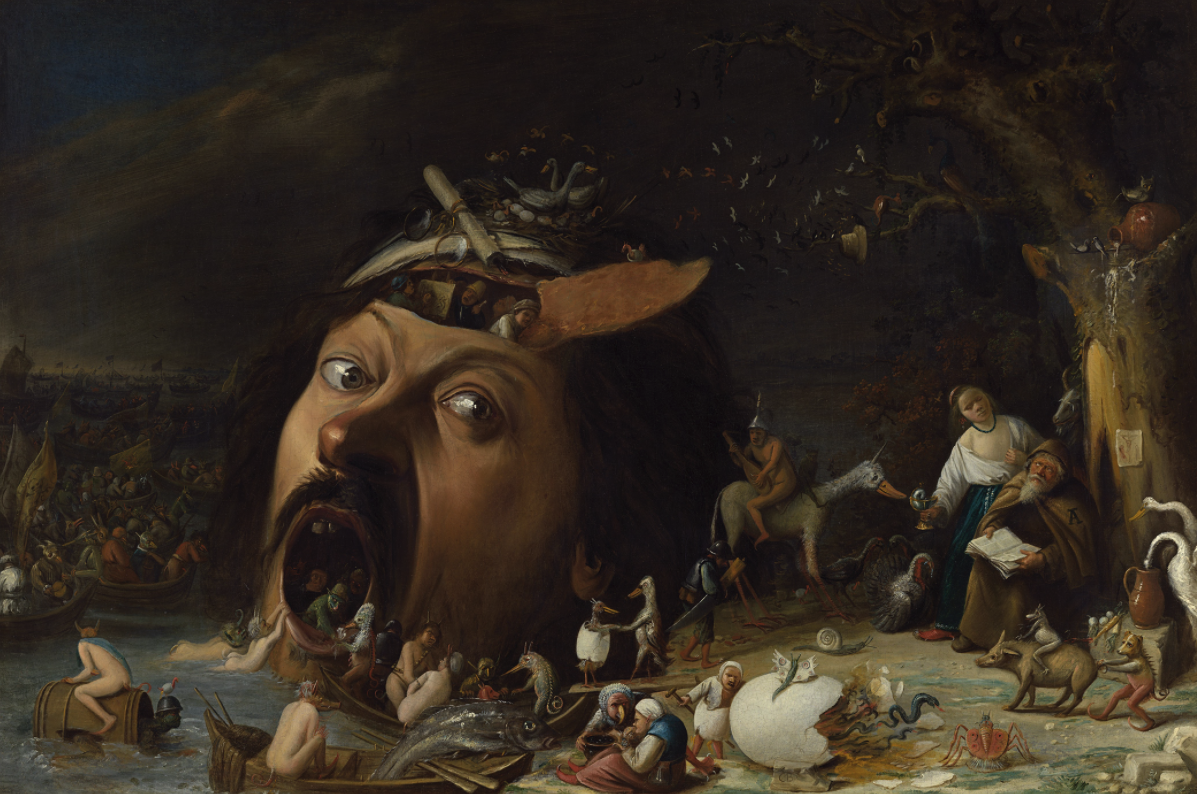
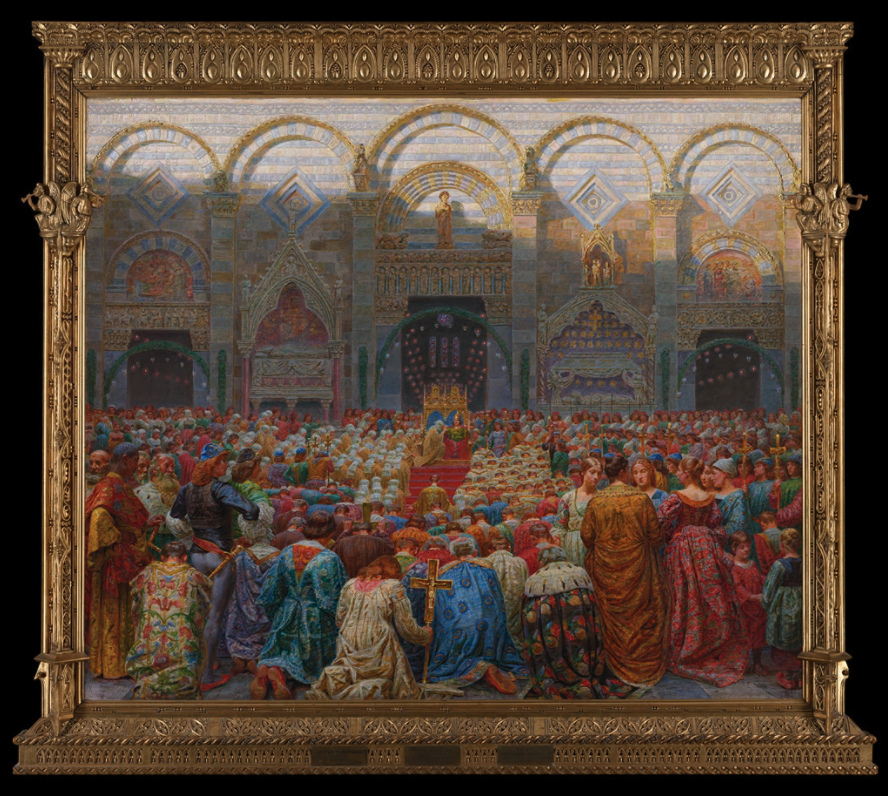
Projects like Google Arts & Culture offer an entirely new kind of art education by digitally conserving hundreds of artworks that don’t tend to appear in textbooks, surveys, or museum gift shops. Works, for example, like Joos van Craesbeeck’s Hieronymus Bosch-influenced The Temptation of Saint Anthony, which show how seriously Bosch’s contemporaries and followers took his medieval “diableries”; and Kristian Zahrtmann’s 1894 painting The Mysterious Wedding in Pistoia. “Idolised” in his time, Zahrtmann “managed to rejuvenate Danish painting in the early 20th century” then sank into obscurity. His work is now “the object of renewed interest — at the dawn of another new century.”
While I hope our experience of art does not become primarily virtual, we can be grateful for the opportunity to see — in ways we never could before — the up-close handiwork of artists who can feel so far away from us even in the best of times. Enter the collection here.
Related Content:
Google Puts Over 57,000 Works of Art on the Web
The Art Institute of Chicago Puts 44,000+ Works of Art Online: View Them in High Resolution
Download 586 Free Art Books from The Metropolitan Museum of Art
Josh Jones is a writer and musician based in Durham, NC. Follow him at @jdmagness
Read More...An Animated History of Writing: From Ancient Egypt to Modern Writing Systems
He would be a very simple person, and quite a stranger to the oracles of Thamus or Ammon, who should leave in writing or receive in writing any art under the idea that the written word would be intelligible or certain. — Socrates
The transmission of truth was at one time a face-to-face business that took place directly between teacher and student. We find ancient sages around the world who discouraged writing and privileged spoken dialogue as the best way to communicate. Why is that? Socrates himself explained it in Plato’s Phaedrus, with a myth about the origin of writing. In his story, the Egyptian god Thoth devises the various means of communication by signs and presents them to the Egyptian god-king Thamus, also known as Ammon. Thamus examines them, praising or disparaging each in turn. When he gets to writing, he is especially put out.
“O most ingenious Theuth,” says Thamus (in Benjamin Jowett’s translation), “you who are the father of letters, from a paternal love of your own children have been led to attribute to them a quality which they cannot have; for this discovery of yours will create forgetfulness in the learners’ souls, because they will not use their memories; they will trust to the external written characters and not remember of themselves. The specific which you have discovered is an aid not to memory, but to reminiscence, and you give your disciples not truth, but only the semblance of truth.”
Other technologies of communication like Incan khipu have the quality of “embeddedness,” says YouTuber NativeLang above, in an animated history of writing that begins with the myth of “Thoth’s Pill.” That is to say, such forms are inseparable from the material context of their origins. Writing is unique, fungible, alienable, and alienating. Its greatest strength — the ability to communicate across distances of time and space — is also its weakness since it separates us from each other, requiring us to memorize complex systems of signs and interpret an author’s meaning in their absence. Socrates criticizes writing because “it will de-embed you.”
The irony of Socrates’ critique (via Plato) is that “it comes to us via text,” notes Bear Skin Digital. “We enjoy it and think about it purely because it is recorded in writing.” What’s more, as Phaedrus says in response, Socrates’ story is only a story. “You can easily invent tales of Egypt, or of any other country.” To which Socrates replies that a truth is a truth, no matter who says it, or how we happen to hear it. Is it so with writing? Does its ambiguity render it useless? Are written works like orphans, as Socrates characterizes them? “If they are maltreated or abused, they have no parents to protect them; and they cannot protect or defend themselves….”
It’s a little too late to decide if we’re better off without the written word, so many millennia after writing grew out of pictographs, or “proto-writing” and into ideographs, logographs, rebuses, phonetic alphabets, and more. Watch the full animated history of writing above and, then, by all means, close your browser and go have a long conversation with someone face-to-face.
Related Content:
40,000-Year-Old Symbols Found in Caves Worldwide May Be the Earliest Written Language
A 4,000-Year-Old Student ‘Writing Board’ from Ancient Egypt (with Teacher’s Corrections in Red)
Josh Jones is a writer and musician based in Durham, NC. Follow him at @jdmagness
Read More...Frida Kahlo: The Complete Paintings Collects the Painter’s Entire Body of Work in a 600-Page, Large-Format Book

Most of us who know Frida Kahlo’s work know her self-portraits. But, in her brief 47 years, she created a more various body of work: portraits of others, still lifes, and difficult-to-categorize visions that still, 67 years after her death, feel drawn straight from the wild currents of her imagination. (Not to mention her elaborately illustrated diary, previously featured here on Open Culture.) Somehow, Kahlo’s work has never all been gathered in one place. That, along with her enduring appeal as both an artist and a historical figure, surely made her an appealing proposition for art-book publisher Taschen, an operation as invested in visual richness as it is in completeness.
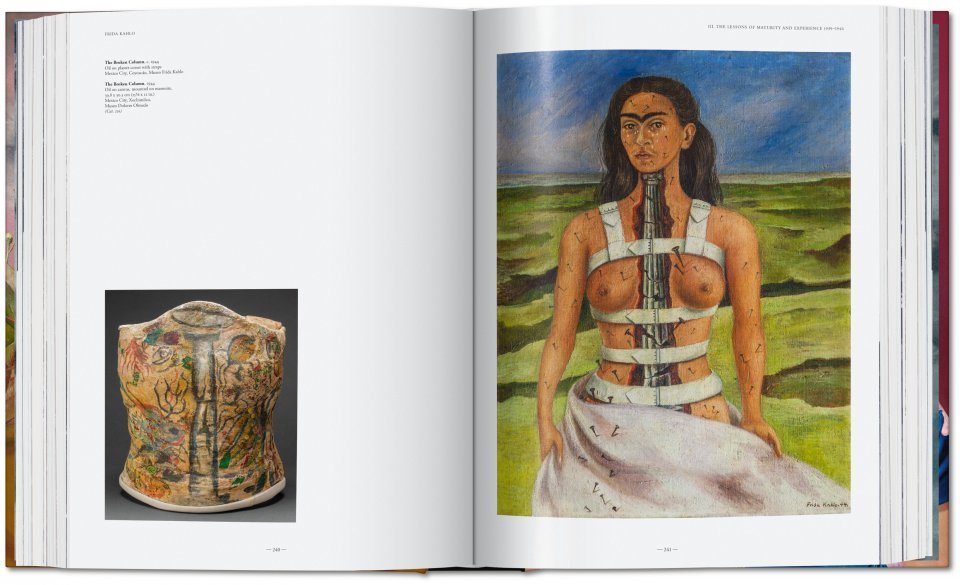
There’s also the matter of size. Though not conceived at the same scale as the murals of Diego Rivera, with whom Kahlo lived in not one but two less-than-conventional marriages, Kahlo’s paintings look best when seen at their biggest. Hence Taschen’s “large-format XXL” production of Frida Kahlo: The Complete Paintings, which “allows readers to admire Frida Kahlo’s paintings like never before, including unprecedented detail shots and famous photographs.” Presented along with a biographical essay, those photos capture, among other subjects, “Frida, Diego, and the Casa Azul, Frida’s home and the center of her universe.”

In creating his volume, editor-author Luis-Martín Lozano and contributors Andrea Kettenmann and Marina Vázquez Ramos focused not on the artist’s life, but her work. “Most people at exhibitions, they’re interested in her personality — who she is, how she dressed, who does she go to bed with, her lovers, her story,” says Lozano in an interview with BBC Culture. Putting together a run-of-the-mill Kahlo book, “you repeat the same things, and it will sell – because everything about Kahlo sells. It’s unfortunate to say, but she’s become a merchandise.” Frida Kahlo: The Complete Paintings is also, of course, a product, and one painstakingly designed to compel the Frida Kahlo enthusiast. Its ideal reader, however, desires to live in not Kahlo’s world, but the world she created.

via Colossal
Related Content:
Frida Kahlo: The Life of an Artist
The Intimacy of Frida Kahlo’s Self-Portraits: A Video Essay
Take a Virtual Tour of Frida Kahlo’s Blue House Free Online
A Brief Animated Introduction to the Life and Work of Frida Kahlo
Based in Seoul, Colin Marshall writes and broadcasts on cities, language, and culture. His projects include the Substack newsletter Books on Cities, the book The Stateless City: a Walk through 21st-Century Los Angeles and the video series The City in Cinema. Follow him on Twitter at @colinmarshall or on Facebook.
Read More...What Makes Edward Hopper’s Nighthawks a Great Painting?: A Video Essay
“Even though you may live in one of the most crowded and busy cities on Earth, it is still possible to feel entirely alone.” Though hardly a novel sentiment, this nevertheless makes for a highly suitable entrée into a video essay on Edward Hopper’s Nighthawks. Its creator is gallerist and Youtuber James Payne, whose channel Great Art Explained has already taken on the likes of Leonardo’s Mona Lisa, Michelangelo’s David, Andy Warhol’s Marilyn Diptych, and Hieronymus Bosch’s The Garden of Earthly Delights. Nighthawks, safe to say, makes a more immediate impression on us 21st-century urbanites than any of those works, whatever our individual degrees of alienation. But why?
Hopper painted what he knew, and especially so in the case of his single best-known work. Though the diner Nighthawks takes as its setting exists nowhere in New York, the artist had spent his entire adult life in the city, an immersion that allowed him to create a street-corner scene that feels realer than real.
But the emotion exuded by that diner’s patrons must run deeper than the standard urban malaise. Eighteen years into a bitter and dysfunctional marriage, the inspiration for all the “disconnected and unhappy couples he portrays time and again in his paintings,” Hopper knew intimately more than one kind of human loneliness. He himself acted as model for all three of Nighthawks’ male figures, in fact, and his wife Josephine posed for the female one.
“It was down to Jo that Edward became a success,” says Payne, “a fact he never thanked her for.” An artist in her own right, she got Hopper his first solo show in 1924, when he was 42. Up to then he’d worked as a magazine illustrator, but even by the time of Nighthawks in 1942, he clearly hadn’t forgotten the misery of his day job. Nor had he discarded what it gave him: “along with the preparation skills he picked up, it also helped to hone his storytelling abilities.” An avid moviegoer, he “planned Nighthawks like a filmmaker, storyboarding the painting ahead of its creation.” Filmmakers have responded to Hopper’s cinematic painting with tributes of their own: Herbert Ross re-created the diner in Pennies from Heaven, as did Wim Wenders in The End of Violence, evoking Hopper’s “world of loneliness, anguish, and quiet isolation.” Ironic, then, that so many in Nighthawks’ generations of appreciators have felt less alone while regarding it.
Related Content:
How Edward Hopper “Storyboarded” His Iconic Painting Nighthawks
Edward Hopper’s Iconic Painting Nighthawks Explained in a 7‑Minute Video Introduction
How Edward Hopper’s Paintings Inspired the Creepy Suspense of Alfred Hitchcock’s Rear Window
Edward Hopper’s Nighthawks: The 2020 Edition
Based in Seoul, Colin Marshall writes and broadcasts on cities, language, and culture. His projects include the Substack newsletter Books on Cities, the book The Stateless City: a Walk through 21st-Century Los Angeles and the video series The City in Cinema. Follow him on Twitter at @colinmarshall or on Facebook.
Read More...How The Pink Panther Painted The Mona Lisa’s Smile: Watch the 1975 Animation, “Pink Da Vinci”
Just a little fun to send you into the summer weekend. Above, we present the 1975 animated short, “Pink Da Vinci,” which IMDB frames as follows:
Another battle of the paintbrush between the Pink Panther and a diminutive painter, who this time is Leonardo Da Vinci, painting his masterpiece, the Mona Lisa. The little Da Vinci paints a pouting mouth on the Mona Lisa, but the Pink Panther decides to covertly replace the pout with a smile. When the smile wins the appreciation of an art patron, Da Vinci is enraged and repaints the pout. The Pink Panther repeatedly changes the pout to a smile while the little painter is not looking, and ultimately it is the Pink Panther’s version of the Mona Lisa that hangs in the Louvre.
If this whets your appetite, watch 15 hours of Pink Panther animations here.
If you would like to support the mission of Open Culture, consider making a donation to our site. It’s hard to rely 100% on ads, and your contributions will help us continue providing the best free cultural and educational materials to learners everywhere. You can contribute through PayPal, Patreon, and Venmo (@openculture). Thanks!
Related Content
The Original 1940s Superman Cartoon: Watch 17 Classic Episodes Free Online
Watch 15 Hours of The Pink Panther for Free
Watch La Linea, the Popular 1970s Italian Animations Drawn with a Single Line
Read More...Frida Kahlo: The Life of an Artist
Frida Kahlo has been a martyr to art history. Her twinned self-portrait The Two Fridas sits at number 87 on a list of the 100 most popular paintings (behind Diego Rivera’s The Flower Carrier and Cassius Coolidge’s Dogs Playing Poker series). She is “one of the most iconic and contradictory cultural figures around,” Judy Cox writes: “a card-carrying Communist whose image adorned a bracelet worn by Theresa May, a feminist who has her own barbie doll.”
Her cultural credentials sell. Her work is acclaimed as a leading example of indigenismo, as Denver art museum senior curatorial assistant Jesse Laird Ortega writes, “a political, intellectual, and artistic movement that celebrated indigenous peoples in Mexico.” Kahlo herself is lauded as “a passionate nationalist who advocated for the revolution… and supported farmers and workers.”
This praise sounds suspicious to other critics. “Missing from the public discourse about the artist are discussions about how the ‘nationalism’ that Kahlo promoted,” Joanna Garcia Cheran argues, “both in her art and personal style perpetuated the construction of a mythologized Indianness at the expense of Indigenous people.” Kahlo only began wearing the rebozos and other indigenous fashions she made famous when she married Diego Rivera (for the first time) in 1929.
Does Paul Priestly, the host of the Art History School video lesson above, help smooth out the contradictions of Kahlo’s life and art? No, but to be fair, he makes no pretense to higher criticism. The lesson is a basic introduction (with a content warning for younger viewers) to the well-known facts of Frida’s life, those amply covered in documentaries like Ken Madel’s Frida Kahlo: A Ribbon Around a Bomb and (with plenty of dramatic license, of course) the Salma Hayek-starring biopic Frida.
Priestley’s video is a sound introduction to Kahlo’s life, however, precisely because it shies away from hagiography or theory. He walks us through the facts of the artist’s life in brief, with clips of a woman reading Frida’s own words and images of her work alongside photographic portraits of herself at every stage of life, allowing viewers to see the side-by-side development of Kahlo’s art and her public persona.
In the midst of Kahlo worship and iconoclasm, what seems too often neglected is Kahlo’s complex humanity. She was not one thing or another — neither wholly Marxist saint, nor a bourgeois appropriator; neither wholly feminist hero, nor tragic victim of patriarchal male hero worship: she was both and neither, at many times, a figure twinned in her imagination and split in half by cultural logics that want to claim and possess art and artists for their own.
Related Content:
Take a Virtual Tour of Frida Kahlo’s Blue House Free Online
Josh Jones is a writer and musician based in Durham, NC. Follow him at @jdmagness
Read More...They Might Be Giants’ John Linnell Releases an EP of Songs in Latin
Those who know Latin know Wheelock’s Latin as the time-honored resource for learning the language of the Caesars. They also know how many years of intensive study and practice goes into translating the textbook’s hefty classical passages. Reading Latin is one thing — writing in the language is quite another: something very few people do for any reason, other than a perverse kind of enjoyment that is most definitely a niche affair.
What about songwriting in Latin? Professor Wheelock doesn’t offer any specific instructions for composing pop music in the dead language, though classics teacher and former British Labour Party MP Eddie O’Hara once translated Beatles songs (see “O Teneum Manum” and “Dei Duri Nox” here). For a more casual approach, one could turn to a resource more in line with contemporary teaching methods — Duolingo, where you can “learn a language for free. Forever.”
For some reason, John Linnell, one of the two Johns in 90s alt-rock band They Might Be Giants, decided on the Duolingo approach while hunkered down at home during the pandemic, and — because he’s a songwriter, and a right good one, at that — he decided to compose some catchy pop songs in Latin. Catchy, he could do (I’m still singing the chorus of “Birdhouse in Your Soul” thirty-two years later.) But the Latin, not so much.
After taking a short course, Linnell writes, “I figured I could write a few songs… I was soon disabused of the notion. I can barely string two words together in Latin, and to borrow from Mark Twain, I would rather decline two drinks than one Latin noun.” A career Latinist and childhood friend Linnell calls “Schoolmaster Smith” came to his aid, translating his English lyrics into Latin for him. “All credit for any success in this project is due to him,” he avers, “and any mistakes and failures are entirely mine.”
Trapped at home with his son Henry, who played guitar on the 4‑track EP, Linnell recorded and released Roman Songs (along with a t‑shirt!). Why? “All I can tell you,” he shrugs, “is that I’m deeply jealous of people who are fluent in a second language and can apply that skill to their creative work in a way that doesn’t seem like cultural appropriation of the most offensive and embarrassing kind.”
No ancient Romans around to accuse Linnell of stealing their culture, but they’d be hard pressed to recognize if they were. “HAEC QVOQVE EST RES” (“This is Also the Case”) and “TECVM CIRCVMAMBVLARE NOLO” (“I Don’t Want to Walk Around with You”) sound like classic They Might Be Giants tunes. (The other John, Mr. Flansburgh, “strongly encouraged this project and art directed the package,” Linnell writes.)
In fact, they sound so much like They Might Be Giants songs, I almost wish they were in English, but as a lover of Latin I have to admit, it’s fun to learn these phrases and melodies and walk around singing them like a Roman pop star. Linnell may be a little in the dark about his motivations, but I say, good on him: if there’s any way to make Latin live again, this may be it. Now we just need someone talented and really bored to step up and deliver classical raps to keep momentum going…. Pick up Linnell’s Roman Songs EP here.
via Boing Boing
Related Content:
Learn Latin, Old English, Sanskrit, Classical Greek & Other Ancient Languages in 10 Lessons
Josh Jones is a writer and musician based in Durham, NC. Follow him at @jdmagness
Read More...When Rage Against the Machine Interviewed Noam Chomsky (1999)
“The first great [economic] experiment was a ‘bad idea’ for the subjects, but not for the designers and local elites associated with them. This pattern continues until the present: placing profit over people.” — Noam Chomsky, Profit Over People
“A global decomposition is taking place. We call it the Fourth World War: neoliberalism’s globalization attempt to eliminate that multitude of people who are not useful to the powerful — the groups called ‘minorities’ in the mathematics of power, but who happen to be the majority population in the world.” — Subcomandante Marcos
Whether we think of global neoliberalism — to the extent that we think about it — as the inertia of centuries-old economic theory or as deliberate genocide, the effects are the same. The majority of the world’s population suffers under massive inequality, including, now, vaccine inequality, leading to raging COVID epidemics in some parts of the world as other places emerge from lockdowns and resume “normal” operations. The “Capitalist Hydra,” as Zapatista leader Subcomandante Marcos once called it, always seems to grow more heads.
Indeed, most plans to alleviate global poverty and disease seem to further enrich the architects and immiserate the targets of their purported care. Noam Chomsky has pointed out repeatedly that neoliberal economic rules are only applied to subject populations, since the wealthy ignore the strict conditions they impose by force and coercion on others, calling the outcomes a natural sorting of “winners and losers.” Ongoing global economic practices have accelerated a climate crisis that impacts the majority of the world’s (poor) population, sending millions on a collision course with brutality at the borders as they flee to other parts of the world for bare survival.
The multiple crises we now face were clearly evident at the turn of the millennium, when Rage Against the Machine played Mexico City for the first time in 1999. They released the concert footage in a video titled The Battle of Mexico City in 2001, the same year the indigenous guerrilla force EZLN — popularly known as the Zapatistas — marched on Mexico City. (Concert audio was released on vinyl this past June.) The video release included interviews with Chomsky and then-EZLN military leader Marcos, and you can see them both here.
At the top, Chomsky responds to a question about NAFTA, a “free-trade” agreement that proved his point about how such policies do the opposite of what they propose, benefitting the very few instead of the many. Chomsky, who analyzed the ways that the government and corporate media manufactured consent for their policies during the Vietnam War, wasn’t taken in by the hype. The agreement never had anything to do with free trade, he says, but with locking Mexico into programs of “structural adjustment” that kept people in poverty and the country dependent on economic terms dictated from outside its borders.
From the perspective of the indigenous people in Mexico fighting for an autonomous region in Chiapas, the struggle is not only against the Mexican government, but also an international economic order that imposes its will on the country and its citizens, who then turn on the poorest and most dispossessed among them in conditions of manufactured scarcity. Indigenous Mexicans, like other internally subjected people around the world, are deemed expendable, figured as a “problem” to be solved or eliminated. What is so striking about these perspectives, twenty years after the release of The Battle of Mexico City, is just how prescient, even prophetic, they sound today.
Related Content:
An Animated Introduction to Noam Chomsky’s Groundbreaking Linguistic Theories
Josh Jones is a writer and musician based in Durham, NC. Follow him at @jdmagness
Read More...What the Eagles’ “Hotel California” Really Means
During the Satanic panic of the 1980s, a new breed of witchfinder cast a dragnet through pop culture, scooping up songs, artists, and albums that were allegedly part of a demonic conspiracy to corrupt America’s youth. One song routinely appearing on such lists — “Hotel California” by the Eagles. Really? The Eagles? Biggest-selling rock band in the U.S.? Soft-rock superstars who paved the cocaine-colored way for even softer yacht rock superstars?
They were hardly Black Sabbath, but the band’s “Hotel California” was really about Anton LaVey’s Church of Satan, it was said (just listen to it backwards). Depending on your feelings about Satanism and/or the Eagles, “the truth proves far less satisfying than the myriad rumors that have sprung up,” writes David Mikkelson at Snopes. “The song is usually interpreted as an allegory about hedonism and greed in Southern California in the 1970s.” It turned out to be a self-fulfilling prophecy.
Hotel California, the album, rocketed the Eagles beyond “success on a frightening level” and into total burnout. By the time they made their last album of the 70s, The Long Run, they felt trapped in a celebrity hell, one that would have to freeze over before they reunited, as Don Henley remarked (hence the title of 1994’s Hell Freezes Over). For the Eagles, hell was the other people in the band, the constant touring, and the incredible amounts of money thrown their way, more curse than blessing, apparently.
Despite these internal tensions, the Eagles produced a perfect soundtrack for the 70s. “They reflected the emerging musical style of a 70s post-war America, and the first truly sexually liberated generation…. had no trouble identifying with a band that sang like angels and partied like devils,” writes Marc Eliot. “Hotel California” has been so closely identified with American culture that “when a US spy plane made an emergency landing in China in 2001,” Mark Savage notes at the BBC, “the crew members were asked to recite the lyrics to prove their nationality.”
In truth, “Hotel California” is neither written in praise of Satan nor America. Its working title was “Mexican Reggae,” a nod to the unusual strumming pattern, which “followed a pattern closer to flamenco than to rock,” Savage writes, “but played on the off-beat.” The forbidding landscape in the song’s lyrics, an “atmosphere of a man in an unfamiliar rural setting, unsure about what he’s witnessing,” came from the 1965 novel The Magus by English author John Fowles, a countercultural favorite, says Glen Frey: “We decided to create something strange, just to see if we could do it.”
There was, of course, more to the song — the standard interpretation of “Hotel California” as a critique of 1970s excesses has been affirmed by Don Henley and Frey, who wrote most of the lyrics. The song, Henley said in a 1995 interview, “sort of captured the zeitgeist of the time, which was a time of great excess in this country and in the music business in particular…. Lyrically, the song deals with traditional or classical themes of conflict: darkness and light, good and evil, youth and age, the spiritual versus the secular. I guess you could say it’s a song about loss of innocence” — a feeling, as Joe Walsh says in the interview clip above, that came out of the experience of arriving and trying to make it in L.A. “Nobody was from California,” Walsh says. “Everybody was from Ohio.”
“Hotel California” also “hides” a dig at Eagles rivals Steely Dan in the lyrics, “they stab it with their steely knives” and barely conceals Henley’s contempt for his ex-girlfriend, L.A. jewelry designer Loree Rodkin, as he later admitted: “There’s some of every girl I’ve ever been with in all my songs; they’re combinations of characters, like fiction. Some of the more derogatory parts of ‘Hotel California,’ however, are definitely about Loree Rodkin – ‘Her mind is Tiffany twisted, she got the Mercedes bends/She got a lot of pretty boys that she calls friends’ – that’s about her, and I wouldn’t be crowing if I were Ms. Rodkin. As far as I’m concerned, she’s the Norma Desmond of her generation.”
Henley’s most trenchant commentary on the song comes from the 2013 documentary History of the Eagles, in which he talks frankly about the band’s critical take on their success and the culture that produced and embraced “Hotel California”:
On just about every album we made, there was some kind of commentary on the music business, and on American culture in general. The hotel itself could be taken as a metaphor not only for the myth-making of Southern California, but for the myth-making that is the American Dream, because it is a fine line between the American Dream, and the American nightmare.
As for those baroque guitar arrangements? For that part of the story, we must turn to Don Felder, who composed the song — after Walsh joined the band to replace Bernie Leadon — in order to showcase the talents of two lead players. See Felder talk about his major contribution at the top and see him play the “Hotel California” solo at the Metropolitan Museum of Art in a clip from CBS’s Sunday Morning.
Just above, see an interview with Felder backstage at the Rock and Roll Hall of Fame, in which he discusses the role of improvisation in his process, and how his background in jazz led him to write the “Mexican reggae” that would eventually play on American radio every 11 minutes, their most refined statement of the “themes that run through all our work,” Henley says: “loss of innocence, the cost of naiveté, the perils of fame, of excess; exploration of the dark underbelly of the American dream, idealism realized and idealism thwarted, illusion versus reality, the difficulties of balancing loving relationships and work, trying to square the conflicting relationship between business and art; the corruption in politics, the fading away of the Sixties dream of ‘peace, love and understanding.’”
Related Content:
Josh Jones is a writer and musician based in Durham, NC. Follow him at @jdmagness
Read More...Support Us
We're hoping to rely on loyal readers, rather than erratic ads. Please click the Donate button and support Open Culture. You can use Paypal, Venmo, Patreon, even Crypto! We thank you!

About Us

Open Culture scours the web for the best educational media. We find the free courses and audio books you need, the language lessons & educational videos you want, and plenty of enlightenment in between.
Advertise With Us

FREE UPDATES!
GET OUR DAILY EMAIL
Get the best cultural and educational resources on the web curated for you in a daily email. We never spam. Unsubscribe at any time.
FOLLOW ON SOCIAL MEDIA

Open Culture editor Dan Colman scours the web for the best educational media. He finds the free courses and audio books you need, the language lessons & movies you want, and plenty of enlightenment in between.
Advertise With Us

