The Life & Art of Hilma Af Klint: A Short Art History Lesson on the Pioneering Abstract Artist
Like many artists whose abstractions cemented their legacy, Hilma af Klint was trained to paint portraits, botanicals, and landscapes.
The naturalist works of her early adulthood depict bourgeois, late-19th century Swedish life, and, by association, the sort of subject matter and approach that were deemed most fitting for a female artist, even in a society where women were allowed to work alongside men.
But something else was afoot with Hilma, as artist and educator Paul Priestley points out in the above episode from his Art History School series.
Her 10-year-old sister’s death from the flu may have caused her to lean into an existing interest in spiritualism, but as Iris Müller-Westermann, director of Moderna Museet Malmö told The Guardian’s Kate Kellaway, the “mathematical, scientific, musical, curious” teen was likely motivated by her own thirst for knowledge as by this family tragedy:
You have to understand this was the age when natural sciences went beyond the visible: Heinrich Hertz discovered electromagnetic waves [1886], Wilhelm Röntgen invented the x‑ray [1895]…Hilma is like Leonardo – she wanted to understand who we are as human beings in the cosmos.
Her interest in the occult did not make her an outsider. Spiritualism was considered a respectable intellectual preoccupation. Abstract painters Vasily Kandinsky, Piet Mondrian, Kasimir Malevich and Frantisek Kupka were also using their art to try and get at that which the eye could not see.
All but Hilma were hailed as pioneers.
The New York Times review of Los Angeles County Museum of Art’s 1986 exhibit The Spiritual in Art: Abstract Painting 1890–1985, mentions some of their spiritual bona fides:
They were generated by such ventures into mysticism as Theosophy, Anthroposophy, Rosicrucianism, Eastern philosophy, and various Eastern and Western religions. Spiritual ideas were not peripheral to these artists’ lives, not something that happened to pop into their minds as they stood by their canvas. Kupka participated in seances and was a practicing medium. Kandinsky attended private fetes involved with magic, black masses and pagan rituals. Mondrian was a member of the Dutch Theosophical Society and lived briefly in the quarters of the French Theosophical Society in Paris. He said once that he ”got everything from the Secret Doctrine” of Theosophy, which was an attempt by its founder Helena Petrovna Blavatsky to do nothing less than read, digest and synthesize all religions. It has been known for some time how much of Mondrian’s symbolism — including the ubiquitous vertical and horizontal lines — and how much of his utopianism, was shaped by Theosophical doctrine.
Reviewer Michael Brenson devotes one sentence to Hilma, “a previously unknown Swedish artist whose somewhat mechanical abstract paintings and drawings of organic, geometrical forms were marked by Theosophy and Anthroposophy.”
Thirty-five years later, she’s receiving much more credit. As Priestley says in his video biography, Hilma, and not Kandinsky, is now hailed as the first painter to experiment with abstraction.
Would Hilma have welcomed such a distinction?
She maintained that she was but a receiving instrument for Amaliel, a “high master” from another dimension, who made contact during the séances she participated in regularly with four friends who met weekly to practice automatic drawing and writing.
Amaliel charged her with creating the artwork for the interior of a temple that was part of the high masters’ vision. The Guggenheim’s classroom materials for The Paintings for the Temple note that her friends warned Hilma against accepting this otherworldly commission, “that the intensity of this kind of spiritual engagement could drive her into madness.”
But Hilma threw herself into the assignment, producing 111 paintings during a one-and-a-half year period, claiming:
The pictures were painted directly through me, without any preliminary drawings and with great force. I had no idea what the paintings were supposed to depict; nevertheless, I worked swiftly and surely, without changing a single brushstroke.
For whatever reason, the paintings proved too much for Rudolph Steiner, the founder of the Anthroposophical Society, whom she had invited to view them, paying his travel expenses in hope that he would provide a detailed analysis and interpretation of the images. Instead, he counseled her that no one would understand them, and that the only course of action would be to keep the paintings out of sight and out of mind for fifty years. To do otherwise might endanger her health.
A disappointing response that ultimately led to the paintings being socked away for an even longer period.
Good news for Kandinsky… and possibly for Steiner.
At any rate, the competition was coerced into eliminating herself, inadvertently planting the seeds for some major, if delayed art world excitement. Hilma, who died more than forty years before the L.A. County Museum show, was not able to bask in the attention on any earthly plane.
For those curious in a take that is not entirely rooted in the art world, Lightforms Art Center in Hudson, New York hosted a recent Hilma Af Klint exhibit. Their strong ties to the Anthroposophical community make for some interesting exhibit commentary.
Related Content:
New Hilma af Klint Documentary Explores the Life & Art of the Trailblazing Abstract Artist
Discover Hilma af Klint: Pioneering Mystical Painter and Perhaps the First Abstract Artist
Ayun Halliday is an author, illustrator, theater maker and Chief Primatologist of the East Village Inky zine. Follow her @AyunHalliday.
Read More...How Caravaggio Painted: A Re-Creation of the Great Master’s Process
His dark, dramatic works incorporate the kind of lighting we associate with horror films. Figures, twisted and contorted in tortuous poses, emerge from deep, black shadows. Instead of beatific smiles, his saints wear grimaces and furrowed frowns, as in The Denial of St. Peter, one of the few Caravaggios in the U.S., and a canvas depicting the weakest moment in the life of the Gospel character whose name means “the rock.” Caravaggio’s work came to be called tenebrism after the Latin for “dark or obscure,” for both its style and its substance.
There’s little evidence that Caravaggio (1571–1610) was a practitioner of the occult arts, but he was unafraid to look into the darkest realms of the human psyche, and to depict them on canvas. He was also drawn to artist’s models who looked weathered and worn down by life, and his hyper-realistic Biblical scenes scandalized many people and thrilled more, and made him the most famous painter in Rome, for a time.
Caravaggio himself was a scandalous character who brawled and fornicated his way through Rome, then in exile in Naples, where he died an early death at age 38, from either an unspecified fever or lead poisoning. (A new film by Italian actor and director Michele Placido imagines Caravaggio in 1600, “a brilliant and subversive artist who lives with the burden of a death sentence. The shadow of a merciless, occult power is about to loom over him.”)
He left no writing behind, the details of his life are sketchy at best, and he fell into obscurity for many years after his death, but not before his paintings showed the way forward for Baroque painters who followed him as Caravaggisti or tenebrosi (“shadowists”), including such great masters as Peter Paul Rubins and Rembrandt. So, how did he do it? How did Caravaggio invent modern painting, as some critics have claimed?
“The testimonies of his contemporaries are scarce and imprecise regarding the procedure he adopted to complete his work,” notes the Artenet video above, an exploration of Caravaggio’s technique. We do know a few details: he worked from models, who held the acrobatic poses in his paintings while he worked; he had a studio in which light streamed in from above; and he worked quickly — “He could paint up to three heads in a single day.”
The lack of unfinished work by Caravaggio has made it difficult to trace his process backward, but some evidence remains. See Caravaggio’s “entire pictorial process” recreated, and learn how a painter called “the master of light” made his luminous figures by surrounding them with darkness.
Related Content:
A Short Introduction to Caravaggio, the Master Of Light
Living Paintings: 13 Caravaggio Works of Art Performed by Real-Life Actors
Josh Jones is a writer and musician based in Durham, NC. Follow him at @jdmagness
Read More...The Intimacy of Frida Kahlo’s Self-Portraits: A Video Essay
“Culture has come to prize this quality in creative work: the ability to grab people quickly,” and “above pretty much anything else” at that. So says Evan Puschak, who should know: as the Nerdwriter, he runs a popular eponymous channel on Youtube, where everything depends on getting and holding the viewer’s increasingly fleeting attention. Even under such pressures, Puschak has managed to maintain one of the most thoughtful cultural channels around, previously featured here on Open Culture for its video essays on everything from the films of Jean-Luc Godard to the paintings of Edward Hopper to the music of Fleetwood Mac.
But it is Frida Kahlo whom the Nerdwriter credits as a master manipulator of audience attention. “Yes, there’s a sensationalistic obsession with the drama of her life, but that wouldn’t arouse nearly as much interest if it weren’t for the drama of her art — which is also sensational, but in the good way.”
The sensationalistic quality of Kahlo’s paintings owes to the “intimacy of the images” they depict, especially when they communicate “her vulnerability, her physical and emotional pain, but also her defiance and self-confidence, and the pride she so clearly has in her culture.” This comes through with special clarity in the self-portraits she created quite prolifically, and in so doing defined herself as well as the new 20th-century Mexican culture with which she came of age.
“I really, really hesitate to bring up the word selfie,” says Puschak, but “insomuch as her self-portraits are always simultaneously a recording and a performance of identity, they’re bound to be relatable to modern audiences.” In the first half of the 20th century during which Kahlo lived, painting was a relatively efficient way to produce images of oneself. Today, many of us do it dozens of times a day, at the touch of a button, marshaling few artistic resources in the process. But if selfies lack the impact of Kahlo’s self-portraits, it may owe to the ironic reason that the selfies look too good. Kahlo’s painting “has a bit of an amateurish quality to it, in its flattening of depth and skewed perspectives and anatomy.” But she used that style on purpose, paying homage to the folk art of her homeland and also making you feel as if “someone you know” painted these works. Puschak, who refers to her on a first-name basis, seemingly feels that way; but then, he’s far from the only Frida fan to do so.
Related Content:
A Brief Animated Introduction to the Life and Work of Frida Kahlo
What the Iconic Painting The Two Fridas Actually Tells Us About Frida Kahlo
Take a Virtual Tour of Frida Kahlo’s Blue House Free Online
Based in Seoul, Colin Marshall writes and broadcasts on cities, language, and culture. His projects include the Substack newsletter Books on Cities, the book The Stateless City: a Walk through 21st-Century Los Angeles and the video series The City in Cinema. Follow him on Twitter at @colinmarshall or on Facebook.
Read More...Discover the 1820’s Color-Coded System for Memorizing Historical Events, Which Resembled Modern Art (1820)

On first encountering Antoni Jażwiński’s “Polish System,” I couldn’t help but think of Incan Quipu, the system that used knotted cords to keep official records. Like Quipu, Jażwiński’s system of colored squares relies on an extreme shorthand to tell complex stories with mnemonic devices. But maybe that’s where the similarities end. Jażwiński’s invention (circa (1820) does not so much resemble other forms of communication as it does the abstract art of the following century.
“Jażwiński’s Méthode polonaise promises that the complexities of centuries can be refined into colors, lines, squares, and just a few marks,” writes Philippa Pitts at Sequitur. “Neatly arranged into a diagram that can be diligently committed to memory, the twists and turns of battles and revolutions are rendered as panes of pure gentle color, quietly plotted as coordinates in a matrix, subsumed back into the orderly progress of history.”
His attempts to impose order on life may have come to little in the end, but as an artifact of visual culture, the “Polish System” is sublime. Pitts goes on to write:
There is a wonderful resonance between Jażwiński’s chronographs and a wide range of artistic production, despite the anachronism of such comparisons. They recall Piet Mondrian’s early checkerboards and Robert Delaunay’s simultaneity. There is something reminiscent of process art here: They evoke the repetitive, cataloguing handwork of Hanne Darboven or Agnes Martin. There appears to be a common calm, comfort, catharsis, or salvation promised by the embrace of rule, order, and logic.
Jażwiński, a Polish educator, invented the system in the 1820s. It was “later brought to public attention in the 1830s and 1840s by General Józef Bem, a military engineer with a penchant for mnemonics,” notes the Public Domain Review. Such systems cropped up everywhere in 19th-century education, such as those pioneered by Emma Willard, the first woman mapmaker in the U.S. “Jażwiński’s contribution (and its later adaptations) proved one of the most popular.”
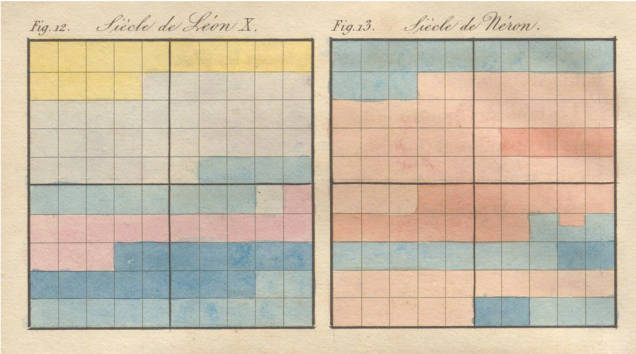
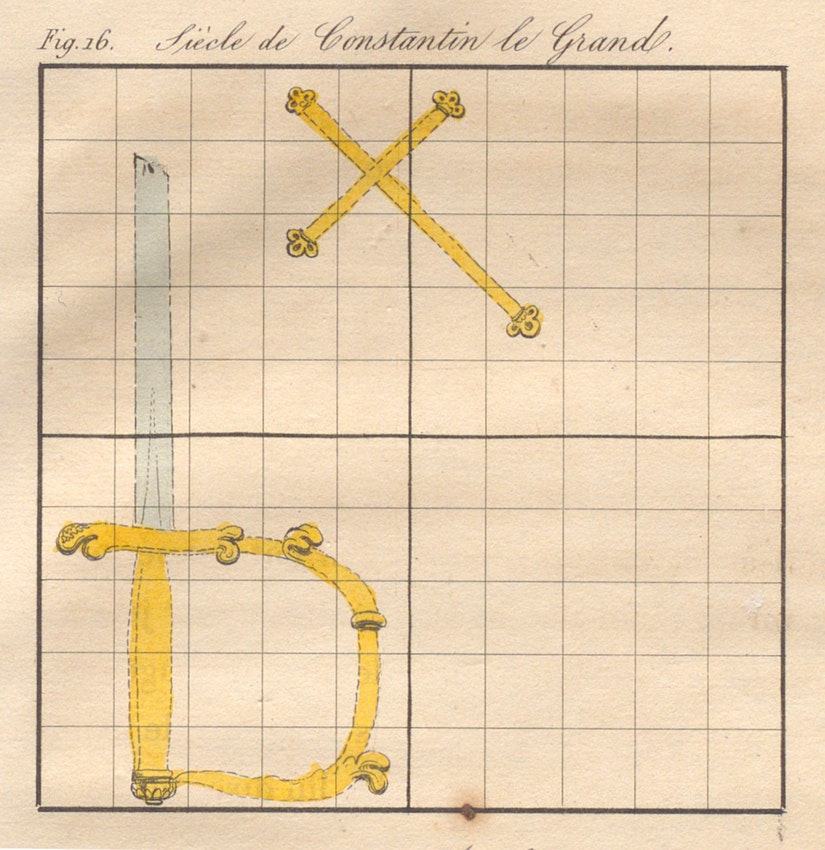
He explained his system with long paragraphs of text (which you can read here, in French), little of which students were likely to remember. What mattered was whether they could make sense of the color-coding and symbols placed inside the grid system, with each grid standing for an entire century — 100 years of human history reduced, for example, in the figure above, to one name, Constantine the Great, and two symbols, a sword and cross. This was an example of a “chronological constellation,” in which historical events take particular shapes, “sometimes it’s a chair,” Jażwiński wrote, “a sickle, a boat, a letter of the alphabet, etc.”
Even the names neatly printed above the grids are redundant, Pitts suggests. In such systems, called chronographs, “denotative text is of limited use. It is connotative visuality which further condenses the information: Flags, shields, and insignia can serve as shorthand for nations and dynasties, while looming storm clouds, bright sunbursts, and invocations of classical architecture add layers of associated meaning.” The view of history represented by such systems is quaint, at best; their oversimplifications erase more than they could ever communicate. But their visual appeal is undeniable as objects from a pre-Google past, when memorization was the only way to reliably store and access knowledge outside of books.
Related Content:
Josh Jones is a writer and musician based in Durham, NC. Follow him at @jdmagness
Read More...A First Look at How Tony Soprano Became Tony Soprano: Watch the New Trailer for The Many Saints of Newark
When The Sopranos drew to a close fourteen years ago, its ambiguous yet somehow definitive final scene hardly promised a continuation of the New Jersey mafia saga. Since then, fans have had to make do with reflections, histories, and exegeses, up to and including re-watch podcasts hosted by the actors themselves. As time has passed the show has only drawn higher and higher acclaim, which can’t be said about every product of the ongoing “golden age of television drama” The Sopranos got started. A return to the well was perhaps inevitable, and indeed has just been announced: The Many Saints of Newark, a prequel film co-written by David Chase, the creator credited with contributing to the original series a significant portion of its genius.
Onscreen, The Sopranos drew its power from one Soprano above all: local mob boss Tony Soprano, as portrayed by James Gandolfini in what has been ranked among the greatest screen acting achievements of all time. Whether or not Tony survived that final scene, Gandolfini died in 2013, and ever since it has been impossible to imagine any other actor portraying the character — or at least portraying the character in a modern-day setting.
Telling the story of a Tony Soprano in his youth, with a young actor necessarily playing him, has remained a viable proposition. Into that role, for the 1960s and 70s-set The Many Saints of Newark, has stepped Gandolfini’s real-life son Michael.
For the then-20-year-old Michael Gandolfini, taking over his father’s role had to be a daunting prospect, especially since he’d never seen The Sopranos before. At least one binge-watch of the series (among other rigorous forms of preparation) later, he delivered the performance of which you can take a first look in The Many Saints of Newark’s new trailer above. “As rival gangs try to wrest control from the DiMeo crime family in the race-torn city of Newark,” Consequence Film’s Ben Kaye writes of its story, the young Anthony Soprano, a promising but indifferent student with an eye on college, “gets swept up in the violence and crime by his uncle Dickie Moltisanti.” As Sopranos fans know full well, “Anthony becomes the feared mob head Tony Soprano and treats Dickie’s son, Christopher, as his protégé.” Evidently, an antihero of Tony’s stature is made, not born.
Related Content:
How David Chase Breathed Life into the The Sopranos
David Chase Reveals the Philosophical Meaning of The Sopranos’ Final Scene
James Gandolfini Shows Kinder, Softer, Gentler Side on Sesame Street (2002)
Based in Seoul, Colin Marshall writes and broadcasts on cities, language, and culture. His projects include the Substack newsletter Books on Cities, the book The Stateless City: a Walk through 21st-Century Los Angeles and the video series The City in Cinema. Follow him on Twitter at @colinmarshall or on Facebook.
Read More...Watch 194 Films by Georges Méliès, the Filmmaker Who “Invented Everything” (All in Chronological Order)
Georges Méliès directed, produced, edited, and starred in over 500 films between 1896 and 1913, most of them brimming with special effects the filmmaker himself invented. Before Méliès, such things as split screens, dissolves, and double exposures did not exist. After him, they were critical to cinema’s vocabulary, and the image of a rocket in the Moon’s eye became iconic. Méliès shocked, scared, and delighted popular audiences while also earning recognition from the avant garde. “The Surrealists would hail him as a great poet,” writes Darrah O’Donohue at Senses of Cinema, “in particular his erasure or subversion of boundaries.” Critics would later call him the first auteur.
Méliès originally set out to become a stage illusionist. He performed in — and purchased, in 1888 — famous magician Jean Eugene Robert-Houdin’s theater, where he became obsessed with film in 1895 at a private demonstration of the Lumière brothers’ cinematograph. When they refused to sell him one, he hunted down another projector — Robert W. Paul’s animatograph — and modified it to work as a camera he called the “coffee grinder” and “machine gun.”
Noisy cameras were not a serious issue in the age of silent film, but Méliès was perpetually dissatisfied with his equipment and strove to improve at every turn while learning to make better cinematic illusions, 194 of which you can watch for free in chronological order in this YouTube playlist. The playlist appears in full at the bottom of this post.
In an autobiographical sketch (ghostwritten in the third person for a journalist tasked with compiling a “dictionary of illustrious men”), Méliès describes himself “an engineer of great precision” and “ingenious by nature.” Modest, he was not, but the great showman was not wrong about his critical importance to early film. He describes the difficulties in detail, prefacing them with a statement about the mechanical heroism of the first filmmakers.
Those who today seek to make motion pictures will find all the required equipment available, complete and perfected: all they need is the necessary funds. They cannot begin to imagine the difficulties against which the creators of this industry had to struggle, at a time when no such material yet existed and when each innovator kept their work and research a closely guarded secret. Therefore Méliès, just like Pathé, Gaumont and others, was only able to progress by making numerous machines, subsequently abandoned and replaced by others which were themselves in due course replaced.
Celebrated as the ultimate fantasist in Martin Scorsese’s Hugo, Méliès now presides over one of cinema’s great ironies. As he helped invent cinema, he also invented the special effects-laden genre film — the sort of thing Scorsese has denied the status of cinematic art. Méliès directed the first horror film, The Haunted Castle (above) and first adaptation of Cinderella (top). He built the first film studio in Europe while making and starring in hundreds of fantasies, ranging from one minute to 40 minutes. While computers do most of the labor in the kinds of genre films we’re used to seeing now, it’s safe to say, for better or worse, that without Méliès, there would be no Marvel Universe.
But without Méliès, there would also be no Scorsese, as he says himself: “Méliès,” argues the director of such gritty neo-realist films as Taxi Driver and Raging Bull, “invented everything.” His technological innovations are only a small part of his influence. “The locked room, containing forbidden sights, darkened but illumined,” O’Donohue observes, “becomes the metaphor for Méliès’ cinema, a manifestation of private desires in a public or communal medium. The flat theatricality of the social world gives way to ‘effects,’ vision, dreams, nightmares, desires, fears, perversions — the releasing of the unconscious and the inner life.” Find films by Méliès in our collection, 4,000+ Free Movies Online: Great Classics, Indies, Noir, Westerns, Documentaries & More.
Related Content:
A Trip to the Moon (and Five Other Free Films) by Georges Méliès, the Father of Special Effects
The First Horror Film, George Méliès’ The Haunted Castle (1896)
Josh Jones is a writer and musician based in Durham, NC. Follow him at @jdmagness
Read More...Michelangelo’s David: The Fascinating Story Behind the Renaissance Marble Creation
Like many schoolchildren, and, for that matter, Goliath, the Biblical giant who was felled by a slingshot, I am a bit of a Philistine.
I admit that the first and, for a long time, primary thing that compelled me about Michelangelo’s David ( 1501–1504) was the frankness with which a certain part of his anatomy was displayed.
Mugs depicting him with a strategically placed fig leaf that dissolves in response to hot liquid, Dress Me Up David fridge magnets, and an endless parade of risqué merchandise suggest that historically, I am not alone.
Kudos to gallerist James Payne, creator and host of the video series Great Art Explained, for his nod to the rabble in opening the above episode not with a view of David’s handsome head or miraculously detailed hands, but rather that most famous of male members.
Having gotten it out of the way right at the top, Payne refrains from mentioning it for nearly 10 minutes, educating viewers instead on other aspects of the statue’s anatomy, including the sculptor’s unusual methods and the narrow, flawed, previously used block of marble from which this masterpiece emerged.
He also delves into the social context into which Michelangelo’s singular vision was delivered.
Florentines were proud of their highly cultured milieu, but were not nearly as comfortable with depictions of nudity as the ancient Greeks and Romans.
This explains the comparative smallness of David’s tackle box. Perhaps Goliath might have gotten away with a gargantuan penis, but David, who vanquished him using intelligence and willpower rather than brute strength, was assigned a size that would convey modesty, respectability, and self-control.
The Bible identifies David as an an Israelite, but Michelangelo decided that this particular Jew should remain uncircumcised, in keeping with Greco-Roman aesthetics. It was a look Christian Florence could get behind, though they also forged 28 copper leaves to conceal David’s controversial manhood.
(This theme returns throughout history — the 1860s saw him outfitted with a temporary fig leaf.)
One wonders how much smaller things would have appeared from the ground, were David installed atop the Duomo, as originally planned. Michelangelo designed his creation with this perspective in mind, deliberately equipping him with larger than usual hands and head.
One of Payne’s viewers points out that David’s face, which conveys both resolve and fear as he considers his upcoming confrontation with Goliath, seems utterly confident when viewed from below.
Given that David is 17’ tall, that’s the vantage point from which most of his in-person admirers experience him. 16th-century Civic leaders, captivated by David’s perfection, placed him not atop the Florentine Cathedral, but rather in Piazza della Signoria, the political heart of Florence, where a replica still faces south toward Rome. (The original was relocated to the Galleria dell’Accademia in 1873, to protect it from the elements.)
Payne points out that David has survived many societal shifts throughout his 600+ years of existence. Fig-leafed or not, he is a perpetual emblem of the underdog, the determined guy armed with only a slingshot, and is thus unlikely to be toppled by history or human passions.
Watch more episodes of James Payne’s Great Art Explained on his YouTube channel. As a bonus below, we’ve included another informatiive video from Smarthistory featuring the always illuminating Dr. Steven Zucker and Dr. Beth Harris.
Related Content:
What Makes Leonardo’s Mona Lisa a Great Painting?: An Explanation in 15 Minutes
New Video Shows What May Be Michelangelo’s Lost & Now Found Bronze Sculptures
Michelangelo’s Handwritten 16th-Century Grocery List
Ayun Halliday is an author, illustrator, theater maker and Chief Primatologist of the East Village Inky zine. Follow her @AyunHalliday.
Read More...This Is “The End”: A Video Exploration of The Doors’ Existential Epic
If you had broken up with your college boyfriend and he told you that he written an 11-minute song about you while on enough LSD to kill a horse, would you want to hear it? Or would you block his number on your phone?
Or maybe because said boyfriend is Jim Morrison and the band is the Doors and the song is “The End,” we’ll let it slide, because whether or not you think Jim’s lyrics are super deep or supercilious, the groove is undeniable, four small furry musicians gathered together in a studio and grooving on a raga, conjuring up Eastern mysticism with Western instruments.
In Polyphonic’s explainer video on “The End,” he pulls apart The Doors’ magnum opus, the closer to its 1967 debut album, analyzing the song in real time as it unspools. (There’s a few moments where Polyphonic and Morrison are vocalizing at the same time—we recommend turning on captions).
The girlfriend in question was Mary Werbelow, Morrison’s steady in the early ‘60s before he chose the path of putting his poetry to music. The Werbelow/Morrison couple had to die for the Doors to be born, in a sense, and Morrison started the lyrics as a goodbye song, a standard pop trope at the time. (There’s a very touching, rare interview with Werbelow here). But Morrison took it in another direction, we could say.
“The End” might be the first musical example of the Psychotronic Breakup genre. Defined by Noah Segan and Adam Egypt Mortimer when talking about film, the Psychotronic Breakup genre “uses dream imagery, paranormal ideas, or the horror genre to express the emotional drama of heartbreak.” Segan and Mortimer’s definition deals only with film, but Morrison does the same thing with song, a little over ten years before the films they discuss. “The End” is a breakup song that breaks down the psyche like LSD, sending the injured party back to basics, and into a universe of archetypes. Things are dying. Things are being reborn. There’s a blue bus which is calling us, and that is either a reference to the Solar Boat in Egyptian mythology or a reference to the Santa Monica bus system (according to one wag in the comments). Or hey, maybe it is both, because Morrison is tapping into something here, much like James Joyce created layers of myth within the quotidian. (Morrison achieves this by walking backwards into it, however.)
Polyphonic gets into the song’s Oedipal Cliff Notes section, describing how it all came fluming out of Morrison on stage, the band having dragged him to a gig at the Whiskey a Go-Go after he consumed “10,000 mikes” (i.e. 10,000 micrograms, about ten full doses) of LSD. A few days later the “kill your teachers, kill your parents” riff was committed to tape, this time also on LSD.
For all its pretense the song still works. And though Morrison never did reconcile with his girlfriend, the song did find its soul mate when Francis Ford Coppola used “The End” as the opening to Apocalypse Now, another work of art that drained the life force from its creator. There are no real cover versions of “The End,” and there are no films past Coppola’s that can use it without irony. It exists like a totem, to be found and puzzled over.
(But because this is late capitalism and everything is terrible, Polyphonic’s segue into a sponsor ad at 11:46 is something wondrous to behold in its perverse beauty. Be warned, my only friend.)
Related Content:
“The Lost Paris Tapes” Preserves Jim Morrison’s Final Poetry Recordings from 1971
A Young, Clean Cut Jim Morrison Appears in a 1962 Florida State University Promo Film
Ted Mills is a freelance writer on the arts who currently hosts the Notes from the Shed podcast and is the producer of KCRW’s Curious Coast. You can also follow him on Twitter at @tedmills, and/or watch his films here.
Read More...How Radical Gardeners Took Back New York City
New Yorkers’ relationship to New York City community gardens is largely informed by how long we’ve lived here.
Do you remember the 60s, when a fiscal crisis and white flight resulted in thousands of vacant lots and abandoned buildings in low income neighborhoods?
Activists like Hattie Carthan and Liz Christy sprung from such soil, creating youth programs, hauling away debris, and putting constant pressure on elected officials to transform those urban wastelands into green oases.
Verdant sites like the Bowery Houston Community Farm and Garden (now known as the Liz Christy Garden) improved air quality, lowered temperatures, and offered a pleasant gathering place for neighbors of all ages.
In the ‘80s, the city boasted 1000 community gardens, mostly in neighborhoods considered blighted. School aged children learned how to plant, tend, and harvest vegetables. Immigrant members introduced seeds new to American-born gardeners, to help combat both homesickness and food insecurity. On site arts programs flourished. There were al fresco birthday parties, concerts, movie screenings, holiday celebrations, permaculture classes, community meetings…. Gardens became focal points for community engagement. Participants were understandably proud, and invested in what they’d built.
As Yonnette Fleming, founder of the community-led market at the Hattie Carthan Community Garden and Farmer’s Market, says in the above episode of Vox’s Missing Chapter: “Community gardens grow communities, for the people, to be run by the people, for the benefit of the people.”
In the mid-90s, newly elected Mayor Rudy Giuliani sided with developers over citizens. More than half of the city’s gardens were bulldozed to make way for luxury residences.
Traditionally low-rise neighborhoods like the East Village and Brooklyn’s Bed-Stuyvesant would become increasingly fashionable during the early days of the new millennium. New arrivals with little interest in neighborhood history might assume that the sidewalks had always been lined with cute cafes and hipster bars, not to mention trees. (In reality, Carthan was 64 when she began her successful campaign to line Bed-Stuy with trees, and landmark a venerable Magnolia that was at risk of being torn down.)
Perhaps hoping to command younger viewers’ attention, Vox’s Missing Chapter opens not with the rich history of New York City’s community gardens, but rather the many recipes for seed bombs on TikTok. The glass half full perspective on our 500-strong surviving gardens can ring a bit empty to those who lost the fight to preserve a number of East Harlem gardens just a few short years ago.
Don’t forget your roots! Christy’s typewritten, hand illustrated Green Guerillas recipe for seed bombs is below. (If you want to try it at home, please use seeds native to your area.)

Related Content:
New York City: A Social History (A Free Online Course from N.Y.U.)
Ayun Halliday is an author, illustrator, theater maker and Chief Primatologist of the East Village Inky zine. Follow her @AyunHalliday.
Read More...Support Us
We're hoping to rely on loyal readers, rather than erratic ads. Please click the Donate button and support Open Culture. You can use Paypal, Venmo, Patreon, even Crypto! We thank you!

About Us

Open Culture scours the web for the best educational media. We find the free courses and audio books you need, the language lessons & educational videos you want, and plenty of enlightenment in between.
Advertise With Us

FREE UPDATES!
GET OUR DAILY EMAIL
Get the best cultural and educational resources on the web curated for you in a daily email. We never spam. Unsubscribe at any time.
FOLLOW ON SOCIAL MEDIA

Open Culture editor Dan Colman scours the web for the best educational media. He finds the free courses and audio books you need, the language lessons & movies you want, and plenty of enlightenment in between.
Advertise With Us


