The Artistic & Mystical World of Tarot: See Decks by Salvador Dalí, Aleister Crowley, H.R. Giger & More

The tarot goes back to Italy of the late Middle Ages. Every day here in the 21st century, I see undeniable signs of its cultural and temporal transcendence: specifically, the tarot shops doing business here and there along the streets of Seoul, where I live. The tarot began as a deck for play, but these aren’t dealers in card-gaming supplies; rather, their proprietors use tarot decks to provide customers suggestions about their destiny and advice on what to do in the future. Over the past five or six centuries, the purpose of the tarot many have changed, but its original artistic sensibility — dramatic, symbol-laden, and highly subject to counterintuitive interpretation — has remained intact.

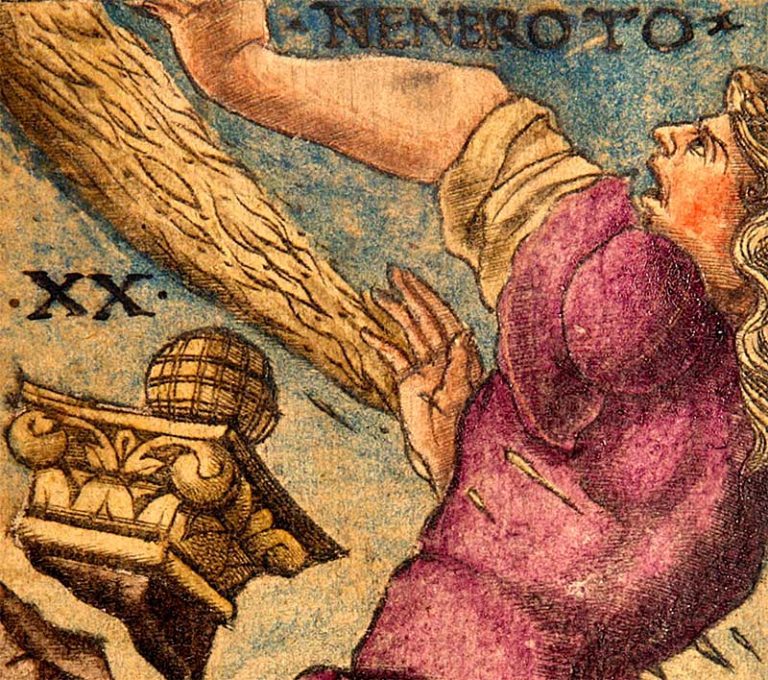
You can get an idea of that original artistic sensibility by taking a look at the the Sola-Busca, the oldest known complete deck of tarot cards. Dating from the 1490s, it holds obvious historical interest, but it’s hardly the only tarot deck we’ve featured here on Open Culture.
Artists of subsequent eras, up to and including our own, have created special decks in accordance with their distinctive visions. The unstoppable surrealist Salvador Dalí designed his own, a project embarked upon at the behest of James Bond film producer Albert Broccoli. Later, the master of biomechanism H.R. Giger received a tarot commission as well; though his deck uses previously unpublished rather than custom-made art, it all looks surprisingly, sometimes chillingly fitting.

The world’s most popular tarot deck was designed not by a famous artist, but by an illustrator named Pamela Coleman-Smith. Many more have used and appreciated her work than even, say, the Thoth deck, designed by no less renowned an occultist than Aleister Crowley, “the wickedest man in the world.” If you won’t take his word for it, perhaps the founder of analytical psychology can sell you on the merits of tarot: for Carl Jung, the deck held out the possibility of the “intuitive method” he sought for “understanding the flow of life, possibly even predicting future events, at all events lending itself to the reading of the conditions of the present moment.” (See his deck here.) Even if you’re not in search of such a method, few other artifacts weave together so many threads of art, philosophy, history, and symbolism. Of course, no few modern enthusiasts find in it the same appeal as did those early tarot players of the 15th century: it’s fun.
Related Content:
Meet the Forgotten Female Artist Behind the World’s Most Popular Tarot Deck (1909)
The Thoth Tarot Deck Designed by Famed Occultist Aleister Crowley
Behold the Sola-Busca Tarot Deck, the Earliest Complete Set of Tarot Cards (1490)
Based in Seoul, Colin Marshall writes and broadcasts on cities, language, and culture. His projects include the Substack newsletter Books on Cities, the book The Stateless City: a Walk through 21st-Century Los Angeles and the video series The City in Cinema. Follow him on Twitter at @colinmarshall or on Facebook.
Read More...David Bowie on Why It’s Crazy to Make Art–and We Do It Anyway (1998)
Art is useless, Oscar Wilde declared. Yet faced with, say, a painting by Kandinsky, film by Malick, or great work by David Bowie, we may feel it “impossible to escape the impression,” as Sigmund Freud wrote, “that people commonly use false standards of measurement — that they seek power, success and wealth for themselves and admire them in others, and that they underestimate what is of true value in life.” However ambiguously, art can move us beyond the selfish boundaries of the ego to connect with intangibles beyond ideas of use and uselessness.
That experience of connectedness, what Freud called the “oceanic,” stimulated by a work of art can mirror the sublime feelings awakened by nature. “A work of art is useless as a flower is useless,” Wilde clarified in a letter to a perplexed reader. “A flower blooms for its own joy. We gain a moment of joy by looking at it. That is all that is to be said about our relations to flowers.” It’s an imperfect analogy. The flower serves quite another purpose for the bee, and for the plant. “All of this is I fear very obscure,” Wilde admits.
The point being, from the point of view of bare survival, art makes no sense. “It’s a loony kind of thing to want to do,” says Bowie himself, in the interview clip above from a 1998 appearance on The Charlie Rose Show. “I think the saner and rational approach to life is to survive steadfastly and create a protective home and create a warm loving environment for one’s family and get food for them. That’s about it. Anything else is extra. All culture is extra…. It’s unnecessary and it’s a sign of the irrational part of man. We should just be content with picking nuts.”
My fav Bowie clip ever is him talking about how the Art establishment co-opts particular voices out of a fertile art movement to kill off that movement by creating singular voices to perpetuate the idea of Art as rare commodity by geniuses rather than something within all people pic.twitter.com/CXBzYBN6cR
— RAMZEE (@RamzeeRawkz) February 28, 2021
Why are we not content with picking nuts? Perhaps most of us are. Perhaps “being an artist,” Bowie wonders “is a sign of a certain kind of dysfunction, of social dysfunctionalism anyway. It’s an extraordinary thing to do, to express yourself in such… in such rarified terms.” It’s a Wildean observation, but one Bowie does not make to stigmatize individuals. As Rose remarks, he has “always resisted the idea that this creativity that you have comes from any form of dysfunction or… madness.” Perhaps instead it is the market that is dysfunctional, Bowie suggests in a 1996 interview, just above, with Rose and Julian Schnabel.
Art may serve no practical purpose in an ordinary sense, but it is not only the provenance of singular geniuses. “Once it falls into the hands of the proletariat,” says Bowie, “that the ability to make art is inherent in all of us, that demolishes the idea of art and commerce, and that’s no good for business.” Wilde also saw art and commerce in fundamental tension. “Of course man may sell the flower, and so make it useful to him,” he wrote. “But this has nothing to do with the flower. It is not part of its essence. It is accidental. It is a misuse,” an artificial elevation and enclosure, says Bowie, of expressions that belong to everyone.
Related Content:
Bowie’s Bookshelf: A New Essay Collection on The 100 Books That Changed David Bowie’s Life
When David Bowie Launched His Own Internet Service Provider: The Rise and Fall of BowieNet (1998)
Josh Jones is a writer and musician based in Durham, NC. Follow him at @jdmagness
Read More...Discover Ikaria, the Greek Island With the Oldest Life Expectancy in the World
Boilerplate human interest stories about the habits of particularly spry centenarians just don’t cut it anymore. Living a long, healthy, and happy life, we know, involves more than making the right individual choices. It means living in societies that make good choices readily available and support the individuals making them. Nutrition research has borne this out — just scan the latest popular food book titles for the word “Mediterranean,” for example, or input the same search term in an academic database, and you’ll pull up hundreds of results. Even fad diets have shifted from promoting individual celebrities to celebrating whole regions.
Scientists have identified a handful of places around the world, in fact, where diet and other ordinary lifestyle and social factors have led to the outcomes governments spend billions trying, and failing, to achieve. One of these regions is — yes — squarely in the Mediterranean, the Greek island of Ikaria, “named one of the healthiest places on earth,” writes Greek City Times, “a spot of exceptional longevity. Here, there are more healthy people over 90 than any other place on the planet.” Ikaria is just one of five so-called “Blue Zones” — which also include Sardinia, Italy, Okinawa, Japan, Nicoya, Costa Rica, and Loma Linda, California — where inhabitants regularly live healthy lives into their 90s and beyond.
In the Vice video above, you can meet some of the residents of Ikaria, where 1 in 3 people live past 90, and learn about some of the factors that contribute to long life in blue zones, and in Ikaria in particular. Great weather doesn’t hurt. Most important, however, is local, fresh food, and lots of it. “The most important thing is the food,” says an Ikarian cook as she prepares a batch of fresh-caught fish. “Because you live with it. You eat the right way, everything works the right way.” This is a much better way of saying “you are what you eat.” As Max Fisher points out in a bulleted list of the Greek Island’s “secrets to long life,” things “working the right way” plays a huge role in longevity.
Not only do older people in Ikaria walk everywhere and continue working into their elderly years – happily but not under duress – they also report very healthy sex lives, part of a network of habits that socially reinforce each other, Fisher writes. Hear Ikarian residents above contrast their lives on the island with their lives in fast-paced modern cities where they traded health and wellbeing for more money. Read Fisher’s full list (excerpted below) at The Washington Post.
1) Plenty of rest.
2) An herbal diet.
3) Very little sugar, white flour, or meat.
4) Mediterranean diet.
5) No processed food.
6) Regular napping.
7) Healthy sex lives after 65.
8) Stay busy and involved.
9) Yes, exercise.
10) Little stress of any kind.
11) “Mutually reinforcing” habits.
Related Content:
10 Longevity Tips from Dr. Shigeaki Hinohara, Japan’s 105-Year-Old Longevity Expert
How to Live to Be 100 and Beyond: 9 Diet & Lifestyle Tips
Book Readers Live Longer Lives, According to New Study from Yale University
Life Lessons From 100-Year-Olds: Timeless Advice in a Short Film
Josh Jones is a writer and musician based in Durham, NC. Follow him at @jdmagness
Read More...Watch a Never-Aired TV Profile of James Baldwin (1979)
In 1979, just a couple of months into his stint with 20/20, ABC’s fledgling television news magazine, producer and documentarian Joseph Lovett was “beyond thrilled” to be assigned an interview with author James Baldwin, whose work he had discovered as a teen.
Knowing that Baldwin liked to break out the bourbon in the afternoon, Lovett arranged for his crew to arrive early in the morning to set up lighting and have breakfast waiting before Baldwin awakened:
He hadn’t had a drop to drink and he was brilliant, utterly brilliant. We couldn’t have been happier.
Pioneering journalist Sylvia Chase conducted the interview. The segment also included stops at Lincoln Center for a rehearsal of Baldwin’s play, The Amen Corner, and the Police Athletic League’s Harlem Center where Baldwin (and perhaps the camera) seems to unnerve a teen reporter, cupping his chin at length while answering his question about a Black writer’s chances:
There never was a chance for a Black writer. Listen, a writer, Black or white, doesn’t have much of a chance. Right? Nobody wants a writer until he’s dead. But to answer your question, there’s a greater chance for a Black writer today than there ever has been.
In the Manhattan building Baldwin bought to house a number of his close-knit family, Chase corners his mother in the kitchen to ask if she’d had any inkling her son would become such a success.
“No, I didn’t think that,” Mrs. Baldwin cuts her off. “But I knew he had to write.”
Baldwin speaks frankly about outing himself to the general public with his 1956 novel Giovanni’s Room and about what it means to live as a Black man in a nation that has always favored its white citizens:
The American sense of reality is dictated by what Americans are trying to avoid. And if you’re trying to avoid reality, how can you face it?
Nearly 35 years before Black Lives Matter’s formation, he tackles the issue of white fragility by telling Chase, “Look, I don’t mean it to you personally. I don’t even know you. I have nothing against you. I don’t know you personally, but I know you historically. You can’t have it both ways. You can’t swear to the freedom of all mankind and put me in chains.”
The finished piece is a superb, 60 Minutes-style profile that covers a lot of ground, and yet, 20/20 chose not to air it.
After the show ran Chase’s interview with Michael Jackson, producer Lovett inquired as to the delay and was told that no one would be interested in a “queer, Black has-been”:
I was stunned, I was absolutely stunned, because in my mind James Baldwin was no has-been. He was a classic American writer, translated into every language in the world, and would live on forever, and indeed he has. His courage and his eloquence continue to inspire us today.
On June 24, Joseph Lovett will moderate James Baldwin: Race, Media, and Psychoanalysis, a free virtual panel discussion centering on his 20/20 profile of James Baldwin, with psychoanalysts Victor P. Bonfilio and Annie Lee Jones, and Baldwin’s niece, author Aisha Karefa-Smart. Register here.
H/T to author Sarah Schulman
Related Content:
Watch the Famous James Baldwin-William F. Buckley Debate in Full, With Restored Audio (1965)
Listen to James Baldwin’s Record Collection in a 478-track, 32-Hour Spotify Playlist
Ayun Halliday is an author, illustrator, theater maker and Chief Primatologist of the East Village Inky zine. Follow her @AyunHalliday.
Read More...Hear the Amati “King” Cello, the Oldest Known Cello in Existence (c. 1560)
The Stradivari family has received all of the popular acclaim for perfecting the violin. But we should know the name Amati — in whose Cremona workshop Antonio Stradivari apprenticed in the 17th century. The violin-making family was immensely important to the refinement of classical instruments. “Born around 1505,” writes Jordan Smith at CMuse, founder Andrea Amati “is considered the father of modern violinmaking. He made major steps forward in improving the design of violins, including through the development of sound-holes” into their now-familiar f‑shape.
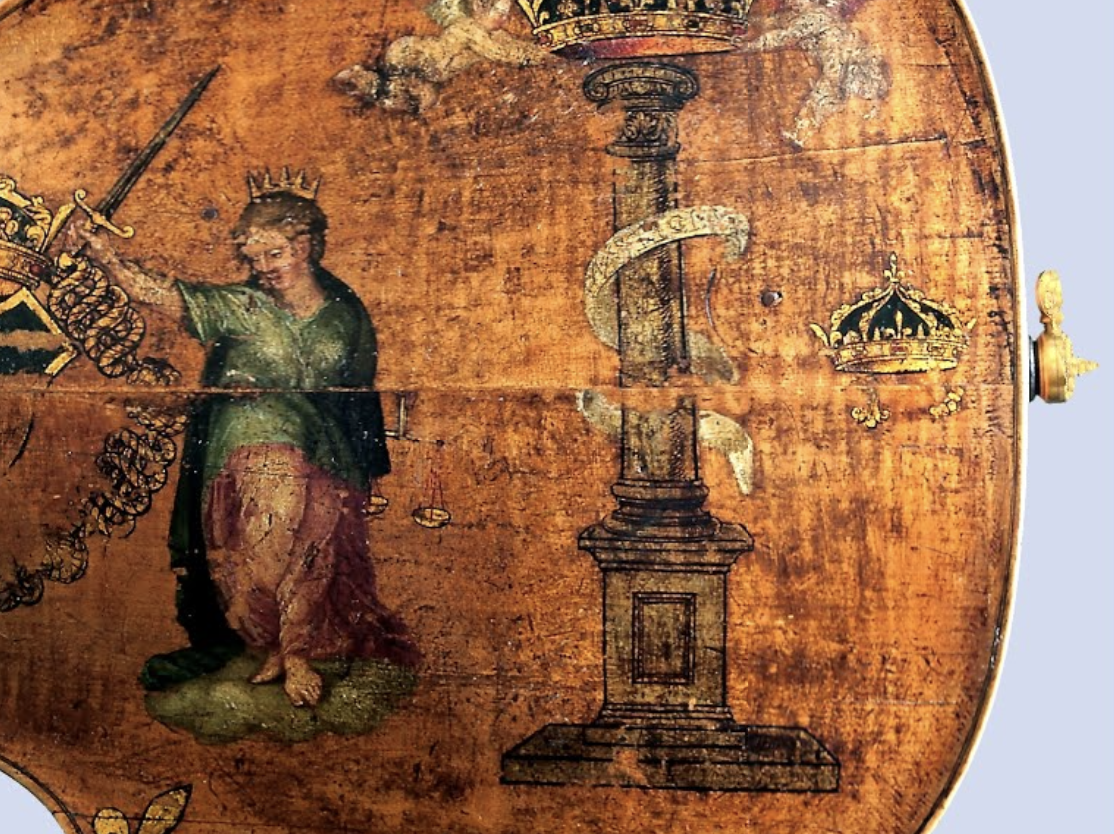
Among Amati’s creations is the so-called “King” cello, made in the mid-1500s, part of a set of 38 stringed instruments decorated and “painted in the style of Limoges porcelain” for the court of King Charles IX of France.
The instrument is now the oldest known cello and “one of the few Amati instruments still in existence.” And yet, calling the “King” a cello is a bit of a historical stretch. “The terminology referring to the early forms of cello is convoluted and inconsistent,” Matthew Zeller notes at the Strad. “Andrea Amati would likely have referred to the ‘King’ as the basso (bass violin).”
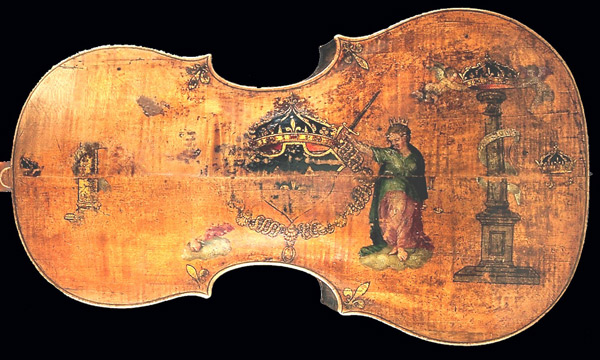
Images courtesy of National Music Museum
The instrument remained in the French court until the French Revolution, after which the basso fell out of favor and the “King” was “drastically reduced in size” through an alteration process that “stood at the forefront of musical instrument development during the last quarter of the 18th century and throughout the 19th,” a way transform obsolete forms into those more suitable for contemporary music. “By 1801,” Zeller writes, “the date that the ‘King’ might have been reduced, large-format bassos were obsolete, discarded in favour of the smaller-bodied cellos.”

Zeller has studied the extensive alteration of the “King” cello (including a new neck and enlargement from three strings to four) with CT scans of its joints and examinations of now-distorted decorations. The reduction means we cannot hear its original glory — and it was, by all accounts, a glorious instrument, “a member of a larger family of instruments of fixed measurements related together by profound mathematical, geometrical, and acoustical relationships of size and tone,” writes Yale conservator Andrew Dipper, “which gave the set the ability to perform, in unison, some of the world’s first orchestral music for bowed strings.”
We can, however, hear the “King” cello (briefly, at the top) in its current (circa 1801), form, and it still sounds stunning. Cellist Joshua Koestenbaum visited the cello at its home in the National Music Museum in Vermillion, South Dakota in 2005 to play it. “It didn’t take much effort to find the instrument’s naturally sweet, warm sound,” he says. “It was incredibly easy to play — comfortable, pleasurable, forgiving, and user-friendly…. I felt at home.” Learn more about the latest research on the “King” cello at Google Arts & Culture and the Strad.
Related Content:
Why Violins Have F‑Holes: The Science & History of a Remarkable Renaissance Design
Josh Jones is a writer and musician based in Durham, NC. Follow him at @jdmagness
Read More...Discover the Ghost Towns of Japan–Where Scarecrows Replace People, and a Man Lives in an Abandoned Elementary School Gym
In recent years, the major cities of Japan have felt as big and bustling as ever. But more than a little of that urban energy has come at a cost to the countryside, whose ongoing depopulation since the Second World War has become the stuff of countless mournful photo essays. Japan is, of course, well-known as the kind of society that keeps a rural train station in service just to take a single pupil to school. But in many of these areas, the day eventually comes when there’s no one left to teach. After not just the students but the faculty and staff have cleared out, what to do with the schools themselves? If you’re anything like Aoki Yohei (known to all as “Yo-chan”), you just move yourself on in.
In one of the school’s many rooms Aoki runs a café, roasting coffee on the premises, and in others he’s set up a hostel. In another space he’s created a recording studio outfitted with guitars, drums, keyboards, and much else besides. This sort of thing would hardly be possible within the confines of a Tokyo apartment, and Aoki accomplished it all after quitting his salaryman job without a plan.
Or rather he did it noupuran, to use one of the many Englishisms he drops in the interview with Tokyo Lens vlogger Norm Nakamura in the video at the top of the post. The school is in Ehime, one of the four prefectures of Shikoku, the second-smallest of Japan’s main islands. Though picturesque, its location is also deep enough in the mountains to seem forbiddingly remote, but the Ehime-born Aoki seems to have had no compunction about it.
Ehime faces the Seto Inland Sea, the areas surrounding which Japanologist Donald Richie described in the 1960s as possessing “the last places on earth where men rise with the sun and where streets are dark and silent by nine at night.” But for Nakamura, nine is the hour to set out in search of unexplained sounds and creepy vibes. Alas, even his best production efforts can’t mask the obvious serenity of the property. He encounters much more eeriness elsewhere on Shikoku: Nagoro Village, the vast majority of whose inhabitants aren’t human beings but fully dressed, scarecrow-like dolls. Each and every one was crafted by Tsukimi Ayano, a native who returned from Osaka to find most everyone she’d known long gone. As for Nagoro’s own elementary school, abandoned for some 20 years now, just wait until you see what “Ayano-san” has done with its gym.
Related Content:
Discover the Japanese Museum Dedicated to Collecting Rocks That Look Like Human Faces
Based in Seoul, Colin Marshall writes and broadcasts on cities, language, and culture. His projects include the Substack newsletter Books on Cities, the book The Stateless City: a Walk through 21st-Century Los Angeles and the video series The City in Cinema. Follow him on Twitter at @colinmarshall or on Facebook.
Read More...The Origin of the Rooftop Concert: Before the Beatles Came Jefferson Airplane, and Before Them, Brazilian Singer Roberto Carlos (1967)
When did the first rooftop concert happen? Probably not long after construction of the first rooftop. How could early humans resist such an opportunity to project sound over the heads of a crowd? But if we’re talking about a Rooftop Concert, we’re talking about a special genre of gig defined by The Beatles’ farewell rooftop show in London on January 30, 1969. Since that historic moment, each time musicians take to a rooftop, they inevitably face comparisons with the Fab Four, even if their rooftop concert happened first.
Before Paul McCartney sang “You’ve been playing on the roofs again” in an improvised “Get Back” in London, Jefferson Airplane “performed on a New York City rooftop in 1968,” writes Rajesh Kumar Jha at The Citizen.
“The context for the concert was provided by events like the assassination of Robert Kennedy and Martin Luther King, and the accelerating Vietnam War.” The affair was organized by Jean-Luc Godard, who “wanted to film the radical mood of the times under his 1 AM. Project, for which the Airplane were best suited.”
Grace Slick opened “The House at Pooneil Corners” by shouting from the roof, “Hello, New York! Wake up, you fuc&ers! Free music! Nice songs! Free love!” They made it 7 minutes into a set before the police broke it up and made arrests. Godard ended up abandoning the film, leaving it to D.A. Pennebaker to finish and release it as 1 P.M. Can we credit Godard for the rooftop concert as a thing? Or did he steal it from an even earlier antecedent, Brazilian singer Roberto Carlos, nicknamed “the Elvis Presley of Brazil”? Carlos staged a rooftop concert living room set below for his song “Quando” in 1967.
Whoever invented the rooftop concert, by the time U2 did it on an L.A. rooftop — legally — playing “Where the Streets Have No Name” to kick off the Joshua Tree tour, the trick had become old hat. Acknowledging their debt, Bono joked in an interview, “it’s not the first time we’ve ripped off the Beatles.” Little did he know, perhaps, that they were also ripping off Jefferson Airplane, who themselves were only imitations, when it came to rooftop concerts, of “the Frank Sinatra of Latin America.” Roberto Carlos might be lip synching, and seemingly sans audience in his appearance on a São Paulo rooftop, but we must admit he set a stylish standard for the genre of the rooftop concert all his own, two years before the Beatles made it theirs.
Related Content:
Jefferson Airplane Plays on a New York Rooftop; Jean-Luc Godard Captures It (1968)
Josh Jones is a writer and musician based in Durham, NC. Follow him at @jdmagness
Read More...The Airline Toilets Theatre Company: Watch One Man Stage Comical Shows in Airplane Bathrooms
When COVID 19 struck, theater lovers were faced with a choice.
Let go entirely, or expand our definitions of what constitutes “theater.”
We’ve had 14 months to get used to the idea of performances staged in closets, in podcast form, or as phone calls hinging on audience participation.
We’re sick of Zoom, but we no longer consider it mandatory for the players to inhabit the same space as each other or the audience.
This is all old news to Peter Brooke Turner, a member of the Ukulele Orchestra of Great Britain and the founder of the Airline Toilets Theatre Company.
The ATTC’s repertoire consists of great works of literature, song and dance… performed exclusively in aircraft lavatories, a true feat when one considers that Turner, impresario and sole company member, is 6’8”.
2015’s inaugural production, above, remains among the company’s most ambitious — a 50th anniversary recreation of Bob Dylan’s 1965 promotional film clip for Subterranean Homesick Blues, shot on various flights throughout the Ukulele Orchestra’s US tour.
Before long, Turner’s carry-on was stuffed with props and costumes — a toga, three self-adhesive Abraham Lincoln beards, a fat suit, a plastic cigar, cardboard face masks of Jimi Hendrix and Queen’s Brian May, and a numbers of inflatables, including a woman, a horse, and a not particularly realistic handgun.
Staging solo, site specific mini productions struck Turner as a far more amusing prospect than remaining in his seat, watching a movie:
I don’t like passive consumerism — I’d rather make my own movie than watch some CGI blockbuster on a plane. 90% of touring is NOT performing but sitting around on a plane/train/bus staring into space — I’m just trying to do something creative to make the time pass.
With advance planning, the simpler productions can make it into the can on a single take.
The James Bond Tribute, below, which called for costume changes, puppets and cardboard masks of Sean Connery, Roger Moore, and Daniel Craig, was shot in segments — London to Frankfurt, Singapore to Auckland, and Singapore to London.
Rather than projecting for the benefit of folks in the non-existent back row, Turner prefers to lip synch prerecorded lines, fed to him via earbud. This helps dial down the suspicions of flight attendants and fellow passengers. Once the “occupied” light comes on, he reckons he has between 7 to 10 minutes to take care of business. Should anyone question the length of his stay, or his large bag of costumes and props, his excuse is that “I suffer from haemorrhoids and need to change my pants. (Believe me, this is a conversation no one wants to take further.)”
Watch a playlist of the Best of the Airline Toilets Theater Company here.
Related Content:
Drift: Passenger Shoots Striking Short Film Out of Airplane Window
Artist Nina Katchadourian Creates Flemish Style Self-Portraits in Airplane Lavatory
Ayun Halliday is an author, illustrator, theater maker and Chief Primatologist of the East Village Inky zine. Join her June 7 for a Necromancers of the Public Domain: The Periodical Cicada, a free virtual variety honoring the 17-Year Cicadas of Brood X. Follow her @AyunHalliday.
Read More...Leonardo da Vinci Designs the Ideal City: See 3D Models of His Radical Design
Le Corbusier, Frank Lloyd Wright, Ray Bradbury: they and other 20th-century notables all gave serious thought to the ideal city, what it would include and what it would exclude. To that extent we could describe them, in 21st-century parlance, as urbanists. But the roots of the discipline — or area of research, or profession, or obsession — we call urbanism run all the way back to the 15th century. At that time, early in the European Renaissance, thinkers were reconsidering a host of conditions taken for granted in the medieval period, from man’s place in the universe (and indeed the universe itself) to the disposal of his garbage. Few of these figures thought as far ahead, or across as many fields as Leonardo da Vinci.
In addition to his accomplishments in art, science, engineering, and architecture, the quintessential “Renaissance man” also tried his hand at urbanism. More specifically, he included in his notebooks designs for what he saw as an ideal city. “Leonardo was 30 when he moved to Milan in around 1482,” writes Engineering and Technology’s Hilary Clarke.
“The city he found was a crowded medieval warren of buildings, with no sanitation. Soon after the young painter had arrived, it was hit by an outbreak of the bubonic plague that killed 50,000 people — more than a third of the city’s population at the time.” This could well have prompted him to draw up his plan, which dates between 1487 and 1490, for a cleaner and more efficient urban environment.
While it wouldn’t have been particularly hard to envision a less dirty and disordered setting than the late medieval European city, Leonardo, true to form, performed a thoroughgoing act of reimagination. “Drawing on the knowledge he had gained from studying Milan’s canals, Leonardo wanted to use water to connect the city like a circulatory system,” writes Clarke, who adds that Leonardo was also studying human anatomy at the time. “His ideal town-planning principle was to have a multi-tiered city, which also included an underground waterway to flush away effluent.” The top tier would have all the houses, squares and other public buildings; “the bottom tier was for the poor, goods and traffic — horses and carts — and ran on the same level as the canals and basins, so wagons could be easily offloaded.”
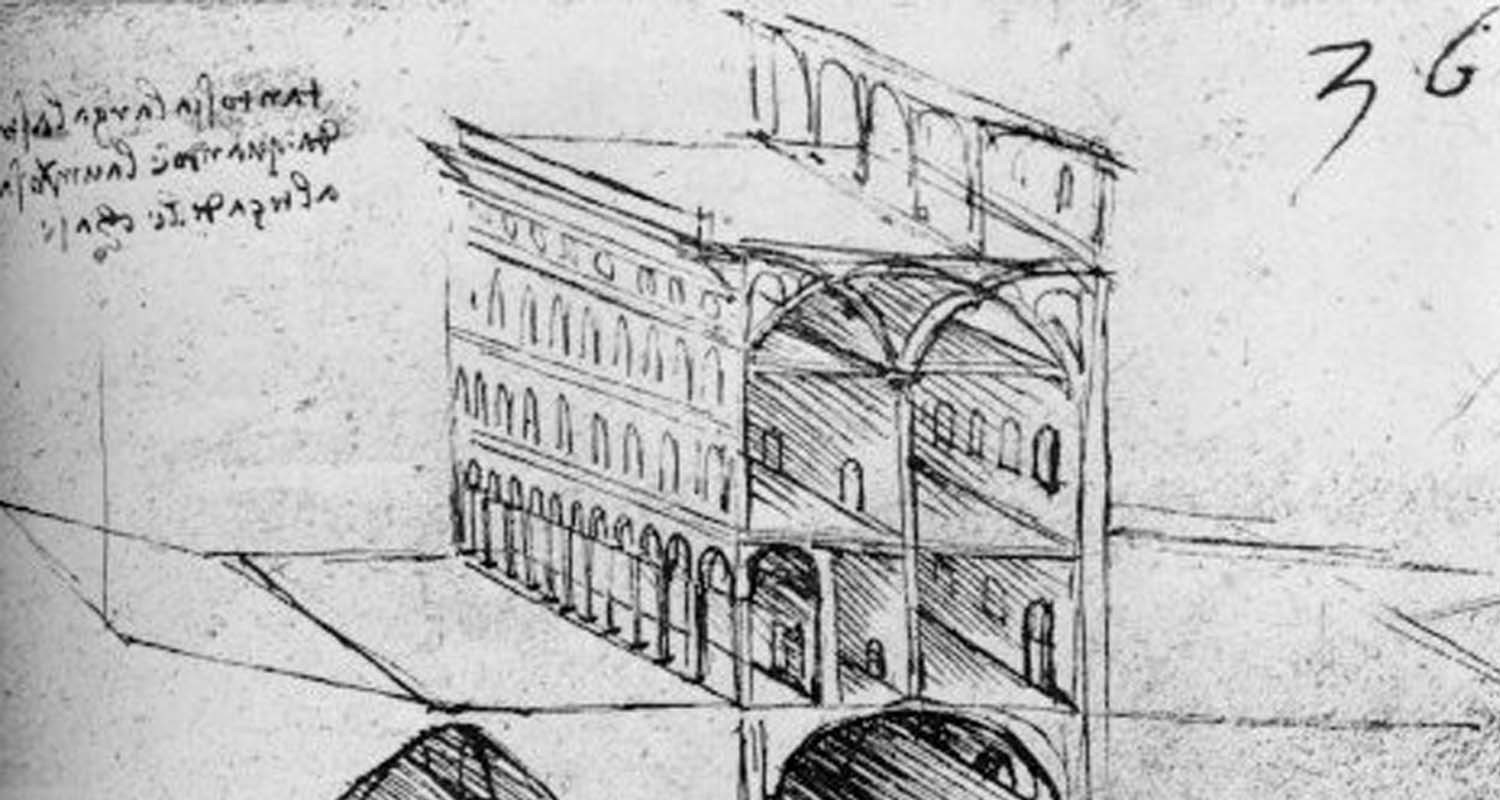
Though its ambition would have seemed fantastical in the 15th century, Leonardo’s city plan everywhere marshals his considerable engineering knowledge to address practical problems. He had a real location in mind — along the Ticino River, which runs through modern-day Italy and Switzerland — and planned details right down to the spiral staircases in every building. He insisted on spirals, Clarke notes, “because they lacked corners, making it harder for men to urinate,” but they also add an elegance to his vision of the vertical city, a notion that strikes us as obvious today but was unknown then. Of course, Leonardo was a man ahead of his time, and the 3D-rendered and physical models of his ideal city in these videos from the Ideal Spaces Working Group and Italy’s Museo Nazionale della Scienza e della Tecnologia Leonardo da Vinci make one wonder if his plan wouldn’t look both alluring and impossibly radical to urbanists even today.
Related Content:
How Leonardo da Vinci Drew an Accurate Satellite Map of an Italian City (1502)
The Medieval City Plan Generator: A Fun Way to Create Your Own Imaginary Medieval Cities
Frank Lloyd Wright Designs an Urban Utopia: See His Hand-Drawn Sketches of Broadacre City (1932)
The Utopian, Socialist Designs of Soviet Cities
Based in Seoul, Colin Marshall writes and broadcasts on cities, language, and culture. His projects include the Substack newsletter Books on Cities, the book The Stateless City: a Walk through 21st-Century Los Angeles and the video series The City in Cinema. Follow him on Twitter at @colinmarshall or on Facebook.
Read More...What Makes the Art of Bonsai So Expensive?: $1 Million for a Bonsai Tree, and $32,000 for Bonsai Scissors
During the past year’s stretches of time at home, quite a few of us have attempted to introduce more plant life into our surroundings. By some accounts, indoor gardening ranks among the most cost-effective ways of increasing the quality of one’s domestic life. But those of us who get too deep into it (aggressive pursuit of interests being a known characteristic of Open Culture readers) may find themselves getting more than they bargained for, or at any rate paying more than they intended to, especially if they go down the road of bonsai. Though it has its origins in the Chinese practice of penzai, one must look to Japan to find the practitioners who have made the greatest investments in the art of growing proportionally impeccable dwarf trees — investments of time and money both.
Buying a mature work of bonsai can cost up to nearly one million U.S. dollars, according to the episode above of Business Insider’s “So Expensive” series. That was the price of one tree at the 2012 International Bonsai Convention, but others have received valuations nearly as impressive. This reflects the enormous amount of labor a proper bonsai demands: not just daily watering, but “years of pruning, wiring, repotting and grafting,” as the narrator puts it.
“Many of these techniques require years to master, and any errors made can result in permanently ruining the shape, or even killing a plant that has been growing for centuries.” The work of bonsai is the work of generations, a fact embodied by Chieko Yamamoto, the fourth-generation bonsai master shown explaining the pursuit in which she’s spent more than half a century.
Even Yamamoto’s relatively simple-looking bonsai have taken fifteen, perhaps 25 years to take their shape. When executing a new idea, she must wait about five years just to see how it turns out, and the outcome isn’t always to her satisfaction. “There are no immediate answers,” she says, “so I need to live a long life to see the results.” Bonsai has on its side the famous longevity of the Japanese population, as well as the equally famous dedication of Japanese civilization to cultivating master craftsmanship. But even so, the now-diminishing number of bonsai businesses aggravates an already severe limitation of supply versus demand, and the trade itself has certain formidable barriers to entry. “The bonsai parts and the tools are often handmade,” says the Business Insider video’s narrator, “and can cost thousands of dollars themselves.”
In the case of Sasuke scissors, profiled in the Great Big Story documentary short just above, they can cost tens of thousands of dollars. In his shop of that name outside Osaka, blacksmith Yasuhiro Hiraka — a fifth-generation scissormaker, and the last of his kind in Japan — works for a week or longer, ten hours a day, just to make one pair. A standard model runs about $1,100 and a deluxe one costs more than $32,000, but a full-fledged bonsai master cannot settle for less. “I never thought I would be able to have them,” says one such adept, Masakazu Yoshikawa, of his first Sasuke scissors. “It was very emotional.” But the mere act of taking them in hand, he adds, “makes me want to make good bonsai.” For Hiraka’s part, he says, after 50 years of scissor-making, “I finally think I am starting to reach my peak.” As we Westerners say, you can’t rush quality.
Related Content:
The Art & Philosophy of Bonsai
See How Traditional Japanese Carpenters Can Build a Whole Building Using No Nails or Screws
Based in Seoul, Colin Marshall writes and broadcasts on cities, language, and culture. His projects include the Substack newsletter Books on Cities, the book The Stateless City: a Walk through 21st-Century Los Angeles and the video series The City in Cinema. Follow him on Twitter at @colinmarshall or on Facebook.
Read More...Support Us
We're hoping to rely on loyal readers, rather than erratic ads. Please click the Donate button and support Open Culture. You can use Paypal, Venmo, Patreon, even Crypto! We thank you!

About Us

Open Culture scours the web for the best educational media. We find the free courses and audio books you need, the language lessons & educational videos you want, and plenty of enlightenment in between.
Advertise With Us

FREE UPDATES!
GET OUR DAILY EMAIL
Get the best cultural and educational resources on the web curated for you in a daily email. We never spam. Unsubscribe at any time.
FOLLOW ON SOCIAL MEDIA

Open Culture editor Dan Colman scours the web for the best educational media. He finds the free courses and audio books you need, the language lessons & movies you want, and plenty of enlightenment in between.
Advertise With Us

