Professional Scrabble Players Replay Their Greatest Moves: Their Most Improbable, Patient & Strategic Moves of All Time
If ever the creators of the musical The 25th Annual Putnam County Spelling Bee are casting about for sequel-worthy source material, we suggest they look no further than The New Yorker’s video above, in which professional Scrabble players replay their greatest moves.
The bingo—a move in which a player uses all seven tiles on their rack, earning a bonus 50 points—figures prominently.
It seems that top ranked players not only eye their racks for potential bingos, they’re constantly calculating the odds of drawing a next-turn bingo by getting rid of existing tiles on a three or four letter word.
And what words!
The desire to win at all costs leads top seated players to throw down such ignoble words as “barf” and “mayo” in an arena where rarified vocabulary is the norm.
How many of us can define “stopbanks,” 2017 North American champion Will Anderson’s winning word?
For the record, they’re continuous mounds of earth built near rivers to stop water from the river flooding nearby land….
The pros’ game boards yield a vocabulary lesson that is perhaps more useful in Scrabble (or Banangrams) than in life. Look ‘em up!
aerugo
capeskin
celom
enginous
gox
horal
jupon
kex
mura
oxeye
pya
uredele
varve
zincate
Don’t neglect the two-letter words. They can make a one-point difference between a major win and total and unmitigated defeat.
ag
al
da
ef
mo
od
oe
qi
xi
yo
Careful, though—“ir” is not a word, as Top 40 player Jesse Day discovered when attempting to rack up multiple horizontal and vertical points.
Bear in mind that challenging a word can also bite you in the butt. Busting an opponent’s fake word play costs them a turn. If the word in question turns out to be valid, you sacrifice a turn, as top 100 player, Princeton University’s Director of Health Professions Advising, Kate Fukawa-Connelly, found out in a match against David Gibson, a previous North American champ. Had she let it go, she would’ve bested him by one point.
Appear even more in the know by boning up on a glossary of Scrabble terms, though you’ll have to look far and wide for such deep cuts as youngest North American champion and food truck manager, Conrad Bassett-Bouchard’s “forking the board,” i.e. opening two separate quadrants, thus preventing the opposing player from blocking.
Reader Content:
With Or Without U: Promoting a Scrabble Book to the Tune of U2
A Free 700-Page Chess Manual Explains 1,000 Chess Tactics in Plain English
Garry Kasparov Now Teaching an Online Course on Chess
Ayun Halliday is an author, illustrator, theater maker and Chief Primatologist of the East Village Inky zine. Join her in NYC on March 20 for the second installment of Necromancers of the Public Domain at The Tank. Follow her @AyunHalliday.
Read More...Mozart’s Diary Where He Composed His Final Masterpieces Is Now Digitized and Available Online
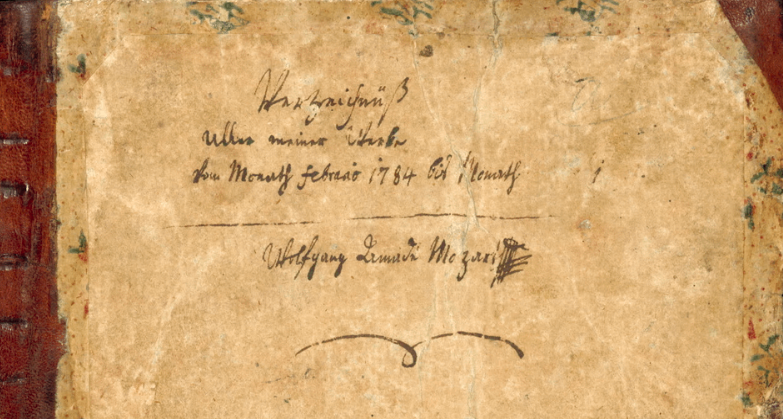
We have a tendency to regard Wolfgang Amadeus Mozart’s music as having emerged fully formed into the world, not least because we hear it performed almost exclusively in a highly polished state of near-perfection. That makes any glimpse into the process of its creation all the more valuable, and the British Library has now provided us with much more than such a glimpse: at its site you can now read Mozart’s own thirty-page musical diary, a record of “his compositions in the last seven years of his life” and thus “a uniquely important document” in the history of classical music.
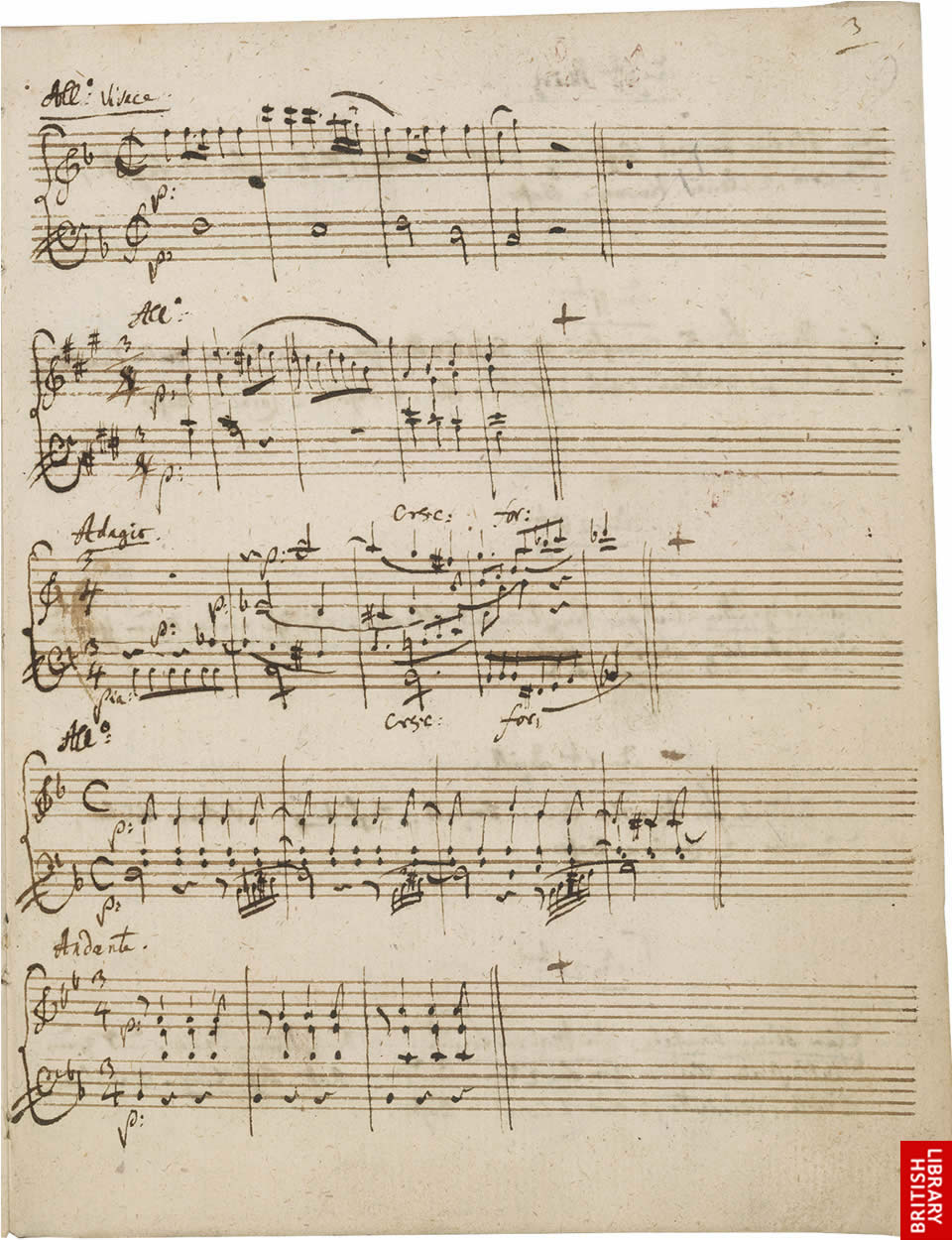
The British Library notes that, during the period from February 1784 until December 1791 that the diary covers, Mozart “composed many of his best-known works, including his five mature operas, several of his most beautiful piano sonatas, and his last three great symphonies, as well as several famous lesser works.”
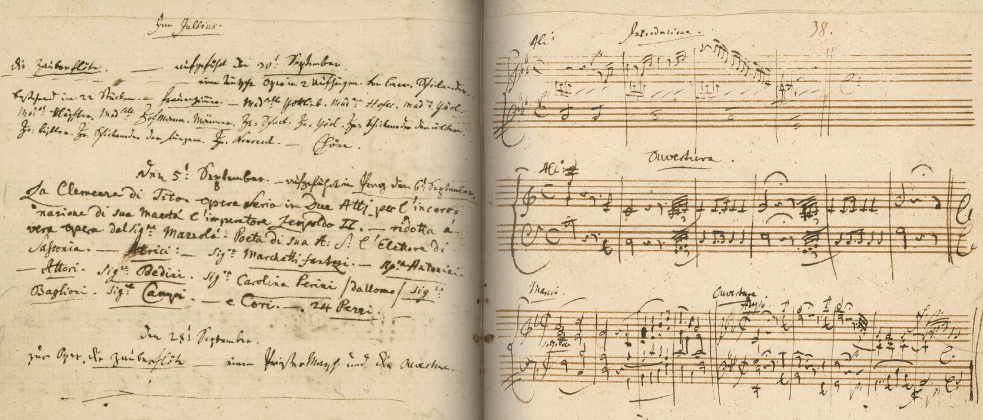
The pages you see above and below this paragraph come from his comic opera The Marriage of Figaro. “It was a turbulent time of his life, with financial crises, family tragedy, and his ongoing unsuccessful search for a permanent court position.” Enthusiasts will have taken notice that those years also constituted the last seven of his life, before his early death at age 35.
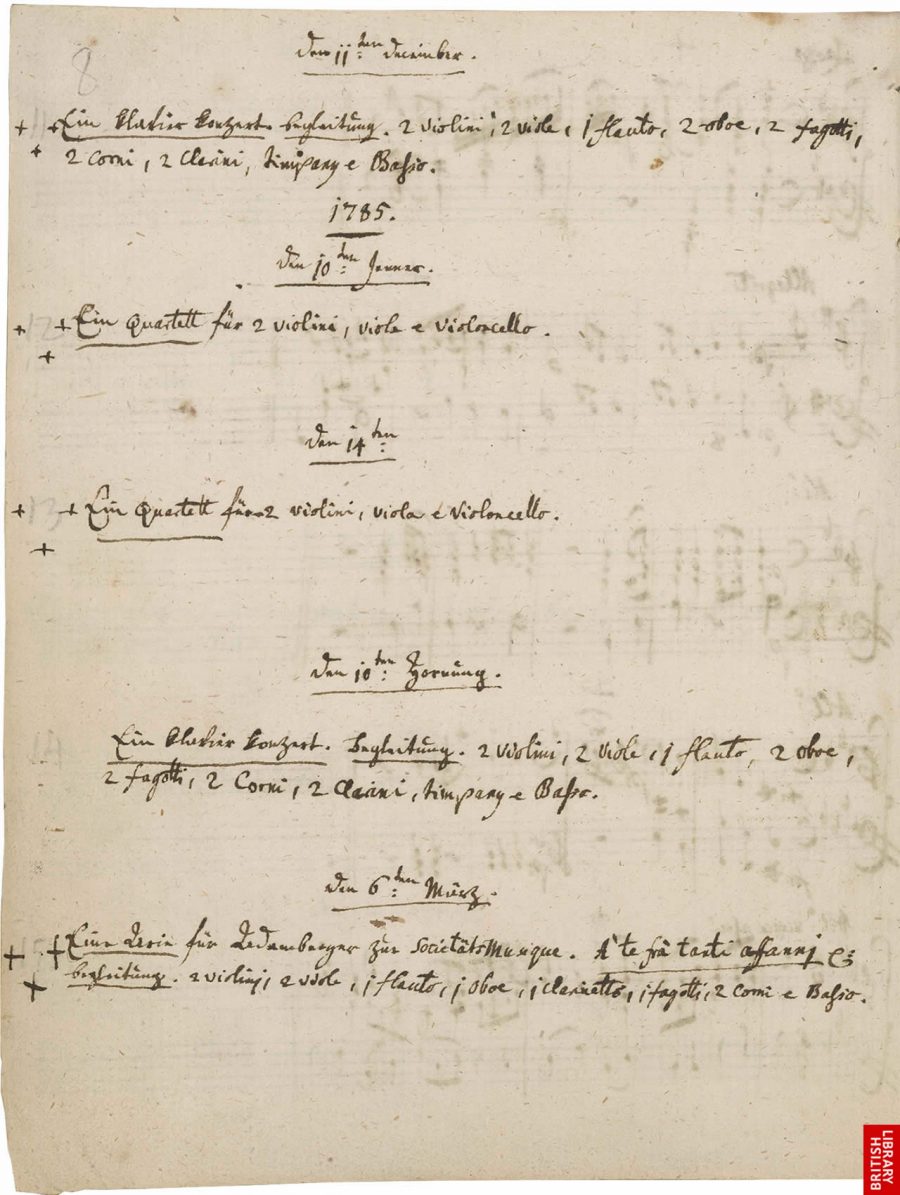
But the flame that burns twice as bright, to coin a phrase, burns half as long, and we’ve previously featured here on Open Culture some of the formidable musical accomplishments Mozart attained before even reaching adolescence. But it somehow feels even more of a wonder to see writings in the actual hand of the mature Mozart, at the height of his compositional powers. You can read the musical diary he wrote in two different formats: as a standard web site with details about the viewed pages and historical context from Mozart’s life provided below each set of pages, and a zoomable, page-flippable browser with optional audio notes. If you’d like a soundtrack to go with the reading experience, a certain 127-hour playlist of Mozart’s music suggests itself.
Related Content:
Hear All of Mozart in a Free 127-Hour Playlist
Hear the Pieces Mozart Composed When He Was Only Five Years Old
Read an 18th-Century Eyewitness Account of 8‑Year-Old Mozart’s Extraordinary Musical Skills
Leck Mich Im Arsch (“Kiss My Ass”): Listen to Mozart’s Scatological Canon in B Flat (1782)
Based in Seoul, Colin Marshall writes and broadcasts on cities and culture. His projects include the book The Stateless City: a Walk through 21st-Century Los Angeles and the video series The City in Cinema. Follow him on Twitter at @colinmarshall or on Facebook.
Read More...An Animated History of Goth
“Is your teen gothic?” Don’t laugh, it’s a serious question. If your teen is a goth, there are a few paths available to you, and not all of them good. Let’s consider some, shall we? You might, in the course of some research, come across a resource called the Parents Universal Resource Experts—or P.U.R.E.—which is not a parody Evangelical band invented by DEVO. You will learn things like “the predominant color of gothic clothing is black” and “the gothic attitude is one of sadness and depression.” So far, so totally unhelpful. This much is obvious, but what should you do?
Surprisingly, P.U.R.E. goes high when others go low, and counsels that parents should accept their teen’s goth lifestyle, “especially if it is not harming them.” Good advice. Even Oprah took the high road, sort of, in 1993, letting goth teen guest Jim calmly “shut down haters” who called him “depressing and weird,” one of the haters in question being his mom. Don’t try to change your goth teen, get to know them by learning about the history of goth yourself. Reach back to the historical and literary origins with this video, dig deep in the crates with this underground playlist…
…or just get a quirky general outline of the basics in the Pitchfork animated video above, which covers the genre from its beginnings before the internet, when it had a very specific set of references unlike such later iterations as “90s Talk Show Goth,” “Mall Goth” and “Cybergoth” (a subset which, on second thought, probably warrants an intervention on the grounds of aesthetic abuse). In the seventies and early eighties, goth meant Siouxsie and the Banshees, The Cure, Bauhaus, The Damned, Joy Division—the biggest but by no means only names at the beginning of a disparate movement that arose naturally from punk.
The Pitchfork playlist above offers a thorough musical overview of those origins, reaching back to a true original, Screamin’ Jay Hawkins, whose campy horror schtick in “I Put a Spell on You” opened doors for Peter Murphy’s vamping in “Bela Lugosi’s Dead,” Lux Interior’s spooky psychobilly delivery, and former gravedigger Dave Vanian’s theatrical persona. (The deadpan teens in the video at the top cite Siouxsie Sioux and her band as the first goths, but many a fan will tell you it was The Damned). Without the next cuts from the Doors and the Velvet Underground, we might not have had the Cure or Joy Division, among a few hundred other goth and goth-like bands.
Then it’s the usual catechism of classic goth rock any educated goth teen can rattle off at a moment’s notice: The Birthday Party, Soft Cell, Swans, Killing Joke, This Mortal Coil, Diamanda Galas, Dead Can Dance, Cocteau Twins, Coil. But perhaps your teen has only picked up the baton where the playlist leaves off, with latecomers (and arguably not-goth-at-all-but-ew-emo band) My Chemical Romance, or with the post-goth (if you will) Karin Driejer’s project Fever Ray? If so, consider immediately sitting your teen down and playing all of these key tracks. They may hate you in the moment, but will surely thank you later. (Missing here is Nico’s Marble Index, an album so bleak, most goths can’t even sit through it).
But perhaps you are yourself an elder (I kid) goth parent of a budding goth teen? If “suddenly”—as Electronic Beats’ Daniel Jones writes in “Finding the Right Albums for Your Goth Teen”—“there’s this horrible, weird version of you who’s slightly taller and displays enough of your own particular quirks that you can never quite tell if you’re being subtly made fun of”? Well, first, let me just say to you, happy 42nd anniversary of goth! You’re welcome. Next, you should follow Jones’ advice. Bypass the 80s and 90s, he says: “Just give that teen some Cocteau Twins and Coil and tell them never to be like Morrissey.” We’ve got it covered above (no Morrissey to be found).
Then you must introduce your teen to contemporary goth art like the sinister dada cabaret work of former 60’s heartthrob Scott Walker, the harrowing noise of Prurient, doomy, sludgy metal of Neurosis or Sunn O))), and the cavernously scary riffage of Ash Borer (“Can you imagine being a teen and hearing the beauty of ‘Rest, You Are the Lightning’ at the exact same time you get your period or first pubic? Probably you’d grow up to be a pro-skater.”) Go on, embrace your goth teen, but probably not with your arms. Do it with Walker’s “The Day the ‘Conducator’ Died (An Xmas Song).” Show your teen you mean business, and, as one YouTube commenter suggests, “put this on next time you have a dinner party and just stare at your guests.”
Related Content:
“A Brief History of Goths”: From the Goths, to Gothic Literature, to Goth Music
Three-Hour Mixtape Offers a Sonic Introduction to Underground Goth Music
Watch The Cure’s First TV Appearance in 1979 … Before The Band Acquired Its Signature Goth Look
Josh Jones is a writer and musician based in Durham, NC. Follow him at @jdmagness
Read More...David Lynch Teaches Typing: A New Interactive Comedy Game
Typing programs demand some patience on the part of the student, and David Lynch Teaches Typing is no exception.
You’ve got 90 seconds to get acclimated to the cruddy floppy disc-era graphics and the cacophonous voice of your instructor, a dead ringer for FBI Deputy Director Gordon Cole, the hard-of-hearing character director David Lynch played on his seminal early 90s series, Twin Peaks.
Things perk up about a minute and a half in, when students are instructed to place their left ring fingers in an undulating bug to the left of their keyboards.
That second “in”? Not a typo (though you’ll notice plenty of no doubt intentional boo-boos in the teacher’s pre-programmed responses…)
The bug in question may well put you in mind of the mysterious baby in Lynch’s first feature length film, 1977’s Eraserhead.
On the other hand, it might not.
David Lynch Teaches Typing is actually a short interactive comedy game, and many of the millennial reviewers covering that beat have had to play catch-up in order to catch the many nods to the director’s work contained therein.
One of our favorites is the Apple-esque name of the program’s retro computer, and we’ll wager that frequent Lynch collaborator, actor Kyle MacLachlan, would agree.
Another reference that has thus far eluded online gaming enthusiasts in their 20s is Mavis Beacon Teaches Typing. Take a peek below at what the virtual typing tutor’s graphics looked like around the time the original Twin Peaks aired to discover the creators of David Lynch Teaches Typing’s other inspiration.
David Lynch Teaches Typing is available for free download here. If you’re anxious that doing so might open you up to a technical bug of nightmarish proportions, stick with watching the play through at the top of the page.
Related Content:
The Big Lebowski Reimagined as a Classic 8‑Bit Video Game
What Makes a David Lynch Film Lynchian: A Video Essay
Ayun Halliday is an author, illustrator, theater maker and Chief Primatologist of the East Village Inky zine. Join her March 20 in New York City for the second edition of Necromancers of the Public Domain, a low budget variety show born of a 1920 manual for Girl Scout Camp Directors. Follow her @AyunHalliday.
Read More...David Sedaris Creates a List of His 10 Favorite Jazz Tracks: Stream Them Online
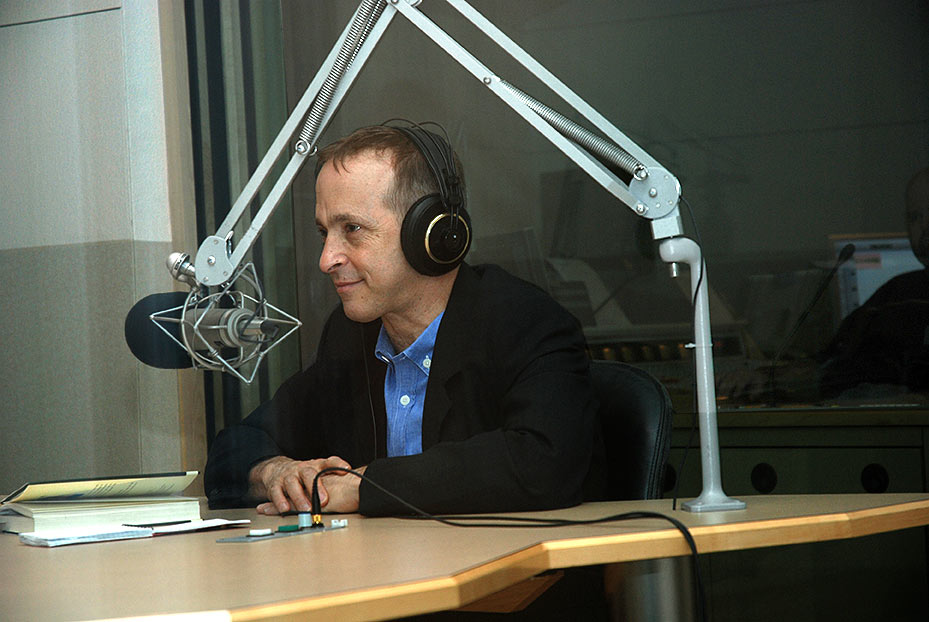
Image by WBUR, via Wikimedia Commons
You can’t read far into David Sedaris’ writing without encountering his father Lou, a curmudgeonly, decades-and-decades-retired IBM engineer with a stiffly practical mind and a harsh word for everybody — especially his misfit son, dedicating his life as he has to the quasi-occupation of writing while living in far-flung places like Paris and rural England. Even now, solidly into his nineties, Sedaris père keeps on providing the sixtysomething Sedaris fils with material, all of it — once polished up just right — a source of laughter for the latter’s many readers and listeners. But Lou has also given David something else: a passion for jazz.
“My father loves jazz and has an extensive collection of records and reel-to-reel tapes he used to enjoy after returning home from work,” writes Sedaris in one essay. “He might have entered the house in a foul mood, but once he had his Dexter Gordon and a vodka martini, the stress melted away and everything was ‘Beautiful, baby, just beautiful.’ ” He then goes on to tell the story of how his father once attempted to train young David and his sisters into a Brubeck-style family jazz combo — a hopeless dream from the start, but one that has since entertained his fans around the world. (Not that Sedaris hasn’t provided some of that entertainment by performing commercial jingles in the voice of Billie Holiday.)
Appearing on a guest DJ segment on Los Angeles public radio station KCRW, Sedaris told of how his father introduced him to jazz: “I remember seeing the movie Lady Sings the Blues, right, and thinking Diana Ross did such a good job. And my Dad saying, ‘Oh boy, you’ve got a lot to learn,’ and then him playing Billie Holiday 78s for me… and then him taking it back even further and sitting me down to listen to Mabel Mercer. He really did give me quite an education and it’s the music that’s stuck with me.” As for the first jazz album he ever heard, he names in a recent JazzTimes interview Charles Mingus’ The Clown, the one “with a close-up of a clown’s face on the cover” that still, in his estimation, “looks so modern and it sounds so modern.”
When Sedaris’ official Facebook page posted ten of his favorite songs, he came up with an all-jazz list including the work of Nina Simone, Antonio Carlos Jobim, John Coltrane, and other luminaries of the tradition. (He did not, of course, neglect Billie Holiday.) A fan turned it into a Spotify playlist, which you’ll find embedded below (and if you don’t have Spotify’s free software, you can download it here):
“I used to work in complete silence,” Sedaris tells JazzTimes, but “about three or four years ago I started listening to music [while I work], but not music with lyrics in it.” Much of the jazz he loves fits that description, and he’s also, in combination with the variety of music-streaming services available now, discovered new jazz artists while writing. Having put drinking and smoking completely behind him — and having written about both of those experiences — Sedaris retains jazz as one of the substances that keeps him going. It certainly seems to have worked for the man who brought the music into his life, whom Sedaris has imagined may yet outlive us all: “If anything happens to me,” he says, “the one thing my father wants is my iPod.”
Related Content:
20 Free Essays & Stories by David Sedaris: A Sampling of His Inimitable Humor
Be His Guest: David Sedaris at Home in Rural West Sussex, England
David Sedaris Sings the Oscar Mayer Theme Song in the Voice of Billie Holiday
Haruki Murakami’s Passion for Jazz: Discover the Novelist’s Jazz Playlist, Jazz Essay & Jazz Bar
The Best Music to Write By: Give Us Your Recommendations
Based in Seoul, Colin Marshall writes and broadcasts on cities and culture. His projects include the book The Stateless City: a Walk through 21st-Century Los Angeles and the video series The City in Cinema. Follow him on Twitter at @colinmarshall or on Facebook.
Read More...Watch Jack Nicholson Get Maniacally Into Character for The Shining’s Iconic Axe Scene
“C’mon you f#ck! C’mon death! Die! Axe murderer! Kill!!”
That’s my best transcription of Jack Nicholson’s loopy warm up dialog seen in the above clip, taken from “Making The Shining.” Director Stanley Kubrick let his then 17-year-old daughter Vivian wander the set during the making of this classic film, and captures a lot of the magic that went on. This scene of Nicholson warming up, Method-style, is a brief highlight.
I’m tickled that Nicholson is in his own mad little world, while the crew at Elstree Studios (where most of the film was shot), go about their business, occasionally swerving aside–careful with that axe, Eugene! I mean, Jack!
This is, of course, a warm up for the now iconic scene where Jack Torrance chops his way into the bathroom where his wife Wendy is hiding. And has there been a better axe in the door scene since? Can any film do so now without referencing Kubrick? I would say no.
If that piqued your interest, there’s even more behind the scenes footage kicking around YouTube, including Kubrick typing away, Nicholson schmoozing it up, Shelley Duvall pointing out her hair is coming out from the stress of filming, Kubrick’s mom visiting the set, the early use of Steadicam and video assist, Kubrick being kind of a dick to Duvall, and much more, including this observation from Nicholson: “The average celebrity meets in one year ten times the amount of people that the average person meets in their entire life.”
Related Content:
How Stanley Kubrick Became Stanley Kubrick: A Short Documentary Narrated by the Filmmaker
93 Films Stanley Kubrick Really Liked
Go Inside the First 30 Minutes of Kubrick’s The Shining with This 360º Virtual Reality Video
Jack Nicholson Puts His Star Power Behind “Green” Cars, 1978
Ted Mills is a freelance writer on the arts who currently hosts the artist interview-based FunkZone Podcast and is the producer of KCRW’s Curious Coast. You can also follow him on Twitter at @tedmills, read his other arts writing at tedmills.com and/or watch his films here.
Read More...Free: The Best Books for Learning Modern Statistics
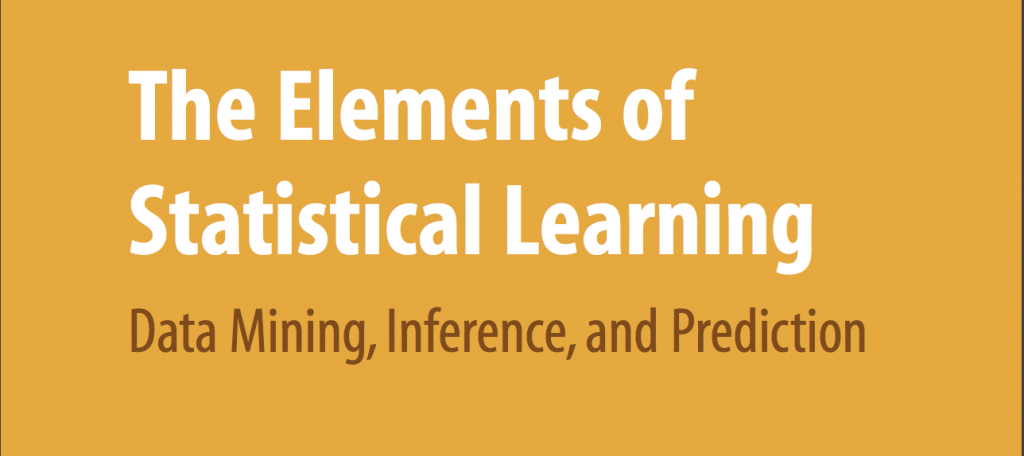
A quick fyi: Dan Kopf, an economics reporter, has a tip that seemed worth passing along. Over at Quartz, he writes:
As a former data scientist, there is no question I get asked more than, “What is the best way to learn statistics?” I always give the same answer: Read An Introduction to Statistical Learning. Then, if you finish that and want more, read The Elements of Statistical Learning. These two books, written by statistics professors at Stanford University, the University of Washington, and the University Southern California, are the most intuitive and relevant books I’ve found on how to do statistics with modern technology… You can download them for free.
Find An Introduction to Statistical Learning in PDF format here. And The Elements of Statistical Learning here. Physical/hard copies can be purchased respectively here and here.
We’d also recommend supplementing these resources (both now available in our collection of Free Math Textbooks) with video-based classes found on our list of Free Math Courses, a subset of our big collection, 1,700 Free Online Courses from Top Universities.
If you would like to support the mission of Open Culture, consider making a donation to our site. It’s hard to rely 100% on ads, and your contributions will help us continue providing the best free cultural and educational materials to learners everywhere. You can contribute through PayPal, Patreon, and Venmo (@openculture). Thanks!
Related Content:
Statistics Explained Through Modern Dance: A New Way of Teaching a Tough Subject
Read More...What Made John Entwistle One of the Great Rock Bassists? Hear Isolated Tracks from “Won’t Get Fooled Again,” “Baba O’Riley” & “Pinball Wizard”
Drummer Keith Moon was surely the most kinetic member of The Who—which is really saying a lot—but he was not the band’s best musician, even if he is routinely named one of the best drummers of all time. Moon knew the appeal of his playing often lay in the fact that it was like no one else’s: he described himself as the “greatest Keith Moon-type drummer in the world.” Nothing in rock approached his untamed excess, modeled after the far more disciplined flights of his hero, Gene Krupa.
But if the band “can be said to have an instrumental virtuoso,” writes Chris Jisi at Drum! magazine, “it is John Alec Entwistle,” their true solid center (they called him “The Ox”) and the perfect rhythmic foil to Moon, who “could sound like a drum kit falling downstairs,” Entwistle says. The bass player not only kept time, he tells Jisi, since Moon didn’t, and followed Moon’s “mess of cymbals” and “all over the place” snare drum, but he also filled in for a rhythm guitarist as Pete Townshend slashed away.
He kept his bass riffs relatively simple, he had to, and he “added top end or treble… to cut through the rest of the noise.” It works, for sure. He is rightfully singled out as one of the greatest rock bass players ever for his phenomenal skill and poise.
A lesser player trying to compete with Moon’s wall of drums and Townshend’s massive power chords might disappear entirely. Entwistle always stands out. His comments about Moon’s playing might sound disparaging, but they come off in context as honest and accurate, as do his descriptions of his own playing.
Entwistle suggests he wouldn’t be the player he became without Moon and the rest of the band. “We constructed our music to fit ‘round each other,” he says. “It was something very peculiar that none of us played the same way as other people.” In their best moments, some parts “slid together by magic and were gone forever.” This is the essence, really, of rock and roll, the serendipitous transcendence that arises from wildly colliding waves of sound.
But such controlled chaos can require, especially in a band like The Who, one cool, well-trained virtuoso who cannot be ruffled, no matter what, whose perfection looks effortless and who never breaks a sweat. The eternal archetype of that player is John Entwistle. At the top, hear Entwistle’s isolated bass in a live take of “Won’t Get Fooled Again.” (He comes in at 1:45, after a much-extended intro). Below it, you’ll easily pick out his every note in the studio version. And further up, after another extended synthesizer intro, hear him solo at 1:25 on “Baba O’Riley,” also live at Shepperton Studios in 1978. (The studio recording is above).
And just above, in one of his most energetic performances, hear him play a live version of “Pinball Wizard” (starting at 0:36). And then catch one more jaw-dropping solo, just for good measure, recorded live at Royal Albert Hall.
Entwistle is sometimes compared to Jimi Hendrix, but in some ways, The Ox came first with his fuzzed-out sound. The mild-mannered player “pioneered the use of feedback in music and smashing his instrument,” writes Ultimate Classic Rock, “with Jimi Hendrix following suit after seeing Entwistle do it.” For all his reserved English coolness, Entwistle first pushed the boundaries of loudness, “using 200 watts of power when most bands used 50,” just one of the reasons, as you’ll hear in these tracks, for his other nickname: “Thunderfingers.”
Related Content:
What Makes Flea Such an Amazing Bass Player? A Video Essay Breaks Down His Style
The Genius of Paul McCartney’s Bass Playing in 7 Isolated Tracks
The Jimi Hendrix of the Bass: Watch a Busker Shred the Bass on the Streets of Newcastle
Josh Jones is a writer and musician based in Durham, NC. Follow him at @jdmagness
Read More...Joan Didion Creates a Handwritten List of the 19 Books That Changed Her Life
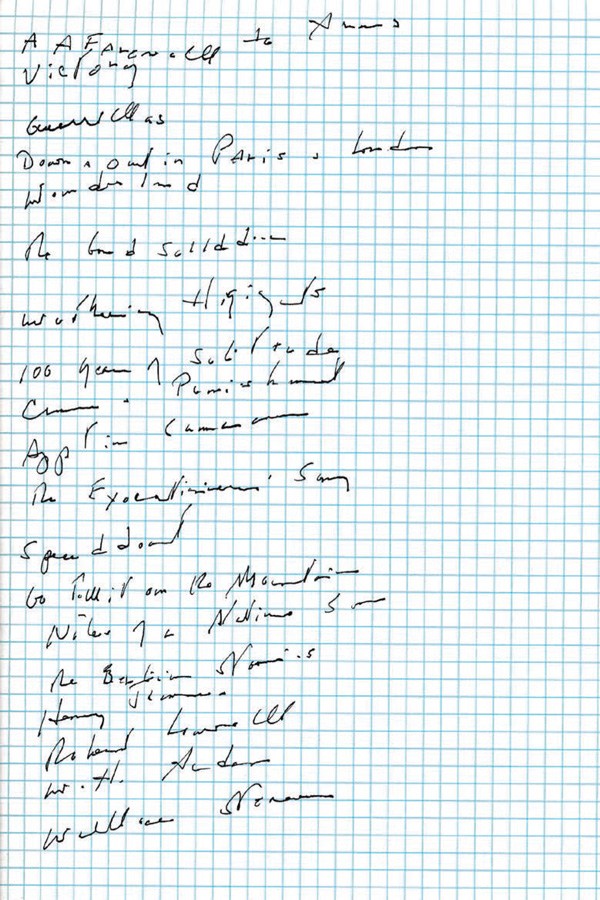
If you’ve read much Joan Didion, you’ve almost surely come across an observation or phrase that has changed the way you look at California, the media, or the culture of the late 20th century — or indeed, changed your life. But if life-changing writers have all had their own lives changed by the writers before them, which writers made Joan Didion the Joan Didion whose writing still exerts an influence today? Conveniently enough, the author of Play It as It Lays, Slouching Towards Bethlehem, and The White Album once drew up a list of the books that changed her life, and it surfaced on Instagram a few years ago:
- A Farewell to Arms by Ernest Hemingway
- Victory by Joseph Conrad
- Guerrillas by V.S. Naipaul
- Down and Out in Paris and London by George Orwell
- Wonderland by Joyce Carol Oates
- Wuthering Heights by Emily Brontë
- The Good Soldier by Ford Madox Ford
- One Hundred Years of Solitude by Gabriel Garcia Márquez
- Crime and Punishment by Fyodor Dostoyevsky
- Appointment in Samarra by John O’Hara
- The Executioner’s Song by Norman Mailer
- The Novels of Henry James: Washington Square, Portrait of a Lady, The Bostonians, Wings of the Dove, The Ambassadors, The Golden Bowl, Daisy Miller, The Aspern Papers, The Turn of the Screw
- Speedboat by Renata Adler
- Go Tell It on the Mountain by James Baldwin
- Notes of a Native Son by James Baldwin
- The Berlin Stories by Christopher Isherwood
- Collected Poems by Robert Lowell
- Collected Poems by W.H. Auden
- The Collected Poems by Wallace Stevens
In 1978, when Didion had already become a new-journalism icon, The Paris Review’s Linda Kuehl asked her whether any writer influenced her more than others. “I always say Hemingway,” she replied, “because he taught me how sentences worked. When I was fifteen or sixteen I would type out his stories to learn how the sentences worked. I taught myself to type at the same time.” Teaching A Farewell to Arms, her number-one most influential book, she “fell right back into those sentences. I mean they’re perfect sentences. Very direct sentences, smooth rivers, clear water over granite, no sinkholes.”
Didion’s list also includes other masters of the sentence, albeit most of them possessed of sensibilities quite distinct from Hemingway’s. Henry James, for instance: “He wrote perfect sentences, too, but very indirect, very complicated. Sentences with sinkholes. You could drown in them.” Consider them alongside the other writers among her favored nineteen, from novelists like Emily Brontë and Joyce Carol Oates to poets like Wallace Stevens and W.H. Auden to figures with one foot in literature and the other in journalism like George Orwell and Norman Mailer, and you’ve got a mix that no two aspiring writers could read and come out sounding exactly alike. No surprise that such a set of influences would produce a writer like Didion, so often imitated but, in her niche, never equaled.
Related Content:
Read 12 Masterful Essays by Joan Didion for Free Online, Spanning Her Career From 1965 to 2013
Joan Didion Reads From New Memoir, Blue Nights, in Short Film Directed by Griffin Dunne
New Documentary Joan Didion: The Center Will Not Hold Now Streaming on Netflix
Based in Seoul, Colin Marshall writes and broadcasts on cities and culture. His projects include the book The Stateless City: a Walk through 21st-Century Los Angeles and the video series The City in Cinema. Follow him on Twitter at @colinmarshall or on Facebook.
Read More...What’s the Origin of Time Travel Fiction?: New Video Essay Explains How Time Travel Writing Got Its Start with Charles Darwin & His Literary Peers
The idea of time travel is probably as old as the feeling of regret, but the desire to go back in time is not the same as the theoretical notion that it might actually be possible to do so. Where, the Nerdwriter wonders above, did this idea originate? And where did time travel narratives come from in general? Time travel, he argues, “as a device to tell stories, is a relatively recent phenomenon.” And time travel as a specific genre of literature is just a little over a hundred years old.
An important point of clarification: We find instances of time travel—or at least a kind of parallax—in many ancient texts, where some characters experience time differently in different realms and dimensions and can thus see the past or future in our world. In the Ramayana, a figure named Kakbhushubdi lives like the Watchers in the Marvel Comics’ universe—outside of time, observing millennia passing. (It is said he sees the same events happen over and over, with different outcomes each time.)
This is not strictly what we mean by time travel. Yet many ancient stories do show humans going back in time, or going to sleep and waking up in the future, through divine agency. In the Buddhist Pali texts, we learn that the Devas experience one hundred human years as a single day (an idea echoed in the Bible). In the Japanese legend of Urashima Taro, a man visits the palace of the Dragon God, and when he comes back 300 years have passed. But the Nerdwriter is talking about something different than these many narrative instances of time dilation (hundreds of years before Einstein elaborated the concept), though the same devices appear in modern time travel stories.
A significant distinction, the video suggests, lies in the very concept of time. Many ancient people believed that time was cyclical—hence the many variations on the same themes in Kakbhushubdi’s experience—or that time was malleable, subject to divine interruption and disruption. After Darwin’s Origin of Species and the rapid acceptance of evolution (if not natural selection), popular notions of time changed. The modern time travel genre begins with broadly Darwinian ideas as a central premise. In the popular imagination, evolution meant inevitable, linear progress, and thus was born a form of literature called the Utopian Romance.
One such novel, Edward Bellamy’s 1888 Looking Backward, has the distinction of being the third-largest bestseller of its time, after Uncle Tom’s Cabin and Ben Hur, with over one million copies sold. Why haven’t you heard of it before? Probably because the book envisions a character who falls asleep and wakes up in a socialist utopia 113 years in the future (the year 2000). It exerted significant influence on the many socialist movements of the time, and “Bellamy clubs” sprang up around the country, advocating for the nationalization of private property. Few Americans, at least, have learned about the widespread popularity of socialism in the U.S. during the late 19th century because… well, you tell me.
But Bellamy’s ideas are embedded in the genre, in work after work we are familiar with (take the parody version in Futurama). In the modern time travel novel, utopias “are no longer on a lost island or a different world, they were in the future.” This observation applies most readily to a more famous foundational text from 1895, H.G. Wells’ The Time Machine, which borrows from Swift’s Gulliver’s Travels, but sets the action not in a distant land but in the very distant future, the year 802701. Wells’ “subterranean workers, the Morlocks, and the decadent Eloi” who profit from their labor, notes the British Library, do not differ that much from humans of the past or the present—they have evolved technologically and physically, but are still subject to exploitation and violence.
Where Gulliver’s Travels can be read as a misanthropic undermining of notions of cultural superiority, Wells’ novel satirizes the idea that human evolution implies an improvement in human beneficence. The book set a pattern “for science-fiction to critique extreme developments of class.” In both Bellamy and Wells, time travel—whether achieved by science or a Rip Van Winkle sleep—presents an occasion for utopian or dystopian allegory. The time travel genre took on a new dimension after Einstein, when the science of relativity replaced Darwinian evolution as the central preoccupation, and paradoxes and rules became central concerns. This shift highlights another important feature of the modern time travel genre—its obsession with cause and effect, and therefore with the very nature and possibility of story itself.
Related Content:
H.G. Wells’ 1930s Radio Broadcasts
How to Recognize a Dystopia: Watch an Animated Introduction to Dystopian Fiction
Josh Jones is a writer and musician based in Durham, NC. Follow him at @jdmagness
Read More...Support Us
We're hoping to rely on loyal readers, rather than erratic ads. Please click the Donate button and support Open Culture. You can use Paypal, Venmo, Patreon, even Crypto! We thank you!

About Us

Open Culture scours the web for the best educational media. We find the free courses and audio books you need, the language lessons & educational videos you want, and plenty of enlightenment in between.
Advertise With Us

FREE UPDATES!
GET OUR DAILY EMAIL
Get the best cultural and educational resources on the web curated for you in a daily email. We never spam. Unsubscribe at any time.
FOLLOW ON SOCIAL MEDIA

Open Culture editor Dan Colman scours the web for the best educational media. He finds the free courses and audio books you need, the language lessons & movies you want, and plenty of enlightenment in between.
Advertise With Us


