Patton Oswalt to William & Mary’s Graduating Class: “You Poor Bastards,” “You Do Not Have a Choice But to Be Anything But Extraordinary”
Patton Oswalt, William & Mary, Class of 1991, graduated with a 2.8 GPA “into a world full of trivia and silliness and fun.”
The Class of 2023, he observed in a recent keynote address at his alma mater, is poised to enter a “hellscape where you will have to fight for every scrap of your humanity and dignity.”
The comedian seasoned his speech with jokes, but its “hard truth” is one that could find favor with activist Greta Thunberg — namely that the inattention, apathy, and blithe wastefulness of his generation, and all generations that came before have saddled today’s young people with a seriously messed up planet:
Your concerns as you stumble out into reality tomorrow are massive. Democracy is crumbling. Truth is up for grabs. The planet’s trying to kill us and loneliness is driving everyone insane.
The good news?
Your generation has rebelled against every bad habit of mine and every generation that came before it. Everything that we let calcify, you have kicked against and demolished.
He sees a student body willing to battle apathy, alienation, and cruelty, who insist on inclusion and openness about mental health.
(By contrast he was a “little daffodil” who angrily took his Physics for Poets prof to task for having committed an inaccuracy involving Star Trek’s chain of command on the final exam.)
The former English major mangles a quote from author Gerald Kirsch’s 1938 short story Busto is a Ghost, Too Mean to Give Us a Fright!
The real quote is:
…there are men whom one hates until a certain moment when one sees, through a chink in their armour, the writhing of something nailed down and in torment.
The paraphrased sentiment retains its power, however, and his sloppy fact checking squares with his portrayal of himself as a lackadaisical B- student.
Returning to campus 32 years later as a successful writer, actor and comedian, he exhorts the most academic members of the Class of 2023 to take a cue from their peers whose GPAs were less than stellar, “the daydreamers, the confused, and the seekers:”
There are people out there who want to manage every moment. They want to divvy up every dream, and they want to commodify every crazy creative caprice that springs out of your cranium. Don’t let them. Be human in all of its bedlam and beauty and madness and mercy for as long as you can and in any way you can.
He may have dashed off his address in his hotel room the night before the ceremony, but he drives his point home with an ingenious Hollywood insider reference that may send the entire class of 2023, their families, professors, and you, dear reader, rushing to view (or revisit) the 1982 sci fi classic, Blade Runner.
As to why Oswalt merits the honorary degree William & Mary conferred on him, fellow alum and Ted Lasso showrunner Bill Lawrence has a theory:
I guess it’s because he didn’t really deserve the degree he got when he was here.
Related Content
John Waters’ RISD Graduation Speech: Real Wealth Is Life Without A*Holes
‘This Is Water’: Complete Audio of David Foster Wallace’s Kenyon Graduation Speech (2005)
“Wear Sunscreen”: The Story Behind the Commencement Speech That Kurt Vonnegut Never Gave
– Ayun Halliday is the Chief Primatologist of the East Village Inky zine and author, most recently, of Creative, Not Famous: The Small Potato Manifesto and Creative, Not Famous Activity Book. Follow her @AyunHalliday.
Read More...Nirvana’s “Come As You Are” Played By Musicians Around the World
Playing For Change did it again. They’ve released a compelling music video featuring an assemblage of international musicians performing Nirvana’s 1991 classic, “Come as You Are.” The musicians come from Australia, Hungary, Morocco, Nepal, Brazil and beyond. And they perform with an array of instruments–from the didgeridoo, to the oud, to the sintir–that you don’t commonly associate with the rock idiom. But it all comes together splendidly well.
In our archive, find other Playing for Change takes on The Grateful Dead’s “Ripple,” The Rolling Stones’ “Gimme Shelter,” Bob Marley’s “Redemption Song,” Ben King’s “Stand by Me” and (our favorite) Led Zeppelin’s “When the Levee Breaks.” Enjoy.
If you would like to support the mission of Open Culture, consider making a donation to our site. It’s hard to rely 100% on ads, and your contributions will help us continue providing the best free cultural and educational materials to learners everywhere. You can contribute through PayPal, Patreon, and Venmo (@openculture). Thanks!
Related Content
“When The Levee Breaks” Performed by John Paul Jones & Musicians Around the World
1,000 Musicians Play Nirvana’s “Smells Like Teen Spirit” Live, at the Same Time
Read More...Fascism!: The US Army Publishes a Pamphlet in 1945 Explaining How to Spot Fascism at Home and Abroad
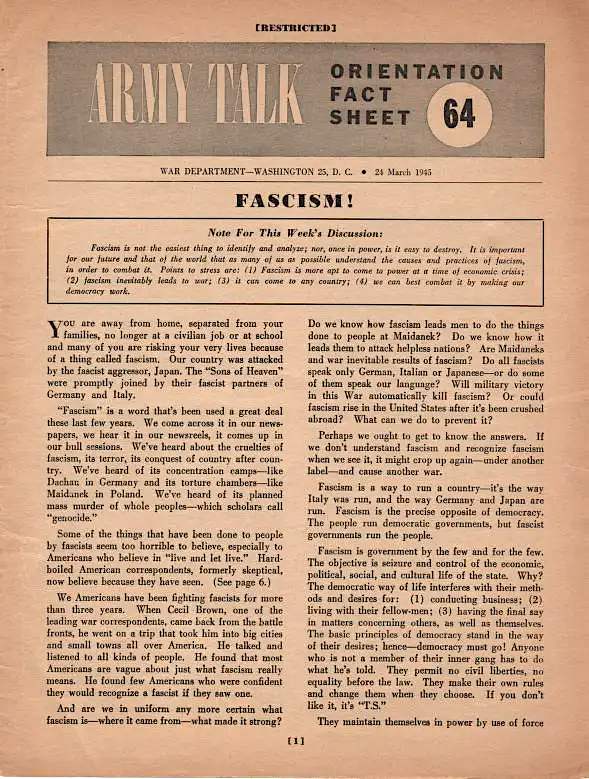
“Fascism is a word that’s been used a great deal these last few years,” says the article pictured above (scanned in full here at the Internet Archive). “We come across it in our newspapers, we hear it in our newsreels, it comes up in our bull sessions.” Other than the part about newsreels (today’s equivalent being our social-media feeds, or perhaps the videos put before our eyes by the algorithm), these sentences could well have been published today. Some see the fascist takeover of modern-day democracies as practically imminent, while others argue that the concept itself has no meaning in the twenty-first century. But 78 years ago, when this issue of Army Talk came off the press, fascism was very much a going — and fearsome — concern.
“Beginning in 1943, the War Department published a series of pamphlets for U.S. Army personnel in the European theater of World War II,” writes historian Heather Cox Richardson. The mission of Army Talks, in the publication’s own words, was to help its readers “become better-informed men and women and therefore better soldiers.”
Each issue included a topic for discussion, and on March 25, 1945, that topic was fascism — or, as the headline puts it, “FASCISM!” Under that ideology, defined as “government by the few and for the few,” a small group of political actors achieves “seizure and control of the economic, political, social, and cultural life of the state.” Such ruling classes “permit no civil liberties, no equality before the law. They make their own rules and change them when they choose. If you don’t like it, it’s ‘T.S.’ ”
Fascists come to power, the text explains, in times of hardship, during which they promise “everything to everyone”: land to the farmers, jobs to the workers, customers and profits to the small businessmen, elimination of small businessmen to the industrialists, and so on. When this regime “under which everything not prohibited is compulsory” inevitably fails to deliver a perfect society, things turn violent, both in the country’s internal struggles and in its conflicts with other powers. To many Americans at the time of World War II, this might seem like a wholly foreign disorder, liable to afflict only such distant lands as Italy, Japan, and Germany. But a notional American fascism would look and feel familiar, working “under the guise of ‘super-patriotism’ and ‘super-Americanism.’ Fascist leaders are neither stupid nor naïve. They know that they must hand out a line that ‘sells.’ ”
That someone’s always trying to sell you something in politics — and even more so in American politics — is as true in 2023 as it was in 1945. Though whoever assumed back then that “it couldn’t happen here” presumably figured that the United States was too wealthy a society for fascist temptations to gain a foothold. But even the most favorable economic fortunes can reverse, and “lots of things can happen inside of people when they are unemployed or hungry. They become frightened, angry, desperate, confused. Many, in their misery, seek to find somebody to blame. They look for a scapegoat as a way out. Fascism is always ready to provide one.” And not only fascism: political opportunists of every stripe know full well the power to be drawn from “the insecure and unemployed” looking for someone on who “to pin the blame for their misfortune” — and how easy it is to do so when no one else has a more appealing vision of the future to offer.
You can see a scan of the original document here, and read the text here.
Related content:
How to Spot a Communist Using Literary Criticism: A 1955 Manual from the U.S. Military
Umberto Eco Makes a List of the 14 Common Features of Fascism
Walter Benjamin Explains How Fascism Uses Mass Media to Turn Politics Into Spectacle (1935)
Based in Seoul, Colin Marshall writes and broadcasts on cities, language, and culture. His projects include the Substack newsletter Books on Cities, the book The Stateless City: a Walk through 21st-Century Los Angeles and the video series The City in Cinema. Follow him on Twitter at @colinmarshall or on Facebook.
Read More...The 100 Greatest Children’s Books of All Time, According to 177 Books Experts from 56 Countries

Given the size and demographic profile of J. R. R. Tolkien’s fan base today, it’s easy to forget that he originally wrote The Hobbit for children. For generations of young readers, that novel has stood as the gateway into Tolkien’s much more complex and ambitious Lord of the Rings trilogy — also written for children, at least according to the new poll of 177 experts around the world conducted by the BBC to determine the 100 greatest children’s books of all time. In its results, The Lord of the Rings comes in around the middle, but The Hobbit takes fifth place, behind only the near-universally beloved titles The Little Prince, Pippi Longstocking, Alice’s Adventures in Wonderland, and — at number one — Where the Wild Things Are.

Any reader who was a child in the past sixty years will know all of those books; any reader alive will know most of them. Throughout this top-100 list appear classics that have been in the children’s canon longer than any of us have been alive, like Anne of Green Gables, Treasure Island, and Little Women.
A great many works, from Goodnight Moon and The Cat in the Hat to A Wrinkle in Time and From the Mixed-Up Files of Mrs Basil E. Frankweiler — joined it in the middle of the twentieth century. “Books published between the 1950s and 1970s were most prevalent,” says the BBC’s accompanying notes, “which may be related to the age profile of voters, the majority of whom were born in the 1970s and 1980s.”

Indeed, a glance through these results can hardly fail to bring back any of the earliest reading memories of any Generation Xer or millennial. Witness the prevalence of books by Roald Dahl: Charlie and the Chocolate Factory, The BFG, The Witches, Matilda. Even Danny, the Champion of the World, which I remember as relatively lackluster, just makes the cut. Of course, “the furor over the rewriting of Roald Dahl’s novels for modern sensibilities” has lately brought his work back into public discourse; that and other unrelated controversies over what books ought to be made available in school libraries have given us reason to consider once again what children’s literature is, or what it could and should be — a range of questions that kids themselves seem rather better equipped to address than many grown-ups. See the BBC’s complete list here.
Related content:
Discover J. R. R. Tolkien’s Little-Known and Hand-Illustrated Children’s Book Mr. Bliss
Hayao Miyazaki Selects His 50 Favorite Children’s Books
Enter an Archive of 6,000 Historical Children’s Books, All Digitized and Free to Read Online
Maurice Sendak Animated; James Gandolfini Reads from Sendak’s Story “In The Night Kitchen”
Based in Seoul, Colin Marshall writes and broadcasts on cities, language, and culture. His projects include the Substack newsletter Books on Cities, the book The Stateless City: a Walk through 21st-Century Los Angeles and the video series The City in Cinema. Follow him on Twitter at @colinmarshall or on Facebook.
Read More...Kraftwerk’s “The Robots” Performed by German 1st Graders in Cute Cardboard Robot Costumes
“Teach your children well” sang Crosby, Stills and Nash once upon a long ago, and that adage could be paraphrased as “make sure your students don’t grow up learning substandard pop songs. Give them a real education.” An enterprising elementary school teacher in Mombach, a district of the Rhineland city of Mainz, did so in 2015, dressing up his students from Lemmchen Elementary in their own handmade robot outfits and teaching them to sing the classic 1978 Kraftwerk hit “The Robots” (or “Roboter” if you own the German version, which you can hear below).
While the original prog-rockers turned electronic demigods tried to strip away as much of their humanity when playing live, you just can’t do it with kids. They’re just too cute, and their wobbly, shuffling attempts to be machines only warms the heart more. (Could their parents tell who was who, I wonder?) Their version of the music is similarly charming and pretty faithful, though it’s possibly played by instructor Lars Reimer. (An older class shows their faces and plays instruments in a more recent video, a cover of “Tanz” by Stoppok.) So yes, Mr. Reimer, you’re passing on some good musical taste.
Though Kraftwerk was often thought of as cold and artificial when they first arrived on the international music scene, the intervening years have only emphasized the romantic beauty of their (mostly major key) melodies. (See for example the Balanescu Quartet’s rendition of the same song below.)
Note: An earlier version of this post appeared on our site in 2016.
If you would like to support the mission of Open Culture, consider making a donation to our site. It’s hard to rely 100% on ads, and your contributions will help us continue providing the best free cultural and educational materials to learners everywhere. You can contribute through PayPal, Patreon, and Venmo (@openculture). Thanks!
Related Content:
Kraftwerk’s First Concert: The Beginning of the Endlessly Influential Band (1970)
One Man Shows You How to Play Kraftwerk’s “The Robots” with Just One Synthesizer
Ted Mills is a freelance writer on the arts who currently hosts the FunkZone Podcast. You can also follow him on Twitter at @tedmills, read his other arts writing at tedmills.com and/or watch his films here.
Read More...The 1920s Lie Detector That Forced Suspected Criminals to Confess to a Skeleton

“In the criminal justice system,” the evergreen Law & Order’s opening credits remind us, “the people are represented by two separate, yet equally important, groups: the police, who investigate crime; and the district attorneys, who prosecute the offenders.”
They fail to mention the life-sized skeleton with ghastly glowing eyes and a camera tucked away inside its skull.
That’s because no police department ever saw fit to put Helene Adelaide Shelby’s 1930 patent for a highly unusual “apparatus for obtaining criminal confessions and photographically recording them” into practice.
Ms. Shelby’s vision sought to transform the police interrogation room into a haunted house where the sudden appearance of the aforementioned skeleton would shock a guilty suspect into confession.
(Presumably an innocent person would have nothing to fear, other than sitting in a pitch black chamber where a truth-seeking skeleton was soon to manifest before their very eyes.)

The idea may have seemed slightly less far-fetched immediately following a decade when belief in Spiritualism flourished.
False mediums used sophisticated stagecraft to convince members of a gullible public that they were in the presence of the supernatural.
Perhaps Ms. Shelby took inspiration from Mysteries of the Seance and Tricks and Traps of Bogus Mediums: A Plea for Honest Mediums and Clean Work by “lifelong spiritualist” Edward D. Lunt. The section on “form materialization” provides plenty of concrete ideas for enacting such trickery.
Ms. Shelby’s proposed apparatus consisted of a “structure divided into two chambers:”
…one chamber of which is darkened to provide quarters in which the suspect is confined while being subjected to examination, the other chamber being provided for the examiner, the two chambers being separated from each other by a partition which is provided with a panel upon one side of which is mounted a figure in the form of a skeleton, the said skeleton having the rear J portion of the skull removed and the recording apparatus inserted therein.
The examiner was also tasked with voicing the skeleton, using appropriately spooky tones and a well-positioned megaphone.
As silly as Ms. Shelby’s invention seems nearly a hundred years after the patent was filed, it’s impressive for its robust embrace of technology, particularly as it pertains to capturing the presumably spooked suspect’s reaction:
The rear portion of the skull of the skeleton is removed and a camera casing is mounted in the panel extending into the skull, said camera being preferable of the continuously-moving film-type an having provisions for simultaneously recording pictures and sound waves, or reproducing these, as may be desired or required, the said camera impression upon the having an objective adapted to register with the nose, or other opening, in the skull. The eye-sockets are provided with bulbs adapted to impress different light intensities on the margins of the film, the central section of the film being arranged to receive the pictures, the variations in the light intensities of the bulbs being governed by means of the microphones, and selenium cells (not shown), which are included in the light circuit and tend to cause the fluctuations of the current to vary the intensity of the light for sound recording purposes, the density of the light film varying with the intensity of the light thus transmitted.
Ms. Shelby believed that a suspect whose confession had been recorded by the skeleton would have difficulty making a retraction stick, especially if photographs taken during the big reveal caught them with a guilty-looking countenance.
Writing on officer.com, Jonathan Kozlowski applauds Ms. Shelby’s impulse to innovate, even as he questions if “scaring a confession out of a guy by being really really creepy (should) be considered coercion:”
Shelby doesn’t seem to have gotten any credit for it and nor am I sure that Shelby was even the first to think of the idea, BUT if you remove the skeleton figure and the red lightbulbs staring into the criminal’s soul was this the inspiration of a mounted surveillance camera?
Allow me to push it even further … imagine your department’s interview room. If you’ve got the camera in the corner (or multiple) let that be. Instead of the skeleton figure just put an officer standing in the corner with a recording body camera. The officer is just standing there. Staring. Sure that’s a MASSIVE waste of time and money — of course. I may be wrong, but if I’m being honest this seems like intimidation.
It also strikes us that the element of surprise would be a challenge to keep under wraps. All it would take is one freaked-out crook (innocent or guilty) blabbing to an underworld connection, “You wouldn’t believe the crazy thing that happened when they hauled me down to the station the other night…”
What sort of horrific special effect could force a guilty party to confess in the 21st century? Something way more dreadful than a skeleton with glowing red eyes, comedian Tom Scott’s experiment below suggests.
Having enlisted creative technologist Charles Yarnold to build Ms. Shelby’s apparatus, he invited fellow YouTubers Chloe Dungate, Tom Ridgewell, and Daniel J Layton to step inside one at a time, hoping to identify which of them had nicked the cookie with which he had baited his crime-catching hook.
The participants’ reactions at the critical moment ranged from delighted giggles to a satisfying yelp, but the results were utterly inconclusive. Nobody ‘fessed up to stealing the cookies.
That’s not to say the apparatus couldn’t work with a subset of criminals on the lower end of elementary school age. Did they or didn’t they? Why not scar ‘em for life and find out?
Related Content
– Ayun Halliday is the Chief Primatologist of the East Village Inky zine and author, most recently, of Creative, Not Famous: The Small Potato Manifesto and Creative, Not Famous Activity Book. Follow her @AyunHalliday.
Read More...Why French Sounds So Unlike Spanish, Italian & Other Romance Languages, Even Though They All Evolved from Latin
French is known as the language of romance, a reputation that, whatever cultural support it enjoys, would be difficult to defend on purely linguistic grounds. But it wouldn’t be controversial in the least to call it a Romance language, which simply refers to its descent from the Latin spoken across the Roman Empire. In that category, however, French doesn’t come out on top: its 77 million speakers put it above Romanian (24 million) and Italian (67 million), but below Spanish (489 million) and Portuguese (283 million). If you know any one of these languages, you can understand at least a little of all the others, but French stands out for its relative lack of family resemblance.
“Why is acqua just eau?” asks Joshua Rudder, creator of the Youtube channel NativLang. “How are cambiar and casa related to change and chez?” He addresses the causes of these differences between modern-day French, Spanish, and Italian in the video above, which presents the historical-linguistic explanation in the form of a long and tricky recipe.
“Start preparing your ingredients 2000 years ago. Take a base of Latin,” ideally at least three centuries old. “Combine traces of Gaulish, because Celtic words will become sources of change.” Then, “gradually incorporate sound shifts, not uniformly: work them in to form a nice continuum, where the edges look distinct, but locally, it’s similar from place to place.”
This cooking session soon becomes a dinner party. Its most important attendees are the Franks next door, who come not empty-handed but bearing a few hundred Germanic words. In the fullness of time, “you might think that the sound of French would come from a single dialect in Paris. Instead, observe as it arises from social changes and urbanization, bringing together people who speak many varieties of oïl” — an old word for what Francophones now know as oui, and which now refers to the dialects spoken in the north of the country (as opposed to oc in the south) back then. Even this far into the process, we’ve come only to the point of making Middle French.
Modern French involves “a thick ganache of kingdom and colonization” spread far and wide. Subsequent “periods of revolution and Napoleon” put more touches on the languages, none of them finishing. Students of French today find themselves seated at an elaborate feast of unfamiliar sounds and rules governing those sounds, many of which may at first seem unpalatable or even indigestible. Yet some of those students will develop a taste for such linguistic fare, and even come to prefer it to the other Romance languages that go down easier. French continues to change in the twenty-first century, not least through its incorporation of askew anglicisms, yet somehow continues to remain a language apart. Therein, perhaps, lies the true meaning of vive la difference.
Related content:
What Shakespeare’s English Sounded Like, and How We Know It
What Ancient Latin Sounded Like, And How We Know It
Watch Ta-Nehisi Coates Speak French Before & After Attending Middlebury’s Immersion Program
Based in Seoul, Colin Marshall writes and broadcasts on cities, language, and culture. His projects include the Substack newsletter Books on Cities, the book The Stateless City: a Walk through 21st-Century Los Angeles and the video series The City in Cinema. Follow him on Twitter at @colinmarshall or on Facebook.
Read More...The Art Collection of David Bowie: An Introduction
Today, it hardly surprises us when a successful, wealthy, and influential rock star has a large art collection. But David Bowie, ahead of the culture even at the outset of his career, began accruing art well before success, wealth, or influence. He put out his debut album when he was twenty years old, in 1967, and didn’t hesitate to create a “rock star” lifestyle as soon as possible thereafter. As the world now knows, however, rock stardom meant something different to Bowie than it did to the average mansion-hopping, hotel room-trashing Concorde habitué. When he bought art, he did so not primarily as a financial investment, nor as a bid for high-society respectability, but as a way of constructing his personal aesthetic and intellectual reality.
Bowie kept that project going until the end, and it was only in 2016, the year he died, that the public got to see just what his art collection included. The occasion was Bowie/Collector, a three-part auction at Sotheby’s, who also produced the new video above. It examines Bowie’s collection through five of its works that were particularly important to the man himself, beginning with Head of Gerda Boehm by Frank Auerbach, about which he often said — according to his art buyer and curator Beth Greenacre — “I want to sound like that painting looks.” Then comes Portrait of a Man by Erich Heckel, whose paintings inspired the recordings of Bowie’s acclaimed “Berlin period”: Low, “Heroes,” Lodger, and even Iggy Pop’s The Idiot, which Bowie produced.
As we’ve previously featured here on Open Culture, Bowie also loved furniture, none more so than the work of the Italian design collective known as Memphis. This video highlights his red Valentine typewriter, a pre-Memphis 1969 creation of the group’s co-founder Ettore Sottsass. “I typed up many of my lyrics on that,” Bowie once said. “The pure gorgeousness of it made me type.” Much later, he and Brian Eno were looking for ideas for the album that would become Outside, a journey that took them to the Gugging Institute, a Vienna psychiatric hospital that encouraged its patients to create art. He ended up purchasing several pieces by one patient in particular, a former prisoner of war named Johann Fischer, enchanted by “the sense of exploration and the lack of self-judgment” in those and other works of “outsider” art.
The video ends with a mask titled Alexandra by Beninese artist Romuald Hazoum, whom Bowie encountered on a trip to Johannesburg with his wife Iman. Like many of the artists whose work Bowie bought, Hazoumè is now quite well known, but wasn’t when Bowie first took an interest in him. Made of found objects such as what looks like a telephone handset and a vinyl record, Alexandra is one of a series of works that “play on expectations and stereotypes of African art, and are now highly sought after.” Bowieologists can hardly fail to note that the piece also shares its name with the daughter Bowie and Iman would bring into the world a few years later. That could, of course, be just a coincidence, but as Bowie’s collection suggests, his life and his art — the art he acquired as well as the art he made — were one and the same.
Related content:
96 Drawings of David Bowie by the “World’s Best Comic Artists”: Michel Gondry, Kate Beaton & More
Bowie’s Bookshelf: A New Essay Collection on The 100 Books That Changed David Bowie’s Life
How Aladdin Sane Became the Most Expensive Album Cover Ever — and David Bowie’s Defining Image
Meet the Memphis Group, the Bob Dylan-Inspired Designers of David Bowie’s Favorite Furniture
Based in Seoul, Colin Marshall writes and broadcasts on cities, language, and culture. His projects include the Substack newsletter Books on Cities, the book The Stateless City: a Walk through 21st-Century Los Angeles and the video series The City in Cinema. Follow him on Twitter at @colinmarshall or on Facebook.
Read More...Jonathan Demme Turns the Kurt Vonnegut Story, “Who Am I This Time?,” Into a TV Movie, with Susan Sarandon & Christopher Walken in Starring Roles (1982)
Back in 1982, the PBS American Playhouse series aired Jonathan Demme’s made-for-TV film based on the Kurt Vonnegut story, “Who Am I This Time?” Now, thanks to the YouTube channel Chicken Soup for the Soul TV, you can watch the rarely-seen film online. The channel writes:
Mix together a small town community theatre’s shy leading man and the lovely telephone worker who moves into town and you have a perfect recipe for a delightful romantic comedy. Academy Award-winners Susan Sarandon and Christopher Walken star as the couple who discover that affairs of the heart on the stage may be a bit less complicated than continuing the romance off the stage. Director Jonathan Demme, an Academy Award-winner, deftly weaves this endearing tale of love in bloom from Kurt Vonnegut, Jr.‘s story.
While the video quality is grainy, the movie is still significant for serving as an early career vehicle for Sarandon, Walken and director Demme. This isn’t exactly ‘Before They Were Stars’ — after all, by 1982, Walken had already won an Oscar for “The Deer Hunter,”
Sarandon had already starred in “Rocky Horror” and been nominated for an Oscar for Atlantic City, and Demme, although still a decade away from his biggest work, had already directed the acclaimed “Melvin & Howard.”
Watch other complete films on the Chicken Soup for the Soul TV Youtube Channel, or on their free-standing website. Enjoy.
If you would like to support the mission of Open Culture, consider making a donation to our site. It’s hard to rely 100% on ads, and your contributions will help us continue providing the best free cultural and educational materials to learners everywhere. You can contribute through PayPal, Patreon, and Venmo (@openculture). Thanks!
Related Content
4,000+ Free Movies Online: Great Classics, Indies, Noir, Westerns, Documentaries & MoreWatch the New Trailer for a Kurt Vonnegut Documentary 40 Years In the Making
Kurt Vonnegut’s 8 Tips on How to Write a Good Short Story
Hear Christopher Walken’s Wonderful Reading of Edgar Allan Poe’s “The Raven”
Susan Sarandon Reads an Animated Version of Good Night Moon … Without Crying
Read More...How John Keats Writes a Poem: A Line-by-Line Breakdown of “Ode on a Grecian Urn”
The Greek term ekphrasis sounds rather exotic if you seldom come across it, but it refers to an act in which we’ve all engaged at one time or another: that is, describing a work of art. The best ekphrases make that description as vivid as possible, to the point where it becomes a work of art in itself. The English language offers no better-known example of ekphrastic poetry than John Keats’ “Ode on a Grecian Urn,” from 1819, which pulls off the neat trick of taking both its subject and its genre from the same ancient culture — among other virtues, of course, several of which are explained by Evan Puschak, better known as the Nerdwriter, in his new video above, “How John Keats Writes a Poem.”
Puschak calls “Ode on a Grecian Urn” “arguably the best poem from arguably the best romantic poet,” then launches into a line-by-line exegesis, identifying the techniques Keats employs in its construction. “The speaker craves the ideal, everlasting love depicted on and symbolized by the urn,” he says. “But the way he expresses himself — well, it’s almost embarrassing, even hysterical, feverish.”
Keats uses compulsive-sounding repetition of words like happy and forever to “communicate something about the speaker that runs counter to his words. It reminds me of those times when you hear someone insist on how happy they are, but you know they’re just trying to will that fact into existence by speaking it.”
In the course of the poem, “the speaker begins to doubt his own cravings for the permanence of art. Is it really as perfect as he imagines?” Throughout, “he’s looked to the urn, to art, to assuage his despair about life,” a task to which it finally proves not quite equal. “In life, things change and fade, but they’re real. In art, things may be eternal, but they’re lifeless.” The famous final lines of “Ode on a Grecian Urn” arrive at the conclusion that “beauty is truth, truth beauty,” and how literal an interpretation to grant it remains a matter of debate. It may not really be all we know on Earth, nor even all we need to know, but the fact that we’re still arguing about it two centuries later speaks to the power of art — as well as art about art.
Related content:
Watch Art on Ancient Greek Vases Come to Life with 21st Century Animation
F. Scott Fitzgerald Reads Shakespeare’s Othello and Keats’ “Ode to a Nightingale” (1940)
Learn to Write Through a Video Game Inspired by the Romantic Poets: Shelley, Byron, Keats
How Ancient Greek Statues Really Looked: Research Reveals Their Bold, Bright Colors and Patterns
Based in Seoul, Colin Marshall writes and broadcasts on cities, language, and culture. His projects include the Substack newsletter Books on Cities, the book The Stateless City: a Walk through 21st-Century Los Angeles and the video series The City in Cinema. Follow him on Twitter at @colinmarshall or on Facebook.
Read More...Support Us
We're hoping to rely on loyal readers, rather than erratic ads. Please click the Donate button and support Open Culture. You can use Paypal, Venmo, Patreon, even Crypto! We thank you!

About Us

Open Culture scours the web for the best educational media. We find the free courses and audio books you need, the language lessons & educational videos you want, and plenty of enlightenment in between.
Advertise With Us
FREE UPDATES!
GET OUR DAILY EMAIL
Get the best cultural and educational resources on the web curated for you in a daily email. We never spam. Unsubscribe at any time.
FOLLOW ON SOCIAL MEDIA
Open Culture editor Dan Colman scours the web for the best educational media. He finds the free courses and audio books you need, the language lessons & movies you want, and plenty of enlightenment in between.
Advertise With Us

