The Destruction of Penn Station: How New York City Lost Its Majestic Beaux-Arts Rail Terminal
In the New York of old, “one entered the city like a god. One scuttles in now like a rat.” When he wrote those words, architectural historian Vincent Scully issued what has ended up as the definitive judgment of Pennsylvania Station. Or rather, of the Pennsylvania Stations: the majestic original building from 1910, as well as its utilitarian replacement that has stood in Midtown Manhattan since 1968. But then, the word “stood” doesn’t quite apply to the latter, since it resides entirely underground, below Madison Square Garden. Over the years, New Yorkers have come more and more openly to resent the Penn Station they have and lament the Penn Station they lost, which architect Michael Wyetzner introduces to us in the Architectural Digest video above.
“A conjectural reconstruction of Imperial Rome’s Baths of Caracalla of 212–216 AD,” writes New York Review of Books architecture critic Martin Filler, the original Penn Station constituted “a harmonious synthesis of two divergent and supposedly irreconcilable architectural approaches, the Classical and the industrial.”
It was commissioned by the Pennsylvania Railroad, which in the late nineteenth century was “the country’s largest business enterprise, with a budget second only to that of the federal government,” writes the New Yorker’s William Finnegan, and which at that time had a formidable engineering problem to solve: “Its tracks ended, like those of every railroad approaching New York from the west, in New Jersey, on the banks of the Hudson River. In 1900, ninety million passengers were obliged to transfer to ferries to reach Manhattan.”
To run the Pennsylvania Railroad’s tracks into the center of New York City required digging a set of tunnels under the Hudson, where, says one historian on PBS’ American Experience documentary on the rise and fall of Penn Station, “nobody thought tunnels could be built. It’s almost as though they were going to go to the moon.” The technological achievement was matched by the aesthetic: “Its main waiting room, paneled in Italian travertine, with fluted columns and coffered ceilings a hundred and fifty feet high, was the world’s largest room,” Finnegan writes. “The train shed was equally grand, with arching steel girders, staggered mezzanines, and glass-block floors that let sunlight through to the tracks. ” Like other major urban rail terminals of its era, writes Tony Judt, Penn Station “spoke directly and deliberately to the commercial ambitions and civic self-image of the modern metropolis.”
By the mid-twentieth-century, however, trains were facing aggressive competition from both the private car and the airplane, which displaced their stations from the center of modern life. “Between 1955 and 1975,” Judt writes, “a mix of antihistoricist fashion and corporate self-interest saw the destruction of a remarkable number of terminal stations.” But prospects for rail of one kind or another in America have looked up in recent years, and “we are no longer embarrassed by the rococo or neo-Gothic or Beaux-Arts excesses of the great railway stations of the industrial age and can see such edifices instead as their designers and contemporaries saw them: as the cathedrals of their age.” Hence, in New York, the preservation of Grand Central Station — as well as the bitter and protracted struggle (covered extensively in Finnegan’s New Yorker piece) over whether and how to turn the unloved Penn Station into a cathedral of our age.
Related content:
An Immersive Architectural Tour of New York City’s Iconic Grand Central Terminal
An Architect Breaks Down the Design of New York City Subway Stations, from the Oldest to Newest
New York’s Lost Skyscraper: The Rise and Fall of the Singer Tower
A Subway Ride Through New York City: Watch Vintage Footage from 1905
Famous Architects Dress as Their Famous New York City Buildings (1931)
Based in Seoul, Colin Marshall writes and broadcasts on cities, language, and culture. His projects include the Substack newsletter Books on Cities, the book The Stateless City: a Walk through 21st-Century Los Angeles and the video series The City in Cinema. Follow him on Twitter at @colinmarshall or on Facebook.
Read More...Hear Demos of Madonna Performing Punk Songs with Her Pre-Fame Band, Breakfast Club (1979)
Isn’t it wonderful when long-forgotten recordings get dusted off and exposed to a much wider audience, thrusting little-remembered artists into the spotlight, perhaps for the first time in their lives?
Think Connie Converse…
Wait, who?
Shortly after the aspirant dancer ditched Michigan for New York City in 1976, making ends by waitressing, modeling nude and working the counter at Dunkin’ Donuts, she formed the band, Breakfast Club with her boyfriend Dan Gilroy and his brother, Ed.
“I was sick of being an out-of-work dancer, so he taught me how to play guitar,” she recalled in her 2008 Rock & Roll Hall of Fame induction speech.
“It was a surprise that she mentioned me, like right away, like that was great,” Dan mused in the 2019 docudrama Madonna and the Breakfast Club:
It was wonderful, in fact and it changed my whole … in town, the musicians in town were like, “Did you see that?” Suddenly, again, it’s like we were with Madonna. It’s like she threw the spotlight.
Boys far outnumbered girls in the scrappy late-70’s New York City scene, but Madonna held her own, working hard and looking the part in full-skirted thrift store dresses from an earlier era.
(If you’ve resisted the Queen of Pop’s charms, thus far, this earliest incarnation may be the one that finally hooks you.)
Before guitar, the brothers turned her onto drums in the basement of the former Queens synagogue the three called home. (She habitually stuck her gum on one of the kit’s metal stands.)
Dan Gilroy observed that her dance training served her well as a musician:
..she was always into counting, you know, everything, eight counts, and it fit right into drumming, so it was a very smooth transition from dancing to drumming…She already could keep the beat, so naturally, she wanted to get more into music than just drumming, not that drumming isn’t music.
Breakfast Club featured Madonna on drums, the brothers out front with guitars, and, briefly Madonna’s friend Angie Smit on bass, though their roles weren’t set in stone.
According to Norris Burroughs, author of MY MADONNA: My Intimate Friendship With The Blue Eyed Girl On Her Arrival In New York:
It kind of felt like it was gonna be the sort of band where, like a Fleetwood Mac thing where you’d have Lindsey Buckingham and Steve Nicks and Christine McVie taking turns on vocals or they would harmonize.
Even a fraction of a Fleetwood Mac-like level of recognition would have been heady stuff, but as Angie Smit’s replacement, bassist Gary Burke unequivocally states, “Madonna wanted to be famous:”
That was her thing, man. And she didn’t care if she got it…through dance, through rock and roll, whatever. She wanted to be famous. She would be so squirrelly, like, “I wanna be famous!” She wanted to be famous now, man. And she was like, you could just see it in her body language, it’s like, “Ooh, when’s it gonna happen!?
SPOILER: It happened.
Just a couple of years after leaving both the band and Dan Gilroy, she had a record contract and a debut single that she promoted tirelessly with live club appearances. 1983 saw the release of a first album so packed with hits, it was only a matter of months til she became a household name.
But the street cred of her Breakfast Club demo is a hard one to beat:
0:01 Shit On The Ground-Safe Neighborhood
1:35 Shine A Ligh
3:13 Little Boy
4:47 l Love Express
Listen to Breakfast Club’s post-Madonna work on Spotify.
Related Content
The Mystical Poetry of Rumi Read By Tilda Swinton, Madonna, Robert Bly & Coleman Barks
David Fincher’s Five Finest Music Videos: From Madonna to Aerosmith
Kurt Cobain’s Home Demos: Early Versions of Nirvana Hits, and Never-Released Songs
– Ayun Halliday is the Chief Primatologist of the East Village Inky zine and author, most recently, of Creative, Not Famous: The Small Potato Manifesto and Creative, Not Famous Activity Book. Follow her @AyunHalliday.
Read More...Dire Straits’ “Sultans Of Swing” Performed on the Gayageum, a Korean Instrument Dating Back to the 6th Century
Every now and then, we check in on the fascinating musical world of Luna Lee–a musician who performs Western music on the Gayageum, a traditional Korean stringed instrument which dates back to the 6th century. Over the years, we’ve shown you her adaptations of Jimi Hendrix’s ‘Voodoo Chile;’ David Bowie’s “The Man Who Sold The World;” Leonard Cohen’s “Hallelujah;” blues classics by John Lee Hooker, B.B. King & Muddy Waters; and Pink Floyd’s “Comfortably Numb,” “Another Brick in the Wall” & “Great Gig in the Sky.” To keep the tradition going, today we bring you Luna’s virtuoso take on Dire Straits’ “Sultans Of Swing.”
According to Guitar Player, Mark Knopfler originally wrote the song on a National Steel guitar in an open tuning. “I thought it was dull, but as soon as I bought my first Strat[ocaster] in 1977, the whole thing changed.” “It just came alive as soon as I played it on that ’61 Strat.” Above, you can hear Luna play the song on a very vintage Gayageum. Be sure to catch that solo at the 1:28 mark. Enjoy…
If you would like to support the mission of Open Culture, consider making a donation to our site. It’s hard to rely 100% on ads, and your contributions will help us continue providing the best free cultural and educational materials to learners everywhere. You can contribute through PayPal, Patreon, and Venmo (@openculture). Thanks!
Related Content:
Mark Knopfler Gives a Short Masterclass on His Favorite Guitars & Guitar Sounds
Guitar Stories: Mark Knopfler on the Six Guitars That Shaped His Career
Musician Plays the Last Stradivarius Guitar in the World, the “Sabionari” Made in 1679
Read More...When There Were Three Popes at Once: An Animated Video Drawn in the Style of Medieval Illuminated Manuscript
Pope Francis, who’s been head of the Catholic Church for a decade now, is officially Pontiff number 266. But if you scroll through Wikipedia’s list of popes, you’ll see quite a few entries without numbers, their rows cast in a disreputable-looking darker shade of gray. The presence of several such unofficial Popes usually indicates particularly interesting times in the history of the Church, and thus the history of Western civilization itself. The new TED-Ed video above, written by medieval history professor Joëlle Rollo-Koster, tells of the only period in which three popes vied simultaneously for legitimacy. This was The Western Schism — or the Papal Schism, or the Great Occidental Schism, or the Schism of 1378.
However one labels it, “the origins of this papal predicament began in 1296, when France’s King Philip IV decided to raise taxes on the church.” So begins the narrator of the video, which animates the historical scenes he describes in the style of a medieval illuminated manuscript. (It includes many amusing details, though I haven’t managed to spot any aggressive rabbits or snails, to say nothing of butt trumpets.) Pope Boniface VIII, the Church’s leader at the time, responded with the Unam Sanctam, “a radical decree asserting the pope’s total supremacy over earthly rulers.” The clash between the two resulted in the death of Boniface, who was eventually replaced in 1305 by Clement V.
As “a French diplomat seeking peace in the war between England and his homeland,” Clement strategically moved the seat of the papacy to Avignon. Seven popes later, the papacy moved back to Italy — not long before the death of Gregory XI, the Pontiff who moved it. Out of the chaotic process of selecting his successor came Pope Urban VI, who turned out to be “a reformer who sought to limit the cardinals’ finances.” Those cardinals then “denounced Urban as a usurper” and elected Pope Clement VII to replace him. But Urban refused to relinquish his position, and in fact “entrenched himself in Rome while Clement and his supporters returned to Avignon.”
This began the schism, splitting Western Christendom between the capitals of Avignon and Rome. Each capital kept its line going, replacing popes who die and perpetuating the situation in which “European rulers were forced to choose sides as both popes vied for spiritual and political supremacy.” Only in 1409 did a group of cardinals attempt to put an end to it, electing a new pope themselves — who went unrecognized, of course, by the existing popes in Rome and Avignon. The schism went on for nearly 40 years, underscoring the alliterative truth that “even those who are supposed to be pious are prone to petty power struggles.” Most popes, like any figures of power, must feel lonely at the top — but that’s surely better than when it’s too crowded there.
Related content:
Listen to a Brief History of Papal Abdication
Animated: Stephen Fry & Ann Widdecombe Debate the Catholic Church
Pope John Paul II Takes Batting Practice in California, 1987
Based in Seoul, Colin Marshall writes and broadcasts on cities, language, and culture. His projects include the Substack newsletter Books on Cities, the book The Stateless City: a Walk through 21st-Century Los Angeles and the video series The City in Cinema. Follow him on Twitter at @colinmarshall or on Facebook.
Read More...A Kubrick Scholar Discovers an Eerie Detail in The Shining That’s Gone Unnoticed for More Than 40 Years
Stanley Kubrick’s The Shining pulls off the uncommon feat of inhabiting a genre without falling victim to its vices. But exactly which genre does it inhabit? Horror? Meta-horror? Supernatural thriller? Psychological drama? Most of the pictures made for these broad fields of cinema share a dispiriting lack of re-watchability, especially those reliant on the device of the twist ending: M. Night Shyamalan’s The Sixth Sense, for example, which now, 24 years after its release, is enjoyed primarily as an artifact of its cultural era. But over the past four decades The Shining has only become a richer viewing experience, and one that continues to yield heretofore unseen details.
In the new video above (and an associated Twitter thread), Kubrick scholar Filippo Ulivieri exposes one such detail — or rather, a whole series of them. Throughout his performance as the Overlook Hotel’s increasingly troubled caretaker Jack Torrance, Jack Nicholson keeps looking directly at the camera. “I’m not talking about when he looks at the camera because he’s talking to someone else,” says Uliveri. “I’m talking about all the times in which Jack Torrance looks at the camera, but there’s no one to look at.”
All are “very brief moments, captured by a few frames of film,” or even just one. But given how many times it happens (much more often than the one fourth-wall-breaking glance already acknowledged by Shining exegetes), as well as Kubrick’s well-known perfectionist attention to detail, all this can hardly be an accident.
Despite the existence of documentary footage that shows Kubrick explicitly telling Nicholson to look down at the camera in one shot, this choice has remained, as it were, overlooked. But what to make of it? It could mean that “we are not safe from Jack’s fury. He knows where we are; he may come for us next.” Yet he also looks at the camera well before descending into insanity. “Who is looking at Jack? Ghosts. The ghosts of the Overlook Hotel.” Perhaps “Jack felt their presence from the very beginning. So the camera in The Shining must be… well, a ghost itself.” But if the subjective camera represents the ghostly point of view, “does that mean that I am a ghost, too?” And more importantly for fans, does that mean Kubrick outdid Shyamalan nearly twenty years before The Sixth Sense came out?
Related content:
Watch Jack Nicholson Get Maniacally Into Character for The Shining’s Iconic Axe Scene
Room 237: New Documentary Explores Stanley Kubrick’s The Shining and Those It Obsesses
Go Inside the First 30 Minutes of Kubrick’s The Shining with This 360º Virtual Reality Video
Stanley Kubrick’s The Shining Reimagined as Wes Anderson and David Lynch Movies
Based in Seoul, Colin Marshall writes and broadcasts on cities, language, and culture. His projects include the Substack newsletter Books on Cities, the book The Stateless City: a Walk through 21st-Century Los Angeles and the video series The City in Cinema. Follow him on Twitter at @colinmarshall or on Facebook.
Read More...The Absurd Logistics of Concert Tours: The Behind-the-Scenes Preparation You Don’t Get to See
If you’re lucky, you get to spend three hours at a concert, communing with your favorite band. That’s just a fraction of the time it takes to prepare the logistics for the show–to sign the original agreements with the venue, rent suitable hotels, hire crews, fill trucks with equipment and haul it from venue to venue, hang speakers and erect the stage, the list goes on.
The absurd logistics of concert tours gets covered in the Wendover Productions video above. It takes you through all the behind-the-scenes logistics you never get to see. Meanwhile, the video below lets you see, in timelapse motion, a crew preparing a Rammstein show at a large German stadium, compressing seven days of beehive activity into 2 minutes. It’s a sight to behold…
Related Content
Read More...
Behold the Microscopically Tiny Handwriting of Novelist Robert Walser, Which Took Four Decades to Decipher
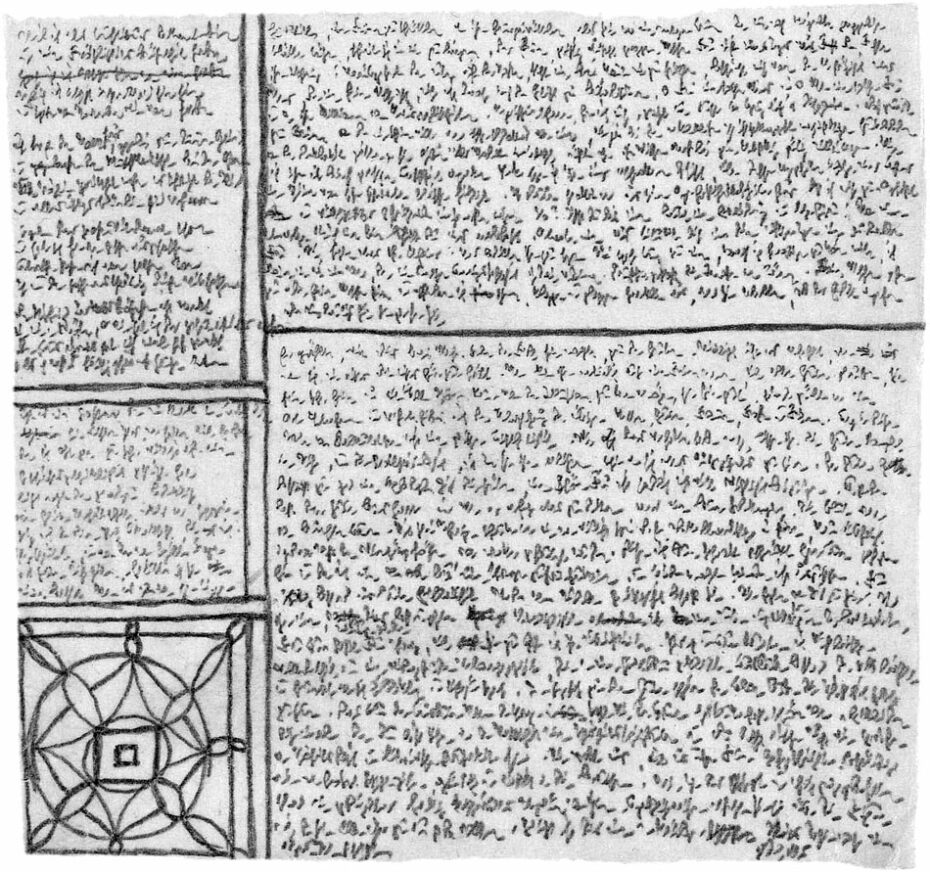
Robert Walser’s last novel, Der Räuber or The Robber, came out in 1972. Walser himself had died fifteen years earlier, having spent nearly three solid decades in a sanatorium. He’d been a fairly successful figure in the Berlin literary scene of the early twentieth century, but during his long institutionalization in his homeland of Switzerland — from which he refused to return to normal life, despite his outward appearance of mental health — he claimed to have put letters behind him. As J. M. Coetzee writes in the New York Review of Books, “Walser’s so-called madness, his lonely death, and the posthumously discovered cache of his secret writings were the pillars on which a legend of Walser as a scandalously neglected genius was erected.”
This cache consisted of “some five hundred sheets of paper covered in a microscopic pencil script so difficult to read that his executor at first took them to be a diary in secret code. In fact Walser had kept no diary. Nor is the script a code: it is simply handwriting with so many idiosyncratic abbreviations that, even for editors familiar with it, unambiguous decipherment is not always possible.”
He devised this extreme shorthand as a kind of cure for writer’s block: “In a 1927 letter to a Swiss editor, Walser claimed that his writing was overcome with ‘a swoon, a cramp, a stupor’ that was both ‘physical and mental’ and brought on by the use of a pen,” writes the New Yorker’s Deirdre Foley Mendelssohn. “Adopting his strange ‘pencil method’ enabled him to ‘play,’ to ‘scribble, fiddle about.’ ”

“Like an artist with a stick of charcoal between his fingers,” Coetzee writes, “Walser needed to get a steady, rhythmic hand movement going before he could slip into a frame of mind in which reverie, composition, and the flow of the writing tool became much the same thing.” This process facilitated the transfer of Walser’s thoughts straight to the page, with the result that his late works read — and have been belatedly recognized as reading — like no other literature produced in his time. As Brett Baker at Painter’s table sees it,” Walser’s compressed prose (rarely more than a page or two) constructs full narratives than can be consumed rapidly – nearly ‘at a glance,’ as it were. Their short length allows the reader to revisit the work in detail, focusing on sentences, phrases, or words as one might examine the painted passages or marks on a canvas.”
These ultra-compressed works from the Bleistiftgebiet, or “pencil zone,” writes Foley Mendelssohn, “establish Walser as a modernist of sorts: the recycling of materials can make the texts look like collages, modernist mashups toeing the line between mechanical and personal production.” But they also make him look like the forerunner of another, later variety of experimental literature: in a longer New Yorker piece on Walser, Benjamin Kunkel proposes 1972 as a culturally appropriate year to publish The Robber, “a fitting date for a beautiful, unsummarizable work every bit as self-reflexive as anything produced by the metafictionists of the sixties and seventies.” The publication of his “microscripts,” in German as well as in translation, has ensured him an influence on writers of the twenty-first century — and not just their choice of font size.
For anyone interested in seeing a published version of Walser’s writing, see the book Microscripts, which features full-color illustrations by artist Maira Kalman.
via Messy Nessy
Related content:
Discover Nüshu, a 19th-Century Chinese Writing System That Only Women Knew How to Write
Based in Seoul, Colin Marshall writes and broadcasts on cities, language, and culture. His projects include the Substack newsletter Books on Cities, the book The Stateless City: a Walk through 21st-Century Los Angeles and the video series The City in Cinema. Follow him on Twitter at @colinmarshall or on Facebook.
Read More...Why Music Festivals Sound Better Than Ever: A Coachella Sound Engineer Demystifies Modern Sound Systems
Back in 1965, the Beatles played Shea Stadium. And to compete with the noise generated by 55,000 screaming youth, they pumped their music through a series of Electro-Voice LR4 column speakers. But to no avail. As Ringo put it, “From the count-in on the first number, the volume of screams drowned everything else.”
It didn’t take long for rock bands to play catch up. By the 1970s, the Grateful Dead had invented the “Wall of Sound,” then the largest concert sound system ever built. Designed by Owsley “Bear” Stanley, the Dead’s sound system brought together 604 speakers, generating 26,400 watts of power in total. Expensive and unwieldy, the Wall of Sound was short-lived, soon giving way to more logistically-feasible and cost-effective touring rigs.
From there, the quest for the perfect sound system–especially ones suitable to sustain large, outdoor concerts–continued. Bringing us to today. Above, sound engineer Dave Rat breaks down exactly how modern sound systems work, “and why modern music festivals sound so much better than they used to.” Mr. Rat has provided audio for the Coachella music festival since 2001. Ergo he knows of what he speaks.
If you would like to support the mission of Open Culture, consider making a donation to our site. It’s hard to rely 100% on ads, and your contributions will help us continue providing the best free cultural and educational materials to learners everywhere. You can contribute through PayPal, Patreon, and Venmo (@openculture). Thanks!
Related Content
One Man’s Quest to Build the Best Stereo System in the World
Read More...Why Movies Don’t Feel Like Movies Anymore: The Rise of Metamodernist Films, and How They Grew Out of Modernism & Postmodernism
Say what you will about Joker; it did, at least, feel like a real movie, which is hardly true of many, if not most, of the influential feature films that have come out since. Yes, they run between 80 and 180 minutes, and yes, they were screened in theaters (though increasingly many viewers have opted to stream them at home), but despite their often considerable entertainment value, they somehow never quite satisfy. If they feel weightless to us, even trivial — shot through with not just irony and self-reference, but also jarring lapses into emotional kitsch — that must owe in large part to the impression that their creators don’t quite take their own art form seriously. Filmmakers surely still want to believe in film, but can’t be seen believing in it too strongly: this is the dilemma of our meta-modern age.
“Just in the year 2022, we saw Nope, which criticizes spectacle even as it tries to be one; The Banshees of Insherin, which is in dialogue with itself about the value of art; we saw Steven Spielberg looking back at his own life in The Fabelmans, and examining the role cinema has played in it for both good and bad — through cinema.” Thomas Flight names these pictures as examples in his new video essay on meta-modernity, a term of recent enough coinage to require definition from a variety of angles. “It seems like there’s very little straightforward storytelling in film anymore,” he says. “Movies are either part of a multidimensional franchise or are satirical, surreal, or absurd. They might contain a multiverse or twists on a classic trope, break storytelling convention, or some combination of all these things.”
No single production pulls as many of these tricks as last year’s Academy Awards-dominating Everything Everywhere All at Once (the subject of a previous Thomas Flight video essay). As much a zeitgeist picture of the early twenty-twenties as Joker was of the late twenty-tens, it shows us where cinema has arrived — for better or for worse — after its nearly century-and-a-half long journey through modernism, post-modernism, and now meta-modernism. Modernism, as Flight defines it, promotes “an objective view of reality” and “displays specific values, and then unapologetically seems to argue for those values as good and beneficial.” When those values were eventually called into question, post-modernism arose “to question the value of narrative itself.” Here Flight quotes films like Apocalypse Now, F For Fake, Blade Runner, Blue Velvet, Barton Fink, Pulp Fiction, suggesting that post-modernism was very good indeed for cinema, at least at first.
But “irony, pastiche, surrealism, and self-reflexivity” inevitably hit the saturation point; “you can only subvert expectations so many times before the new expectation becomes that expectations will be subverted, and it all starts to get a little bit old.” As post-modernism responded to modernism, so meta-modernism responds to post-modernism, attempting to lay claim to the power of both cultural periods at once. We see this in Quentin Tarantino’s Once Upon a Time… in Hollywood, as well as most of the oeuvre of Wes Anderson — but also in a lot of “swinging wildly back and forth between modernist sincerity and postmodern deconstruction,” little of it more convincing than the latest CGI extravaganza extruded by any given superhero franchise. Still, it’s early day in our era of meta-modernity; when its arts reach maturity, perhaps we’ll wonder how we ever saw the world before them.
Related Content:
David Foster Wallace on What’s Wrong with Postmodernism: A Video Essay
Quentin Tarantino’s Once Upon a Time… in Hollywood Examined on Pretty Much Pop #12
How Ridley Scott’s Blade Runner Illuminates the Central Problem of Modernity
Nietzsche and the Postmodern Condition: A Free Philosophy Course by Rick Roderick
Based in Seoul, Colin Marshall writes and broadcasts on cities, language, and culture. His projects include the Substack newsletter Books on Cities, the book The Stateless City: a Walk through 21st-Century Los Angeles and the video series The City in Cinema. Follow him on Twitter at @colinmarshall or on Facebook.
Read More...J. R. R. Tolkien Writes & Speaks in Elvish, a Language He Invented for The Lord of the Rings
J. R. R. Tolkien was undoubtedly a storyteller, but he was even more of a world-builder. One may read the Lord of the Rings novels the first time for the high adventure, but one re-reads them to continue inhabiting the painstakingly crafted alternate reality of Middle-Earth. Tolkien put serious time and effort into the diversity of not just its magic, its geography, and its inhabitants, but also of its languages. Indeed, the whole of his masterwork could fairly be said to have served his linguistic interests first and foremost: “Invention of languages is the foundation,” he once wrote. “The ‘stories’ were made rather to provide a world for the languages than the reverse.”
An Oxford philologist with a special interest in Old Norse, Tolkien had been experimenting with constructed languages since adolescence. But it was The Lord of the Rings that allowed him to engage fully in that pursuit, spurring the creation of such tongues as Adûnaic, Dwarvish, and Entish. Like anyone of his linguistic expertise, he understood that, in reality, most languages come to us not in isolation but in families, and it is the family of Elvish languages — including Quendya, Exilic Quenya, Telerin, Sindarin, and Nandorin — that represents the pinnacle of his language-construction project.
In the video at the top of the post, Tolkien himself reads aloud an Elvish-language poem. Just below, you can see him writing in Elvish script, or Tengwar, one of the seven writing systems he created for The Lord of the Rings alone. He didn’t just assemble it out of forms that looked nice to him: much as with the Elvish language itself, he made sure that it plausibly descended from more basic ancestors, and that it reflected the history, social practices, and mythology of its fictional users. But nor are Elvish or Tengwar completely free of any influence from what’s spoken and written in our own world, given that Tolkien could draw on English, Old Norse, and Latin, but also Old English, Gothic, Spanish, Italian, and Greek.
Tolkien also took a strong interest in the Finnish language. In a letter to W. H. Auden, he likened it to “a complete wine-cellar filled with bottles of an amazing wine of a kind and flavor never tasted before.” The influence of Finnish manifests in certain traits of the Elvish language of Quenya — “the absence of any consonant combinations initially, the absence of the voiced stops b, d, g (except in mb, nd, ng, ld, rd, which are favored) and the fondness for the ending -inen, ‑ainen, ‑oinen” — but one suspects that Tolkien’s broader literary sensibility was shaped more by the Kalevala, the nineteenth-century national epic that inspired him to take up the study of Finnish in the first place. How close he ever got to mastery history hasn’t recorded, but as a fellow Finnish-learner, I can attest that se ei ole helppoa.
Related content:
Map of Middle-Earth Annotated by Tolkien Found in a Copy of Lord of the Rings
Animated Video Explores the Invented Languages of Lord of the Rings, Game of Thrones & Star Trek
Based in Seoul, Colin Marshall writes and broadcasts on cities, language, and culture. His projects include the Substack newsletter Books on Cities, the book The Stateless City: a Walk through 21st-Century Los Angeles and the video series The City in Cinema. Follow him on Twitter at @colinmarshall or on Facebook.
Read More...
Support Us
We're hoping to rely on loyal readers, rather than erratic ads. Please click the Donate button and support Open Culture. You can use Paypal, Venmo, Patreon, even Crypto! We thank you!

About Us

Open Culture scours the web for the best educational media. We find the free courses and audio books you need, the language lessons & educational videos you want, and plenty of enlightenment in between.
Advertise With Us
FREE UPDATES!
GET OUR DAILY EMAIL
Get the best cultural and educational resources on the web curated for you in a daily email. We never spam. Unsubscribe at any time.
FOLLOW ON SOCIAL MEDIA
Open Culture editor Dan Colman scours the web for the best educational media. He finds the free courses and audio books you need, the language lessons & movies you want, and plenty of enlightenment in between.
Advertise With Us

