How to Bake Ancient Roman Bread from 79 AD: A Video Introduction
Ecce panis—try your hand at the kind of loaf that Mel Brooks’ 2000-year-old man might have sunk his teeth into. Literally.
In 1930 a loaf of bread dating to AD 79 (the year Vesuvius claimed two prosperous Roman towns) was excavated from the site of a bakery in Herculaneum.
Eighty-three years later, the British Museum invited London chef Giorgio Locatelli, above, to take a stab at creating an edible facsimile for its Pompeii Live exhibition.
The assignment wasn’t as easy as he’d anticipated, the telegenic chef confesses before whipping up a lovely brown miche that appears far more mouth-watering than the carbonized round found in the Herculaneum oven.
His recipe could be mistaken for modern sourdough, but he also has a go at several details that speak to bread’s role in ancient Roman life:
Its perimeter has a cord baked in to provide for easy transport home. Most Roman homes were without ovens. Those who didn’t buy direct from a bakery took their dough to community ovens, where it was baked for them overnight.
The loaf was scored into eight wedges. This is true of the 80 loaves found in the ovens of the unfortunate baker, Modestus. Locatelli speculates that the wedges could be used as monetary units, but I suspect it’s more a business practice on par with pizza-by-the-slice.
(Nowadays, Roman pizza is sold by weight, but I digress.)
The crust bears a telltale stamp. Locatelli takes the opportunity to brand his with the logo of his Michelin-starred restaurant, Locanda Locatelli. His inspiration is stamped ‘Property of Celer, Slave of Q. Granius Verus.’ To me, this suggests the possibility that the bread was found in a communal oven.
Locatelli also introduces a Flintstonian vision when he alludes to specially-devised labor-saving machines to which Roman bakers yoked “animals,” presumably donkeys…or knowing the Romans and their class system, slaves.
His published recipe is below. Here is a conversion chart for those unfamiliar with metric measurements.
INGREDIENTS
400g biga acida (sourdough)
12g yeast
18g gluten
24g salt
532g water
405g spelt flour
405g wholemeal flour
Melt the yeast into the water and add it into the biga. Mix and sieve the flours together with the gluten and add to the water mix. Mix for two minutes, add the salt, and keep mixing for another three minutes. Make a round shape with it and leave to rest for one hour. Put some string around it to keep its shape during cooking. Make some cuts on top before cooking to help the bread rise in the oven and cook for 30–45 minutes at 200 degrees.
For an even more artisanal attempt (and extremely detailed instructions) check out the Artisan Pompeii Miche recipe on the Fresh Loaf bread enthusiast community.
True Roman bread for true Romans!
Note: An earlier version of this post appeared on our site in 2015.
Related Content:
Explore the Roman Cookbook, De Re Coquinaria, the Oldest Known Cookbook in Existence
Cook Real Recipes from Ancient Rome: Ostrich Ragoût, Roast Wild Boar, Nut Tarts & More
Ayun Halliday is an author, illustrator, and Chief Primatologist of the East Village Inky zine. Follow her @AyunHalliday
Read More...Hear a Recently-Discovered 12,000-Year-Old Flute That Musically Mimics the Sound of Raptor Calls
Here on Open Culture, we’ve featured ancient wind instruments going back 9,000, 18,000, even 43,000 years. Just this month, archaeological research has just added a new item to this venerable lineup: a set of 12,000-year-old flutes made from the bones of birds. “The instruments are among the oldest in the world and, according to the researchers, represent the first to be found in the Levant, the region that fostered the first stages of the Neolithic Revolution approximately 12,000 years ago,” writes Discover’s Sam Walters. They’re creations of the Natufian civilization, which “bridged the difference between the foraging of the Paleolithic period and the agriculture of the Neolithic,” and which was “the first to adopt a sedentary lifestyle in the Levant.”
The bones were unearthed in Eynan-Mallaha, which is part of modern-day northern Israel’s Hula Valley. It was “during a recent examination of the artifacts,” writes Smithsonian.com’s Teresa Nowakowski, that “scientists noticed that seven had strange features — like finger holes and mouthpieces — that would have allowed them to function as musical instruments.”
You can read in detail about the discovery and study of these ancient instruments in the article published earlier this month in Scientific Reports. Nowakowski quotes its co-author Tal Simmons as saying that “the sound they produce is very similar to that of two specific birds of prey that were hunted by the people living at the site where they were discovered, namely the kestrel and the sparrowhawk.”
Only the most bird-oriented among us could easily imagine what that sounds like. But they’d surely also be interested to hear the Natufian flute itself, and how closely it, in fact, mimics those calls. The video above offers about a minute of the sound of a replica, the creation of which would have involved a considerable amount of small-detail work, given the tiny size of the bird bones from which the originals were crafted. “Though there were plenty of bigger bird bones preserved at the site, which would have been better for turning into instruments as well as for playing, the Natufians specifically selected smaller bones that produced a screechy sound similar to a bird of prey,” writes Walters. They thus created a useful hunting tool — but they also opened to their civilization a whole new dimension of music.
Related content:
Hear a 9,000 Year Old Flute — the World’s Oldest Playable Instrument — Get Played Again
Hear the Sound Of Endangered Birds Get Turned Into Electronic Music
Hear a Prehistoric Conch Shell Musical Instrument Played for the First Time in 18,000 Years
Hear the World’s Oldest Instrument, the “Neanderthal Flute,” Dating Back Over 43,000 Years
Based in Seoul, Colin Marshall writes and broadcasts on cities, language, and culture. His projects include the Substack newsletter Books on Cities, the book The Stateless City: a Walk through 21st-Century Los Angeles and the video series The City in Cinema. Follow him on Twitter at @colinmarshall or on Facebook.
Read More...Behold a 19th-Century Atlas of the United States, Designed for Blind Students (1837)
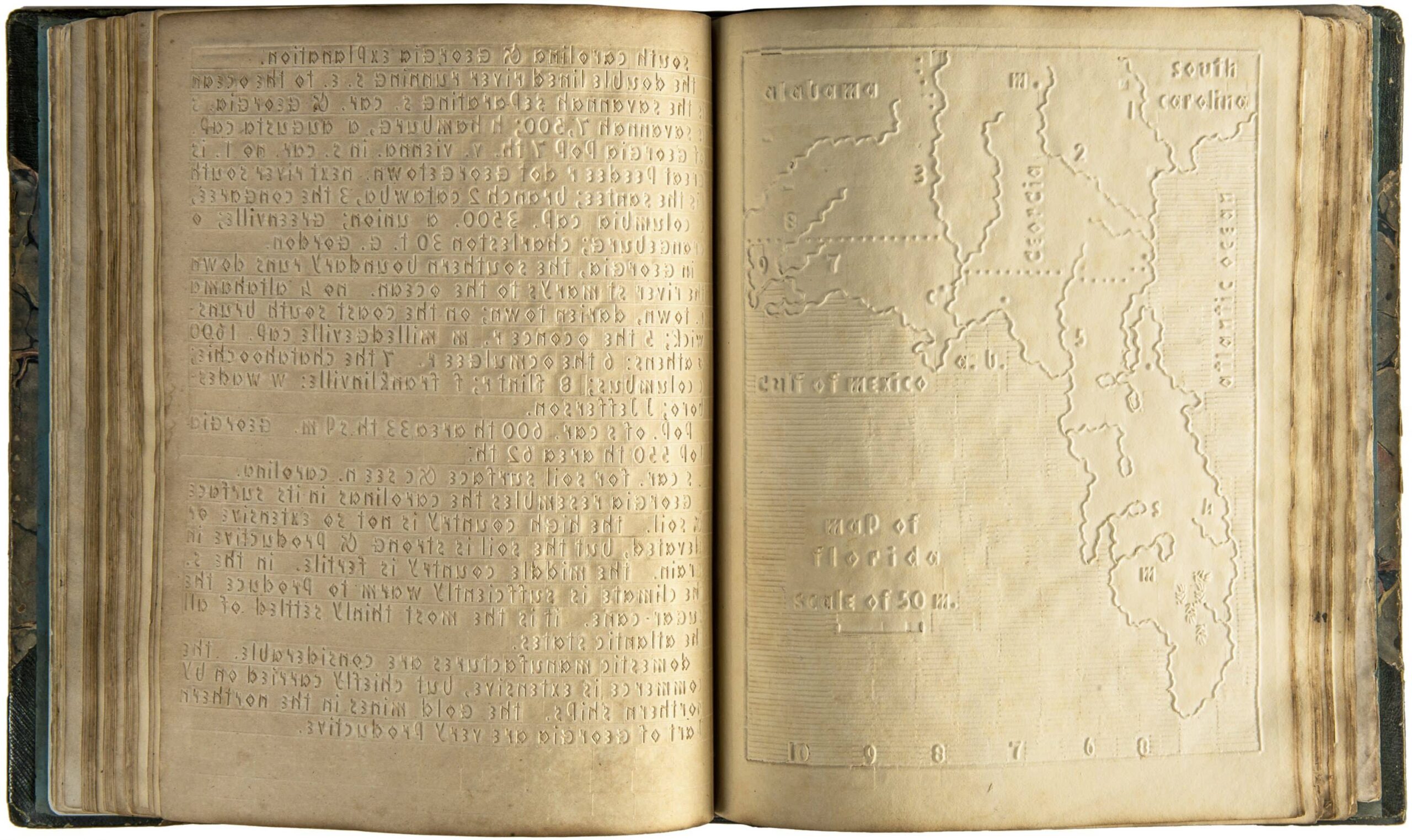
In 1835, the New England Institution for Education of the Blind (now known as Perkins School for the Blind) acquired a printing press.
Under the leadership of its first director, Samuel Gridley Howe, the press was customized in order to print in raised text that allowed blind and visually impaired people to read unassisted.
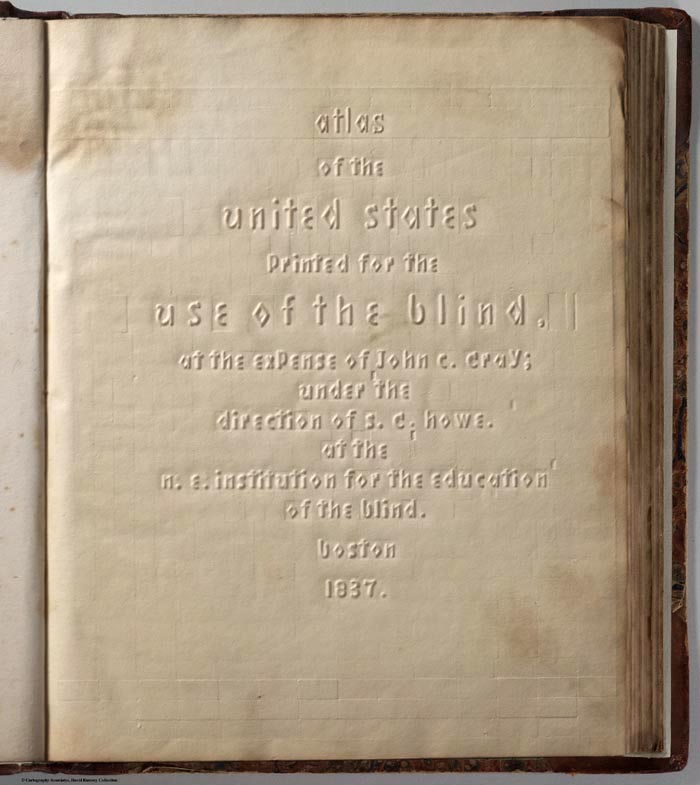
Inclusivity was a prime motivator for Howe, who strove to make sure his students would not be “doomed to inequality” or regarded as “mere objects of pity.”
After investigating European tactile printing systems, he developed Boston Line Type, an embossed Roman alphabet that could be read with the fingers.
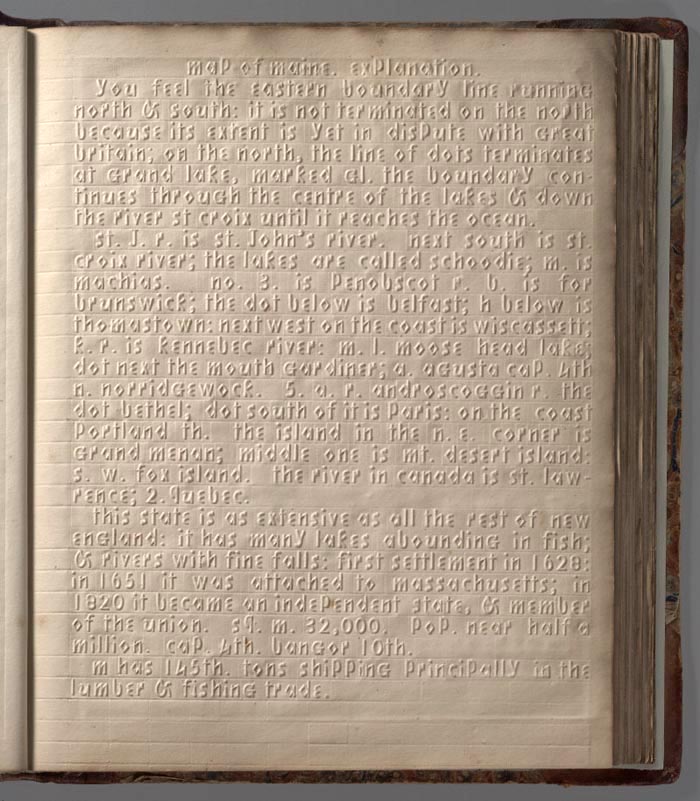
It eschewed flourishes and capital letters, but reading it required a lot of training and even then, was likely to be slow going. Howe estimated that reading it would take three times as long as a sighted person would take to read an equivalent amount of traditionally printed text.
Ultimately it proved far less user-friendly than braille.
Text accompanying the exhibition Touch This Page! Making Sense of the Ways We Read, notes that braille had been in use in Great Britain and France for decades before being widely adopted in the US:
The amount of time and money that Perkins and other American schools had invested into Boston Line Type made them resistant to adopting a new system. Boston Line Type was, however, much harder to learn than braille, and only braille allowed individuals with visual impairments to read and write tactilely.
The school used its Boston Line Type press to publish history, grammar, and spelling books, as well as the New Testament, and a complete Bible.
After a visit to the school, Charles Dickens paid to have 250 Boston Line Type copies of his novel The Old Curiosity Shop printed for distribution to blind Americans.
In light of Touch This Page!’s assertion that Boston Line Type’s print forms were “designed to be universally accessible rather than in those [print forms] most accessible to the touch”, we suspect that the school’s 1837 Atlas of the United States offered its readers the best value.
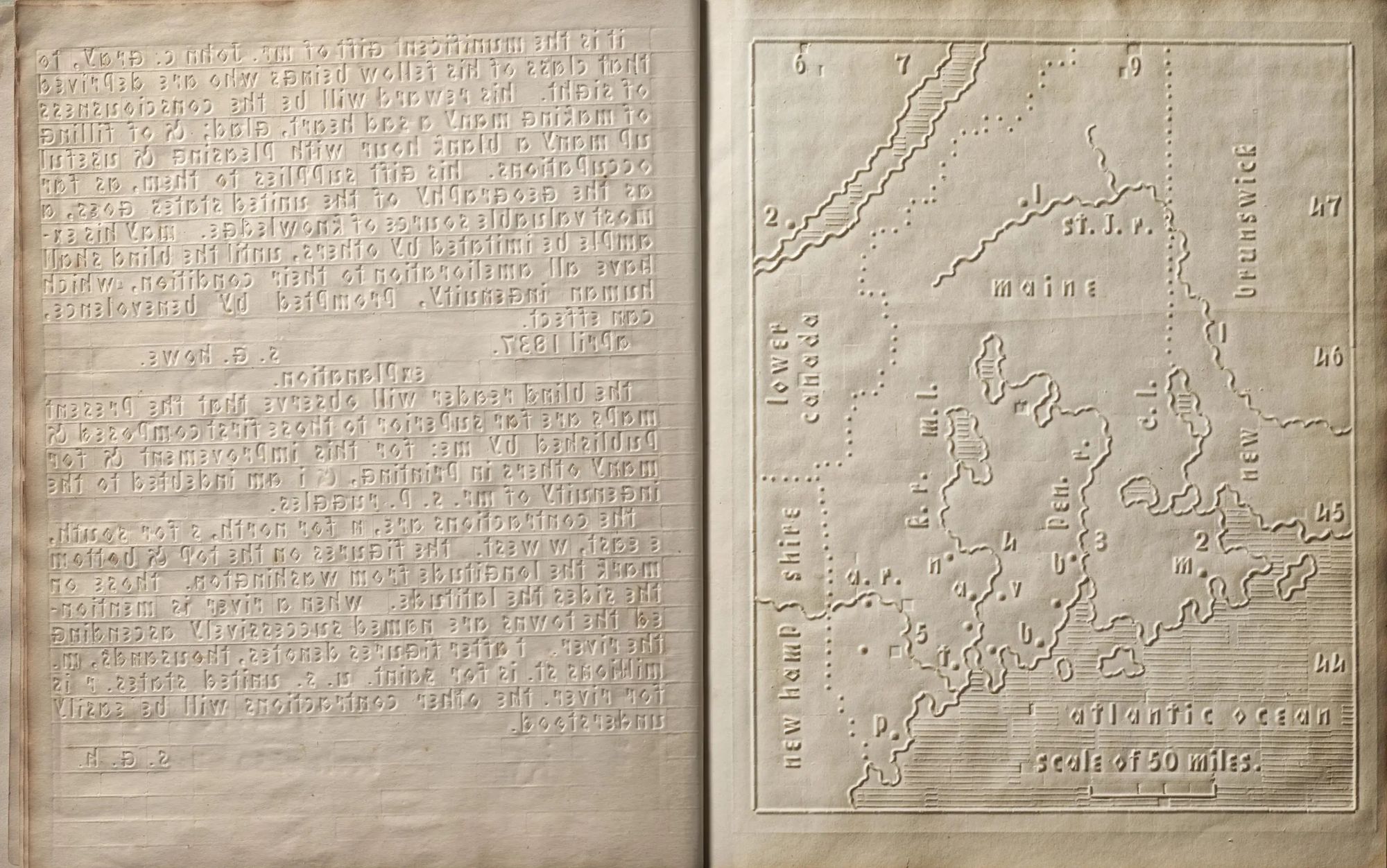
While there were many dense descriptive passages in Boston Line Type to wade through, it also boasted embossed maps to orient geography students with raised outlines of each state.
Rivers were charted as solid raised lines, while oceans were indicated with parallel lines. Sets of triangles represented mountains.
Longitudes, latitudes, and city locations were also noted, but the presence of negative space gave blind and low vision students the opportunity to grasp information quickly.
50 copies were printed, of which four survive.
Explore the Atlas of the United States Printed for the Use of the Blind here.
Related Content
Please Touch the Art: Watch a Blind Man Experience His Own Portrait for the First Time
Helen Keller Had Impeccable Handwriting: See a Collection of Her Childhood Letters
– Ayun Halliday is the Chief Primatologist of the East Village Inky zine and author, most recently, of Creative, Not Famous: The Small Potato Manifesto and Creative, Not Famous Activity Book. Follow her @AyunHalliday.
Read More...When Henri Matisse Was 83 Years Old, He Couldn’t Go to His Favorite Swimming Pool, So He Created a Swimming Pool as a Work of Art
I will die from the heat, take me home. I will make my own Pool. — Henri Matisse
Representing water is an elusive proposition for many artists, especially when it’s not posing placidly on a windless, moonlit evening.
In the summer of 1952, Henri Matisse headed to a favorite Cannes swimming pool with his studio assistant (and favored model), Lydia Delectorskaya.
Shortly after their arrival, the octogenarian became overwhelmed by the heat, and the two doubled back to his home in Nice, where he instructed Delectorskaya to pin white paper to the burlap wall treatment of his dining room, until it ringed the room at head level.
This tabula rasa became the pool that he filled with swimmers, divers and marine creatures he cut from paper his assistants had colored ultramarine blue with gouache.
His shapes were both simple and evocative, suggesting all the exuberant lifeforms splashing in a swimming pool on a sweltering summer’s day.
They adorned the walls of his dining room until his death, two years later.
His widow supervised its removal, making sure that the placement of the individual cut outs could be duplicated on fresh white paper pinned to new burlap panels.
The Museum of Modern Art acquired The Swimming Pool, Matisse’s first and only self-contained, site-specific cut-out in 1975, exhibiting it to great acclaim.
Welcome summer by taking a stroll through the installation with membership guest specialist Josephine McReynolds, above.
McReynolds, a 2019 graduate of the University of Texas, finds in the work a blurring of the boundaries between early childhood and old age, drawing on our collective memories of summer to “provide the life force in this pool.”
While we’re at it, we should thank MoMA’s conservators for their efforts to restore and preserve The Swimming Pool after determining it had suffered extreme damage from the acidity of the burlap, and exposure to light and atmospheric pollution.
Senior conservator Karl Buchberg estimates that it took some 2000 hours just to separate the paper elements from the burlap using a scalpel, rotary tool, and, in places, dismantling the burlap strand by strand by pulling on individual threads.
The conservators restored the color balance to the best of their abilities and reinstalled the work at its intended height, in a configuration that mimics the architecture of the Matisses’ dining room.
Read more about the conservation of Matisse’s The Swimming Pool here.
– Ayun Halliday is the Chief Primatologist of the East Village Inky zine and author, most recently, of Creative, Not Famous: The Small Potato Manifesto and Creative, Not Famous Activity Book. Follow her @AyunHalliday.
Read More...What Is Gender Theory? Berkeley Professor Judith Butler Explains
Nobody who keeps up with current discourse could fail to notice that gender has become a fraught topic in recent years. This condition can hardly have gone unforeseen by the theorist Judith Butler, who published the now-well-known volume Gender Trouble: Feminism and the Subversion of Identity back in 1990. “Everybody has a theory of gender,” Butler says in the new Big Think video above. “Everybody has certain assumptions going about what gender is or should be. And at a certain point in life, we ask ourselves, ‘Wow, where’d that assumption come from?’ ” Butler’s career has, in part, focused on the search for the roots of these very assumptions.
This experience places Butler well to comment on the heated arguments about gender being stoked even now in the political realm, on social media, and elsewhere besides. “We have a whole range of differences, biological in nature, so I don’t deny them, but I don’t think they determine who we are in some sort of final way.”
As with many controversies — not least philosophical ones — a core problem has to do with differing definitions of words and concepts. At issue here in particular is “the distinction between sex and gender,” achieving a full understanding of which, to Butler’s mind, requires delving into all the relevant history, including the work of theorists like Gayle Rubin, Juliet Mitchell, and Simone de Beauvoir.
According to Butler, the “basic point” of de Beauvoir’s The Second Sex is that “one is not born a woman, but rather becomes one, that the body is not a fact.” This possibility opened by de Beauvoir — that of “a difference between the sex you’re assigned and the sex you become” — has been much explored since the book’s publication nearly three quarters of a century ago. Some of those explorations have involved the idea of the “performative.” “We do enact who we are,” Butler says. “There are performances that we do in our lives that are not mere performance; they’re not fake.” Following on that, “what if we were to say that, in acting our lives as a particular gender, we are actually realizing that gender anew?” For many readers of gender theory, this raises a host of thrilling new possibilities, but behind it lies perhaps the oldest philosophical question of all: what, now, will you do?
Related content:
An Animated Introduction to the Feminist Philosophy of Simone de Beauvoir
Based in Seoul, Colin Marshall writes and broadcasts on cities, language, and culture. His projects include the Substack newsletter Books on Cities, the book The Stateless City: a Walk through 21st-Century Los Angeles and the video series The City in Cinema. Follow him on Twitter at @colinmarshall or on Facebook.
Read More...
Discover The Plastics, the Influential Japanese New Wave Band from the 1980s
Brian Eno famously said of the Velvet Underground that, though their debut album didn’t sell well, everyone who bought a copy started a band. One could, perhaps, make a similar remark about a new wave band called The Plastics, who formed a decade or so later on the other side of the Pacific. They recorded for only five years, from the mid-nineteen-seventies to the early eighties, but wide swaths of all Japanese popular music released since bear marks of their influence. According to Underground, co-founder Toshio Nakanishi, who sang and played guitar, is “now considered one of the most well-known Japanese musicians of all time.”
“One day in 1976,” writes Neojaponisme’s W. David Marx, the 20-year-old Nakanishi “gathered his friends at Harajuku’s most famous cafe, Leon, and decided they needed to form a band. They did not own any instruments, but music seemed an obvious means of expression.” They began by covering the likes of Leslie Gore’s “It’s My Party” and Connie Francis’ “Vacation” at fashion parties, but were soon advised by the visiting David Bowie to write songs of their own; subsequent well-timed encounters with the work of bands like the Sex Pistols and Devo gave them an idea of how to do it.
“The Plastics’ reliance on the latest Western musical trends was a common practice in the Tokyo music scene, but unlike their predecessors, the band was able to be in dialogue with their favorite Western artists in real time.”
Marx quotes Nakanishi writing in his autobiography that “YMO’s record label plotted to make them international, but we forged all of those developments ourselves and the label just followed up.” Those developments included the members’ associations with Western musical figures as various as Mark Mothersbaugh, Brian Ferry, Bob Marley, and Iggy Pop. When the group’s guitarist Hajime Tachibana, who also worked as a graphic designer, created Japanese tour programs for Talking Heads, David Byrne ended up with a Plastics demo tape in hand, which he passed along to the B‑52s, who passed it along to their manager, who signed them. The height of their exposure to Western audiences came in 1982, when SCTV aired the music video for their song “Top Secret Man” on its “Midnight Video Special.”
Clad in checkerboard-and-neon retro fashions, singing nonsensically catchy lyrics, and busting extravagantly herky-jerky dance moves against void-like backdrops, the members of The Plastics come off in the “Top Secret Man” as near-parodic embodiments of the new wave musical aesthetic. That they also happened to be Japanese surely added, for Western viewers those four decades ago, a certain layer of cross-cultural absurdity. “Indeed, is the disparity between the East and West which sets the Plastics apart from their contemporaries,” says Undeground, “their lyrics citing Bauhaus and Russian avant-garde, technology and American consumerism through their remote, Japanese lens.” (Marx quotes Byrne’s observation that “the very name Plastics was a tip off: an ironic take on the common Western perception of Japanese products being ‘plastic,’ and therefore inferior copies of better made Western items.”)
Having spent the decade since the war both absorbing Western popular culture and achieving an almost futuristically advanced level of development, the Japan of the early eighties had actually become an ideal place to develop new wave’s signature incongruity of D.I.Y and high tech. Plastics Masahide Sakuma even worked on the development of Roland’s TR-808, and before that drum machine went on to shape the sound of entire genres of music around the world, his band owned the very first model. Alas, Sakuma and Nakanishi both died in the twenty-tens, and with them the possibility of a true Plastics reunion. But it would be a surprise if their three albums — Welcome Plastics, Origato Plastico, and the West-oriented set of remakes Welcome Back — don’t still have more than a few new bands, Eastern or Western, to inspire.
Related content:
Ryuichi Sakamoto, RIP: Watch Him Create Groundbreaking Electronic Music in 1984
The Clash Live in Tokyo, 1982: Watch the Complete Concert
Based in Seoul, Colin Marshall writes and broadcasts on cities, language, and culture. His projects include the Substack newsletter Books on Cities, the book The Stateless City: a Walk through 21st-Century Los Angeles and the video series The City in Cinema. Follow him on Twitter at @colinmarshall or on Facebook.
Read More...What Did Music in Ancient Rome Sound Like?
Almost all of ancient literature is lost to us, as classical-history Youtuber Garrett Ryan explains in a video previously featured here on Open Culture. But we have even less ancient music, given that form’s essential ephemerality as well as the not-inconsiderable fact that the ancients didn’t have tape recorders. Still, that hasn’t stopped Ryan from describing to us what music would have sounded like in the heyday of the Roman Empire in the video above, for his channel Told in Stone. Not only does he introduce the instruments played by the popular musicians of ancient Rome, he also evokes the atmosphere of ancient Roman concerts, which had their own “equivalent of rock stars, notorious for selling out theaters, sparking riots, and talking back to emperors.”
They did all of this by mastering what look to us like simple tools indeed. The dominant examples of these were the cithara, a kind of lyre amplified by a sound box; the tibia or aulos, whose two pipes could be played at once (thus producing “a fluttering counterpoint that audiences found wildly exciting”); and the hydraulis or water organ, the rare instrument that could be heard even over a loud crowd.
Though Roman musicians could be virtuosic in their technique, some still consider them “hacks, content to borrow Greek music without anything substantial to it.” Ryan acknowledges that in music, as in certain other realms, Romans did indeed pick up where the Greeks left off, but “over time they evolved both a distinctive musical culture and distinctive tastes in musical spectacle.”
Despite the aforementioned lack of tapes — to say nothing of CDs, MP3 players, or streaming services — music was “everywhere in ancient Rome.” One would hear it at religious rituals, sacrifices included; at festivals, where hymns were sung in honor of the gods; during gladiatorial combat, when the organs “roared as men and beasts battled in the bloodstained sands”; in private gardens and dining rooms; on street corners and plazas, full of the ancient version of buskers; often the theater and less often at musical contests judged by the emperor himself. But it was the most skilled soloists who became renowned across the empire and “inspired something like Beatlemania, driving aristocratic ladies to fight for cast-off plectrums and lyre strings.” For those besieged Roman rock stars, alas, it was a couple thousand years too early to make a Beatles-style retreat into the studio.
Related content:
What Ancient Greek Music Sounded Like: Hear a Reconstruction That is “100% Accurate”
The Evolution of Music: 40,000 Years of Music History Covered in 8 Minutes
Hear the Oldest Song in the World: A Sumerian Hymn Written 3,400 Years Ago
A Street Musician Plays Pink Floyd’s “Time” in Front of the 1,900-Year-Old Pantheon in Rome
Based in Seoul, Colin Marshall writes and broadcasts on cities, language, and culture. His projects include the Substack newsletter Books on Cities, the book The Stateless City: a Walk through 21st-Century Los Angeles and the video series The City in Cinema. Follow him on Twitter at @colinmarshall or on Facebook.
Read More...How Carole King Revolutionized ’70s Music
In 1960, The Shirelles became the first Black female group to have a #1 US hit with “Will You Love Me Tomorrow?”.
The song also represented a big break for its composer, 17-year-old Carole King, and her then-husband, lyricist Gerry Goffin.
The two set up shop in New York City’s Brill Building, a pre-British Invasion hotbed of songwriting teams, cranking out pop tunes for others to record.
King and Goffin’s collaboration was a fruitful one for both themselves and the artists they sent climbing the charts:
Bobby Vee with “Take Good Care of My Baby”.
The Chiffons with “One Fine Day”.
The Monkees with “Pleasant Valley Sunday”.
“Little Eva” Boyd (the couple’s babysitter) with “The Loco-Motion”.
Aretha Franklin with “(You Make Me Feel Like) A Natural Woman”.
The late 60s ushered in both a musical and social revolution.
As King writes in her memoir, A Natural Woman, “Had I been forty-two and Gerry forty-five, I might have understood his yearning for the Bohemian lifestyle he’d never had:”
But I was a twenty-two year old wife and mother losing my twenty-five year old husband to avant-garde ideas. I wanted my life back. Unfortunately, yesterday had a no return policy, and today wasn’t where I wanted to be. I could only hope tomorrow would be better.
The couple split in 1968, and King left New York for LA, settling in Laurel Canyon, another hive of musical activity. Here, however, singers like Joni Mitchell, James Taylor, and Neil Young wrote their own songs, sharing intimate details of their lives and relationships in the name of creative expression.
King began to explore these avenues, too, though as Polyphonic’s Noah Lefevre observes in the above video essay on her seminal second album, 1971’s Tapestry, the Brill Building’s high bar for solid song craft and catchy hooks had become part of her DNA.
Her first solo recording was little heralded, but Tapestry was a smash from the get go, nabbing King Grammys for both record and song of the year, the first female solo act to be so recognized:
Tapestry changed my life. In an immediate way, it gave me financial independence, which was really wonderful. Less immediate and in an ongoing way, it opened doors.
Released as second wave feminism was cresting, Tapestry’s lyrics resonated with many women who, raised on dreams of marriage and motherhood, found themselves seeking fulfillment elsewhere, whether by choice or circumstance.
Compared to Joni Mitchell’s confessional Blue, Polyphonic’s Lefevre sees Tapestry as a work of “quiet resilience.”
It modeled the soft rock sound that became a 70s staple, and its cover art eschewed the idea of artist as glamorous being, in favor of an approachable human-scale individual.
It also afforded King the opportunity for timely reinterpretations of “Will You Still Love Me Tomorrow” and “A Natural Woman,” this time as a singer-songwriter.
Listen to Carole King’s Tapestry here.
– Ayun Halliday is the Chief Primatologist of the East Village Inky zine and author, most recently, of Creative, Not Famous: The Small Potato Manifesto and Creative, Not Famous Activity Book. Follow her @AyunHalliday.
Read More...Some of the Oldest Photos You Will Ever See: Discover Photographs of Greece, Egypt, Turkey & Other Mediterranean Lands (1840s)
Beginning in the late seventeenth century, aristocratic Englishmen or continental Europeans came of age and went on a Grand Tour. Lasting anything from few a months to a few years, such trips were meant directly to expose their young takers to the legacy of the Renaissance and antiquity. Naturally, most Grand Tour itineraries placed the utmost importance on Italy and Greece; some even went to the Holy Land, as satirized by Mark Twain in The Innocents Abroad. By the time that book was published in 1869, the Grand Tour was out of high fashion — but a couple of decades earlier, Joseph-Philibert Girault de Prangey had preserved many of its destinations with a piece of cutting-edge technology known as the camera.
Girault de Prangey went on his first photographic “Grand Tour” in 1841, when he was in his late thirties. Having already traveled extensively and received an education in both art and law, he was hardly a callow youth in need of refinement. But he was an aristocrat, the sole inheritor of his family fortune, and thus able to “devote his life to his passions: travel, arts, and publishing.”
So says the narrator of the Kings and Things video above, which tells the story of how Girault de Prange managed to leave us the earliest known photographs of a large swath of the world. This project “took him from Italy to Greece, Egypt, Turkey, and the Levant, he captured over 1,000 photographs, with subjects ranging from streetscapes and architectural details to nature and landscapes and portraits of local people.”
Not that photography per se was Girault de Prangey’s goal; for him, taking a picture constituted merely an early step in the creation of a drawing or painting. “Although he only intended to use them as a sort of sketch to refer to back home in his studio,” he “arranged his pictures so as to produce a sense of drama or mystery, and this artistic sensibility sets him apart from many other pioneers of photography, who were primarily technicians or inventors.” The age of the Grand Tour was ending even in Girault de Prangey’s day, but 180 years later (and about a century after their rediscovery in one of his estate’s storerooms), his photographs send us on a very different kind of trip: not just across the world, but — much more thrillingly — deep back in time as well.
via Aeon
Related content:
The First Photograph Ever Taken (1826)
See the First Photograph of a Human Being: A Photo Taken by Louis Daguerre (1838)
Take a Visual Journey Through 181 Years of Street Photography (1838–2019)
The First Surviving Photograph of the Moon (1840)
Based in Seoul, Colin Marshall writes and broadcasts on cities, language, and culture. His projects include the Substack newsletter Books on Cities, the book The Stateless City: a Walk through 21st-Century Los Angeles and the video series The City in Cinema. Follow him on Twitter at @colinmarshall or on Facebook.
Read More...The Three Punctuation Rules of Cormac McCarthy (RIP), and How They All Go Back to James Joyce
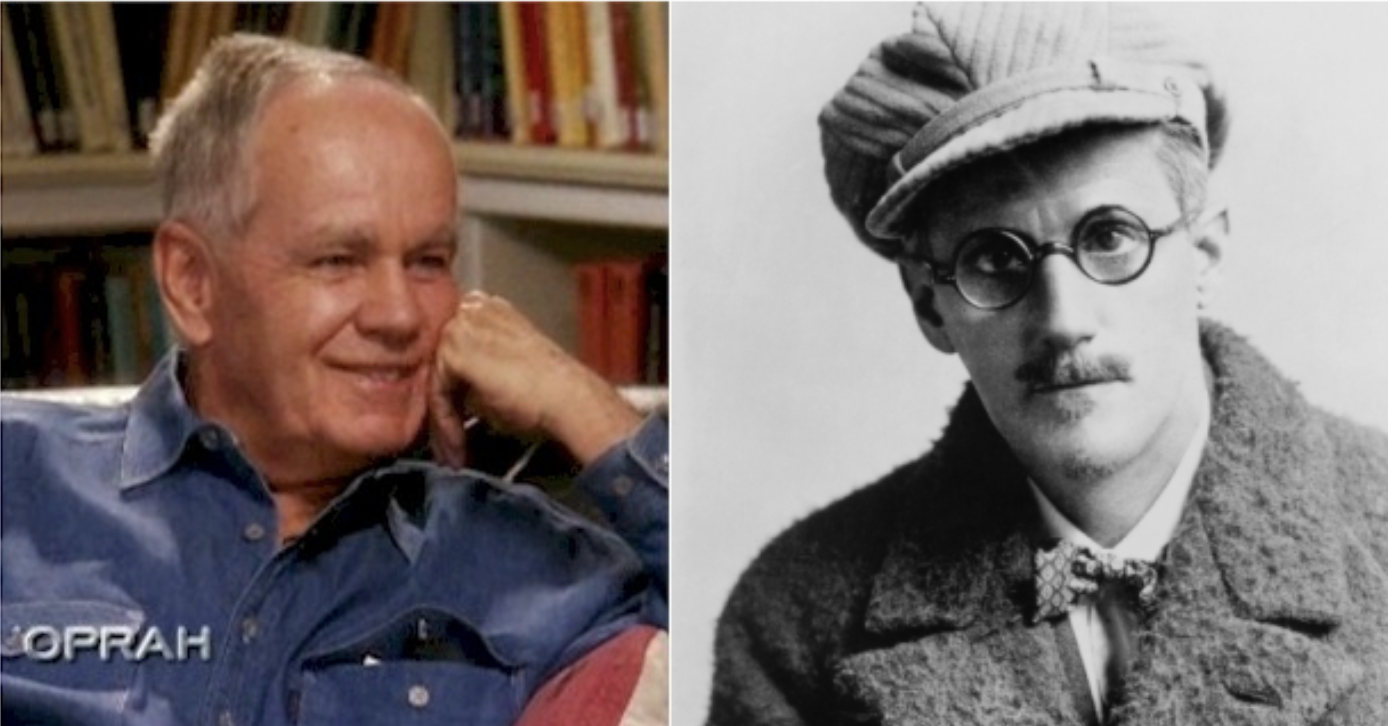
Note: Today novelist Cormac McCarthy (All the Pretty Horses, The Road and No Country for Old Men) passed away at the age of 89. Below, we’re revisiting a favorite post from our archive that focuses on punctuation, a distinctive element of McCarthy’s writing.
Cormac McCarthy has been—as one 1965 reviewer of his first novel, The Orchard Keeper, dubbed him—a “disciple of William Faulkner.” He makes admirable use of Faulknerian traits in his prose, and I’d always assumed he inherited his punctuation style from Faulkner as well. But in his very rare 2008 televised interview with Oprah Winfrey, McCarthy cites two other antecedents: James Joyce and forgotten novelist MacKinlay Kantor, whose Andersonville won the Pulitzer Prize in 1955. Joyce’s influence dominates, and in discussion of punctuation, McCarthy stresses that his minimalist approach works in the interest of maximum clarity. Speaking of Joyce, he says,
James Joyce is a good model for punctuation. He keeps it to an absolute minimum. There’s no reason to blot the page up with weird little marks. I mean, if you write properly you shouldn’t have to punctuate.
So what “weird little marks” does McCarthy allow, or not, and why? Below is a brief summary of his stated rules for punctuation:
1. Quotation Marks:
McCarthy doesn’t use ’em. In his Oprah interview, he says MacKinlay Kantor was the first writer he read who left them out. McCarthy stresses that this way of writing dialogue requires particular deliberation. Speaking of writers who have imitated him, he says, “You really have to be aware that there are no quotation marks, and write in such a way as to guide people as to who’s speaking.” Otherwise, confusion reigns.
2. Colons and semicolons:
Careful McCarthy reader Oprah says she “saw a colon once” in McCarthy’s prose, but she never encountered a semicolon. McCarthy confirms: “No semicolons.”
Of the colon, he says: “You can use a colon, if you’re getting ready to give a list of something that follows from what you just said. Like, these are the reasons.” This is a specific occasion that does not present itself often. The colon, one might say, genuflects to a very specific logical development, enumeration. McCarthy deems most other punctuation uses needless.
3. All other punctuation:
Aside from his restrictive rationing of the colon, McCarthy declares his stylistic convictions with simplicity: “I believe in periods, in capitals, in the occasional comma, and that’s it.” It’s a discipline he learned first in a college English class, where he worked to simplify 18th century essays for a textbook the professor was editing. Early modern English is notoriously cluttered with confounding punctuation, which did not become standardized until comparatively recently.
McCarthy, enamored of the prose style of the Neoclassical English writers but annoyed by their over-reliance on semicolons, remembers paring down an essay “by Swift or something” and hearing his professor say, “this is very good, this is exactly what’s needed.” Encouraged, he continued to simplify, working, he says to Oprah, “to make it easier, not to make it harder” to decipher his prose. For those who find McCarthy sometimes maddeningly opaque, this statement of intent may not help clarify things much. But lovers of his work may find renewed appreciation for his streamlined syntax.
Related Content:
Werner Herzog Reads From Cormac McCarthy’s All the Pretty Horses
Werner Herzog and Cormac McCarthy Talk Science and Culture
Josh Jones is a writer and musician based in Washington, DC. Follow him at @jdmagness
Read More...Support Us
We're hoping to rely on loyal readers, rather than erratic ads. Please click the Donate button and support Open Culture. You can use Paypal, Venmo, Patreon, even Crypto! We thank you!

About Us

Open Culture scours the web for the best educational media. We find the free courses and audio books you need, the language lessons & educational videos you want, and plenty of enlightenment in between.
Advertise With Us
FREE UPDATES!
GET OUR DAILY EMAIL
Get the best cultural and educational resources on the web curated for you in a daily email. We never spam. Unsubscribe at any time.
FOLLOW ON SOCIAL MEDIA
Open Culture editor Dan Colman scours the web for the best educational media. He finds the free courses and audio books you need, the language lessons & movies you want, and plenty of enlightenment in between.
Advertise With Us

