The Big Lebowski Reimagined as a Classic 8‑Bit Video Game
The above video brings together two things that few people of my generation can resist. The first hardly needs an introduction: at the risk of angering Coen Brothers fans with the comparison, their 1998 cult hit The Big Lebowski has generated at least as many endlessly quotable lines as Caddyshack did almost 20 years earlier, and it appeals to a similar contingent of slacker wiseasses. The movie gave Jeff Bridges—son of Lloyd, brother of Beau, and certainly a star in his own right before he played The Dude—the kind of cachet most actors only dream of. I’m not saying he wouldn’t have won his 2009 best actor Oscar for Crazy Heart without Lebowski, but I’m not saying that he would have either. And then, of course, there was the renewed interest in the “sport” of bowling, Hollywood weirdo and self-identified gun nut John Milius (who inspired John Goodman’s character), and the creamy vodka cocktail.
The second thing: the 8‑bit video games that, believe it or not, represented a revolution in home gaming, and gave us the first Nintendo and Sega systems and games that, true confession, used to keep me up all night, like the various versions of Megaman (which you can play online here). The games now have legendary status and their definitively colorful, blocky aesthetic has been—or was at least a few years ago—the ultimate in geek nostalgia chic, along with a new wave of “chiptune” music made with, or inspired by, the 8‑bit chips of the games of our youth. So what, I ask, could be more fun than bringing Lebowski and 8‑bit gaming together for a 3‑minute bowling game? Very little. As C‑Net describes the video above, it’s “an experience we only wish we’d had back in the 90’s.” Made by CineFix, who have previously animated Pulp Fiction, The Hunger Games, Blade Runner and a string of other hits as 8‑bit shorts, the 8‑Bit Cinema Big Lebowski isn’t actually playable, but it should be. Regardless, it’s as fun to watch as you might imagine a mash-up of the Coen Brothers and Super Mario World would be. Get your nostalgia on.
Related Content:
Free Fun: Play Donkey Kong, Pac Man, Frogger & Other Golden Age Video Games In Your Web Browser
Long Live Glitch! The Art & Code from the Game Now Released into the Public Domain
Want to learn about Video Game Law? It’s covered in our list of Free Online Courses
Josh Jones is a writer and musician based in Durham, NC. Follow him at @jdmagness
Read More...Read Allen Ginsberg’s Poignant Final Poem “Things I’ll Not Do (Nostalgias)”

Allen Ginsberg died on April 5, 1997. Less than a week before, after the long terminally ill poet had made parting phone calls to nearly everyone in his address book, he wrote the poem above, “Things I’ll Not Do (Nostalgias).” He once called all his work extended biography, and we might call this particular work a piece of biography extended into speculation, comprising all the places (Tibet, Morocco, Los Angeles), people (composer Philip Glass, noted Tangier expat Paul Bowles, his own relatives), and things (attending concerts, teaching students, smoking various substances) he knew he would never experience again, or indeed for the first time — items left over, in short, from what we might now call Ginsberg’s bucket list. The transcript runs as follows:
Never go to Bulgaria, had a booklet & invitation
Same Albania, invited last year, privately by Lottery scammers or
recovering alcoholics,
Or enlightened poets of the antique land of Hades Gates
Nor visit Lhasa live in Hilton or Ngawang Gelek’s household & weary
ascend Potala
Nor ever return to Kashi “oldest continuously habited city in the world”
bathe in Ganges & sit again at Manikarnika ghat with Peter,
visit Lord Jagganath again in Puri, never back to Bibhum take
notes tales of Khaki B Baba
Or hear music festivals in Madras with Philip
Or enter to have Chai with older Sunil & Young coffeeshop poets,
Tie my head on a block in the Chinatown opium den, pass by Moslem
Hotel, its rooftop Tinsmith Street Choudui Chowh Nimtallah
Burning ground nor smoke ganja on the Hooghly
Nor the alleyways of Achmed’s Fez, nevermore drink mint tea at Soco
Chico, visit Paul B. in Tangiers
Or see the Sphinx in Desert at Sunrise or sunset, morn & dusk in the
desert
Ancient sollapsed Beirut, sad bombed Babylon & Ur of old, Syria’s
grim mysteries all Araby & Saudi Deserts, Yemen’s sprightly
folk,
Old opium tribal Afghanistan, Tibet — Templed Beluchistan
See Shangha again, nor cares of Dunhuang
Nor climb E. 12th Street’s stairway 3 flights again,
Nor go to literary Argentina, accompany Glass to Sao Paolo & live a
month in a flat Rio’s beaches and favella boys, Bahia’s great
Carnival
Nor more daydream of Bali, too far Adelaide’s festival to get new scent
sticks
Not see the new slums of Jakarta, mysterious Borneo forests & painted
men and women
Nor mor Sunset Boulevard, Melrose Avenue, Oz on Ocean Way
Old cousin Danny Leegant, memories of Aunt Edith in Santa Monica
No mor sweet summers with lovers, teaching Blake at naropa,
Mind Writing Slogans, new modern American Poetics, Williams
Kerouac Reznikoff Rakosi Corso Creely Orlovsky
Any visits to B’nai Israel graves of Buda, Aunt Rose, Harry Meltzer and
Aunt Clara, Father Louis
Not myself except in an urn of ashesMarch 30, 1997, A.M.
Allen Ginsberg
As much of a final statement as it sounds like, “Things I’ll Not Do (Nostalgias)” remains, in a way, a work in progress, given the manuscript’s semi-decipherable hand. “Although many of his poems’ first drafts looked like this,” say the caretakers of AllenGinsberg.org, “if anything was unclear, we could just ask. That, obviously, wasn’t an option after April 5 that year.” Ten of Ginsberg’s associates passed the paper around, Google- and Wikipedialessly trying to piece together all of his characteristically far-flung references. The Caves of Dunhuang “went incorrectly transcribed for the first edition as ‘cares of Dunhuang’, since none of us were aware these were caves,” and “when we got to the ‘antique lands of Hades Necromanteion,” we couldn’t find a single reference to it anywhere, and in the end simply stated ‘Hades Gates.’ That’s how it’s published today — still. Till the next edition that is.”
Related Content:
The Last (Faxed) Poem of Charles Bukowski
Hear the Very First Recording of Allen Ginsberg Reading His Epic Poem “Howl” (1956)
James Franco Reads a Dreamily Animated Version of Allen Ginsberg’s Epic Poem ‘Howl’
Colin Marshall hosts and produces Notebook on Cities and Culture and writes essays on cities, Asia, film, literature, and aesthetics. He’s at work on a book about Los Angeles, A Los Angeles Primer. Follow him on Twitter at @colinmarshall or on his brand new Facebook page.
Read More...George Orwell’s Harrowing Race to Finish 1984 Before His Death

A few weeks ago, we featured George Orwell’s 1944 letter revealing the ideas that would lead him to write his still widely read, and even more widely assigned, novel/anti-authoritarian statement 1984. The book would come out five years later, in 1949, suggesting that Orwell worked at a pretty good clip to turn out a book of such high stature. Alas, he never lived to see it attain its current place in the culture, and barely even to see its publication. It turns out Orwell had to work faster than you may expect; beset by poor health in various manifestations, he had to finish off the novel’s manuscript, which he had then tentatively titled The Last Man in Europe, before his conditions finished him off. “I am not pleased with the book but I am not absolutely dissatisfied,” he wrote his agent of the rough draft. “I think it is a good idea but the execution would have been better if I had not written it under the influence of TB.”

That typically gray but hardy Blairian observation (as in Eric Arthur Blair, Orwell’s given name, taking into account that “Orwellian” has, owing to 1984, a meaning of its own) comes from Robert McCrum, writing in The Guardian of the author’s struggle to complete the book by the end of 1948. “It was a desperate race against time. Orwell’s health was deteriorating, the manuscript needed retyping, and the December deadline was looming.” Feeling beyond help, he “followed his ex-public schoolboy’s instincts: he would go it alone. [ … ] Sustained by endless roll-ups, pots of coffee, strong tea and the warmth of his paraffin heater, with gales buffeting [his borrowed house on a remote Scottish island] night and day, he struggled on. By 30 November 1948 it was virtually done.” On June 8th, the book appeared in England’s bookstores, met by acclaim from Winston Churchill himself on down. Orwell died on January 21, 1950, 64 years ago this past Monday.

Above, we’ve included images of 1984’s manuscript from GeorgeOrwellNovels.com (click on each for a larger version), and you can learn more about it at The Fiction Desk. Do consider giving a read — or, better yet, a re-read — to Orwell’s 1946 essay “Why I Write,” from which McCrum quotes to illuminate the writer’s drive to complete this harrowing final work: “Writing a book is a horrible, exhausting struggle, like a long bout of some painful illness. One would never undertake such a thing if one were not driven by some demon whom one can neither resist or understand.”
Read more about this story at The Guardian.
via Reddit
Related Content:
George Orwell Explains in a Revealing 1944 Letter Why He’d Write 1984
George Orwell’s 1984: Free eBook, Audio Book & Study Resources
The Only Known Footage of George Orwell (Circa 1921)
Colin Marshall hosts and produces Notebook on Cities and Culture and writes essays on cities, Asia, film, literature, and aesthetics. He’s at work on a book about Los Angeles, A Los Angeles Primer. Follow him on Twitter at @colinmarshall or on his brand new Facebook page.
Read More...Paintings by Caravaggio, Vermeer, & Other Great Masters Come to Life in a New Animated Video
With his short video “Beauty,” the Italian director Rino Stefano Tagliafierro takes “a series of well selected images from the tradition of pictorial beauty” and uses the “fire of digital invention” to animate sentiments lost on immobile canvasses. In the video above, you will see works by Caravaggio, Vermeer, Rubens and others put into digital motion. A complete list of the paintings included in the video can be found here. Plus there’s a tumblr with animated GIFs of the paintings. Find more information, including a manifesto for the video (in Italian), on Tagliafierro’s web site. An English translation of the manifesto appears below the jump.
Don’t miss anything from Open Culture. Sign up for our Daily Email or RSS Feed. And we’ll send cultural curiosities your way, every day.
Related Content:
Watch an Animated Version of Ridley Scott’s Blade Runner Made of 12,597 Watercolor Paintings
Michelangelo’s Handwritten 16th-Century Grocery List
Free: The Metropolitan Museum of Art and the Guggenheim Offer 474 Free Art Books Online
Read More...Does God Exist?: William Lane Craig Debates Christopher Hitchens, Sam Harris & Richard Dawkins
Debates are modern gladiator contests—predicated on the blunt force of the opponents’ forensic stamina, charisma, and personal conviction. Speakers lacking in personality make for tedious debaters, and substance seems to matter little when partisans gather to cheer on their champion. Rarely do rhetorical spectacles sway the faithful. At least in our time, they tend to seem more like competing pep rallies. We’ve learned, for example, that such high profile events as U.S. presidential debates have little effect on the outcome of elections. But verbal contests over who will make the best Leader of the Free World can seem modest next to debates between theologians and philosophers over the existence of God. After all, we’ve heard more or less the same arguments for centuries now, and no one’s any closer to a “proof.” And though I’m not aware of anyone who argues thus, there is no way to disprove God’s existence either.
Nonetheless, with the rise of religious fervor worldwide, and rejection of the same by vociferous seculars, we’ve seen so-called “New Atheists” mount challenge after challenge to the authority and validity of religious institutions—primarily those representing the big three monotheisms. The philosophically inclined religious have their heavyweights as well. Biola University professor of philosophy and evangelical Christian William Lane Craig has taken on the mantle of defender not only of his particular brand of faith but of the existence of God generally. Craig is a skilled orator—his fans like to point out that he “wins” all of his debates, though what exactly that means is unclear. His critics call him everything from “dishonest” and “sleazy” to an apologist for genocide and religiously motivated pseudoscience. Whatever you think of Craig, he certainly does draw a crowd. But so do his most famous antagonists. Today, we bring you two such existence of God debates: at the top, see Craig debate the unflappable Christopher Hitchens on his home turf of Biola. And directly above, he takes on Sam Harris at Notre Dame.
You may be wondering, if you’ve followed these squabbles at all, whether the infamous evolutionary biologist Richard Dawkins has stepped into the ring with Craig. He has. Dawkins appeared with skeptical authors Michael Shermer and Matt Ridley in an intellectual wrestlemania of sorts at a Mexican conference called “Ciudad de las Ideas” (City of Ideas). On the other side of the stage sat Craig, his colleague Doug Geivett, and rabbi David Wolpe. You can see the event above—each speaker gets up and steps into a literal ring, complete with bright red ropes, and the result is less a debate than bewildering series of metaphysical sales pitches. Dawkins himself did not consider it a debate. Though he’s made plenty of enemies among atheists and believers alike, accused of intolerance, sloppy reasoning, sexism, and worse, Dawkins has won adherents for declaring a principled stand against appearing with Craig in a true debate format, citing Craig’s “dark side” as a “deplorable apologist for genocide.” As with all these attacks and ripostes, not to mention the universe-sized questions, you’ll simply have to make up your own mind.
via Metafilter
Related Content:
Christopher Hitchens: No Deathbed Conversion for Me, Thanks, But it was Good of You to Ask
Religion: Free Courses Online
Josh Jones is a writer and musician based in Durham, NC. Follow him at @jdmagness
Read More...Discover Cy Endfield’s “Microwriter,” The World’s First Portable Word Processor (Circa 1980)
The hallmark of an enduring invention is the difficulty others encounter when attempting to improve on its original design. The QWERTY keyboard is a prime example: since the emergence of the Remington No. 1 typewriter in 1874, the keyboard has confidently withstood any significant challenges. That’s not to say that curious alternatives haven’t occasionally come along. Indeed, several weeks ago we wrote about the Malling-Hansen Writing Ball, the late 19th century typewriter Friedrich Nietzsche used while travelling. Unfortunately, the writing ball proved too fragile and expensive to manufacture, and today survives solely as a relic.
The most unusual recent attempt to reinvent the keyboard was devised by Cy Endfield in the early 1980s. Endfield was a Hollywood director of some success prior to being declared a Communist by Joseph McCarthy’s House Un-American Activities Commission and blacklisted in 1951. An altogether enterprising fellow, Endfield kept his chin up and his upper lip stiff, opting to head to England where he worked on films (e.g., Zulu, 1964), wrote a book, and performed card tricks with remarkable skill. He also created a six-button word processor he called the Microwriter.
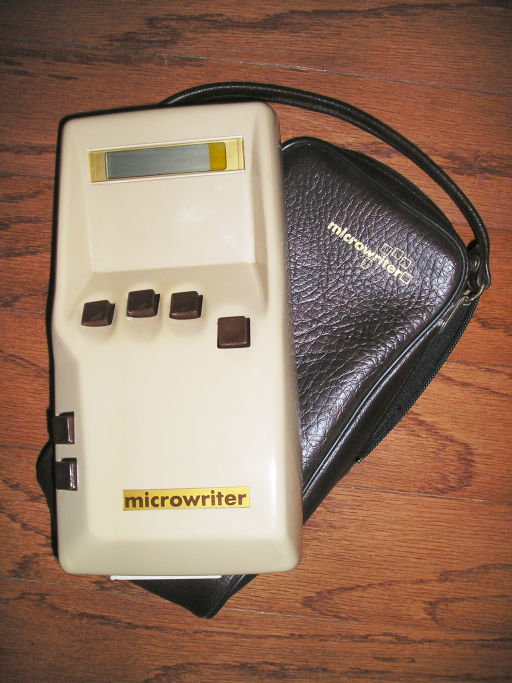
In a 1984 interview with NPR, Endfield recounted wanting to reduce the number of keys used when typing. Instead of pushing a key and obtaining the corresponding letter (a 1‑to‑1 ratio), he wanted to use a handful of keys to yield the whole of the alphabet. He decided that chords were the answer:
“It occurred to me that… it would be possible to combine a set of signals from separate keys, and therefore you could reduce the total number of keys. But, of course, this involved the learning of chords… difficult to memorize… But how do you make these chords memorable? And, one day, staring at a sheet of paper on which I was drawing a set of five keys in sort of the arch formed by the finger ends, it occurred to me, ah! if I press the thumb key, and the index finger key, anybody can do this just listening now, press your thumb key and your index finger down and you’ll see that a vertical line joins those two finger ends, a short vertical line. There is an equivalence between that short vertical line and one letter of the alphabet. It’s the letter “I.”
The above video provides a much simpler and more concise explanation.
Equipped with 16 kb of RAM and a single line LED display, the Microwriter allowed users to quickly type notes on the go and transfer the results to their computers through the serial port. Five of the buttons corresponded to the various chord-keys, and the lower thumb button allowed users to cycle through various input modes.
While it was possible to achieve a quick pace with the device when typing textual rather than numeric input, users of the device remember needing several days of training to remember the various key combinations and to begin using the device with some proficiency. Needless to say, in spite of Endfield’s claims of being the world’s first portable word processor, the Microwriter simply wasn’t user friendly enough to survive. It entered production in the early 1980s, and ceased in 1985.
To read or listen to Cy Endfield’s full interview, head over to the NPR Archives tumblr.
Ilia Blinderman is a Montreal-based culture and science writer. Follow him at @iliablinderman.
Related Content:
Mark Twain Wrote the First Book Ever Written With a Typewriter
The History of the Seemingly Impossible Chinese Typewriter
The Enduring Analog Underworld of Gramercy Typewriter
Discover Friedrich Nietzsche’s Curious Typewriter, the “Malling-Hansen Writing Ball”
Computer Science: Free Online Courses
Read More...Highlights from the First Ever Stanford Code Poetry Slam
I was lucky enough to be living in Chicago when Marc Smith’s Poetry Slam movement became a thing. What fun it was to hit the Green Mill on Sunday nights to hear such innovators as Lisa Buscani or Patricia Smith tearing into their latest entries in front of packed-to-capacity crowds. Those early slam poets inspired a lot of other wordsmiths to brave the mic, a glorious revolution whose gleam was inevitably tarnished for me once it caught on for real.
I remember thinking something like, “If I never hear another poem about someone’s relationship troubles, it’ll be too soon.”
To further illustrate my waning enthusiasm, here’s the above thought, rendered in Standard Spoken Word Venacular:
If
I never heeeear
Another Po
Em About Someone’s
Re-la-tion-ship…
Troubles, it’ll be
Too
Soon.
Some two-and-a-half decades further along, Leslie Wu, a doctoral student in Computer Science at Stanford University, has been crowned the winner of the inaugural Code Poetry Slam, and I’m mourning the loss of those long-ago relationship troubles.
To create her winning entry, “Say 23,” Wu donned a Google Glass headset, as she recited and typed 16 lines of computer code, which were projected onto a screen. When Wu ran the script, three different computerized voices took over performance duties, sampling the 23rd Psalm along with an uncredited snippet of In the Hall of the Mountain King.
I may be too hot-blooded to appreciate the artistry here.
Melissa Kagen, who organized the competition with fellow graduate student Kurt James Werner, stated on the university’s website that in order “to really get into the intricacies you really need to know that language.”
I guess that goes double for the competitors. According to Werner, Wu’s poem wove together a number of different concepts, tools, and languages, including Japanese, English, and Ruby. Philistine that I am, I had always thought of the latter as an uncapitalized gemstone and nothing more.
Not that I’m aligning myself with those curmudgeons whose typical reaction to a Rothko or a Jackson Pollack is, “My two-year-old could do better.” For one thing, I’ve got teenagers, and given their druthers, they’d eat their way through the contents of Werner Herzog’s shoe closet before agreeing to learn so much as a single line of code.
What a wonderful world in which so many of us are free to pursue our individual passions to the point of poetry!
If you’re the type to whom code poetry speaks—nay, sings—you should consider putting something together for the fast approaching second slam. Have a look at the work of the eight finalists, if you’re in need of inspiration. Entries are being accepted through Feb. 12.
Find 74 free courses from Stanford in our collection: 825 Free Online Courses from Top Universities.
Related Content:
Learn to Code with Harvard’s Intro to Computer Science Course And Other Free Tech Classes
Codecademy’s Free Courses Democratize Computer Programming
Ayun Halliday is the Chief Primatologist of the East Village Inky, an award-winning, handwritten zine. Follow her @AyunHalliday
Read More...George Orwell Explains in a Revealing 1944 Letter Why He’d Write 1984
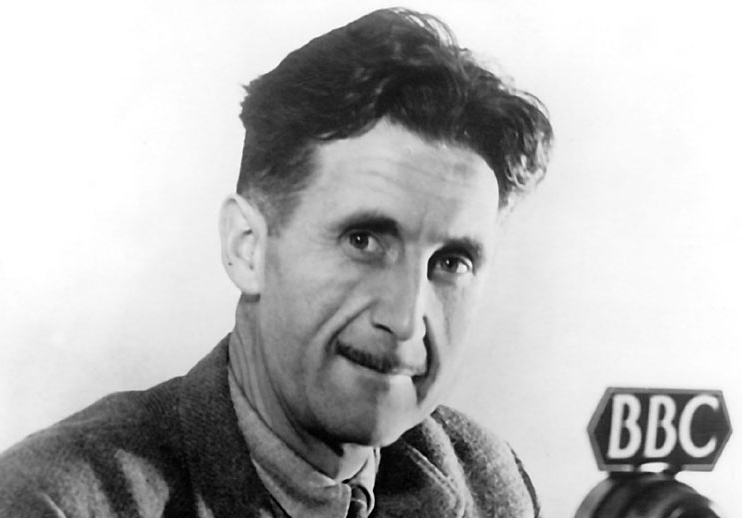
Image via Wikimedia Commons
Most of the twentieth century’s notable men of letters — i.e., writers of books, of essays, of reportage — seem also to have, literally, written a great deal of letters. Sometimes their correspondence reflects and shapes their “real” written work; sometimes it appears collected in book form itself. Both hold true in the case of George Orwell, a volume of whose letters, edited by Peter Davison, came out last year. In it we find this missive, also published in full at The Daily Beast, sent in 1944 to one Noel Willmett, who had asked “whether totalitarianism, leader-worship etc. are really on the up-grade” given “that they are not apparently growing in [England] and the USA”:
I must say I believe, or fear, that taking the world as a whole these things are on the increase. Hitler, no doubt, will soon disappear, but only at the expense of strengthening (a) Stalin, (b) the Anglo-American millionaires and © all sorts of petty fuhrers of the type of de Gaulle. All the national movements everywhere, even those that originate in resistance to German domination, seem to take non-democratic forms, to group themselves round some superhuman fuhrer (Hitler, Stalin, Salazar, Franco, Gandhi, De Valera are all varying examples) and to adopt the theory that the end justifies the means. Everywhere the world movement seems to be in the direction of centralised economies which can be made to ‘work’ in an economic sense but which are not democratically organised and which tend to establish a caste system. With this go the horrors of emotional nationalism and a tendency to disbelieve in the existence of objective truth because all the facts have to fit in with the words and prophecies of some infallible fuhrer. Already history has in a sense ceased to exist, ie. there is no such thing as a history of our own times which could be universally accepted, and the exact sciences are endangered as soon as military necessity ceases to keep people up to the mark. Hitler can say that the Jews started the war, and if he survives that will become official history. He can’t say that two and two are five, because for the purposes of, say, ballistics they have to make four. But if the sort of world that I am afraid of arrives, a world of two or three great superstates which are unable to conquer one another, two and two could become five if the fuhrer wished it. That, so far as I can see, is the direction in which we are actually moving, though, of course, the process is reversible.
As to the comparative immunity of Britain and the USA. Whatever the pacifists etc. may say, we have not gone totalitarian yet and this is a very hopeful symptom. I believe very deeply, as I explained in my book The Lion and the Unicorn, in the English people and in their capacity to centralise their economy without destroying freedom in doing so. But one must remember that Britain and the USA haven’t been really tried, they haven’t known defeat or severe suffering, and there are some bad symptoms to balance the good ones. To begin with there is the general indifference to the decay of democracy. Do you realise, for instance, that no one in England under 26 now has a vote and that so far as one can see the great mass of people of that age don’t give a damn for this? Secondly there is the fact that the intellectuals are more totalitarian in outlook than the common people. On the whole the English intelligentsia have opposed Hitler, but only at the price of accepting Stalin. Most of them are perfectly ready for dictatorial methods, secret police, systematic falsification of history etc. so long as they feel that it is on ‘our’ side. Indeed the statement that we haven’t a Fascist movement in England largely means that the young, at this moment, look for their fuhrer elsewhere. One can’t be sure that that won’t change, nor can one be sure that the common people won’t think ten years hence as the intellectuals do now. I hope they won’t, I even trust they won’t, but if so it will be at the cost of a struggle. If one simply proclaims that all is for the best and doesn’t point to the sinister symptoms, one is merely helping to bring totalitarianism nearer.
You also ask, if I think the world tendency is towards Fascism, why do I support the war. It is a choice of evils—I fancy nearly every war is that. I know enough of British imperialism not to like it, but I would support it against Nazism or Japanese imperialism, as the lesser evil. Similarly I would support the USSR against Germany because I think the USSR cannot altogether escape its past and retains enough of the original ideas of the Revolution to make it a more hopeful phenomenon than Nazi Germany. I think, and have thought ever since the war began, in 1936 or thereabouts, that our cause is the better, but we have to keep on making it the better, which involves constant criticism.
Yours sincerely,
Geo. Orwell
Three years later, Orwell would write 1984. Two years after that, it would see publication and go on to generations of attention as perhaps the most eloquent fictional statement against a world reduced to superstates, saturated with “emotional nationalism,” acquiescent to “dictatorial methods, secret police,” and the systematic falsification of history,” and shot through by the willingness to “disbelieve in the existence of objective truth because all the facts have to fit in with the words and prophecies of some infallible fuhrer.” Now that you feel like reading the novel again, or even for the first time, do browse our collection of 1984-related resources, which includes the eBook, the audio book, reviews, and even radio drama and comic book adaptations of Orwell’s work.
If you would like to support the mission of Open Culture, consider making a donation to our site. It’s hard to rely 100% on ads, and your contributions will help us continue providing the best free cultural and educational materials to learners everywhere. You can contribute through PayPal, Patreon, and Venmo (@openculture). Thanks!
Related Content:
An Animated Introduction to George Orwell
The Only Known Footage of George Orwell (Circa 1921)
George Orwell and Douglas Adams Explain How to Make a Proper Cup of Tea
George Orwell’s Political Views, Explained in His Own Words
Colin Marshall hosts and produces Notebook on Cities and Culture and writes essays on cities, Asia, film, literature, and aesthetics. He’s at work on a book about Los Angeles, A Los Angeles Primer. Follow him on Twitter at @colinmarshall or on his brand new Facebook page.
Read More...Watch Beer Ferment in Time-Lapse Motion, and Then Learn How to Make Beer with an Animated Video
In one time-lapse minute, you can watch Bigfoot Barleywine Style Ale, made by Sierra Nevada, turbulently sloshing around, rising and falling, over the course of six days. The clip is set to the music of Edvard Grieg’s Peer Gynt Suite No. 1, Op. 46. Now if you want to put this visual display into a bit of a larger educational context, then we recommend you spend another two minutes watching a short animated video explaining the beer-making process, from start to finish. For the impatient, the fermenting comes at the 1:20 mark.
Related Content:
The Physics of Guinness Beer Demystified
A Beer Bottle Gets Turned Into a 19th Century Edison Cylinder and Plays Fine Music
Read More...Benjamin Bratton Explains “What’s Wrong with TED Talks?” and Why They’re a “Recipe for Civilizational Disaster”
TED Talks — they give your “discovery-seeking brain a little hit of dopamine;” make you “feel part of a curious, engaged, enlightened, and tech-savvy tribe;” almost giving you the sensation that you’re attending a “new Harvard.” That was the hype around TED Talks a few years ago. Since then, the buzz around TED has mercifully died down, and the organization has gone on, staging its conferences around the globe. It’s been a while since we’ve featured a TED Talk whose ideas seem worth spreading. But today we have one for you. Intriguingly, it’s called “What’s Wrong with TED Talks?” It was presented by Benjamin Bratton, Associate Professor of Visual Arts at UCSD, at none other than TEDxSanDiego 2013. Bratton makes his case (above) in 11 minutes — well within the 18 allotted minutes — by arguing that TED doesn’t just help popularize ideas. Instead, it changes and cheapens the agenda for science, philosophy and technology in America. He begins to frame the problem by telling a story:
I was at a presentation that a friend, an astrophysicist, gave to a potential donor. I thought the presentation was lucid and compelling.… After the talk the sponsor said to him, “you know what, I’m gonna pass because I just don’t feel inspired …you should be more like Malcolm Gladwell.”
Think about it: an actual scientist who produces actual knowledge should be more like a journalist who recycles fake insights! This is beyond popularization. This is taking something with value and substance and coring it out so that it can be swallowed without chewing. This is not the solution to our most frightening problems – rather this is one of our most frightening problems.
Bratton then concludes, “astrophysics run on the model of American Idol is a recipe for civilizational disaster.” If “our best and brightest waste their time – and the audience’s time – dancing like infomercial hosts,” the cost will be too high, and our most difficult problems won’t get solved.
In watching Bratton’s talk, I found myself agreeing with many things. Sure, TED Talks are often “a combination of epiphany and personal testimony … through which the speaker shares a personal journey of insight and realization, its triumphs and tribulations.” Yes, the talks offer viewers a predictably “vicarious insight, a fleeting moment of wonder, an inkling that maybe it’s all going to work out after all.” Maybe TED Talks sometimes provide nothing more than “middlebrow megachurch infotainment.” But is TED really changing the agenda for scientists, technologists and philosophers? Are scholars actually choosing their intellectual projects based on anything having to do with TED (or TED-inspired ways of thinking)? Is someone at the NIH doling out money based on whether a project will eventually yield 15 good minutes of diversion and entertainment? Short of empirical evidence that actually applies to TED (the anecdote above doesn’t), it feels like Bratton is giving TED way too much credit. Maybe TED matters on YouTube. But let’s get real, its pull largely starts and ends there. You can read a complete transcript of Bratton’s talk here.
via The Guardian
Don’t miss anything from Open Culture in 2014. Sign up for our Daily Email or RSS Feed. And we’ll send cultural curiosities your way, every day.
Read More...Support Us
We're hoping to rely on loyal readers, rather than erratic ads. Please click the Donate button and support Open Culture. You can use Paypal, Venmo, Patreon, even Crypto! We thank you!

About Us

Open Culture scours the web for the best educational media. We find the free courses and audio books you need, the language lessons & educational videos you want, and plenty of enlightenment in between.
Advertise With Us

FREE UPDATES!
GET OUR DAILY EMAIL
Get the best cultural and educational resources on the web curated for you in a daily email. We never spam. Unsubscribe at any time.
FOLLOW ON SOCIAL MEDIA

Open Culture editor Dan Colman scours the web for the best educational media. He finds the free courses and audio books you need, the language lessons & movies you want, and plenty of enlightenment in between.
Advertise With Us


