Celebrate the 75th Anniversary of the Golden Gate Bridge with a Free iPad App
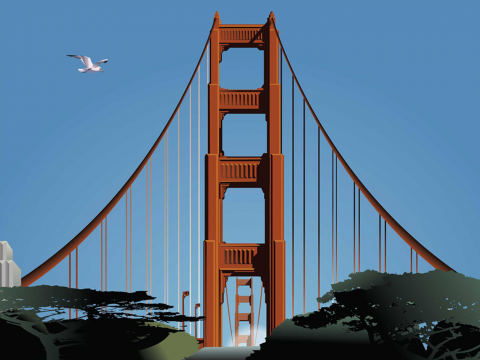
When it opened to vehicle traffic in May, 1937 the Golden Gate Bridge was the longest suspension bridge in the world. Since then eight bridges have surpassed it in length, but the iconic international orange span is still the most photographed bridge in the world. This month marks the Golden Gate’s 75th anniversary and the California Historical Society’s exhibit, A Wild Flight of the Imagination, celebrates the event with a look at the bridge’s construction. The exhibit has also been made available as a free eBook for the iPad, which includes historic photographs by Ansel Adams and Dorothea Lange as well as a short film of bridge designer Joseph Strauss speaking to a reporter during the bridge’s construction. At the time, experts said that the Golden Gate strait’s ferocious winds and strong, swirling currents would make construction impossible. But the design introduced deflection theory, which utilizes a thin, flexible roadway and long cables that reduce structural stress.
The interactive app is accompanied by a musical score—the opening selection from composer Rob Kapilow’s Chrysopylae, Greek for “Golden Gate.” Early users of the eBook reported glitches with the app’s audio. The culprit may have been the side mute switch, which must be flipped off for the audio to work. Also, make sure your iPad’s volume is up. Like the exhibit in the society’s San Francisco museum, the app includes access to images of some 350 objects and ephemera related to the span’s construction. Almost as nice as a walk across the bridge’s 1.7 miles, and not nearly as windy.
Kate Rix writes about k‑12 instruction and higher ed.
Read More...ZeroN: An Amazing, Gravity-Defying New Interactive Technology at M.I.T.
In Stephen Spielberg’s film E.T. The Extra-Terrestrial there is a memorable scene in which a group of children ask a stranded visitor from outer space where he is from, and he tries to communicate by using an unseen force to lift a group of balls into mid-air and move them around to simulate a solar system. Now a researcher at the Massachusetts Institute of Technology has tapped into the physics of magnetic levitation to create something similar: a computer-controlled system that allows users to manipulate a metal sphere floating in space.
“I think there is something fundamental behind motivations to liberate physical matter from gravity and enable control,” writes Jinha Lee on his Web site. “The motivation has existed as a shared dream amongst humans for millennia. It is an idea found in mythologies, desired by alchemists, and visualized in Science Fiction movies. I have aspired to create a space where we can experience a glimpse of this future.”
Lee’s device is part of the M.I.T. Tangible Media Group’s larger project of giving physical form to digital information. The group strives to bring together the separate worlds of bits and atoms in a Tangible User Interface, or TUI, to allow people to use their naturally evolved physical dexterity to visualize and manipulate computation. To help achieve this, Lee developed a programmable interface element he calls “ZeroN.” He describes it in the abstract of a paper published last October with collaborators Rehmi Post and Hiroshi Ishii:
ZeroN serves as a tangible representation of a 3D coordinate of the virtual world through which users can see, feel, and control computation. To acomplish this we developed a magnetic control system that can levitate and actuate a permanent magnet in a pre-defined 3D volume. This is combined with an optical tracking and display system that projects images on the levitating object. We present applications that explore this new interaction modality. Users are invited to place or move the ZeroN object just as they can place objects on surfaces. For example, users can place the sun above physical objects to cast digital shadows, or place a planet that will start revolving based on simulated physical conditions.
You can access the complete paper as a PDF. And you can find similar videos when you explore our Technology section.
Read More...David Rees and His One-Man Artisanal Pencil Sharpening Service
This is for anyone with a love of old school woodworking — luthiers, ébénistes and the rest. In 2009, the humorist David Rees gave up cartooning and opened up his one-man artisanal pencil sharpening service in Beacon, New York, an old factory town along the Hudson River. Just a man, some high quality cedar, a knife, and an occasional pencil sharper revive a bygone era and a disappearing instrument of communication. 400 pencils later, at $15 a pop, Rees has something good going. You can learn more about Rees and his craftsmanship by reading (seriously) his new book, How to Sharpen Pencils, with a forward by John Hodgman.
Note: Rees uses some NSFW language during the video.
Read More...New Great Gatsby, On the Road Adaptations Revive an Old Debate: Can Great Books Make Great Movies?
Two of the greatest American novels of the 20th century–F. Scott Fitzgerald’s The Great Gatsby and Jack Kerouac’s On the Road–are headed for the big screen later this year, and literary fans are bracing for the worst.
Or at least that’s very much the case with Baz Luhrmann’s 3‑D version of The Great Gatsby, starring Leonardo DiCaprio as Jay Gatsby, Carey Mulligan as Daisy Buchanan and Tobey Maguire as narrator Nick Carraway. The trailer was released earlier this week (see above) and the Internet has been buzzing. A headline writer at the New York Daily News observed that the new adaptation by the Australian filmmaker who brought us Moulin Rouge! “won’t be your high school teacher’s F. Scott Fitzgerald.” Over at the Wall Street Journal’s “Speakeasy” blog, Lyneka Little described the music in the trailer (by those Jazz Age luminaries Kanye West, Jay‑Z and Jack White) as “awfully contemporary.” But when it comes to the perfect choice of words, the prize must go to actor James Urbaniak, who said yesterday on Twitter, “The Great Gatsby 3D: Borne back ceaselessly into your face.”
Literary purists are a bit more hopeful when it comes to the first-ever film of Kerouac’s On the Road. In The New York Times yesterday, Steve Chagollan described the painstaking research conducted by director Walter Salles, best known for his 2004 film about Che Guevara, The Motorcycle Diaries. The Brazilian director retraced Kerouac’s journeys across North America and interviewed scholars and surviving members of the Beat Generation. “I was well aware that my passion for the book was not sufficient to justify launching into an adaptation straight away,” Salles told the Times. “In fact, making the feature film ceased to be my main concern at the time. Understanding and getting to know these people better became my main goal.” Still, as Chagollan put it, Beat aficionados will be watching the film very closely, “certain to cast an unforgiving eye.”
There’s an old saying: Good books make bad movies, and vice versa. But is it true? It’s not difficult to come up with the names of a few good books that have been made into memorable movies. Phillip Noyce’s adaptation of Graham Greene’s The Quiet American comes to mind. So does Blake Edwards’s film of Truman Capote’s Breakfast at Tiffany’s and Stanley Kubrick’s film of Anthony Burgess’s A Clockwork Orange. It’s even possible to think of a great film made from a literary masterpiece, as in the case of Kubrick’s adaptation of Vladimir Nabokov’s Lolita. Kubrick expressed his thoughts on translating books into films in a 1960–1961 essay, “Words and Movies”:
It’s sometimes said that a great novel makes a less promising basis for a film than a novel which is merely good. I don’t think that adapting great novels presents any special problems which are not involved in adapting good novels or mediocre novels; except that you will be more heavily criticised if the film is bad, and you may be even if it’s good. I think almost any novel can be successfully adapted, provided it is not one whose aesthetic integrity is lost along with its length. For example, the kind of novel in which a great deal and variety of action is absolutely essential to the story, so that it loses much of its point when you subtract heavily from the number of events or their development. People have asked me how it is possible to make a film out of Lolita when so much of the quality of the book depends on Nabokov’s prose style. But to take the prose style as any more than just a part of a great book is simply misunderstanding just what a great book is. Of course, the quality of the writing is one of the elements that make a novel great. But this quality is a result of the quality of the writer’s obsession with his subject, with a theme and a concept and a view of life and an understanding of character. Style is what an artist uses to fascinate the beholder in order to convey to him his feelings and emotions and thoughts. These are what have to be dramatised, not the style. The dramatising has to find a style of its own, as it will do if it really grasps the content. And in doing this it will bring out another side of the structure which has gone into the novel. It may or may not be as good as the novel; sometimes it may in certain ways be even better.
What do you think? Are you looking forward to seeing the new Great Gatsby and On the Road films? And can you think of a great book that has been made into an equally great–or even greater–movie?
Read More...Watch: New Film by Roman Polanski, Starring Helena Bonham Carter, Sir Ben Kingsley & Prada Shoes
At the Cannes Film Festival this week, Roman Polanski screened a restored version of his 1979 film, Tess. And then he tantalized the audience, at least momentarily, when he offered a sneak preview of his new film, which turned out to be a cinematic commercial for Prada. A Therapy stars Helena Bonham Carter and Sir Ben Kingsley, with Prada shoes and coat serving as the props. Or actually it’s the other way around.
Filmmakers putting their talents in the service of fashion designers isn’t particularly new. Just two years ago, David Lynch shot his own film, Lady Blue Shanghai, for Dior. It starred the Oscar-winning French actress Marion Cotillard. You can find it online here.
Related Content:
David Lynch’s Surreal Commercials
Fellini’s Fantastic TV Commercials
Ingmar Bergman’s Soap Commercials Wash Away the Existential Despair
Read More...The Idea TED Didn’t Consider Worth Spreading: The Rich Aren’t Really Job Creators
Late last week, The National Journal published a story called The Inequality Speech That TED Won’t Show You, along with a related story explaining the controversy, which boils down to this:
TED organizers invited a multimillionaire Seattle venture capitalist named Nick Hanauer – the first nonfamily investor in Amazon.com – to give a speech on March 1 at their TED University conference. Inequality was the topic – specifically, Hanauer’s contention that the middle class, and not wealthy innovators like himself, are America’s true “job creators.”…
You can’t find that speech online. [Note: it has now been independently published on YouTube.] TED officials told Hanauer initially they were eager to distribute it. “I want to put this talk out into the world!” one of them wrote him in an e‑mail in late April. But early this month they changed course, telling Hanauer that his remarks were too “political” and too controversial for posting.
The National Journal and Hanauer present it as a case of censorship. But TED’s lead curator Chris Anderson responded in a blog post, saying: “Our policy is to post only talks that are truly special. And we try to steer clear of talks that are bound to descend into the same dismal partisan head-butting people can find every day elsewhere in the media.” He went on to offer this analogy: Sometimes you send an op-ed to The New York Times and they don’t publish it. Does that mean your ideas are being censored? Or does it maybe mean your ideas aren’t very well put? Or did someone else do a better job of framing the argument?
One way or another, TED didn’t see Hanauer’s ideas as being “worth spreading.” The video now appears on YouTube. You can watch it above and decide what you think: Censorship or selectivity? Or, let me add a third option: a desire to please anyone and everyone at the expense of opening deeply-held beliefs and oft-stated mantras to real debate?
Read More...Play Caesar: Travel Ancient Rome with Stanford’s Interactive Map
Scholars of ancient history and IT experts at Stanford University have collaborated to create a novel way to study Ancient Rome. ORBIS, a geospatial network model, allows visitors to experience the strategy behind travel in antiquity. (Find a handy tutorial for using the system on the Web and YouTube). The ORBIS map includes about 750 mostly urban settlements of the Roman period. Users of the model can select a point of origin and destination for a trip and then choose from a number of options to determine either the cheapest, fastest or shortest route. Select river or open sea transport for the cheapest route. Pick road travel by pack animal or wagon for the shortest, but most expensive, trip. In creating ORBIS, historians used ancient maps and records along with modern-day weather information and results from experiments sailing in ancient-style ships to calculate the travel conditions of 2,000 years ago.
Aside from the site’s interactivity, there’s enough discussion in ORBIS about ancient Roman transport to satisfy the biggest history buff but the real fun is in exploring how people and goods were moved across the empire. Cities on the edge of the empire, for example, were more expensive to transport to, even if they weren’t that far away. All trips vary in time and cost, however, depending upon the time of year and mode of travel. The fastest route to deliver wheat from Carthago (modern-day Tunisia) to Londinium (London) would take more than 27 days under the best travel conditions (during July). Cargo would move across the Mediterranean by open sea, across southwestern France by riverboat and along the coast to southeastern England. The cost? A little less than 8 dinarii per kilogram of wheat using a donkey for land transport. Compare that to other routes that eliminate the open sea during winter months, or road travel to save money, and you’re close to understanding why it was no picnic ruling the Roman Empire.
Read More...The Miracle of Flight, the Classic Early Animation by Terry Gilliam
As Michael Palin once put it, “there’s no getting away from the wit, wonder and wizardry of the man Cahiers du Cinéma once described as Terry Gilliam.”
Those qualities are clearly visible in this very funny early film by Gilliam called The Miracle of Flight. The film was made in 1971 for the American-British TV show The Marty Feldman Comedy Machine. Monty Python was on hiatus that year, so Gilliam went to work for the short-lived Comedy Machine, creating the opening credit sequence and various animated features using his trademark airbrush and paper cutout techniques. (Watch his primer on doing your own cutout animation here.) The material for The Miracle of Flight was apparently packaged as a stand-alone film in 1974, right after Gilliam’s first film, Storytime. It was later used as a bonus feature before theatrical screenings of Gilliam movies, and during live Python performances. The film version is slightly different from the one aired on the Comedy Machine. According to Smarter Than The Average, “for the theatrical version it lost a grizzly punchline where a man who had failed at his attempt to fly by emulating the ergonomics of a bird takes his revenge by ripping the bird to pieces.” The writer then goes on to describe details only a Python fanatic could notice:
The Miracle of Flight in particular is a cornucopia of oddities for the Python connoisseur, containing as it does one line recorded by Terry Jones, the tarred-and-feathered character who appears in Animations of Mortality, the mountain in the finale of the Meaning of Life computer game and the animated woman from Python who says “Turn that television off–you know it’s bad for your eyes”. Most baffling of all is the muzak in the airport terminal, which is the same as used in the Dental sequence of the Meaning of Life CD-Rom nearly thirty years later. For sheer numbers of Python iconography appearing in a non-Python production, The Miracle of Flight’s only rival is Eric Idle’s music video for George Harrison’s Crackerbox Palace. But I digress.
Indeed. But we enjoyed it. And you’ll enjoy The Miracle of Flight, which might more accurately be called The Triumph of Gravity.
If you would like to support the mission of Open Culture, consider making a donation to our site. It’s hard to rely 100% on ads, and your contributions will help us continue providing the best free cultural and educational materials to learners everywhere. You can contribute through PayPal, Patreon, and Venmo (@openculture). Thanks!
Read More...Morgan Freeman Teaches Kids to Read in Vintage Electric Company Footage from 1971
Every actor has to start somewhere, and Morgan Freeman (Driving Miss Daisy, The Shawshank Redemption, and Million Dollar Baby) could have done worse than joining the cast of The Electric Company, the PBS children’s television series that aired from 1971 to 1977. The original cast included Bill Cosby and Rita Moreno (not bad company), and the versatile Freeman played a series of characters: “Mel Mounds,” “Vincent the Vegetable Vampire,” and then, of course, Easy Reader. If you’re of my generation, you might recognize his theme song above. Below, we show you Easy Reader (a pun on the 1969 film Easy Rider) in action, teaching kids to read in his effortlessly cool, hipster way. H/T Metafilter
If you would like to support the mission of Open Culture, consider making a donation to our site. It’s hard to rely 100% on ads, and your contributions will help us continue providing the best free cultural and educational materials to learners everywhere. You can contribute through PayPal, Patreon, and Venmo (@openculture). Thanks!
Read More...A Brief History of John Baldessari, Narrated by Tom Waits
Tom Waits narrates this whimsical, fast-moving introduction to the life and work of West-Coast conceptual artist John Baldessari. The film was directed by Henry Joost and Ariel Schulman, the creative team behind Catfish and Paranormal Activity 3. It was made for the Los Angeles County Museum of Art’s inaugural Art & Film Gala, held last November in honor of Baldessari and Clint Eastwood. Baldessari mixes a variety of media in his art, including sculpture, painting, printmaking and video. “His work,” writes Elisabeth Roark of Grove Art Online, “is characterized by a consciousness of language evident in his use of puns, semantics based on the structuralism of Claude Lévi-Strauss and by the incorporation of material drawn from popular culture.” When Joost and Schulman ask Baldessari how he will be remembered 100 years hence, he says dryly, “I’m the guy who puts dots over people’s faces.”
If you would like to support the mission of Open Culture, consider making a donation to our site. It’s hard to rely 100% on ads, and your contributions will help us continue providing the best free cultural and educational materials to learners everywhere. You can contribute through PayPal, Patreon, and Venmo (@openculture). Thanks!
Related Content:
Tom Waits Reads Charles Bukowski
Tom Waits Makes Comic Appearance on Fernwood Tonight (1977)
Tom Waits Reads Two Charles Bukowski Poems, “The Laughing Heart” and “Nirvana”
Read More...Support Us
We're hoping to rely on loyal readers, rather than erratic ads. Please click the Donate button and support Open Culture. You can use Paypal, Venmo, Patreon, even Crypto! We thank you!

About Us

Open Culture scours the web for the best educational media. We find the free courses and audio books you need, the language lessons & educational videos you want, and plenty of enlightenment in between.
Advertise With Us

FREE UPDATES!
GET OUR DAILY EMAIL
Get the best cultural and educational resources on the web curated for you in a daily email. We never spam. Unsubscribe at any time.
FOLLOW ON SOCIAL MEDIA

Open Culture editor Dan Colman scours the web for the best educational media. He finds the free courses and audio books you need, the language lessons & movies you want, and plenty of enlightenment in between.
Advertise With Us

