Ryuichi Sakamoto, RIP: Watch Him Create Groundbreaking Electronic Music in 1984
Ryuichi Sakamoto was born and raised in Japan. He rose to prominence as a member of Yellow Magic Orchestra, the most influential Japanese band in pop-music history. Last week, he died in Japan. But he also claimed not to consider himself Japanese. That reflects the dedication of his life’s work as a composer and performer to cross-cultural inspiration, collaboration, and synthesis. How fitting that the announcement of his death this past weekend should elicit an outpouring of tributes from fans and colleagues around the world, sharing his work from a variety of different stylistic and technological periods in a variety of different languages.
Fitting, as well, that the first documentary made about Sakamoto as a solo artist should have been directed by a Frenchwoman, the photographer Elizabeth Lennard. Shot in 1984, Tokyo melody: un film sur Ryuichi Sakamoto captures not only Sakamoto himself on the rise as an international cultural figure, but also a Japan that had recently become the red-hot center — at least in the global imagination — of wealth, technology, and even forward-looking imagination. It was in the Japanese capital that Sakamoto recorded Ongaku Zukan, or Illustrated Musical Encyclopedia, the album that showed the listening public, in Japan and elsewhere, what it really sounded like to make music not just in but of the late twentieth century.
Or perhaps it was music for the End of History. “Japan has become the leading capitalist country,” Sakamoto says in Tokyo Melody. “I don’t know if it’s good or bad. The season of politics is over. People don’t think of rebelling. On the other hand they have a real hunger for culture.” Then comes the footage of wax model food and obsessively ersatz nineteen-fifties-style greasers: clichéd representations of urban Japan at the time, yes, but also genuine reflections of the somehow refined mix-and-match retro-kitsch sensibility that had come to prevail there. “Mainstream culture has lost its authority,” Sakamoto adds. “There is a floating notion of values. Technology is progressing by itself. The gears move more and more efficiently. We feel possibilities appearing that exceed our imagination and our horizons.”
For nearly forty years therafter, Sakamoto would continue to explore this range of possibilities — sublime, bizarre, or even threatening — through his music, whether on his own releases, his projects with other artists, or his many film soundtracks for a range of auteurs including Nagisa Ōshima (for whom he also acted, alongside David Bowie, in Merry Christmas, Mr. Lawrence), Brian De Palma, Bernardo Bertolucci, and Alejandro Iñarritu. In Tokyo Melody he reveals one secret of his success: “When I work with Japanese, I become Japanese. When I work with Westerners, I try to be like them.” Hence the way, no matter the artistic or cultural context, Sakamoto’s music was never identifiable as either Japanese or Western, but always identifiable as his own.
Related Content:
Hear the Greatest Hits of Isao Tomita (RIP), the Father of Japanese Electronic Music
Brian Eno on Creating Music and Art As Imaginary Landscapes (1989)
Discover the Ambient Music of Hiroshi Yoshimura, the Pioneering Japanese Composer
Based in Seoul, Colin Marshall writes and broadcasts on cities, language, and culture. His projects include the Substack newsletter Books on Cities, the book The Stateless City: a Walk through 21st-Century Los Angeles and the video series The City in Cinema. Follow him on Twitter at @colinmarshall or on Facebook.
Read More...The Most Popular Song from Each Month Since January 1980: 40+ Years of Changing Musical Tastes in 50 Minutes
As Helen Reddy sang in the 70s:
You live your life in the songs you hear
On the rock n’ roll radio…
The 80s ushered in a new era, leaving the music industry forever changed, though the songs themselves retained their power to speak to us on a deeply personal level.
In 1979, the English New Wave band The Buggles’ “Video Killed the Radio Star” — which famously became the very first song played on MTV the following year (1980) — was getting a lot of attention.
40 years later Puerto Rican rapper and reggaeton artist Bad Bunny dominates, which speaks not only to the public’s evolving musical tastes but also to the expanded access and opportunities of the Internet age.
Listening to all 512 songs on Boogiehead’s mashup Most Popular Song Each Month Since January 1980 in their entirety would take over 24 hours, so Boogiehead settles instead on a single representative phrase, getting the job done in a whirlwind 50 minutes. Watch it above.
For many of us, that’s all it takes to unleash a flood of memories.
Queen, Madonna, David Bowie, and Michael Jackson make strong showings, as do, more recently, Rhianna, Beyoncé, Lady Gaga, Bruno Mars, and Ariana Grande.
Elsewhere, there are reminders that fame is not just fleeting, but often tethered to a single hit.
That said, sometimes those hits have remarkable staying power.
Witness Dexys Midnight Runners’ Come On Eileen from 1982, with its prescient lyric “I’ll hum this tune forever…”
And some songs turn out to be an unexpected slow burn. How else to explain one of the third-to-last earworms on Boogiehead’s list, “Running Up That Hill” from English singer-songwriter Kate Bush’s 1985 album Hounds of Love?
Its appearance on the hit series Stranger Things led it to go viral on TikTok, netting the 64-year-old Bush a host of new fans in their teens and 20s as well as a couple million dollars. Talk about old wine in new bottles!
Forbes’ Peter Suciu observes how songs’ shelf lives and in-roads are longer and wider than they were in the 80s and 90s:
Running Up That Hill has certainly become more popular now than it was when it was released – and one factor could be that social media has changed the way people listen to music. In 1985, when Michael Jackson was the undisputed King of Pop, Kate Bush would have been relegated to “alternative” music radio stations, which were few and far between, or college radio.
Readers, what song from Boogiehead’s Most Popular Song Each Month Since January 1980 do you most wish would make a comeback? Which of the newer songs could you imagine listening to forty years from now? Let us know in the comments.
Listen to the playlist of every song featured on the Most Popular Song Each Month Since January 1980 here.
Related Content
1980s Metalhead Kids Are Alright: Scientific Study Shows That They Became Well-Adjusted Adults
All the Music Played on MTV’s 120 Minutes: A 2,500-Video Youtube Playlist
– Ayun Halliday is the Chief Primatologist of the East Village Inky zine and author, most recently, of Creative, Not Famous: The Small Potato Manifesto and Creative, Not Famous Activity Book. Follow her @AyunHalliday.
Read More...Carl Sagan Explains How the Ancient Greeks, Using Reason & Math, Discovered That the Earth Isn’t Flat Over 2,000 Years Ago
The denial of science suffuses American society, and no matter what the data says, some conservative forces refuse efforts to curtail, or even study, climate change. Astrophysicist Katie Mack calls this retrenchment a form of “data nihilism,” writing in an exasperated tweet, “What is science? How can a thing be known? Is anything even real???” Indeed, what can we expect next from what Isaac Asimov called the United States’ anti-intellectual “cult of ignorance”? A flat earth lobby?
Welp… at least a couple celebrity figures have come out as flat-earthers, perhaps the vanguard of an anti-round earth movement. Notably, [Dallas Mavericks] guard Kyrie Irving made the claim on a podcast, insisting, Chris Matyszczyk writes, that “we were being lied to about such basic things by the global elites.” Is this a joke? I hope so. Neil DeGrasse Tyson—who hosted the recent Cosmos remake to try and dispel such scientific ignorance—replied all the same, noting that Irving should “stay away from jobs that require… understanding of the natural world.” The weird affair has played out like a sideshow next to the mainstage political circus, an unsettling reminder of Carl Sagan’s prediction in his last book, The Demon Haunted World, that Americans would soon find their “critical faculties in decline, unable to distinguish between what feels good and what’s true.”
Sagan devoted much of his life to countering anti-science trends with warmth and enthusiasm, parking himself “repeatedly, arguably compulsively, in front of TV cameras,” writes Joel Achenbach at Smithsonian. We most remember him for his original 1980 Cosmos miniseries, his most public role as a “gatekeeper of scientific credibility,” as Achenbach calls him. I think Sagan may have chafed at the description. He wanted to open the gates and let the public into scientific inquiry. He charitably listened to unscientific theories, and patiently took the time to explain their flaws.
In the very first episode of Cosmos, Sagan addressed the flat-earthers, indirectly, by explaining how Eratosthenes (276–194 BC), a Libyan-Greek scholar and chief librarian at the Library of Alexandria, discovered over 2000 years ago that the earth is a sphere. Given the geographer, mathematician, poet, historian, and astronomer’s incredible list of accomplishments—a system of latitude and longitude, a map of the world, a system for finding prime numbers—this may not even rank as his highest achievement.
In the Cosmos clip above, Sagan explains Eratosthenes’ scientific method: he made observations of how shadows change length given the position of the sun in the sky. Estimating the distance between the cities of Syene and Alexandria, he was then able to mathematically calculate the circumference of the earth, as Cynthia Stokes Brown explains at Khan Academy. Although “several sources of error crept into Eratosthenes’ calculations and our interpretation of them,” he nonetheless succeeded almost perfectly. His estimation: 250,000 stadia, or 25,000 miles. The actual circumference: 24,860 miles (40.008 kilometers).
No, of course the Earth isn’t flat. But Sagan’s lesson on how one scientist from antiquity came to know that isn’t an exercise in debunking. It’s a journey into the movement of the solar system, into ancient scientific history, and most importantly, perhaps, into the scientific method, which does not rely on hearsay from “global elites” or shadowy figures, but on the tools of observation, inference, reasoning, and math. Professional scientists are not without their biases and conflicts of interest, but the most fundamental intellectual tools they use are available to everyone on Earth.
Note: An earlier version of this post appeared on our site in 2017. This version has been lightly edited and updated.
Related Content:
Carl Sagan Presents His “Baloney Detection Kit”: 8 Tools for Skeptical Thinking
Josh Jones is a writer and musician based in Durham, NC. Follow him at @jdmagness
Read More...David Byrne Explains How the “Big Suit” He Wore in Stop Making Sense Was Inspired by Japanese Kabuki Theatre
In the nineteen-seventies and eighties, the name of David Byrne’s band was Talking Heads — as the title of their 1982 live album perpetually reminds us. But their overall artistic project arguably had less to do with the head than the body, a proposition memorably underscored in Stop Making Sense, the Jonathan Demme-directed concert film that came out two years later. “Music is very physical and often the body understands it before the head,” Byrne says in a bizarre contemporary self-interview previously featured here on Open Culture. To make that fact visible onstage, “I wanted my head to appear smaller, and the easiest way to do that was to make my body bigger.”
Hence costume designer Gail Blacker’s creation of what Talking Heads fans have long referred to as the “big suit.” Byrne has always been willing discuss its origins, which he traces back to a trip to Japan. There, as he put it to Entertainment Weekly in 2012, he’d “seen a lot of traditional Japanese theater, and I realized that yes, that kind of front-facing outline, a suit, a businessman’s suit, looked like one of those things, a rectangle with just a head on top.”
A friend of his, the fashion designer Jurgen Lehl, said that “everything is bigger on stage.” “He was referring to, I think, gestures and the way you walk and what not,” Byrne told David Letterman in 1984. But he took it literally, thinking, “Well, that solves my costume problem right there.”
Though Byrne only wore the big suit for one number, “Girlfriend Is Better” (from whose lyrics Stop Making Sense takes its title), it became the acclaimed film’s single most iconic element, referenced even in children’s cartoons. New Yorker critic Pauline Kael called it “a perfect psychological fit,” remarking that “when he dances, it isn’t as if he were moving the suit — the suit seems to move him.” The association hasn’t been without its frustrations; he once speculated that his tombstone would be inscribed with the phrase “Here lies David Byrne. Why the big suit?” But now that Stop Making Sense is returning to theaters in a new 4K restoration, nearly 40 years after its first release, he’s accepted that the time has finally come to pick it up from the cleaner’s. Unsurprisingly, it still fits.
Related content:
Talking Heads Live in Rome, 1980: The Concert Film You Haven’t Seen
Based in Seoul, Colin Marshall writes and broadcasts on cities, language, and culture. His projects include the Substack newsletter Books on Cities, the book The Stateless City: a Walk through 21st-Century Los Angeles and the video series The City in Cinema. Follow him on Twitter at @colinmarshall or on Facebook.
Read More...The Complete “Everything is a Remix”: An Hour-Long Testament to the Brilliance & Beauty of Human Creativity
Let me quote myself: “From 2010 to 2012, filmmaker Kirby Ferguson released Everything is a Remix, a four-part series that explored art and creativity, and particularly how artists inevitably borrow from one another, draw on past ideas and conventions, and then turn these materials into something beautiful and new. In the initial series, Ferguson focused on musicians, filmmakers, writers and even video game makers. Now, a little more than a decade later, Ferguson has resurfaced and released a fifth and final chapter in his series, with this episode focusing on a different kind of artist: artificial intelligence.” Above, you can watch the complete edition of “Everything is a Remix,” with all parts combined into a single, hour-long video. A transcript of the entire production can be found here. Watch. Ponder. Create.
If you would like to support the mission of Open Culture, consider making a donation to our site. It’s hard to rely 100% on ads, and your contributions will help us continue providing the best free cultural and educational materials to learners everywhere. You can contribute through PayPal, Patreon, and Venmo (@openculture). Thanks!
Related Content
David Lynch Explains How Meditation Enhances Our Creativity
Malcolm McLaren: The Quest for Authentic Creativity
Read More...
Enroll Today for Online Courses with Stanford Continuing Studies: Open Culture Readers Get 15% Off
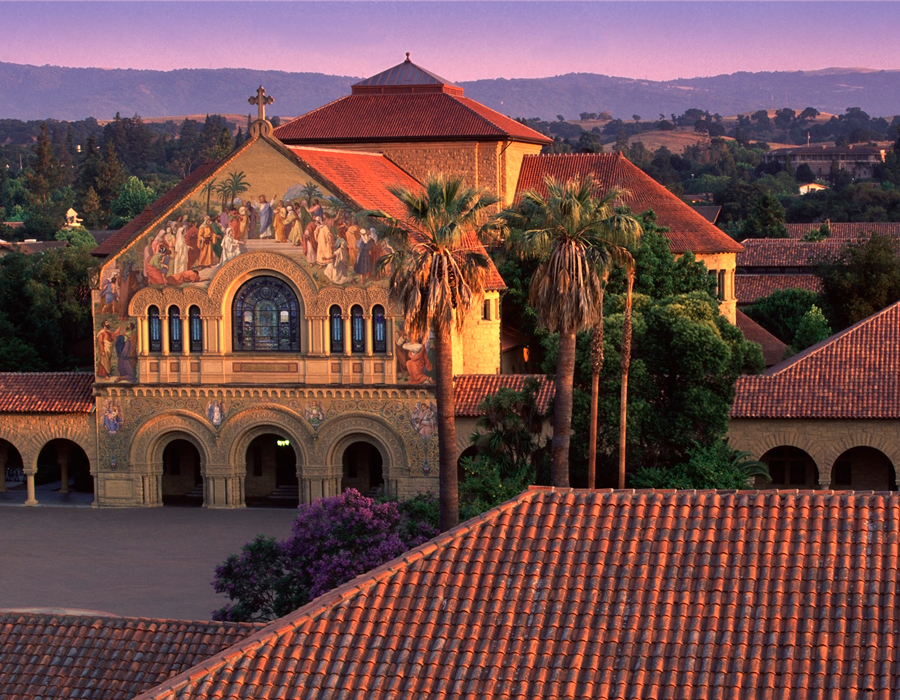
A heads up for Open Culture readers: This spring, Stanford Continuing Studies has a rich lineup of online courses, and they’re offering a special 15% discount to our readers. Just use the promo code CULTURE during checkout.
Serving lifelong learners everywhere, Stanford Continuing Studies will launch its spring curriculum next week (the week of April 3), letting you choose from over 100 courses. Among the courses, you will find some notable mentions:
Defending Democracy at Home and Abroad features three Stanford scholars (including the former US ambassador to Russia Mike McFaul) who will examine the uncertain state of democracy at home and abroad. Together, they will explore 1) the merits of democracy compared with the alternatives, 2) challenges to democracy both in the US and across the globe, and 3) solutions for protecting and advancing democracy everywhere.
With Stanford Monday University: 2023, five Stanford scholars will focus on important trends currently shaping our society, especially after the pandemic. What’s the future of working from home, and how will remote work affect the economy of the United States? Why have addictions—including to devices and screens—skyrocketed in the US, and how can a dopamine fast help bring them under control? Why has the modern economy left behind so many working-class communities in America, and how can investment in these communities help address the wealth inequalities in our country? These, and other questions, will be explored in the course.
Finally, in The Book of Change: Ovid, Art, and Us, art historian Alexander Nemerov–voted one of Stanford’s top 10 professors by Stanford students–will examine Ovid’s Metamorphoses and the great works of art inspired by the Roman classic. Along the way, he will explore paintings by Peter Paul Rubens, Diego Velázquez, and Nicolas Poussin, plus sculptures by Gian Lorenzo Bernini.
Stanford Continuing Studies also offers a large number of online creative writing courses and online business courses. See the complete lineup of courses here. And remember to use the promo code CULTURE during checkout to get your 15% discount. The code expires on April 30.
Read More...Watch the World’s First Film Made in Babylonian, the Language of Ancient Mesopotamia
“Enable subtitles,” says the notification that appears before The Poor Man of Nippur — and you will need them, unless, of course, you happen to hail from the cradle of civilization. The short film is adapted from “a folktale based on a 2,700-year-old poem about a pauper,” says the University of Cambridge’s alumni news, acted out word-for-word by “Assyriology students and other members of the Mesopotamian community at the University.” The result qualifies as the world’s very first film in Babylonian, a language that has “been silent for 2,000 years.”
“Found on a clay tablet at the archaeological site of Sultantepe, in south-east Turkey,” the story of The Poor Man of Nippur hasn’t come down to us in perfectly complete form. The film represents the points of breakage in the tablet with VHS-style glitches, a neat parallel of forms of media degradation across the millennia.
That isn’t the only noticeable anachronism — taking the buildings of Cambridge for Mesopotamia in the seventh century BC demands a certain suspension of disbelief — but we can rest assured of the Babylonian dialogue’s historical accuracy, or at least that this is the most accurate Babylonian dialogue we’re likely to get.
According to Cambridge Assyriologist Martin Worthington, who oversaw the Poor Man of Nippur project (after serving as Babylonian consultant for The Eternals), determining its pronunciation involves “a mix of educated guesswork and careful reconstruction,” but one that benefits from existing “transcriptions into the Greek alphabet” as well as connections with stabler languages like Arabic and Hebrew. The result is an unprecedented historical-linguistic attraction, a compelling advertisement for the study of Babylonian at Cambridge, and also — in depicting the impoverished protagonist’s revenge on a thuggish town mayor — a demonstration that the underdog story transcends time, culture, and language.
Related content:
Listen to The Epic of Gilgamesh Being Read in its Original Ancient Language, Akkadian
Listen to the Oldest Song in the World: A Sumerian Hymn Written 3,400 Years Ago
Trigonometry Discovered on a 3700-Year-Old Ancient Babylonian Tablet
Learn Latin, Old English, Sanskrit, Classical Greek & Other Ancient Languages in 10 Lessons
Based in Seoul, Colin Marshall writes and broadcasts on cities, language, and culture. His projects include the Substack newsletter Books on Cities, the book The Stateless City: a Walk through 21st-Century Los Angeles and the video series The City in Cinema. Follow him on Twitter at @colinmarshall or on Facebook.
Read More...Discover Edo, the Historic Green/Sustainable City of Japan
When you picture modern day Tokyo, what comes to mind?
The electronic billboards of Shibuya and Shinjuku?
The teeming streets?
The maid cafes?
The robot hotel?
A 97 square foot micro apartment?
Bernard Guerrini’s documentary Naturopolis — Tokyo, from megalopolis to garden-city describes Tokyo as “a giant city, a city which never stops growing:”
It has destroyed its natural spaces. It has created its own weather. It’s too big for its own good. They say Tokyo is like an amoeba that absorbs everything in its path.
It’s a far cry from the urban space Tokugawa Ieyasu, founder of the Tokugawa Shogunate, intended when planting the seeds for Edo, as Tokyo was originally called.
As the above excerpt from Naturopolis explains, the 16th-century city was innovative in its incorporation of green space.
The daimyō, or military lords, were required by the shogunate to keep residences in Edo. Each of these homes was furnished with a gardener and a landscaper to maintain the beauty of its al fresco areas.
Meanwhile, crops were cultivated in all communal outdoor open spaces, with irrigation canals supplying the necessary water for growing rice.
These plant-rich settings provided a hospitable environment for animals both wild and domestic. The carefully curated natural zones invited quiet contemplation of flora and fauna, giving rise to the seasonal celebrations and rites that are still observed throughout Japan.
Whether admiring blossoms and fireflies in spring and summer or autumn leaves and snowy winter scenes in the colder months, Edo’s citizens revered the natural world outside their doorsteps.
Bashō did the same in his haiku; Utagawa Hiroshige in his series of ukiyo‑e prints, One Hundred Famous Views of Edo.
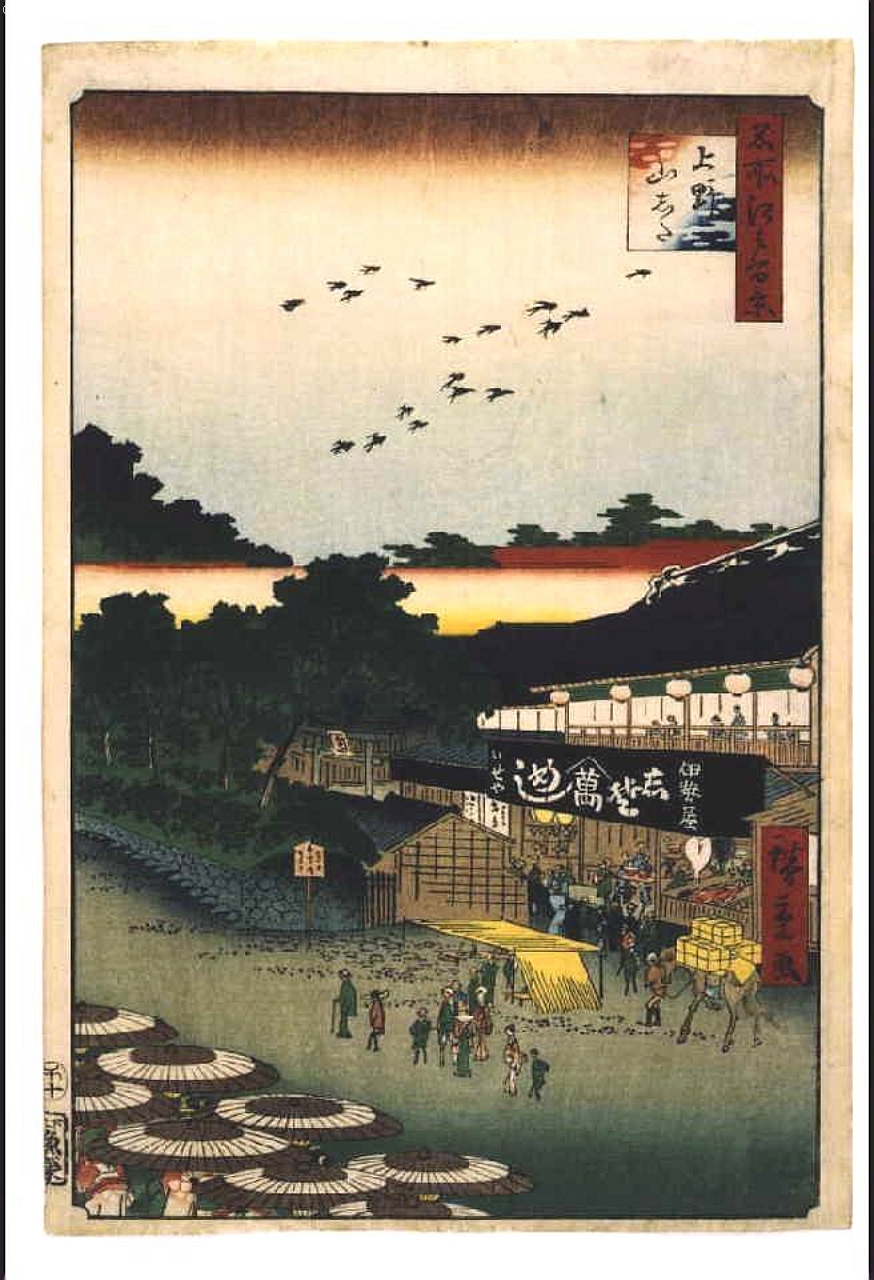
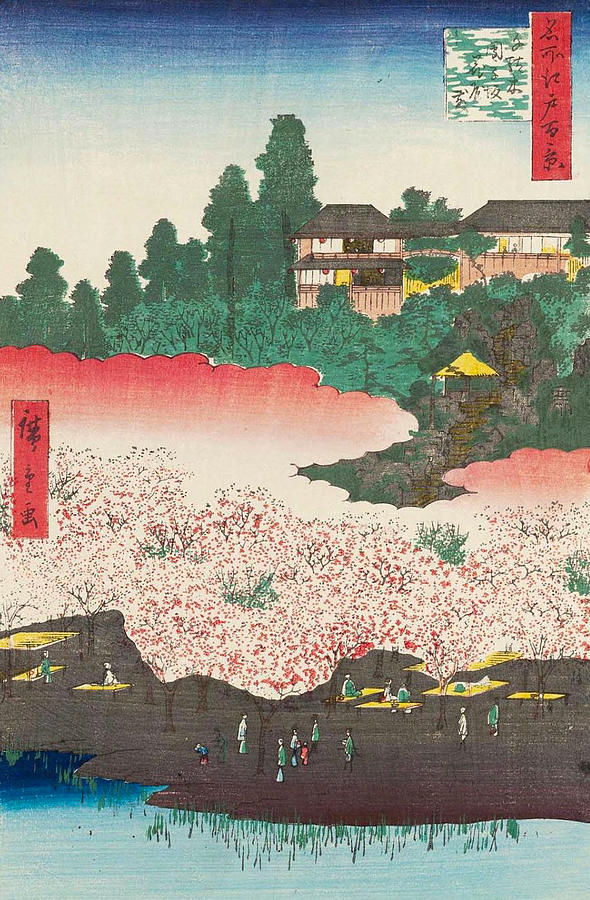

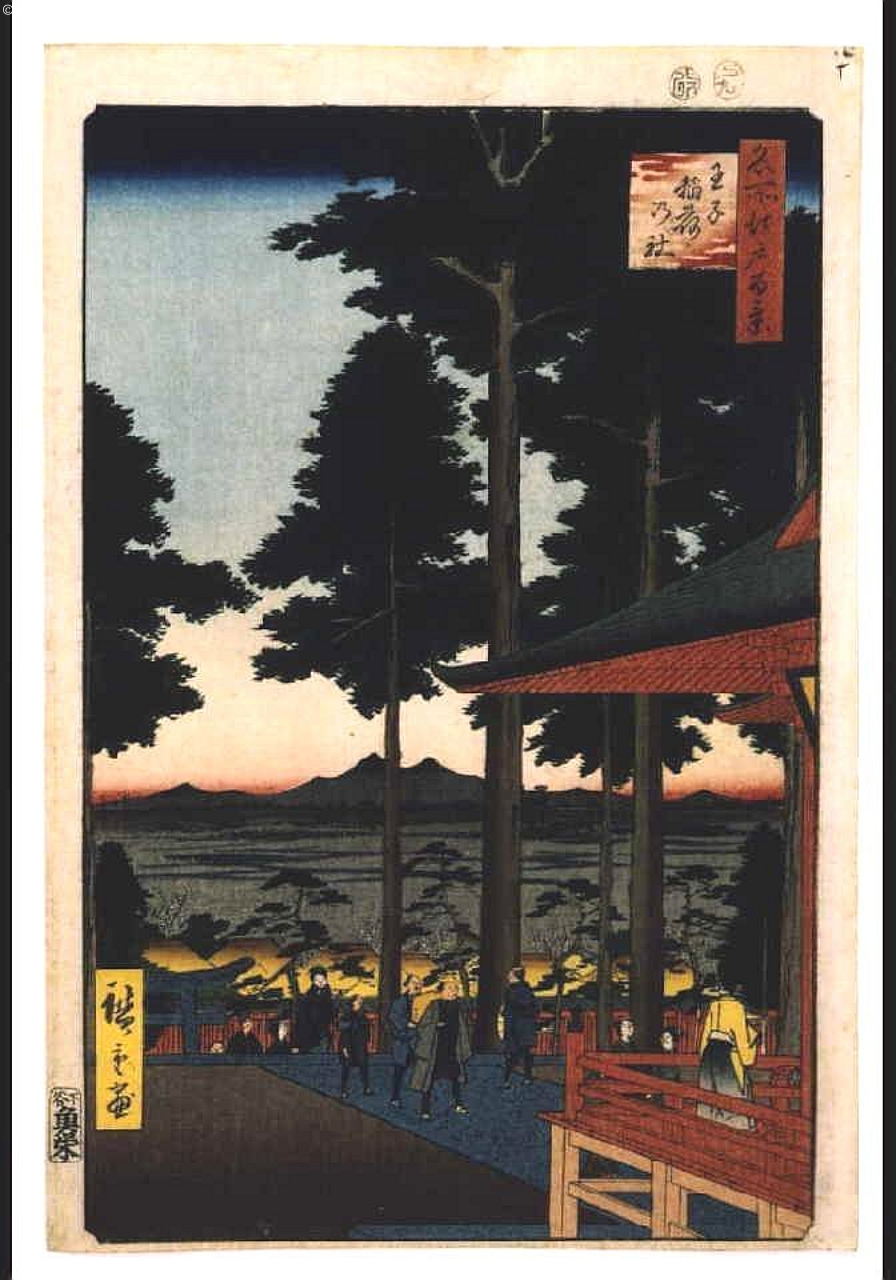
Somewhat less poetically celebrated was the importance of night soil to this biodynamic, pre-industrial shogunate capital. As environmental writer Eisuke Ishikawa delicately notes in Japan in the Edo Period — An Ecologically-Conscious Society:
A long time ago, when excrement was a precious fertilizer, it naturally belonged to the person who produced it. Farmers used to buy excrement for cash or trade it for a comparable amount of vegetables. Fertilizer shortages were a chronic problem during the Edo period. As the standard of living in cities improved, surrounding villages needed an increasing amount of fertilizer…
(Anyone who’s shouldered the surprisingly heavy interactive–not THAT interactive–night soil buckets on display in Tokyo’s Edo Museum will have a feel for just how much of this necessary element each block of the capital city generated on a daily basis.)
The Meiji Restoration of 1868 brought many changes — a new government, a new name for Edo, and a race toward Western-style industrialization. Many parks and gardens were destroyed as Tokyo rapidly expanded beyond Edo’s original footprint.
But now, the Tokyo Metropolitan Government is looking to its past in an effort to combat the effects of climate change with a push toward environmental sustainability.
The goal is net zero CO2 emissions by 2050, with 2030 serving as a benchmark.
In addition to holding the business, financial, and energy sectors to environmentally responsible standard, the zero emission plan seeks to address the average citizen’s quality of life, with a literal return to more green spaces:
Accelerating climate change measures is important to preserve biodiversity and continue to reap its bounty. In recent years, the idea of green infrastructure that utilizes the functions of the natural environment has attracted attention. It is one of the most important considerations for the future: achieving both biodiversity conservation and climate change measures.
A United Nation report* pointed out that COVID-19 is potentially a zoonotic disease derived from wildlife, such infectious diseases will increase in the future, and one of the reasons is the destruction of nature by humans.
Read Tokyo Metropolitan Government’s Zero Transmission Strategy and Update here.
Related Content
Wabi-Sabi: A Short Film on the Beauty of Traditional Japan
See How Traditional Japanese Carpenters Can Build a Whole Building Using No Nails or Screws
The Entire History of Japan in 9 Quirky Minutes
Cats in Japanese Woodblock Prints: How Japan’s Favorite Animals Came to Star in Its Popular Art
– Ayun Halliday is the Chief Primatologist of the East Village Inky zine and author, most recently, of Creative, Not Famous: The Small Potato Manifesto and Creative, Not Famous Activity Book. Follow her @AyunHalliday.
Read More...Understanding Espresso: A Six-Part Series Explaining What It Takes to Pull the Ideal Shot
It doesn’t take long to learn how to pull a shot of espresso. Search for that phrase on Youtube, and you’ll find hours’ worth of sound instruction, most of it in the form of brief and easily digestible videos. All of them cover the same basic stages of the process: grinding, dosing, tamping, and brewing. When examined closely, each of those stages reveals a formidable body of knowledge to master. If any one Youtuber can lay claim to having mastered all of them, it must be James Hoffmann, previously featured here on Open Culture for his videos on subjects from deep-fried coffee to the classic Bialetti Moka Express. In the six-part series above, he offers viewers an overview of all they need to know to achieve a true understanding of espresso.
Episode by episode, Hoffmann explains how to choose the right dose of coffee, ratio between the amount of ground and liquid coffee, brew time, grind size, brew temperature, and pressure. Of course, there is no single universally correct setting or amount of any of these things: each is a variable with its own range of effects on the shot of espresso ultimately yielded.
Each drinker, too, has a different conception of the taste and texture of the ideal espresso shot, and consistently realizing those qualities — or at least getting close — necessitates no small amount of trial and error. But those who listen well to Hoffmann’s explanations will surely end up with fewer errors, and in any case get more enjoyment from the trials.
Watch “Understanding Espresso,” and you’re going to want to know how Hoffmann pulls shots for himself. This he addresses in a bonus episode — unsurprisingly, the longest one of the bunch — which shows his entire process in detail, from preparing the beans to stirring and sipping. Along the way, he also introduces the variety of specialized devices he uses: a strong draw for his many coffee-gearhead subscribers, but one he presents with the caveat that you really don’t need to go high-end all the way in order to live your best espresso life. Even so, the dedicated home enthusiast must put in considerably more time and attention than the average chain-coffee-shop barista. “Cafés want to make good espresso as quickly and easily as possible,” he reminds us. “We want to make incredible espresso every time.”
You can watch the entire playlist, from start to finish, at the very top of the post.
Related content:
The Birth of Espresso: The Story Behind the Coffee Shots That Fuel Modern Life
Coffee College: Everything You Wanted to Know about Coffee Making in One Lecture
All Espresso Drinks Explained: Cappuccino, Latte, Macchiato & Beyond
Life and Death of an Espresso Shot in Super Slow Motion
Based in Seoul, Colin Marshall writes and broadcasts on cities, language, and culture. His projects include the Substack newsletter Books on Cities, the book The Stateless City: a Walk through 21st-Century Los Angeles and the video series The City in Cinema. Follow him on Twitter at @colinmarshall or on Facebook.
Read More...Listen to The Epic of Gilgamesh Being Read in its Original Ancient Language, Akkadian

Creative Commons image by Osama Shukir Muhammed Amin
Long ago, in the ancient civilization of Mesopotamia, Akkadian was the dominant language. And, for centuries, it remained the lingua franca in the Ancient Near East. But then it was gradually squeezed out by Aramaic, and it faded into oblivion once Alexander the Great Hellenized (Greekified) the region.
Now, 2,000+ years later, Akkadian is making a small comeback. At Cambridge University, Dr. Martin Worthington, an expert in Babylonian and Assyrian grammar, has started recording readings of poems, myths and other texts in Akkadian, including The Epic of Gilgamesh. This clip gives you a taste of what Gilgamesh, one of the earliest known works of literature, sounds like in its mother tongue. Or, you can jump into the full collection of readings right here, courtesy of the University of London.
If you would like to support the mission of Open Culture, consider making a donation to our site. It’s hard to rely 100% on ads, and your contributions will help us continue providing the best free cultural and educational materials to learners everywhere. You can contribute through PayPal, Patreon, and Venmo (@openculture). Thanks!
Related Content:
The Epic of Gilgamesh, the Oldest-Known Work of Literature in World History
World Literature in 13 Parts: From Gilgamesh to García Márquez
20 New Lines from The Epic of Gilgamesh Discovered in Iraq, Adding New Details to the Story
Read More...Support Us
We're hoping to rely on loyal readers, rather than erratic ads. Please click the Donate button and support Open Culture. You can use Paypal, Venmo, Patreon, even Crypto! We thank you!

About Us

Open Culture scours the web for the best educational media. We find the free courses and audio books you need, the language lessons & educational videos you want, and plenty of enlightenment in between.
Advertise With Us
FREE UPDATES!
GET OUR DAILY EMAIL
Get the best cultural and educational resources on the web curated for you in a daily email. We never spam. Unsubscribe at any time.
FOLLOW ON SOCIAL MEDIA
Open Culture editor Dan Colman scours the web for the best educational media. He finds the free courses and audio books you need, the language lessons & movies you want, and plenty of enlightenment in between.
Advertise With Us


