The Smithsonian Puts 4.5 Million High-Res Images Online and Into the Public Domain, Making Them Free to Use
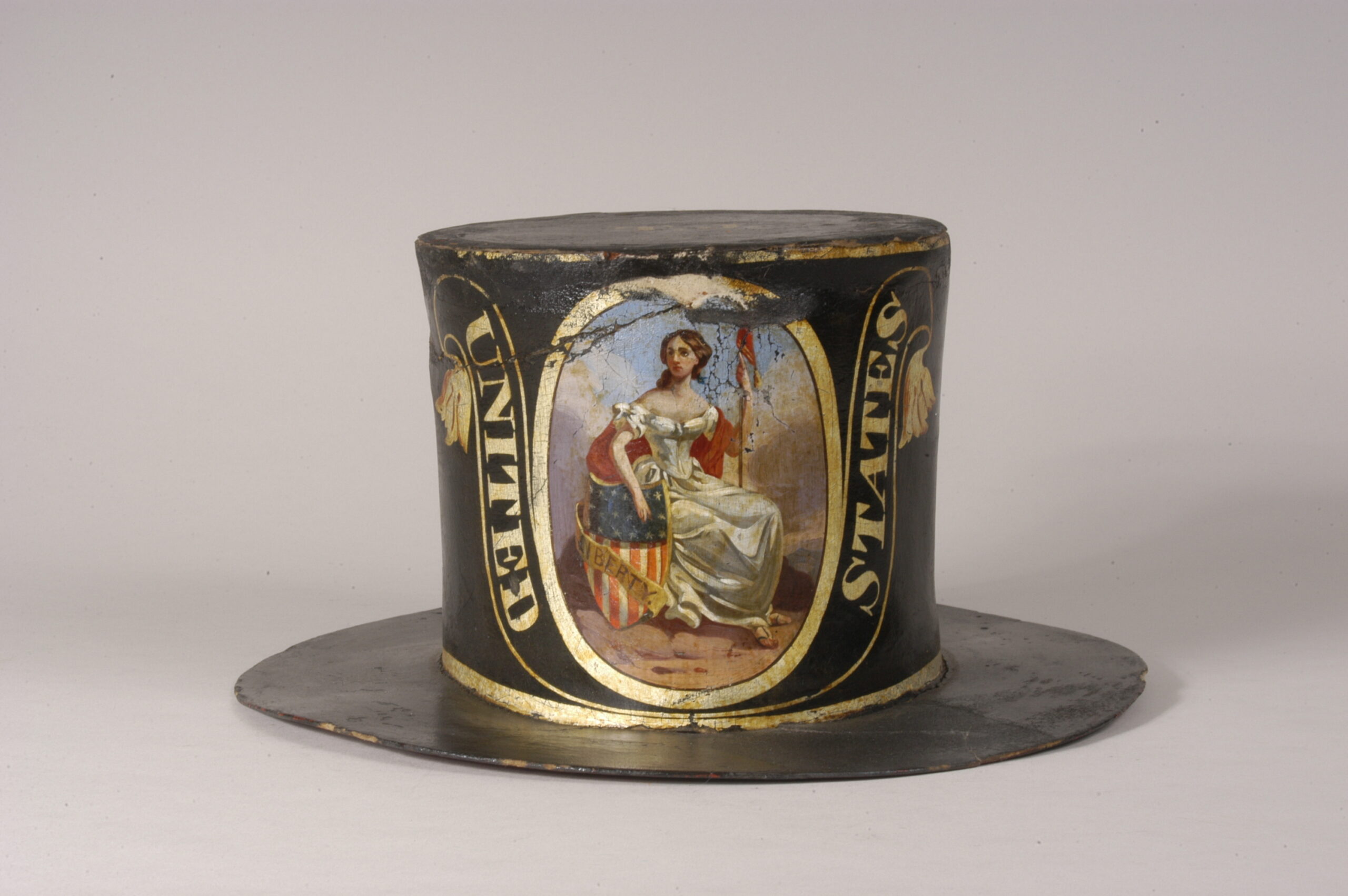
That vast repository of American history that is the Smithsonian Institution evolved from an organization founded in 1816 called the Columbian Institute for the Promotion of Arts and Sciences. Its mandate, the collection and dissemination of useful knowledge, now sounds very much of the nineteenth century — but then, so does its name. Columbia, the goddess-like symbolic personification of the United States of America, is seldom directly referenced today, having been superseded by Lady Liberty. Traits of both figures appear in the depiction on the nineteenth-century fireman’s hat above, about which you can learn more at Smithsonian Open Access, a digital archive that now contains some 4.5 million images.
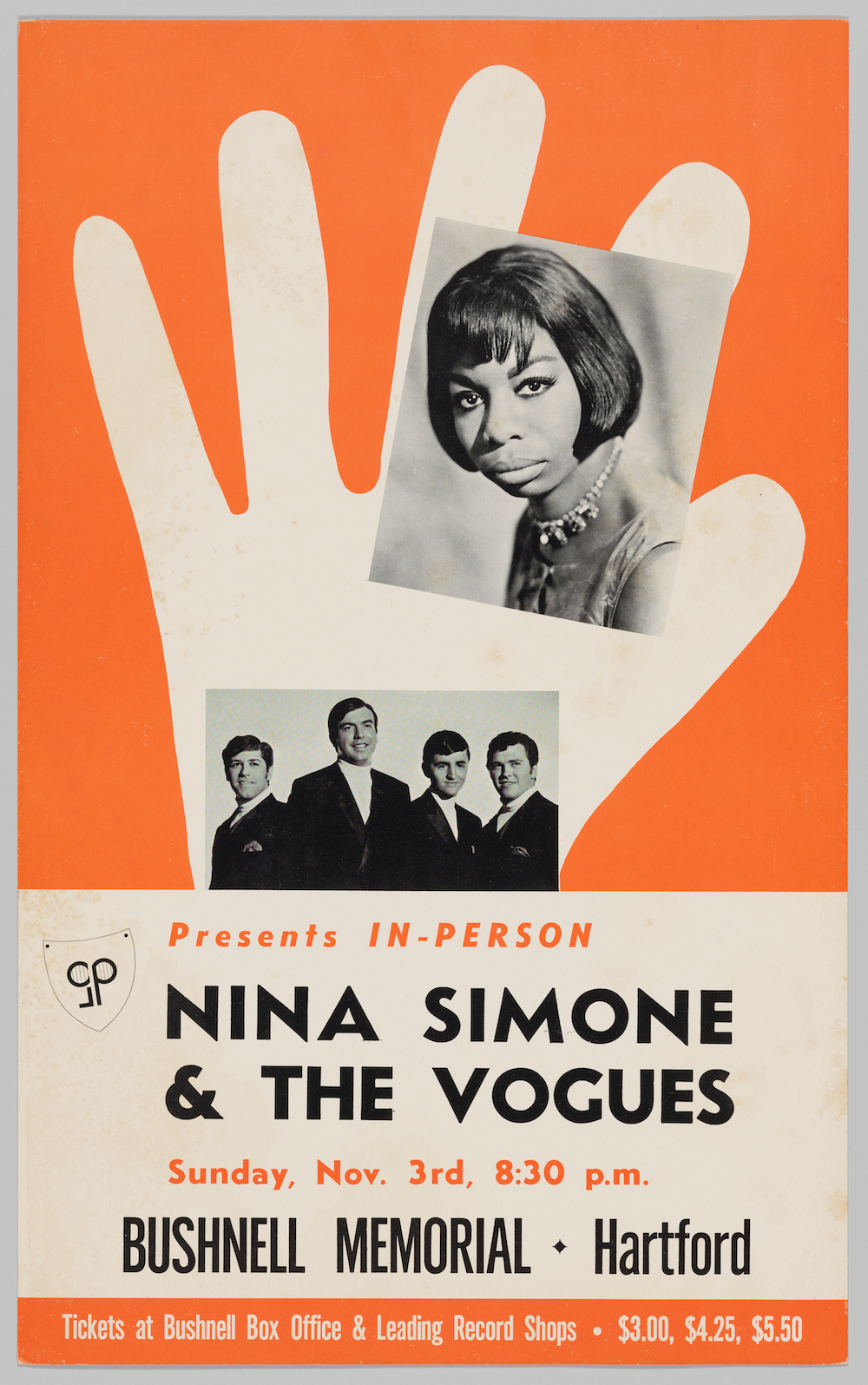
“Anyone can download, reuse, and remix these images at any time — for free under the Creative Commons Zero (CC0) license,” write My Modern Met’s Jessica Stewart and Madeleine Muzdakis. “A dive into the 3D records shows everything from CAD models of the Apollo 11 command module to Horatio Greenough’s 1840 sculpture of George Washington.”
The 2D artifacts of interest include “a portrait of Pocahontas in the National Portrait Gallery, an image of the 1903 Wright Flyer from the National Air and Space Museum, and boxing headgear worn by Muhammad Ali from the National Museum of African American History and Culture.”
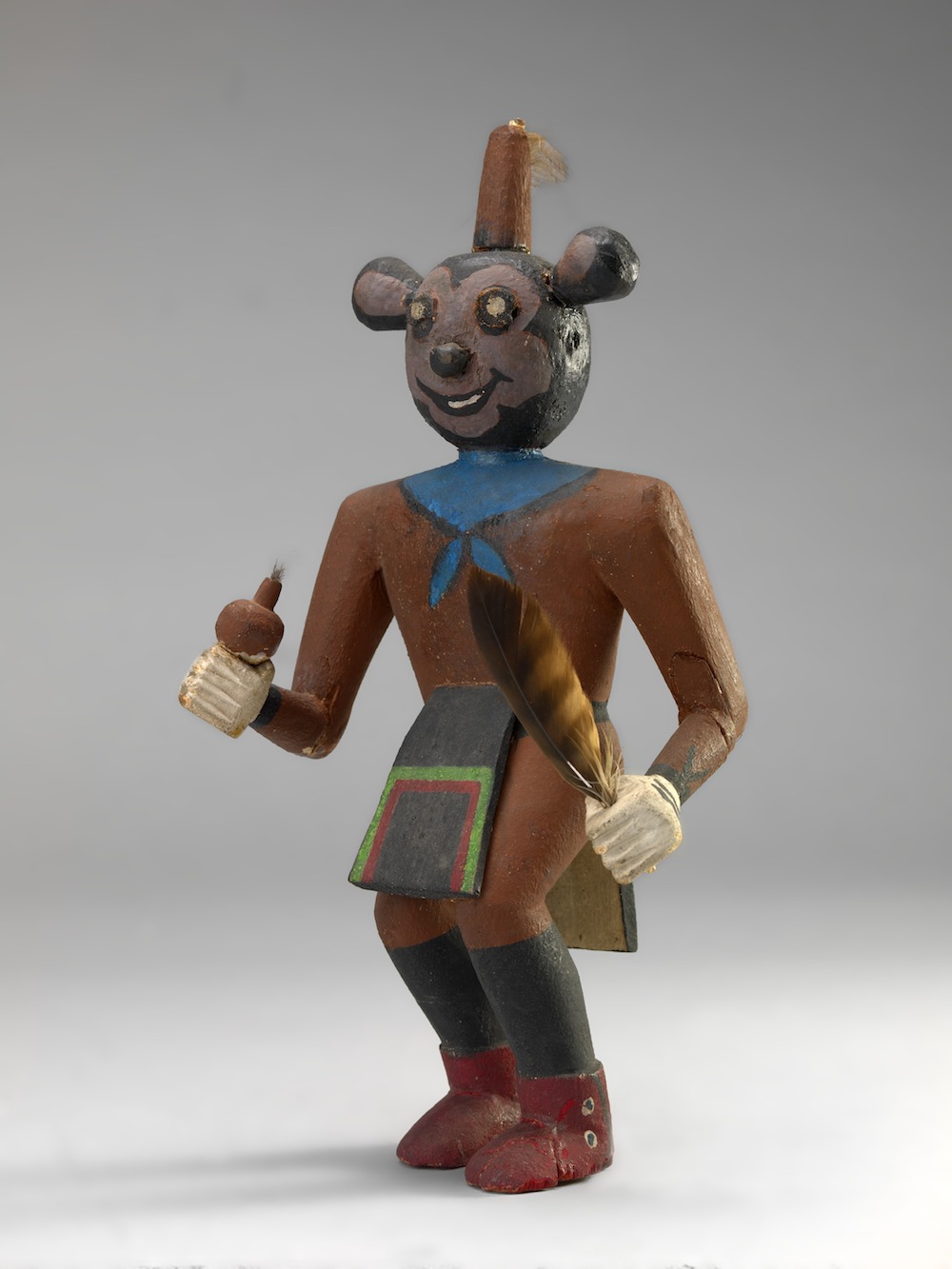
The NMAAHC in particular has provided a great many items relevant to twentieth-century American culture, like James Baldwin’s inkwell, Chuck Berry’s guitar Maybellene, Public Enemy’s boombox, and the poster for a 1968 Nina Simone concert. The more obscure object just above, a Native American kachina figure with the head of Mickey Mouse, comes from the Smithsonian American Art Museum. “When Disney Studios put a mouse hero on the silver screen in the 1930s,” explain the accompanying notes, “Hopi artists saw in Mickey Mouse a celebration of Tusan Homichi, the legendary mouse warrior who defeated a chicken-stealing hawk” — and were thus themselves inspired, it seems, to sum up a wide swath of American history in a single object.
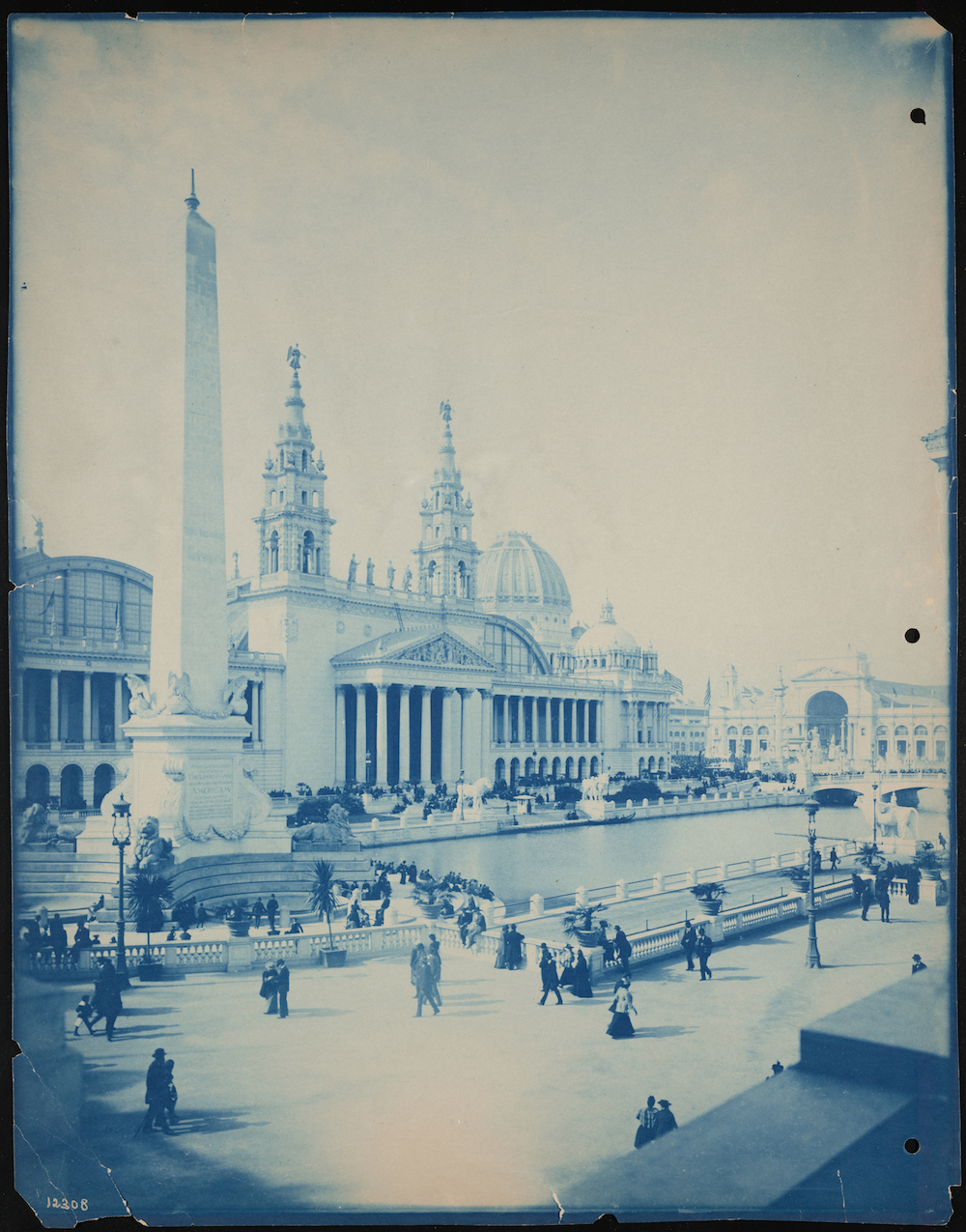
More items are being added to Smithsonian Open Access all the time, each with its own story to tell — and all accessible not just to Americans, but internet users the world over. In that sense it feels a bit like the Chicago World’s Fair of 1893, better known as the World’s Columbian Exposition, with its mission of revealing America’s scientific, technological, and artistic genius to the whole of human civilization. You can see a great many photos and other artifacts of this landmark event at Smithsonian Open Access, or, if you prefer, you can click the “just browsing” link and behold all the historical, cultural, and formal variety available in the Smithsonian’s digital collections, where the spirit of Columbia lives on.
Related content:
Why 99% Of Smithsonian’s Specimens Are Hidden In High Security
John Green’s Crash Course in U.S. History: From Colonialism to Obama in 47 Videos
Based in Seoul, Colin Marshall writes and broadcasts on cities, language, and culture. His projects include the Substack newsletter Books on Cities, the book The Stateless City: a Walk through 21st-Century Los Angeles and the video series The City in Cinema. Follow him on Twitter at @colinmarshall or on Facebook.
Read More...16-Year-Old Dave Grohl Demonstrates His Emerging Drumming Talent, Playing in His Punk Band “Mission Impossible” (1985)
Before Foo Fighters, before Nirvana, before even Dain Bramage, Scream and other bands, Dave Grohl played in the Springfield, Virginia punk band Mission Impossible. Above, we have footage of Grohl, only 16 years old, giving us a preview of performances to come. The camera puts Grohl center stage around the 1:30 mark.
This July 1985 footage was captured by Sohrab Habibion, who documented shows from the 1980s DC punk scene. His recordings now reside at the Punk Archive at the DC Public Library. Likewise, you can stream them on his YouTube channel. Among other things, you can watch vintage performances by Fugazi, GWAR, the Lemonheads, Dain Bramage (another Grohl band) & more. Stream them online.
If you would like to support the mission of Open Culture, consider making a donation to our site. It’s hard to rely 100% on ads, and your contributions will help us continue providing the best free cultural and educational materials to learners everywhere. You can contribute through PayPal, Patreon, and Venmo (@openculture). Thanks!
Related Content
Read More...Behold the World’s First Modern Art Amusement Park, Featuring Attractions by Salvador Dalí, Jean-Michel Basquiat, Keith Haring, Roy Lichtenstein & More (1987)
Think of the names David Hockney, Jean Michel-Basquiat, Roy Lichtenstein, and Keith Haring, and one time period comes vividly to mind: the nineteen-eighties, the blast radius of whose explosion of shape, color, and motion encompassed everything from mainstream pop culture to the avant-garde. One could experience this through movies, clothes, paintings, graphic design, architecture, and even furniture. But did anyone really know the aesthetic of the eighties, in its full high-low span, who did not visit Luna Luna, the first and only modern-art amusement park?
Staged in the summer of 1987 in Hamburg, the largest city in then West Germany, Luna Luna was conceived by the Austrian artist André Heller. Inspired by the cultural memory of fairgrounds like Coney Island’s Luna Park and its many imitators around the world, Heller made use of all his connections to solicit designs for attractions from the superstar artists of the day.
“Visitors could get a little lost inside Salvador Dalí’s mirrored fun house and spin around on a Keith Haring carousel,” writes Atlas Obscura’s Sarah Durn. “They could take in the view from atop a dazzling Jean-Michel Basquiat Ferris wheel while listening to Miles Davis.”
Elsewhere on the grounds, writes Jessica Stewart at My Modern Met, “Roy Lichtenstein took the opportunity to design a colorful glass structure called the Pavilion of the Glass Labyrinth. Fittingly, it was accompanied by music by Philip Glass.” One wonders what John Cage would have contributed to Luna Luna’s soundtrack, but the composer of “4’33”’ was the only artist to turn Heller down. So reports the New York Times’ Joe Coscarelli, in a piece on the current project to restore the nearly forgotten Luna Luna (whose components have spent the intervening decades languishing in warehouses) and take it on tour. With a budget nearing $100-million, it’s becoming a reality thanks to the involvement of a surprising party: the rap superstar Drake, who knows full well the value of embodying the zeitgeist.
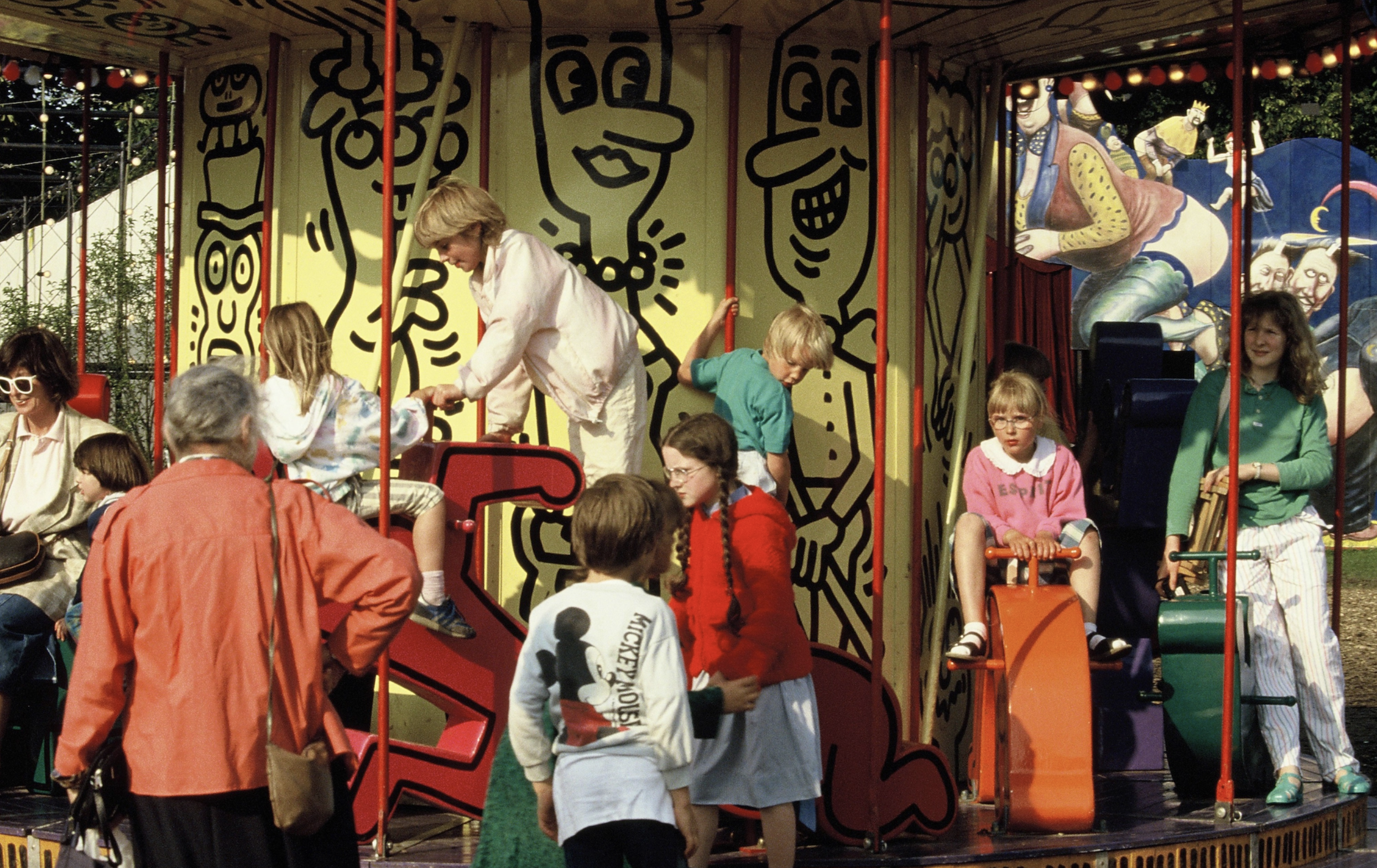
To complement the restoration of his project, André Heller published this year Luna Luna: The Art Amusement Park, a new book that documents in photographs this one-of-a-kind amusement park. You can purchase copies of the 300+ page book online.

Related content:
A Short Biography of Keith Haring Told with Comic Book Illustrations & Music
The Revolutionary Paintings of Jean-Michel Basquiat: A Video Essay
Watch David Hockney Paint with Light, Using the Quantel Paintbox Graphics System (1986)
Inside the Creepy, “Abandoned” Wizard of Oz Theme Park: Scenes of Beautiful Decay
Based in Seoul, Colin Marshall writes and broadcasts on cities, language, and culture. His projects include the Substack newsletter Books on Cities, the book The Stateless City: a Walk through 21st-Century Los Angeles and the video series The City in Cinema. Follow him on Twitter at @colinmarshall or on Facebook.
Read More...Discover Leonora Carrington, Britain’s Lost Surrealist Painter
I didn’t have time to be anyone’s muse…I was too busy rebelling against my family and learning to be an artist. — Leonora Carrington
In some ways, Surrealist Leonora Carrington’s story is a familiar one, given her gender and generation.
A creative young woman, stifled by her conventional upbringing, escapes to Paris, falls in love with an older male artist, gains a degree of recognition destined always to be smaller than that of her celebrated lover’s, suffers hardships, continues working, lives a very long time and is the subject of nearly as many exhibitions in the decade and a half following her death as in the 70 years preceding it.
Certainly, Carrington, who died in 2011, would be deeply rankled by this, or any attempt to condense her narrative into an easily-grasped package. Witness the brusque way she rejects her younger cousin Joanna Moorhead’s invitations, above, to describe the inspiration behind various canvases:
You’re trying to intellectualize something, desperately, and you’re wasting your time! That’s not a way of understanding to make …a sort of mini logic. You’ll never understand by that road.
The story of how Moorhead connected with her notorious cousin is a fascinating one.
Growing up in England, Moorhead knew next to nothing about the family’s absent black sheep — who had taken up with the 46-year-old Max Ernst at the age of 20, hobnobbed with Picasso, Marcel Duchamp and Andre Breton in Paris, and wound up in Mexico City after WWII.
All she was told was that Carrington, known to the family as Prim, had “run off with an artist to become his model.”
As Moorhead writes in The Surreal Life of Leonora Carrington:
…there were occasional snatches: a hushed phone call where the word ‘Mexico’ was just audible; a whispered conversation on the sofa after Sunday lunch between (great aunt) Maurie and (grandmother) Miriam. There were guffawas occasionally from (uncle) Gerard and my father: “And then she painted a creature with three breasts!”
In 2006, Moorhead was at a party, making polite conversation with another guest, an art historian who lived in Mexico, “scrap(ing) together a few questions about the only Mexican artist I knew anything about — Frida Kahlo”, when she suddenly remembered her bohemian and seldom spoken of relative, who might even be dead by now for all she knew…
Her fellow guest was amazed by both the blood connection and Moorhead’s ignorance, describing Carrington as Mexico’s most famous living artist, and a “national treasure” who Mexico happily claimed as one of its own.
Gobsmacked, Moorhead Googled “Leonora Carrington”, discovering a wealth of photos from various phases of life, as well as the prodigious output from her brush:
A strange, Hieronymus Bosch-style world filed with horse-like creatures who floated, danced and curled their way across alien landscapes…Some of her pictures depicted unfamiliar and sinister-looking worlds: one showed a country with. Red sky and amber hills across which trapised a procession of people wearing white robes. More figures, wearing black, huddled around a huge eunuch like creature, while an outsize turquoise snake unfurled itself dramatically in mid-air. There seemed to be various elements competing to be the centre of the action in that painting: a globe, a God-like effigy and a cathedral all nestled below a rainbow. And the story, whatever it was, didn’t end there because (Carrington) had painted an underworld in which more people (dead, presumably) seemed to have been transformed into animals with pointy, black heads. They were crawling, or trying to crawl, and their efforts were being watched, ominously, by a sharp-toothed, one-eyed tiger.
Driven to find out more, Moorhead traveled to Mexico City, where Carrington had lived off and on since 1942. Her cousin was now in her late 80s, isolated with an infirm second husband, but still painting and championing Surrealism as a visual expression that couldn’t be captured with words:
There was no softness around the edges with Leonora; she had taken a hard path, suffered a great deal as a result, and she wore her toughness like a badge of honour she had earned from herself. It is far more of an honour than the certificate Blu-Tacked to her cupboard door, the honour the Mexican government had given her; it was certainly more of an honour than the OBE she had belatedly been awarded by the British, receiving it on a visit from Prince Charles on a visit he made to Mexico in 2000. She was bemused by these late accolades, but never impressed by them. Early on in her life, she had decided there was only one thing she could ever rely on, and that was the steeliness in her heart. External events, the trappings of wealth and success, the opinions of others, all these were swept away, dismissed, ignored. She was as unconcerned by the approval of others as by their disapproval.
See more of Leonora Carrington’s work here.
Listen to Joanna Moorhead interviewed about Leonora Carrington on the Great Women Artists Podcast (with the understanding that the subject would have resisted that gender-based categorization…). And read more about her at The New Yorker.
Related Content
The Forgotten Women of Surrealism: A Magical, Short Animated Film
Ayun Halliday is the Chief Primatologist of the East Village Inky zine and author, most recently, of Creative, Not Famous: The Small Potato Manifesto and Creative, Not Famous Activity Book. Follow her @AyunHalliday.
Read More...Watch Joni Mitchell Perform George Gershwin’s “Summertime”
“I’ve been a painter all my life. I’ve been a musician most of my life. If you can paint with a brush, you can paint with words.” — Joni Mitchell
There’s been a lot of love for Joni Mitchell circulating of late, the sort of heartfelt outpouring that typically accompanies news of an artist’s death.
Fortunately, the beloved singer-songwriter has shown herself to be very much alive, despite a 2015 brain aneurysm that initially left her unable to speak, walk, or play music.
As she quipped in a recent interview with Librarian of Congress Carla Hayden, “I’m hard to discourage and hard to kill.”
How wonderful, then to be so fully alive as a windfall of testimonials roll in, describing the personal significance of her work, from the famous friends feting her last month with a concert of her own compositions as she was awarded the Library of Congress Gershwin Prize for Popular Song to ordinary citizens with fond memories of singing “The Circle Game” at camp.
Mitchell says that song, which you can hear her singing above, along with last month’s all-star line up, “kind of became like Old MacDonald Had a Farm” owing to its campfire popularity, though she resisted Hayden’s invitation to explain its timeless appeal:
I don’t know. Why was Old MacDonald Had a Farm so timeless?
This 79-year-old legend’s growing tendency to goof her way through interviews is endearing, but the Gershwin Prize is serious business, intended to “celebrate the work of an artist whose career reflects the influence, impact and achievement in promoting song as a vehicle of musical expression and cultural understanding.”
Performer Cyndi Lauper reflected that Mitchell’s influence is not confined to the realm of music:
When I was growing up the landscape of music was mostly men. There were a few women — far and few from me — and Joni Mitchell was the first artist who really spoke about what it was like to be a woman navigating in a male world … You taught me that I could be a multimedia artist if I wanted, because you painted and you wrote and you played and that’s what I wanted and I thought, “Well, if you could do it, maybe I can do it too.”
Mitchell trained as a commercial artist. Her paintings and self-portraits are featured on the covers of seventeen albums. When Hayden asked whether she primarily conceives of herself as a musician or artist, Mitchell went with artist, “because it’s more general.”
I think that, you know, my songs are kind of, they’re not folk music, they’re not chat. They’re kind of art songs and they embody classical things and jazzy things and folky things, you know, long line poetry. So yeah, I forged my identity very early as an artist. I’ve always thought of myself as an artist, but not specifically as a musician. You know, in some ways I’m just not a normal musician because I play in open tunings. I never learned the neck of my guitar well enough to jam with other people. I can jam if I lead, but I can’t really follow.
She believes her painting practice enriches her songwriting, much as crop rotation helps a field to remain fertile.
Not every artist switches lanes so effortlessly.
When Georgia O’Keeffe — who once told ARTnews she’d choose to be reincarnated as a “blond soprano who could sing high, clear notes without fear” — confided that she would have liked to be a musician as well as an artist, “but you can’t do both”, Mitchell claims to have responded, “Yeah, you can. You just have to give up TV.”
Songwriters George and Ira Gershwin, namesakes of the Prize for Popular Song, were closer to Mitchell in terms of creative omnivorousness. Their self-portraits hang in the National Portrait Gallery and the Library of Congress’ Gershwin room.
Mitchell was thrilled when Library staff presented her with a copy of the handwritten original score for her favorite George Gershwin tune, “Summertime,” which she recorded for Herbie Hancock’s 1998 album, Gershwin’s World, seven years after an Interview magazine piece in which she referred to her voice as “middle-aged now…like an old cello.”
Twenty-five years later, singing “Summertime” at the end of the concert in her honor, that cello’s tones are seasoned…and even more mellow.
I love the melody of (Summertime) and I like the simplicity of it. And I don’t know, I just I really get a kick out of singing it.
Stream Joni Mitchell: The Library of Congress Gershwin Prize, an all-star concert featuring Brandi Carlile, Annie Lennox, James Taylor, Herbie Hancock, Cyndi Lauper, and other luminaries, including the Lady of the Canyon herself, for free on PBS through April 28.
– Ayun Halliday is the Chief Primatologist of the East Village Inky zine and author, most recently, of Creative, Not Famous: The Small Potato Manifesto and Creative, Not Famous Activity Book. Follow her @AyunHalliday.
Read More...How John Singer Sargent Became the Greatest Portraitist Who Ever Lived — by Painting “Outside the Lines”
Evan Puschak, better known as Youtube’s Nerdwriter, has created video essays on a host of visual artists from Goya to Picasso, de Chirico to Hopper, Leonardo to Van Gogh. And though he narrates all his analyses of their work with evident enthusiasm, one sooner or later comes to suspect that he isn’t without personal preferences in this arena. In the opening of his new video above does he name his personal favorite painter: John Singer Sargent, for whom he makes the case by telling us why — and how — the artist “painted outside the lines.”
“Sargent came of age as the Impressionist movement, led by Claude Monet, flowered,” says Puschak. But despite his close association with Monet himself, “Sargent was not usually counted among the Impressionists,” but he was an impressionist in that “the impressions of light and color were his subjects.”
By his early twenties, he had already become a master of conjuring (and even enhancing) reality on a canvas with an absolute minimum of brushstrokes or fine detail work. “High society came knocking en masse,” all wanting to commission a Sargent portrait; in fulfilling their orders, Sargent became “the greatest portraitist who ever lived.”
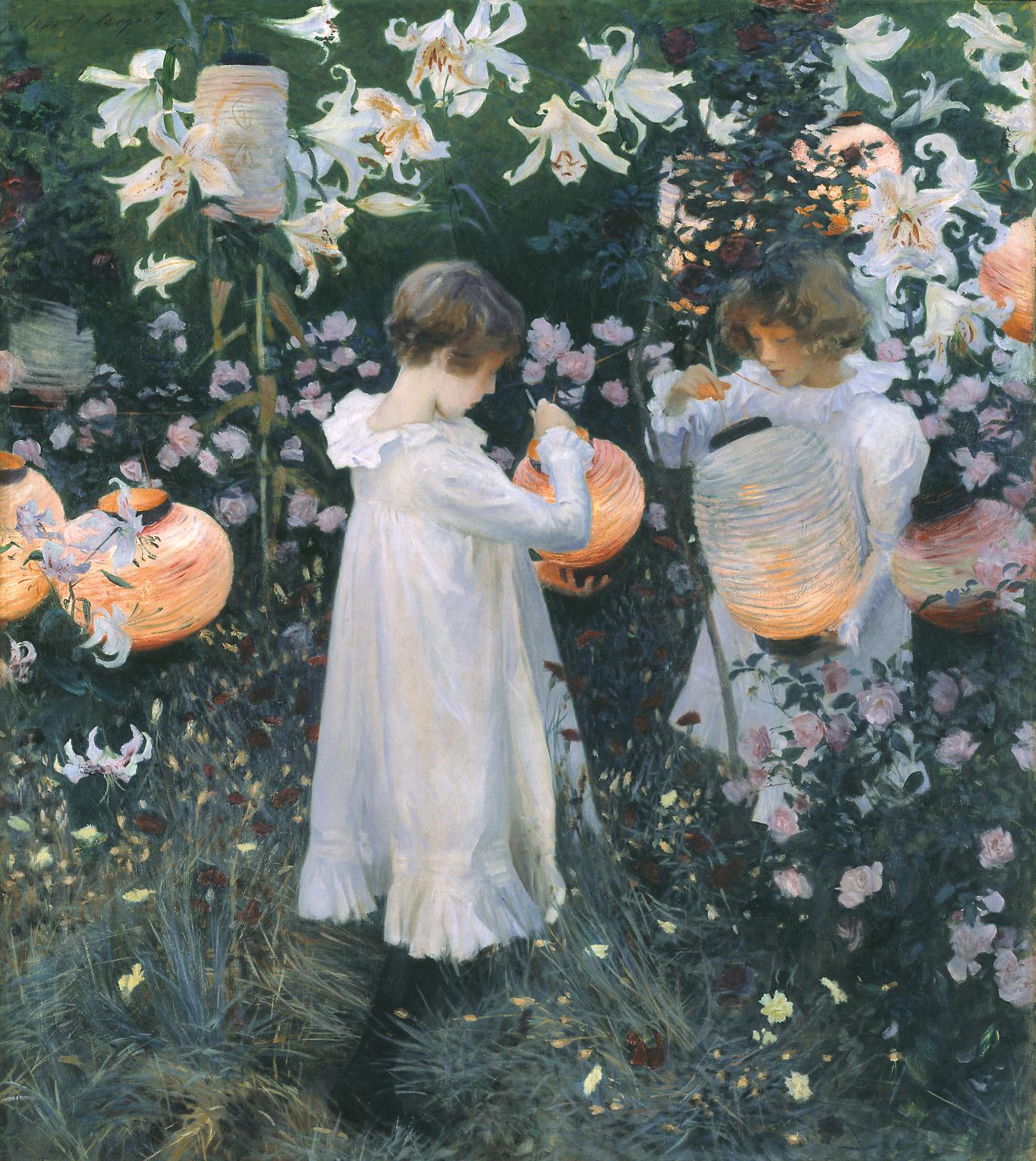
It was also portraiture that got him into trouble. After his “stunning painting of a wealthy socialite” — Madame X, as previously featured here on Open Culture — “caused a scandal in Paris for being too racy,” he move to England. There he would paint Carnation, Lily, Lily, Rose in 1885 and 1886, working only during the “golden hour” just before sunset in order to capture its distinctive light. Puschak explains that, apart from the power of the artist’s long-refined small‑i impressionist technique, “what Sargent gets here, by the accumulation of little effects, is an atmosphere, a mauve-ish coloring that gets in the air itself, which is what it really feels like to be outside on a summer evening.” We all enjoy that feeling, of course, but in this painting — Puschak’s favorite — Sargent established himself as the most masterful summer-evening appreciator of them all.
Below you can watch from the Tate “How John Singer Sargent Painted Carnation, Lily, Lily, Rose”
Related content:
When John Singer Sargent’s Madame X Scandalized the Art World in 1884
Edward Hopper’s Iconic Painting Nighthawks Explained in a 7‑Minute Video Introduction
Why Monet Painted The Same Haystacks 25 Times
How Andrew Wyeth Made a Painting: A Journey Into His Best-Known Work Christina’s World
Why Leonardo da Vinci’s Greatest Painting is Not the Mona Lisa
Based in Seoul, Colin Marshall writes and broadcasts on cities, language, and culture. His projects include the Substack newsletter Books on Cities, the book The Stateless City: a Walk through 21st-Century Los Angeles and the video series The City in Cinema. Follow him on Twitter at @colinmarshall or on Facebook.
Read More...Europe’s Oldest Map: Discover the Saint-Bélec Slab (Circa 2150–1600 BCE)
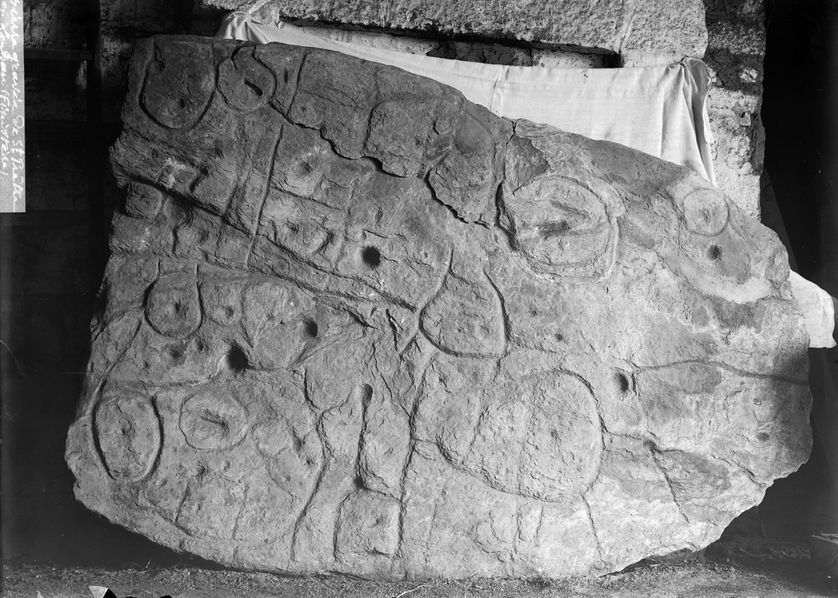
Image by Paul du Châtellier, via Wikimedia Commons
In 1900, the French prehistorian Paul du Châtellier dug up from a burial ground a fairly sizable stone, broken but covered with engraved markings. Even after he put it back together, neither he nor anyone else could work out what the markings represented. “Some see a human form, others an animal one,” he wrote in a report. “Let’s not let our imagination get the better of us and let us wait for a Champollion to tell us what it says.” Champollion, as Big Think’s Frank Jacobs explains, was “the Egyptologist who in 1822 deciphered the hieroglyphics” — which he did with the aid of a more famous inscription-bearing piece of rock, the Rosetta Stone.
Still, the Saint-Bélec slab, as Châtellier’s discovery is now known, has attained a great deal of recognition in the more than 120 years since he unearthed it. But it did so relatively recently, after a long period of relative obscurity.
“In 1994, researchers revisiting du Châtellier’s original drawing found that the intricate markings on the stone looked a lot like a map,” writes Jacobs. “The stone itself, however, had gone missing.” Only in 2014 was it rediscovered in a cellar below the moat of the chateau in Saint-Germain-en-Laye once owned by du Châtellier, by which time it could be subjected to the kind of high-tech analysis unimagined in his lifetime.
Operating on the theory that the artifact was indeed created as a map, France’s INRAP (the National Institute for Preventive Archaeological Research) “found that the markings on the slab corresponded to the landscape of the Odet Valley” in modern-day Brittany. Then, “using geolocation technology, the researchers established that the territory represented on the slab bears an 80 percent accurate resemblance to an area around a 29-km (18-mi) stretch of the Odet river,” which seems to have been a small kingdom or principality back in the early Bronze Age, between 2150 BC and 1600 BC. This makes the Saint-Bélec slab Europe’s oldest map, and quite possibly the earliest map of any known territory — and certainly the earliest known map of a popular kayaking destination.
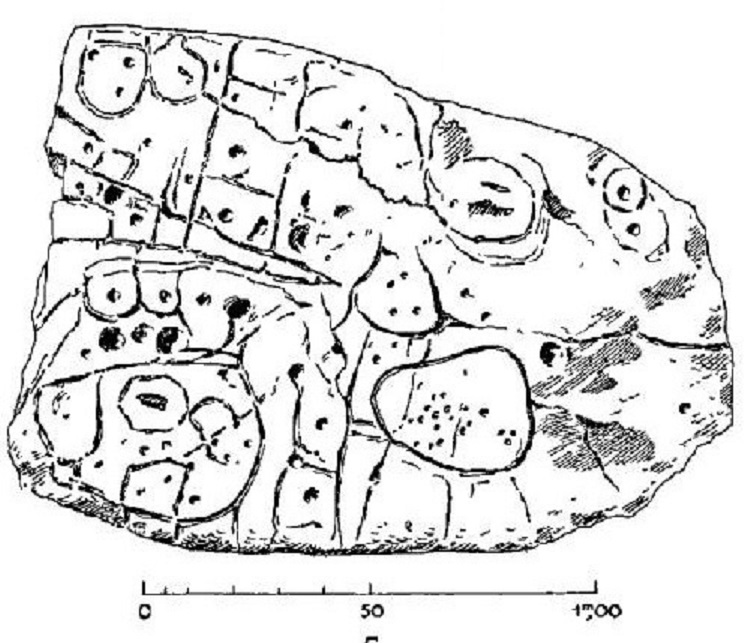
Drawing by Paul du Chatellier, via Wikimedia Commons
via Big Think
Related content:
Explore the Hereford Mappa Mundi, the Largest Medieval Map Still in Existence (Circa 1300)
Bronze Age Britons Turned Bones of Dead Relatives into Musical Instruments & Ornaments
What the Rosetta Stone Actually Says
Based in Seoul, Colin Marshall writes and broadcasts on cities, language, and culture. His projects include the Substack newsletter Books on Cities, the book The Stateless City: a Walk through 21st-Century Los Angeles and the video series The City in Cinema. Follow him on Twitter at @colinmarshall or on Facebook.
Read More...Behold John Coltrane’s Handwritten Outline for His Masterpiece A Love Supreme
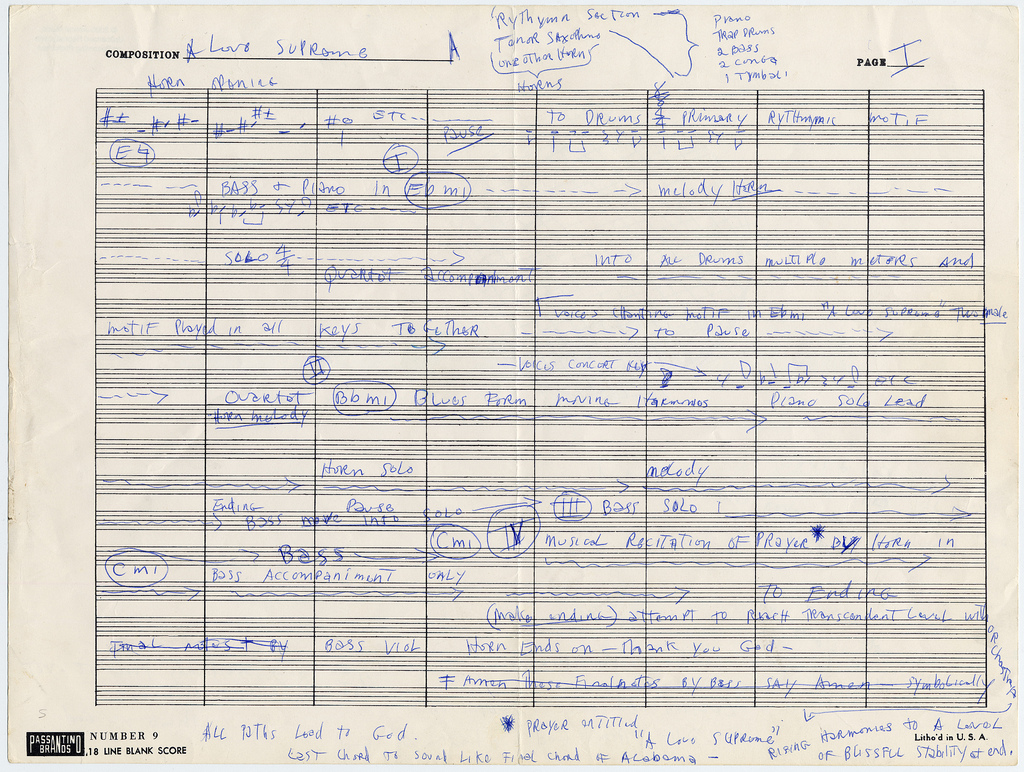
Above, we present an important document from the Smithsonian’s National Museum of American History: John Coltrane’s handwritten outline of his groundbreaking jazz composition, A Love Supreme.
Recorded in December of 1964 and released in 1965, A Love Supreme is Coltrane’s personal declaration of his faith in God and his awareness of being on a spiritual path. “No road is an easy one,” writes Coltrane in a prayer at the bottom of his own liner notes for the album, “but they all go back to God.”
If you click here and examine a larger copy of the manuscript, you will notice that Coltrane has written the same sentiment at the bottom of the page. “All paths lead to God.” The piece is made up of a progression of four suites. The names for each section are not on the manuscript, but Coltrane eventually called them “Acknowledgement,” “Resolution,” “Pursuance” and “Psalm.”
In the manuscript, Coltrane writes that the “A Love Supreme” motif should be “played in all keys together.” In the recording of “Acknowledgement,” Coltrane indeed repeats the basic theme near the end in all keys, as if he were consciously exhausting every path. As jazz historian Lewis Porter, author of John Coltrane: His Life and Music, tells NPR in the piece below:
Coltrane more or less finished his improvisation, and he just starts playing the “Love Supreme” motif, but he changes the key another time, another time, another time. This is something very unusual. It’s not the way he usually improvises. It’s not really improvised. It’s something that he’s doing. And if you actually follow it through, he ends up playing this little “Love Supreme” theme in all 12 possible keys. To me, he’s giving you a message here.
In section IV of the manuscript, for the part later named “Psalm,” Coltrane writes that the piece is a “musical recitation of prayer by horn,” and is an “attempt to reach transcendent level with orchestra rising harmonies to a level of blissful stability at the end.” Indeed, in the same NPR piece which you can listen to below, Rev. Franzo Wayne King of the Saint John Coltrane African Orthodox Church in San Francisco describes how his congregation one day discovered that Coltrane’s playing corresponds directly to his prayer at the bottom of the liner notes.
In addition to Porter and King, NPR’s Eric Westervelt interviews pianist McCoy Tyner, who was the last surviving member of Coltrane’s quartet. The 13-minute piece, “The Story of ‘A Love Supreme,’ ” is a fascinating overview of one of the great monuments of jazz.
Note: An earlier version of this post appeared on our site in 2013.
Related Content:
Saint John Coltrane: The San Francisco Church Built On A Love Supreme
Watch a Jaw-Dropping Visualization of John Coltrane’s “Giant Steps” Solo
John Coltrane Draws a Picture Illustrating the Mathematics of Music
Read More...
Watch David Bowie’s Final Performance as Ziggy Stardust, Singing “I Got You Babe” with Marianne Faithfull, on The Midnight Special (1973)
If you had to choose a living cultural figure to represent nineteen-seventies America, you could do much worse than Burt Sugarman. He made his name as a television impresario with The Midnight Special, which put on NBC’s airwaves performances by everyone from ABBA to AC/DC, REO Speedwagon to Roxy Music, and War to Weather Report. Breaking with common practice at the time, the show allowed these acts to perform live rather than lip-sync against pre-recorded tracks. Thus, even viewers who tuned in to The Midnight Special to see their favorite bands were guaranteed to hear something they’d never heard before.
They stayed up quite late to do so: The Midnight Special followed The Tonight Show Starring Johnny Carson, which meant that it aired at midnight in the Central and Mountain time zones, and 1:00 in Eastern and Pacific. In 1972, the notion of putting on a music show at that hour was unfamiliar enough that Sugarman had trouble selling it.
He ultimately had to buy the airtime himself in order to convince NBC to pick the show up, which it did soon thereafter. (For the network, the prospect of extending their programming schedule would have been sweetened by the previous year’s Public Health Cigarette Smoking Act, which had banned the once-lucrative airing of tobacco advertisements on television.)
Now, more than half a century after its debut, The Midnight Special has reappeared in the form of a Youtube channel, which features high-quality videos of the show’s original performances. Those uploaded so far have been organized into artist playlists dedicated to acts like the Bee Gees, Fleetwood Mac, Tina Turner, and David Bowie. That last includes Bowie’s rendition of “I Got You Babe” with Marianne Faithfull, seen at the top of this post, as well as his version of The Who’s “I Can’t Explain” above, part of his final performance as his space-alien alter ego Ziggy Stardust — itself originally shot for The 1980 Floor Show in London, which despite its name took place in 1973. The Midnight Special itself would run until 1981, which means that a great deal of music remains to be brought out of Sugarman’s archives for us to enjoy here in the twenty-twenties. You can watch Bowie’s complete 1973 performance on The Midnight Special below.
Related content:
David Bowie Became Ziggy Stardust 48 Years Ago This Week: Watch Original Footage
8 Hours of David Bowie’s Historic 1980 Floor Show: Complete & Uncut Footage
David Bowie’s Final Gig as Ziggy Stardust Documented in 1973 Concert Film
David Bowie Talks and Sings on The Dick Cavett Show (1974)
Watch an Episode of TV-CBGB, the First Rock ‘n’ Roll Sitcom Ever Aired on Cable TV (1981)
Based in Seoul, Colin Marshall writes and broadcasts on cities, language, and culture. His projects include the Substack newsletter Books on Cities, the book The Stateless City: a Walk through 21st-Century Los Angeles and the video series The City in Cinema. Follow him on Twitter at @colinmarshall or on Facebook.
Read More...Watch a Transfixing Demonstration of Kumihimo, the Ancient Japanese Artform of Making Braids & Cords
It’s easy to see why kumihimo, the ancient Japanese art of silk braiding, is described as a meditative act.
The weaver achieves an intricate design by getting into a rhythmic groove, overlapping hand-dyed silken threads on a circular or rectangle wooden loom, from which up to 50 weighted-wooden bobbins dangle.
If the mind wanders too far from the task, the weaver risks screwing up the pattern or the uniformity of the threads’ tension. The word kumihimo translates to “gathering threads” — one mustn’t let them get snarled by a lack of attention.
While simple braids of tree bark or plant fiber have been found in Japanese burial sites dating back six thousand years, the Golden Age of kumihimo occurred during the Heian period (794‑1185), when exquisitely detailed cords began to be incorporated into the nobility’s garments, decorative furnishings, musical instruments, religious implements, and, most famously, samurai arms and armor.
Anime fans may recall how kumihimo shows up and serves as a major metaphor in Makoto Shinkai’s hit animated feature, Your Name - the braided cords representing the threads of time and the strength of the lovers’ bond.
Kumihimo is still in use today in jewelry and decorative souvenirs, and fastening obi to formal kimono, though 95% of obijime are now machine-made.
There are plenty of online tutorials for novices interested in making simple kumihimo friendship bracelets on a lightweight foam disk, but to appreciate the beauty inherent in every step of traditional kumihimo creation, watch Japan House’s above video, released in celebration of their recent exhibit, KUMIHIMO: The Art of Japanese Silk Braiding by DOMYO.
ASMR fans, prepare to be riveted by the sounds of the silken threads being swished through a dye bath, the gentle clack tama bobbins, and the tapping of the bamboo hera as it snugs the threads of the growing braid suspended from the rectangular stand, or takadai.
The circular loom, or marudai, seen later in the video produces a rounded cord via a central hole, an engineering feat that takes us back to our childhood passion for finger knitting.
Japan House reports that the industrial sector has taken inspiration from kumihimo for braiding carbon fiber and fiber-reinforced plastic:
The continuity of the kumihimo braid structure as well as the variability of the fiber orientation angle and the rigidity of the braids help produce extremely strong cords that can be used in products as diverse as aircraft, golf clubs, and artificial limbs.
Meanwhile several schools in Japan are keeping kumihimo alive as a traditional art, as is the American Kumihimo Society, in the West.
via Colossal
Related Content
20 Mesmerizing Videos of Japanese Artisans Creating Traditional Handicrafts
– Ayun Halliday is the Chief Primatologist of the East Village Inky zine and author, most recently, of Creative, Not Famous: The Small Potato Manifesto and Creative, Not Famous Activity Book. Follow her @AyunHalliday.
Read More...Support Us
We're hoping to rely on loyal readers, rather than erratic ads. Please click the Donate button and support Open Culture. You can use Paypal, Venmo, Patreon, even Crypto! We thank you!

About Us

Open Culture scours the web for the best educational media. We find the free courses and audio books you need, the language lessons & educational videos you want, and plenty of enlightenment in between.
Advertise With Us
FREE UPDATES!
GET OUR DAILY EMAIL
Get the best cultural and educational resources on the web curated for you in a daily email. We never spam. Unsubscribe at any time.
FOLLOW ON SOCIAL MEDIA
Open Culture editor Dan Colman scours the web for the best educational media. He finds the free courses and audio books you need, the language lessons & movies you want, and plenty of enlightenment in between.
Advertise With Us



