A Medieval Arabic Manuscript Features the Designs for a “Perpetual Flute” and Other Ingenious Mechanical Devices

In the late twelfth and early thirteenth century there lived a mechanically inclined polymath named Badi’ al-Zaman Abu-‘l-‘Izz Ibn Isma’il Ibn al-Razzaz al-Jazari, whom we might prefer simply to call Al-Jazari. A resident of Diyar-Bakir, in modern-day Turkey, he was employed as a court engineer, and indeed, proved to be the finest engineer for which a Mesopotamian ruler of that era could hope. He worked out a variety of functional camshafts, crankshafts, pumps, fountains, and clocks, not to mention his more ambitious designs, including a host of humanoid automata meant to handle tasks like serving beverages and even playing music.

Lying between the practical and the fanciful are such Al-Jazarian inventions as the “perpetual flute,” a diagram of which you can see at the site of the Metropolitan Museum of Art. Involving “two adjacent tanks, each with a plug attached to a chain,” the setup would work when “the pipe on an axle with a bowl fills with water from a channel at the upper right and tips so that water flows into one tank. The air in the tank is thus forced through a pipe attached to a jar that plays a flute until the tank is filled. Then the pipe tilts to fill the other tank with water, causing the other flute to play.” Like a pre-modern Rube Goldberg, Al-Jazari created mechanical concepts that are better seen than explained, and you’ll find many more of them illustrated at Flashbak.

These works of schematic art come not from Al-Jazari’s own hand, but from an Arabic manuscript created some three to six centuries after his death. It appears to pay a kind of tribute to his popular Book of Knowledge of Ingenious Mechanical Devices, which itself drew upon a ninth-century Book of Ingenious Devices written by three Persian brothers known as the Banu Musa. All of these artistic and technical works, and their continued availability in different forms through the generations, reflect the serious work of intellectual custodianship and development across the civilizations of the Middle East after the fall of the Roman Empire — a project that greatly benefited from the occasional sui generis imagination like Al-Jazari’s.
If you would like to support the mission of Open Culture, consider making a donation to our site. It’s hard to rely 100% on ads, and your contributions will help us continue providing the best free cultural and educational materials to learners everywhere. You can contribute through PayPal, Patreon, and Venmo (@openculture). Thanks!
via Flashbak
Related content:
Download 10,000+ Books in Arabic, All Completely Free, Digitized and Put Online
How Arabic Translators Helped Preserve Greek Philosophy … and the Classical Tradition
500+ Beautiful Manuscripts from the Islamic World Now Digitized & Free to Download
Based in Seoul, Colin Marshall writes and broadcasts on cities, language, and culture. His projects include the Substack newsletter Books on Cities, the book The Stateless City: a Walk through 21st-Century Los Angeles and the video series The City in Cinema. Follow him on Twitter at @colinmarshall or on Facebook.
Read More...The Pulp Magazine Archive Lets You Read Thousands of Digitized Issues of Classic Sci-Fi, Fantasy & Detective Fiction

Pulp Fiction will likely hold up generations from now, but the resonance of its title may already be lost to history. Pulp magazines, or “the pulps,” as they were called, once held special significance for lovers of adventure stories, detective and science fiction, and horror and fantasy. Acquiring the name from the cheap paper on which they were printed, pulp magazines might be said, in large part, to have shaped the pop culture of our contemporary world, publishing respected authors like H.G. Wells and Jules Verne and many an unknown newcomer, some of whom became household names (in certain houses), like Isaac Asimov, Arthur C. Clarke, and Philip K. Dick.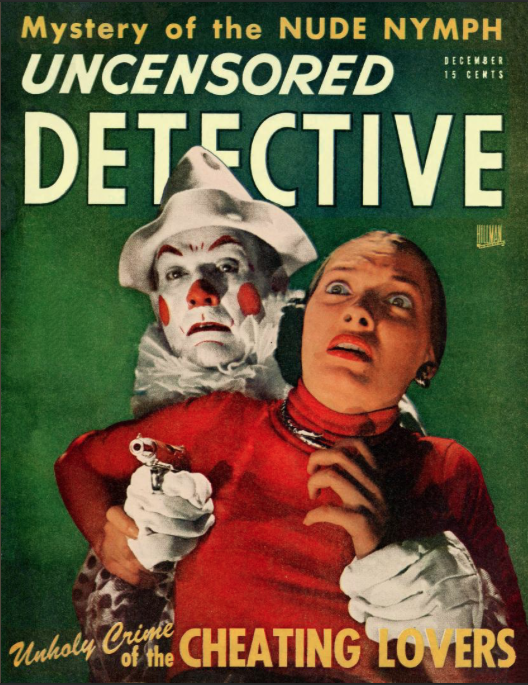
Beginning in the late 19th century, the pulps opened up the publishing space that became flooded with comic books and popular novels like those of Stephen King and Michael Crichton in the latter half of the twentieth century.
They varied widely in quality and subject matter but all share certain preoccupations. Sexual taboos are explored in their naked essence or through various genre devices. Monsters, aliens, and other features of the “weird” predominate, as do the forerunners of DC and Marvel’s superhero empires in characters like the Shadow and the Phantom Detective.

Unlike higher-rent “slicks” or “glossies,” pulp magazines had license to go places respectable publications feared to tread. Genre fiction now spawns multimillion dollar franchises, one after another, purged of much of the pulps’ salacious content. But paging through the thousands of back issues available at the Pulp Magazine Archive will give you a sense of just how outré such magazines once were—a quality that survived in the underground comics and zines of the 60s and beyond and in genre tabloids like Scream Queens.

The enormous archive contains thousands of digitized issues of such titles as If, True Detective Mysteries, Witchcraft and Sorcery, Weird Tales, Uncensored Detective, Captain Billy’s Whiz Bang, and Adventure (“America’s most exciting fiction for men!”). It also features early celebrity rags like Movie Pictorial and Hush Hush, and retrospectives like Dirty Pictures, a 1990s comic reprinting the often quite misogynist pulp art of the 30s.

There’s great science fiction, no small amount of creepy teen boy wish-fulfillment, and lots of lurid, noir appeals to fantasies of sex and violence. Swords and sorcery, guns and trussed-up pin-ups, and plenty of creature features. The pulps were once mass culture’s id, we might say, and they have now become its ego.
Enter the Pulp Magazine Archive here.
Related Content:
Free: 355 Issues of Galaxy, the Groundbreaking 1950s Science Fiction Magazine
Isaac Asimov Recalls the Golden Age of Science Fiction (1937–1950)
Josh Jones is a writer and musician based in Durham, NC. Follow him at @jdmagness
Read More...Beethoven’s Genome Has Been Sequenced for the First Time, Revealing Clues About the Great Composer’s Health & Family History
Ludwig van Beethoven died in 1827, a bit early to be subjected to the kinds of DNA analysis that have become so prevalent today. Luckily, the German-speaking world of the early nineteenth century still adhered to the custom of saving locks of hair from the deceased — particularly lucky for an archaeology student named Tristan Begg and his collaborators in the study “Genomic analyses of hair from Ludwig van Beethoven,” published just this month in Current Biology. In the video from Cambridge University just above, Begg introduces the research project and describes what new information it reveals about the composer whose life and work have been so intensively studied for so long.
“Working with an international team of scientists, I identified five genetically matching, authentic locks of hair and used them to sequence Beethoven’s genome,” Begg says. “We discovered significant genetic risk factors for liver disease and evidence that Beethoven contracted the Hepatitis B virus in, at the latest, the months before his final illness.”
And “while we couldn’t pinpoint the cause of Beethoven’s deafness or gastrointestinal problems, we did find modest genetic risk for Systemic Lupus Erythematosus,” an autoimmune disease. History remembers Beethoven as a not particularly healthy man; now we have a clearer idea of which conditions he could have suffered.
But this study’s most revelatory discoveries concern not what has to do with Beethoven, but what doesn’t. The famous lock of hair “once believed to have been cut from the dead composer’s head by the fifteen-year-old musician Ferdinand Hiller” turns out to have come from a woman. Nor was Beethoven himself “descended from the main Flemish Beethoven lineage,” which is shown by genetic evidence that “an extramarital relationship resulted in the birth of a child in Beethoven’s direct paternal line at some point between 1572 and 1770.” This news came as a shock to “the five people in Belgium whose last name is van Beethoven and who provided DNA for the study,” writes the New York Times’ Gina Kolata. But then, Beethoven’s music still belongs to them — just as it belongs to us all.
Related content:
Stream the Complete Works of Bach & Beethoven: 250 Free Hours of Music
The Story of How Beethoven Helped Make It So That CDs Could Play 74 Minutes of Music
Based in Seoul, Colin Marshall writes and broadcasts on cities, language, and culture. His projects include the Substack newsletter Books on Cities, the book The Stateless City: a Walk through 21st-Century Los Angeles and the video series The City in Cinema. Follow him on Twitter at @colinmarshall or on Facebook.
Read More...Listen to Patti Smith’s Glorious Three Hour Farewell to CBGB’s on Its Final Night
CBGB is a state of mind — Patti Smith
All good things must come to an end, but it hurt when CBGB’s, New York City’s celebrated — and famously filthy — music club shuttered for good on October 15th, 2006, a victim of skyrocketing Lower East Side rents.
While plenty of punk and New Wave luminaries cut their teeth on the legendary venue’s stage — Talking Heads, The Ramones, Blondie — final honors went to Patti Smith, a CBGB’s habitué, whose seven-week residency in 1975 earned her a major record deal.
In her National Book Award-winning memoir, Just Kids, Smith described her first impressions of the place, when she and her guitarist Lenny Kaye headed downtown to catch their friend Richard Hell’s band, Television, following the premiere of the concert film, Ladies & Gentlemen, the Rolling Stones at the Ziegfeld:
CBGB was a deep and narrow room along the right side, lit by overhanging neon signs advertising various brands of beer. The stage was low, on the left-hand side, flanked by photographic murals of turn-of-the-century bathing belles. Past the stage was a pool table, and in back was a greasy kitchen and a room where the owner, Hilly Krystal, worked and slept with his saluki, Jonathan…
It was a world away from the Ziegfeld. The absence of glamour made it seem all the more familiar, a place that we could call our own. As the band played on, you could hear the whack of the pool cue hitting the balls, the saluki barking, bottles clinking, the sounds of a scene emerging. Though no one knew it, the stars were aligning, the angels were calling.
Some 30 years later, Kaye prepared to bid CBGB goodbye, telling the New York Times, “It’s like it’s grown its own barnacles:”
You couldn’t replicate the décor in a million years, and dismantling all those layers of archaeology of music in the club is a daunting task.
The Village Voice observed that it was “a crazy, emotional night for everyone in the crowd and for everyone on the stage,” and the New York Times reported how Smith documented the club’s awning with a Polaroid, explaining, “I’m sentimental…”
But Smith, who actively encouraged young fans to resist worshiping at the altar of the club’s reputation when they could be starting scenes of their own, also pushed back against sentimentality, telling the crowd, “It’s not a fucking temple — it is what it is.”
That may be, but her three-and-a-half-hour performance, above, was still one for the history books, from the opening reading of Piss Factory (I’m gonna be somebody, I’m gonna get on that train, go to New York City /I’m gonna be so bad I’m gonna be a big star and I will never return) to the closing in memoriam recitation (Joe Strummer…Johnny Thunders…Stiv Bators…Johnny, Joey, and Dee Dee Ramone…)
Smith took care that other artists who helped make the scene were represented in her below set lists, from Blondie and Lou Reed to Television and the Dead Boys:
Piss Factory 0:22
Kimberly/Tide is High 12:40
Pale Blue Eyes 20:30
Lou (Reed) had a gift of taking very simple lines, ‘Linger on, your pale blue eyes,’ and make it so they magnify on their own. That song has always haunted me. (The Associated Press)
Marquee Moon/We Three 29:02
Television will help wipe out media. They are not theatre. Neither were the early Stones or the Yardbirds. They are strong images procduce from pain and speed and the fanatic desire to make it. They are also inspired enough below the belt to prove that SEX is not dead in rock ’n’ roll. (Rock Scene)
Distant Fingers 38:48
Without Chains 47:50
We had emotional duties, and I respected that. But I also thought it was important to do a song like that. (Rolling Stone)
Ghost Dance 55:30
Birdland 1:00:08
Sonic Reducer 1:11:52
Redondo Beach 1:16:00
Free Money 1:20:44
Pissing in a River 1:28:27
Gimme Shelter 1:33:50
I was thinking about the words to that: “War, children, it’s just a shot away.” To me, a song like that is more meaningful than ever. (Rolling Stone)
Space Monkey 1:43
Blitzkrieg Bop / Beat on the Brat / Do You Remember Rock ‘N’ Roll Radio? / Sheena Is a Punk Rocker 1:48:30
Ain’t It Strange 1:55:20
So You Want to Be a Rock ‘n’ Roll Star 2:02:11
Babelogue/Rock n Roll N — - — - — - 2:10:17
Happy Birthday to Flea 2:21:38
For Your Love 2:22:15
My Generation 2:27:22
Land/Gloria 2:36:51
Even though I wrote the poem at the beginning of “Gloria” in 1970, it took all those years to evolve, to merge into “Gloria.” And that was pretty much done at CBGB. We recorded Horses in 1975, and did all the groundwork at CBGB. (Rolling Stone)
Elegie 2:55:57
As I was reading that little list, those people seemed in that moment — because of the intense emotional energy in that room — to be alive. Everyone in the room knew or heard of or loved one of those people. That collective love and sorrow and recognition made those people seem as alive as any of us. (Rolling Stone)
Related Content
Patti Smith’s 40 Favorite Books
– Ayun Halliday is the Chief Primatologist of the East Village Inky zine and author, most recently, of Creative, Not Famous: The Small Potato Manifesto and Creative, Not Famous Activity Book. Follow her @AyunHalliday.
Read More...Ai Weiwei Recreates Monet’s Water Lilies Triptych Using 650,000 Lego Bricks

Nearly a century after Claude Monet painted them, the Nymphéas, or Water Lilies, still impress as a vision of a seemingly minor subject realized at a grand scale. The paintings installed in a dedicated room at the Musée de l’Orangerie in Paris make an especially strong impact on their viewers — an impact surely not lost on Ai Weiwei, who has lately re-created another set of Water Lilies (a triptych whose original resides at the Museum of Modern Art) entirely out of Lego bricks. Titled Water Lilies #1, this 50-foot-long plastic homage will go on display at London’s Design Museum as part of Ai Weiwei: Making Sense, which opens on April 7th and runs until July 30th.
“Ai used 650,000 Lego bricks in 22 colors in his version of the famous Impressionist triptych,” writes ARTnews’ Karen K. Ho. Apart from simply replicating, brick by pixel-like brick, the brushstrokes with which Monet replicated the lily pond at his Giverny home, Weiwei also included “a dark area on the right-hand side. The Design Museum said it represents the underground dugout in Xinjiang province where Ai and his father, Ai Qing, lived in forced exile in the 1960s.” On one level, this is an unexpected addition; on another, it’s just the touch one might expect from the most famous dissident Chinese artist alive.

Image by Ela Bialkowska/OKNO Studio
Experienced in the medium of Lego, Ai has also used everyone’s favorite building blocks “to produce portraits of political prisoners. In 2017, the Hirshhorn Museum and Sculpture Gallery exhibited 176 of these Lego artworks.” Making Sense will also include a new Lego piece called Untitled (Lego Incident), which, as the Guardian’s Caroline Davies writes, “comprises thousands of Lego blocks donated by members of the public after Lego briefly refused to sell their products to him in 2014.” It seems that Lego had reservations about being associated with such a politically charged project. The statement made by Water Lilies #1 may be less direct, but — enriched by its large scale, its cross-cultural inspiration, and its materials that have long been a near-universal fixture of childhood — it won’t be any less powerful.
Related content:
How to Paint Water Lilies Like Monet in 14 Minutes
Ai Weiwei Creates Hand-Silkscreened Scarves Drawing on a Chinese Paper Cutting Tradition
Who’s Afraid of Ai Weiwei: A Short Documentary
Hokusai’s Iconic Print, “The Great Wave off Kanagawa,” Recreated with 50,000 LEGO Bricks
Based in Seoul, Colin Marshall writes and broadcasts on cities, language, and culture. His projects include the Substack newsletter Books on Cities, the book The Stateless City: a Walk through 21st-Century Los Angeles and the video series The City in Cinema. Follow him on Twitter at @colinmarshall or on Facebook.
Read More...Hear the Oldest Song in the World: A Sumerian Hymn Written 3,400 Years Ago
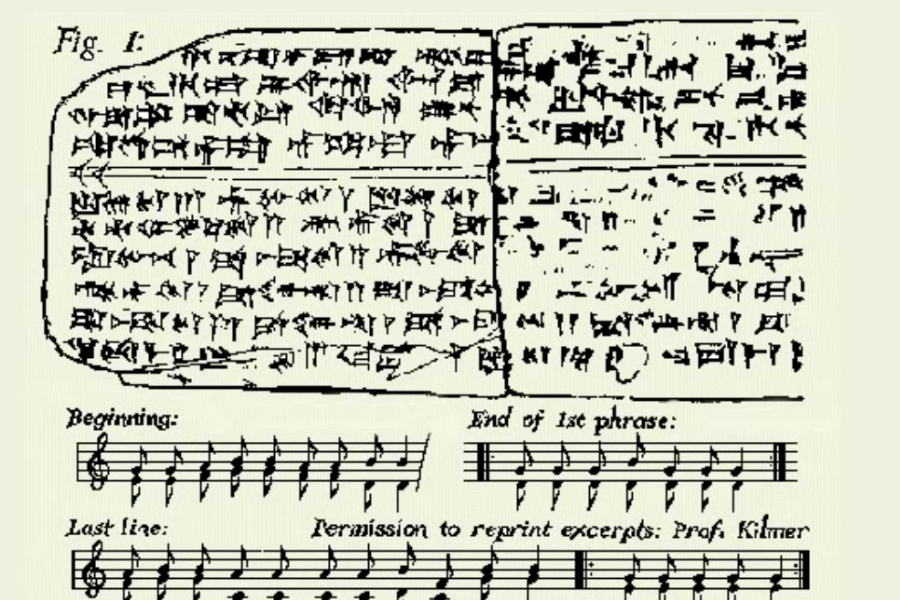
In the early 1950s, archaeologists unearthed several clay tablets from the 14th century BCE. Found, WFMU tells us, “in the ancient Syrian city of Ugarit,” these tablets “contained cuneiform signs in the hurrian language,” which turned out to be the oldest known piece of music ever discovered, a 3,400 year-old cult hymn. Anne Draffkorn Kilmer, professor of Assyriology at the University of California, produced the interpretation below in 1972. (She describes how she arrived at the musical notation—in some technical detail—in this interview.) Since her initial publications in the 60s on the ancient Sumerian tablets and the musical theory found within, other scholars of the ancient world have published their own versions.
The piece, writes Richard Fink in a 1988 Archeologia Musicalis article, confirms a theory that “the 7‑note diatonic scale as well as harmony existed 3,400 years ago.” This, Fink tells us, “flies in the face of most musicologists’ views that ancient harmony was virtually non-existent (or even impossible) and the scale only about as old as the Ancient Greeks.”
Kilmer’s colleague Richard Crocker claimed that the discovery “revolutionized the whole concept of the origin of western music.” So, academic debates aside, what does the oldest song in the world sound like? Listen to a midi version below and hear it for yourself. Doubtless, the midi keyboard was not the Sumerians instrument of choice, but it suffices to give us a sense of this strange composition, though the rhythm of the piece is only a guess.
Kilmer and Crocker published an audio book on vinyl (now on CD) called Sounds From Silence in which they narrate information about ancient Near Eastern music, and, in an accompanying booklet, present photographs and translations of the tablets from which the song above comes. They also give listeners an interpretation of the song, titled “A Hurrian Cult Song from Ancient Ugarit,” performed on a lyre, an instrument likely much closer to what the song’s first audiences heard. Unfortunately, for that version, you’ll have to make a purchase, but you can hear a different lyre interpretation of the song by Michael Levy below, as transcribed by its original discoverer Dr. Richard Dumbrill.
Note: An earlier version of this post appeared on our site in 2014. It’s old but gold. So we hope you enjoy revisiting it again.
If you would like to support the mission of Open Culture, consider making a donation to our site. It’s hard to rely 100% on ads, and your contributions will help us continue providing the best free cultural and educational materials to learners everywhere. You can contribute through PayPal, Patreon, and Venmo (@openculture). Thanks!
Related Content:
What Ancient Greek Music Sounded Like: Hear a Reconstruction That is ‘100% Accurate’
Hear The Epic of Gilgamesh Read in the Original Akkadian and Enjoy the Sounds of Mesopotamia
Watch 13 Levels of Drumming, from Easy to Complex, Explained by Snarky Puppy Drummer Larnell Lewis
Above, Snarky Puppy drummer Larnell Lewis explains drumming in 13 levels of difficulty, from easy to complex, showing how “drum techniques build upon each other as the easiest levels incorporate the hi-hat, bass and snare drums, and more difficult levels include polyrhythms, the floor tom, ride cymbals, syncopation and much more.” It’s fun to watch. In another video from the same series produced by Wired magazine, musician Jacob Collier explains the concept of harmony with increasing difficulty to five different people– a child, a teen, a college student, a professional, and jazz legend Herbie Hancock. Enjoy…
If you would like to support the mission of Open Culture, consider making a donation to our site. It’s hard to rely 100% on ads, and your contributions will help us continue providing the best free cultural and educational materials to learners everywhere. You can contribute through PayPal, Patreon, and Venmo (@openculture). Thanks!
Related Content
The Neuroscience of Drumming: Researchers Discover the Secrets of Drumming & The Human Brain
What Makes John Bonham Such a Good Drummer? A New Video Essay Breaks Down His Inimitable Style
The Case for Why Ringo Starr Is One of Rock’s Greatest Drummers
Read More...Amélie Was Really a KGB Spy: Director Jean-Pierre Jeunet Re-Edits His Beloved Film, Amélie, into a New Comedic Short
No French film of this century is more beloved than Jean-Pierre Jeunet’s Amélie. Or rather, no protagonist of a French film in this century is more beloved than Audrey Tautou’s eponymous Amélie. Hence, no doubt, why the movie is best known by that short version of its title rather than by the long version, Le fabuleux destin d’Amélie Poulain. Now, more than twenty years after the release of Le fabuleux destin d’Amélie Poulain, Jeunet has followed it up with La véritable histoire d’Amélie Poulain, which you can watch (with optional French or English subtitles) just above.
“After all this time,” Jeunet says in a brief introduction, “I felt the moment was right to tell you, at long last, the real story of Amélie Poulain.” She turns out, according to his voice-over narration that follows, not to be a simple Montmartre waitress who dedicates herself to surreptitiously enriching the lives of those around her.
In fact she works as a spy for the KGB, having first been recruited in childhood with the promise of candy bars. That may sound far-fetched, but Jeunet supports every detail of Amélie’s double life, and of the story of her re-entry into espionage after the fall of the Berlin Wall, using the very same scenes and involving the very same characters we remember from Amélie.
On one level, La véritable histoire d’Amélie Poulain testifies to the enduring playfulness that keeps Jeunet from taking his own work — even the work that became a global phenomenon — too seriously. (Indeed, that spirit is on display in the original movie’s exaggeration of whimsical-French-film tropes.) Much like the Hollywoodified Kubrick trailers we previously featured here on Open Culture, this new short also constitutes a demonstration of how the meaning and impact of cinema are created not by the images themselves, but rather by their context and juxtaposition. And so, with characteristic cleverness, Jeunet has reinvented Amélie as a Soviet agent by employing the principles of Soviet montage.
Related content:
The Shining and Other Complex Stanley Kubrick Films Recut as Simple Hollywood Movies
Paris Through Pentax: Short Film Lets You See a Great City Through a Different Lens
Tuileries: The Coen Brothers’ Short Film About Steve Buscemi’s Very Bad Day in the Paris Metro
History Declassified: New Archive Reveals Once-Secret Documents from World Governments
Based in Seoul, Colin Marshall writes and broadcasts on cities, language, and culture. His projects include the Substack newsletter Books on Cities, the book The Stateless City: a Walk through 21st-Century Los Angeles and the video series The City in Cinema. Follow him on Twitter at @colinmarshall or on Facebook.
Read More...Explore the Hereford Mappa Mundi, the Largest Medieval Map Still in Existence (Circa 1300)
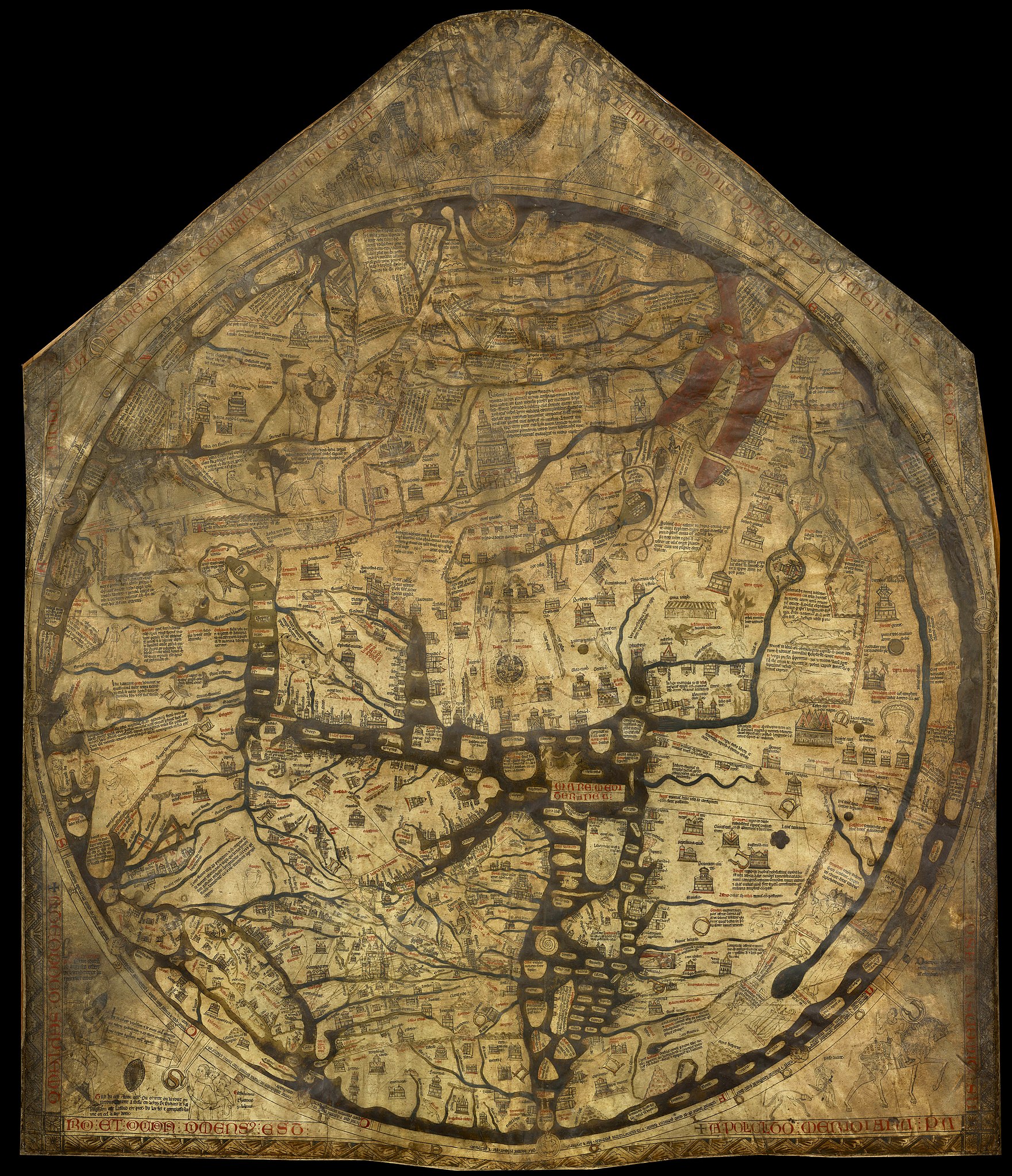
If you wanted to see a map of the world in the fourteenth century, you could hardly just pull up Google Earth. But you could, provided you lived somewhere in or near the British Isles, make a pilgrimage to Hereford Cathedral. There you would find the shrine of St. Thomas Cantilupe, the main attraction for the true believer, but also what we now know as the Hereford Mappa Mundi, a large-scale (64″ x 52″) depiction of the entire world — or at least entire world as conceived in the pious English mind of the Middle Ages, which turns out to be almost unrecognizable at first glance today.
Created around 1300, the Hereford Mappa Mundi “serves as a sort of visual encyclopedia of the period, with drawings inspired by Biblical times through the Middle Ages,” write Chris Griffiths and Thomas Buttery at BBC Travel.
“In addition to illustrating events marking the history of humankind and 420 cities and geographical features, the map shows plants, animals, birds and strange or unknown creatures, and people.” These include one “ ‘Blemmye’ — a war-like creature with no head, but with facial features in its chest,” two “Sciapods,” “men with one large foot,” and “four cave-dwelling Troglodites,” one of whom feasts on a snake.
Amid geography we would now consider severely limited as well as fairly mangled — Europe is labeled as Asia, and vice versa, to name only the most obvious mistake — the map also includes “supernatural scenes from classical Greek and Roman mythology, Biblical tales and a collection of popular legends and stories.” As such, this reflects less about the world itself than about humanity’s worldview in an era that drew fewer lines of demarcation between fact and legend. You can learn more about what it has to tell us in the Modern History TV video below, as well as in the video further down from Youtuber ShūBa̱ck, which asks, “Why are Medieval Maps so Weird?”
The intent of the Hereford Mappa Mundi, ShūBa̱ck says, is to show that “the Bible is right.” To that end, “east is on top, as that’s where they said Jesus would come from on the day of judgment. Jerusalem is, of course, at the center.” Other points of interest include the site of the crucifixion, the Tower of Babel, and the Garden of Eden — not to mention the locations of the Golden Fleece and Mount Olympus. You can examine all of these up close at the Hereford Cathedral’s site, which offers a detailed 3D scan of the map, viewable from every angle, embedded with explanations of all its major features: in other words, a kind of Google Medieval Earth.
via Aeon
Related content:
40,000 Early Modern Maps Are Now Freely Available Online (Courtesy of the British Library)
The Biggest Mistakes in Mapmaking History
Based in Seoul, Colin Marshall writes and broadcasts on cities, language, and culture. His projects include the Substack newsletter Books on Cities, the book The Stateless City: a Walk through 21st-Century Los Angeles and the video series The City in Cinema. Follow him on Twitter at @colinmarshall or on Facebook.
Read More...David Byrne Picks Up His Big Suit from the Dry Cleaners and Gets Ready for Stop Making Sense to Return to Theaters
First released in 1984, Jonathan Demme’s acclaimed concert film Stop Making Sense featured the Talking Heads at the height of their creative and musical powers. The film starts with David Byrne, alone on a bare stage, with a boombox and his big white suit, performing “Psycho Killer.” Then, with each new song, he’s joined by different bandmates and an assemblage of gear and lights, all showing, step-by-step, how a concert gets made. It’s an inventive film. And it’s coming back to theaters this August, restored no less in 4K resolution.
Above, in the official trailer, watch Byrne retrieve his oversized suit from the dry cleaners some 40 years late, then try it on for size. Turns out, it still fits.…
If you would like to support the mission of Open Culture, consider making a donation to our site. It’s hard to rely 100% on ads, and your contributions will help us continue providing the best free cultural and educational materials to learners everywhere. You can contribute through PayPal, Patreon, and Venmo (@openculture). Thanks!
Related Content
Talking Heads Live in Rome, 1980: The Concert Film You Haven’t Seen
Read More...Support Us
We're hoping to rely on loyal readers, rather than erratic ads. Please click the Donate button and support Open Culture. You can use Paypal, Venmo, Patreon, even Crypto! We thank you!

About Us

Open Culture scours the web for the best educational media. We find the free courses and audio books you need, the language lessons & educational videos you want, and plenty of enlightenment in between.
Advertise With Us
FREE UPDATES!
GET OUR DAILY EMAIL
Get the best cultural and educational resources on the web curated for you in a daily email. We never spam. Unsubscribe at any time.
FOLLOW ON SOCIAL MEDIA
Open Culture editor Dan Colman scours the web for the best educational media. He finds the free courses and audio books you need, the language lessons & movies you want, and plenty of enlightenment in between.
Advertise With Us

