On Art Speigelman’s Maus: Should Comics Expose Kids to the World’s Horrors? Pretty Much Pop: A Culture Podcast #122
In light of its being recently banned in some settings, we discuss Art Spiegelman’s Maus (1980–91), which conveys his father’s account of living through the Holocaust. We also consider other war-related graphic novels like Marjane Satrapi’s Persepolis (2000) and George Takei’s They Called Us Enemy (2019).
Your host Mark Linsenmayer is joined by comics scholar Vi Burlew, comics blerd/acting coach Anthony LeBlanc, and comedian/graphic novelist Daniel Lobell.
Are comics particularly effective in changing hearts and minds when they display people’s hardships? Should kids be exposed to the horrors of the world in this way? What about the complexities of social justice and gender identity? We also touch on Gilbert Gottfried and the relationship between humor and tragedy, learning history vs. reading one person’s experience, the ages at which became political, and how comics may have aided that.
Read Vi’s Washington Post editorial about censorship that inspired this episode.
Other relevant sources include:
- “Nine Poignant Graphic Novels on War and Violence” from The Curious Reader
- “Why Maus Opened the Door to Comics as Literature in Schools” by Jason Batt
- Video: “Arena: Art Spiegelman’s Maus” (1987)
- “ ‘MetaMaus’: The Story Behind Spiegelman’s Classic” from NPR’s Talk of the Nation
If you enjoyed this discussion, try our episodes featuring Vi talking about the trope of the heroine’s journey in film, Anthony talking about blerds, i.e. black nerds, and Daniel talking about the comic Peanuts.
Follow us @ViolaBurlew, @anthonyleblanc, @DanielLobel, and @MarkLinsenmayer.
Hear more Pretty Much Pop. Support the show at patreon.com/prettymuchpop or by choosing a paid subscription through Apple Podcasts. This podcast is part of the Partially Examined Life podcast network.
Pretty Much Pop: A Culture Podcast is the first podcast curated by Open Culture. Browse all Pretty Much Pop posts.
Read More...The Ghosts and Monsters of Hokusai: See the Famed Woodblock Artist’s Fearsome & Amusing Visions of Strange Apparitions
When Halloween comes around this year, consider playing a round of hyakumonogatari. You’ll need to assemble a hundred candles beforehand, but that’s the easy part; you and your friends will also need to know just as many ghost stories. In early nineteenth-century Japan, “participants would sit in a candlelit room and take turns telling frightening tales. After each one was shared, a candle would be extinguished until there was no light left, in the room. It was then that the yōkai [“strange apparitions”) would appear.” So says Youtuber Hochelaga (who’s previously covered the Biblical apocalypse and long-ago predictions of the future) in the video above, “The Ghosts of Hokusai.”

We all know the name of Katsushika Hokusai, the most widely renowned master of the traditional Japanese woodblock-print art called ukiyo‑e. In a lifetime spanning the mid-eighteenth to the mid-nineteenth century, Hochelaga notes, Hokusai created around 30,000 unique pieces of art, including The Great Wave off Kanagawa, part of Thirty-Six Views of Mount Fuji.
But before executing that triumphant late series, Hokusai made his own Hyakumonogatari (literally, “hundred tales”) — or rather, he rendered in his distinctive style five of those traditional ghost stories’ tragic, grotesque, and often humorous protagonists.

These characters are yōkai, those “weird and mysterious beings” that “inhabit supernatural Japan.” They “come in all shapes and sizes, from friendly household spirits to fierce demons,” including the Oyajirome, who literally has an eye in the back of his head, and the Ushi-oni, “one part bull, one part crab, and the rest nightmare fuel.” Hokusai’s interest tended toward yōkai who had once been normal humans: the neglected wife of a samurai whose spirit became trapped in a lantern, the murdered kabuki actor whose skeletal remains emerged from a swamp to hunt down his killers.

You can read more about these yōkai, and take a look at Hokusai’s depictions of them, at the Public Domain Review and Thoughts on Papyrus. Soon after Hokusai’s death Japan opened to the world, beginning its transformation into a state of hypermodernity. But tales of yōkai still have a certain influence on the Japanese cultural imagination, as evidenced by the Miyoshi Mononoke Museum in Hiroshima. Japan has been more or less closed once again these past couple of years, but once it re-opens, why not make a trip to collect a few scary monogatari for yourself?

Related content:
The First Museum Dedicated to Japanese Folklore Monsters Is Now Open
View 103 Discovered Drawings by Famed Japanese Woodcut Artist Katsushika Hokusai
Based in Seoul, Colin Marshall writes and broadcasts on cities, language, and culture. His projects include the Substack newsletter Books on Cities, the book The Stateless City: a Walk through 21st-Century Los Angeles and the video series The City in Cinema. Follow him on Twitter at @colinmarshall, on Facebook, or on Instagram.
Read More...Ray Dalio Is Giving Away Free Copies of His New Book Principles for Dealing with the Changing World to High School & College Teachers and Their Students
As we noted back in March, investor Ray Dalio has published his latest bestseller, Principles for Dealing with the Changing World: Why Nations Succeed and Fail. A history of the rise and fall of empires over the last 500 years, the book uses the past to contemplate the future, particularly the fate of the United States and China. Today, for Teacher Appreciation Week, Dalio has announced that he’s willing to give a copy of the book “to any high school or college educator who wants it—and to all of their students if they intend to have them read it.” He writes:
Since releasing my book and animated video [above], Principles for Dealing with the Changing World Order, many people have told me that both would be helpful for teaching history in schools and asked me if I would help make that happen. So, during this Teacher Appreciation Week I will give a copy of the book to any high school or college educator who wants it—and to all of their students if they intend to have them read it. And if there’s a lot of interest, I’d be happy to extend the offer past this week. Of course, the Youtube video is already free and easily available and I encourage you to check that out if you want an overview of what’s in the book.
When you sign up, let me know if you’re interested in me hosting a live online session for classrooms, which I’ll do if people would like it. If you are not an educator but know some who might be interested in this offer, please share this link with them.
To access the offer, click here.
If you would like to support the mission of Open Culture, consider making a donation to our site. It’s hard to rely 100% on ads, and your contributions will help us continue providing the best free cultural and educational materials to learners everywhere. You can contribute through PayPal, Patreon, and Venmo (@openculture). Thanks!
Related Content
The Principles for Success by Entrepreneur & Investor Ray Dalio: A 30-Minute Animated Primer
Read More...The Red Hot Chili Peppers’ Flea Presents a Bass Lesson, and Essential Advice That Every Bass Player Should Know
“What do you call someone who hangs out with musicians?” goes the hoary old musicians’ joke. Answer: “a bass player.” Hahaha. Very funny. And just plain untrue. Maybe the bass has fewer strings to master than the guitar, but it requires better timing, and — most importantly — more listening than any other instrument in a band setting. Or so says Flea of the Red Hot Chili Peppers, a band I sometimes think of as a bunch of guys who hang out with a bass player.
All musicians need to listen carefully to other players on stage, but the bass player’s role is special, Flea says in the video above, excerpted from the hour-long bass lesson you can watch in full below. Bassists need to listen to melody players and soloists, supporting their parts with subtlety and nuance, without (says Flea of all people) doing the kind of showboating that pulls focus from the leads. Bass players also need to lock in with the drummer, listening so intently they can fit their notes right in the center of each drum hit.
This hardly sounds like unskilled musical labor, even if most bassists can’t — and don’t need to — play with the speed and ferocity as our instructor above. But Flea as teacher isn’t trying to teach others how to play the way he does, a style inspired by legends like slap bass pioneer Larry Graham and Motown stalwart James Jamerson. He’s giving students his take on the basics — first learn to walk, then learn to walk really, really well, with lots of practice. These basics include going over the parts of a bass guitar, talking about tuning, and learning different ways of hitting the strings, from plucking to picking to, yes, slapping, within reason.
Coming from a player who so commands the spotlight with his bass theatrics, Flea’s advice to aspiring players might seem oddly conservative. But it’s the bass player’s job, he says, to make everyone else in the band sound good. And the better a bassist is at helping other players shine, the more they stand out as a great musician in their own right.
See timestamps for the different topics in Flea’s lesson just below:
0:01 Flea Bass
7:27 Restring and Tuning
12:51 Plucking
16:36 Slapping
22:53 Picking
23:53 Finger Practice
30:24 Major Scale
44:34 Final Thoughts
Related Content:
Flea Rocks “The Star Spangled Banner” on the Bass
What Makes Flea Such an Amazing Bass Player? A Video Essay Breaks Down His Style
Josh Jones is a writer and musician based in Durham, NC. Follow him at @jdmagness
Read More...How People Imagined in 1948 What Cars Would Look Like in the Future
With a few exceptions, car design of the last two decades has been stuck in a rut, with a sameness on the outside—-aerodynamic, sleek, rounded—-hiding the advancements under the hood and in the control panel. That’s why it’s always a hoot to check out mock designs from the past, especially when they are being used to forecast the future.
This short 1948 film from Popular Mechanics shows three possible cars of the future, all of which for various reasons, never really caught on. But films like this offer a tantalizing thought-—what if they had? It’s a tiny glimpse of an alternative reality, and we all seem to be loving that multiverse vibe these days.
The first is the Davis Divan, which is perfect for parallel parking with its single front tire and tight maneuverability. It certainly looks cool but I will disagree with the narrator: no amount of space-age oomph is going to make changing a tire an “exhilarating experience.” The Divan was built by the Davis Motorcar Company of Van Nuys, CA, designed by used-car salesman Gary Davis, and included ideas taken from the aeronautical industry. This film appearance was part of a major publicity push from 1947–1949, but in the end only 13 Divans were produced, and a dozen survive. Not so the company, which was sued into liquidation after it failed to deliver product.
The second has an even stranger history. If this is a “car from the future”, then the filmmakers neglected to note it’s actually from 1935. The Hoppe & Streur Streamliner prototype was designed and built by Allyn Streur and Allen Hoppe as part of Consolidated Aircraft San Diego, and based on a Chrysler 66 chassis. It seated five people. If it looks like flimsy metal on top of a skeletal frame, then you’ve guessed correctly.
You can see how Southern California’s aerospace industry has started to influence everything after the war, which accounts for the airplane obsession with these autos, especially what comes next. The final selection is Gordon Buehrig’s TACSO prototype from 1948. Several of the controls in the driver’s seat imitate those found in the cockpit of a plane, and the four wheels are covered in fiberglass directional fenders. Not noted in the film: the car had “a transparent roof that could be removed to let the wind in,” a feature way ahead of its time. But it would have been too expensive to mass produce (AutoBlog figures one of these would have cost the equivalent of $80,000 back in the day) so the one in the video is the only one in existence.
As people are still trying (and failing) to successfully parallel park, safe to say none of these predictions came true. Partly, that’s sad. On the other hand, next time you hear some doom-n-gloom prediction of our current moment, think on this video and how thankfully wrong they were.
Related Content:
Ted Mills is a freelance writer on the arts who currently hosts the Notes from the Shed podcast and is the producer of KCRW’s Curious Coast. You can also follow him on Twitter at @tedmills, and/or watch his films here.
Read More...David Byrne’s New Illustrated Book Playfully Presents A History of the World (in Dingbats)

What does David Byrne know about the history of the world in his new book A History of the World (in Dingbats)? As much as he knows about psycho killers, burning down houses, and “non-rational logic,” the subject of a show at New York’s Pace Gallery this past February featuring elaborate doodles Byrne calls “dingbats.” That is to say, he knows quite a lot about the history of the world. Or maybe, it hardly matters. “Burning Down the House” is not really about arson.

The new book presents us, instead of history, with a “cross between Codex Seraphinianus and E.E. Cumming’s little-known philosophical line drawings,” Maria Popova writes at The Marginalian. It is a work of the hopefulness of imagination; a statement about how “non-rational logic” can shape reality.
“The way things were,” Byrne writes, “the way we made things, it turns out, none of it was inevitable — none of it is the way things have to be.” Popova calls the project an “illustrated history of the possible future.”
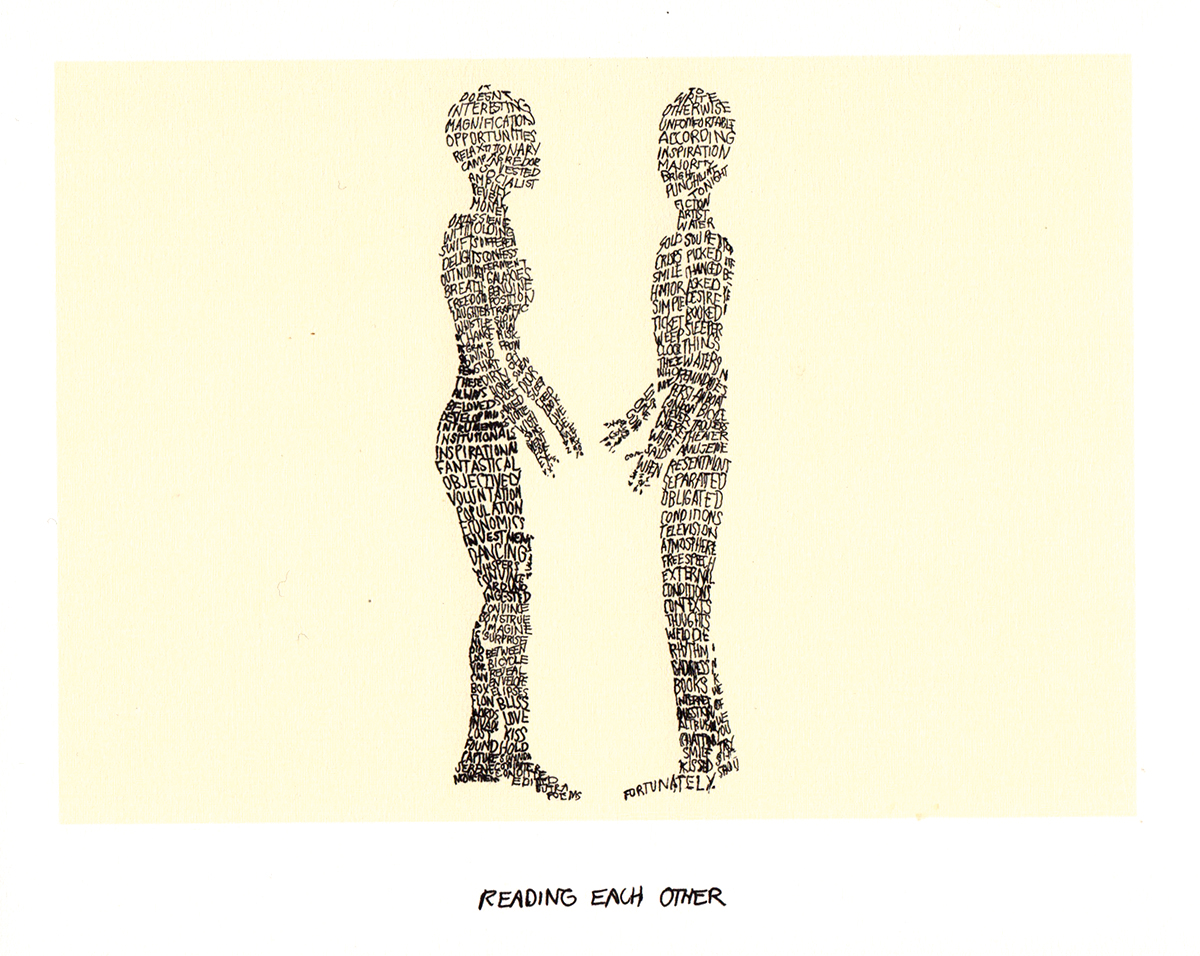
“Created while under quarantine,” notes publisher Phaidon — the drawings “expand on the dingbat, a typographic ornament used to illuminate or break up blocks of text.” Byrne says he was inspired by the little illustrations in The New Yorker, though he took the concept much further. He writes text in each themed section that echoes the anxiety, contemplation, and strange excitement of life in lockdown: thoughts on what has been lost to us and on the life that might emerge in a world remade by a virus.
Byrne reminds us that history is “a story we tell ourselves.… These stories we tell ourselves about the world are not fixed.” Nor are the stories we each tell ourselves about who we are as individuals. These are ideas the artist has explored in projects ranging from his first book, 1995’s Strange Ritual, to his work with Luaka Bop, his world music label, to the album/Broadway show/feature film/picture book American Utopia — all projects concerned with expanding the boundaries of our shared human narrative.
Stories are lessons we send to ourselves — some remain vibrant and relevant while others are only useful for a moment. They serve myriad purposes that are often beyond our ken, for better or worse, and sometimes both at the same time.
How can we know when it’s time to let go, to move into a history of the future rather than the past? “Only you can find the way,” he writes, “in the city in your head.” It is our task to sift the stories that serve us from those that don’t, through critical reflection, the play of the imagination, and making new connections between our minds and bodies:
In the new world the rules have changed — or at least there is the possibility of change.
We can be different.
Order A History of the World (in Dingbats) here and see more of Byrne’s drawings at The Marginalian.
Related Content:
Watch a Very Nervous, 23-Year-Old David Byrne and Talking Heads Performing Live in NYC (1976)
David Byrne Answers the Internet’s Burning Questions About David Byrne
Josh Jones is a writer and musician based in Durham, NC. Follow him at @jdmagness
Read More...Experience Seinfeld’s Famous “Soup Nazi” Scenes With & Without Laugh Tracks
For a twenty-first-century television fan, watching old network sitcoms can take some getting used to. Nothing about them takes more getting used to than their laugh tracks, which must strike anyone who didn’t grow up hearing them as utterly bizarre. But was it really so long ago that we took for granted — nay, expected — an eruption of pre-recorded laughter after each and every punch line? As late as the nineteen-nineties, even sitcoms well-regarded for their sophistication and subversiveness added “canned laughter” to their soundtracks. Take Seinfeld, the show famously “about nothing,” scenes from one of whose episodes you can watch without a laugh track in the video above.
The episode in question is one of Seinfeld’s best-known: “The Soup Nazi,” originally broadcast on NBC on November 2, 1995. These scenes portray Jerry, George and Elaine’s encounters with the title figure, a harsh soup-restaurant proprietor based on Ali “Al” Yeganeh, owner of Soup Kitchen International in New York. (Unaware of the character’s real-life counterpart, actor Larry Thomas based his performance on that of Omar Sharif in Lawrence of Arabia.)
With the laugh track cut out, the main characters’ interactions with each other reach heights of near-surreal awkwardness, to say nothing of their confrontations with the Soup Nazi and his rigid ordering rules.
The resultant tension, unbroken by the transplanted guffaws heard in the original scenes above, would become the stock in trade of later sitcoms like the improvisation-based Curb Your Enthusiasm, starring Seinfeld co-creator Larry David. But that show could only have existed under the permissiveness of a premium cable channel like HBO; on NBC, the legacy of the laugh track would be upheld for some years. After all, laugh tracks had been in use since the early nineteen-fifties, during television’s transition away from all-live broadcasting to the methods of pre-production used for practically all drama and comedy still today. Even then, live studio audiences were becoming a thing of the past — but the exploitation of television’s power to generate artificial feelings of community had only just begun.
Related content:
Seinfeld & Nothingness: A Supercut of the Show’s Emptiest Moments
Jacques Derrida on Seinfeld: “Deconstruction Doesn’t Produce Any Sitcom”
David Lynch’s Twin Peaks Theme Song Gets the Seinfeld Treatment
Based in Seoul, Colin Marshall writes and broadcasts on cities, language, and culture. His projects include the Substack newsletter Books on Cities, the book The Stateless City: a Walk through 21st-Century Los Angeles and the video series The City in Cinema. Follow him on Twitter at @colinmarshall, on Facebook, or on Instagram.
Read More...Watch a New Animation of Richard Feynman’s Ode to the Wonder of Life, with Music by Yo-Yo Ma
…I would like not to underestimate the value of the world view which is the result of scientific effort. We have been led to imagine all sorts of things infinitely more marvelous than the imaginings of poets and dreamers of the past.
- Richard Feynman
In 1955, theoretical physicist Richard Feynman gave a talk on the value of science to members of the National Academy of Sciences at at Caltech University.
In the wake of the destruction of Hiroshima and Nagasaki, his involvement with the Manhattan Project had been cause for serious depression and soul searching.
He concluded that the pursuit of scientific knowledge remained valuable to society, even though such knowledge comes without operating instructions, and thus can be put to evil purposes.
In the Caltech speech, he cited the life improving technological and medical breakthroughs that are the result of scientific explorations, as well as the scientific field’s allegiance to the concept that we must be free to dissent, question, and discuss:
If we suppress all discussion, all criticism, proclaiming “This is the answer, my friends; man is saved!” we will doom humanity for a long time to the chains of authority, confined to the limits of our present imagination.
(This strikes a profound chord in 2022, remembering how some extremely vocal politicians and citizens took changing public health mandates as evidence of conspiracy, rather than an ever-deepening scientific understanding of how an unfamiliar virus was operating.)
Any child with an interest in STEM will be gratified to learn that Feynman also found much to admire in “the fun …which some people get from reading and learning and thinking about (science), and which others get from working in it.
Throughout his speech, he refrained from technical jargon, using language that those whose passions skew more toward the arts can understand to invoke the experience of scientific discovery.
His meditations concerning the interconnectedness between every molecule “stupidly minding its own business” and everything else in the known universe, including himself, a human standing beside the sea, trying to make sense of it all, is of a piece with Shakespeare and Walt Whitman.
Untitled Ode to the Wonder of Life
by Richard Feynman
I stand at the seashore, alone, and start to think.
There are the rushing waves
mountains of molecules
each stupidly minding its own business
trillions apart
yet forming white surf in unison.
Ages on ages before any eyes could see
year after year
thunderously pounding the shore as now.
For whom, for what?
On a dead planet
with no life to entertain.
Never at rest
tortured by energy
wasted prodigiously by the sun
poured into space.
A mite makes the sea roar.
Deep in the sea
all molecules repeat
the patterns of one another
till complex new ones are formed.
They make others like themselves
and a new dance starts.
Growing in size and complexity
living things
masses of atoms
DNA, protein
dancing a pattern ever more intricate.
Out of the cradle
onto dry land
here it is
standing: atoms with consciousness;
matter with curiosity.
Stands at the sea,
wonders at wondering: I
a universe of atoms
an atom in the universe
The Marginalian’s (formerly Brain Pickings) Maria Popova seizes on this interlude for the final installment of her video series, The Universe in Verse, above, collaborating with animator Kelli Anderson on a “perspective-broadening, mind-deepening” visual interpretation of Feynman’s excerpted remarks.
Flowing under and around Feynman’s narration is an original composition by cellist Yo-Yo Ma, whose renown in the field of music is on par with Feynman’s in physics, and who notes in the introduction to The Quotable Feynman:
While he paid close attention to problems we face and generate, he also knew that humans are a subset of nature, and nature held for him the greatest fascination — for the imagination of nature is far, far greater than the imagination of man, and nature guards her secrets jealously.
Read Feynman’s complete speech to the National Academy of Sciences at at Caltech University here.
Watch all nine chapters of The Universe in Verse here.
Related Content
The “Feynman Technique” for Studying Effectively: An Animated Primer
Richard Feynman’s “Lost Lecture:” An Animated Retelling
Richard Feynman’s Technique for Learning Something New: An Animated Introduction
What Ignited Richard Feynman’s Love of Science Revealed in an Animated Video
- Ayun Halliday is the Chief Primatologist of the East Village Inky zine and author, most recently, of Creative, Not Famous: The Small Potato Manifesto. Follow her @AyunHalliday.
Read More...A Creative Animation Documents What Happened When a 1970s Self-Help Seminar Turned Into a Nightmare (NSFW)
Self-improvement is a wonderful thing, and we obviously embrace the idea here at Open Culture. But corporate leadership trainings and self-help seminars can often serve to break people down rather than build them up. The cult-like mentality one finds in such environs should not surprise us: 1 in 5 business leaders have “psychopathic tendencies”; many self-help gurus actually do become — or start out as — narcissistic cult leaders. In the short film above by filmmaker Joey Izzo we see one corporate leadership training course that immediately devolved into a nightmarish scene of abuse and humiliation.
Based on an interview with Gene Church — a participant in the 1970 four-day leadership seminar in Palo Alto, California — the film mixes animation, photography, and dramatic recreations filmed in 16mm, portraying “an unconventional Mind Dynamics class where participants were forced to find a ‘moment of truth’ through a number of degrading and often violent acts,” writes Rob Munday at Short of the Week.
Participants of the men-only encounter group each paid $1000 for the privilege. All of them were distributers of a cosmetics brand called Holiday Magic, owned by William Penn Patrick, a multimillionaire John Bircher who unsuccessfully ran as a Republican for governor of California and who owned both Mind Dynamics and a corporate training company called Leadership Dynamics Institute.
Patrick offered his seminars both “for his people” and “whoever wanted to come,” says Church, and aimed to teach them “how to be successful, how to be a better husband, father, leader parent, on and on and on.” Overpromising seems to be a hallmark of fraudulent self-improvement courses, and this one was no different. What set it apart is the degree to which the participants voluntarily subjected themselves to what Church’s roommate at his hotel called “a rather rough four days.” As they would learn, the true purpose of the course was to force its students to find their “moment of truth” through various forms of beating and torture. One man was placed in a coffin, beaten severely, then locked in overnight; one was placed in a cage; one tied to a cross. These are just some of the horrors, according to the film.
Like some kind of sadistic Milgram experiment gone totally off the rails, the program enlisted all of the participants to administer beatings to each other and prevent each from leaving. And like the Milgram experiment, the Mind Dynamics seminar stands as one of many object lessons in “the perils of obedience.” There are many more examples of dark descents into cultish abuse in the self help world. Writer C.L. Taylor tells the more recent story of self-help businessman James Arthur Ray, who in 2011 was convicted of “three counts of negligent homicide when three people died during one of his ‘new age’ retreats.” These involved “sleep deprivation, fire walking, fasting, board breaking and arrow breaking,” and a sweat lodge ceremony that turned deadly.
The fact that people are often willing to relinquish their autonomy in order grow as individuals says a great deal about the amount of help people perceive they need and the degree to which human beings can be manipulated by charismatic leaders. In most cases, those leaders have no business giving advice in the first place. As one former self-help “expert,” Michelle Goodman (who found herself pushed into the arena by her publisher) admits, “the dirty little secret of those in the advice business is that we wind up teaching others the lessons we most need to learn ourselves.” Her advice to those who came to her with problems she couldn’t realistically solve: “You should really talk to a qualified professional about that.” To learn more about Church’s harrowing experience with Mind Dynamics, read his book The Pit: A Group Encounter Defiled.
Related Content:
The Science of Well-Being: Take a Free Online Version of Yale University’s Most Popular Course
Behold Octavia Butler’s Motivational Notes to Self
Josh Jones is a writer and musician based in Durham, NC. Follow him at @jdmagness
Read More...Revisiting the Music of the Pioneering German Composer Klaus Schulze (RIP), the “Godfather of Techno,” Ambient, German Experimental Psych Rock & More
This past Tuesday, April 26, experimental German electronic composer and musician Klaus Schulze died, leaving a musical legacy as significant as they come in the past half-century or so. Crowned the “godfather of techno,” Pitchfork writes, he was integral to both Krautrock (as 1970s German progressive rock was unflatteringly called) and the “Berlin School” of techno, and he “laid the groundwork for ambient, IDM, and many other sub-genres of contemporary electronic music. His relevance never waned.” Although a legend among those in the know, Schulze isn’t known in broader popular culture.
He should be, and will be, says Oscar-winning Dune composer Hans Zimmer, who worked parts of Schulze’s 1978 composition “Frank Herbert” (below) into the 2021 film’s score. “Klaus Schulze’s music has never been as relevant as it is now,” said Zimmer.
Soon afterward, Schulz recorded a new album, Deus Arrakis, scheduled for release on June 10. “I needed more of that spice,” the 74-year-old composer said. (See him above, sitting cross-legged, with blonde Prince Valiant ‘do, performing “For Barry Graves” live in Köln in 1977.) “From there I felt completely unleashed and just played and played…”
Given Schulze’s staying power and influence, it may be puzzling that he isn’t mentioned with household names like Brian Eno and Kraftwerk, or even hipper names to drop like Karlheinz Stockhausen or Jean-Michel Jarre. This is in part because he rarely stuck with one sound long enough for praise and couldn’t have cared less whether anyone knew who he was. Though an early member, as a percussionist, of Tangerine Dream, Schulze left after their 1970 debut, Electronic Meditation to form the band Ash Ra Tempel, which he also left after their stellar self-titled debut, a psychedelic classic (though he’d return occasionally over the decades) to form and dissolve project after project, while also consistently releasing albums under his own name.
Moving from band to band was hardly unusual in the 1970s German music scene. Two of Kraftwerk’s founding members split off to form major post-punk influence NEU! (then further split for other projects); the list of current and former Tangerine Dream members runs over two score entries. Schulze’s “almost allergic response to the past,” Pitchfork writes, set him apart. “The composer refused to release reworks of his catalog, instead preferring to push forward and discover new sounds.” His experimentation started as a drummer in the 1960s for Berlin bands, when he began “placing his guitar on the ground and playing it with unlikely objects such as metal tubes and copper plates.”
“His first solo release was Irrlicht in 1972,” The Guardian notes, “a composition in four parts that involved Schulze manipulating a broken organ, recordings of an orchestra and an amplifier to create a towering wall of sound.” His next album, 1973’s Cyborg, began his use of synthesizers, which continued throughout his 50-album run (including live albums and soundtracks) but never typecast him. After Cyborg, Rolling Stone writes:
Schulze and his labelmates formed the Krautrock supergroup Cosmic Jokers and their eponymous debut album. That collaboration segued into the most vital period of Schulze’s solo career, as the mid-to-late Seventies saw the release of electronic music classics like 1975’s Timewind, 1976’s Moondawn and 1978’s “X.”
The list of solo albums and collaborations continues (including an all-Moog interpretation of Pink Floyd titled Dark Side of the Moog), stacking up into a must-hear list of titles for those unfamiliar with Schulze’s work. “I hope never to get boring,” he said in 1997, and he meant it. “If an artist cannot amaze people anymore, that’s the end.”
Reaching the end of his own life, after a long illness, Schulze did deign to revisit a moment from his past. It propelled him forward into his final work. “At the end of that second private Dune journey,” he said, “I realized: Deus Arrakis became another salute to Frank Herbert and to that great gift of life in general.”
Schulze lived and still lives in the music he inspired, performed, and recorded. “There was still so much to write about him as a human and artist,” concludes a statement from his family, “but he probably would have said by now: nuff said!… You know what he was like: his music matters, not his person.” Or maybe it was that the two were inseparable. Hear music from his upcoming and final album, Deus Arrakis, just above.
Related Content:
The History of Electronic Music in 476 Tracks (1937–2001)
Josh Jones is a writer and musician based in Durham, NC. Follow him at @jdmagness
Read More...Support Us
We're hoping to rely on loyal readers, rather than erratic ads. Please click the Donate button and support Open Culture. You can use Paypal, Venmo, Patreon, even Crypto! We thank you!

About Us

Open Culture scours the web for the best educational media. We find the free courses and audio books you need, the language lessons & educational videos you want, and plenty of enlightenment in between.
Advertise With Us
FREE UPDATES!
GET OUR DAILY EMAIL
Get the best cultural and educational resources on the web curated for you in a daily email. We never spam. Unsubscribe at any time.
FOLLOW ON SOCIAL MEDIA
Open Culture editor Dan Colman scours the web for the best educational media. He finds the free courses and audio books you need, the language lessons & movies you want, and plenty of enlightenment in between.
Advertise With Us

