Philosopher Bertrand Russell Talks About the Time When His Grandfather Met Napoleon
Maybe our generational enmity has grown too great these days, but once upon a time, primary school teachers would ask students to interview an elder as an eyewitness to history. Most of our elders didn’t participate in History, big H. Few of them were (or stood adjacent to) world leaders. But in some way or another, they experienced events most of us only see in photographs and film: the Vietnam War, segregation and the Civil Rights Movement, the Cold War and its end…. It’s not hard to see how this relatively recent history has shaped the world we live in.
Hearing from people who lived through such world-historical events can give us needed perspective, if they’re still living and willing to talk. It offers a sense that the apocalyptic dread we often feel in the face of our own crises – climate, virus, war, the seeming end of democratic institutions – was also acutely felt, and often with as much good reason, by those who lived a generation or two before us. And yet, they survived — or did so long enough to make children and grandchildren. They saw global catastrophes pass and change and sometimes witnessed turns of fortune that brought empires to their knees.
Indeed, when we step back just a generation or two before the oft-maligned boomers, we find people whose elders lived through the event that has come to stand for the hubristic fall of empires — Napoleon’s defeat and capture at Waterloo on March, 20, 1815. The philosopher, writer, social critic, and public figure Bertrand Russell was such a person. Both of Russell’s parents died when he was very young, and his grandparents raised him. In the restored, colorized and “speech adjusted” 1952 interview just above, you can hear Russell reminisce about his grandfather, the 1st Earl Russell, who was born in 1792.
Russell’s grandfather was a world leader. He served as prime minister between 1846 and 1856 and again from 1865 to 1866. Or as Russell puts it to his American interviewer, “He was prime minister during your Mexican War, during the Revolutions of 1848. I remember him quite well. But as you can see, he belonged to an age that now seems rather removed.” A time when one man could and did, in just a few years time, place nearly all of Europe under his direct control or the control of his subordinates; before modern warfare, guerrilla warfare, cyber and drone war.…
Earl Russell not only met Napoleon, but became a late ally. After a 90-minute meeting with Bonaparte during the self-proclaimed Emperor’s exile, “Russell denounced the Bourbon Restoration and Britain’s declaration of war against the recently-returned Napoleon,” notes the video’s poster, “by arguing in the House of Commons that foreign powers had no right to dictate France’s form of government.” The younger Russell, himself born in 1872, also saw history swept away. He lived in “a world where all kinds of things that have now disappeared were thought to be going to last forever,” he says.
One may be reminded of the Communist Manifesto’s “all that is solid melts into air.” Russell gives no indication that his grandfather, a contemporary of that world-historical document’s author, ever interacted with Karl Marx. But Russell himself met an imposing historical figure who looms just as large in world history. Hear him above, in 1961, describe how he met Vladimir Lenin in 1920.
via @TamasGorbe
Related Content:
Josh Jones is a writer and musician based in Durham, NC. Follow him at @jdmagness
Read More...Two Decades of Fire Island DJ Sets Get Unearthed, Digitized & Put Online: Stream 232 Mixtapes Online (1979–1999)
“I was the young, lonely gay boy in the Midwest who had no idea paradise existed. Everything about the Pines was new, the very idea of a place where you could play on the beach and hold hands with a guy and be with like-minded people and dance all night with a man.” — photographer Tom Bianchi
Disco did not get demolished at Comiskey Park in 1979. It may have disappeared from popular culture after jumping the duck, but it never left the New York nightclubs that had nurtured its exuberant sound — Studio 54, Paradise Garage, The Sanctuary.… Four on the floor beats pounded all night in the dawning decade of the 80s, only the beat soon became house music, an electrified disco derivative — without the horns and string sections — first played in clubs by DJs like Larry Levan, who ruled the Paradise Garage for a decade and “changed dance music forever.”
The sounds of Manhattan nightlife at the turn of the 80s have gone mainstream, but stories about the early, underground days of house tend to leave out another scene just miles away, led by DJs as beloved as Levan.
For LGBTQ New Yorkers, the party moved every summer to Fire Island, where artists, vacationers, celebrities, and DJs crowded clubs like The Pavilion and the Ice Palace to hear DJs Robbie Leslie, Michael Jorba, Richie Bernier, Giancarlo, Teri Beaudoin, Michael Fierman, and Roy Thode, “whose performance at the Ice Palace showed how shimmery, guitar-driven disco slowly gave way to the driving bass of house music,” The New York Times notes.
Thode became a legend not only in the Fire Island summer scene but during his residency at Studio 54, at the personal invitation of club owner Steve Rubell. Fire Island DJs played records they heard in the off season at the island’s clubs, or debuted newly-released tracks. (Donna Summer’s “MacArthur Park” made its debut on the island, for example.) “Fire Island’s infamous bacchanals have gone on to become the stuff of gay myth and legend,” write Matt Moen at Paper. The island has also long been “an iconic refuge and safe haven for New York City’s queer community dating back well over half a century.” One resident calls it a “gay Shangri La.” Another compares it to Israel, a “spiritual homeland.”
Split between two towns, Cherry Grove and the Pines, the summer retreat has especially “been a haven for the creative,” says Bobby Bonnano, founder and president of the Fire Island Pines Historical Preservation Society. It has also been a hideaway for celebrities like Marilyn Monroe, Calvin Klein, and Perry Ellis. Bonnano’s extensive online history of the island documents its 20th century origins as a place for gay artists who built houses in a distinctive architectural style that defines the island to this day, and who partied hard at clubs like The Pavillion. The mixes here from Fire Island’s best DJs come from one such beach house, bought by Peter Kriss and Nate Pinsley, who discovered a box of tapes left behind by a previous owner.
The couple gave the box of tapes to their friend Joe D’Espinosa. A software engineer and DJ, D’Espinoza has spent “countless hours” digitizing, remastering, and uploading the collection to Mixcloud. The resulting archive represents a “treasure trove of recorded DJ sets,” spanning “two decades worth of parties,” Moen writes, from 1979 through 1999. The Pine Walk collection features more than 200 tapes (some from gigs in Manhattan),“taken from from Memorial Day weekenders, Labor Day parties, season openings and recurring club nights.” These are solid sets of vintage disco and classic house, many of them documenting the transition from one to the other. Browse and stream the full collection on Mixcloud.
Related Content:
Disco Saves Lives: Give CPR to the The Beat of Bee Gees “Stayin’ Alive”
Josh Jones is a writer and musician based in Durham, NC. Follow him at @jdmagness
Read More...Stanley Kubrick & Arthur C. Clarke Spent Years Debating How to Depict the Aliens in 2001: A Space Odyssey; Carl Sagan Provided the Answer: Don’t Depict Them at All
The statute of limitations has surely expired for Contact, the 1997 Robert Zemeckis adaptation of Carl Sagan’s eponymous novel. The film suggests early on that Earth has been receiving communications from outer space, but for most of its two and a half hours keeps its audience in suspense as to the nature of the extraterrestrials sending them. When Jodie Foster’s astronomer protagonist finally gets some one-on-one time with an alien, it takes the form of her own long-dead father, who inspired her choice of career. This ending quickly became fodder for South Park jokes, but time seems to have vindicated it; any look back at the CGI aliens in other movies of the mid-nineteen-nineties confirms that the right choice was made.
Contact was not a straightforward book-to-film adaptation. Rather, Sagan and his wife Ann Druyan intended the project as a film first, and even wrote a detailed script treatment before publishing the story as a novel. About three decades earlier, 2001: A Space Odyssey had emerged out of a similarly unconventional process. Rather than adapting an existing book, as he’d done before with Lolita and Dr. Strangelove, Stanley Kubrick and Arthur C. Clarke decided to work together on the ideas that would shape both a film directed by the former and a novel written by the latter. The collaboration had its difficulties, not least when it came time to bring their vision of mankind’s future to a satisfying close.
Enter Sagan, already on his way to becoming a well-known thinker about the universe and man’s place within it. “My friend Arthur C. Clarke had a problem,” he remembers in his book The Cosmic Connection. “He was writing a major motion picture with Stanley Kubrick” (then called Journey Beyond the Stars) on which “a small crisis in the story development had arisen.” In the film a spacecraft’s crew “was to make contact with extraterrestrials. Yes, but how to portray the extraterrestrials?” Kubrick had ideas about going the traditional route, creating aliens “not profoundly different from human beings” and thus portrayable by humans in suits, much like the apes at the monolith
Sagan opposed this, as “the number of individually unlikely events in the evolutionary history of Man was so great that nothing like us is ever likely to evolve again anywhere else in the universe. I suggested that any explicit representation of an advanced extraterrestrial being was bound to have at least an element of falseness about it, and that the best solution would be to suggest, rather than explicitly to display, the extraterrestrials.” Kubrick ultimately did choose that artistic path, resulting in such haunting, alien-free scenes as the ending wherein David Bowman encounters his aged self in an eighteenth-century bedroom. Whether or not that was quite what he had in mind, Sagan did credit Kubrick’s 2001 with “expanding the average person’s awareness of the cosmic perspective” — which was more than he could say a decade later about Star Wars.
Related content:
Carl Sagan, Stephen Hawking & Arthur C. Clarke Discuss God, the Universe, and Everything Else
An Animated Carl Sagan Talks with Studs Terkel About Finding Extraterrestrial Life (1985)
Based in Seoul, Colin Marshall writes and broadcasts on cities, language, and culture. His projects include the Substack newsletter Books on Cities, the book The Stateless City: a Walk through 21st-Century Los Angeles and the video series The City in Cinema. Follow him on Twitter at @colinmarshall, on Facebook, or on Instagram.
Read More...The Polish Artist Stanisław Witkiewicz Made Portraits While On Different Psychoactive Drugs, and Noted the Drugs on Each Painting
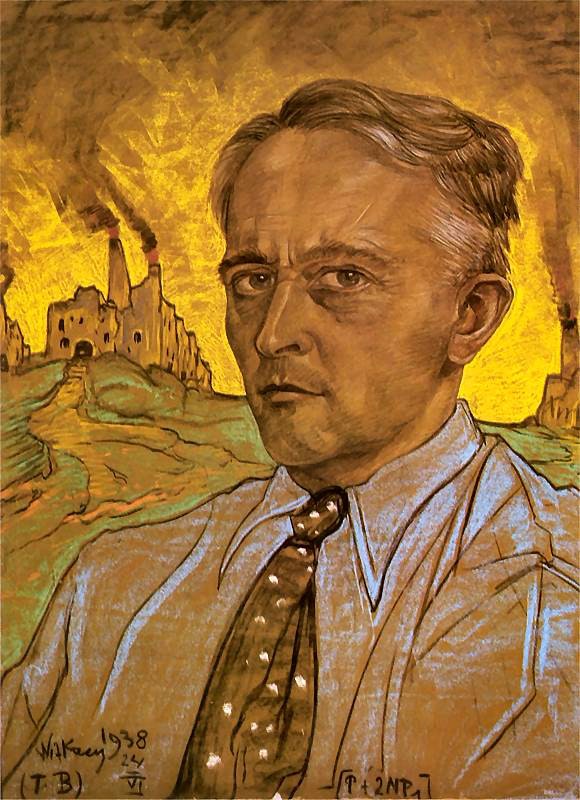
Much of the information in this post comes from Juliette Breton at the Public Domain Review. See her post for more.
At least once a day, staff at art museums and galleries worldwide must hear someone say, “the artist must have been on drugs.” It’s the easiest explanation for art that disturbs, unsettles, confounds our expectations of what art should be. Maybe sometimes artists are on drugs. (R. Crumb tells the story of discovering his inimitable style while on acid.) But maybe it’s not the drugs that make their art seem otherworldly. Maybe mind-altering substances make them more receptive to the source of creativity.…
In any case, artists have long used psychoactive substances to reach higher states of consciousness and cope with a world that doesn’t get their vision. In the early days of LSD experimentation, one psychiatrist even tested the phenomenon. UC Irvine’s Oscar Janiger dosed volunteer subjects at a rented L.A. house, then had them draw or otherwise record their experiences. He ultimately aimed to make a “creativity pill,” testing hundreds of willing subjects between 1954 and 1962.
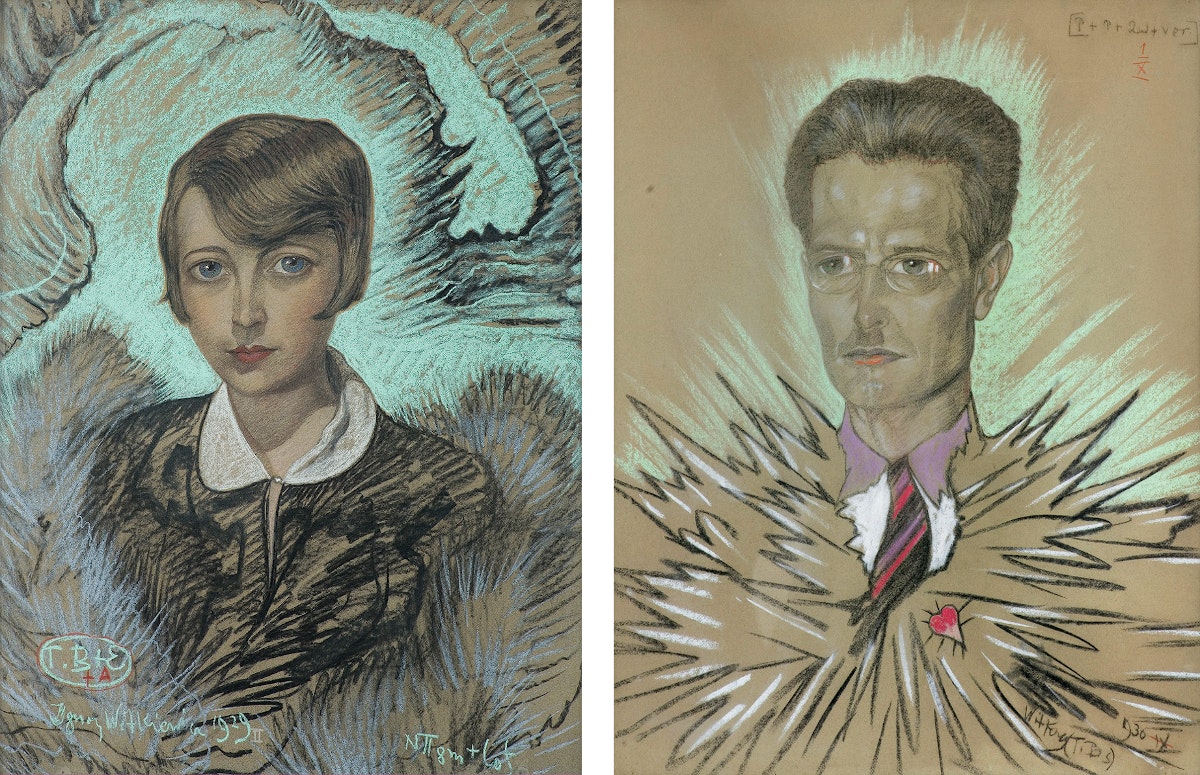
Had Polish artist Stanisław Ignacy Witkiewicz (1885–1939) — who went by “Witkacy” — lived to see the spread of LSD, he would have signed up for every trial. More likely, he would have conducted his own experiments, with himself as the sole test subject. The Warsaw-born artist, writer, philosopher, novelist, and photographer died in 1939, the year after Swiss chemist Albert Hoffman accidentally synthesized acid. Throughout his career, however, Witkacy experimented with just about every other psychoactive substance, anticipating Janiger by decades with his portraits — painted while… yes… he was on lots of drugs.
Unlike his contemporary Dalí, Witkacy did not claim to be drugs. But he was hardly coy about their use. He made notes on each painting to indicate his state of intoxication. “Under the influence of cocaine, mescaline, alcohol, and other narcotic cocktails,” Juliette Bretan writes at the Public Domain Review, “Witkacy prepared numerous studies of clients and friends for his portrait painting company, founded in the mid-1920s.” The drugs induced “different approaches to colour, technique, and composition. The resulting images are surreal — and occasionally horrific.” Sometimes the drugs in question were limited to caffeine, a daily staple of artists everywhere. He also made portraits while abstaining from other addictive substances like nicotine and alcohol.
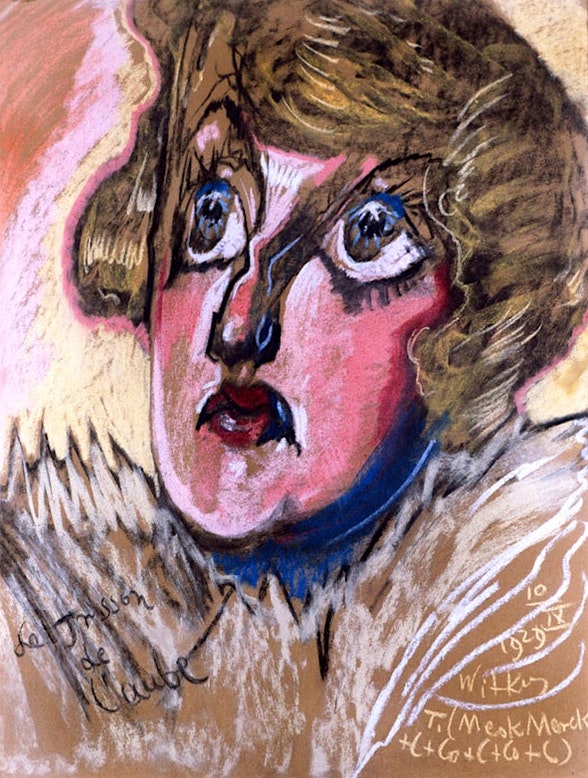
At other times, Witkacy’s notes — written in a kind of code — specified more pronounced usage. He made the portrait above, of Nina Starchurska, in 1929 while on “narcotics of a superior grade,” including mescaline synthesized by Merck and “cocaine + caffeine + cocaine + caffeine + cocaine.” Another portrait of Starchurska (below) made in that same year involved some heavy doses of peyote, among other things.
Witkacy’s investigations were literary as well, culminating in a 1932 book of essays called Narcotics: Nicotine, Alcohol, Cocaine, Peyote, Morphone, Ether + Appendices. The book “owes much to the experimental works of other European psychonauts throughout the nineteenth and twentieth centuries.” Invoking the decadent moralism of Thomas De Quincey and Baudelaire, and it anticipates the utopian, psychedelic prose of Aldous Huxley and Carlos Castaneda.
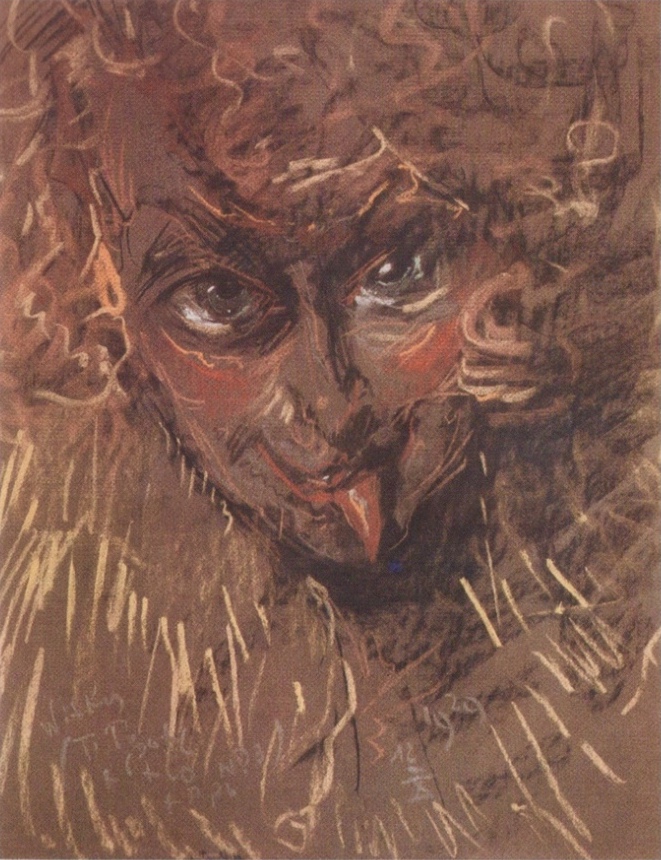
Where he might fulminate, with satirical edge, against the use of drugs, Witkacy also joyously records their liberating effects on his creative consciousness. His chapter on peyote “most closely approximates the spirit” of his paintings, notes Bibiliokept in a review of the recently republished volume:
“Peyote” begins with Witkiewicz taking his first of seven (!) peyote doses at six in the evening and culminating around eight the following morning with “Straggling visions of iridescent wires.” In increments of about 15 minutes, Witkiewicz notes each of his surreal visions. The wild hallucinations are rendered in equally surreal language: “Mundane disumbilicalment on a cone to the barking of flying canine dragons” here, “The birth of a diamond goldfinch” there.
Elsewhere he writes of “elves on a seesaw (Comedic number)” and “a battle of centaurs turned into a battle between fantastical genitalia,” all of which lead him to conclude, “Goya must have known about peyote.”
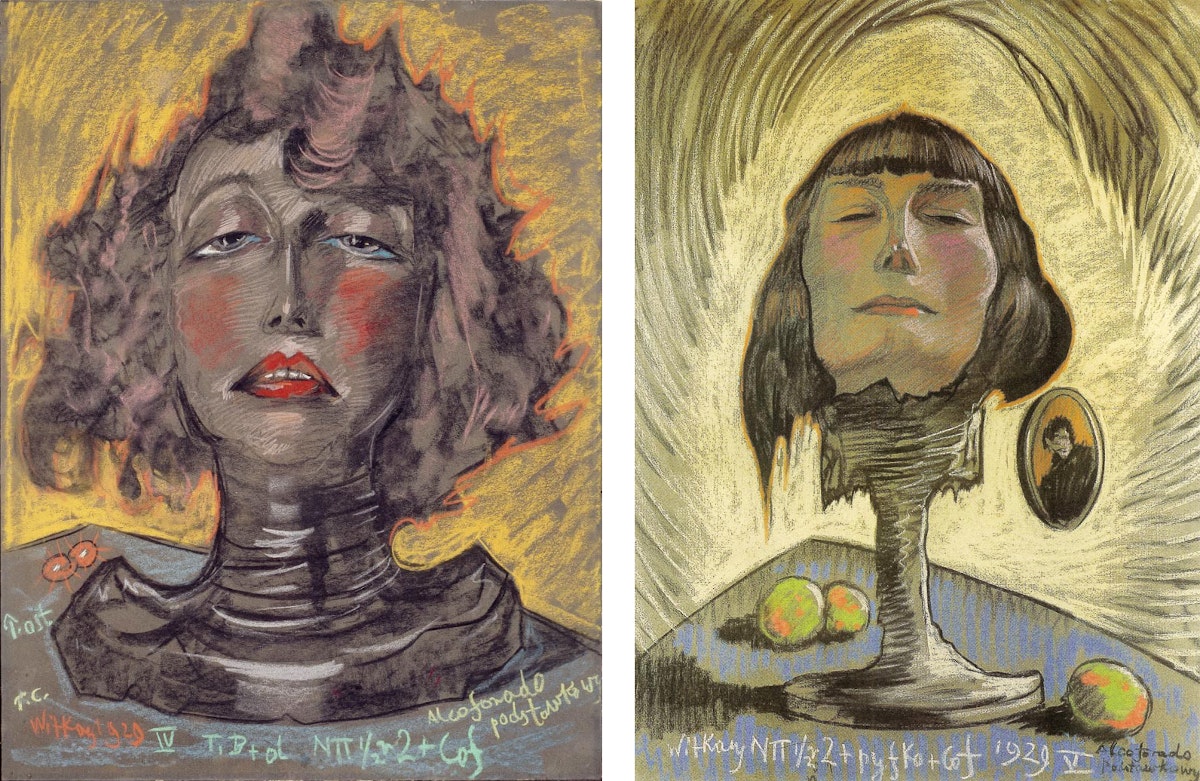
Narcotics functions as a kind of key to Witkacy’s thinking as he made the portraits; part drug diary, part artistic statement of purpose, it includes a “List of Symbols” to help decode his shorthand. The artist committed suicide in 1939 when the Red Army invaded Poland. Had he lived to connect with the psychedelic revolution to come, perhaps he would have been the artist to make psychotropic drug use a respectable form of fine art. Then we might imagine conversations in galleries going something like this: “Excuse me, was this artist on drugs?” “Why yes, in fact. She took large doses of psylocybin when she made this. It’s right here in her manifesto.….”
See many more Witkacy portraits by visiting Juliette Bretan’s post at the Public Domain Review.
Related Content:
R. Crumb Describes How He Dropped LSD in the 60s & Instantly Discovered His Artistic Style
Take a Trip to the LSD Museum, the Largest Collection of “Blotter Art” in the World
Josh Jones is a writer and musician based in Durham, NC. Follow him at @jdmagness
Read More...Hayao Miyazaki, The Mind of a Master: A Thoughtful Video Essay Reveals the Driving Forces Behind the Animator’s Incredible Body of Work
“If the cinema, by some twist of fate, were to be deprived overnight of the sound track and to become once again the art of silent cinematography that it was between 1895 and 1930, I truly believe most of the directors in the field would be compelled to take up some new line of work.” So wrote François Truffaut in the nineteen-sixties, arguing that, of filmmakers then living, only Howard Hawks, John Ford, and Alfred Hitchcock could survive such a return to silence. Alas, Truffaut died in 1984, the very same year that saw the release of Nausicaä of the Valley of the Wind, the first animated feature by what would become Studio Ghibli. Had he lived longer, he would certainly have had to grant its mastermind Hayao Miyazaki pride of place in his small catalog of master visual storytellers.
“He doesn’t actually write a script,” says Any-Mation Youtuber Cole Delaney in “Hayao Miyazaki: The Mind of a Master,” the video essay above. “He might write an outline with his plan for a feature, but generally he draws an image and works from there.”
My Neighbor Totoro, for instance, began with only the image of a young girl and the titular forest creature standing at a bus stop; from that artistic seed everything else grew, like the enormous tree that Totoro and the children make grow in the film itself. Delaney also explores other essential aspects of Miyazaki’s process, including the creation of full worlds with distinctive funiki, or ambience; the incorporation of Ozu-style “pillow shots” to shape a film’s space and rhythm; and the creation of protagonists whose strong will translates directly into physical motion.
“What drives the animation is the will of the characters,” says Miyazaki himself, in a clip Delaney borrows from the NHK documentary 10 Years with Hayao Miyazaki. “You don’t depict fate, you depict will.” The master makes other observations on his work and life itself, which one senses he regards as one and the same. “I want to make a film that won’t shame me,” he says by way of explaining his notorious perfectionism. “I want to stay grumpy,” he says by way of explaining his equally notorious demeanor in the Ghibli office. As for “the notion that one’s goal in life is to be happy, that your own happiness is the goal… I just don’t buy it.” Rather, people must “live their lives fully, with all their might, within their given boundaries, in their own era.” The surpassing vitality of his films reflects his own: “Like it or not,” he says, “a film is a reflection of its director,” and in these words Truffaut would surely recognize a fellow auteurist-auteur.
Related content:
Watch Hayao Miyazaki Animate the Final Shot of His Final Feature Film, The Wind Rises
What Made Studio Ghibli Animator Isao Takahata (RIP) a Master: Two Video Essays
How Master Japanese Animator Satoshi Kon Pushed the Boundaries of Making Anime: A Video Essay
The Aesthetic of Anime: A New Video Essay Explores a Rich Tradition of Japanese Animation
Japanese Animation Director Hayao Miyazaki Shows Us How to Make Instant Ramen
Based in Seoul, Colin Marshall writes and broadcasts on cities, language, and culture. His projects include the Substack newsletter Books on Cities, the book The Stateless City: a Walk through 21st-Century Los Angeles and the video series The City in Cinema. Follow him on Twitter at @colinmarshall or on Facebook.
Read More...Finding Purpose & Meaning In Life: Living for What Matters Most–A Free Online Course from the University of Michigan
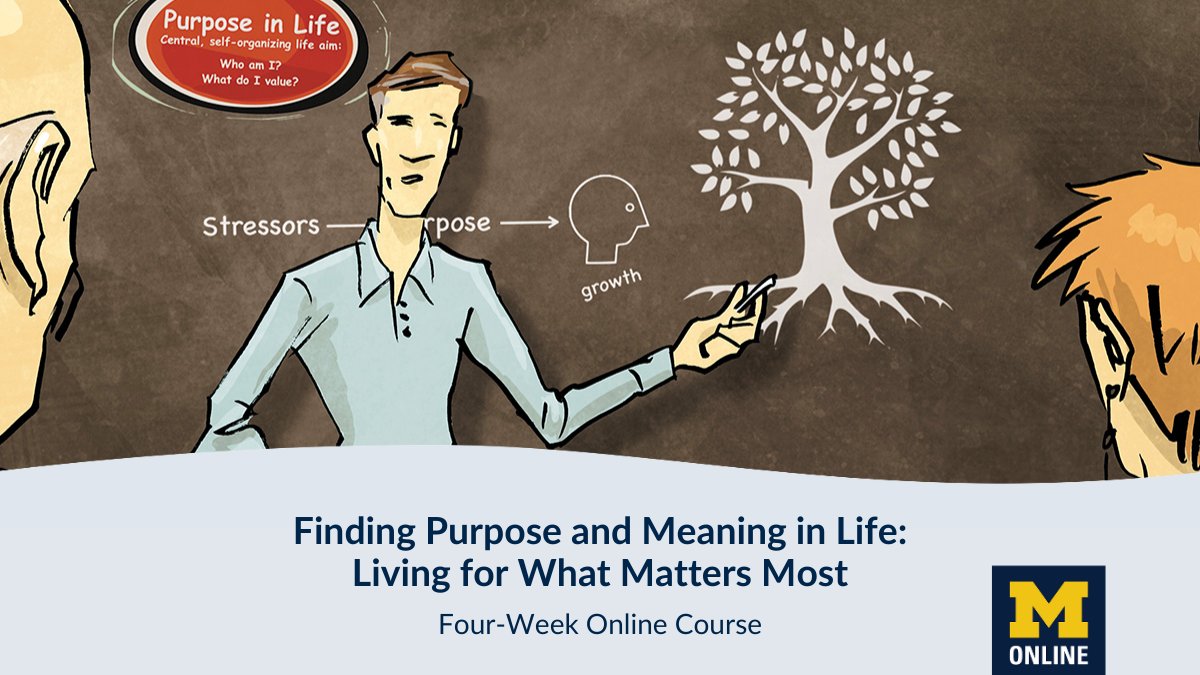
From the University of Michigan comes a course for our disorienting times–Finding Purpose and Meaning In Life: Living for What Matters Most. Taught by Vic Strecher, a professor in the Schools of Public Health and Medicine, the course promises students this:
In this course, you’ll learn how science, philosophy and practice all play a role in both finding your purpose and living a purposeful life. You will hear from historical figures and individuals about their journeys to finding and living a purposeful life, and will walk through different exercises to help you find out what matters most to you so you can live a purposeful life.
By the end of the course, students will:
1. Understand that having a strong purpose in life is an essential element of human well-being.
2. Know how self-transcending purpose positively affects well-being.
3. Be able to create a purpose for your life (don’t be intimidated, this is different from creating “the purpose” for your life).
4. Apply personal approaches and skills to self-change and become and stay connected to your purpose every day.
To take the course for free, selection the Audit Only option available upon registration.
Finding Purpose and Meaning In Life: Living for What Matters Most will be added to our list: 1,700 Free Online Courses from Top Universities.
Anyone interested can watch Vic Strecher’s TED Talk here.
If you would like to support the mission of Open Culture, consider making a donation to our site. It’s hard to rely 100% on ads, and your contributions will help us continue providing the best free cultural and educational materials to learners everywhere. You can contribute through PayPal, Patreon, and Venmo (@openculture). Thanks!
Related Content
The Science of Well-Being: Take a Free Online Version of Yale University’s Most Popular Course
97-Year-Old Philosopher Ponders the Meaning of Life: “What Is the Point of It All?”
Read More...U2’s Bono & the Edge Give Surprise Concert in Kyiv Metro/Bomb Shelter: “Stand by Me,” “Angel of Harlem,” and “With or Without You”
Volodymyr Zelenskyy invited U2 to perform in Kyiv as a show of solidarity with the Ukrainian people. And they showed up, playing an improvised acoustic set in a Kyiv Metro station, which now doubles as a bomb shelter. Above you can watch Bono and the Edge perform “Stand by Me,” “Angel of Harlem,” and “With or Without You.” At points, they’re joined by members of the Ukrainian band Antytila.
#StandwithUkraine
Related Content
Pink Floyd Releases Its First New Song in 28 Years to Help Support Ukraine
Discover 18 Underground Bands From Ukraine
Read More...Grandma Moses Started Painting Seriously at Age 77, and Soon Became a Famous American Artist
As an artistic child growing up on a farm in the 1860s and early 1870s, Anna Mary Robertson (1860–1961) used ground ochre, grass, and berry juice in place of traditional art supplies. She was so little, she referred to her efforts as “lambscapes.” Her father, for whom painting was also a hobby, kept her and her brothers supplied with paper:
He liked to see us draw pictures, it was a penny a sheet and lasted longer than candy.
She left home and school at 12, serving as a full-time, live-in housekeeper for the next 15 years. She so admired the Currier & Ives prints hanging in one of the homes where she worked that her employers set her up with wax crayons and chalk, but her duties left little time for leisure activities.
Free time was in even shorter supply after she married and gave birth to ten children — five of whom survived past infancy. Her creative impulse was confined to decorating household items, quilting, and embroidering gifts for family and friends.
At the age of 77 (circa 1937), widowed, retired, and suffering from arthritis that kept her from her accustomed household tasks, she again turned to painting.
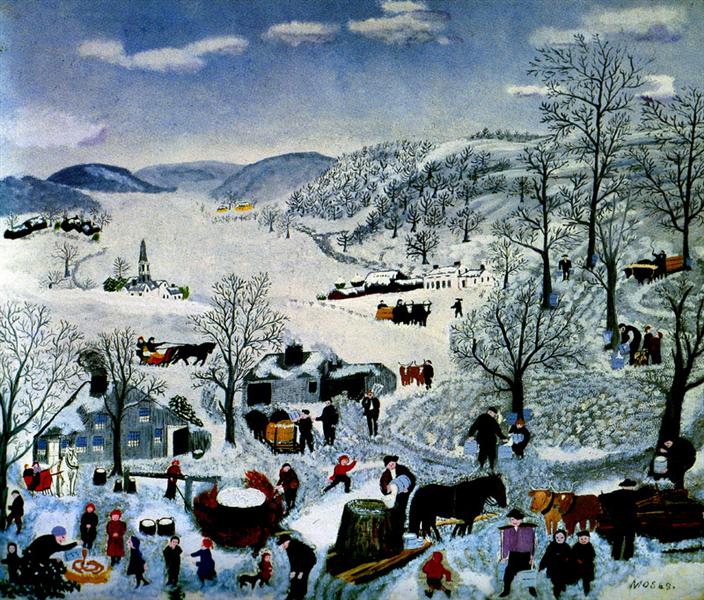
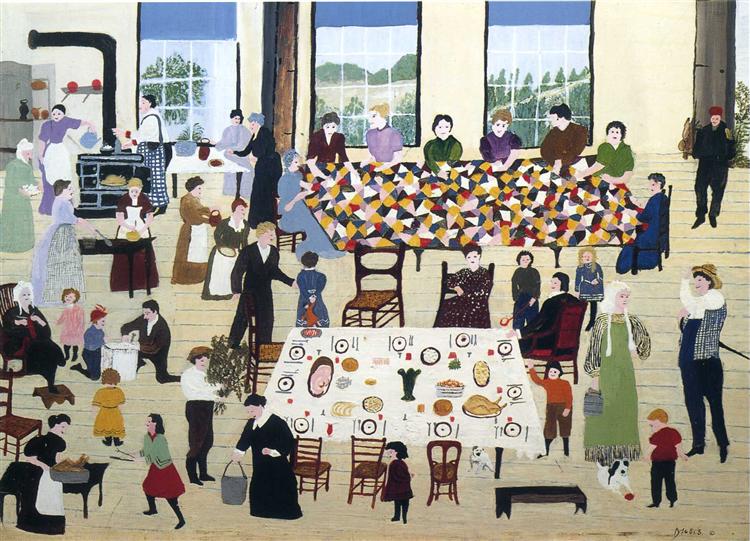
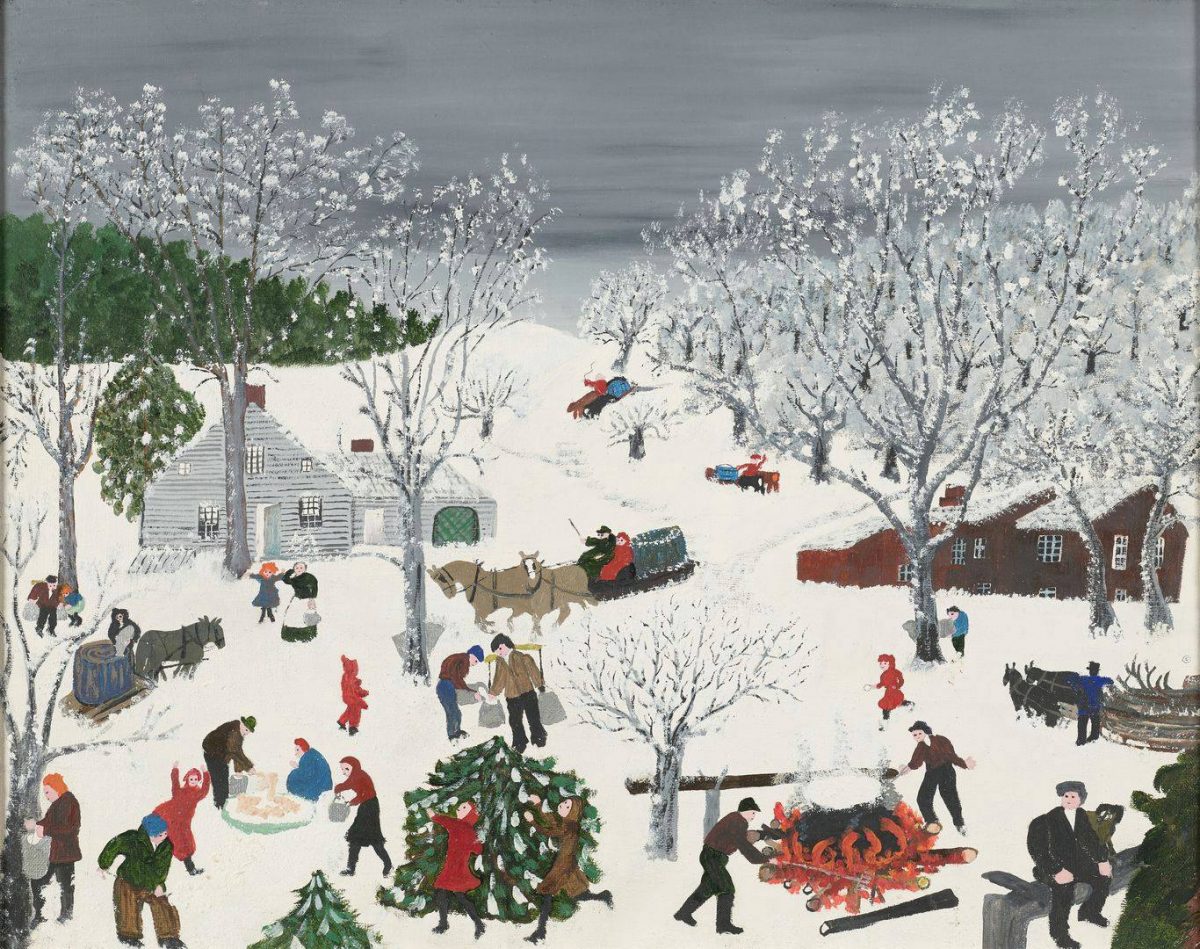
Setting up in her bedroom, she worked in oils on masonite prepped with three coats of white paint, drawing on such youthful memories as quilting bees, haying, and the annual maple sugar harvest for subject matter, again and again.
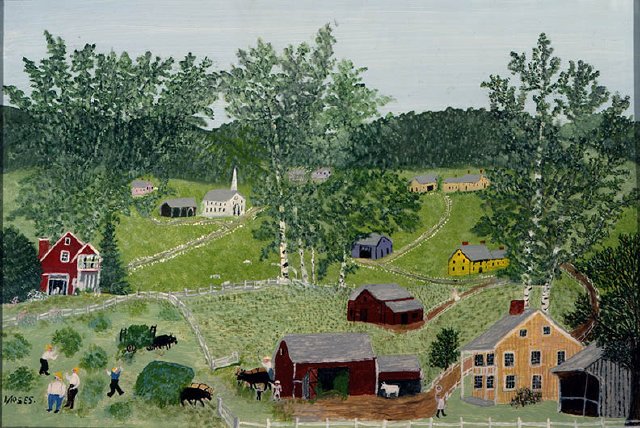
Thomas’ Pharmacy in Hoosick Falls, New York exhibited some of her output, alongside other local women’s handicrafts. It failed to attract much attention, until art collector Louis J. Caldor wandered in during a brief sojourn from Manhattan and acquired them all for an average price tag of $4.
The next year (1939), Mrs. Moses, as she was then known, was one of several “housewives” whose work was included in the Museum of Modern Art’s exhibit “Contemporary Unknown American Painters”. The emphasis was definitely on the untaught outsider. In addition to occupation, the catalogue listed the non-Caucasian artists’ race…
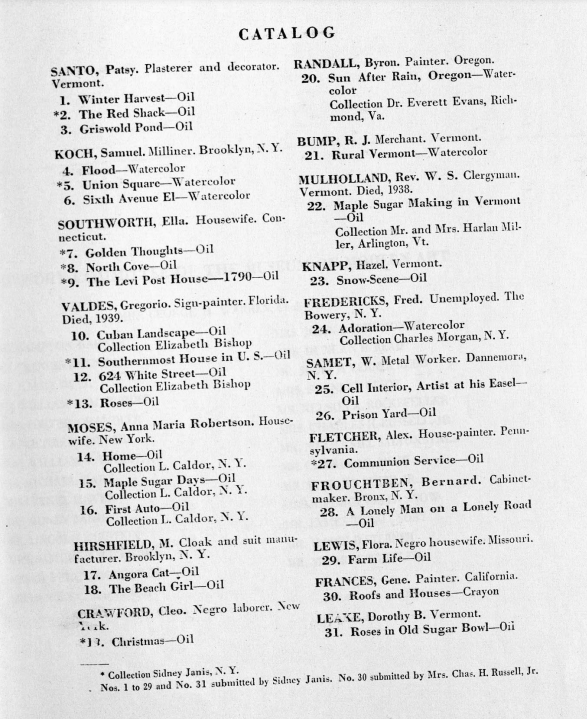
In short order, Anna Mary Robertson Moses had a solo exhibition in the same gallery that would give Gustav Klimt and Egon Schiele their first American one-person shows, Otto Kallir’s Galerie St. Etienne.
In reviewing the 1940 show, the New York Herald Tribune’s critic cited the folksy nickname (“Grandma Moses”) favored by some of the artist’s neighbors. Her wholesome rural bonafides created an unexpected sensation. The public flocked to see a table set with her homemade cakes, rolls, bread and prize-winning preserves as part of a Thanksgiving-themed meet-and-greet with the artist at Gimbels Department Store the following month.
As critic and independent curator Judith Stein observes in her essay “The White Haired Girl: A Feminist Reading”:
In general, the New York press distanced the artist from her creative identity. They commandeered her from the art world, fashioning a rich public image that brimmed with human interest…Although the artist’s family and friends addressed her as “Mother Moses” and “Grandma Moses” interchangeably, the press preferred the more familiar and endearing form of address. And “Grandma” she became, in nearly all subsequent published references. Only a few publications by-passed the new locution: a New York Times Magazine feature of April 6, 1941; a Harper’s Bazaar article; and the landmark They Taught Themselves: American Primitive Painters of the 20th Century, by the respected dealer and curator Sidney Janis, referred to the artist as “Mother Moses,” a title that conveyed more dignity than the colloquial diminutive “Grandma.”
But “Grandma Moses” had taken hold. The avalanche of press coverage that followed had little to do with the probity of art commentary. Journalists found that the artist’s life made better copy than her art. For example, in a discussion of her debut, an Art Digest reporter gave a charming, if simplified, account of the genesis of Moses’ turn to painting, recounting her desire to give the postman “a nice little Christmas gift.” Not only would the dear fellow appreciate a painting, concluded Grandma, but “it was easier to make than to bake a cake over a hot stove.” After quoting from Genauer and other favorable reviews in the New York papers, the report concluded with a folksy supposition: “To all of which Grandma Moses perhaps shakes a bewildered head and repeats, ‘Land’s Sakes’.” Flippantly deeming the artist’s achievements a marker of social change, he noted: “When Grandma takes it up then we can be sure that art, like the bobbed head, is here to stay.”
Urban sophisticates were besotted with the plainspoken, octogenarian farm widow who was scandalized by the “extortion prices” they paid for her work in the Galerie St. Etienne. As Tom Arthur writes in a blog devoted to New York State historical markers:
New Yorkers found that, once wartime gasoline rationing ended, Eagle Bridge made a nice excursion destination for a weekend trip. Local residents were usually willing to talk to outsiders about their local celebrity and give directions to her farm. There they would meet the artist, who was a delight to talk to, and either buy or order paintings from her. Songwriter/impresario Cole Porter became a regular customer, ordering several paintings every year to give to friends around Christmas.
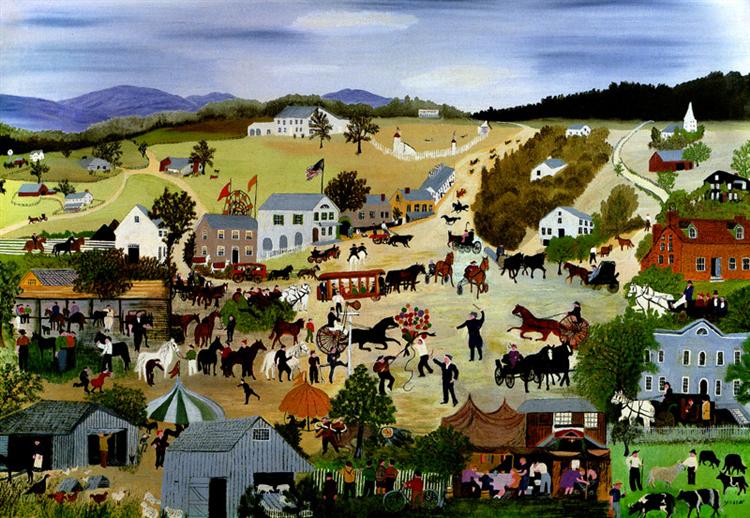
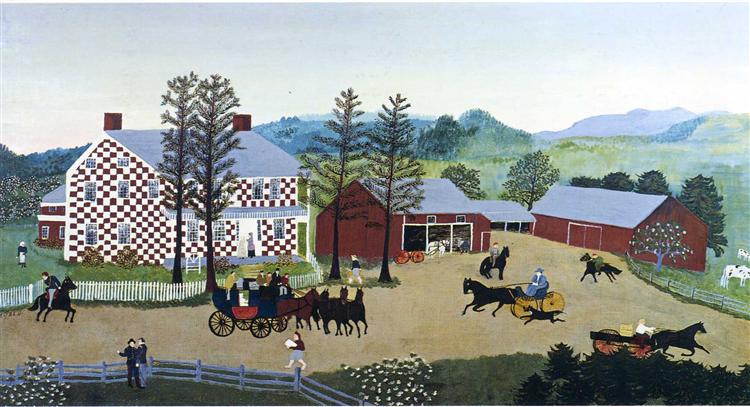
In the two-and‑a half decades between picking her paintbrush back up and her death at the age of 101, she produced over 1600 images, always starting with the sky and moving downward to depict tidy fields, well kept houses, and tiny, hard working figures coming together as a community. In the above documentary she alludes to other artists known to depicting “trouble”… such as livestock busting out of their enclosures.
She preferred to document scenes in which everyone was seen to be behaving.
Remarkably, MoMA exhibited Grandma Moses’ work at the same time as Picasso’s Guernica.
In a land and in a life where a woman can grow old with fearlessness and beauty, it is not strange that she should become an artist at the end. — poet Archibald MacLeish
Hmm.
Read Judith Stein’s fascinating essay in its entirety here.
See more of Grandma Moses’ work here, and her portrait on TIME magazine in 1953.
Related Content
How Leo Tolstoy Learned to Ride a Bike at 67, and Other Tales of Lifelong Learning
Free Art & Art History Courses
- Ayun Halliday is the Chief Primatologist of the East Village Inky zine and author, most recently, of Creative, Not Famous: The Small Potato Manifesto. Follow her @AyunHalliday.
Read More...Self-Encounter: The 10-Episode TV Show That Introduced Existentialism to Americans in 1961
“Existentialism is both a philosophy and a mood,” says Hazel Barnes by way of opening the television series Self-Encounter: A Study in Existentialism. “As a mood, I think we could say that it is the mood of the twentieth century — or, at least, of those people in the twentieth century who are discontent with things as they are. It expresses the feeling that, somehow or other, all of those systems — whether they be social, psychological, or scientific — which have attempted to define and explain and determine man, have somehow missed the living individual person.”
Existentialism was on the rise in 1961, when Barnes spoke those words, and the subsequent six decades have arguably done little to assuage its discontent. By the time of Self-Encounter’s broadcast in ’61, Barnes was already well-known in philosophical circles for her English translation of Jean-Paul Sartre’s Being and Nothingness. When she took on that job, with what she later described as “three years of badly taught high school French and one yearlong course in college, and a bare minimum of background in philosophy,” she couldn’t have known that it would set her on the road to becoming the most famous popularizer of existentialism in America.
Five years after the publication of Barnes’ Sartre translation, along came the opportunity to host a ten-part series on National Public Educational Television (a predecessor of PBS) explaining Sartre’s thought as well as that of other writers like Simone de Beauvoir, Albert Camus, and Richard Wright, between dramatizations of scenes drawn from existentialist literature. Self-Encounter was once “thought to be entirely lost, the original tapes having been reported recorded over,” writes Nick Nielsen. But after the series’ unexpected rediscovery in 2017, all of its episodes gradually made their way to the web. You can watch all ten of them straight through in the nearly five-hour video at the top of the post, or view them one-by-one at the American Archive of Public Broadcasting.
“Self Encounter was produced in 1961 and first broadcast in 1962,” Nielsen writes. “I cannot help but note that Route 66 aired from 1960 to 1964, The Outer Limits aired from 1963 to 1965, Rawhide aired from 1959 to 1965, and Perry Mason aired from 1957 to 1966” — not to mention The Twilight Zone, from 1959 to 1964. “It would be difficult to name another television milieu of comparable depth. Our mental image of this period of American history as being one of stifling conformity is belied by these dark perspectives on human nature.” And as for the social, psychological, scientific, and of course technological systems in effect today, the existentialists would surely take a dim view of their potential to liberate us from conformity — or any other aspect of the human condition.
Related content:
Existentialism with Hubert Dreyfus: Five Free Philosophy Courses
Existential Philosophy of Kierkegaard, Sartre, Camus Explained with 8‑Bit Video Games
Based in Seoul, Colin Marshall writes and broadcasts on cities, language, and culture. His projects include the Substack newsletter Books on Cities, the book The Stateless City: a Walk through 21st-Century Los Angeles and the video series The City in Cinema. Follow him on Twitter at @colinmarshall, on Facebook, or on Instagram.
Read More...MasterClass Is Offering Up to 35% Off an Annual Subscription for Mother’s Day (Through May 8)

FYI: MasterClass is offering up to 35% off an annual subscription for Mother’s Day. Through Sunday, May 8th you can become a member and gain access to 150 courses, featuring some of our leading creative minds–from Annie Leibovitz, David Sedaris and Neil Gaiman, to Margaret Atwood, David Lynch and Helen Mirren. You can sign up by clicking here.
Note: If you get a MasterClass subscription, Open Culture will receive a small fee that helps support our operation.
Read More...Support Us
We're hoping to rely on loyal readers, rather than erratic ads. Please click the Donate button and support Open Culture. You can use Paypal, Venmo, Patreon, even Crypto! We thank you!

About Us

Open Culture scours the web for the best educational media. We find the free courses and audio books you need, the language lessons & educational videos you want, and plenty of enlightenment in between.
Advertise With Us
FREE UPDATES!
GET OUR DAILY EMAIL
Get the best cultural and educational resources on the web curated for you in a daily email. We never spam. Unsubscribe at any time.
FOLLOW ON SOCIAL MEDIA
Open Culture editor Dan Colman scours the web for the best educational media. He finds the free courses and audio books you need, the language lessons & movies you want, and plenty of enlightenment in between.
Advertise With Us

