Learn Ancient Greek in 118 Free Lessons: A Free Online Course from Brandeis & Harvard
Leonard Muellner (Professor Emeritus of Classical Studies at Brandeis University) and Belisi Gillespie (who now teaches classics at Agnes Scott College) have posted 118 videos on YouTube, which, when taken together, “present all the content covered in two semesters of a college-level Introduction to Ancient Greek course.”
The textbook used is Greek: An Intensive Course. 2nd edition. And if you read the blurb that accompanies each video on YouTube, you’ll find out 1) what material each video covers, and 2) what pages are being used in the textbook.
Made available online by Harvard’s Center for Hellenic Studies, the playlist of Ancient Greek lessons will be added to our collections, Learn 45+ Languages Online for Free: Spanish, Chinese, English & More and 1,700 Free Online Courses from Top Universities.
If you would like to support the mission of Open Culture, consider making a donation to our site. It’s hard to rely 100% on ads, and your contributions will help us continue providing the best free cultural and educational materials to learners everywhere. You can contribute through PayPal, Patreon, and Venmo (@openculture). Thanks!
Related Content:
Hear Homer’s Iliad Read in the Original Ancient Greek
What Ancient Greek Music Sounded Like: Listen to a Reconstruction That’s “100% Accurate”
Introduction to Ancient Greek History: A Free Online Course by Yale Historian Donald Kagan
The History of Ancient Greece in 18 Minutes: A Brisk Primer Narrated by Brian Cox
Read More...
Hear Paul McCartney’s Forgotten 1967 Movie Soundtrack, Arranged by George Martin
In 1967, a young Roger Ebert drew up a top-ten-films-of-the-year list including Bonnie and Clyde, Blow-Up, The Graduate, A Man for All Seasons, and Cool Hand Luke. Later, he added a few more pictures from this cinematic bumper crop that he remembered fondly, the first of which was The Family Way. Though seldom referenced today, it was a big hit in Britain — one of several, in fact, for the twin-brother filmmakers John and Roy Boulting. Responsible for such nineteen-fifties comedies as Lucky Jim and I’m All Right Jack, the two attained in their homeland not only auteur status, but also the curious position of establishment satirists, validating the institutions of mid-century English life even as they ridiculed them.
Adapted from a stage play by Alfie author Bill Naughton, The Family Way finds its material in the trials of a pair of northern newlyweds who, having been fleeced by a crooked travel agent, end up having to spend their honeymoon at home. What’s worse, given their impecuniousness, “home” meant a room in the house of the groom’s parents.
That 1967 was a different time is also signaled by a scene in which the father-in-law bellows for his chamber pot, which his wife had hoped to keep hidden from her new daughter-in-law’s sensitive eyes. In that role is the acclaimed performer of English everyman John Mills, appearing onscreen for the first time with his daughter Hayley, who plays the bride. It marked her first real adult part, a kind of graduation from her child-actress career in pictures like The Parent Trap and That Darn Cat!
The picture also boasted a score by Paul McCartney, or at any rate by Beatles producer George Martin, who built upon what themes he could successfully importune the seemingly writer’s-blocked Beatle to bang out. Taking into account that this was happening between Revolver and Sgt. Pepper, it’s perhaps understandable that McCartney would feel his creative energies drained by other projects, but the Boulting brothers had offered a first, irresistible opportunity to compose officially outside the Lennon-McCartney dyad. Though not without the charms of Martin’s orchestral work (more of which would be heard in Yellow Submarine in 1969), The Family Way’s brief soundtrack bears few obvious marks of the McCartney musical sensibility. Present on the Beatles’ albums, of course, that sensibility has continued to develop throughout a solo career that has outlived the band by 56 years — and counting.
Related Content:
The Genius of Paul McCartney’s Bass Playing in 7 Isolated Tracks
Paul McCartney Explains How Bach Influenced “Blackbird”
Hear The Beatles’ Abbey Road with Only Paul McCartney’s Bass: You Won’t Believe How Good It Sounds
Based in Seoul, Colin Marshall writes and broadcasts on cities, language, and culture. He’s the author of the newsletter Books on Cities as well as the books 한국 요약 금지 (No Summarizing Korea) and Korean Newtro. Follow him on the social network formerly known as Twitter at @colinmarshall.
Read More...The Fascinating Engineering of the Titanic: How the Great Ocean Liner Was Built
When many of us first learned of the RMS Titanic, it was presented first as one of history’s greatest ironies: the “unsinkable” ocean liner that went down on its maiden voyage. Of course, there’s a great deal more to the story, as anyone who becomes obsessed with the ill-fated ship (James Cameron being just one notable example) understands full well. Even apart from the many human experiences surrounding it, some of them told by the wreck’s survivors and preserved on film, the mechanical aspects of the Titanic hold out considerable fascination for anyone with an engineer’s cast of mind. Put aside, for the moment, the matter of the sinking, and consider just what went into making it one of the most glorious creations of man launched into the ocean to date — or rather, one of the three most glorious.
The Titanic was one of a trio of similar White Star Line ships completed in the early nineteen-tens. In the video above, Bill Hammack, known on YouTube as Engineerguy, tells the story of not just the Titanic, but also the Olympic and the HMHS Britannic. An engineering professor at the University of Illinois, he found in the campus library issues of the journal The Engineer published between 1909 and 1911 that contain detailed photographs of the construction of both the Titanic and Olympic, sister ships that were built side-by-side.
One element highlighted that we may not much consider today is the sheer scale of the things: each was held together by three million rivets, could contain 1.5 million gallons of ballast water, weighed 52,000 tons when fully fitted, required 23 tons of lubricant to slide from the dock into the water, and burned 650 tons of coal per day on a transatlantic crossing.
Alas, size alone wasn’t enough to prevent disaster. “Less than a year after the launch of these two giant ships, one suffered a collision that ripped a gaping hole in its side,” says Hammack. “That ship was of course, the Olympic.” Its sudden encounter with a passing warship necessitated patching with wood before it could return home for a full repair, but thereafter it remained in service for nearly a quarter-century. Its less lucky sibling ended up at the bottom of the ocean after running into trouble of its own: a mine and a torpedo spelled the end for the Britannic in 1916. As for the Titanic, we all know about its fateful encounter with the iceberg, and maybe we’ve even heard discussions of how its designers could have mitigated the impact: more or taller bulkheads, a double hull rather than just a double bottom, greater lifeboat capacity. As for whether and how those solutions would have worked, perhaps Hammack could still shoot a follow-up explaining it all to us.
Related Content:
See the First 8K Footage of the Titanic, the Highest-Quality Video of the Shipwreck Yet
The Titanic: Rare Footage of the Ship Before Disaster Strikes (1911–1912)
Titanic Survivor Interviews: What It Was Like to Flee the Sinking Luxury Liner
Based in Seoul, Colin Marshall writes and broadcasts on cities, language, and culture. He’s the author of the newsletter Books on Cities as well as the books 한국 요약 금지 (No Summarizing Korea) and Korean Newtro. Follow him on the social network formerly known as Twitter at @colinmarshall.
Read More...How to Read Books That Challenge Your Mind: Advice from Robert Greene, Author of The 48 Laws of Power
If you’ve fallen out of the habit of reading books, you’re certainly not alone. Consider how often posts circulate on social media (itself a big part of the problem) about studies showing a rapid increase in the number of people who don’t even get one book read per year. How best to get back on the literary wagon? You might try going straight for the hard stuff, as it were, by taking on a novel like Moby-Dick. But that, according to the view articulated in the video above by The 48 Laws of Power author Robert Greene, would be like stepping back into the gym after years away and trying to bench press 300 pounds. Rather than starting with Melville’s masterpiece, build your way up to it — but once you get to it, you’ve got to finish it.
“You want to train yourself to finish books, and not constantly be going from one to another to another,” Greene says, and that holds even for those you may not enjoy. “When I read a book that I hate, that is boring, and I make myself read all the way through, I kind of take angry notes about it: God, this is ridiculous, this is so stupid, I hate this, this guy doesn’t know what he’s talking about. You can react to the book, you can have a dialogue with it, but you want to be able to have the patience to get through a 400- 500, 600-page book.” To return to the weight-training analogy, a shorter book to start could be “kind of easy, and it could be in a subject that interests you,” but upon finishing it, you should “choose something that’s a little bit difficult and a little bit complicated.”
The idea is deliberately to choose books that challenge you, a quality that doesn’t come from length alone. If one gives you an impression that “it’s not how you feel politically about the world, it’s not how you feel spiritually about the world, it’s something that’s a little bit outside what you would normally encounter,” take it as a sign that you should read it. Approaching the matter from the other direction, Greene also advises not to “just choose things that you think are entertaining and fun, because that’s going to make you lazy, and it’s going to make you weak, and it’s going to make you always look for things that are entertaining, fun, and distracting.” An airport-thriller-heavy diet may work for Malcolm Gladwell, but it’s unlikely to work for you.
As an example of a challenging read, Greene points to any of Robert Caro’s four biographical volumes about U.S. President Lyndon B. Johnson, one of which runs to well over 1,000 pages. He could also have suggested Caro’s earlier The Power Broker: Robert Moses and the Fall of New York, one of those books — alongside not just Moby-Dick, but also the Bible, Ulysses, War and Peace, and even Pride and Prejudice — that even many serious readers only pretend to have made it through, or indeed started. Whatever the material you use, Greene says, “I beg you to train your mind like you train your body, to go through something that’s a little more difficult, a little more challenging, that’s going to take some time for you. That’s the way to develop the habit of wanting to read, and to have the patience to read more books.” No pain, no gain, as the bodybuilders say; bear that in mind when you get to Melville’s distilled course on cetology.
Related content:
20 Books People Pretend to Read (and Now Your Confessions?)
5 Books You Can Read Again .… and Again and Again: Here’s Our Picks, Now Yours
7 Tips for Reading More Books in a Year
The Nature of Human Stupidity Explained by The 48 Laws of Power Author Robert Greene
Based in Seoul, Colin Marshall writes and broadcasts on cities, language, and culture. He’s the author of the newsletter Books on Cities as well as the books 한국 요약 금지 (No Summarizing Korea) and Korean Newtro. Follow him on the social network formerly known as Twitter at @colinmarshall.
Read More...Hear Seven Hours of Women Making Electronic Music (1938–2014)

Image via Wikimedia Commons
A number of years ago, in a post on the pioneering composer of the original Doctor Who theme, we wrote that “the early era of experimental electronic music belonged to Delia Derbyshire.” Derbyshire—who almost gave Paul McCartney a version of “Yesterday” with an electronic backing in place of strings—helped invent the early electronic music of the sixties through her work with the Radiophonic Workshop, the sound effects laboratory of the BBC. She went on to form one of the most influential, if largely obscure, electronic acts of the decade, White Noise. And yet, calling the early eras of electronic music hers is an exaggeration. Of course her many collaborators deserve mention, as well as musicians like Bruce Haack, Pierre Henry, Kraftwerk, Brian Eno, and so many others. But what gets almost completely left out of many histories of electronic music, as with so many other histories, is the prominent role so many women besides Derbyshire played in the development of the sounds we now hear around us all the time.
In recognition of this fact, musician, DJ, and “escaped housewife/schoolteacher” Barbara Golden devoted two episodes of her KPFA radio program “Crack o’ Dawn” to women in electronic music, once in 2010 and again in 2013. She shares each broadcast with co-host Jon Leidecker (“Wobbly”), and in each segment, the two banter in casual radio show style, offering history and context for each musician and composer. Highlighted on Ubu’s former Twitter stream, the first show, “Women in Electronic Music 1938–1982 Part 1” (above) gives Derbyshire her due, with three tracks from her, including the Doctor Who theme.
It also includes music from twenty one other composers, beginning with Clara Rockmore, a refiner and popularizer of the theremin, that weird instrument designed to simulate a high, tremulous human voice. Also featured is Wendy Carlos’s “Timesteps,” an original piece from her A Clockwork Orange score.
The second show, above, fills in several gaps in the original broadcast and “could easily be six hours” says co-host Leidecker, given the sheer amount of electronic music out there composed and recorded by women over the past seventy years. This show includes one of our host Golden’s own compositions, “Melody Sumner Carnahan,” as well as music from Laurie Anderson and musique concrete composer Doris Hays. These two broadcasts alone cover an enormous range of stylistic and technological ground, but for even more discographical history of women in electronic music, see the playlist below, compiled by “Nerdgirl” Antye Greie-Ripatti. Commissioned by Club Transmediale Berlin, the mix includes such well-known names as Yoko Ono, Bjork, and M.I.A., as well as foremothers Derbyshire and Carlos, and dozens more.
In lieu of the radio-show chatter of Golden and Leidecker, we have Greie-Ripatti’s post detailing each artist’s time period, country of origin, and contributions to electronic music history. Many of the composers represented here worked for major radio and film studios, scored feature films (like 1956’s Forbidden Planet), invented and innovated new instruments and techniques, wrote for orchestras, and passed on their knowledge as educators and producers. Greie-Ripatti’s page quotes a Danish electronic producer and performer saying “there is a lot of women in electronic music… invisible women.” Thanks to efforts like hers and Golden’s, these pioneering creators need no longer go unseen or, more importantly, unheard.
Note: An earlier version of this post appeared on our site in 2015.
Related Content:
Watch Composer Wendy Carlos Demo an Original Moog Synthesizer (1989)
Thomas Dolby Explains How a Synthesizer Works on a Jim Henson Kids Show (1989)
Josh Jones is a writer and musician based in Durham, NC.
Read More...The Monty Python Philosophy Soccer Match: The Ancient Greeks Versus the Germans
Today, we’re revisiting a classic Monty Python skit. The scene is the 1972 Munich Olympics. The event is a football/soccer match, pitting German philosophers against Greek philosophers. On the one side, the Germans — Hegel, Nietzsche, Kant, Marx and, um, Franz Beckenbauer. On the other side, Archimedes, Socrates, Plato and the rest of the gang. The referee? Confucius. Of course.
Enjoy!
If you would like to support the mission of Open Culture, consider making a donation to our site. It’s hard to rely 100% on ads, and your contributions will help us continue providing the best free cultural and educational materials to learners everywhere. You can contribute through PayPal, Patreon, and Venmo (@openculture). Thanks!
Related Content:
Why Jorge Luis Borges Hated Soccer: “Soccer is Popular Because Stupidity is Popular”
Video: Bob Marley Plays a Soccer Match in Brazil, 1980
Read More...How the Long-Lost Body of Richard III Was Found Under a Parking Lot: Solving a 500-Year-Old Mystery
Shakespeare’s The Tragedy of Richard the Third begins with the eponymous character uttering the famous line “Now is the winter of our discontent.” It ends at the Battle of Bosworth Field, by which point his villainous schemes have come to ruin and his desertion by Lord Stanley seems to have sealed his fate. “A horse, a horse, my kingdom for a horse,” he cries out, coining another expression used four centuries later before being slain by the Earl of Richmond, the man who would be Henry VII. Though Shakespeare himself was writing more than 100 years after the historical events he dramatized, he included little after the event of Richard’s death, whose most fascinating mystery was in any case only solved in our own time.
You can see the story of Richard III’s long-unknown whereabouts in the Primal Space video above. According to records, says the narrator, “he was buried unceremoniously beneath the Greyfriars Church in Leicester, and a monument was eventually placed above his grave.” When Henry VIII ordered such houses of worship shut down forty years later, Greyfriars was among the institutions demolished.
Everyone eventually came to believe that, amid this destruction, Richard’s body had been exhumed and tossed off the Bow Bridge. Only in the early two-thousands did a search for his corpse commence in earnest, spearheaded by the Richard III Society. Having determined that the Bow Bridge story had been made up, the society’s members then had to pin down the long-confused former location of Greyfriars Church.
One of them, Philippa Langley, got the hunch to start looking under a Leicester parking lot. Budgetary limitations forced her team to try digging just three trenches across spaces likeliest to cross the church’s footprint. “Amazingly, just six hours into the first day, they came across a skeleton” with skull damage and spinal curvature. Richard was indeed described as a “hunchback” in his lifetime, but in the twenty-first century, only DNA evidence closes the case. Its acquisition necessitated both finding a couple unbroken female lines (the only means of transmitting mitochondrial DNA) from his sister down to living, testable individuals while carbon-dating the skeleton. Sure enough, Richard turned out to have been in eternal repose not just under that parking lot, but near a stenciled letter R — the kind of coincidence from which even the Bard himself might have shied away.
Related content:
Confirmed: The Bones of Richard III (1452–1485) Found Under a UK Parking Lot
How England First Became England: An Animated History
A New Analysis of Beethoven’s DNA Reveals That Lead Poisoning Could Have Caused His Deafness
Based in Seoul, Colin Marshall writes and broadcasts on cities, language, and culture. He’s the author of the newsletter Books on Cities as well as the books 한국 요약 금지 (No Summarizing Korea) and Korean Newtro. Follow him on the social network formerly known as Twitter at @colinmarshall.
Read More...How to Rescue a Wet, Damaged Book: A Handy Visual Primer
How to save those wet, damaged books? The question has to be asked. Above, you can watch a visual primer from the Syracuse University Libraries—people who know something about taking care of books. It contains a series of tips, some intuitive, some less so, that will give you a clear action plan the next time water and paper meet.
If you would like to support the mission of Open Culture, consider making a donation to our site. It’s hard to rely 100% on ads, and your contributions will help us continue providing the best free cultural and educational materials to learners everywhere. You can contribute through PayPal, Patreon, and Venmo (@openculture). Thanks!
Related Content:
Watch a Japanese Craftsman Lovingly Bring a Tattered Old Book Back to Near Mint Condition
Watch 52,000 Books Getting Reshelved at The New York Public Library in a Short, Timelapse Film
Read More...The Met Releases High-Definition 3D Scans of 140 Famous Art Objects: Sarcophagi, Van Gogh Paintings, Marble Sculptures & More
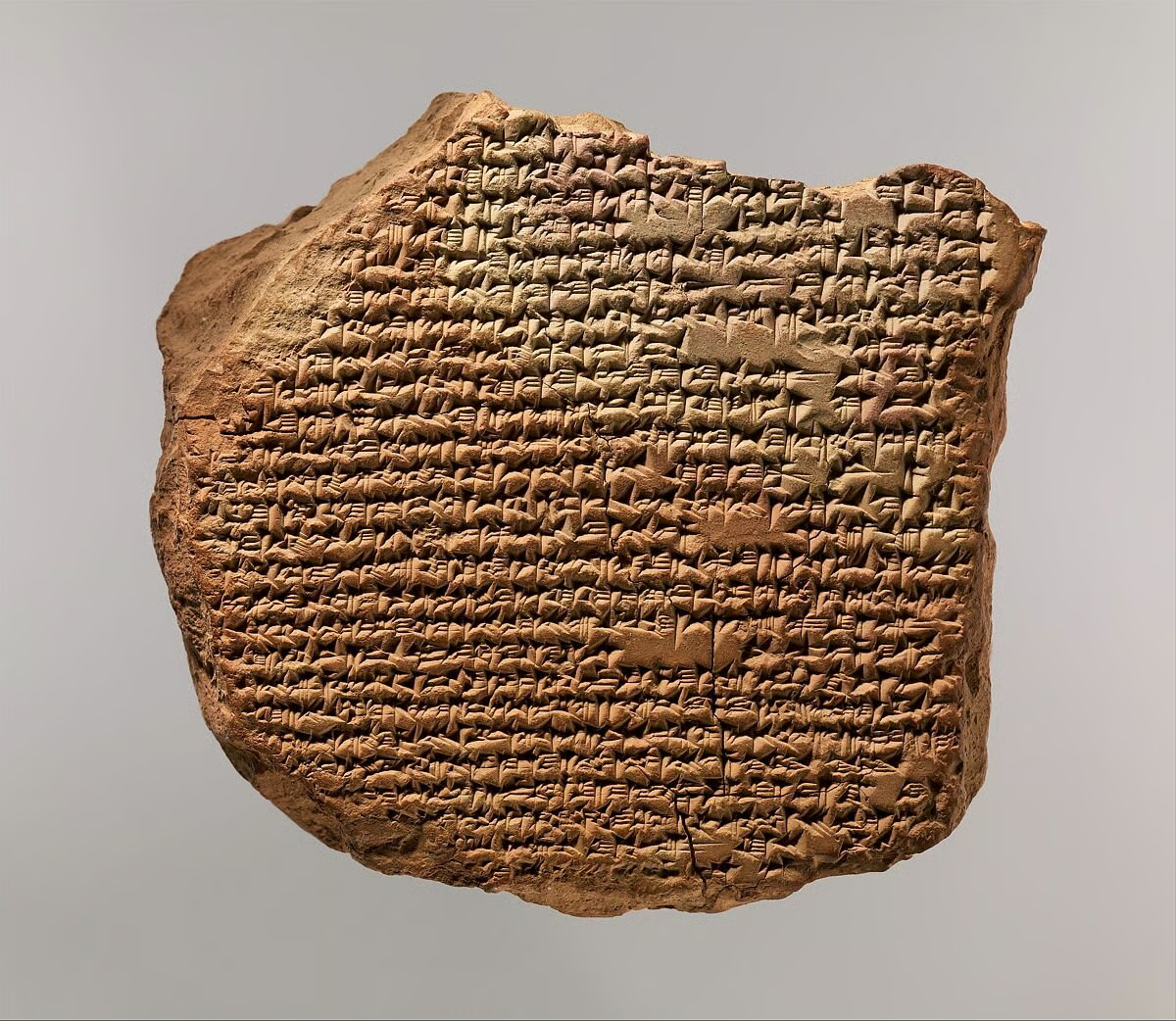
We can go through most of our lives holding out hope of one day seeing in reality such works as van Gogh’s Sunflowers, Monet’s Haystacks, a clay tablet containing actual cuneiform writing with our own eyes, or the ancient Egyptian Temple of Dendur. We can actually come face to face — or rather, face to surface — with all of them, temple included, at New York’s Metropolitan Museum of Art, which contains all those and more artifacts of human civilization than any of us could hope to examine closely in a lifetime. But even if we did, we might only feel tempted to look at them more closely still, even to touch them. That may be an improbable hope, but we can at least get closer than ever now thanks to the Met’s new archive of high-definition 3D scans.
“Viewers can zoom in, rotate, and examine each model, bringing unprecedented access to significant works of art,” says the Met’s official announcement. “The 3D models can also be explored in viewers’ own spaces through augmented reality (AR) on most smartphone and VR headsets, as a resource for research, exploration, and curiosity.”
Highlights include “a marble sarcophagus with lions felling antelope (3rd century); a statue of Horus as a falcon protecting King Nectanebo II (360–343 BCE); Kano Sansetsu’s Old Plum (1646); and a house model by Nayarit artist(s) (200 BCE–300 CE).” Or perhaps you’d prefer an intimate view of an eighteenth-century tile depiction of Mecca, a nineteenth-century marble sculpture of Perseus with the head of Medusa, or a suit of armor belonging to King Henry II of France?

Browsing this archive of more than 100 digitized historical objects, you’ll also notice pieces from Japan like seventeenth-century screens by the artists Kano Sansetsu and Suzuki Kiitsu. These must have been priorities for the Met’s institutional partner in this project, the Japanese television network NHK. It all came about “as part of the public broadcaster’s initiative to produce ultra-high definition 3D computer graphics of national treasures and other important artworks,” with “further educational programming and potential content using these cutting-edge, best-in-class models” in the offing. For now, though, the archive offers us more than enough to behold from any possible angle. To do so, just click the “View in 3D” button below the image on the page of your artifact or artwork of choice. It may not be the same as holding the object in your hands, but it’s as close as you’re going to get — unless, of course, you find yourself inspired to pursue the dream of becoming a curator at the Met.
via Colossal
Related content:
Take a New Virtual Reality Tour of the Metropolitan Museum of Art
See Vermeer’s Girl with a Pearl Earring in 3D in a New 108-Gigapixel Scan
OpenVertebrate Presents a Massive Database of 13,000 3D Scans of Vertebrate Specimens
The Earth Archive Will 3D-Scan the Entire World & Create an “Open-Source” Record of Our Planet
Based in Seoul, Colin Marshall writes and broadcasts on cities, language, and culture. He’s the author of the newsletter Books on Cities as well as the books 한국 요약 금지 (No Summarizing Korea) and Korean Newtro. Follow him on the social network formerly known as Twitter at @colinmarshall.
Read More...Watch Peter Tork Quietly Mouth Other Actors’ Lines in The Monkees: A Strange Quirk You’ll Never Unsee
And now for something entirely random. As noted on Metafilter, “Peter Tork from the Monkees had a strange little quirk. Sometimes, when other actors … were delivering their lines Tork would unthinkingly mouth their dialogue along with them, as seen in this YouTube compilation. Once you spot it, it makes the show (which was already kinda weird) weird in a whole new way.” The YouTuber who created this compilation spent countless hours staring at Peter’s lips. Given the alternative these days, it’s not a bad use of time.
Related Content
Jimi Hendrix Opens for The Monkees on a 1967 Tour; Then Flips Off the Crowd and Quits
How the 1968 Psychedelic Film Head Destroyed the Monkees & Became a Cult Classic
Watch Frank Zappa Play Michael Nesmith (RIP) on The Monkees–and Vice Versa (1967)
Read More...Support Us
We're hoping to rely on loyal readers, rather than erratic ads. Please click the Donate button and support Open Culture. You can use Paypal, Venmo, Patreon, even Crypto! We thank you!

About Us

Open Culture scours the web for the best educational media. We find the free courses and audio books you need, the language lessons & educational videos you want, and plenty of enlightenment in between.
Advertise With Us

FREE UPDATES!
GET OUR DAILY EMAIL
Get the best cultural and educational resources on the web curated for you in a daily email. We never spam. Unsubscribe at any time.
FOLLOW ON SOCIAL MEDIA

Open Culture editor Dan Colman scours the web for the best educational media. He finds the free courses and audio books you need, the language lessons & movies you want, and plenty of enlightenment in between.
Advertise With Us


