Scientists at Purdue University Create the “Whitest White” Paint Ever Seen: It Reflects 98% of the Sun’s Light

Xiulin Ruan, a Purdue University professor of mechanical engineering, holds up his lab’s sample of the whitest paint on record. Purdue University/Jared Pike
Surely, you’ve heard of Vantablack, the high-tech coating invented by UK company Surrey NanoSystems that absorbs over 99 percent of light and makes three-dimensional objects look like black holes? Aside from its controversially exclusive use by artist Anish Kapoor, the blackest of black paints has so far proven to be most effective in space. “You can imagine up in space people think of it as being really black and dark,” Surrey NanoSystems chief technical officer Ben Jensen explains. “But actually it’s incredibly bright up there because the Sun’s like a huge arc lamp and you’ve got light reflecting off the Earth and moon.”
All that sunlight can make certain parts of the world unbearably hot for humans, a rapidly worsening phenomenon thanks to climate change, which has itself been worsened by climate control systems used to cool homes, offices, stores, etc. Since the 1970s scientists have attempted to break the vicious cycle with white paints that can cool buildings by reflecting sunlight from their surfaces. “Painting buildings white to reflect sunlight and make them cooler is common in Greece and other countries,” notes The Washington Post. “Cities like New and Chicago have programs to paint roofs white to combat urban heat.”
The problem is “commercial white paint gets warmer rather than cooler,” writes Purdue University. “Paints on the market that are designed to reject heat reflect only 80%-90% of sunlight and can’t make surfaces cooler than their surroundings,” since they absorb ultraviolet light. That may well change soon, with the invention by a team of Purdue engineers of an as-yet unnamed, patent-pending ultra-white paint that has “pushed the limits on how white paint can be.” Those limits now fall just slightly short of Vantablack on the other side of the spectrum (or grayscale).

An infrared camera shows how a sample of the whitest white paint (the dark purple square in the middle) actually cools the board below ambient temperature, something that not even commercial “heat rejecting” paints do. Purdue University/Joseph Peoples
Purdue describes the properties of the revolutionary compound.
Two features give the paint its extreme whiteness. One is the paint’s very high concentration of a chemical compound called barium sulfate, which is also used to make photo paper and cosmetics white.
The second feature is that the barium sulfate particles are all different sizes in the paint. How much each particle scatters light depends on its size, so a wider range of particle sizes allows the paint to scatter more of the light spectrum from the sun.
This formula “reflects up to 98.1% of sunlight — compared with the 95.5%,” of light reflected by a previous compound that used calcium carbonate instead of barium sulfite. The less than 3% difference is more significant than it might seem.
Xiulin Ruan, professor of mechanical engineering, describes the potential of the new reflective coating: “If you were to use this paint to cover a roof area of about 1,000 square feet, we estimate that you could get a cooling power of 10 kilowatts. That’s more powerful than the central air conditioners used by most houses… If you look at the energy [savings] and cooling power this paint can provide, it’s really exciting.”
Will there be a proprietary war between major players in the art world to control it? “Ideally,” Kait Sanchez writes at The Verge, “anything that could be used to improve people’s lives while reducing the energy they use should be free and widely available.” Ideally.
Learn more about the whitest white paint here and, if you have access, at the researchers’ publication in the journal ACS Applied Materials & Interfaces.
via Smithsonian
Related Content:
YInMn Blue, the First Shade of Blue Discovered in 200 Years, Is Now Available for Artists
Josh Jones is a writer and musician based in Durham, NC. Follow him at @jdmagness
Read More...The Meaning of Hieronymus Bosch’s The Garden of Earthly Delights Explained
Over the half-millennium since Hieronymus Bosch painted it, The Garden of Earthly Delights has produced an ever-widening array of interpretations. Is it “a painting about sexual freedom”? A “medieval acid trip”? An “erotic fantasy”? A “heretical attack on the church”? The work of “a member of an obscure free-love cult”? James Payne, the London curator behind the Youtube channel Great Art Explained, rejects all these views. In the opening of the in-depth video analysis above, he describes Bosch’s well-known and much-scrutinized late-15th or early-16th century triptych as, “pure and simply, hardcore Christianity.”
Dating from “a time when European artists, writers, and theologians were shaping a new, terrifying vision of Hell and the punishment awaiting sinners,” Payne argues, The Garden of Earthly Delights is “an intensely moralistic work that should be approached as what it is: religious propaganda.”
Depicting the Biblical creation of the world on its outer panels, the work opens up to reveal elaborately detailed visions of Adam and Eve in the Garden of Eden, then humanity indulging in all known earthly delights, then the consequent torments of Hell. It is that last panel, with its abundance of perverse activities and grotesque human, animal, and human-animal figures (recently made into figurines and even piñatas) that keeps the strongest hold on our imagination today.
Payne’s explanation goes into detail on all aspects of the work, highlighting and contextualizing details that even avowed appreciators may not have considered before. While identifying both the possible inspirations and the possible symbolic intentions of the figures and symbols with which Bosch filled the triptych, Payne emphasizes that, as far as the artist was concerned, “his images were a realistic portrayal of sin and its consequences, so in that sense, it wasn’t surrealism, it was realism.” This bears repeating, given how difficult we moderns find it “to look at this painting and not see it as surrealism or a product of the subconscious, not see it as a sexual utopia, a critique of religion, or even a psychedelic romp.” Just as The Garden of Earthly Delights tells us a great deal about the world Bosch lived in, so our views of it tell us a great deal about the world we live in.
If you would like to support the mission of Open Culture, consider making a donation to our site. It’s hard to rely 100% on ads, and your contributions will help us continue providing the best free cultural and educational materials to learners everywhere. You can contribute through PayPal, Patreon, and Venmo (@openculture). Thanks!
Related Content:
Figures from Hieronymus Bosch’s The Garden of Earthly Delights Come to Life as Fine Art Piñatas
Based in Seoul, Colin Marshall writes and broadcasts on cities, language, and culture. His projects include the Substack newsletter Books on Cities, the book The Stateless City: a Walk through 21st-Century Los Angeles and the video series The City in Cinema. Follow him on Twitter at @colinmarshall or on Facebook.
Read More...Quarantined Dancer Creates Shot-for-Shot Remake of the Final Dirty Dancing Scene with a Lamp as a Dance Partner
1987’s low budget sleeper hit, Dirty Dancing, propelled its leads, Jennifer Grey and the late Patrick Swayze, to instant stardom.
Swayze later mused to the American Film Institute about the film’s remarkable staying power:
It’s got so much heart, to me. It’s not about the sensuality; it’s really about people trying to find themselves, this young dance instructor feeling like he’s nothing but a product, and this young girl trying to find out who she is in a society of restrictions when she has such an amazing take on things. On a certain level, it’s really about the fabulous, funky little Jewish girl getting the guy because [of] what she’s got in her heart.
Nearly 35 years after the original release, another gifted male dancer, Brooklyn-based photographer Quinn Wharton, is tapping into that heart… and Grey has been replaced by a lamp.
Wharton once told Ballet Hub that his favorite part of dancing professionally with the San Francisco Ballet and Hubbard Street Dance Chicago was the access it gave him to the great names in dance — William Forsythe, Mats Ek, Christopher Wheeldon, Wayne McGregor, and others whose proximity made for “a remarkable education.”
The first few months of the pandemic forced him to dance solo, recreating memorable film moments in response to a friend’s challenge:
I was hesitant at first but thought I would give it a try to see what I might be able to learn from it. Turns out it was way more fun than I thought and the result was funnier than I could have imagined.
We agree that his Quinn-tessential Dance Scenes series is very funny, as well as beautifully executed in the twin arenas of camera work and dance. His self-imposed parameters — no outside help, no green screen, no filming outside of the apartment, and no special purchases of props or costumes, contribute to the humor.
His hardworking, disembodied, comparatively well-covered haunches elicit laughs when seen next to the much skimpier original costume of Flashdance’s “Maniac” scene, above. 18-year-old star Jennifer Beals had three dance doubles — Marine Jahan, gymnast Sharon Shapiro, and legendary B‑Boy Richard Colón, aka Crazy Legs of Rock Steady crew. None of them appeared in the original credits because, as Jahan told Entertainment Tonight, the producers “didn’t want to break the magic.”
In other words, a lot of steamy 80s-era fantasies centered on Beals are now known to be a case — possibly three cases — of mistaken identity.
Wharton’s quarantine project afforded him a chance to come at John Travolta from two angles, thanks to the disco classic Saturday Night Fever and Pulp Fiction’s twist sequence, a surprisingly popular fan request. Though Travolta’s dance training was limited to childhood tap lessons with Gene Kelly’s brother, Fred, Wharton praises his “serious range.”
Wharton cites the inspiration for one of his lesser known recreations, director Baz Lurhman’s first feature, Strictly Ballroom, as a reason he began dancing:
My dad loves this movie and as a kid I can’t count the number of times that I watched it. It’s so much, loud, brash, exuberant …It also allowed me to bring back my favorite partner.
Quinn-tessential Dance Scenes is on hiatus so Wharton can concentrate on his work as a dance photographer. Watch a playlist of all eight episodes here.
See more of his dance photography on his Instagram page.
Related Content:
Ayun Halliday is an author, illustrator, theater maker and Chief Primatologist of the East Village Inky zine, who can occasionally be spotted wandering around New York City in a bear suit, in character as L’Ourse. Follow her @AyunHalliday.
Read More...Ray Dalio & Adam Grant Launch Free Online Personality Assessment to Help You Understand Yourself (and Others Understand You)
Back in 2017, Ray Dalio published Principles: Life and Work, a bestselling book where the creator of the world’s largest hedge fund shared “the unconventional principles that he’s developed, refined, and used over the past forty years to create unique results in both life and business.” You can find a distilled version of those unconventional principles in a 30-minute animation video previously featured on our site.
To accompany his book, Dalio has now released, along with University of Pennsylvania organizational psychologist Adam Grant, a free personality assessment tool called PrinciplesYou. The assessment takes about 30 to 40 minutes to complete, and we would strongly encourage you to sign up for an account before you get started, so that you can save the results of the assessment afterwards. Otherwise you will lose the results.
According to psychologist Brian Little, “PrinciplesYou was developed over a two-year intensive and creative R&D process with two goals in mind. First, it measures traits that Ray Dalio and his team have observed and studied for many years as critical for personal and organizational success. Second, it is based on the latest research in personality science. The assessment provides a person’s score on a comprehensive set of traits, their underlying facets and interactive patterns, and it has high reliability, internal structure, re-test reliability and validity of these traits and facets. A distinctive strength is its ability to predict an extraordinary array of actual behaviors observed by the Bridgewater staff over many years.”
Adam Grant adds: “To achieve success, you need to know yourself and the people around you. Although your car comes with an owner’s manual, your mind doesn’t—and neither do your colleagues. We designed PrinciplesYou to help you gain the self-awareness and other-awareness that are critical to making good decisions, getting things done, and turning a group of coworkers into a great team.”
You can watch Grant and Dalio discuss PrinciplesYou above. You can listen to Grant feature Dalio’s insights on his Work Life podcast here. And finally you can start the free personality assessment here.
Related Content:
Free Online Psychology & Neuroscience Courses
The Principles for Success by Entrepreneur & Investor Ray Dalio: A 30-Minute Animated Primer
Read More...
Freddie Mercury & Rami Malek’s Live Aid Performance: A Side-By-Side Comparison
All Hollywood musicals need a big final set piece, one final rousing number to bring all the narrative threads back together, and provide redemption to our fallen hero. Bohemian Rhapsody, the 2018 biopic about Freddie Mercury and the band Queen, uses Live Aid as its final number. We’ve written elsewhere about how this was not really the final hurrah for the band, nor was this some kind of triumphant return after years in the Wilderness. (“Radio Gaga” and “I Want to Break Free” had been in the charts just over a year previous.) Neither was it their biggest concert of the 1980s. That would be the Wembley concert of 1986, where they would fill the exact same stadium used for Live Aid, but this time it was just for them.
But Hollywood cares not for that, so instead lets look at how faithfully Rami Malek and his fellow actors (along with what might have been Bryan Singer as director or possibly Dexter Fletcher, the man who replaced him after events we’d rather not go into, look it up) faithfully recreate those 20 glorious minutes. After all, it was one of the most watched events in the summer of 1985. There is video evidence!
I’ll leave it up to you out there to debate over Malek’s performance, which is going to suffer no matter what he does in a side-by-side with the real thing. Instead, notice how the filmmakers use certain parts of the performance to complete the narratives of the film. We get a cutaway to Brian May (Gwilym Lee) with a “by George he’s actually got it” look on his face—relief that Mercury finally got it together for the performance. There’s no equivalent shot in real life. The kiss that Mercury blows to somebody off camera is received by his mother and sister back at his childhood home.
After Mercury’s call-and-response with the teeming audience, the band dives into “Hammer to Fall” and the film cuts to a montage to show Live Aid’s phones ringing off the hook, anxious viewers wanting to donate even more because of Queen’s performance. This is again Hollywood hokum, as donations only really stepped up after Bob Geldof got in front of the cameras a little after Queen brought the house down and harangued viewers.
Still, you have to hand it to the movie for having the stones to indulge in the full 20 minute set, despite silly moves like cutting away to the movie’s “you’ll never go anywhere” record executive for the line “no time for losers” during the final song. (D’oh!)
YouTube user Juan Dela Cruz, who assembled this side-by-side, has made two other comparison videos using existing footage and the film: Part One is here, and here’s Part Two.
Related Content:
Watch Queen Rehearse & Meticulously Prepare for Their Legendary 1985 Live Aid Performance
Watch 16 Hours of Historic Live Aid Performances: Queen, Led Zeppelin, Neil Young & Much More
Ted Mills is a freelance writer on the arts who currently hosts the Notes from the Shed podcast and is the producer of KCRW’s Curious Coast. You can also follow him on Twitter at @tedmills, and/or watch his films here.
Read More...3D Print 18,000 Famous Sculptures, Statues & Artworks: Rodin’s Thinker, Michelangelo’s David & More
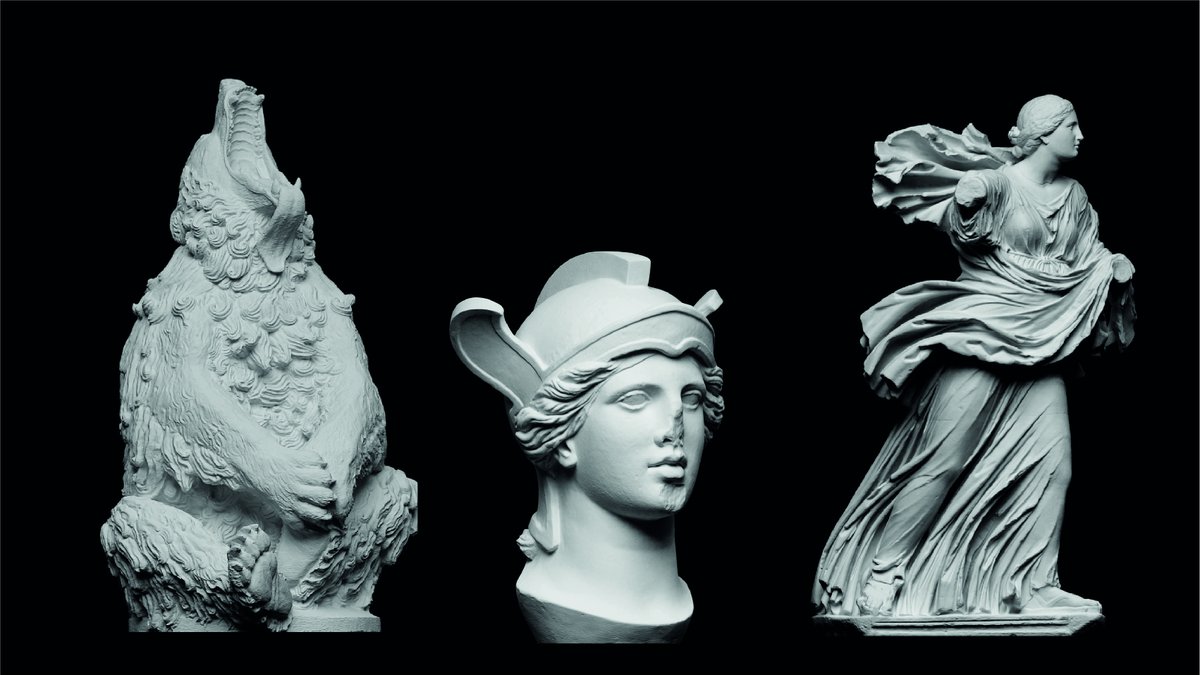
To recent news stories about 3D printed guns, prosthetics, and homes, you can add Scan the World’s push to create “an ecosystem of 3D printable objects of cultural significance.”
Items that took the ancients untold hours to sculpt from marble and stone can be reproduced in considerably less time, provided you’ve got the technology and the know-how to use it.
Since we last wrote about this free, open source initiative in 2017, Scan the World has added Google Arts and Culture to the many cultural institutions with whom it partners, expanding both its audience and the audience of the museums who allow items in their collections to be scanned prior to 3D printing.


Community contributors have uploaded scan data for over 18,000 sculptures and artifacts onto the platform.
China and India are actively courting participants to make some of their treasures available.
Although Scan the World is searchable by collection, artist, and location, with so many options, the community blog is a great place to start.
Here you will find helpful tips for beginners hoping to produce realistic looking skulls and sculptures — control your temperature, shake your resin, and learn from your mistakes.
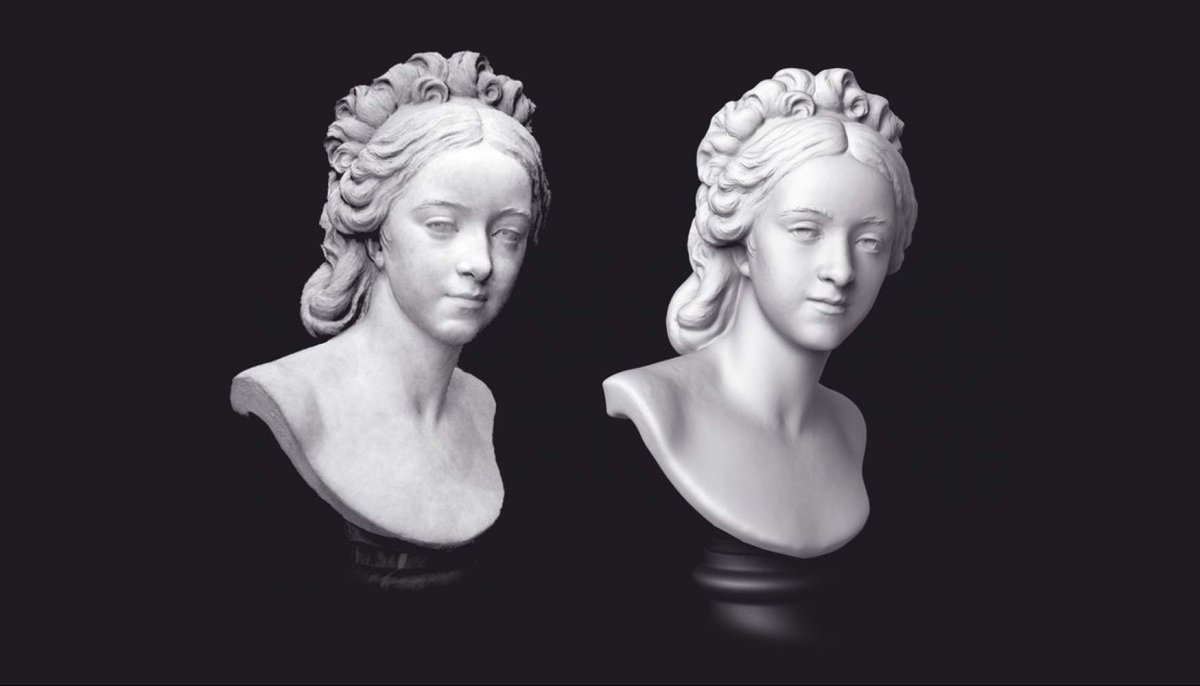
Got an unreachable object you’re itching to print? Take a look at the drone photogrammetry tutorial to prep yourself for taking a good scan — rotate slowly, remember the importance of light, and get up to speed on your drone by test-driving it in an open location.
Keep an eye peeled for competitions, like this one, which was won by a photo editor and retoucher with no formal 3‑D training.
Art lovers with little inclination to crack out the 3D printer will find interesting essays on such topics as the Gates of Hell, scanning in the pandemic, and the history of hairstyles in sculpture
You can also embark on a virtual tour of some of the global locations whose splendors are being scanned, programmed, and rendered in resin.

A virtual trip to Paris takes in some of the Louvre’s greatest 3‑dimensional hits: the Venus de Milo, Winged Victory, and Psyche Revived by Cupid’s Kiss.
(Any one of those oughta class up the ol’ bedsit…)
The virtual trip to Austria includes Kierling’s monument to Franz Kafka, the Beethoven memorial in Vienna’s Heiligenstädter Park, and Klaus Weber’s tribute to Hugo Rheinhold’s Darwinian sculpture, Monkey with Skull. (1,868 downloads and counting!)
A Google map awaits those who would tour the original flavor inspirations in person.
Begin your explorations of Scan the World here, and do let us know in the comments if you have plans for printing.
Related Content:
The Earth Archive Will 3D-Scan the Entire World & Create an “Open-Source” Record of Our Planet
Ayun Halliday is an author, illustrator, theater maker, Chief Primatologist of the East Village Inky zine, and sometimes, a French Canadian bear known as L’Ourse. Follow her @AyunHalliday.
Read More...30,000 People Line Up for the First McDonald’s in Moscow, While Grocery Store Shelves Run Empty (1990)
Everyone has waited in a long line — for burgers, Broadway tickets, Black Friday sales… But few us have the notorious queuing resilience of the Soviets. “When the first McDonald’s arrived in Moscow in 1990, the city went mad,” Boris Egorov writes at Russia Beyond. “Thousands of Muscovites flocked to the new burger joint, forming lines several kilometers long in the center of Moscow on Pushkinskaya Square.” On its first day, the restaurant obliterated the previous record for most McDonald’s customers (9,100 in Budapest), serving over 30,000 people, a testament to the fortitude of the employees. The CBC news segment on the opening above quotes a line from Pushkin to set the scene: “a feast in a time of plague.”
Stereotypes of fast food workers as lacking in skill and ambition did not find purchase here. “The first workers,” Egorov notes, “were the crème de la crème of Soviet youth: students from prestigious universities who could speak foreign languages with brilliant customer service skills.” Their cheerfulness so unnerved some customers that they were asked to tone it down for Russians “accustomed to rude, boorish service.”
Customers seemed less awed by the iconography than the “simple sight of polite shop workers,” wrote an American journalist. The restaurant, once a tourist attraction, notes travel site Bridge to Moscow, had “more than 700 seats inside and 200 outside,” and was once the largest McDonald’s in the world.
The Moscow McDonald’s represented more for Russians than an American novelty. Original customer Ksenia Oskina had never heard of McDonald’s before she visited. She later saved her Big Mac box. “I used that Big Mac box for a long time and put my sandwich in there instead of a lunchbox,” she tells The Washington Post. “I’d clean it, dry it on the heater and then use it again.” It wasn’t about brand recognition for many who dutifully lined up to pay half a day’s wages for a couple “thin slabs of meat and sliced vegetables between buns of bread.” (Sorry… “two all-beef patties, special sauce, lettuce, cheese, and a sesame seed bun…..”)
What did Soviet Russians, who had not been raised to sing fast food advertising jingles, see in the new restaurant? Capitalism’s promises of abundance. One Soviet journalist wrote of McDonald’s as “the expression of America’s rationalism and pragmatism toward food.” Just months afterward, the first Pizza Hut arrived. As the Soviet Union dissolved less than two years later, the country saw the creation of more desire for high-calorie, ultra-processed foods with Western-style TV ads: most famously a Pizza Hut spot from 1997 featuring the U.S.S.R.’s last premier, Mikhail Gorbachev. (“Because of him, we have Pizza Hut!”)
The politics may have mattered little to the average Muscovite McDonald’s customer in 1990. “Visiting the restaurant was less a political statement than an opportunity to enjoy a small pleasure in a country still reeling from disastrous economic problems and internal political turmoil,” notes History.com. Large, seemingly abstract problems had tangible effects: the empty grocery stores for which the failing empire became famous.
The Moscow McDonald’s was a colorful oasis for its first customers, who had no sentimental associations with burgers and fries. Now, those tastes are nostalgic. “I love it,” said Oskina thirty years later. “For some reason in America, it’s not as tasty as it is here.” Insert your own dated Yakov Smirnoff reference.
Related Content:
Josh Jones is a writer and musician based in Durham, NC. Follow him at @jdmagness
Read More...Watch a Newly-Restored Peter Gabriel-Era Genesis Concert Film From 1973 in Stunning 4K Quality
There are two late-20th century rock bands named Genesis and both of them featured Phil Collins, Mike Rutherford, and Tony Banks. The second Genesis we know of as one of the biggest-selling bands of all time and authors of such massive hits as “Land of Confusion,” “In Too Deep,” and “Throwing It All Away.” The first we may not know at all, except indirectly by way of its frontman, Peter Gabriel, better known as… solo artist Peter Gabriel.
One reason Genesis, the second, is more famous than its predecessor must be the unabashed pop ambitions of the remaining three members after Gabriel departed in 1975 and pioneering lead guitarist Steve Hackett left in ‘77. Another, related, reason must surely be that Genesis, the first, made music that was not what most people would call accessible, even in the ‘70s, though it is undeniably beautiful and strange. Lovers of the song “Invisible Touch” might find themselves unprepared for “The Lamb Lies Down on Broadway.”
Gabriel, too, went pop in the 80s, though he only got a little less weird. Yet what largely drove the success of his solo career also drove the success of Genesis II: MTV made it impossible to escape “Big Time” and “No Reply at All.” Can we imagine an alternate ‘80s, perhaps, in which Gabriel’s odd-pop leanings and the earnest balladry of Collins & company found a middle ground? That is to say, if Peter Gabriel-era Genesis had made music videos? What too-little visual record we have of the first Genesis looks more and more promising in the YouTube age.…
A few years back, we brought you news of a restored Peter Gabriel-era Genesis concert film from a 1973 show at England’s Shepperton Studios. Now, we have, from that same year, the concert above in Paris at the Bataclan in “a 4K restoration that is a stunning improvement over anything seen before,” writes Rolling Stone. “Simply put, it’s the most pristine video of a Peter Gabriel-era show that has ever surfaced.”
This is a good thing for fans of Genesis One. The band played their final album with Gabriel, The Lamb Lies Down on Broadway, in its entirety on all 104 tour stops two years later. It was “the most elaborate production they’d ever attempted,” and “in a decision they lived to regret, they never bothered to film it.” The Paris concert, if sadly incomplete, may be the closest we’ll get visually to the glorious high weirdness of the original Genesis.
Related Content:
Watch Genesis (from the Peter Gabriel Era) Perform in a Glorious, 1973 Restored Concert Film
Peter Gabriel Re-Records “Biko,” His Anti-Apartheid Protest Song, with Musicians Around the World
Revisit Kate Bush’s Peculiar Christmas Special, Featuring Peter Gabriel (1979)
Josh Jones is a writer and musician based in Durham, NC. Follow him at @jdmagness
Read More...Watch “Hi-Fi-Fo-Fum,” a Short Satirical Film About the Invention of the Audiophile (1959)
Sometime in the mid-1990s, my father gave me his hi-end, hi-fi stereo system from the mid-1970s: a vacuum tube-powered amplifier, pair of stereo speakers in walnut cabinets, and a turntable. Heavy, bulky, and built with hardly an ounce of plastic between them, these components lacked all of the functionality we look for in consumer audio today: no 4K HDMI, no Bluetooth, no surround sound of any kind. As such features became de rigeur, my stereo migrated to the closet, piece by piece, then out the door, to make room for new, shiny black plastic boxes.
Now, a search for that same equipment turns up auctions for hundreds more than its worth ten, twenty, fifty years ago. Why does obsolete audio technology fetch such high prices, when there are appliance graveyards filled with CRT TVs and other relics of the analogue past? Blame the audiophile, a very specific kind of nerd who spends their days obsessing over frequency response curves, speaker placement, and the optimal tracking force of a stylus, immersed in magazine articles, online forums, and product reviews.
While the rest of the world contents itself with streaming MP3s and tinny computer speakers, audiophiles buy and restore old analogue stereo equipment, pair it with the latest in high-tech engineering, wire it together with connectors that cost more than your TV, and build specialized listening environments more like boutique showrooms than any run-of-the-mill man- or woman-cave. In short, they tend to orient their lives, as much possible, around the pursuit of perfect sound reproduction.
Audiophilia has trickled down, somewhat, in the renewed consumer love for vinyl records, but to compare the big box-store systems on which most people listen to LPs to the gear of the well-heeled cognoscenti is to spit upon the very name of Audio. The snobbery and endless dissatisfaction of the audiophile are nothing new, as the 1959 BBC short film above shows, addressing the question asked of audiophiles everywhere, at all times: “Do they like music? Or are they in love with equipment?”
The charming, satirical BBC portrait brings this character to life for non-audiophiles, who tend to find the audiophile’s obsessions unbearably tedious. But if appreciation for such things makes audiophiles just slightly better than ordinary listeners, so be it. Whatever the disagreements, and they are numerous, among them, all audiophiles “agree on the fundamental facts in life,” writes Lucio Cadeddu in a “Survivor’s Guide on Audiophile Behavior.”
Enjoyment of rhythmic, organized sound may be universally human, but for the audiophile, that pedestrian pleasure is secondary to “having a wide frequency response and getting a realistic virtual image, whatever that means.” Audiophilia, for all its privileged investment in equipment the average person can’t afford, can be seen as no more than an advanced form of conspicuous consumption. Or it can be seen as a life “devoted,” Cadeddu writes, “to formal perfection.”
via Ted Gioia
Related Content:
How Vinyl Records Are Made: A Primer from 1956
How Old School Records Were Made, From Start to Finish: A 1937 Video Featuring Duke Ellington
Josh Jones is a writer and musician based in Durham, NC. Follow him at @jdmagness
Read More...Godzilla, Kong, et al: Stupid Fun or Channeling Deep Fears? Pretty Much Pop: A Culture Podcast #90

What’s the meaning behind the continued international popularity of kaiju media in which giant creatures stomp on cities and beat each other up? Is this just pro wrestling drama with special effects, or does it relate to deep-seated feelings of helplessness in the face of natural disasters? Perhaps both?
Your Pretty Much Pop hosts Mark Linsenmayer, Erica Spyres, and Brian Hirt reflect on the MonsterVerse films: Godzilla (2014), Kong: Skull Island (2017), Godzilla: King of the Monsters (2019), and chiefly Godzilla vs. Kong (2021). We also go into the history of Godzilla in Japan from the 1954 original to 2016’s award-winning Shin Godzilla. Do we care at all about the humans in these films? Are King Kong films too sad? Is there any legitimate sci-fi or political commentary in this genre? We touch on Pacific Rim, The Host, Cloverfield, Colossal, When a Monster Calls, Rampage, giant video game bosses, and more.
Some sources we used to prepare:
- “‘Godzilla vs. Kong’ Raises the Question: Is Nonsense the New Normal?” by Owen Gleiberman
- “Godzilla vs Kong Suggests KOTM’s Villains Were Right” by Nicholas Raymond
- “Shin Godzilla Made Its Kaiju Monstrous Again” by Darren Mooney
- “10 Monsters Godzilla Should Fight Next” by Matthew Chernov
- “15 Best Kaiju Movies That Don’t Star Godzilla” by Patrick Leigh
- “The Top 21 Most Kick-Ass Giant Monsters in Movie History!” by Brian Solomon
- “MST3K: A Guide to the Giant Monster Movies of Mystery Science Theater 3000″ by Gavin Jasper
- “The History of Godzilla (1954)” the beginning of a great YouTube series by Big Action Bill
Plus, here’s more on The Great Buddha Arrival and Wolfman vs. Godzilla.
Hear more of this podcast at prettymuchpop.com. This episode includes bonus discussion that you can access by supporting the podcast at patreon.com/prettymuchpop. This podcast is part of the Partially Examined Life podcast network.
Pretty Much Pop: A Culture Podcast is the first podcast curated by Open Culture. Browse all Pretty Much Pop posts.
Read More...Support Us
We're hoping to rely on loyal readers, rather than erratic ads. Please click the Donate button and support Open Culture. You can use Paypal, Venmo, Patreon, even Crypto! We thank you!

About Us

Open Culture scours the web for the best educational media. We find the free courses and audio books you need, the language lessons & educational videos you want, and plenty of enlightenment in between.
Advertise With Us
FREE UPDATES!
GET OUR DAILY EMAIL
Get the best cultural and educational resources on the web curated for you in a daily email. We never spam. Unsubscribe at any time.
FOLLOW ON SOCIAL MEDIA
Open Culture editor Dan Colman scours the web for the best educational media. He finds the free courses and audio books you need, the language lessons & movies you want, and plenty of enlightenment in between.
Advertise With Us


