Nerves of Steel!: Watch People Climb Tall Buildings During the 1920s.
Thrillseekers! Are you girding your loins to rejoin the amusement park crowds this summer?
No worries if you don’t feel quite ready to brave the socially distanced rollercoaster lines. Indulge in some low-risk vertigo, thanks to British Pathé’s vintage newsreels of steeplejacks, steelworkers, and window cleaners doing their thing.
While these tradespeople were called in whenever an industrial chimney required repair or a steel beam was in need of welding, many of the newsreels feature iconic locations, such as New York City’s Woolworth Building, above, getting a good stonework cleaning in 1931.
In 1929, some “workmen acrobats” were engaged to adorn St. Peter’s Basilica and the Vatican with thousands of lamps when Pope Pius XI, in his first official act as pope, revived the public tradition of Urbi et Orbi, a papal address and apostolic blessing for the first time in fifty-two years.
Some gender boundaries got smashed in the aftermath of WWII, but “steeplejills” were novelty enough in 1948 that the scriptwriter predictably milks it by having the announcer crack wise to and about the unidentified woman ready to climb all the way to the rim of a very tall smokestack.
“There it is! That long thing pointing up there, it’s all yours!”
These days such a jib might constitute workplace harassment.
Did she get the job?
We don’t know. We hope so, whoever she is — presumably one of twenty female Londoners responding to the help wanted ad described in the Lethbridge Herald, below:
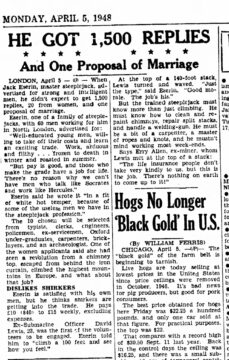
Watch more scenes of vintage steeplejacks — and jills — at work in a British Pathé “Nerves of Steel” playlist here.
Related Content:
Watch 85,000 Historic Newsreel Films from British Pathé Free Online (1910–2008)
Ayun Halliday is an author, illustrator, theater maker and Chief Primatologist of the East Village Inky zine. She’s had a terrible fear of heights since a near miss in the Trogir Bell Tower some 14 years ago. Follow her @AyunHalliday.
Read More...A Short Animation Explores the Nature of Creativity & Invention, with Characters That Look Like Andrei Tarkovsky & Sergei Eisenstein
A gentleman goes to the movies, only to find a marquee full of retreads, reboots, sequels, and prequels. He demands to know why no one makes original films anymore, a reasonable question people often ask. But it seems he has run directly into a graduate student in critical theory behind the glass. The ticket-seller rattles off a theory of unoriginality that is difficult to refute but also, it turns out, only a word-for-word recitation of the Wikipedia page on “Plagiarism.”
This is one of the ironies in “Allergy to Originality” every English teacher will appreciate. In the short, animated New York Times Op-Doc by Drew Christie, an official Sundance selection in 2014, “two men discuss whether anything is truly original — especially in movies and books,” notes the Times. The question leads us to consider what we might mean by originality when every work is built from pieces of others. “In creating this Op-Doc animation,” Christie writes, “I copied well-known images and photographs, retraced innumerable drawings, then photocopied them as a way to underscore the un-originality of the entire process.”
From William Burroughs’ cut-ups to Roland Barthes’ “The Death of the Author,” moderns have only been re-discovering what ancients accepted with a shrug — no one can take credit for a story, not even the author. Barthes argued that “literature is precisely the invention of this voice, to which we cannot assign a specific origin: literature is that neuter, that composite, that oblique into which every subject escapes, the trap where all identity is lost, beginning with the very identity of the body that writes.”
In Christie’s short, the smartass theater employee continues quoting sources, now from the “Originality” Wikipedia, now from Mark Twain, who had many things to say about originality. Twain once wrote to Helen Keller, for example, outraged that she had been accused of plagiarism. He came to her defense with an earnest conviction: “The kernel, the soul—let us go further and say the substance, the bulk, the actual and valuable material of all human utterance — is plagiarism.”
Postmodern sophistry from Mark Twain? Maybe. We haven’t had much opportunity to verbally spar in public like this lately, unmasked and in search of entertainment in a public square. If you find yourself exasperated with the streaming choices on offer, if the books you’re reading all start to feel too familiar, consider the infinite number of creative possibilities inherent in the art of quotation — and remember that we’re always repeating, replaying, and remixing what came before, whether or not we cite our sources.
Related Content:
Everything is a Remix: A Video Series Exploring the Sources of Creativity
Malcolm McLaren: The Quest for Authentic Creativity
Where Do Great Ideas Come From? Neil Gaiman Explains
Josh Jones is a writer and musician based in Durham, NC. Follow him at @jdmagness
Read More...Affinities, a Book of Images to Celebrate 10 Years of The Public Domain Review

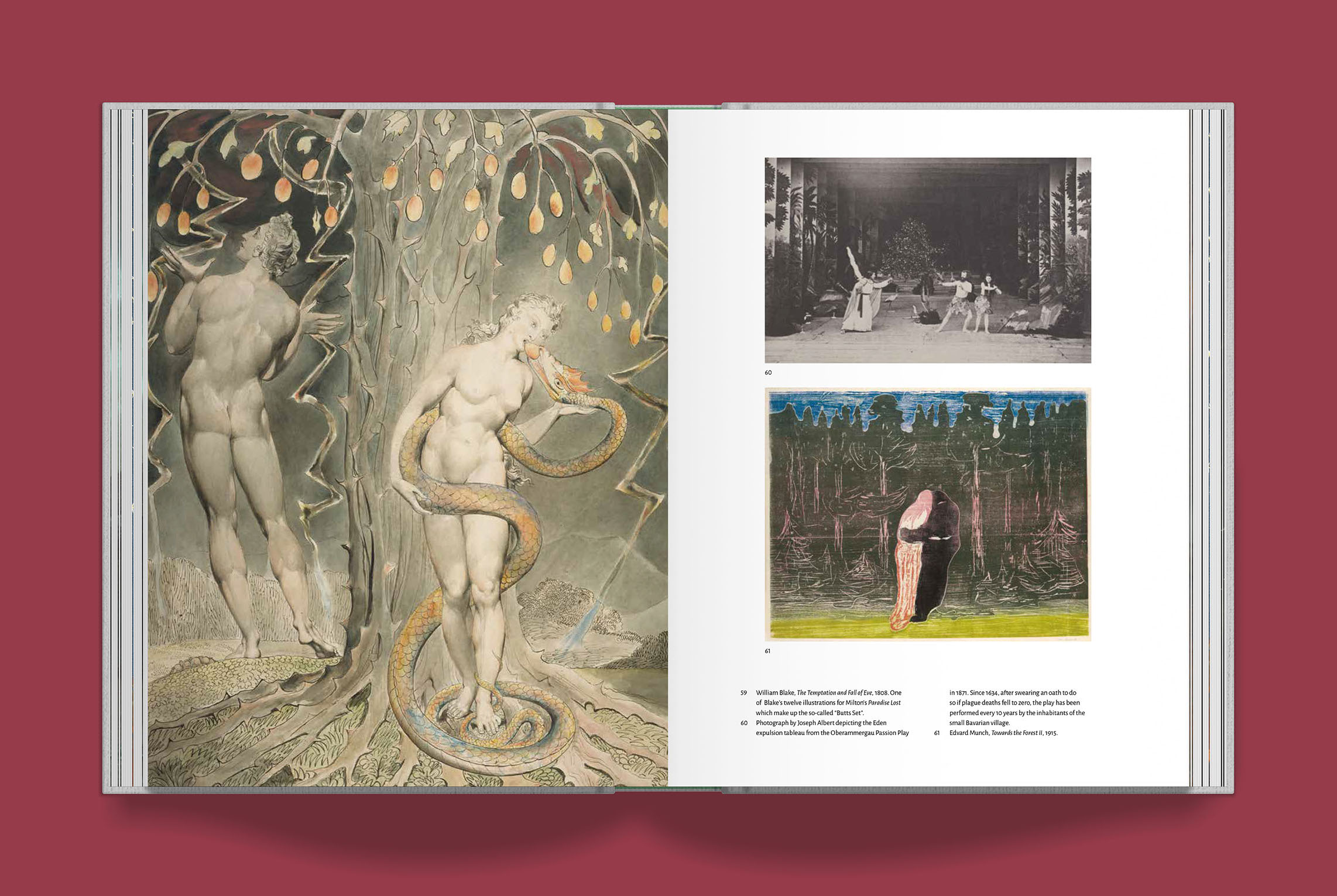
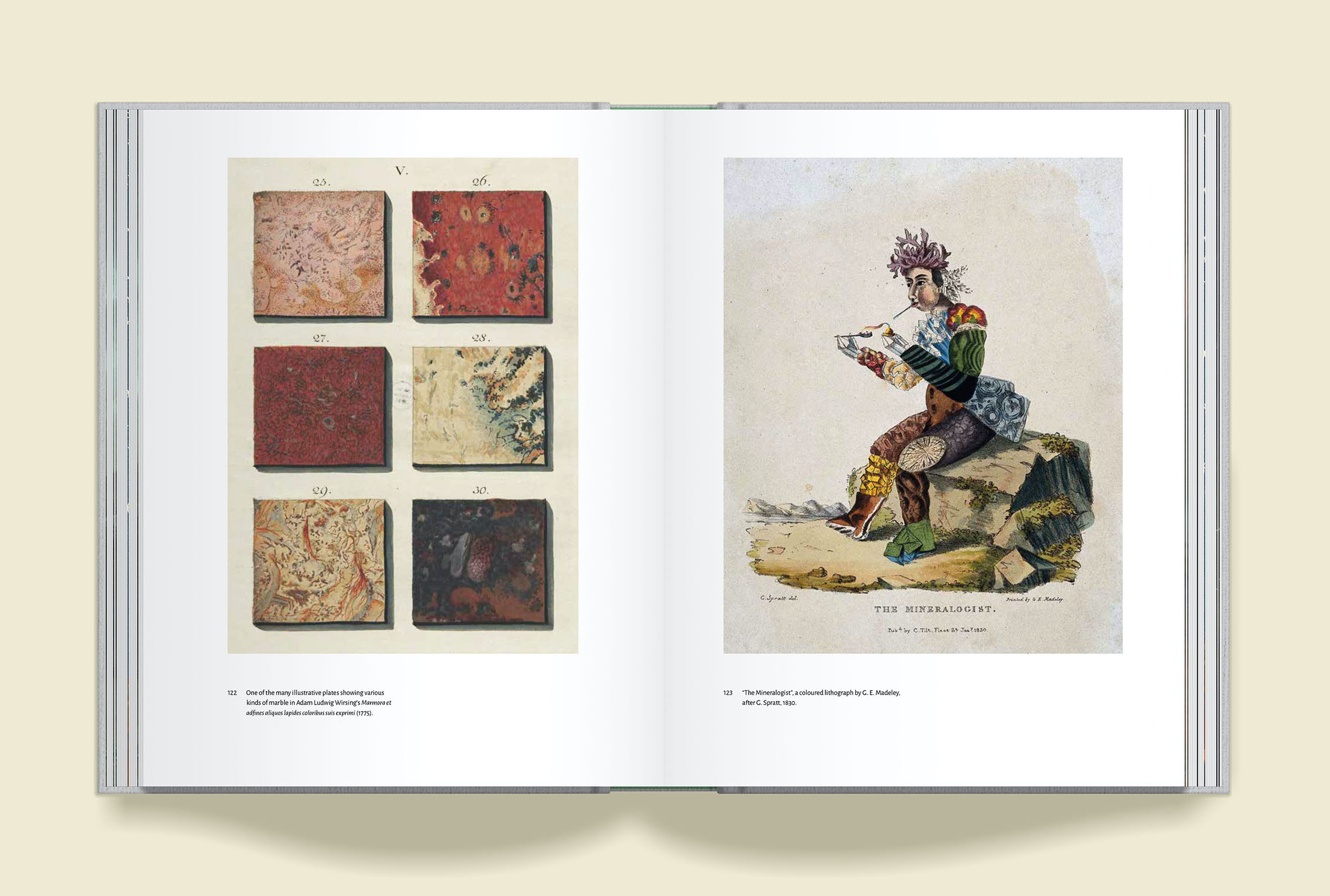
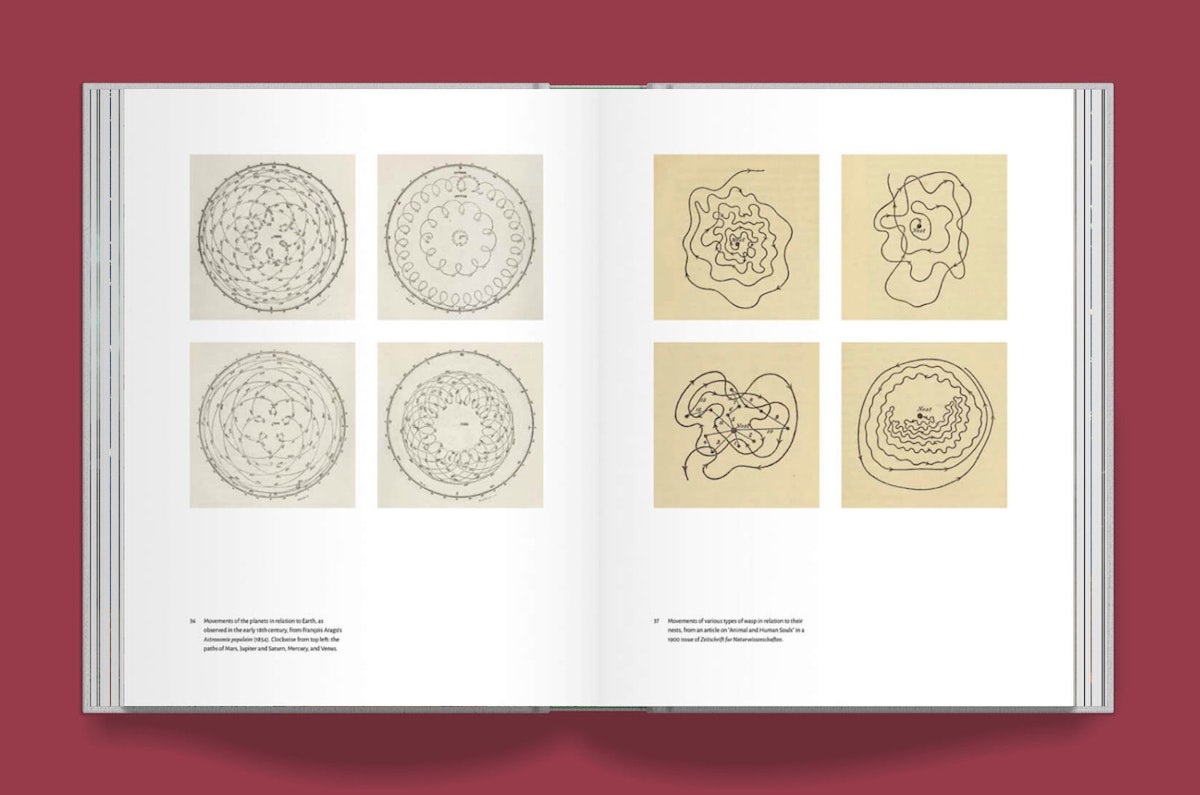
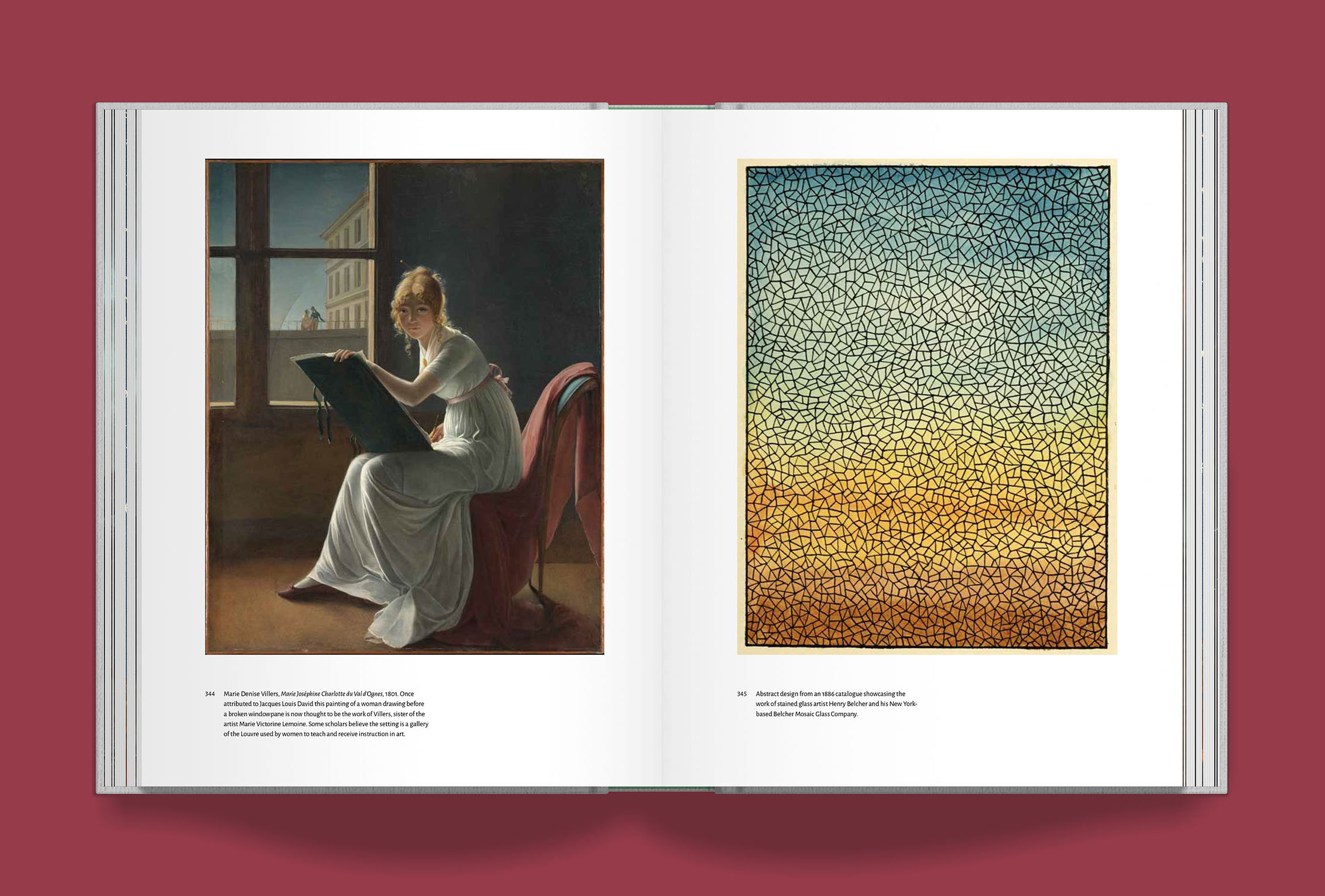
In a similar way to how Open Culture aims to distill in one place the web’s high-quality free cultural and educational media, so The Public Domain Review aims to help readers explore the vast (and sometimes overwhelming!) sea of public domain works available online — like a small exhibition gallery at the entrance to an immense network of archives and storage rooms that lie beyond. Celebrating curious and beautiful public domain images is at the very heart of what we do, and so it seemed fitting to mark our 10th anniversary with a big and beautiful book of images. Ever since the project began back in 2011, readers have implored us to do one, and so finally here it is… we are extremely excited to bring out into the world AFFINITIES.
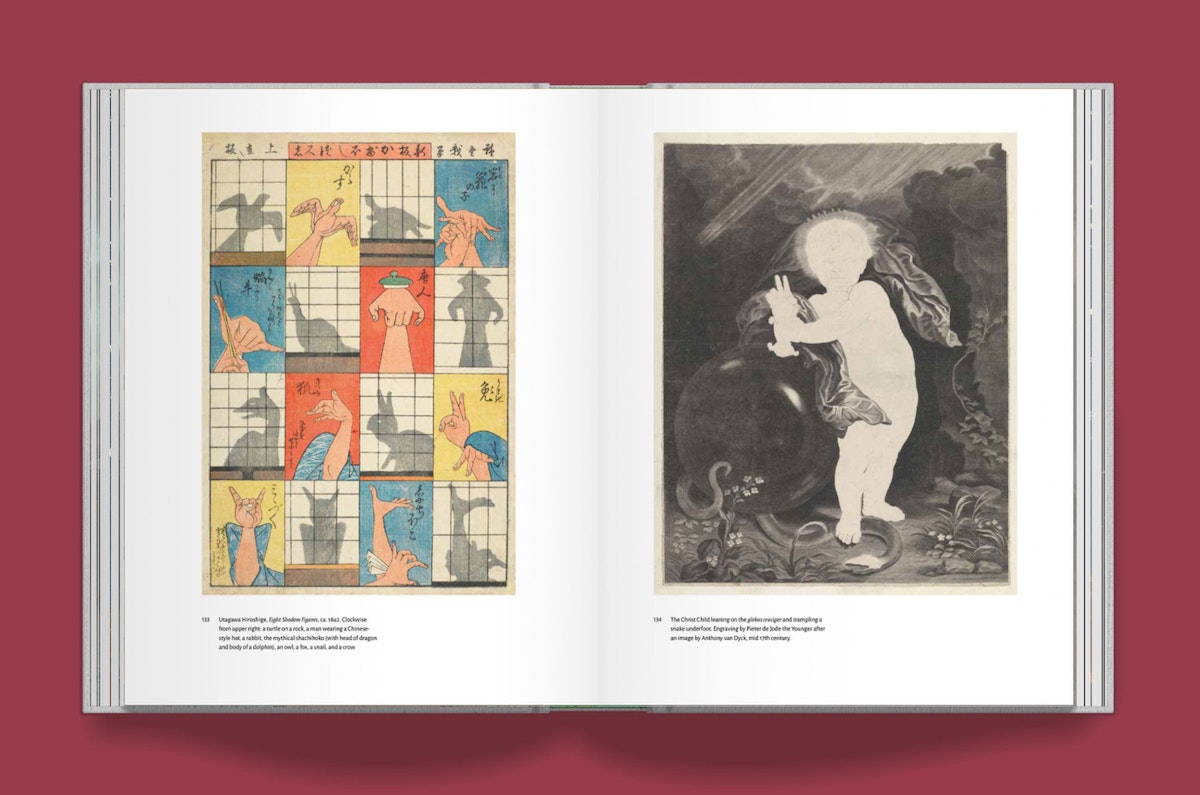
Gathering over 500 prints, paintings, illustrations, sketches, photographs, doodles, and everything in between, the book is a carefully curated journey exploring echoes and connections across more than two millennia of visual culture. Assembled according to a dreamlike logic, the images unfurl in a single unbroken sequence, through a play of visual echoes and evolving thematic threads.
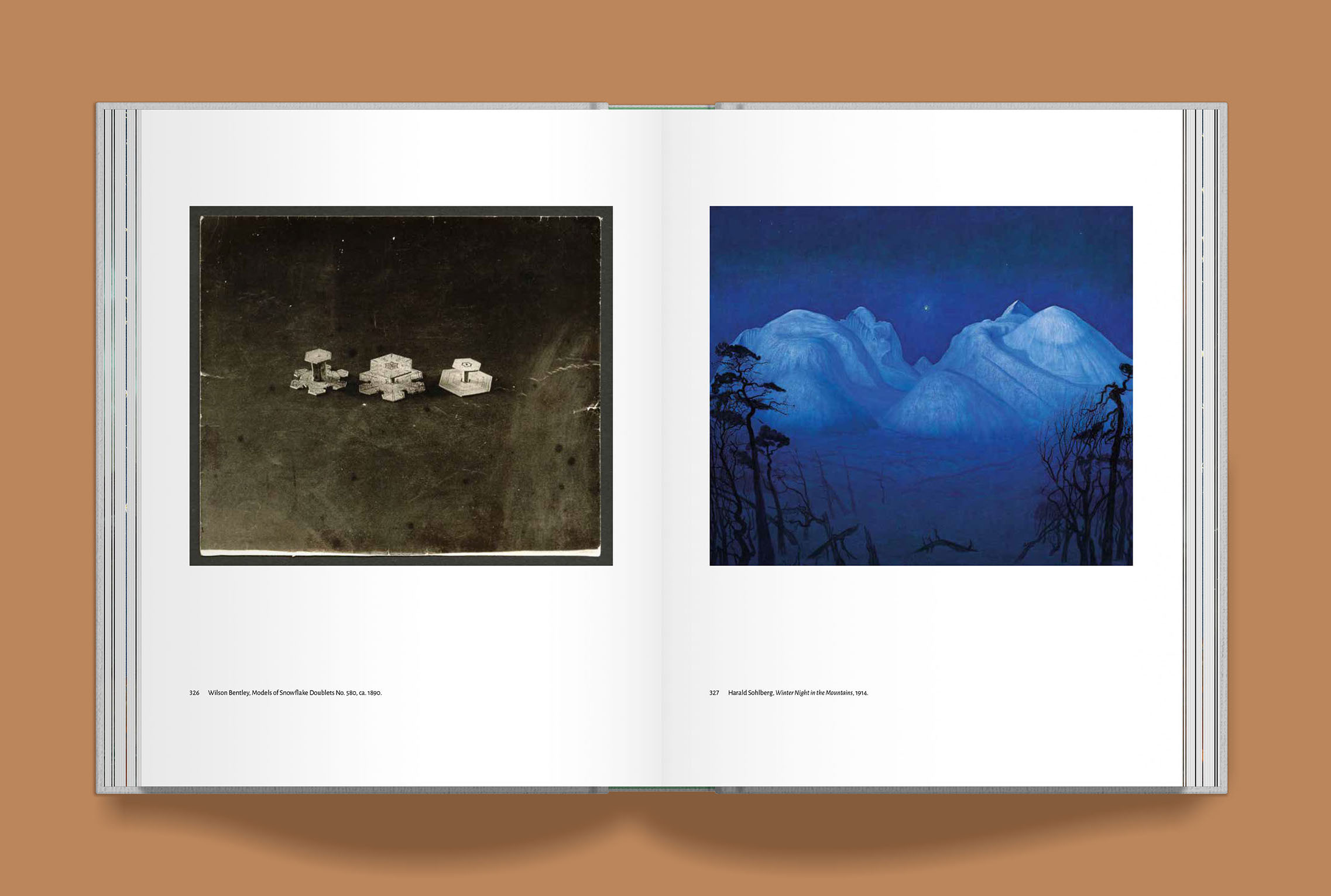
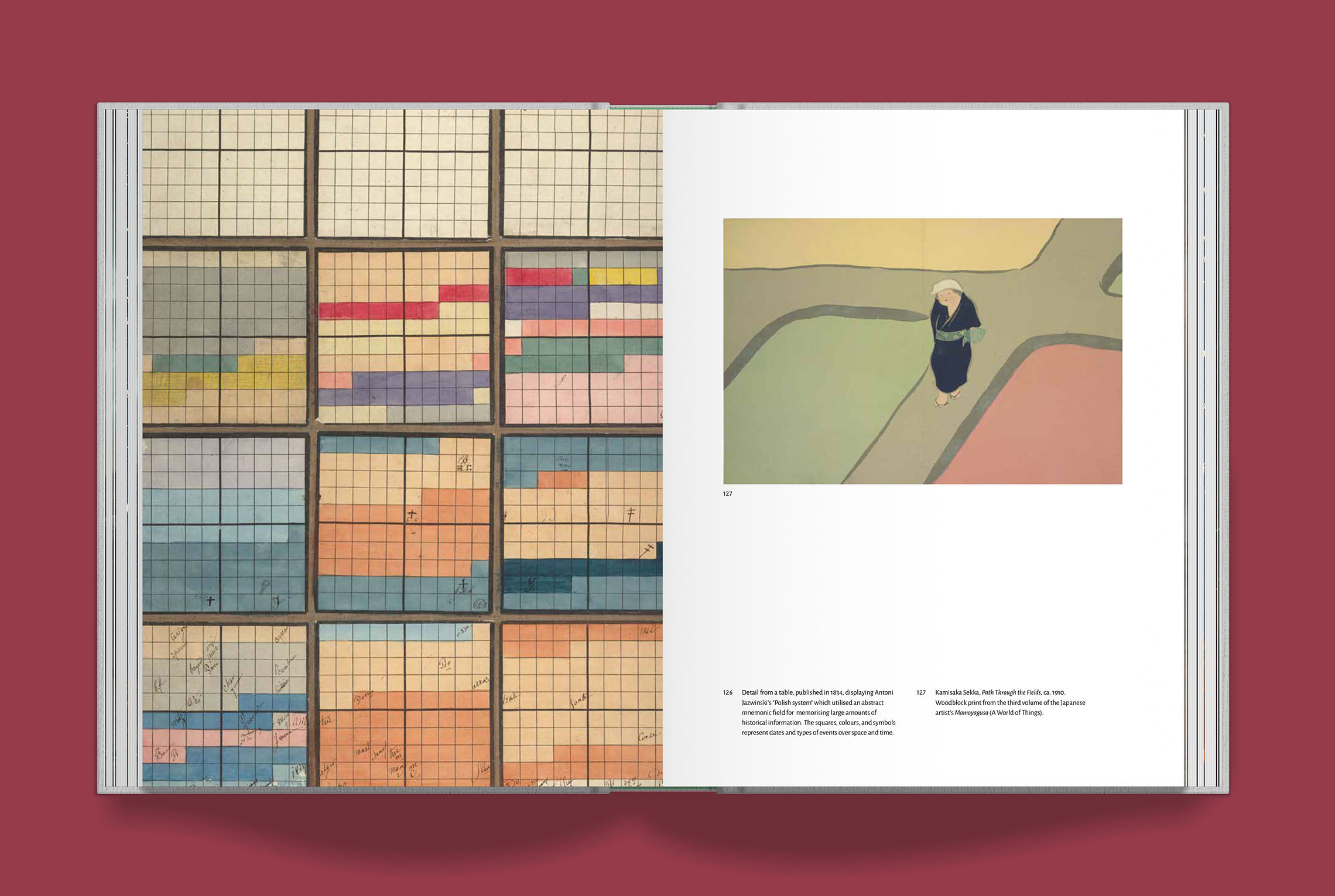
While it’s taken the best part of a year to create (a true lockdown baby), this has really been 10 years in the making — a book born from a decade of deep immersion in public domain archives.
A compelling object and experience in its own right, Affinities also acts as a launchpad for further discoveries and inventive engagements with the commons. It’s meticulous sourcing points to works, creators, and collections around the world, serving as a gateway for future forays into the digital public domain.
As for the physical book itself, we wanted to create an object as stunning as the images within. It is large format (28 x 21.5cm / 11 x 8.5”), boasts a cloth-bound hardcover, with a foil stamped title and embossed inset image, and extends across a whopping 368 pages. To help get this beauty made and assure the highest quality production, we are very happy to have teamed up with specialist art book publisher Volume, an imprint of Thames & Hudson.
It’s being sold via a crowdfunder and delivery will be early next year. In addition to the standard edition of the book, we’ve worked with Volume to create a special Collector’s Edition (in a slipcase with limited edition poster) and also a set of limited edition prints. All of the offerings are only available during the campaign.
Learn more, and order your copy, over on the crowdfunder page.

Adam Green is co-founder, creator, and main editor of The Public Domain Review and PDR Press.
Read More...Has TV Rotted Our Minds? On Neil Postman’s Amusing Ourselves to Death (A Pretty Much Pop Culture Podcast/Partially Examined Life Philosophy Podcast Crossover)
Marshall McLuhan famously said “The medium is the message,” by which he meant that when we receive information, its effect on us is determined as much by the form of that information as by the actual content.
Neil Postman, in his 1985 book Amusing Ourselves to Death: Public Discourse in the Age of Show Business, ran with this idea, arguing that TV has conditioned us to expect that everything must be entertaining, and that this has had a disastrous effect on news, politics, education, and thinking in general.
In this discussion, your Pretty Much Pop hosts Mark Linsenmayer and Brian Hirt join with the rest of the Partially Examined Life crew: Seth Paskin, Dylan Casey and Wes Alwan.
The result is much more philosophical context than you’d get in a typical Pretty Much Pop discussion. Plato, for example, argued (through the character of Socrates) in the Phaedrus against writing, which he said amounts to off-loading thought to this inert thing, when it should be lively in our minds and our direct conversations. Postman’s book describes the Age of Print as highly congenial toward lengthy, abstract reasoning. High literacy rates, particularly in America, conditioned people to expect that this is how information is to be received, and as such they were, for instance, prepared to listen raptly to the Lincoln-Douglas debates in which the speakers provided lawyerly speeches that might span multiple hours.
Postman, an educational theorist, described television as not just providing a no-context experience whose high level of visual and auditory stimulation beats its spectators into thoughtless passivity, but that its popularity positively infects all the other communication channels available. Of course there is still in-person teaching, but television shortens attention spans such that teachers now feel the need to constantly entertain instead of forcing students to make the effort required to attend carefully to what they have to teach. Of course there are still books, but they are less read, and the competition of television for our time has changed the presentation within books so that they must be as immediately and consistently appealing as television.
McLuhan described television as a “hot” medium due to its high level of stimulation, where a “cool” one like a textbook requires more active participation of the recipient. We discuss how Postman’s critique fares in the Age of the Internet, which interestingly mixes things up, with more interactivity (in that sense cooler) yet even more possibility for sensory distraction (in that perhaps more important sense hotter). To supplement Postman, we also consulted a widely read article from The Atlantic written by Nicholas Carr in 2008 called “Is Google Making Us Stupid.”
For more philosophical touchpoints, see the post for this discussion at partiallyexaminedlife.com.
Hear more Pretty Much Pop at prettymuchpop.com. This episode includes an equally long second part that you can access by supporting Pretty Much Pop at patreon.com/prettymuchpop or by supporting The Partially Examined Life at partiallyexaminedlife.com/support. Listen to a preview of part two.
Pretty Much Pop: A Culture Podcast is the first podcast curated by Open Culture. Browse all Pretty Much Pop posts.
Read More...Watch 400+ Documentaries from German Broadcaster Deutsche Welle: Art Forgery, Fashion Photography, the Mona Lisa, and More
You’re certainly familiar with Nouvelle Vague, the “French new wave” that shook up world cinema in the mid-2oth century. You’ve probably also heard of Hallyu, the “Korean wave” of pop music and television dramas (and, increasingly, films) now crashing across not just Asia but the West. As for Deutsche Welle, literally the “German wave,” you may know the term better in its abbreviated form: DW, the brand of Germany’s public international broadcaster. Here on Open Culture we’ve previously featured DW’s series Bauhaus World, a celebration of that influential German school of art, architecture, and design, but it’s just one of 415 documentaries free to watch on the DW Documentary Youtube channel.
DW’s documentarians have a thoroughly international mandate, as evidenced by their popular examinations of the dictatorial regime of North Korea, Bulgaria’s Roma marriage market, extravagant wealth in central Africa, and dire poverty in the United States. You can also browse the archive through themed playlists ranging from politics and economics to human nature and society to culture and arts.
That last section, no doubt of particular interest to Open Culture readers, demonstrates DW’s advantage as a long-standing broadcaster situated in the heart of Europe. Where better to start learning about Gothic and Romanesque cathedrals, top electronic dance music DJs, Martin Luther and the Reformation, or the truth behind the Last Supper and the Mona Lisa?
Even more interest lies in DW’s explorations of lesser-known topics like the treasures of Turkmenistan, fakery in the art world, and Berlin’s Little Hanoi. There are also profiles of such German figures as Peter Lindbergh, the late fashion and advertising photographer counted as an inspiration by the likes of Wim Wenders, and Klaus-Dieter Lehmann, outgoing president of the Goethe-Institut, a natural subject for DW to cover. Founded within a couple of years of one another, both DW and the Goethe-Institut take the promotion of German culture abroad as a large part of their mission — and both do so in the knowledge that, to get other societies interested in your culture, you’ve got to show genuine interest in all of theirs as well. Explore the complete list of DW documentaries here. And find more documentaries online in our collection, 4,000+ Free Movies Online: Great Classics, Indies, Noir, Westerns, Documentaries & More.
Related Content:
Watch 3,000+ Films Free Online from the National Film Board of Canada
285 Free Documentaries Online
Based in Seoul, Colin Marshall writes and broadcasts on cities, language, and culture. His projects include the Substack newsletter Books on Cities, the book The Stateless City: a Walk through 21st-Century Los Angeles and the video series The City in Cinema. Follow him on Twitter at @colinmarshall or on Facebook.
Read More...What Makes Ringo Starr a Great Drummer: Demonstrations from a German Teenager & Ringo Himself
The question of whether or not Ringo Starr is a great rock drummer — maybe one of the greatest– seems more or less settled among drummers. “From the simplistic heavy-hitting of Dave Grohl, to the progressive mind bending of Mike Portnoy, and way beyond,” writes Stuart Williams at Music Radar, “all roads lead back to Ringo.” Not only is Ringo “your favorite drummer’s favorite drummer,” but when he took the stage in 1964 on The Ed Sullivan Show, “you’d be hard-pushed to find another moment where one drummer inspired an entire generation of kids and teenagers to pick up a pair of sticks and beg their parents to buy them a kit.”
There was little precedent for what he did in rock drumming even in the band’s earliest years. Ringo helped change “the role of the drums from an orthodox, military and jazz-led discipline into a more democratised art form. If there was a blueprint for what drummers ‘did’ in rock ’n’ roll, Ringo’s approach widened it,” adds Music Radar. Much of his expansive vocabulary was accidental, at least at first, a product of what Beatles biographer Bob Spitz calls a childhood beset by “a Dickensian chronicle of misfortune.”
Like many a groundbreaking musician, Ringo played at what might be considered a physical disadvantage. He learned the drums in “the hospital band,” he once said, while convalescing from tuberculosis. “My grandparents gave me a mandolin and a banjo, but I didn’t want them. My grandfather gave me a harmonica… we had a piano — nothing. Only the drums.” Like Hendrix, he was a lefty forced to adapt to a right-handed version of the instrument, thus enlarging what right- (and left) handed drummers thought could be done with it.
As German drummer Sina demonstrates at the top of the post, Ringo’s unique style involves a great deal of subtlety, “tone, taste, musicality, and that left-handed drummer on a right-handed kit reverse-fell tom-tom work,” writes Boing Boing. We’ve previously featured Sina in a post in which great drummers pay tribute to Ringo. The daughter of a musician in German Beatles tribute band the Silver Beatles, she shows off an unimpeachable grasp of Starr’s signature moves.
In the clip above, Ringo himself demonstrates his technique on “Ticket to Ride,” “Come Together,” and his highest-charting solo single “Back Off Boogaloo.” In explaining how he employed his most highly praised talent — playing exactly what the song needed and no more — he shows how the drum pattern in the Abbey Road opener came directly from John’s vocals and Paul’s bass line. In “Ticket to Ride,” he shows how he works from his shoulder, producing a downbeat that’s slightly ahead.
Where do Ringo’s quirks come from, according to Ringo? “It has to do with swing,” he deadpans, “or as we keep mentioning, medication.” More seriously, he explains above in an interview with Conan O’Brien, he “leads with his left,” a limitation that he turned into a musical legacy on his favorite Beatles drum moments and on everyone else’s.
via Boing Boing
Related Content:
How Can You Tell a Good Drummer from a Bad Drummer?: Ringo Starr as Case Study
Isolated Drum Tracks From Six of Rock’s Greatest: Bonham, Moon, Peart, Copeland, Grohl & Starr
Josh Jones is a writer and musician based in Durham, NC. Follow him at @jdmagness
Read More...Watch Colorized 1940s Footage of London after the Blitz: Scenes from Trafalgar Square, Piccadilly Circus, Buckingham Palace & More
“Regular features of the time: neatly swept-up piles of glass, litter of stone and splinters of flint, smell of escaping gas, knots of sightseers waiting at the cordons.”
– George Orwell
What was it like to live in London during and after the Blitz? George Orwell’s notebooks from the time contain a “fascinating account of everyday life in London during the Second World War,” full of journalistic detail, the British Library writes. In Orwell’s estimation, the city was riven with class divides. “Despite his criticism of Stalinism, Orwell remained a convinced socialist all his life.” He believed the war could only be won if it turned into a revolution. “When you see how the wealthy are still behaving, in what is manifestly developing into a revolutionary war,” he wrote in a diary entry that would become the 1941 essay The Lion and the Unicorn, “you think of St. Petersburg in 1916.”
Orwell may have been wrong about the revolution, but he reported honestly on much of what was happening in London. Meanwhile, the Ministry of Information produced a short propaganda film in 1940 for the American public called “London Can Take It.” The tone was in keeping with the “Keep Calm and Carry On” ethos we associate with Britain in the period. A companion film, “Britain Can Take It,” similarly sold the “illusion of social unity,” Craig Stewart Hunter writes, “created by the use of films and other media to portray positive morale.” (View many more British WWII propaganda films here.) These did not account for “growing disenchantment in urban areas, which found themselves ‘unable to take it,’ so to speak.”
Peter Watts writes in The Guardian about once-vibrant city blocks that were demolished by the firebombing, then later turned into parking garages. Many of these neighborhoods were then, in the 1960s, folded into massive estate housing projects with “high-rise towers nobody wanted to live in,” says Peter Larkham, professor of planning at Birmingham School of the Built Environment. Could London take it? It depended on which London one meant, in the long run. But during the war itself, there was perhaps more social cohesion than Orwell was willing to grant, given that something like one in every six Londoners suffered homelessness during the bombing campaign and over 40,000 civilians lost their lives.
The degree of Britain’s national unity during the war remains “a continuing historiographical debate,” writes Hunter, ever since” the generation of historians born after the war… have been able to write with more critical detachment.” And since most everyone alive then is no longer, ideas about what it felt like to be in London during WWII will change as historians view the source material differently over time.
But thanks to photography and film from the period, we’ll always have a fairly good idea of what London looked like during the war, though we’ll have to make do, until the AI “becomes more mature,” as the poster of the video compilation above notes, with inferior colorization techniques. (Yes, they know, the buses should be red.)
The various scenes have been motion-stabilized, slightly speed-corrected, enhanced and colorized by means of sophisticated Artificial Intelligence software.
The film shows remarkable scenes of bomb damage, close up filming of the release of barrage balloons, anti-aircraft gun positions, traffic at Trafalgar Square, Piccadilly Circus, military parades in front of Buckingham Palace, beautiful scenes of the Thames during daytime and at dusk, Waterloo Station, and much more.
Most of the film dates from late 1943, but some of the footage of Waterloo station and Piccadilly Circus comes from the late 1930s and it ends with a minute of VE day on 8 May 1945. All of the footage comes from the Prelinger Archives. Can we see national unity in the crowds of people going about their business amidst a city full of armaments and rubble? Is it visible to the naked eye? See timestamped descriptions of the location and action in each clip at the video’s YouTube page here.
Related Content:
WWII Britain Revisited in 120 Short Films, Now Free on the Web
Dramatic Color Footage Shows a Bombed-Out Berlin a Month After Germany’s WWII Defeat (1945)
The Oldest Known Footage of London (1890–1920) Features the City’s Great Landmarks
Josh Jones is a writer and musician based in Durham, NC. Follow him at @jdmagness
Read More...A Relaxing 3‑Hour Tour of Venice’s Canals
Experience Venice in this boat tour through 17 miles (27 km) of canals. “You will see the full Grand Canal going in both directions, navigate through the small canals and under bridges and see sites that you cannot see by walking.” It’s quiet, meditative, a mental escape from the tedium of quarantine life.
Right below, you can find a list of the stops along the way…
1:32 Constitution Bridge
2:02 The Grand Canal (Full Tour)
3:23 Santa Lucia Train Station
13:33 Rialto Bridge
23:28 Ponte dell’Accademia
30:38 Piazza San Marco
36:08 Small Inside Canals & Bridges
41:05 Libreria Acqua Alta
44:08 Campo Santi Giovanni e Paolo
47:16 Open Water — Skip ahead to the next section
57:25 Canal of Saint Peter
58:18 Building Bridges Sculpture
1:09:55 Bridge of Sighs
1:16:15 Rialto Bridge & Grand Canal
1:18:39 Small Inside Canals & Bridges
1:23:04 The Grand Canal
1:27:14 Pont dell’Accademia
1:34:44 Rialto Bridge
1:43:34 Ponte delle Guglie
1:46:04 Tre Archi Bridge
1:48:38 Liberty Bridge (Ponte della Libertà)
1:54:18 Constitution Bridge
1:58:38 Close Call!
2:04:43 Squero di San Trovaso (gondola boatyard)
2:07:23 Grand Canal (short section)
2:10:44 Small Canals and Bridges
2:17:14 Grand Canal (short section)
2:20:14 Magister Canova
2:22:04 Open Water
2:26:14 Small Inside Canals & Bridges
2:30:44 Piazza San Marco
2:33:04 The Grand Canal (Full Tour)
Related Content:
How Venice Works: 124 Islands, 183 Canals & 438 Bridges
Read More...Behold the 1940s Typewriter That Could Type in English, Chinese & Japanese: Watch More Than a Thousand Different Characters in Action
There was a time, not long after the widespread adoption of telegraphy in the 19th century, when the written Chinese language looked doomed. Or at least it did to certain thinkers considering the implications of that instant global communication-enabling technology having been developed for the relatively simple Latin alphabet. And as unsuited as the Chinese writing system must have seemed to the world of the telegraph, it would have presented a seemingly even heavier burden in the world of the typewriter.
Only in 1916, thanks to the efforts of a U.S.-educated Shanghai engineer named Hou-Kun Chow, did the Chinese typewriter debut, built around a large, revolving cylinder that could print 4,000 ideographic (that is to say, each one representing a different word or sound) characters. From that point the evolution of the Chinese typewriter was rather quick, by the standards of the day. And it didn’t only happen in China: Japan, whose own written language incorporates many ideographic Chinese characters, had been subject to more intense technological influence from the West since opening to foreign trade in the 1860s.
The very year after its founding in 1939, electronics-giant-to-be Toshiba (the product of a merger involving Japan’s first maker of telegraph equipment) produced the first Japanese cylindrical typewriter. “Mostly used by the Japanese military during World War II,” says the Vintage Typewriter Museum, it incorporated 630 characters. After the war “Toshiba introduced a new model, the 1200 A, featuring 1172 Japanese and Chinese characters.” In the video above, from Youtuber by the name of Typewriter Collector, you can see a slightly later model in action.
Produced before the introduction of “Western-style” keyboards, the Toshiba BW-2112 has the same interface as its predecessors: “The character is selected by rotating the cylinder and shifting it horizontally, so that the necessary character is selected with the index pointer,” according to the Vintage Typewriter Museum. “When the print key is depressed, the type strip is pushed upwards from the cylinder, and the type hammer swings to the center to print the character onto the paper.”
These vintage Japanese typewriters still today strike their viewers as marvels of engineering, though their then-vast store of characters (which included not just Chinese-derived kanji but phonetic kana and even the Latin alphabet) have long since been surpassed by digital technology. Now that every student’s smartphone puts all 50,000 or extant Chinese characters in their command — to say nothing of the world’s other written languages — it’s safe to say they’re not about to fall into disuse any time soon.
Related content:
The Enduring Analog Underworld of Gramercy Typewriter
When IBM Created a Typewriter to Record Dance Movements (1973)
Based in Seoul, Colin Marshall writes and broadcasts on cities, language, and culture. His projects include the Substack newsletter Books on Cities, the book The Stateless City: a Walk through 21st-Century Los Angeles and the video series The City in Cinema. Follow him on Twitter at @colinmarshall or on Facebook.
Read More...The Rolling Stones Jam with Muddy Waters for the First and Only Time at Chicago’s Legendary Checkerboard Lounge (1981)
Whatever marketing materials may claim, the Rolling Stones did not just happen upon Buddy Guy’s Checkerboard Lounge on Chicago’s South Side (before it closed, reopened in Hyde Park, then closed again for good) on a night when Muddy Waters happened to be there in 1981. And they did not spontaneously get invited to jam, as it seems, when they “climbed over tables” to get onstage with their hero and blues legends Buddy Guy and Junior Wells.
A chance meeting, of course, would have been magical, but the truth is the event was probably “planned and coordinated,” writes W. Scott Poole at Popmatters. These were the biggest names in the blues and rock and roll, after all. “Why,” before the Stones and their entourage arrive, “is there an empty table on the night Muddy Waters came back to Southside?”
And why did the Rolling Stones’ manager claim he “approached the Checkerboard higher-ups a week in advance,” Ted Scheinman writes at Slant, “proposing a surprise concert and proffering $500 as proof-of earnest”?
Was it a cynical ploy to re-establish the band’s blues cred during what would turn out to be the largest grossing tour of the year — one featuring what Jagger called “enormous images of a guitar, a car and a record — an Americana idea.” In some sense, Muddy Waters was also an “Americana idea,” but how could he be otherwise to the Stones, given that they’d grown up listening to him from across the Atlantic, associating him with experiences they had never known firsthand?
And so what if the historic meeting at the Checkerboard Lounge was stage-managed behind the scenes? That’s what managers do — they arrange things behind the scenes and let performers create the illusion of spontaneity, as though they hadn’t spent an entire tour, or decades of tours, making the same songs seem fresh on any given night. When it comes to the blues, playing the same songs over again is a key part of the game, seeing how much attitude and style one can wring out of a few chords, doggedly persistent themes of sex, love, death, betrayal, and maybe a bottleneck slide.
It’s a lesson the Stones learned well, and their adoration and respect for Muddy Waters is nothing less than genuine, even if it took some backstage negotiation to bring them together this one and only time. Muddy is spectacular. “Even as one of the aging elder statesmen of the Chicago blues in 1981,” writes Poole, “he exudes an aura of sex and power, showing off every attribute that so inspired Mick and Keith and that became an ineffable part of their own music and their persona.”
Meanwhile, the absolutely boyish glee on the faces of Jagger, Richards, Ronnie Wood, and Stones’ pianist Ian Stewart as they perform onstage with an artist who had given them so much more than just their name speaks for itself. The concert video and live album “began appearing as bootleg and unofficial releases almost immediately,” Allmusic notes, “from LP and CD to VHS and DVD.” Here, you can see them jam out three songs from the night: “Baby Please Don’t Go” (on which Waters brings Jagger onstage at 5:30 for an extended version and Keith joins at 6:50), “Mannish Boy,” and “Hoochie Coochie Man.”
Related Content:
10-Story High Mural of Muddy Waters Goes Up in Chicago
The Rolling Stones Release a Long Lost Track Featuring Led Zeppelin’s Jimmy Page
Josh Jones is a writer and musician based in Durham, NC. Follow him at @jdmagness
Read More...Support Us
We're hoping to rely on loyal readers, rather than erratic ads. Please click the Donate button and support Open Culture. You can use Paypal, Venmo, Patreon, even Crypto! We thank you!

About Us

Open Culture scours the web for the best educational media. We find the free courses and audio books you need, the language lessons & educational videos you want, and plenty of enlightenment in between.
Advertise With Us
FREE UPDATES!
GET OUR DAILY EMAIL
Get the best cultural and educational resources on the web curated for you in a daily email. We never spam. Unsubscribe at any time.
FOLLOW ON SOCIAL MEDIA
Open Culture editor Dan Colman scours the web for the best educational media. He finds the free courses and audio books you need, the language lessons & movies you want, and plenty of enlightenment in between.
Advertise With Us

