Keith Richards Demonstrates His Famous 5‑String Technique (Used on Classic Stones Songs Like “Start Me Up,” “Honky Tonk Women” & More)
For the guitarist, alternate tunings expand the sonic possibilities of the instrument. But where, say, a progressive metal player will add a seventh or eighth string, pitch everything down, and get technical, the opposite is the case with “open” tunings in folk and blues. They are an ideal basis for slide guitar and three-chord, 12-bar vamps, and became the perfect platform for Keith Richards, giving him the room he needed to translate the music of his folk heroes into the gritty, distorted rock and roll of the Stones.
Feeling like he had gone as far as he could in standard tuning, Richards first turned to an open D on the band’s 1968 return to roots, Beggars Banquet and non-album single “Jumpin’ Jack Flash.” In his autobiography, Life, he describes how he moved to open G from a desire to imitate the five-string banjo: “With the five-string it was just like turning a page; there’s another story. And I’m still exploring. With five strings you can be sparse; that’s your frame, that’s what you work on. ‘Start Me Up,’ ‘Can’t You Hear Me Knocking,’ ‘Honky Tonk Women,’ all leave gaps between the chords.”
As Keef tells it, the great Ry Cooder — who plays on Let it Bleed and Sticky Fingers — first introduced him to five-string open G tuning in the 60s, thirty years before curating Cuban music for the world on Buena Vista Social Club. Cooder “had the tunings down. He had the open G,” Richards writes:
The advantage (of the open‑G tuning) is that you can get certain drone notes going. It’s an open‑G tuning, with the low E‑string removed and there’s really only three notes you use. My favorite phrase about this style of playing is that all you need to play it is five strings, two notes, two fingers and one assh*le.
Doing an impression of a mean Ike Turner, Richards demonstrates “that five-string sh*t” above on a beat-up Martin acoustic at the top of the post. Guitarists who cover the Stones in standard tunings “know something’s wrong, that an element is amiss,” writes George Rajna at Huffington Post. “Altering to Keith’s open ‘G’ tuning makes songs such as ‘Can’t You Hear Me Knocking’ simple to play.”
Open G can also help players break out of a six-string rut. As Keith says, when he “found the five-string, it was like discovering a new instrument.” Cooder, it seems wasn’t very happy about Richards taking his licks, calling the Stones “bloodsuckers” in a 70s Rolling Stone interview. But as far as Keef is concerned, it seems, everything’s fair game, and “if it’s in the bones, it’s in the bones,” he writes.
Related Content:
The Rolling Stones Release a Long Lost Track Featuring Led Zeppelin’s Jimmy Page
Josh Jones is a writer and musician based in Durham, NC. Follow him at @jdmagness
Read More...Kermit the Frog Gives a TED Talk About Creativity & the Power of “Ridiculous Optimism”
In 2015, 3.8 billion years after “creativity emerged” out of “sheerest emptiness,” Kermit the Frog was tapped to give a talk on creativity at TEDxJackson.
How did a local, one-day event manage to snag such a global icon?
Roots.
The famed frog’s creator, Jim Henson, spent his first decade in Mississippi (though Kermit was born of a ping pong ball and Henson’s mother’s old coat after the family relocated to Maryland.)
The conference took place 15 years after Henson’s untimely death, leaving Kermit to be animated by Steven Whitmire, the first of two puppeteers to tackle a role widely understood to be Henson’s alter ego.
The voice isn’t quite the same, but the mannerisms are, including the throat clearing and crumpled facial expressions.
Also present are a number of TED Talk tropes, the smart phone prompts, the dark stage, projections designed to emphasize profound points.
A number of jokes fail to elicit the expected laughs … we’ll leave it up to you to determine whether the fault lays with the live audience or the material. (It’s not easy being green and working blue comes with challenges, too.)
Were he to give his TED Talk now, in 2021, Kermit probably wouldn’t describe the audience’s collective decision to “accept a premise, suspend our disbelief and just enjoy the ride” as a “conspiracy of craziness.”
He might bypass a binary quote like “If necessity is the mother of invention, then creativity is the father.”
He’d also be advised to steer clear of a photo of Miss Piggy dressed as a geisha, and secure her consent to share some of the racier anecdotes… even though she is a known attention hog.
He would “transcend and include” in the words of philosopher Ken Wilber, one of many inspirations he cites over the course of his 23-minute consideration of creativity and its origins, attempting to answer the question, “Why are we here?”
Also referenced: Michelangelo, Albert Einstein, Salvador Dali, Charles Baudelaire, Zen master Shunryū Suzuki, mathematician Alfred North Whitehead, author and educator, Sir Ken Robinson (who appears, briefly) and of course, Henson, who applauded the “ridiculous optimism” of flinging oneself into creative explorations, unsure of what one might find.
He can’t wander freely about the stage, but he does share some stirring thoughts on collaboration, mentors, and the importance of maintaining “beginner’s mind,” free of pre-conceptions.
How to cultivate beginner’s mind?
Try fast forwarding to the 11:11 mark. Watch for 20 seconds. It’s the purest invitation to believe since Peter Pan begged us to clap Tinker Bell back to life.
Do you? Because Kermit believes in you.
Related Content:
Witness the Birth of Kermit the Frog in Jim Henson’s Live TV Show, Sam and Friends (1955)
Ayun Halliday is an author, illustrator, theater maker and Chief Primatologist of the East Village Inky zine. Follow her @AyunHalliday.
Read More...How the Internet Archive Has Digitized More than 250,000 78 R.P.M. Records: See the Painstaking Process Up-Close
At the Internet Archive, this is how we digitize #78 rpm records.
Our partner @georgeblood_lp has perfected this technique, digitizing with 4 different styli at once.We put as much effort into capturing the #metadata as we do digitizing the music. pic.twitter.com/dn4EjXTS9z
— Internet Archive (@internetarchive) April 25, 2021
In the history of recorded music, no medium has demonstrated quite the staying power of the phonograph record. Hearing those words, most of us envision a twelve-inch disc designed to play at 33 1⁄3 revolutions per minute, the kind still manufactured today. But like every other form of technology, that familiar vinyl LP didn’t appear ex nihilo: on its introduction in 1948, it was the latest in a series of phonograph records of different sizes and speeds. The first dominant record format spun at 78 r.p.m., a speed standardized in the mid-1920s, though the discs themselves (made of rubber, shellac, or other pre-vinyl materials) had been in production since the end of the 19th century and remained in production until the 1950s.
The half-century of the “78” adds up to quite a lot of music, most of which has long been inaccessible to non-antiquarians. Enter the historically minded technologists of the Internet Archive, who since 2016 have been working with media preservation company George Blood LP to digitize, preserve, and make available, as of this writing, more than 250,000 such records.
The process involves much more than playing them all into a computer, due not least to the toll the past century or so has taken on the discs’ surfaces. “Each record is cleaned on a machine that sprays distilled water onto its surface,” writes The Verge’s Kait Sanchez. “A little vacuum arm then sucks up the water, along with whatever dirt and nastiness has built up in the record’s grooves.”
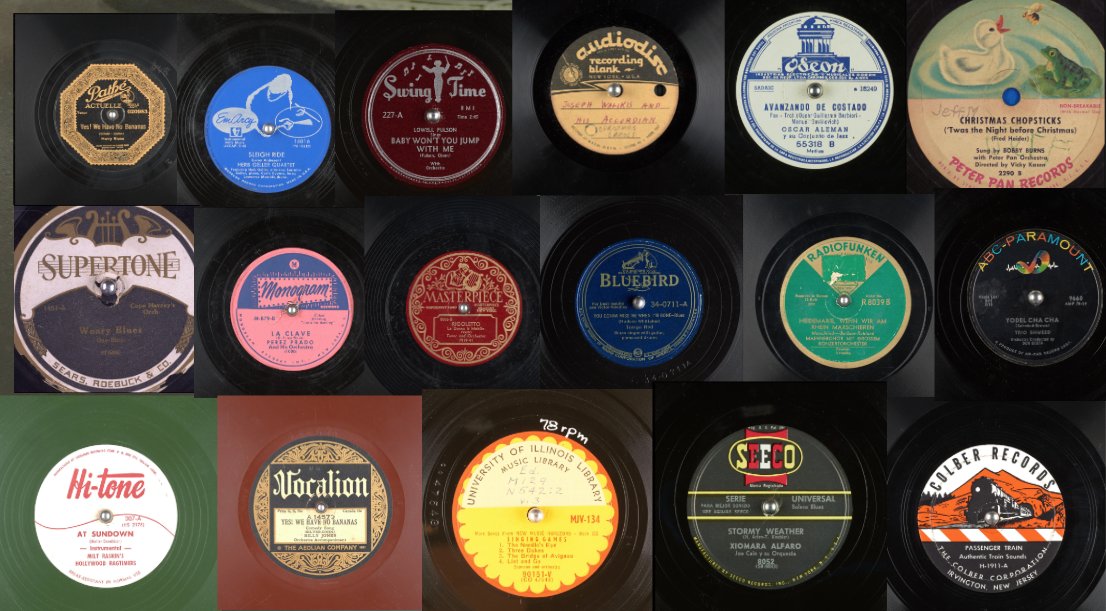
“The discs are then photographed, and the photos are referenced to pull info from the discs’ labels and add it to the archive’s database by hand.” There follows the actual digitization, which records each disc with four styli at once: since 78s never had standardized groove sizes, “recordings taken with various stylus tips will each sound slightly different,” but for any record in the George Blood Collection the listener can choose which of the four they’d prefer to listen through. You can see each step of the process in the video at the top of the post, part of a Twitter thread recently posted by the Internet Archive. There the Archive notes that, “after scanning 250,000 sides, we’ve found 80% of these 78s were produced by the ‘Big Five’ labels” — Columbia, RCA Victor, Decca, Capitol and Mercury — “but along the way, we’ve uncovered 1700 other music labels and some pretty beautiful picture discs.”
You can look at — and more to the point, listen to — everything in the the George Blood Collection here, which is a subset of the Internet Archive’s larger collection of digitized 78 records as well as the cylinders that 78s wholly displaced as a consumer format. As the Internet Archive’s Twitter thread reminds us, “from 1898–1950, this was THE way music was recorded & shared.” In other words, if your parents were listening to music in that period — or maybe your grandparents, great-grandparents, or great-great grandparents — 78s were their MP3s, their Spotify, their Youtube. We descend as listeners from enthusiastic buyers of 78s, and now, thanks to the Internet Archive and its collaborators, we can enjoy a large and ever-increasing proportion of their entire world of recorded music for free.
Related Content:
The Boston Public Library Will Digitize & Put Online 200,000+ Vintage Records
The Groundbreaking Art of Alex Steinweiss, Father of Record Cover Design
How the Internet Archive Digitizes 3,500 Books a Day–the Hard Way, One Page at a Time
Based in Seoul, Colin Marshall writes and broadcasts on cities, language, and culture. His projects include the Substack newsletter Books on Cities, the book The Stateless City: a Walk through 21st-Century Los Angeles and the video series The City in Cinema. Follow him on Twitter at @colinmarshall or on Facebook.
Read More...Hear the First Japanese Visitor to the United States & Europe Describe Life in the West (1860–1862)
“Oh, would some Power give us the gift / To see ourselves as others see us!” wrote poet Robert Burns. “It would from many a blunder free us, And foolish notion.” I cannot vouch for a being blunder-free, but reading historical accounts of our nation from foreign visitors does help to increase our worldly perspective, and hopefully question what often we take for granted. The 19th century was a particularly ripe time for the narratives, as oceanic commerce (and on its tail tourism) was making the world smaller than ever before.
The YouTube channel Voices of the Past has been bringing a lot of these stories to life over the last few years, with new translations of foreign texts, dramatic readings, and thoughtful image presentations to reveal the world to us as new and wondrous as it was to the original writers. The video above and the one below take us on trips to the United States and Great Britain by some of the first ever Japanese travelers to step onto Western soil.
For over 200 years, 1600 — 1868, Japan had remained isolated from much of the world, a time known as the Edo Period (named after the capitol) or the Tokugawa Period (named after the shogunate). Within this hothouse, it developed much of the traditional culture that we know today—the tea ceremony, haiku, woodblock prints—and the capital Edo (now Tokyo) grew from a fishing village to a major city. When Commodore Matthew C. Perry landed in 1853 to get Japan to open up to trading, the country knew its time in isolation was at an end. The technology they saw on the American ships was advanced enough they knew they’d have to catch up or be dominated.
Both videos concern Fukuzawa Yukichi, one of the founders of modern Japan. An author, journalist, founder of Keio University, and creator of the first English-Japanese dictionary, he was also a main proponent of modern reform. (He’s also the face on Japan’s 10,000 yen note).
In Fukuzawa’s retelling, you can hear how his encounters with Dutch and English tradesmen made him insatiably curious to learn the language he could not understand. After the Japanese government bought a ship from the Dutch, naming it the Kanrin Maru, Fukuzawa and a crew of 96 men (a minority being American), landed in San Francisco in 1860, the first Japanese diplomatic mission to America. Technically they did not stay in San Francisco, but in a naval hotel on Mare Island, 23 miles north east of the city. Fukuzawa takes note of the abundance of carpet and rugs in many of the official buildings—such fabric was so expensive in Japan that he had only seen it used as handbags and such—and the American desire to walk on it with their street shoes. Even more amazing: ice cubes. He also notes something that hasn’t changed since his time: the amount of waste in the streets, and the high cost of goods in California.
Fukuzawa likens his experience—warm hospitality mixed with his own embarrassment of an unfamiliarity with foreign mores—with the “shy, self-conscious blushing bride.”
The most important purchase Fukuzawa made on his trip was a Webster’s Dictionary, which would help him write his own English-Japanese version when he returned. Two years after his American trip, he once again set out on a diplomatic mission, this time to Europe. He and his co-patriots would be away from Japan for a whole year, taking in France, the United Kingdom, the Netherlands, Prussia, Russia, and Portugal. This trip is different in its awareness of politics. Mention is made of Napoleon III (well admired) and the rise of Prussia. He is suitably baffled by Britain’s Parliament (as are most Americans these days watching it on CSPAN), but comes away with a strong conviction in independent thought and democracy that would begin to change Japan through his influence.
We have mentioned Voices of the Past previously, and you can find all sort of accounts of early international travelers. Fukuzawa’s accounts are some of the best, as his down-to-earth voice feels less foreign than the English speakers he meets.
Related Posts:
Adams Slaying Snakes & Other Fantastic Scenes
The Entire History of Japan in 9 Quirky Minutes
Ted Mills is a freelance writer on the arts who currently hosts the Notes from the Shed podcast and is the producer of KCRW’s Curious Coast. You can also follow him on Twitter at @tedmills, and/or watch his films here.
Read More...The Isolator: A 1925 Helmet Designed to Eliminate Distractions & Increase Productivity (Created by SciFi Pioneer Hugo Gernsback)
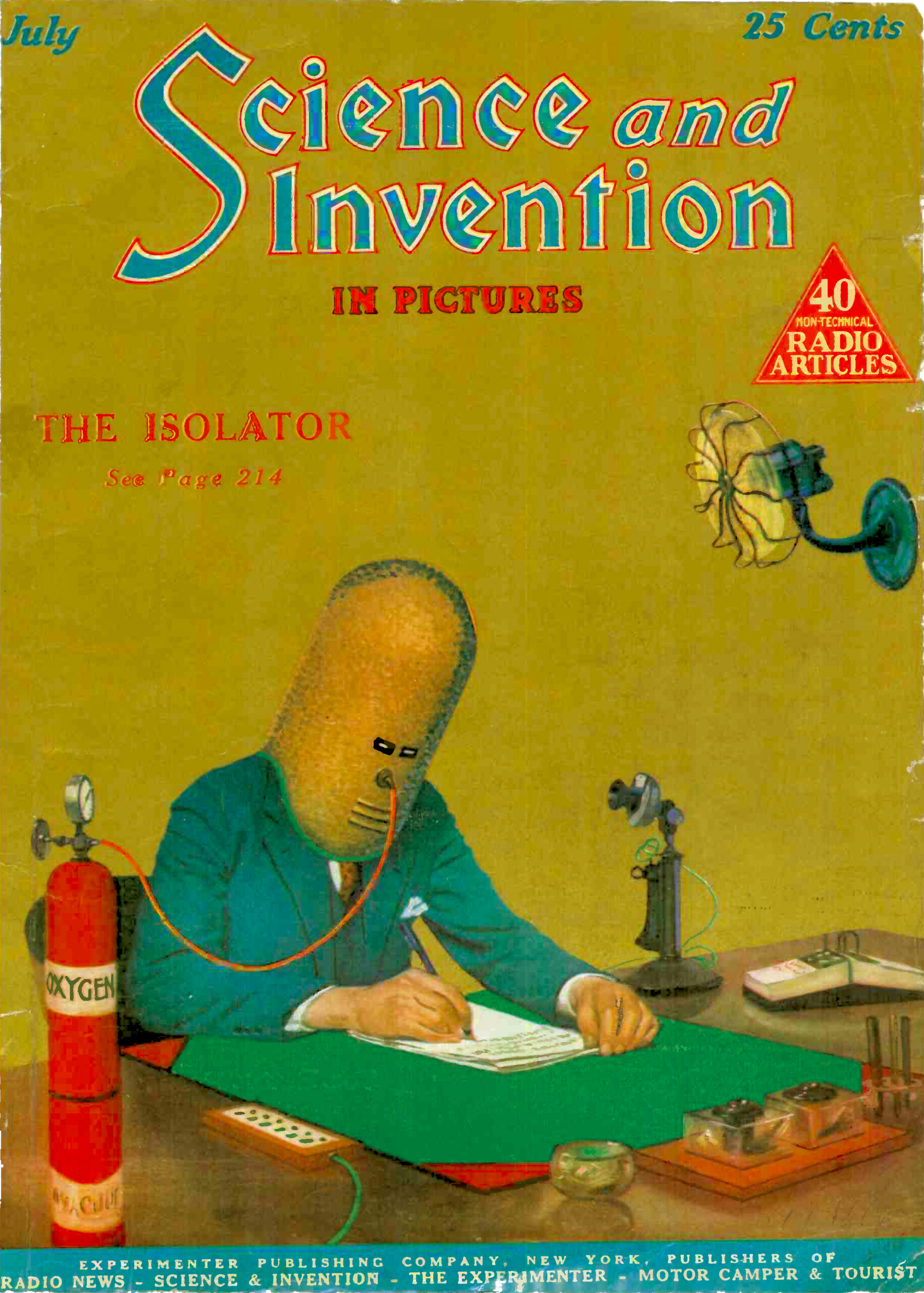
The anti-distraction device is the modern mousetrap: build a better one, and the world will beat a path to your door. Or so, at least, will the part of the world engaged in the pursuits we’ve broadly labeled “knowledge work.” Even among the knowledge workers who’ve spent most of the past year in pandemic-prompted isolation, many still feel besieged by unending claims on their attention. Laments at having been rendered unproductive by constant distraction go back at least to medieval times, but the proposed solutions to this long-standing problem change with — and reflect — the times. Take the “Isolator,” the formidable-looking wearable machine above that debuted on the cover of July 1925’s Science and Invention magazine.
“Perhaps the most difficult thing that a human being is called upon to face is long, concentrated thinking,” writes inventor Hugo Gernsback in the accompanying article. “Most people who desire thus to concentrate find it necessary to shut themselves up in an almost soundproof room in order to go ahead with their work, but even here there are many things that distract their attention.”
Even absent such nuisances as “street noises” and the “telephone bell,” the mind seeks out its own distractions as if naturally compelled: “You will lean back in your chair and begin to study the pattern of the wallpaper, or you will see a fly crawl along the wall, or a window curtain will be moving back and forth, all of which is often sufficient to turn your mind away from the immediate task to be performed.”
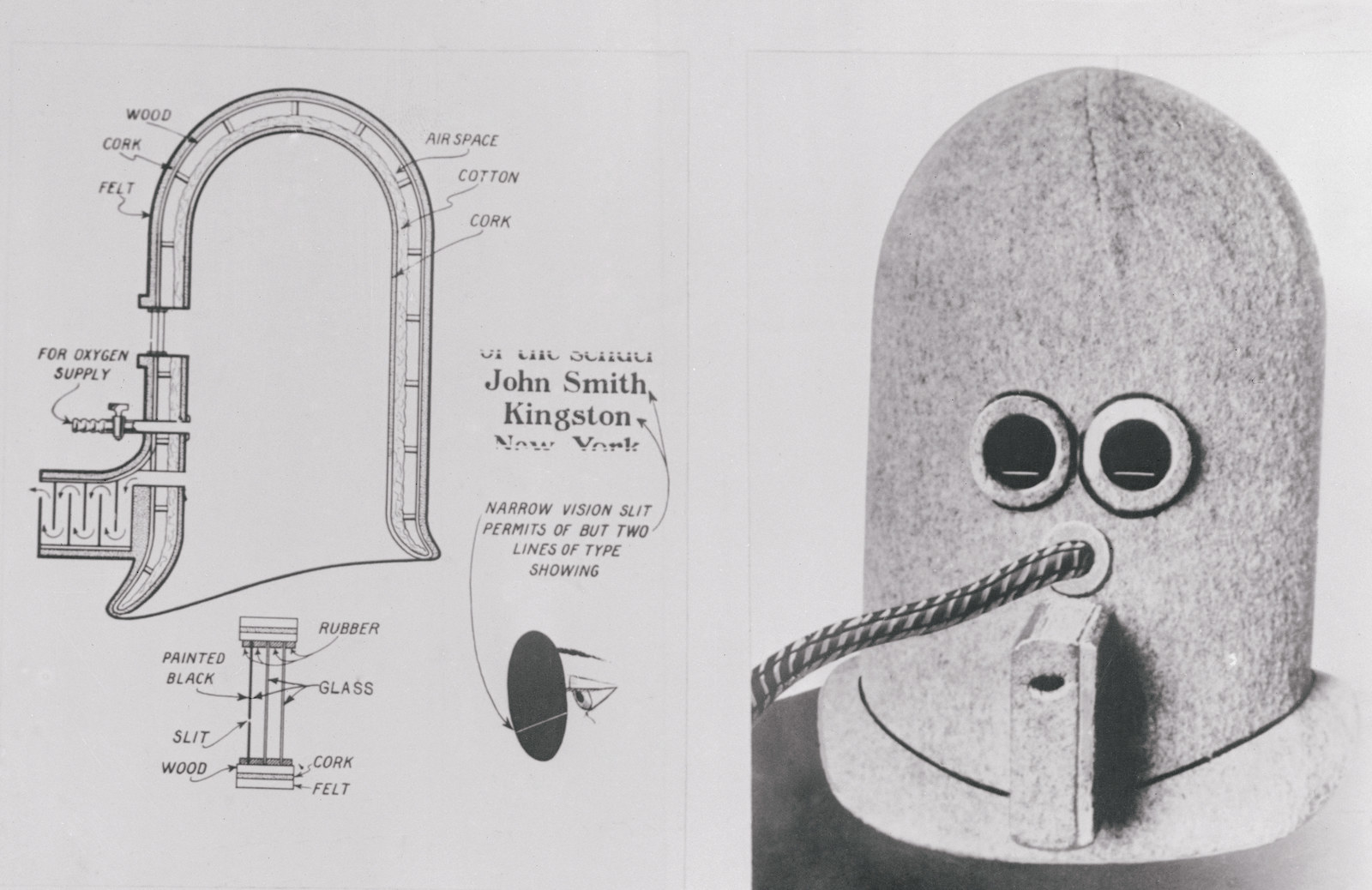
Gernsback’s solution involves a large helmet, lined with cork and covered in felt, with a baffle for breathing and glass eyeholes to see through. Painted black but for two thin bands, the eyeholes make it “almost impossible to see anything except a sheet of paper in front of the wearer. There is, therefore, no optical distraction here.” To prevent drowsiness, “the writer introduced a small oxygen tank, attached to the helmet. This increases the respiration and livens the subject considerably.” And so we arrive at the setup pictured below, originally captioned, “The author at work in his private study aided by the Isolator. Outside noises being eliminated, the worker can concentrate with ease upon the subject at hand.” The Isolator’s patent appears just above, one of 80 for various inventions that Gernsback held in his lifetime.

Whatever the device contributed to Gernsback’s productivity, there can be no question that the man got a lot done. Not just a contributor to Science and Invention but also its publisher, he oversaw a small media empire whose other periodicals included Everyday Science and Mechanics, Scientific Detective Monthly, the sinister-sounding Technocracy Review, and Amazing Stories, which launched in 1926 as the first magazine devoted entirely to science fiction (or “scientifiction,” as Gernsback called it). For his advancement of the genre he was honored by the World Science Fiction Society’s Annual Achievement Awards, better known as the “Hugos.” Pulp-fictional though the Isolator may have looked in 1925 (as indeed it looks now), it represents a genuine effort to alleviate with technology a bothersome aspect of the human condition — and a precedent for the new-and-improved isolation helmets engineered for the even more distracting world in which we live a century on.
Related Content:
How to Focus: Five Talks Reveal the Secrets of Concentration
The Benefits of Boredom: How to Stop Distracting Yourself and Get Creative Ideas Again
Medieval Monks Complained About Constant Distractions: Learn How They Worked to Overcome Them
What Happens When You Spend Weeks, Months, or Years in Solitary Confinement
Based in Seoul, Colin Marshall writes and broadcasts on cities, language, and culture. His projects include the Substack newsletter Books on Cities, the book The Stateless City: a Walk through 21st-Century Los Angeles and the video series The City in Cinema. Follow him on Twitter at @colinmarshall or on Facebook.
Read More...The Story of the Rolling Stones: A Selection of Documentaries on the Quintessential Rock-and-Roll Band
The Rolling Stones define the rock-and-roll band, as they have for nearly six decades now. Exactly how they’ve done so is thoroughly documented, not least by the band’s own expansive and still-growing catalog of songs and albums (all of which I happen to have spent the last few months listening through). But the story of the Stones continues to compel, told and re-told as it is in every form of media produced by each era through which the band has passed: books, articles, podcasts, and also the sort of documentaries we’ve collected here today. Some were originally produced for television; others, like WatchMojo’s “The Rolling Stones: The Story & the Songs” above, for the internet. Each of them addresses the same question: how did a couple of blues-obsessed lads from Kent come to run the biggest rock group in the world?
Even when straightforwardly presented, as in the Biography broadcast above, the history of the Rolling Stones constitutes a pop-cultural thrill ride. It begins, by most accounts, with former classmates Mick Jagger and Keith Richards bumping into each other at a train station in 1961. Their shared interest in music, and especially American blues, inspired them to put a band together.
Before long, Jagger and Richards’ Blues Boys made the acquaintance of another band, Blues Incorporated, whose members included Brian Jones, Ian Stewart and Charlie Watts. Though Watts wouldn’t join up until later, the other four constituted most of the first lineup of the Rolling Stones, who made their debut at London’s Marquee Club in July 1962.
You can see a great deal of archive footage depicting the Stones in their early years in the documentary above, Rolling Stones: Rock of Ages. The title implies an obvious and much-repeated joke about the once-rebellious youngsters’ insistence on rocking into relatively advanced age. But onstage — and the live performance has always been essential to their appeal, more so even than their albums — they remain very much the same band once promoted with the question “Would you let your sister go with a Rolling Stone?” That line was only one of the strategies used by its author, the Stones’ first manager Andrew Loog Oldham, to launch his boys into worldwide popularity by framing them as the brash opposite of the Beatles — to whom, despite their considerable musical differences, one can hardly avoid making reference in the story of the Stones.
Though the bands became fast friends in real life, the press of the 1960s couldn’t resist crafting a rivalry, as recounted in The Beatles vs. The Rolling Stones, the Canal+ documentary above. Whatever competition existed between them (or with American bands like the Beach Boys) only encouraged them to make their music more powerful and distinctive. This they did in the face of countless personal and professional setbacks, which for the Stones included the loss of founding member Brian Jones and the violent Altamont Free Concert, widely interpreted as the end of the utopian 1960s. As products and survivors of that era, the Stones also remain embodiments of its insouciant ambition. “For my generation, what was happening and the feeling in the air was: it’s time to push limits, says no less a survivor than the subject of Keith Richards: The Origin Of The Species. “The world is ours now, and you can rise or fall on it.”
Related Content:
The Rolling Stones at 50: Mick, Keith, Charlie & Ronnie Revisit Their Favorite Songs
Based in Seoul, Colin Marshall writes and broadcasts on cities, language, and culture. His projects include the Substack newsletter Books on Cities, the book The Stateless City: a Walk through 21st-Century Los Angeles and the video series The City in Cinema. Follow him on Twitter at @colinmarshall or on Facebook.
Read More...Magnus Carlsen’s Mind-Blowing Memory of Historic Chess Matches
How many historic chess games can Magnus Carlsen recognize just by looking at the placement of chess pieces on the board? It turns out a lot. And that’s partly what makes him the reigning World Chess Champion.
If you would like to support the mission of Open Culture, consider making a donation to our site. It’s hard to rely 100% on ads, and your contributions will help us continue providing the best free cultural and educational materials to learners everywhere. You can contribute through PayPal, Patreon, and Venmo (@openculture). Thanks!
Related Content
Learn How to Play Chess Online: Free Chess Lessons for Beginners, Intermediate Players & Beyond
A Free 700-Page Chess Manual Explains 1,000 Chess Tactics in Straightforward English
A Beautiful Short Documentary Takes You Inside New York City’s Last Great Chess Store
A Brief History of Chess: An Animated Introduction to the 1,500-Year-Old Game
Vladimir Nabokov’s Hand-Drawn Sketches of Mind-Bending Chess Problems
Garry Kasparov Now Teaching an Online Course on Chess
Read More...Great Art Explained: Watch 15 Minute Introductions to Great Works by Warhol, Rothko, Kahlo, Picasso & More
Can great art be explained? Isn’t it a little like explaining a joke? Yet this can be worthwhile when the joke is in a foreign language or an unfamiliar idiom, a long-forgotten dialect or an alien idiolect. Consider, for example, the most common response to Mark Rothko’s monochromatic rectangles: “I don’t get it.”
Will perplexed viewers better understand Rothko’s Seagram murals when they learn that “he was found in a pool of blood six by eight feet wide, roughly the size of one of his paintings,” as James Payne writes, hours after he sent the nine canvasses to the Tate Modern gallery in London in 1970? “His suicide would change everything and shape the way we respond to his work,” adding a darker edge to comments of his like “I’m interested only in expressing basic human emotions, tragedy, ecstasy, doom and so on.”
Last summer, Payne launched his series Great Art Explained in Fifteen Minutes, “a brilliant new addition to YouTube art history channels,” Forbes enthused — “entertaining and informative short films [that] present a fresh look at familiar artworks.” There’s much more to Rothko than his tragic death at 66. We learn of his love for Mozart, a composer who was “always smiling through his tears,” the painter said.
An artist who seems to embody the opposite of Rothko’s troubled passion, Andy Warhol gets an explainer, above, in which Payne takes on the artist’s Marilyn Diptych. He opens with 30 seconds of audio from an interview with Warhol, who gives characteristically disinterested yes or no responses: “Andy, do you think that Pop Art has reached the point where it’s becoming repetitious now?” “Uh, yes.”
Pop Art’s repetitions were the point. Warhol elevated the unremarkable mass product to the level of high art, becoming the biggest-selling artist in the world. Payne draws a parallel between Marilyn Monroe’s transformation from “abused foster child from the rural midwest” to Hollywood royalty, and Warhol’s move from a shy, sickly child of immigrants to an international art star.
Even if Payne is explaining things you already knew about famous artworks like Monet’s Water Lilies, you’ll still enjoy his presentation, with its clever editing and compelling narration. “I want to present art in a jargon free, entertaining, clear and concise way,” he writes. Each video covers one famous artwork, not all of them modern. (We recently featured Payne’s take on Hieronymus Bosch’s Garden of Earthly Delights.)
Payne’s work as an art consultant, guide, “and art and film writer,” Forbes writes, “make him the ideal presenter of this excellent new art history series.” Craving some context on your lunch break? Head over the Great Art Explained in Fifteen Minutes and catch a few excellent mini-art history lectures, each one 15 minutes or less, for free.
Related Content:
An Introduction to 100 Important Paintings with Videos Created by Smarthistory
Free Course: An Introduction to the Art of the Italian Renaissance
Josh Jones is a writer and musician based in Durham, NC. Follow him at @jdmagness
Read More...Harrison Ford Gets Delightfully Dumbfounded by David Blaine’s Card Trick
Originally recorded back in 2014, this clip of David Blaine performing a card trick for Harrison Ford went viral this week. (Can we still use this expression in the age of COVID?) Hang with it until the end. It’s worth the 1:50 of your time.
If you would like to support the mission of Open Culture, consider making a donation to our site. It’s hard to rely 100% on ads, and your contributions will help us continue providing the best free cultural and educational materials to learners everywhere. You can contribute through PayPal, Patreon, and Venmo (@openculture). Thanks!
Related Content:
Willie Nelson Shows You a Delightful Card Trick
Orson Welles Performs a Magic Trick
Read More...Invisible People: Watch Poignant Mini-Documentaries Where Homeless People Tell Their Stories
Over the past year, the story of evictions during COVID has often risen above the muck. It’s made headlines in major newspapers and TIME magazine, and received serious attention from the government, with stop-gap eviction moratoriums put in effect and renewed several times, and likely due to be renewed again. Stopping evictions is not enough. “For many landlords,” notes the United Way, “the order created a financial burden of housing renters with no payments,” and without income, they have no way to pay. But these measures have kept many thousands of vulnerable adults and children from experiencing homelessness.
And yet moratoriums aside, the number of people losing their homes is on the rise during the pandemic, with a disproportionate impact on Black, Latinx, and Indigenous communities, and shelters have been forced to close or lower capacity. Framing increasing homelessnes solely as a crisis driven by the virus misses the fact that it has been growing since 2016, though it is down from pre-2007 levels. “Even before the current health/economic crisis,” notes a Homelessness Research Institute report, “the older adult homeless population was projected to trend upwards until 2030.”
Indeed, homelessness has seemed like a sad, inevitable fact of American life for decades. Rather than accept the situation, organizations like Invisible People have worked to end it. “The first step to solving homelessness,” they write, “is acknowledging that its victims are people. Regular people. Fathers. Mothers. Veterans. Whole families. Folks who fell on hard times and lost their core foundation of being human — their homes.” No one asks to be in the situation, and the longer a person goes unhoused, the harder it is for them to rebuild their lives.
Invisible People offers action steps and publishes well-researched journalism on the problems, and solutions, for the millions of people experiencing homelessness at any given time. But as their name suggests, their primary aim is to make the lives of unhoused people visible to those of us who tend to walk right by them in our haste. We can feel overwhelmed by the intractable scale of the problem, which tends to turn individuals into statistics. Invisible People asks us to “change the story,” and to start by approaching homelessness one person, or one family, at a time.
Invisible People was founded in Los Angeles by Mark Horvath, a former TV executive who became homeless after drug and alcohol addiction in 1995. After recovering, he lost his home again during the 2008 Recession. Horvath began interviewing people he met on the streets of L.A. and posting the videos to YouTube and Twitter. Soon, the project became a global one, incorporated as a non-profit, and Horvath has traveled across the U.S. and to Canada, Peru, and the UK to interview people living without homes.
The project, says Horvath is designed to foster “a conversation about solutions to end homelessness [that] gives homeless people a chance to tell their own story.” Those stories are moving, human, unforgettable, and usually not at all what you might expect. You can see some of them here, and many more at the Invisible People YouTube channel. Connect with the organization and find out what you can do here.
Related Content:
Designer Creates Origami Cardboard Tents to Shelter the Homeless from the Winter Cold
Josh Jones is a writer and musician based in Durham, NC. Follow him at @jdmagness
Read More...Support Us
We're hoping to rely on loyal readers, rather than erratic ads. Please click the Donate button and support Open Culture. You can use Paypal, Venmo, Patreon, even Crypto! We thank you!

About Us

Open Culture scours the web for the best educational media. We find the free courses and audio books you need, the language lessons & educational videos you want, and plenty of enlightenment in between.
Advertise With Us
FREE UPDATES!
GET OUR DAILY EMAIL
Get the best cultural and educational resources on the web curated for you in a daily email. We never spam. Unsubscribe at any time.
FOLLOW ON SOCIAL MEDIA
Open Culture editor Dan Colman scours the web for the best educational media. He finds the free courses and audio books you need, the language lessons & movies you want, and plenty of enlightenment in between.
Advertise With Us


