Japanese Carpenters Unearth 100-Year-Old Wood Joineries While Taking Apart a Traditional House
According to myth, the first Japanese poet, Susano‑o, the storm god, named the activity of building as equal to the works of nature. Travel blog Kansai Odyssey writes, “Susano‑o felt rather inspired” while at Suga Shrine in Shimane Prefecture, “and recited the first poem in Japanese literature.” Roughly translated, it reads: “In Izumo, where the clouds form, / I see a fence of clouds. / To protect my wife, I too, built a fence. / These clouds are as my fence.”
An embrace of the natural world intermingles in Japanese culture with a craft tradition renowned the world over, not least in the building arts. “Since the 12th Century,” Grace Ebert writes at Colossal, “Japanese artisans have been employing a construction technique that uses just one simple material: wood. Rather than utilize glue, nails, and other fasteners, the tradition of Japanese wood joinery notches slabs of timber so that the grooves lock together and form a sturdy structure.”
Although mostly practiced in the repair and preservation of historic buildings these days, Japanese joinery still inspires modern woodworkers, engineers, and architects for its incredible precision and endurance. Traditional Japanese buildings are “structures built from natural materials and the knowledge and skills passed down generations,” writes Yamanashi-based carpenter Dylan Iwakuni. “Through the fine skills and knowledge, Japanese Wooden Architecture has been standing for (thousands of) years.”
In the video at the top, you can see Iwakuni and his team’s excitement as they discover traditional joinery while disassembling a 100-year-old Japanese house. The video shows each joint in close-up, adding a title that names its particular type. “As it became a tradition in Japan,” wrote Colin Marshall in a previous post on Iwakuni’s craft, “this carpentry developed a canon of joining methods.” All of the joints, from the very simple to the mind-bogglingly puzzle-like, were of course cut by hand. No power tools in medieval Japan.
Just above, see Iwakuni introduce the art of joinery, and see several more of his demonstrations here. Those interested in going further should see our previous posts at the links below. Find even more hands-on resources at the Japan Woodcraft Association.
via Twisted Sifter
Related Content:
See How Traditional Japanese Carpenters Can Build a Whole Building Using No Nails or Screws
Josh Jones is a writer and musician based in Durham, NC. Follow him at @jdmagness
Read More...An Immersive Pink Floyd Museum Exhibition Is Coming to the U.S.: Get Tickets Online
While it’s not technically incorrect to call Pink Floyd a rock band, the term feels somehow unequal to the descriptive task at hand. One doesn’t so much listen to albums like The Dark Side of the Moon and The Wall as experience them, and this went even more so for their elaborate, increasingly colossal live performances. A retrospective of Pink Floyd’s history, which stretched back to 1965, must do justice to Pink Floyd’s transcendent ambition: this was the goal of Pink Floyd: Their Mortal Remains, an exhibition that first opened at London’s Victoria and Albert Museum in 2017 and is now preparing to make its United States debut at Los Angeles’ Vogue Multicultural Museum this summer.
“You arrive into Their Mortal Remains via a life-size replica of the band’s Bedford van, their black-and-white touring vehicle in the mid-Sixties,” Rolling Stone’s Emily Zemler writes of the V&A show. “The story is told by letters, drawings, posters, video footage, newspaper clippings, music instruments, ticket stubs and odd objects, some of them replicas.”
The items on display come not just from the professional life of the band but the personal lives of it members as well: “Syd Barrett’s red-orange bicycle,” for instance, or “the actual cane used on Waters during his early years” to deliver punishment for misbehavior at school.
Also on display are no few notable musical instruments, including a kit painted for drummer Nick Mason with ukiyo‑e artist Katsushika Hokusai’s The Great Wave off Kanagawa. “Once it’s behind glass, it just looks a million dollars,” Mason says in one of Their Mortal Remains’ trailers, appearing in his capacity as a consultant to the project. It main curator, graphic designer Aubrey “Po” Powell, co-created the cover art for The Dark Side of the Moon, and brings to bear a thorough knowledge of Pink Floyd’s music, their history, and their sensibility. “It’s way out of scale to anything that you’ve ever seen before,” he says of the exhibition’s design, “and that sort of journey is very reminiscent of psychedelia, of being on psychedelic drugs.”
In its way, the alteration of consciousness is as essential to the Pink Floyd phenomenon as the incorporation of technology (subject of a recent Mason-hosted BBC podcast series) and the expansion of rock music’s sonic territory. On a deeper level, there’s also what V&A director Tristram Hunt calls “an English pastoral idiom,” which will certainly make for an intriguing juxtaposition when Their Mortal Remains completes its installation in the thick of Hollywood Boulevard. There it will run from August 3rd to November 28th, though tickets are already on sale at the Vogue Multicultural Museum’s web site. Though in Los Angeles the consciousness-altering substances that have traditionally accompanied their music are now more legal than ever, be warned that what Salvador Dalí said of himself also holds true for Pink Floyd: they are drugs.
Related Content:
An Hour-Long Collection of Live Footage Documents the Early Days of Pink Floyd (1967–1972)
The Dark Side of the Moon Project: Watch an 8‑Part Video Essay on Pink Floyd’s Classic Album
Based in Seoul, Colin Marshall writes and broadcasts on cities, language, and culture. His projects include the Substack newsletter Books on Cities, the book The Stateless City: a Walk through 21st-Century Los Angeles and the video series The City in Cinema. Follow him on Twitter at @colinmarshall or on Facebook.
Read More...Electronic Music Pioneer Wendy Carlos Demonstrates the Moog Synthesizer on the BBC (1970)
We can break popular music into two periods: before the Moog and after the Moog. Upon its debut in 1964, that synthesizer made a big splash in the small but long-established electronic-music world by, among other innovative qualities, being smaller than an entire room. Over the next few years, inventor Bob Moog (whose previous line was in theremins) refined his eponymous brainchild to the point that it became accessible to composers not already on the cutting edge of music technology. But for Wendy Carlos, the cutting edge of music technology was where she’d spent most of her life; hence her ability to create the first bestselling all-Moog album, 1968’s Switched-On Bach.
By the beginning of the 1970s, great public curiosity had built up about these new music-making machines, thanks to Carlos’ work as well as that of composers like the BBC Radiophonic Workshop’s Daphne Oram. It was the BBC that produced the clip above, in which Carlos explains the fundamentals of not just the Moog but sound synthesis itself.
She even plays a bit of the second movement of Bach’s Brandenburg Concerto #4, Carlos’ rendition of which on Switch-On Bach’s follow-up The Well-Tempered Synthesizer moved no less an authority than Glenn Gould to call it “the finest performance of any of the Brandenburgs — live, canned, or intuited — I’ve ever heard.”
In this footage, more than half a century old as it is, only an evident skill at operating the Moog and understanding of the principles of synthesizers suggest Carlos’ identity. At that time in her career she was still known as Walter Carlos, and she has since spoken of having maintained that image by applying a pair of fake sideburns for public appearances. (She would return to the BBC to do another Moog demonstration as Wendy nineteen years later.) Today one dares say those mutton chops look a bit obvious, but it isn’t as a master of disguise that Carlos has gone down in history. Rather, her work has showed the way for generations of musicians, well outside of campus laboratories, to make use of electronically generated sounds in a manner that resonates, as it were, with the wider listening public.
Related Content:
Watch Composer Wendy Carlos Demo an Original Moog Synthesizer (1989)
Bob Moog Demonstrates His Revolutionary Moog Model D Synthesizer
How the Moog Synthesizer Changed the Sound of Music
Based in Seoul, Colin Marshall writes and broadcasts on cities, language, and culture. His projects include the Substack newsletter Books on Cities, the book The Stateless City: a Walk through 21st-Century Los Angeles and the video series The City in Cinema. Follow him on Twitter at @colinmarshall or on Facebook.
Read More...Watch “Colette,” the Oscar-Winning Short Documentary (2021)
Thanks to The Guardian, you can now watch online “Colette,” the film that recently won the Academy Award in the category of best documentary short. The British newspaper sets the stage as follows:
90-year-old Colette Marin-Catherine confronts her past by visiting the German concentration camp Mittelbau-Dora where her brother was killed. As a young girl, she fought Hitler’s Nazis as a member of the French Resistance. For 74 years, she has refused to step foot in Germany, but that changes when a young history student named Lucie enters her life. Prepared to re-open old wounds and revisit the terrors of that time, Marin-Catherine offers important lessons for us all.
In a separate interview, filmmakers Anthony Giacchino and Alice Doyard “explain how they found out about the story of Colette and why they decided to make a documentary about her.”
“Colette” will be added to our list of online documentaries, a subset of our collection, 4,000+ Free Movies Online: Great Classics, Indies, Noir, Westerns, Documentaries & More.
If you would like to support the mission of Open Culture, consider making a donation to our site. It’s hard to rely 100% on ads, and your contributions will help us continue providing the best free cultural and educational materials to learners everywhere. You can contribute through PayPal, Patreon, and Venmo (@openculture). Thanks!
Related Content:
Glass: The Oscar-Winning “Perfect Short Documentary” on Dutch Glassmaking (1958)
Why Man Creates: Saul Bass’ Oscar-Winning Animated Look at Creativity (1968)
Oscar-Winning Animated Short, The Dot and the Line, Celebrates Geometry and Hard Work (1965)
Read More...Beautiful 19th-Century Indian Drawings Show Hatha Yoga Poses Before They Reached the West
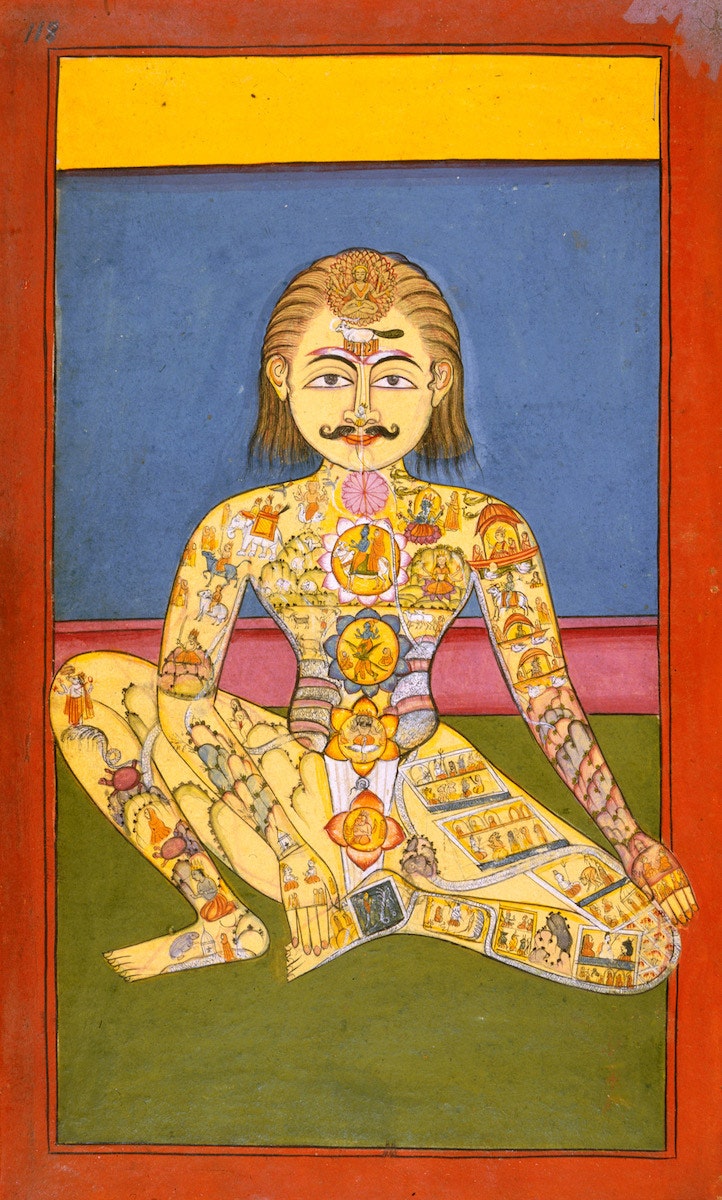
Yoga as an athletic series of postures for physical health came into being only about 100 years ago, part of a wave of gymnastics and calisthenics that spread around the Western world in the 1920s and made its way to India, combining with classical Indian spirituality and asanas, a word which translates to “seat.” Yoga, of course, had existed as a classical spiritual discipline in India for thousands of years. (The word is first found in the Rig Veda), but it had little to do with fitness, as yoga scholar Mark Singleton found when he delved into the roots of yoga as we know it.
Asana practice was often marginal, even scorned by some 19th century Indian teachers of high caste as the domain of “fakirs” and mendicant beggars. “The first wave of ‘export yogis,’” writes Singleton, “headed by Swami Vivekananda, largely ignored asana and tended to focus instead on pranayama [breath practice], meditation, and positive thinking…. Vivekananda publicly rejected hatha yoga in general and asana in particular.”
In the 20th century, yoga became associated with Indian nationalism and anti-colonial resistance, and imported Western poses were combined with asanas for a program of intense physical training.
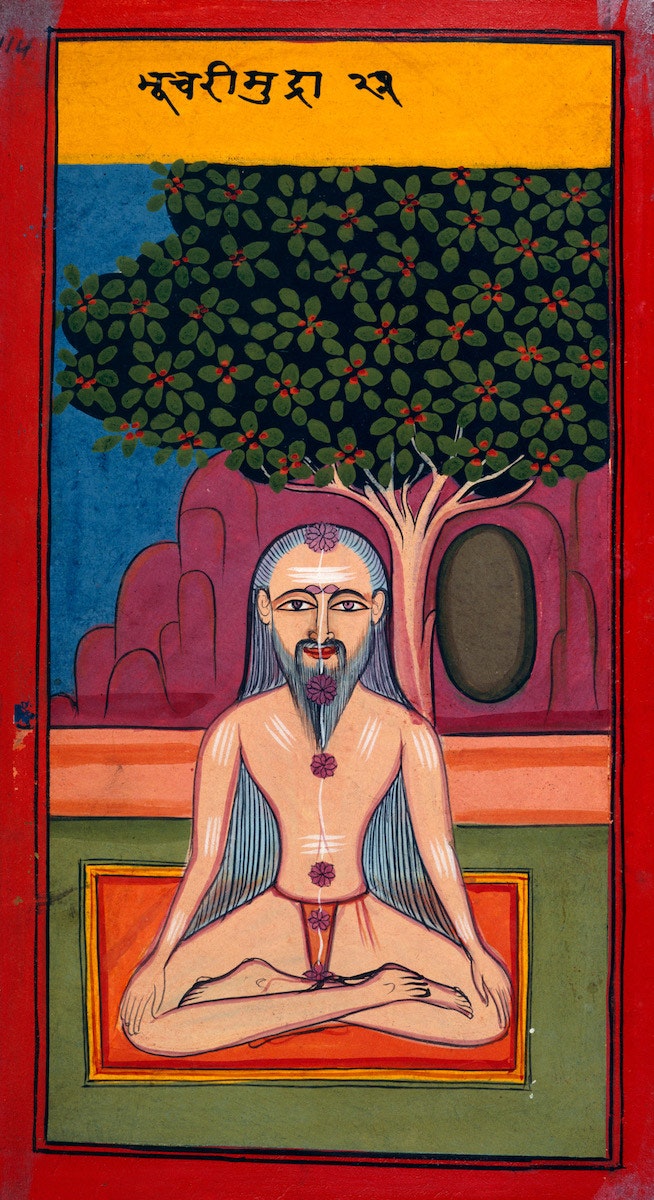
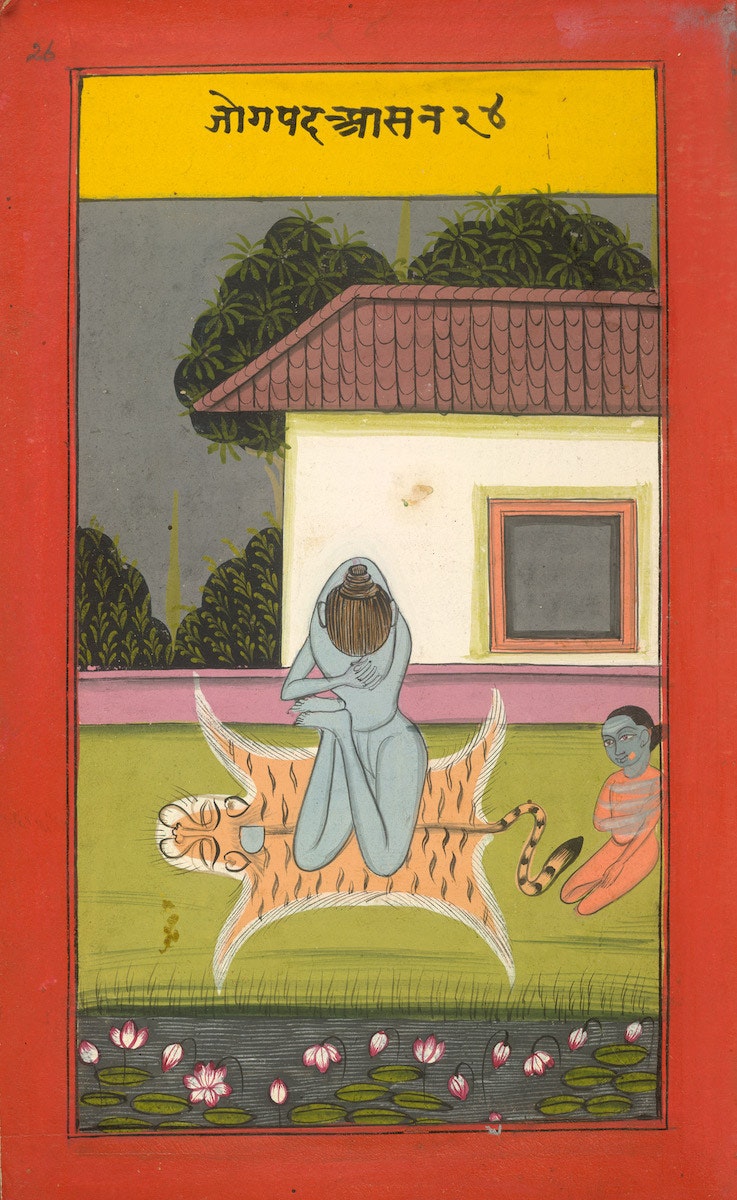
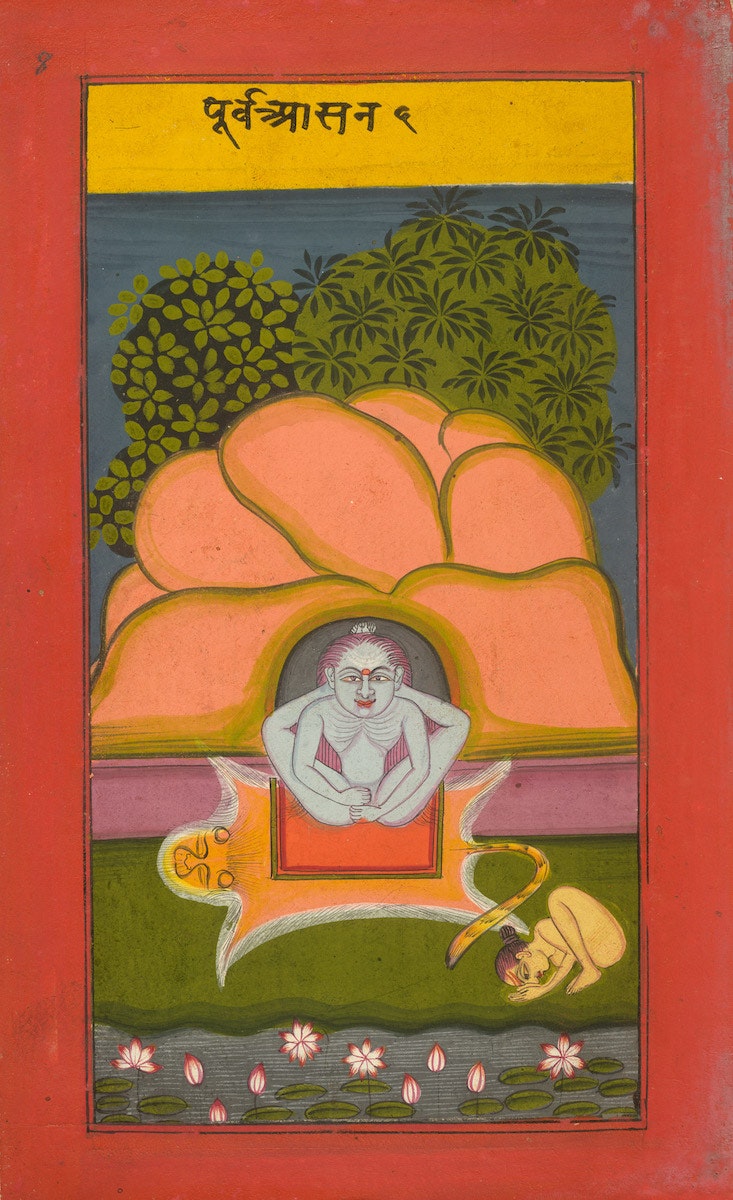
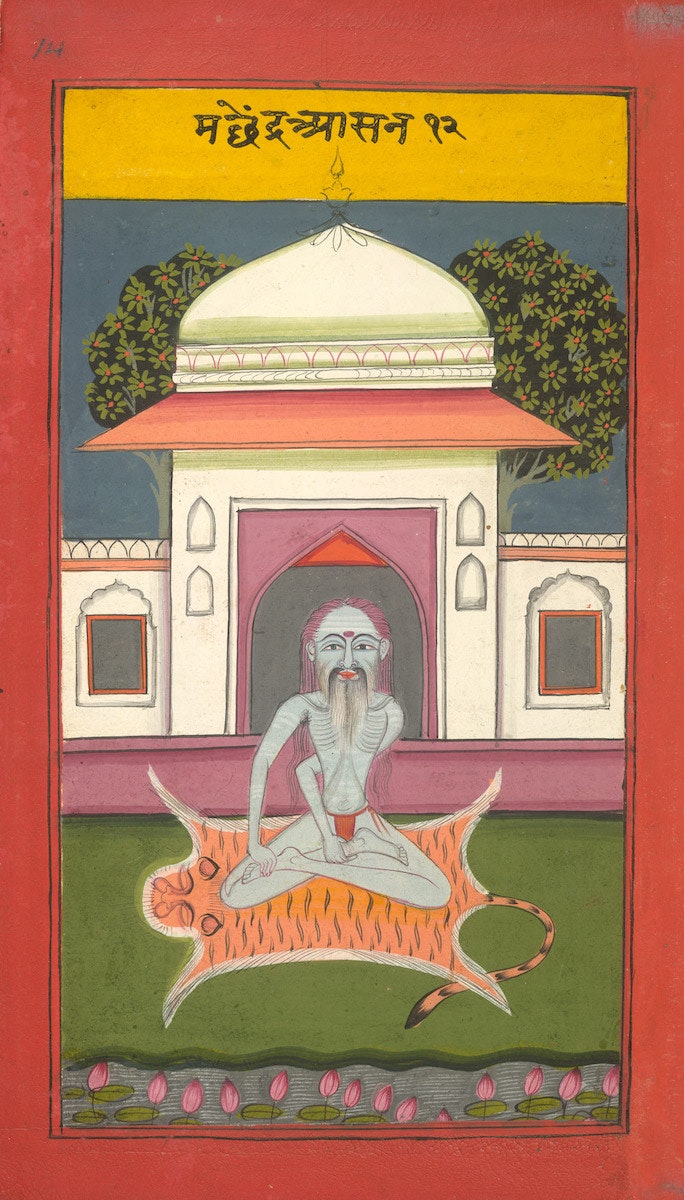
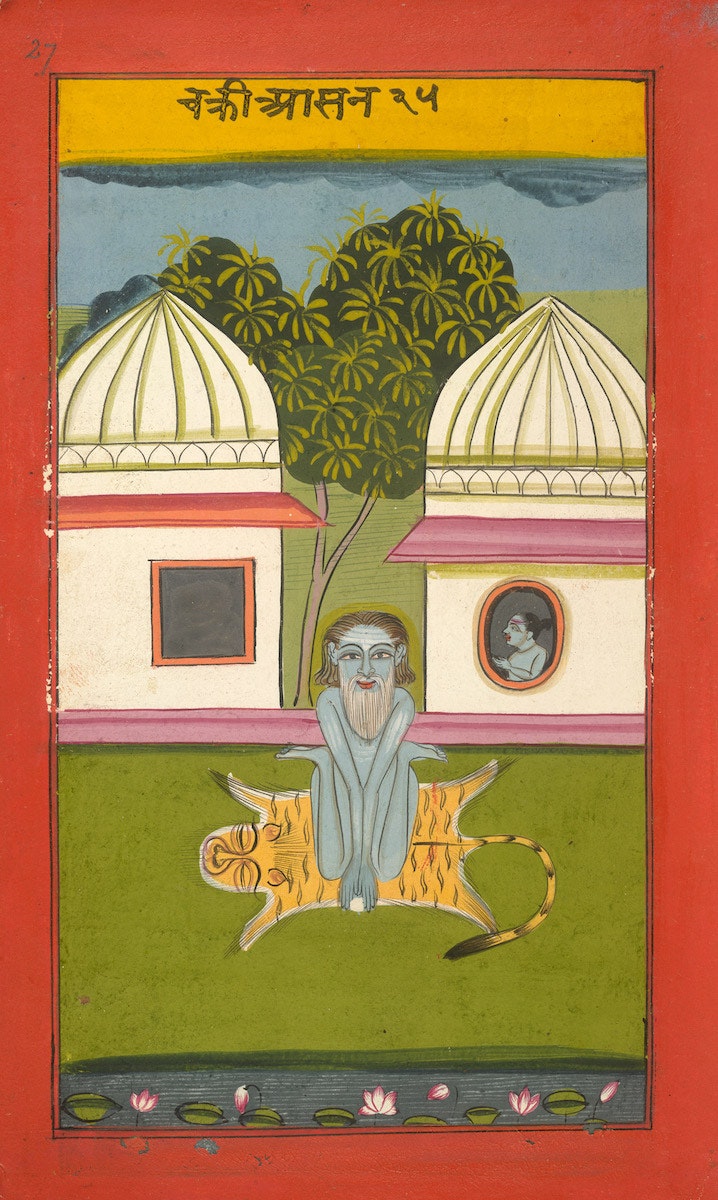
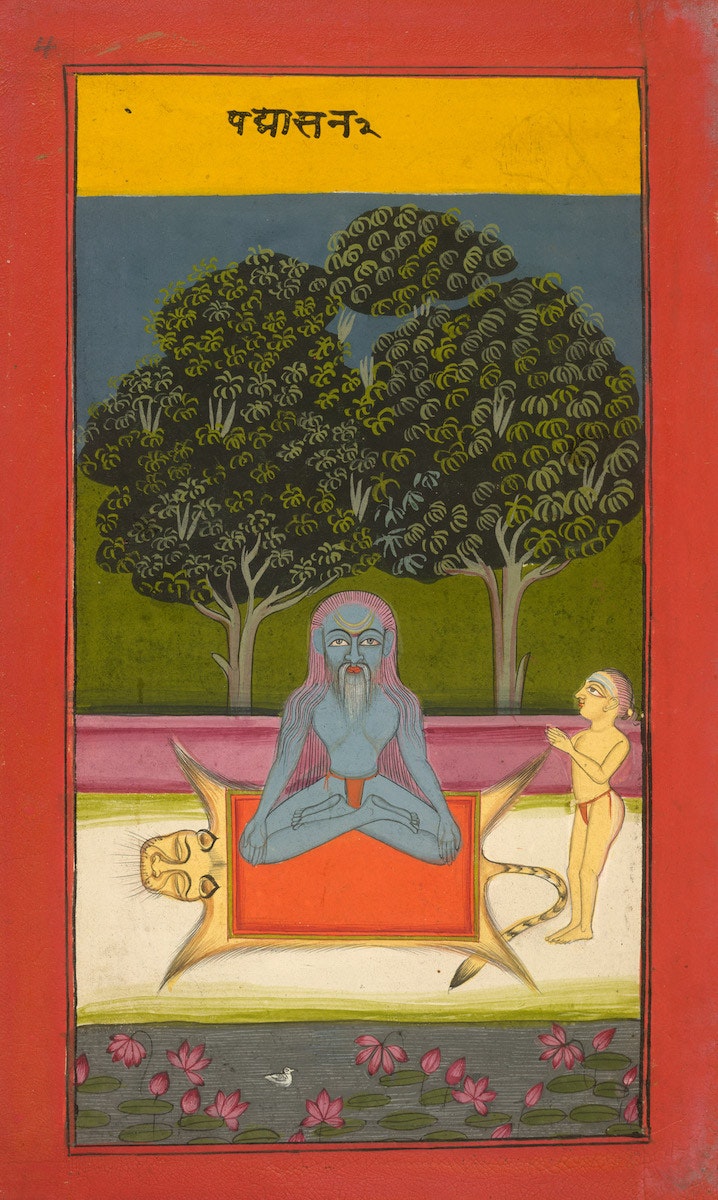
Westernized yoga has obscured other traditions around the world that developed over hundreds or thousands of years. For his book with James Mallinson, Roots of Yoga, Singleton consulted “yogic texts from Tibetan, Arabic, Persian, Bengali, Tamil, Pali, Kashmiri, Old Marathi, Avadhi, Braj Bhasha, and English,” notes the Public Domain Review, who bring our attention to this early 19th-century series of images from a text called the Joga Pradīpikā, made before classical yoga became known in the west by adventurous thinkers like Henry David Thoreau.
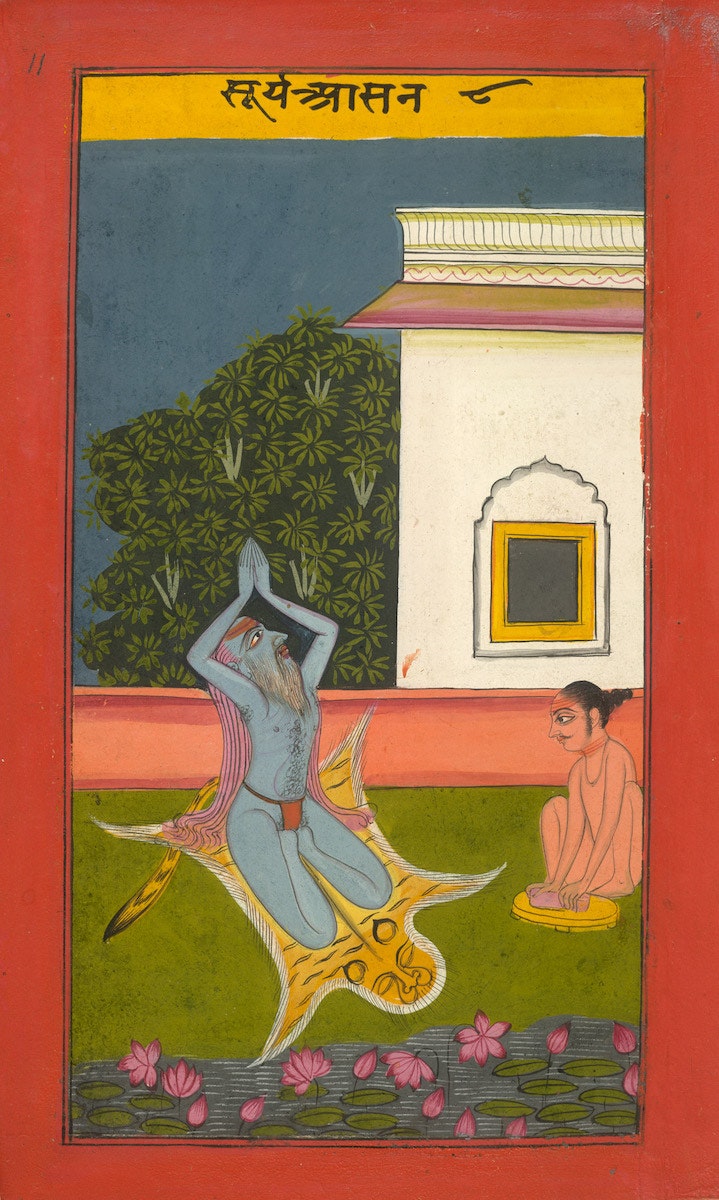
A few millennia before it was the provenance of lycra-clad teachers in boutique studios, asana practice combined rigorous, often quite painful-looking, meditative postures with mudras (“seals”), hand gestures whose origins “remain obscure,” though yoga historian Georg Feuerstein argues “they are undoubtedly the products of intensive meditation practice during [which] the body spontaneously assumes certain static as well as dynamic poses.” The collection of drawings in the 118-page book depicts 84 asanas and 24 mudras, “with explanatory notes in Braja-Bhasha verse,” notes the British Library, and one image (top) related to Kundalini yoga.
Whatever the various practices of yogic schools in both the Eastern and Western world, “the methods and lifestyles developed by the Indian philosophical and spiritual geniuses over a period of at least five millennia all have one and the same purpose,” writes Feuerstein in his seminal study, The Yoga Tradition: “to help us break through the habit patterns of our ordinary consciousness and to realize our identity (or at least union) with the perennial Reality. India’s great traditions of psychospiritual growth understand themselves as paths of liberation. Their goal is to liberate us from our conventional conditioning and hence also free us from suffering.”
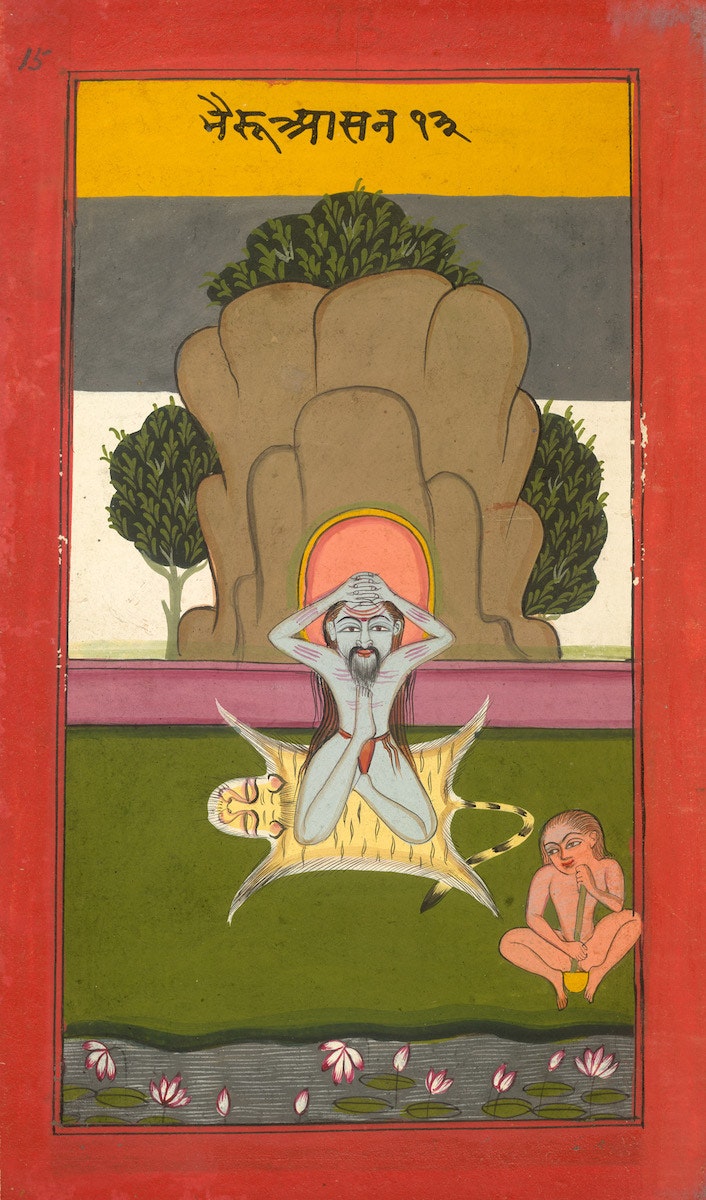
Under a broad umbrella, yoga has flourished as an incredible wealth of traditions, philosophies, religious practices, and scholarship whose strands weave loosely together in what most of us know as yoga in a synthesis of East and West. Learn more at the Public Domain Review, and have a look at their new book of historic images, Affinities, here, a curated journey through visual culture.
Related Content:
How to Get Started with Yoga: Free Yoga Lessons on YouTube
How Yoga Changes the Brain and May Guard Against Alzheimer’s and Dementia
Sonny Rollins Describes How 50 Years of Practicing Yoga Made Him a Better Musician
Read More...Watch a New Director’s Cut of Prince’s Blistering “While My Guitar Gently Weeps” Guitar Solo (2004)
Recently, I was walking with a young relative who, upon passing a mural of the late Prince Rogers Nelson, looked up at me and asked, “who is that?,” whereupon my eyes grew wide as saucers and I began the tale of a musical hero who conquered every instrument, every musical style, every chord and scale, etc. It was a story fit for young ears, mind you, but mythic enough, I guess, that it inspired my relative to stop me mid-sentence and ask in awe, “was he a god?” To which I stammered, caught off guard, “well, kind of…..”
Humanly flawed though he was, Prince comes as close as any recent figure to musical divinity in the flesh. He seemed to conjure and create effortlessly, ex nihilo, never seeming to tire and always looking as though he just stepped off of a cloud. Now we know a little more about the source of some of that serenity, but it diminishes his legend not one bit. If not a god, he was at least some sort of wizard.
Prince’s famously epic live solo at the 2004 Rock and Roll Hall of Fame Induction Ceremony in the star-packed jamboree cover of George Harrison’s “While My Guitar Gently Weeps” holds up as a wondrously succinct case in point to show the children. Now, the performance has been re-edited in a “director’s cut” by the broadcast’s original director Joel Gallen. Thom Dunn at Boing Boing quotes his explanation: “there were several shots that were bothering me. I got rid of the dissolves and made them all cuts, and added lots more close ups of Prince during his solo.” (See the original below.)
“Fortunately,” notes Dunn, “Gallen preserved the disappearing guitar at the end.” No one knows to this day where the guitar went, not even Tom Petty and the Heartbreakers drummer Steve Ferrone, who was on stage behind Prince at the time. The stunt was unrehearsed, and so was everything about the solo — no one had any idea what was going to happen, a frightening prospect on live television but a risk one must take, I suppose, when working with the Purple One.
In 2016, Gallen told The New York Times the story, worth quoting in full, of the performance’s rehearsal, a moment of private humility from Prince behind his live bravura show onstage.
The Petty rehearsal was later that night. And at the time I’d asked him to come back, there was Prince; he’d shown up on the side of the stage with his guitar. He says hello to Tom and Jeff and the band. When we get to the middle solo, where Prince is supposed to do it, Jeff Lynne’s guitar player just starts playing the solo. Note for note, like Clapton. And Prince just stops and lets him do it and plays the rhythm, strums along. And we get to the big end solo, and Prince again steps forward to go into the solo, and this guy starts playing that solo too! Prince doesn’t say anything, just starts strumming, plays a few leads here and there, but for the most part, nothing memorable.
They finish, and I go up to Jeff and Tom, and I sort of huddle up with these guys, and I’m like: “This cannot be happening. I don’t even know if we’re going to get another rehearsal with him. [Prince]. But this guy cannot be playing the solos throughout the song.” So I talk to Prince about it, I sort of pull him aside and had a private conversation with him, and he was like: “Look, let this guy do what he does, and I’ll just step in at the end. For the end solo, forget the middle solo.” And he goes, “Don’t worry about it.” And then he leaves. They never rehearsed it, really. Never really showed us what he was going to do, and he left, basically telling me, the producer of the show, not to worry. And the rest is history. It became one of the most satisfying musical moments in my history of watching and producing live music.
No, kid, he wasn’t a god, just a guy who could do things no one else could. He was a genius.
via Boing Boing / Laughing Squid
Related Content:
Prince Plays a Mind-Blowing Guitar Solo On “While My Guitar Gently Weeps”
Prince’s First Television Interview (1985)
Josh Jones is a writer and musician based in Durham, NC. Follow him at @jdmagness
Read More...Watch Online Eric Hobsbawm: The Consolations of History, a Documentary Exploring the Life & Work of the Influential Historian
Courtesy of The London Review of Books, you can now watch Eric Hobsbawm: The Consolations of History:
In this documentary, Anthony Wilks traces the connections between the events of Eric Hobsbawm’s life and the history he told, from his teenage years in Germany and his communist membership, to the jazz clubs of 1950s Soho and the makings of New Labour, taking in Italian bandits, Peruvian peasant movements and the development of nationalism in the modern world, with help from the assiduous observations of MI5. The film features contributions from Frances Stonor Saunders, Richard J. Evans, John Foot, Stefan Collini, Marlene Hobsbawm and Donald Sassoon, as well as Hobsbawm himself in extensive archive footage.
To learn more about Hobsbawm, read the 2019 New Yorker profile “Eric Hobsbawm, the Communist Who Explained History.”
The film will be added to our list of online documentaries and our larger collection, 4,000+ Free Movies Online: Great Classics, Indies, Noir, Westerns, Documentaries & More.
If you would like to support the mission of Open Culture, consider making a donation to our site. It’s hard to rely 100% on ads, and your contributions will help us continue providing the best free cultural and educational materials to learners everywhere. You can contribute through PayPal, Patreon, and Venmo (@openculture). Thanks!
Related Content:
5 Free Online Courses on Marx’s Capital from Prof. David Harvey
Marxism by Raymond Geuss: A Free Course
Hear Theodor Adorno’s Avant-Garde Musical Compositions
Read More...Watch “Degrees of Uncertainty,” an Animated Documentary about Climate Science, Uncertainty & Knowing When to Trust the Experts
We should just trust the experts. But wait: to identify true expertise requires its own kind of even more specialized expertise. Besides, experts disagree with each other, and over time disagree with themselves as well. This makes it challenging indeed for all of us non-experts — and we’re all non-experts in the fields to which we have not dedicated our lives — to understand phenomena of any complexity. As for grasping climate change, with its enormous historical scale and countless many variables, might we as well just throw up our hands? Many have done so: Neil Halloran, creator of the short documentary Degrees of Uncertainty above, labels them “climate denialists” and “climate defeatists.”
Climate denialists choose to believe that manmade climate change isn’t happening, climate defeatists choose to believe that it’s inevitable, and both thereby let themselves off the hook. Not only do they not have to address the issue, they don’t even have to understand it — which itself can seem a fairly daunting task, given that scientists themselves express no small degree of uncertainty about climate change’s degree and trajectory. “The only way to learn how sure scientists are is to dig in a little and view their work with some healthy skepticism,” says Halloran. This entails developing an instinct not for refutation, exactly, but for examining just how the experts arrive at their conclusions and what pitfalls they encounter along the way.
Often, scientists “don’t know how close they are to the truth, and they’re prone to confirmation bias,” and as anyone professionally involved in the sciences knows full well, they work “under pressure to publish noteworthy findings.” Their publications then find their way to a media culture in which, increasingly, “trusting or distrusting scientists is becoming a matter of political identity.” As he did in his previous documentary The Fallen of World War II, Halloran uses animation and data visualization to illuminate his own path to understanding a global occurrence whose sheer proportions make it difficult to perceive.
This journey takes Halloran not just around the globe but back in time, starting in the year 19,000 B.C. and ending in projections of a future in which ring seas swallow much of Amsterdam, Miami, and New Orleans. The most important stop in the middle is the Age of Enlightenment and the Industrial Revolution of the 17th through the 19th century, when science and technology rose to prominence and brought about an unprecedented human flourishing — with climatic consequences that have begun to make themselves known, albeit not with absolute certainty. But as Halloran sees it, “uncertainty, the very thing that clouds our view, also frees us to construct possible answers.”
Related Content:
A Century of Global Warming Visualized in a 35 Second Video
Climate Change Gets Strikingly Visualized by a Scottish Art Installation
Based in Seoul, Colin Marshall writes and broadcasts on cities, language, and culture. His projects include the Substack newsletter Books on Cities, the book The Stateless City: a Walk through 21st-Century Los Angeles and the video series The City in Cinema. Follow him on Twitter at @colinmarshall or on Facebook.
Read More...Muhammad Ali Explains Why He Refused to Fight in Vietnam: “My Conscience Won’t Let Me Go Shoot My Brother… for Big Powerful America” (1970)
In April of 1967, Muhammad Ali arrived at the U.S. Armed Forces Examining and Entrance Station in Houston, Texas. “Standing beside twenty-five other nerve-racked young men called to the draft,” writes David Remnick at The New Yorker, Ali “refused to respond to the call of ‘Cassius Clay!’” Offered the choice of going to Vietnam or to jail, he chose the latter “and was sentenced to five years in prison and released on bail.” Ali lost his title, his boxing license, his passport, and — as far as he knew at the time — his career. He was newly married with his first child on the way.
When Ali refused to go to Vietnam, he was “already one of America’s greatest heavyweights ever,” notes USA Today. “He’d won an Olympic gold medal for the United States in Rome when he was just 18 and four years later, against all odds, defeated Sonny Liston to win his first title as world champion.” Ali, it seemed, could do no wrong, as long as he agreed to play a role that made Americans comfortable. He refused to do that too, becoming a Muslim in 1961, changing his name in 1964, and speaking out in his inimitable style against racism and American imperialism.
Ali stood on principle as a conscientious objector at a time when resisting the Vietnam War made him extremely unpopular. Sports Illustrated called him “another demagogue and an apologist for his so-called religion” and pronounced that “his views of Vietnam don’t deserve rebuttal.” Television host David Susskind called him “a disgrace to his country” and even Jackie Robinson felt Ali was “hurting… the morale of a lot of young Negro soldiers over in Vietnam.”
Robinson gave voice to a sentiment one hears often from critics of politically outspoken athletes: “Cassius has made millions of dollars off of the American public, and now he’s not willing to show his appreciation to a country that’s giving him, in my view, a fantastic opportunity.” But the country also gave Ali the opportunity to take his case to the Supreme Court, as his lawyer told Howard Cosell in the ABC news segment at the top. “Ali had no intention of fleeing to Canada,” DeNeen L. Brown writes at The Washington Post, “but he also had no intention of serving in the Army.”
Ali strung together a living giving speaking engagements at anti-war events around the country for the next few years as he fought the verdict. It was hardly the living he’d made as champion. But “my conscience won’t let me go shoot my brother, or some darker people, or some poor hungry people in the mud for big powerful America,” he said. “And shoot them for what? They never called me [the N word], they never lynched me, they didn’t put no dogs on me, they didn’t rob me of my nationality, rape and kill my mother and father…. Shoot them for what? How can I shoot them poor people? Just take me to jail.”
Ali remained prominently in the public eye throughout his appeal. He had become a “fixture on the TV talk show circuit in the precable days of the 1960s and ‘70s,” writes Stephen Battaglio in a LA Times review of the recent documentary Ali & Cavett. He remained so during his hiatus from boxing thanks in no small part to Dick Cavett, who had Ali on frequently for everything from “serious discussions of race relations in the U.S. to playful confrontations aimed at promoting fights.” Cavett’s show “provided a comfort zone for Ali, especially before he became a beloved figure.” And it gave Ali a forum to counter public slander. In the clip above from 1970, he talks about how his sacrifices made him a credible role model for troubled young people.
He seems at first to compare himself to early American pioneers, Japanese kamikaze pilots, and the first astronauts when Cavett asks him about the possibility of going to jail, but his point is that he thinks he’s paying a small price compared to what others have given up for progress — “We’ve been in jail 400 years,” he says. “The system is built on war.” The following year, the Supreme Court would dismiss the case against him, swayed by the argument that Ali opposed all war, not just the war in Vietnam. He saw Cavett as a worthy sparring partner, helping the late-night host earn a place on Nixon’s list of enemies. It would become a place of honor in the coming years as Ali won back his career, his reputation, and his title in the “Rumble in the Jungle” four years later, and the Vietnam War became a cause for national shame.
Related Content:
Muhammad Ali Gives a Dramatic Reading of His Poem on the Attica Prison Uprising
Josh Jones is a writer and musician based in Durham, NC. Follow him at @jdmagness
Read More...Diagnosing America’s Relationship with Pets — Pretty Much Pop: A Culture Podcast #91 w/ Trainer Hannah Branigan

What is with the weird relationship we Americans have with our pets? Many of us treat them as our babies, yet of course they’re our captives. Dog trainer Hannah Branigan joins your hosts Mark Linsenmayer, Erica Spyres, and Brian Hirt to talk about pets as entertainment, as hobby, and as pandemic companions. How can we make this relationship as beneficial as possible for all involved, and how can learning to be a better pet owner inform our treatment of other people? Plus, what do we want out of TV talking animals, dog training TV, and the abomination that is Pooch Perfect.
Hannah’s podcast is Drinking from the Toilet, and you can learn more about her book and training program at hannahbranigan.dog. A couple of her podcast episodes that we refer to are #129 Treat Everyone Like a Dog, #114 Accidental Behavior, and #80 I Wrote a Book.
And a few article links as usual:
- “Households Buy 3.2 Million Pets in Lockdown” from BBC News
- “The Pet Culture” by Jenna Goudreau (from way back in 2009)
- “Do Dogs Really Prefer Baby Talk? You Might Be Surprised.” by Linda Lombardi
- “Top Pet TV Shows to Binge Watch” by Hannah Miller
- “Dog and cat Halloween costumes are flying off the shelves as homebound Americans desperately search for ‘a little joy’ amid a dark year” by Kate Taylor and Mary Meisenzahl
Hear more of this podcast at prettymuchpop.com. This episode includes bonus discussion that you can access by supporting the podcast at patreon.com/prettymuchpop. This podcast is part of the Partially Examined Life podcast network.
Pretty Much Pop: A Culture Podcast is the first podcast curated by Open Culture. Browse all Pretty Much Pop posts.
Read More...Support Us
We're hoping to rely on loyal readers, rather than erratic ads. Please click the Donate button and support Open Culture. You can use Paypal, Venmo, Patreon, even Crypto! We thank you!

About Us

Open Culture scours the web for the best educational media. We find the free courses and audio books you need, the language lessons & educational videos you want, and plenty of enlightenment in between.
Advertise With Us
FREE UPDATES!
GET OUR DAILY EMAIL
Get the best cultural and educational resources on the web curated for you in a daily email. We never spam. Unsubscribe at any time.
FOLLOW ON SOCIAL MEDIA
Open Culture editor Dan Colman scours the web for the best educational media. He finds the free courses and audio books you need, the language lessons & movies you want, and plenty of enlightenment in between.
Advertise With Us

