J.R.R. Tolkien Expressed a “Heartfelt Loathing” for Walt Disney and Refused to Let Disney Studios Adapt His Work
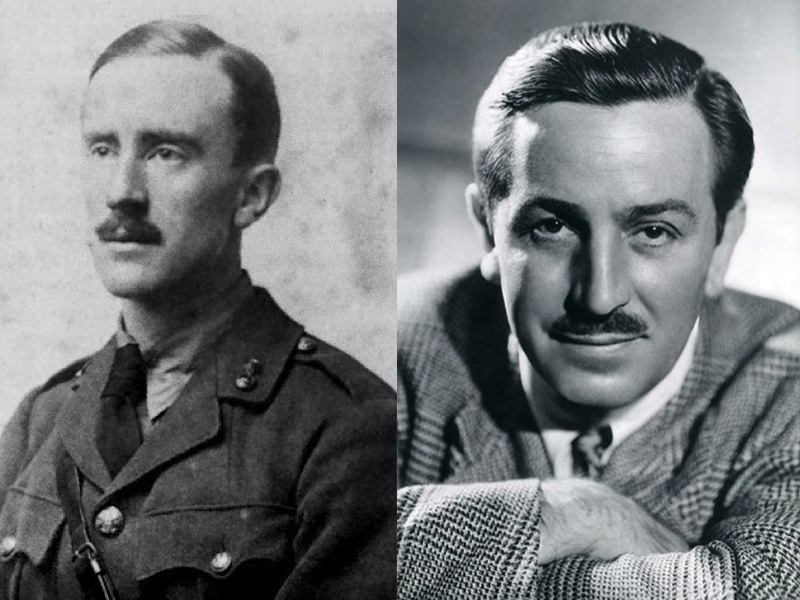
Image via Wikimedia Commons
I’ve just started reading J.R.R. Tolkien’s The Hobbit to my daughter. While much of the nuance and the references to Tolkienian deep time are lost on her, she easily grasps the distinctive charms of the characters, the nature of their journey, and the perils, wonders, and Elven friends they have met along the way so far. She is familiar with fairy tale dwarfs and mythic wizards, though not with the typology of insular, middle-class, adventure-averse country gentry, thus Hobbits themselves took a bit of explaining.
While reading and discussing the book with her, I’ve wondered to myself about a possible historical relationship between Tolkien’s fairy tale figures and those of the Walt Disney company which appeared around the same time. The troupe of dwarves in The Hobbit might possibly share a common ancestor with Snow White’s dwarfs—in the German fairy tale the Brothers Grimm first published in 1812. But here is where any similarity between Tolkien and Disney begins and ends.
In fact, Tolkien mostly hated Disney’s creations, and he made these feelings very clear. Snow White debuted only months after The Hobbit’s publication in 1937. As it happened, Tolkien went to see the film with literary friend and sometime rival C.S. Lewis. Neither liked it very much. In a 1939 letter, Lewis granted that “the terrifying bits were good, and the animals really most moving.” But he also called Disney a “poor boob” and lamented “What might not have come of it if this man had been educated—or even brought up in a decent society?”
Tolkien, notes Atlas Obscura, “found Snow White lovely, but otherwise wasn’t pleased with the dwarves. To both Tolkien and Lewis, it seemed, Disney’s dwarves were a gross oversimplification of a concept they held as precious”—the concept, that is, of fairy stories. Some might brush away their opinions as two Oxford dons gazing down their noses at American mass entertainment. As Tolkien scholar Trish Lambert puts it, “I think it grated on them that he [Disney] was commercializing something that they considered almost sacrosanct.”
“Indeed,” writes Steven D. Greydanus at the National Catholic Register, “it would be impossible to imagine” these two authors “being anything but appalled by Disney’s silly dwarfs, with their slapstick humor, nursery-moniker names, and singsong musical numbers.” One might counter that Tolkien’s dwarves (as he insists on pluralizing the word), also have funny names (derived, however, from Old Norse) and also break into song. But he takes pains to separate his dwarves from the common run of children’s story dwarfs.
Tolkien would later express his reverence for fairy tales in a scholarly 1947 essay titled “On Fairy Stories,” in which he attempts to define the genre, parsing its differences from other types of marvelous fiction, and writing with awe, “the realm of fairy story is wide and deep and high.” These are stories to be taken seriously, not dumbed-down and infantilized as he believed they had been. “The association of children and fairy-stories,” he writes, “is an accident of our domestic history.”
Tolkien wrote The Hobbit for young people, but he did not write it as a “children’s book.” Nothing in the book panders, not the language, nor the complex characterization, nor the grown-up themes. Disney’s works, on the other hand, represented to Tolkien a cheapening of ancient cultural artifacts, and he seemed to think that Disney’s approach to films for children was especially condescending and cynical.
He described Disney’s work on the whole as “vulgar” and the man himself, in a 1964 letter, as “simply a cheat,” who is “hopelessly corrupted” by profit-seeking (though he admits he is “not innocent of the profit-motive” himself).
…I recognize his talent, but it has always seemed to me hopelessly corrupted. Though in most of the ‘pictures’ proceeding from his studios there are admirable or charming passages, the effect of all of them is to me disgusting. Some have given me nausea…
This explication of Tolkien’s dislike for Disney goes beyond mere gossip to an important practical upshot: Tolkien would not allow any of his works to be given the Walt Disney treatment. While his publisher approached the studios about a Lord of the Rings adaptation (they were turned down at the time), most scholars think this happened without the author’s knowledge, which seems a safe assumption to say the least.
Tolkien’s long history of expressing negative opinions about Disney led to his later forbidding, “as long as it was possible,” any of his works to be produced “by the Disney studios (for all whose works I have a heartfelt loathing).” Astute readers of Tolkien know his serious intent in even the most comic of his characters and situations. Or as Vintage News’ Martin Chalakoski writes, “there is not a speck of Disney in any of those pages.”
Note: An earlier version of this post appeared on our site in 2018.
Related Content:
J.R.R. Tolkien Snubs a German Publisher Asking for Proof of His “Aryan Descent” (1938)
110 Drawings and Paintings by J.R.R. Tolkien: Of Middle-Earth and Beyond
J. R. R. Tolkien Writes & Speaks in Elvish, a Language He Invented for The Lord of the Rings
Josh Jones is a writer and musician based in Durham, NC.
Read More...An Introduction to Hilma af Klint: Once a Forgotten Painter, Now a Celebrated Pioneer of Abstract Art
If pressed to pick the most international art figure of the past dozen years, one could do much worse than the Swedish artist-mystic Hilma af Klint, despite her having been dead for more than 80 years now. As evidenced by the links at the bottom of the post, we’ve been featuring her here on Open Culture since 2017, first in the context of whether she counts as the first abstract painter. Just a few years before that, practically no one in the world had ever heard her name, let alone beheld any of her more than 1,200 paintings and drawings. In fact, it was only in 2013, with the show Hilma af Klint — A Pioneer of Abstraction at Stockholm’s Moderna Museet, that she first became publicly known.
From there, her canonization proceeded rapidly. One uses that word advisedly, given af Klint’s religiosity, whose intensity, esotericism, and rigor constitute one of the themes of Alice Gregory’s recent New Yorker piece on the artist’s work, legacy, and relatively newfound popularity, all of it colored by the fact that none of her pieces have ever been for sale.
The uncannily modern, before-its-time aesthetic appeal of af Klint’s work is one thing; the dearth of widespread knowledge about the details of her life and thought, which has allowed many of her suddenly avid twenty-first century fans to imagine her into their preferred artistic, philosophical, and social narratives, is another. Yet key to the fascination of her images is that, having been born in 1862, she wasn’t a twenty-first century woman.
Af Klint barely even belonged to the twentieth century, or indeed to any worldly time period at all. The complex and seemingly contradictory worldview that inspired her artwork is practically inaccessible to us, even if we manage to get through the 26,000 journal pages she left behind. Gregory interviews one such (and perhaps the only) dedicated individual, a nonprofit CEO and af Klint scholar dedicated to exploding the myths that have so readily accreted around her. One is that she worked alone: evidence suggests that some paintings attributed to her may actually have been executed by other members of her spiritualist circle, The Five. But even if she turns out not to have been a movement of one after all, her name will no doubt continue to sell out museum exhibitions for years to come.
Related content:
Discover Hilma af Klint: Pioneering Mystical Painter and Perhaps the First Abstract Artist
The Life & Art of Hilma Af Klint: A Short Art History Lesson on the Pioneering Abstract Artist
New Hilma af Klint Documentary Explores the Life & Art of the Trailblazing Abstract Artist
Based in Seoul, Colin Marshall writes and broadcasts on cities, language, and culture. His projects include the Substack newsletter Books on Cities and the book The Stateless City: a Walk through 21st-Century Los Angeles. Follow him on the social network formerly known as Twitter at @colinmarshall.
Read More...The Great Wave Off Kanagawa by Hokusai: An Introduction to the Iconic Japanese Woodblock Print in 17 Minutes
When woodcut artist Katsushika Hokusai made his famous print The Great Wave off Kanagawa in 1830 — part of the series Thirty-six Views of Mount Fuji — he was 70 years old and had lived his entire life in a Japan closed off from the rest of the world. In the 19th century, however, “the rest of the world was becoming industrialized,” James Payne explains above in his Great Art Explained video, “and the Japanese were concerned about foreign invasions.” The Great Wave shows “an image of Japan fearful that the sea — which has protected its peaceful isolation for so long — would become its downfall.”
It’s also true, however, that The Great Wave would not have existed without a foreign invasion. Prussian blue, the first stable blue pigment, accidentally invented around 1705 in Berlin, arrived in the ports of Nagasaki on Dutch and Chinese ships in the 1820s. Prussian Blue would start a new artistic movement in Japan, aizuri‑e, woodcuts printed in bright, vivid blues.
“Hokusai was one of the first Japanese printmakers to boldly embrace the colour,” Hugh Davies writes at The Conversation, “a decision that would have major implications in the world of art.” When the country’s isolationist policies ended in the 1850s, “a showcase at the inaugural Japanese Pavilion elevated the artistic status of woodblock prints and a craze for their collection quickly followed.”
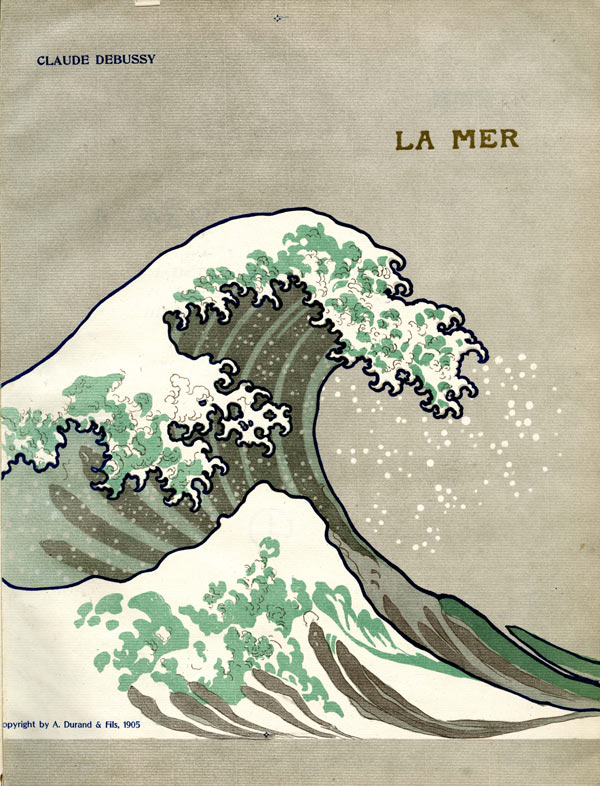
Chief among the works collected in the European and American fervor for Japanese prints were those from Hokusai, his contemporary Hiroshige, and other aizuri‑e artists. So famous was The Great Wave in the West by 1891 that French graphic artist Pierre Bonnard would satirize its stylish spray in an advertisement for champagne. A print of The Great Wave hung on Claude Debussy’s wall, and the first edition of his La Mer bore an adaptation of a detail from the print. As Michael Cirigliano writes for the Metropolitan Museum of Art:
Cultural circles throughout Europe greatly admired Hokusai’s work…. Major artists of the Impressionist movement such as Monet owned copies of Hokusai prints, and leading art critic Philippe Burty, in his 1866 Chefs-d’oeuvre des Arts industriels, even stated that Hokusai’s work maintained the elegance of Watteau, the fantasy of Goya, and the movement of Delacroix. Going one step further in his lauded comparisons, Burty wrote that Hokusai’s dexterity in brush strokes was comparable only to that of Rubens.
These comparisons are not misplaced, John-Paul Stonard explains in The Guardian: “That the Great Wave became the best known print in the west was in large part due to Hokusai’s formative experience of European art.” Not only did he absorb Prussian blue into his repertoire, but “prints from early in his career show him attempting, rather awkwardly, to apply the lesson of mathematical perspective, learnt from European prints brought into Japan by Dutch Traders.” By the time of The Great Wave, he had perfected his own synthesis of Western and Japanese art, over two decades before European painters would attempt the same in the explosion of Japanophilia of the late 19th and early 20th centuries.
Note: An earlier version of this post appeared on our site in 2021.
Related Content:
View 103 Discovered Drawings by Famed Japanese Woodcut Artist Katsushika Hokusai
Hokusai’s Action-Packed Illustrations of Japanese & Chinese Warriors (1836)
The Evolution of Hokusai’s Great Wave: A Study of 113 Known Copies of the Iconic Woodblock Print
Josh Jones is a writer and musician based in Durham, NC.
Read More...How a Dutch “Dementia Village” Improves Quality of Life with Intentional Design
People suffering from dementia lose their ability to take an active part in conversations, everyday activities, and their own physical upkeep.
They are prone to sudden mood swings, irritability, depression, and anxiety.
They may be stricken with delusions and wild hallucinations.
All of these things can be understandably upsetting to friends and families. There’s a lot of stigma surrounding this situation.
Taking care of a spouse or parent with dementia can be an overwhelmingly isolating experience, though no one is more isolated than the person experiencing severe cognitive decline firsthand.
While many of us would do anything to stay out of them, the sad fact is residential memory care facilities are often the end-of-the-line reality for those living with extreme dementia.
The Hogeweyk, a planned village just outside of Amsterdam, offers a different sort of future for those with severe dementia.
The above episode of By Design, Vox’s series about the intersection of design and technology, explores the innovations that contribute to the Hogeweyk’s residents’ overall happiness and wellbeing.
Rather than grouping residents together in a single institutional setting, they are placed in groups of six, with everyone inhabiting a private room and sharing common spaces as they see fit.
The common spaces open onto outdoor areas that can be freely enjoyed by all housed in that “neighborhood”. No need to wait until a staff member grants permission or finishes some task.
Those wishing to venture further afield can avail themselves of such pleasant quotidian destinations as a grocery, a restaurant, a barbershop, or a theater.
These locations are designed in accordance with certain things proven to work well in institutional settings — for instance, avoiding dark floor tiles, which some people with dementia perceive as holes.
But other design elements reflect the choice to err on the side of quality of life. Hand rails may help in preventing falls, but so do rollators and walkers, which the residents use on their jaunts to the town squares, gardens and public amenities.
The designers believe that equipping residents with a high level of freedom not only promotes physical activity, it minimizes issues associated with dementia like aggression, confusion, and wandering.
Co-founders Eloy van Hal and Jannette Spiering write that the Hogeweyk’s critics compare it to the Truman Show, the 1998 film in which Jim Carrey’s title character realizes that his wholesome small town life, and his every interaction with his purported friends, neighbors, and loved ones, have been a set up for a highly rated, hidden camera reality TV show.
They describe The Hogeweyk as a stage for, “the reminiscence world”, in which actors help the residents live in a fictitious world. Many Alzheimer’s experts have, however, valued The Hogeweyk for what it really is: a familiar and safe environment in which people with dementia live while retaining their own identity and autonomy as much as possible. They live in a social community with real streets and squares, a real restaurant with real customers, a supermarket for groceries and a theatre that hosts real performances. There is no fake bus stop or post office, there are no fake façades and sets. The restaurant employee, the handyman, the caretaker, the nurse, the hairdresser, etc.—in short: everyone who works at The Hogeweyk uses their professional skills to actually support the residents and are, therefore, certainly not actors.
Professional care and support goes on around the clock, but rarely takes centerstage. Normal life is prioritized.
A visitor describes a stroll through some of the Hogeweyk’s public areas:
In the shade of one of the large trees, a married couple gazes happily at the activity in the theatre square. An elderly gentleman, together with a young lady, intently study the large chess board and take turns moving the pieces. At the fountain, a group of women chat loudly on colourful garden chairs. The story is clearly audible—it is about a memory of a visit to a park in Paris which had the same chairs. Passers-by, old and young, greet the women enthusiastically. A little further on, a woman is talking to a man opposite her. She is gesturing wildly. After a while, another woman joins the conversation. The two women then walk through the open front door of Boulevard 15.
The covered passage smells of freshly-baked cookies. The scent is coming from De Bonte Hof. Amusing conversations can be heard that pause for a moment when the oven beeps in the kitchen that has been decorated in an old-fashioned style. A tray of fresh cookies is removed from the oven. Two women, one in a wheelchair, enter the venue, obviously seduced by the smell. They sample the cookies.
The supermarket across the street is very busy. Shopping trolleys loaded with groceries are pushed out of the shop. The rattle of a shopping trolley dissipates into the distance as it disappears from view towards Grote Plein. A man reluctantly pushes the full trolley while two women follow behind him arm in arm. The trio disappear behind the front door of Grote Plein 5.
A staffer’s account of a typical morning in one of Hogeweyk’s houses reveals more about the hands-on care that allows residents to continue enjoying their carefully designed home, and the autonomous lifestyle it makes possible:
Mr Hendricks wakes up on the sofa. He unzips his fly. I jump up and escort him to the toilet just in time. I grab a roll of medication for him from the medication trolley. He is now walking to his room. We pick out clothes together and I lay them out on his bed. He washes himself at the sink. I watch briefly before leaving. Fifteen minutes later, I poke my head through the door. That’s not how electric shaving works! I offer to help, but Mr. Hendricks is clearly a bit irritated and grumbles. He’ll be a little less shaven today. We’ll try again after breakfast…
We help Mrs Stijnen into the shower chair with the hoist. She is clearly not used to it. Discussing her extensive Swarovski collection, displayed in the glass case in her room, turns out to be an excellent distraction. She proudly talks about the latest piece she acquired this year. On to the shower. The two other residents are still sleeping. Great, that gives me the chance to devote some extra time to Mrs Stijnen today.
The doorbell rings again and my colleague, Yasmin, walks in. She’s the familiar face that everyone can rely on. Always present at 8 a.m., 5 days a week. What a relief for residents and family. She, too, puts her coat and bag in the locker. The washing machine is ready, and Yasmin loads up the dryer. The table in the dining room is then set. Yasmin puts a floral tablecloth from the cupboard on the table. Mr Hendricks lends a hand and, with some guidance, puts two plates in their place, but then walks away to the sofa and sits down. A Dutch breakfast with bread, cheese, cold cuts, jam, coffee, tea and milk is served. Yasmin is making porridge for Mrs Smit. As always, she has breakfast in bed. Yasmin helps Mrs Smit. It is now 08:45 and Mr Hendricks and Mrs Stijnen are sitting at the dining table. Yasmin pushes the chairs in and sits down herself. They chat about the weather, and Yasmin lends a helping hand when needed.
Mr Hendricks is really grumpy today and is currently grumbling at Mrs Jansen. I’m wondering if we’re overlooking something?
Learn more about the Hogeweyk, the world’s first dementia village here.
Watch a playlist of Vox By Design episodes here.
Note: An earlier version of this post appeared on our site in 2022.
Related Content
How Music Can Awaken Patients with Alzheimer’s and Dementia
Dementia Patients Find Some Eternal Youth in the Sounds of AC/DC
- Ayun Halliday is the Chief Primatologist in NYC.
Read More...Why Overconfidence Is Our Most Dangerous Cognitive Bias
In the two-thousands, the magician-comedians Penn and Teller hosted a television series called Bullshit! In it, they took on a variety of cultural phenomena they regarded as worthy of the titular epithet, from ESP to Area 51, exorcism to creationism, feng shui to haute cuisine. Their sardonic arguments were enriched by clips of assorted interviewees —speaking in defense of the topic of the day. Penn once addressed the viewers, saying that we might wonder why anyone agrees to come on the show, given how they must know it will make them come off. But everyone, he explained, confidently believes that their own ideas are the correct ones.
That episode came right to mind while watching the new Veritasium video above, which deals with the phenomenon of overconfidence. Like the oft-cited 93 percent of Americans who believe themselves better drivers than the median, we all fall victim to that affliction at one time or another, to one degree or another; the more interesting matter under investigation is why that should be so.
One can always point to what T. S. Eliot called “the endless struggle to think well of themselves”: wanting to believe that we know it all, we take pains to present ourselves as if we do. But as explained by the professors interviewed here, Carnegie Mellon’s Baruch Fischhoff and Berkeley’s Don A. Moore (author of Perfectly Confident: How to Calibrate Your Decisions Wisely), the research has also revealed other potential factors in play.
One important candidate is, as ever, stupidity. Much has been made of the Dunning-Kruger effect, previously featured here on Open Culture, which holds that the less competent people are at a task, the more confident they tend to be about their ability to perform it. That would seem to accord with much of our everyday experience, but we should also consider the role played by the basic cognitive limitations that apply to us all. Our brains can only process so much at once, and when they come up against capacity, they default to simplified, and often too-simplified, versions of the problem before them. It all becomes more difficult if we’re insulated from direct, objective feedback, a condition that often results from the kind of success and esteem that can be achieved by projecting — you guessed it — confidence.
Related content:
Why Incompetent People Think They’re Competent: The Dunning-Kruger Effect, Explained
Based in Seoul, Colin Marshall writes and broadcasts on cities, language, and culture. His projects include the Substack newsletter Books on Cities and the book The Stateless City: a Walk through 21st-Century Los Angeles. Follow him on the social network formerly known as Twitter at @colinmarshall.
Read More...AC/DC Plays a Short Gig at CBGB in 1977: Hear Metal Being Played on Punk’s Hallowed Grounds
Punk rock and heavy metal were two genres that evolved over the ‘70s, but seemed to run parallel to each other, despite sharing common fashion, sounds, and attitudes. But then there are moments in history, where everybody plays together in the same sandbox. For example, the above remastered audio, which captures the Australian band AC/DC on their first American tour, playing New York’s CBGB, synonymous now with punk and new wave music.
The date is August 24, 1977, and AC/DC were on a cross-country trip that had taken in both club dates and arenas, where they supported—yes, hard to believe, I know—REO Speedwagon. Their album Let There Be Rock had just dropped in June. The band would be in the States until the winter.
This CBGB gig finds them on the same bill as Talking Heads and the Dead Boys, according to a poster from the time. And while there’s no video for this show, you can find a few photos that document the concert here. You can feel the muggy New York summer in these photos, but also the excitement of an unforgettable gig.
At 15 minutes, the set is short, but still three minutes longer than the Ramones’ first set at the same club three years earlier. That’s pretty metal, man.
Note: An earlier version of this post appeared on our site in 2016.
Related Content:
Listen to Patti Smith’s Glorious Three Hour Farewell to CBGB’s on Its Final Night
The Talking Heads Play CBGB, the New York Club That Shaped Their Sound (1975)
Watch an Episode of TV-CBGB, the First Rock ‘n’ Roll Sitcom Ever Aired on Cable TV (1981)
Ted Mills is a freelance writer on the arts.
Read More...Why Your Vision of Ancient Rome Is All Wrong, According to Historian Mary Beard
Everyone in ancient Rome wore togas, surrounded themselves with pure-white marble statues, bayed for blood as gladiators fought to the death in the Colosseum, programmatically imitated the Greeks, and, after each and every debaucherous feast, excused themselves to the vomitoria, where they ritually vacated their stomachs. Or at least that’s the picture any of us here in the twenty-first century might piece together out of the impressions we happen to receive from a steady flow of sword-and-sandals movies and TV shows — not to mention the countless references that popular culture makes to the Roman Empire, which inevitably make their way into the consciousness even of those of us who don’t think about it every day.
In the new, almost 80-minute Big Think interview above, Mary Beard explains some of the ways in which we’ve been “picturing ancient Rome all wrong.” The ancient Romans lived in a world in which men kissed each other as a standard greeting (at least until a massive outbreak of herpes put a stop to it it), statuary was painted in all manner of garish colors (though just how garish remains a matter of scholarly inquiry), citizens rich enough to wear togas needed the assistance of slaves even to get dressed in the morning, and Greece took cultural influence as well as gave it. These may not yet be features of the Rome we imagine, but they could be if we make a habit of listening to Beard’s new podcast Instant Classics.
Whatever liberties they take, the depictions of the Roman Empire that entertain us today also remind us that, as Beard puts it, “Rome has never gone away in the modern world.” Nowhere is that clearer than in ever-more-frequent discussions about the fate of modern global powers. If we look at our surroundings and see Rome, perhaps that’s because the Eternal City has “given us an image of what it is to be powerful, what it is to be larger than life, what it is to be funny, what it is to be an empire, so it’s provided many of the building blocks we need to think about ourselves.” Even if we’re not the modern equivalents of Augustus, Virgil, Cicero, or even Nero — to name a few of the Romans Beard name as, for better or worse, the most important — we could all stand to make our image of Roman life a little more realistic.
Related Content:
Empire Without Limit: Watch Mary Beard’s TV Series on Ancient Rome
The History of Ancient Rome in 20 Quick Minutes: A Primer Narrated by Brian Cox
A Map Showing How the Ancient Romans Envisioned the World in 40 AD
Mythology Expert Reviews Depictions of Greek & Roman Myths in Popular Movies and TV Shows
Based in Seoul, Colin Marshall writes and broadcasts on cities, language, and culture. His projects include the Substack newsletter Books on Cities and the book The Stateless City: a Walk through 21st-Century Los Angeles. Follow him on the social network formerly known as Twitter at @colinmarshall.
Read More...How Paris Became Paris: The Story Behind Its Iconic Squares, Bridges, Monuments & Boulevards
Even today, the Paris of the popular imagination is, for the most part, the Paris envisioned by Baron Georges-Eugène Haussmann and made a reality in the eighteen-fifties and sixties. Not that he could order the city built whole: as explained by Manuel Bravo in the new video above, Paris had already existed for about two millennia, growing larger, denser, and more intricate all the while. But as the prefect under Emperor Napoleon III, Haussmann was empowered to carve it up by force, opening “dozens of wide, long avenues that connected important parts of the city,” a layout that “mirrored the street system in Rome created 300 years earlier by Pope Sixtus V, but on a much grander scale.”
However considerable the violence it did to medieval Paris, this process of “Haussmannization” showed a certain historical consciousness. After all, the French capital was once a Roman city: Lutetia Parisorum, named for the Parisii, the Gallic tribe that had inhabited the island in the middle of the Seine that Parisians now call Île de la Cité.
As was their usual modus operandi, the conquering Romans laid a cardo maximus running from north to south, today known as Rue Saint-Jacques. Thereafter, “the rest of the original layout was lost to organic growth.” In the form Paris eventually took in the Middle Ages, “there were no public urban spaces of major significance”: no Place Dauphine, no Place des Vosges, no Place Vendôme.
Those very same Parisian squares now enjoyed by locals and tourists alike did much to develop the expectation of “aesthetic unity” in the city’s built environment, and a couple of centuries before Haussmann at that. It may not be a complete exaggeration to call Paris frozen in the Baron’s mid-nineteenth century, but as Bravo explains, a close examination of both the city’s celebrated spaces and overall form reveals the ways in which a much deeper past has done its part to shape or inspire them. An enthusiast of urban history can spend weeks, months, or even years appreciating the details that remind us that the palimpsest of Paris has never quite been overwritten, even in a place as unrelentingly examined — if seldom truly seen — as the Louvre.
Related Content:
A 3D Animation Reveals What Paris Looked Like When It Was a Roman Town
Take an Aerial Tour of Medieval Paris
The Architectural History of the Louvre: 800 Years in Three Minutes
A 5‑Hour Walking Tour of Paris and Its Famous Streets, Monuments & Parks
Venice Explained: Its Architecture, Its Streets, Its Canals, and How Best to Experience Them All
Based in Seoul, Colin Marshall writes and broadcasts on cities, language, and culture. His projects include the Substack newsletter Books on Cities and the book The Stateless City: a Walk through 21st-Century Los Angeles. Follow him on the social network formerly known as Twitter at @colinmarshall.
Read More...Aleister Crowley Reads Occult Poetry in the Only Known Recordings of His Voice (1920)

Image by Jules Jacot Guillarmod, via Wikimedia Commons
In 2016, we brought you a rather strange story about the rivalry between poet William Butler Yeats and magician Aleister Crowley. Theirs was a feud over the practices of occult society the Hermetic Order of the Golden Dawn; but it was also—at least for Crowley—over poetry. Crowley envied Yeats’ literary skill; Yeats could not say the same about Crowley. But while he did not necessarily respect his enemy, Yeats feared him, as did nearly everyone else. As Yeats’ biographer wrote a few months after Crowley’s death in 1947, “in the old days men and women lived in terror of his evil eye.”
The press called Crowley “the wickedest man in the world,” a reputation he did more than enough to cultivate, identifying himself as the Anti-Christ and dubbing himself “The Beast 666.” (Crowley may have inspired the “rough beast” of Yeats’ “The Second Coming.”) Crowley did not achieve the literary recognition he desired, but he continued to write prolifically after Yeats and others ejected him from the Golden Dawn in 1900: poetry, fiction, criticism, and manuals of sex magic, ritual, and symbolism—some penned during famed mountaineering expeditions.
Throughout his life, Crowley was variously a mountaineer, chess prodigy, scholar, painter, yogi, and founder of a religion he called Thelema. He was also a heroin addict and by many accounts an extremely abusive cult leader. However one comes down on Crowley’s legacy, his influence on the occult and the counterculture is undeniable. To delve into the history of either is to meet him, the mysterious, bizarre, bald figure whose theories inspired everyone from L. Ron Hubbard and Anton LaVey to Jimmy Page and Ozzy Osbourne.
Without Crowley, it’s hard to imagine much of the dark weirdness of the sixties and its resulting flood of cults and esoteric art. For some occult historians, the Age of Aquarius really began sixty years earlier, in what Crowley called the “Aeon of Horus.” For many others, Crowley’s influence is inexplicable, his books incoherent, and his presence in polite conversation offensive. These are understandable attitudes. If you’re a Crowley enthusiast, however, or simply curious about this legendary occultist, you have here a rare opportunity to hear the man himself intone his poems and incantations.
“Although this recording has previously been available as a ‘Bootleg,’” say the CD liner notes from which this audio comes, “this is its first official release and to the label’s knowledge, contains the only known recording of Crowley.” Recorded circa 1920 on a wax cylinder, the audio has been digitally enhanced, although “surface noise may be evident.” (Stream them above, or on this YouTube playlist here.) Indeed, it is difficult to make out what Crowley is saying much of the time, but that’s not only to do with the recording quality, but with his cryptic language. The first five tracks comprise “The Call of the First Aethyr” and “The Call of the Second Aethyr.” Other titles include “La Gitana,” “The Pentagram,” “The Poet,” “Hymn to the American People,” and “Excerpts from the Gnostic Mass.”
It’s unclear under what circumstances Crowley made these recordings or why, but like many of his books, they combine occult liturgy, mythology, and his own literary utterances. Love him, hate him, or remain indifferent, there’s no getting around it: Aleister Crowley had a tremendous influence on the 20th century and beyond, even if only a very few people have made serious attempts to understand what he was up to with all that sex magic, blood sacrifice, and wickedly bawdy verse.
Note: An earlier version of this post appeared on our site in 2017.
Related Content:
Josh Jones is a writer and musician based in Durham, NC. Follow him at @jdmagness
Read More...Watch 50 David Bowie Music Videos Spanning Five Decades of Reinvention: “Space Oddity,” “Life on Mars?” “ ‘Heroes’,” “Let’s Dance” & More
Each of us has a different idea of when, exactly, the sixties ended, not as a decade, but as a distinct cultural period. Some have a notion of the “long sixties” that extends well into the seventies; if pressed for a specific final year, they could do worse than pointing to 1972, when David Bowie made his epoch-shifting appearance as Ziggy Stardust, backed by the Spiders from Mars, on the BBC’s Top of the Pops. It was also the year he released music videos for “Space Oddity,” the single that had begun to make his name at the time of the moon landing in 1969, and “Jean Genie,” the first single from Aladdin Sane, an album inspired in part by the debauchery of the American Ziggy tour he undertook after blasting off into stardom.
Having struggled in the sixties to find a suitable identity and audience, the young Bowie developed an unusually strong understanding of not just the music industry, but also the culture itself. One era was giving way to another, and nobody knew it better than he did. When all those hirsute figures in beards and denim, singing with ostentatious earnestness about love and freedom, disappeared, who would replace them?
In Bowie’s vision, the next phase belonged to clean-shaven, made-up androgynes in flamboyant designer costumes working grand, sometimes science fictional, and often inscrutable themes into what would strike concertgoers as almost complete theatrical experiences — and he would be the first and foremost among them.
Bowie, in other words, made the seventies his own, operating on his knowledge of and instincts about the media environment of that decade and how images would be made in it. By that time, he’d seen too many flashes in the pan of pop music to get complacent about his own prospects for endurance. The reception of “Space Oddity” as a novelty song did its part to motivate him to come up with his bisexual space-alien rock-star alter ego — and to motivate him to terminate that persona on stage in 1973. A couple of years before that, he had already sung of the importance of changes, a kind of manifesto that would guide his career through all the decades that remained. Never would Bowie adhere to a particular musical or aesthetic style for very long, an abiding tendency vividly on display in this playlist of 50 music videos on his official YouTube channel.
The experience of putting out music videos in the seventies placed Bowie well, especially compared to other artists of his generation, to make his mark on MTV in the eighties with a stadium-ready hit like “Let’s Dance.” The nineties found him taking the form in new directions, as with the cinephilically astute video for “Jump They Say” and the daringly action-free visual treatment of the reflective “Thursday’s Child” (from the album Hours…, which began as the soundtrack to the computer game Omikron: The Nomad Soul). Apart from this playlist, his channel also contains music videos for his later songs from the two-thousands and twenty-tens, from “New Killer Star” to “The Stars (Are Out Tonight)” to “Blackstar” — the nature of stardom having been a preoccupation since the beginning, even though he kept on changing to the very end.
Related Content:
Watch David Bowie Star in His First Film Role, a Short Horror Flick Called The Image (1967)
Watch David Bowie’s New Video for “The Stars (Are Out Tonight)” With Tilda Swinton
When Bowie & Jagger’s “Dancing in the Street” Music Video Becomes a Silent Film
Based in Seoul, Colin Marshall writes and broadcasts on cities, language, and culture. His projects include the Substack newsletter Books on Cities and the book The Stateless City: a Walk through 21st-Century Los Angeles. Follow him on the social network formerly known as Twitter at @colinmarshall.
Read More...Support Us
We're hoping to rely on loyal readers, rather than erratic ads. Please click the Donate button and support Open Culture. You can use Paypal, Venmo, Patreon, even Crypto! We thank you!

About Us

Open Culture scours the web for the best educational media. We find the free courses and audio books you need, the language lessons & educational videos you want, and plenty of enlightenment in between.
Advertise With Us

FREE UPDATES!
GET OUR DAILY EMAIL
Get the best cultural and educational resources on the web curated for you in a daily email. We never spam. Unsubscribe at any time.
FOLLOW ON SOCIAL MEDIA

Open Culture editor Dan Colman scours the web for the best educational media. He finds the free courses and audio books you need, the language lessons & movies you want, and plenty of enlightenment in between.
Advertise With Us


