Beautiful New Photo Book Documents Patti Smith’s Breakthrough Years in Music: Features Hundreds of Unseen Photographs
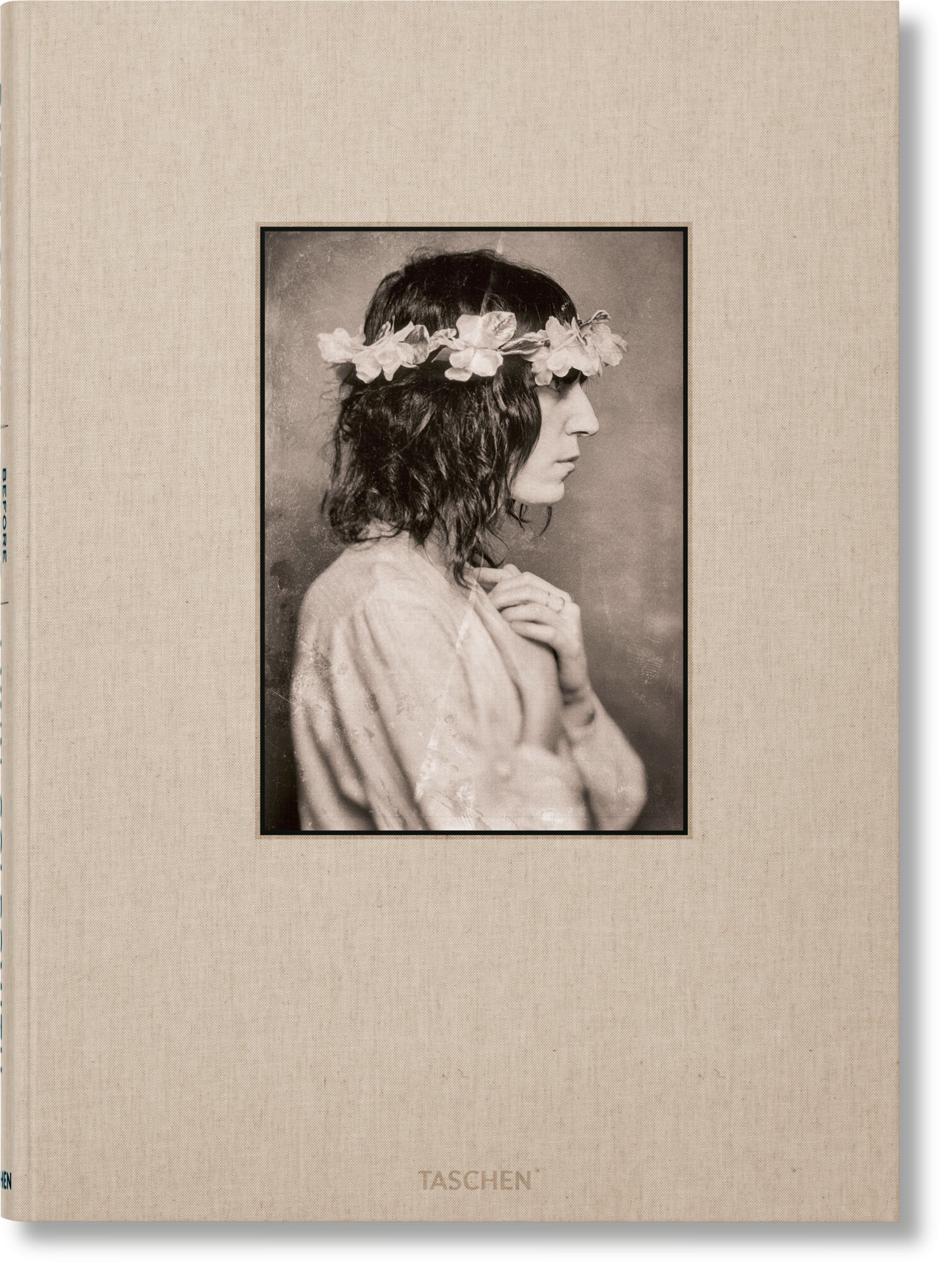
Patti Smith is always surprising her fans with new work and new opportunities to admire her commitment to art and activism. If she isn’t publishing another memoir, or leading 250 people in a protest song, she’s showing her photographs, which she’s taken since the 60s, with Polaroid cameras and a German Minox 35EL. “I am not a photographer,” she says, “yet taking pictures has given me a sense of unity and personal satisfaction. They are relics of my life. Souvenirs of my wandering.” She surprised her fans once again by putting her treasury of pictures on Instagram.
But as comfortable as Smith has been behind the camera, she has been even more relaxed in front of it: “widely regarded as a style icon,” writes Stephanie Eckardt at W magazine, “she’s been a magnet for photographers almost immediately” after she arrived in New York “to hang around CBGB’s and pose for Robert Mapplethorpe.”
She appeared in plenty of photos with Mapplethorpe when the two were just kids. Photographer Frank Stefanko captured her bohemian lounging in the 60s and 70s in stark black and white. (When he first encountered her in South Jersey, he says, she looked like “the bad guy walking into a saloon in an old Western movie.”)

“There are many photographers who have photographed Patti who are wonderful artists,” writes Lynn Goldsmith, whose own striking photographic record of Smith’s career is now being published in a new book by Taschen titled Before Easter After. Unlike Goldsmith, however, “they did not do documentary as well as concert as well as studio work with her. So that enabled Patti and I to have a narrative in the book that we could share with people of what was going on at that time.”
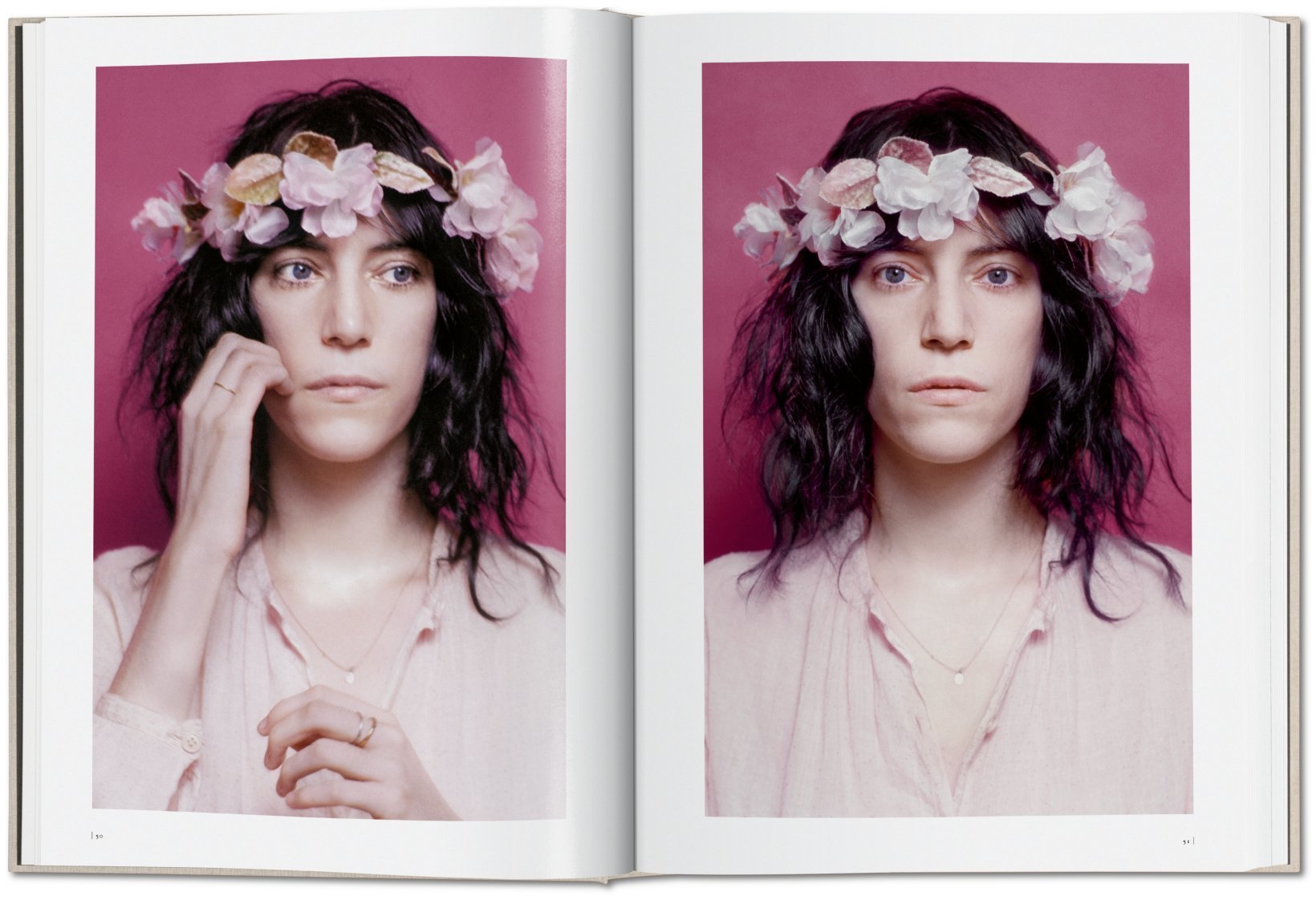
Smith describes what was going on with her usual casual lyricism:
We traipsed the path of rock ‘n’ roll, savouring its swagger, yet dodging the pitfalls. [Lynn] witnessed formative nights at CBGBs, gaining ground across America, my accident in a Tampa arena, and the struggle to rise again.
She refers to her fall offstage in 1977 while the band toured their album Radio Ethiopia. She broke her neck and spent the year recovering. Goldsmith captured the tragic event: “I saw her nearing the edge of the stage, but I thought she knew what she was doing because she always did this turning dervish on that song, where she spun and spun and spun.” The following year, the band released Easter, their third and “most widely known and distributed” album, notes AnOther, and Goldsmith nervously shot Smith onstage at CBGBs in a neck brace.
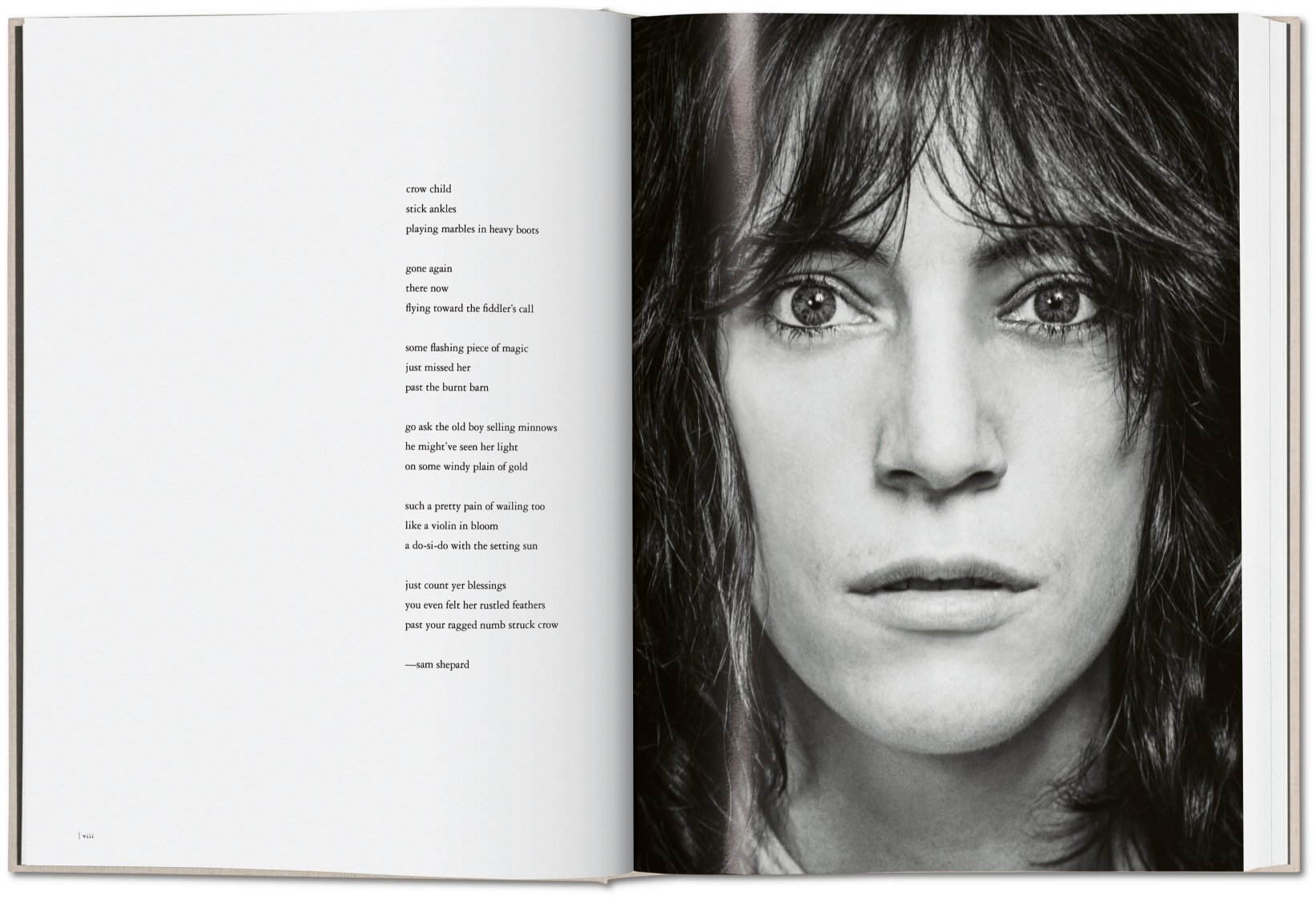
The photographer surprised Smith by asking her longtime friend Sam Shepard to write a poem for the book inspired by the 1977 photo above. And at the book’s October 8th launch party, which included Henry Rollins, Rosanna Arquette, Moon Zappa, and John Densmore, Smith surprised her 150 guests by playing a set of songs “inspired by Goldsmith’s previous unseen photographs of the transformative period documented in the book,” writes Taschen. “She ended her set with her best-known hit ‘Because the Night’ from the album Easter… joined in song by every person in the room.”
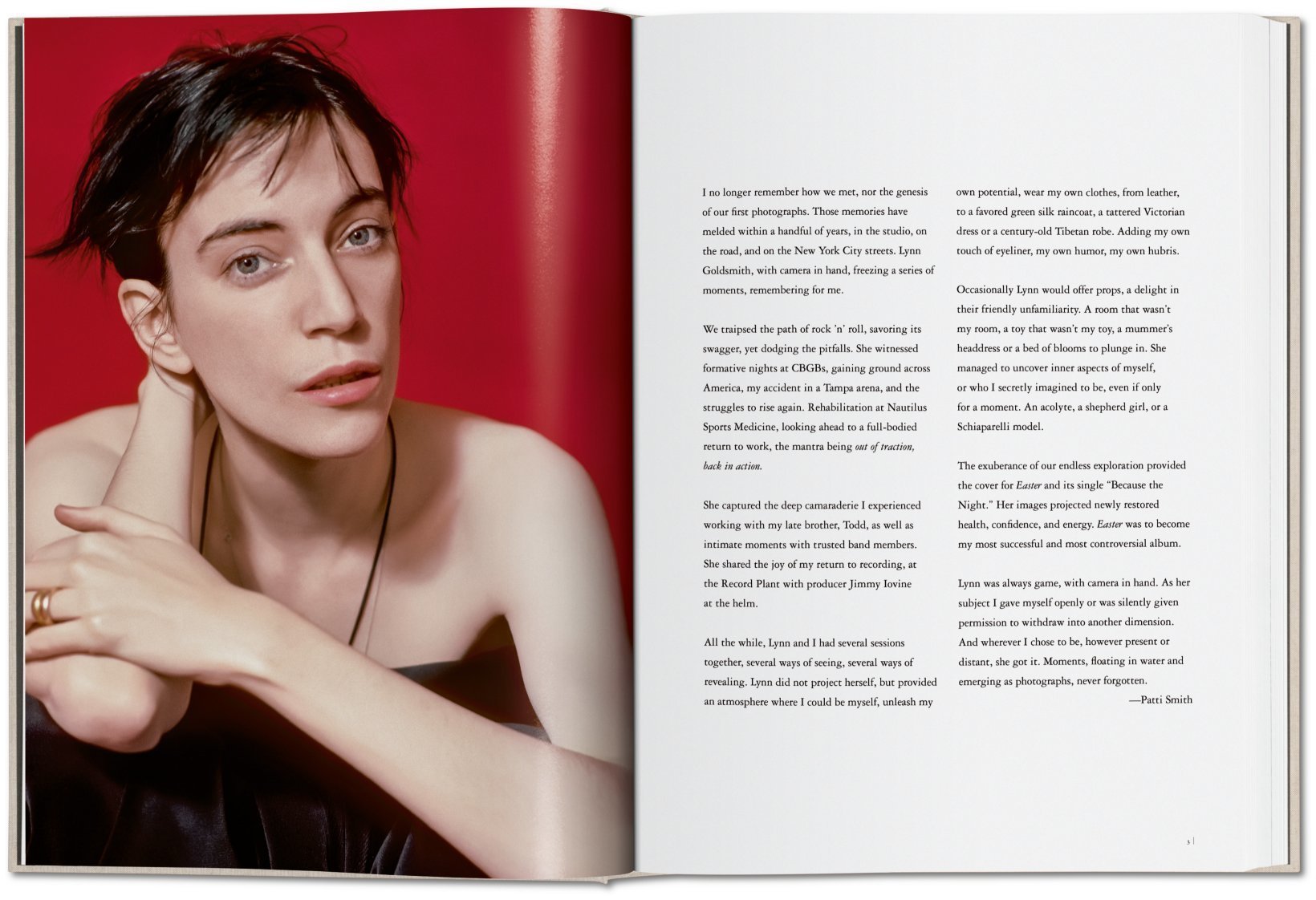
The book is available in a pricey edition from Taschen. Here’s hoping they’ll surprise Patti Smith fans for the holidays with a paperback.
Related Content:
Patti Smith, The Godmother of Punk, Is Now Putting Her Pictures on Instagram
Patti Smith Sings “People Have the Power” with a Choir of 250 Fellow Singers
Patti Smith’s 40 Favorite Books
Josh Jones is a writer and musician based in Durham, NC. Follow him at @jdmagness
Read More...A Flowchart of Philosophical Novels: Reading Recommendations from Haruki Murakami to Don DeLillo
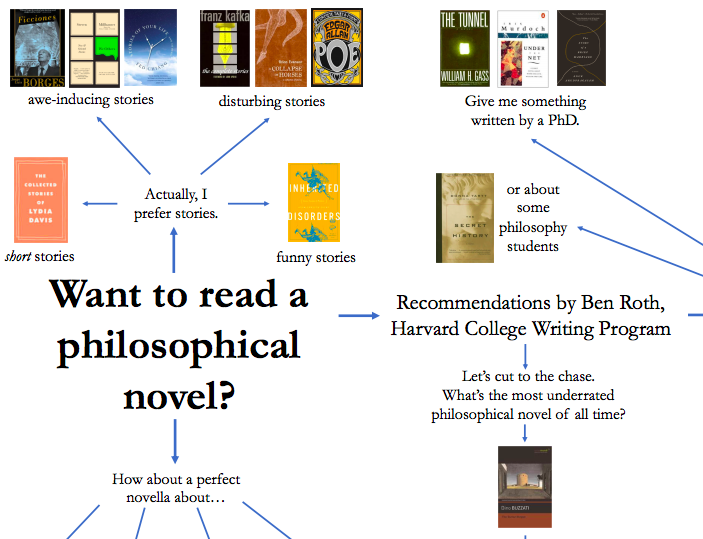
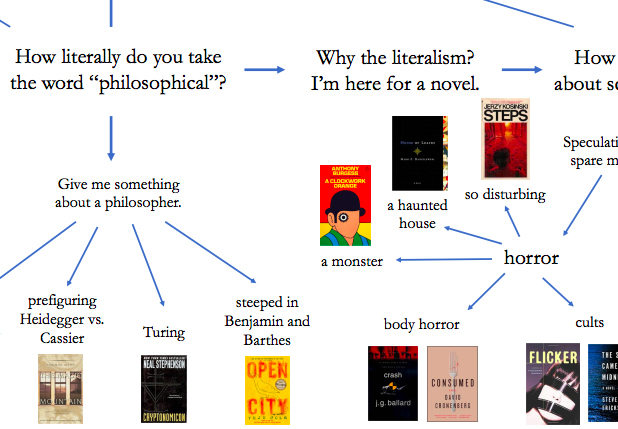
Do you want to read a philosophical novel? Sure, we all do. But the question of exactly what kind of philosophical novel you want to read, let alone which individual book, isn’t quite so easily answered. But now a professional has come to the rescue: “Ben Roth, a philosopher who teaches in the Harvard College Writing Program, has put together a kind of flowchart recommending philosophical novels and stories,” reports Daily Nous’ Justin Weinberg. “With categories like ‘about a philosopher,’ ‘by a Ph.D.,’ ‘horror,’ ‘the complications of history,’ and many more, the chart is pretty big.”
The choices you make in navigating it could land you on the work of a writer from one of a variety of countries, one of several eras, and one of a capacious range of definitions of “philosophical.” If you take the word in the sense of a novel’s being about or steeped in the work of a particular philosopher, Roth recommends books like Thomas Bernhard’s Correction (Wittgenstein) and Teju Cole’s Open City (Benjamin and Barthes). Elsewhere on the map he also includes novels written by philosophically credentialed academics like William Gass, Iris Murdoch, and Anuk Arudpragasam.
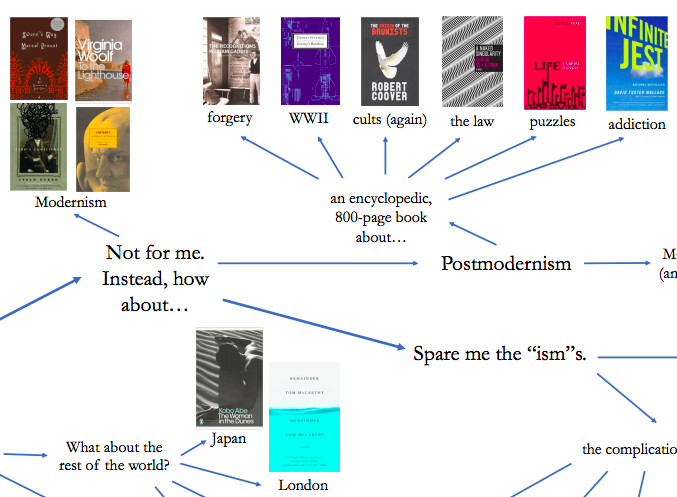
If you prefer novels where “fiction writers drop into straight essayistic mode,” Roth offers a choice between the easy mode of Milan Kundera’s The Unbearable Lightness of Being and the hard mode of Robert Musil’s The Man Without Qualities. (If you just wanted to read about a bunch of philosophy students, well, there’s always Donna Tartt’s The Secret History.)
To those who go in for more “novelly novels,” as Geoff Dyer (a known Bernhard enthusiast and author of some pretty philosophical fiction himself) memorably put it, Roth presents more forks in the road: Would you like to read science fiction? Existentialism? Postmodernism? A book free of ‑isms entirely, or anyway as free as possible?
Your answers to those questions and others could have you reading anything from J.G. Ballard’s Crash (“body horror”) to Jean-Paul Sartre’s Nausea (“mid-century French classic”) to David Foster Wallace’s Infinite Jest (postmodern, encyclopedic, on addiction). Other choices may lead you to selections less obviously involved with philosophy: J.M. Coetzee’s Waiting for the Barbarians, or Virginia Woolf’s To the Lighthouse, Haruki Murakami’s Hard-Boiled Wonderland and the End of the World. Of course, you may not want to read a philosophical novel at all: you may want to read philosophical short stories, in which case Roth recommends such form-defining figures as Edgar Allan Poe, writer of “disturbing stories”; Lydia Davis, writer of “short stories” (emphasis his); and Jorge Luis Borges, writer of “awe-inducing stories.”
Borges and quite a few other names on Roth’s philosophical-novel flowchart also appear in critic David Auerbach’s “Inquest on Left-Brained Literature,” a revealing look at the authors read by “engineers with a literary bent.” Both also include Don DeLillo, whose work Auerbach characterizes as making “heavy use of phantasmagoria, complemented by very sophisticated narrative construction,” and “simple, visceral, classical themes approached in [a] flashy, novel way.” Roth, for his part, describes DeLillo’s White Noise as his “favorite book ever.” Elsewhere on the flowchart, to the philosophical literature enthusiast who’s read everything he offers “the most underrated philosophical novel of all time,” Dino Buzzati’s The Tartar Steppe. No, I haven’t heard of it either, but I have to admit that it keeps good company.
Related Content:
Jorge Luis Borges Selects 74 Books for Your Personal Library
R. Crumb Illustrates Jean-Paul Sartre’s Nausea: Existentialism Meets Underground Comics
44 Essential Movies for the Student of Philosophy
Based in Seoul, Colin Marshall writes and broadcasts on cities, language, and culture. His projects include the book The Stateless City: a Walk through 21st-Century Los Angeles and the video series The City in Cinema. Follow him on Twitter at @colinmarshall or on Facebook.
Read More...Pretty Much Pop #16 Considers the Sitcom “Friends” 25 Years Later

Mark Linsenmayer, Erica Spyres, and Brian Hirt examine the conventions, techniques, and staying power of the beloved ’90s sitcom. Are we supposed to identify with, or idolize, or merely like these people? What makes the formula work, did it sustain itself over its 10-year run, was it successfully replicated (like by How I Met Your Mother or by Chuck Lorre?), and what parts haven’t aged well?
We reviewed a ton of articles to prep for this that you may want to read:
- “What the Critics Said About the 1994 Debut of Friends” by Margaret Lyons
- “‘Friends’ Is Turning 25. Here’s Why We Can’t Stop Watching It” by Wesley Morris
- “Why ‘Friends’ Is Still the World’s Favourite Sitcom, 25 Years On” by J.T. (at The Economist)
- “‘Friends’ Is Getting Old. Its Fans Have Never Been Younger” by Andrew Dalton
- “Friends Was a Great Show — That Just Happened to Ruin TV Comedy” by Emily Todd VanDerWerff
- “‘Friends’ Hasn’t Aged Well” by Scaachi Koul
- “‘Fat Monica’ Is the Ghost That Continues to Haunt Friends 25 Years Later” from Entertainment Weekly (no byline)
- “Friends at 25: Is the Sitcom Really as Problematic as People Say? Stylist Investigates” by Kayleigh Dray
- “Don’t Knock Friends. It’s Still Relevant, and Progressive, Too” by Sarah Gosling
- “Why ‘Friends’ Won’t Get Rebooted” by Saul Austerlitz
- “A Party Room and a Prison Cell Inside the Friends Writers’ Room” by Saul Austerlitz
- “Television Without Pity” by Christopher Nixon
- “‘Friends’ Creator Regrets One Of The Show’s Problematic Elements” by Nick Levine
This episode includes bonus discussion that you can only hear by supporting the podcast at patreon.com/prettymuchpop. This podcast is part of the Partially Examined Life podcast network.
Pretty Much Pop is the first podcast curated by Open Culture. Browse all Pretty Much Pop posts or start with the first episode.
Read More...Discover the Persian 11th Century Canon of Medicine, “The Most Famous Medical Textbook Ever Written”
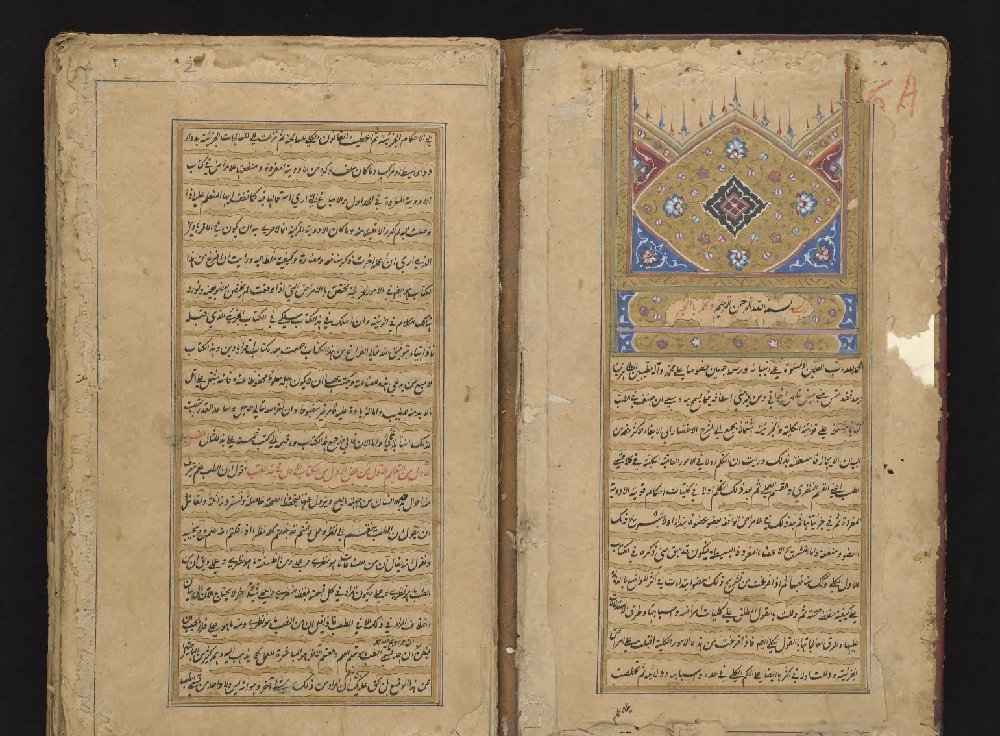
It may never lend a catchy title to a steamy TV hospital drama, but Avicenna’s 11th-century Canon of Medicine has the distinction of being “the most famous medical textbook ever written.” It has remained, as William Osler wrote in a 1918 Yale lecture, “a medical bible for a longer time than any other work.” Completed in 1025, the compendium drew Greek, Roman, Arabic, Indian, and Chinese medical science together in five dense volumes of material informed by the theories of Galen and structured by the systematic philosophy of Aristotle, whom Avicenna (Abū-ʿAlī al-Ḥusayn ibn-ʿAbdallāh Ibn-Sīnā) called “The First Teacher.”
Translated into Latin in the 12th century and “often revised,” the Canon, notes the Stanford Encyclopedia of Philosophy, “formed the basis of medical instruction in European Universities until the 17th century.” A copy of excerpts from the text has even been found translated into 15th-century Irish, demonstrating a link between medieval Ireland and the Islamic world. Avicenna’s influence generally on the intellectual culture of medieval and early modern Europe and the Arab-speaking world can hardly be overstated.
Born in 980 A.D., the Persian philosopher and physician was instrumental in the recovery of Hellenic thought, first in the Islamic world, then later in Europe. He took to the study of medicine very early in his extraordinary career. “I became proficient in it in the shortest time,” he says, “until the excellent scholars of medicine began to study under me.” He also became a practicing physician, inspired by a desire to put his learning to the test. “Through my experiences I acquired an amazing practical knowledge and ability in methods of treatment.”
The practical knowledge in The Canon of Medicine was largely the basis for its continued use for centuries. It lays out rules for drug testing, which include an insistence on human trials and the importance of conducting multiple experiments and showing consistent results across cases. Like most classical scientific texts, it weaves empirical observation with metaphysics, theology, scholastic speculation, and cultural biases particular to its time and place. But the practical outlines of its medical knowledge transcend its archaisms.
The work presents “an integrated view of surgery and medicine,” notes the Journal of the Royal Society of Medicine. In addition to his imminently useful guide for assessing the effects of drugs, Ibn Sina tells his readers “how to judge the margin of healthy tissue to remove with an amputation,” an intervention that has saved countless numbers of lives. “The enduring respect in the 21st century for a book written a millennium earlier is testimony to Ibn Sina’s achievement.”
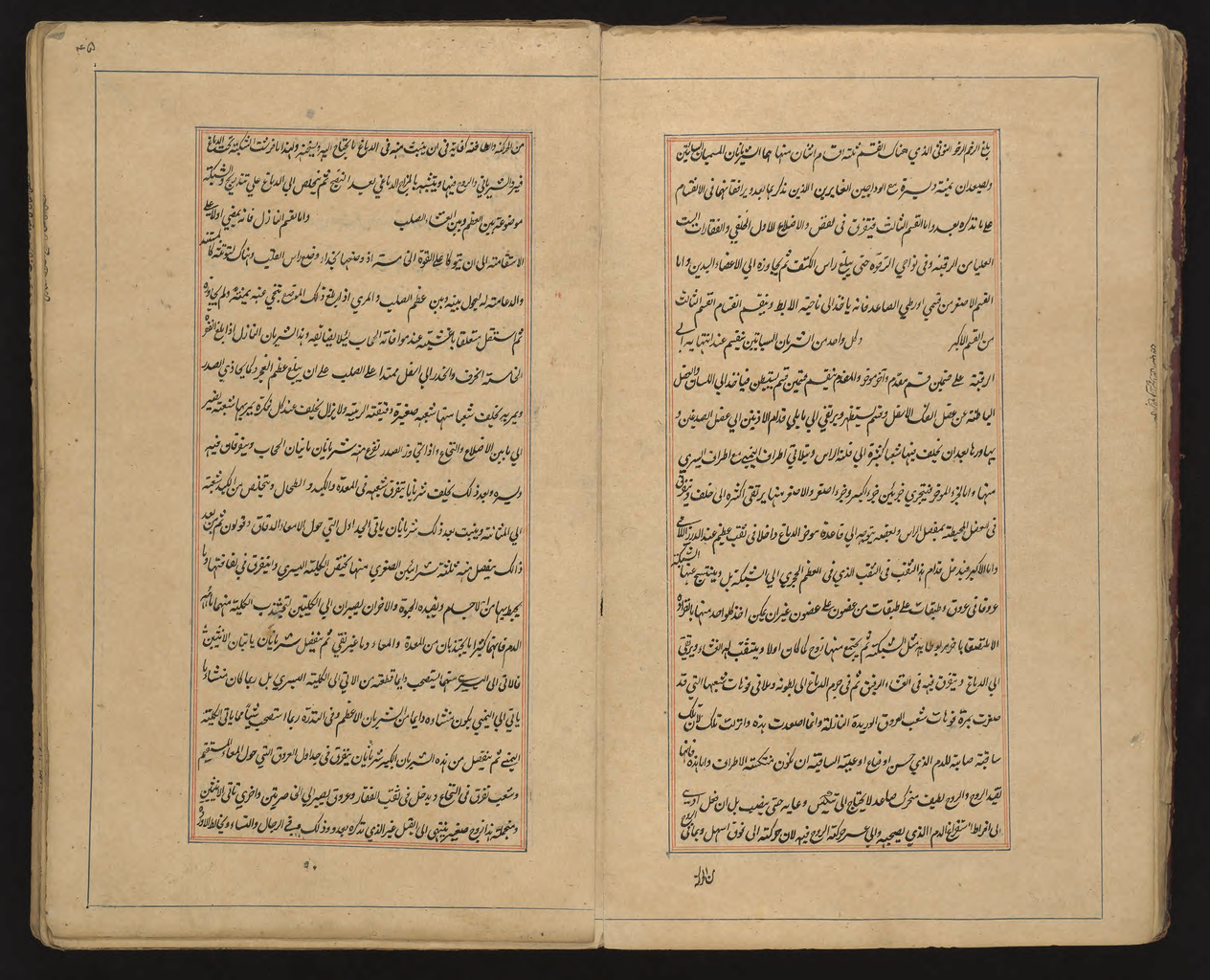
One of the defining features of the text is its insistence on the practice of medicine as a systematic scientific pursuit of equal merit to the theorizing of it:
Someone might say to us that medicine is divided into theoretical and practical parts and that, by calling it a science, we have considered it as being all theoretical. To this we respond by saying that some arts and philosophy have theoretical and practical parts, and medicine, too, has its theoretical and practical parts. The division into theoretical and practical parts differs from case to case, but we need not discuss these divisions in disciplines other than medicine. If it is said that some parts of medicine are theoretical and other parts are practical, this does not mean that one part teaches medicine and the other puts it into practice – as many researchers in this subject believe. One should be aware that the intention is something else: it is that both parts of medicine are science, but one part is the science dealing with the principles of medicine, and the other with how to put those principles into practice.
Of course, much of the medical theory in the Canon has been disproven, but it remains of keen interest to students of the history of medicine and of European and Islamic intellectual cultural history more generally. Avicenna towers above his contemporaries, yet his work also bears witness to the larger “intellectual climate of his time,” as the site Medical History Tour points out. He emerged from a milieu “shaped by centuries of translation and cross-cultural scholarship” of Greek, Roman, Indian, Chinese, Persian, and Arabic literature. “A rich Persian medical tradition began 200 years before Avicenna.”
Nonetheless, “however the world came by the genius of Avicenna, his influence was lasting,” with The Canon of Medicine remaining a definitive “best practices” guide to medicine for centuries after its composition. See full scans of several Arabic copies of the text at the Library of Congress’s World Digital Library and read a full English translation of the massive 5‑volume work, with its extensive chapters on definitions, anatomy, etiology, and treatments, at the Internet Archive.
Related Content:
1,000-Year-Old Illustrated Guide to the Medicinal Use of Plants Now Digitized & Put Online
700 Years of Persian Manuscripts Now Digitized and Available Online
How Arabic Translators Helped Preserve Greek Philosophy … and the Classical Tradition
Josh Jones is a writer and musician based in Durham, NC. Follow him at @jdmagness
Read More...The Provocative Art of Modern Sketch, the Magazine That Captured the Cultural Explosion of 1930s Shanghai
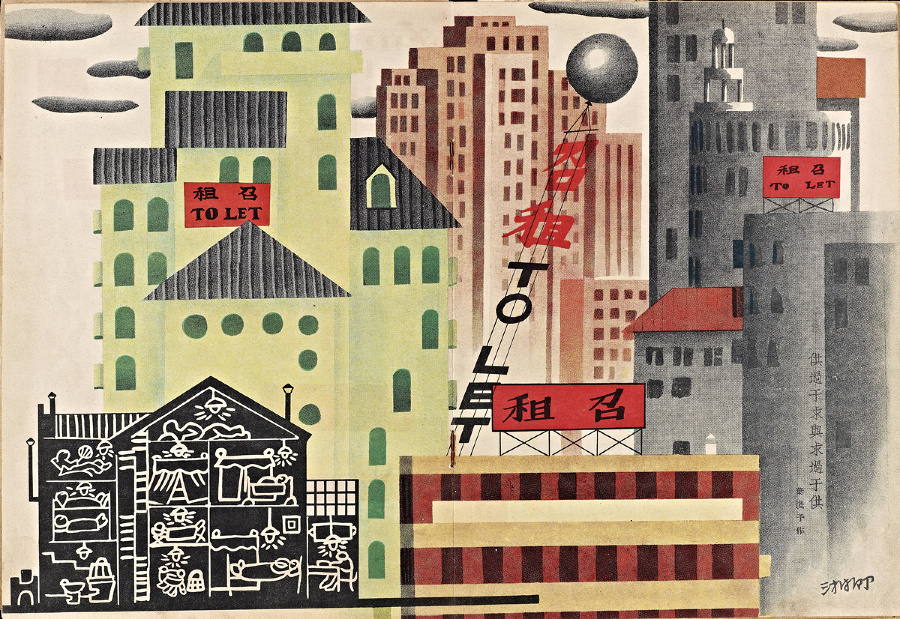
“With its newspapers in every language and scores of radio stations, Shanghai was a media city before its time, celebrated as the Paris of the Orient and ‘the wickedest city in the world.’ ” So British writer J.G. Ballard remembers the Chinese metropolis in which he grew up in his autobiography Miracles of Life. “Shanghai struck me as a magical place, a self-generating fantasy that left my own little mind far behind.” Born in 1930, Ballard caught Shanghai at a particularly stimulating time: “Developed on the basis of ‘unequal treaties’ successively instituted after the First Opium War in 1842,” writes MIT’s John A. Crespi, Chinese port cities like Shanghai “experienced a welter of technological and demographic changes,” including automobiles, skyscrapers, rolled cigarettes, movie theaters coffeehouses, and much else besides.
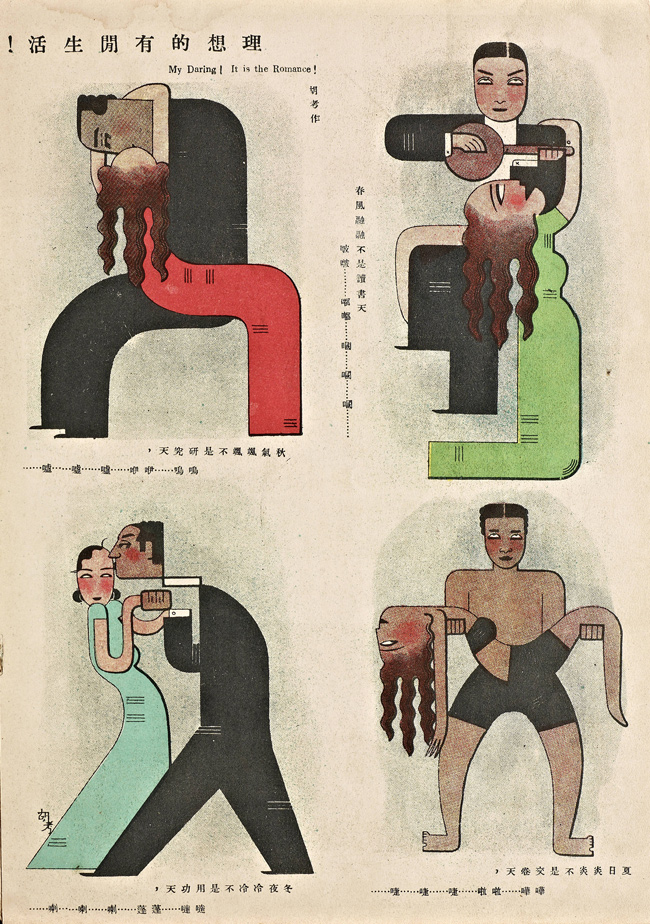
Such heady days also gave rise to media that reflected and critiqued them, and 1930s Shanghai produced no more compelling an example of such a publication than Modern Sketch (时代漫画, Shídài Mànhuà).
Among its points of interest, writes Crespi, “one can point to Modern Sketch’s longevity, the quality of its printing, the remarkable eclecticism of its content, and its inclusion of work by young artists who went on to become leaders in China’s 20th-century cultural establishment. But from today’s perspective, most intriguing is the sheer imagistic force with which this magazine captures the crises and contradictions that have defined China’s 20th century as a quintessentially modern era.”
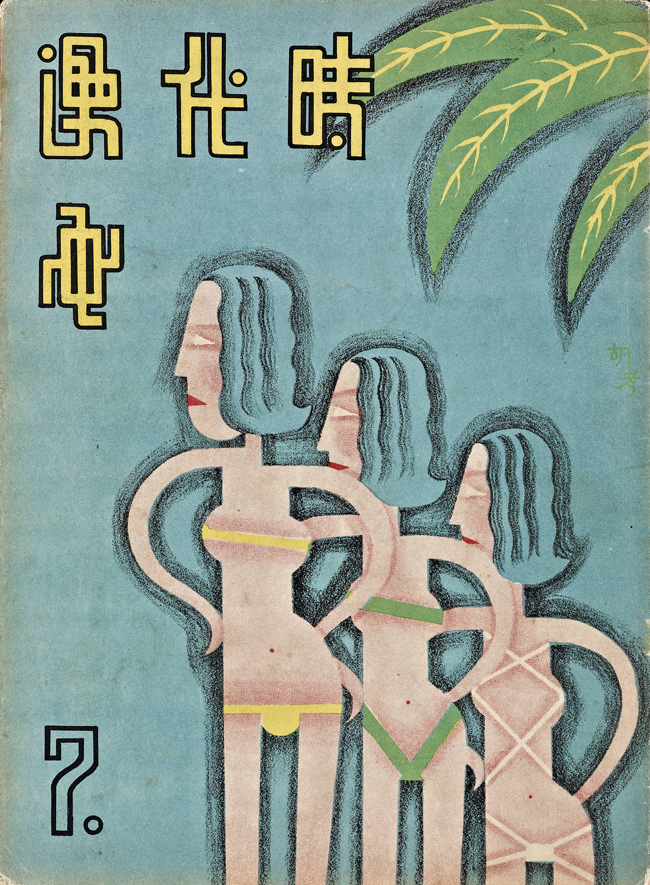
Published monthly from January 1934 through June 1937, the magazine first appeared on newsstands just over two decades after the collapse of China’s dynastic system. The modernization-minded May Fourth Movement, nationalist Northern Expedition, and purge of communists by “Generalissimo” Chiang Kai-shek were even more recent memories.
But the relative stability of the “Nanjing Decade” had begun in 1927, and its zeitgeist turned out to be rich soil for a wild cultural flowering in China’s coastal cities, none wilder than in Shanghai. To the reading public of this time Modern Sketch offered treatments of material like “eroticized women, foreign aggression — particularly the rise of fascism in Europe and militarized Japan — domestic politics and exploitation, and modernity-at-large,” writes Crespi.
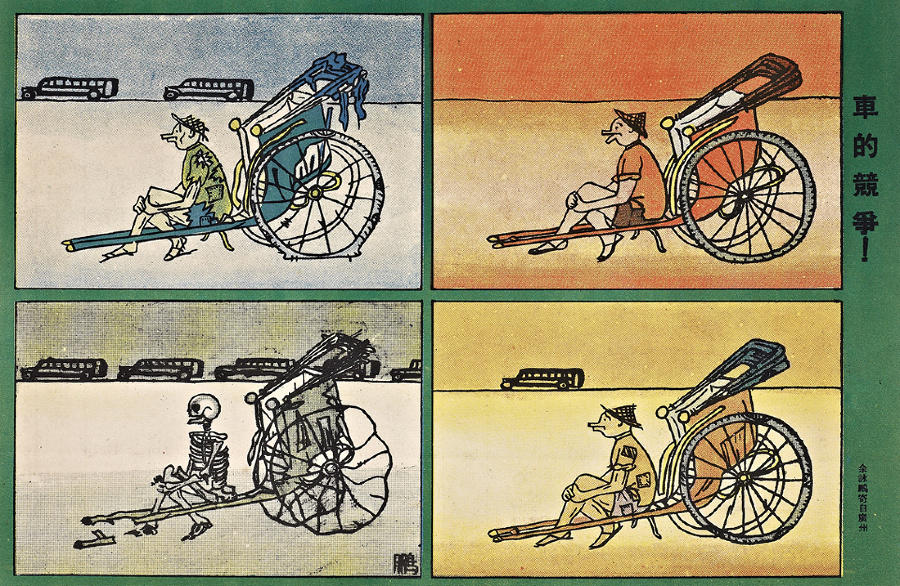
The magazine’s attitude “could be incisive, bitter, shocking, and cynical. At the very same time it could be elegant, salacious, and preposterous. Its messages might be as simple as child’s play, or cryptically encoded for cultural sophisticates.”
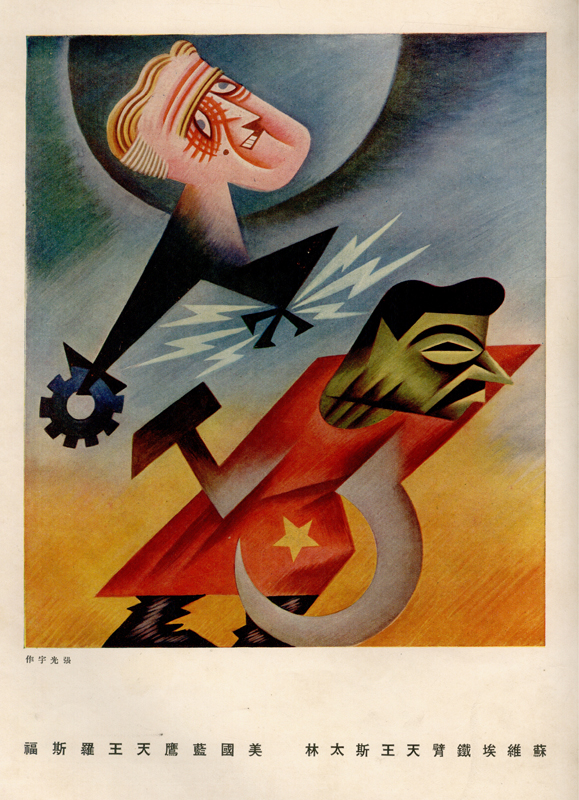
Sometimes it didn’t encode its messages cryptically enough: as a result of one unflattering depiction of Xu Shiying, China’s ambassador to Japan, the authorities suspended publication and detained editor Lu Shaofei. Not that Lu didn’t know what he was getting into with Modern Sketch: “On all sides a tense era surrounds us,” he wrote in the magazine’s inaugural issue. “As it is for the individual, so it is for our country and the world.”
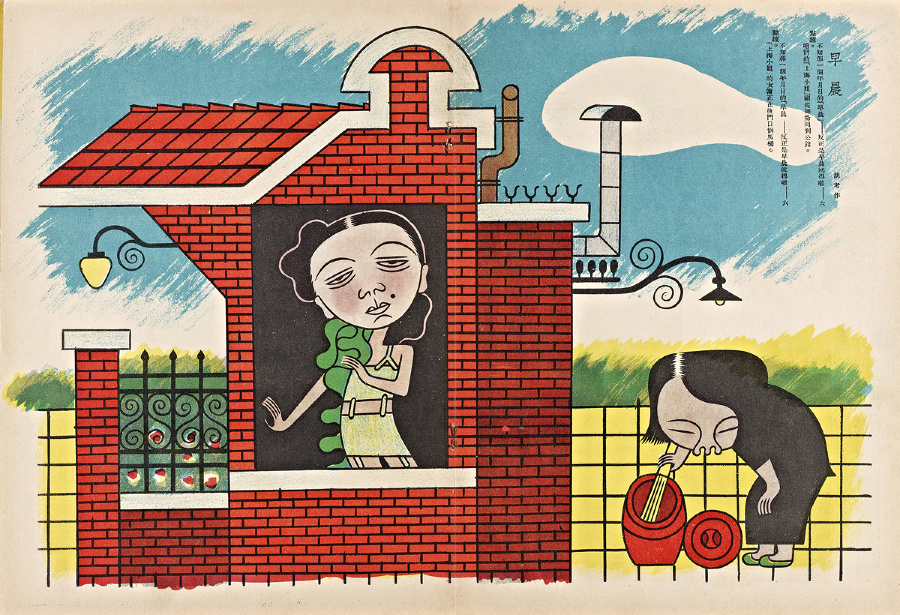
As for an answer to the question of whether the strange and tense but enormously fruitful cultural and political moment in which Lu and his collaborators found themselves wold last, “the more one fails to find it, the more that desire grows. Our stance, our single responsibility, then, is to strive!”
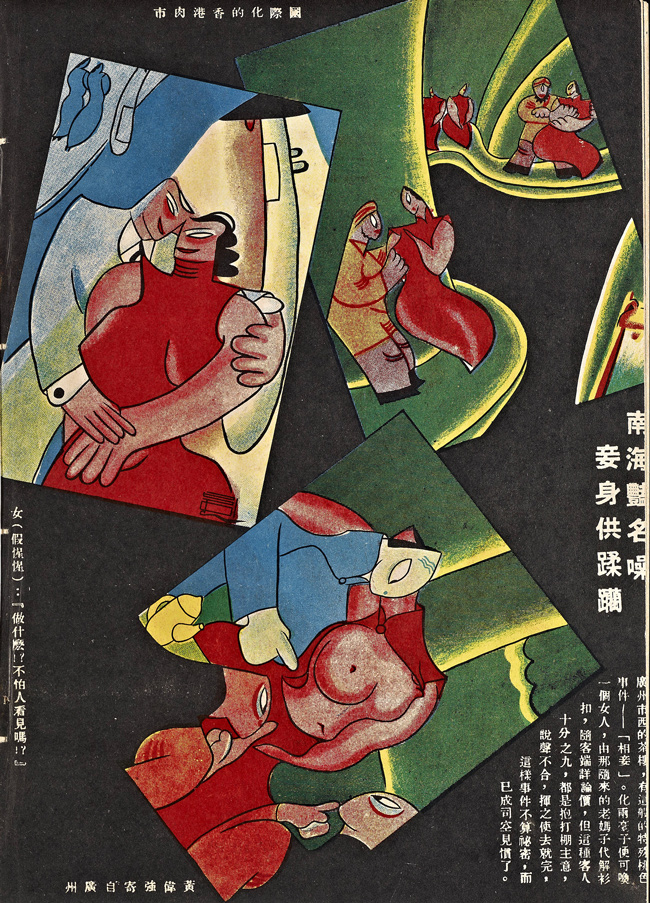
You can read more about what project entailed, and see in greater detail its textual and visual results, in Crespi’s history of this magazine that strove to capture the everyday reality of life on display in 1930s Shanghai — “though I sometimes wonder,” Ballard writes, “if everyday reality was the one element missing from the city.”
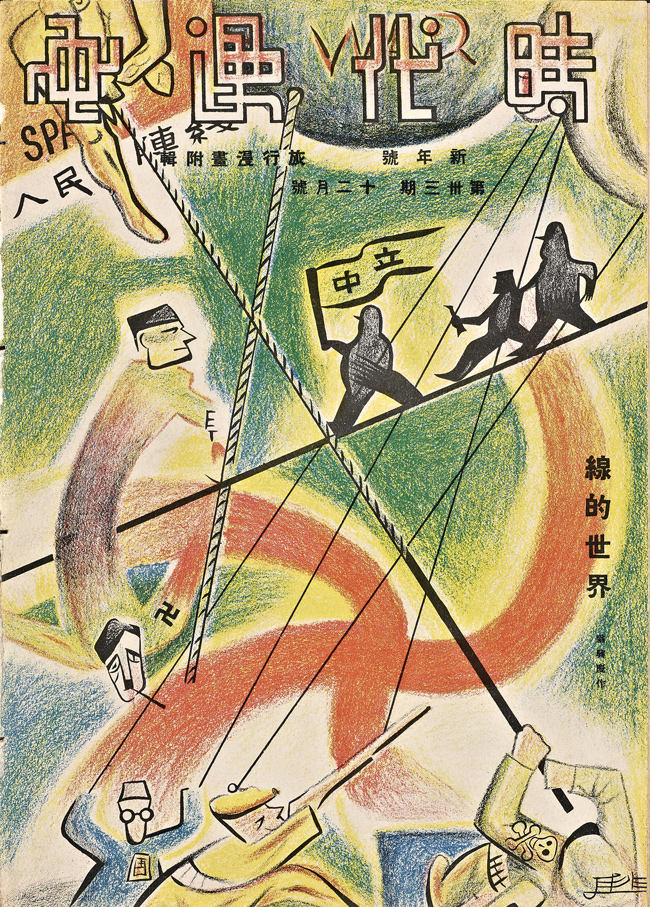
via 50 Watts
Related content:
China’s New Luminous White Library: A Striking Visual Introduction
Vintage 1930s Japanese Posters Artistically Market the Wonders of Travel
A Curated Collection of Vintage Japanese Magazine Covers (1913–46)
Extensive Archive of Avant-Garde & Modernist Magazines (1890–1939) Now Available Online
Based in Seoul, Colin Marshall writes and broadcasts on cities, language, and culture. His projects include the book The Stateless City: a Walk through 21st-Century Los Angeles and the video series The City in Cinema. Follow him on Twitter at @colinmarshall or on Facebook.
Read More...Behold the New York City Street Tree Map: An Interactive Map That Catalogues the 700,000 Trees Shading the Streets of New York City

It may sound odd, but one of the things I miss most about living in New York City is the ability to hop on a bus or train, or walk a few blocks from home, and end up lounging in a forest, the cacophony of traffic reduced to a dim hum, squirrels bounding around, birds twittering away above. Such urban respites are plentiful in NYC thanks to its 10,542 acres of forested land, “about half as much as the Congaree Swamp in South Carolina,” notes James Barron at The New York Times, in one of the most densely populated urban areas in the country.
“Most of the city’s forest is deep in parks”—in Central Park, of course, and also Prospect Park and Riverside, and dozens of smaller oases, and the lush Botanical Gardens in the Bronx. The city’s forests are subject to the usual pressures other wooded areas face: climate change, invasive species, etc.
They are also dependent on a well-funded Parks Department and nonprofits like the Natural Areas Conservancy for the preservation and upkeep not only of the large parks but of the trees that shade city streets in all five boroughs.

Luckily, the city and nonprofit groups have been working together to plan for what the conservancy’s senior ecologist, Helen Forgione, calls “future forests,” using big data to map out the best paths for urban woodland. The NYC Parks department has been busy compiling figures, and you can find all of their tree stats at the New York City Street Tree Map, which “brings New York City’s urban forest to your fingertips. For the first time,” the Parks department writes, “you have access to information about every street tree in New York City.”
Large forested parks on the interactive map appear as flat green fields—the department has not counted each individual tree in Central Park. But the map gives us fine, granular detail when it comes to street trees, allowing users to zoom in to every intersection and click on colored dots that represent each tree, for example lining Avenue D in the East Village or Flatbush Avenue in Brooklyn. You can search specific locations or comb through citywide statistics for the big picture. At the time of this writing, the project has mapped 694,249 trees, much of that work undertaken by volunteers in the TreesCount! 2015 initiative.

There are many more trees yet to map, and the department’s forestry team updates the site daily. Out of 234 species identified, the most common is the London Planetree, representing 12% of the trees on the map. Other popular species include the Littleleaf Linden, Norway Maple, Pin Oak, and Ginko. Some other stats show the ecological benefits of urban trees, including the amount of energy conserved (667,590,884 kWh, or $84,279,933.06) and amount of carbon dioxide reduced (612,100 tons).
Visit the New York City Street Tree Map for the full, virtual tour of the city’s trees, and marvel—if you haven’t experienced the city’s vibrant tree life firsthand—at just how green the empire city’s streets really are.

Related Content:
New York Public Library Puts 20,000 Hi-Res Maps Online & Makes Them Free to Download and Use
New York City: A Social History (A Free Online Course from N.Y.U.)
Josh Jones is a writer and musician based in Durham, NC. Follow him at @jdmagness
Read More...Is Opera Part of Pop Culture? Pretty Much Pop #15 with Sean Spyres

Opera used to be a central part of European pop culture, Pavarotti was as big a pop star as they come. But still, it’s now the quintessential art-form of the wealthy and snobbish. What gives?
Guest Sean Spyres from Springfield Regional Opera joins his sister Erica along with Mark and Brian to discuss opera’s place in culture (including its film appearances), how it’s different from music theater, the challenges it faces and how it might become more relevant.
Some articles:
- “Expecting Rain: Opera as Popular Culture” by John Storey
- “14 Artists Who Are Transforming The Future Of Opera” by Priscilla Frank
- “As Hip as Elvis: Caruso the Pop Idol” by John Potter
- “Emotions Unveiled: Romance at the Opera in Moonstruck (1987), Pretty Woman (1990) and Little Women (1994)” by Kordula Knaus
Watch the Shawshank Redemption opera scene or perhaps the Pretty Woman scene. What Is pop opera? Here’s Ranker’s list of artists. Paul Potts sings that famous song on Britain’s Got Talent. Plus, check out albums from brother Michael Spyres. Yes, you can hear an opera-singer sing “Take Me Out to the Ballgame,” but you probably shouldn’t.
This episode includes bonus discussion that you can only hear by supporting the podcast at patreon.com/prettymuchpop. This podcast is part of the Partially Examined Life podcast network.
Pretty Much Pop is the first podcast curated by Open Culture. Browse all Pretty Much Pop posts or start with the first episode.
Read More...Found: A Long Lost Chapter from the World’s Oldest Novel, the 11th-Century Japanese Classic, The Tale of Genji
Henry James’ disparagement of Victorian novels has always struck me as odd. “What do such large loose baggy monsters,” as he called them, “with their queer elements of the accidental and the arbitrary, artistically mean?” The question might be asked of what has often been considered the first modern novel, Miguel de Cervantes’ Don Quixote, a tragic-comic adventure whose first volume ranges over 52 loose, episodic chapters and whose second appeared ten years later to comment explicitly on the first’s success.
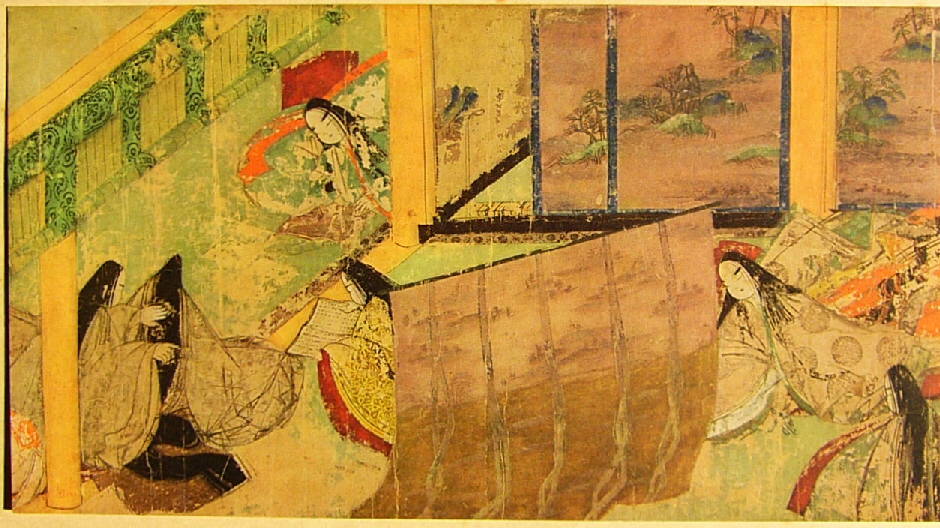
And then, six-hundred years earlier, there appeared what many consider to be the first novel ever written, The Tale of Genji, which “covers almost three quarters of a century,” notes translator Edward Seidensticker in an introduction to his 1976 edition. “The first forty-one chapters have to do with the life and loves of the nobleman known as ‘the shining Genji,’” the son of an emperor. We follow Genji from birth to his 52nd year, then the final ten chapters relate the tale of Kaoru, “who passes in the world as Genji’s son but is really the grandson of his best friend.” (See a 12th-century illustration from the tale above.)
Written by a noblewoman and lady of the court in 11th century Heian Japan, the book’s author is called Murasaki Shikibu, but her real name is unknown. Shikibu “designates an office held by her father”; Murasaki probably derives from the name of a main character in the novel. There is no “conclusive evidence that the Genji was either finished or unfinished at the time, nor is there conclusive evidence that it is finished or unfinished today.” Some chapters have been thought spurious, some deemed missing. No original manuscript exists, and only four of the novel’s 54 chapters have been authenticated as transcriptions from the original text.
That is, until this month, when a “lost”—or previously unknown—chapter surfaced, and “is now the fifth confirmed transcription of the historical novel,” as Hakim Bishara writes at Hyperallergic. “The newly discovered chapter, titled ‘Wakamurasaki,’ depicts Genji’s encounter with Murasaki-no-ue, the young woman who later becomes his wife.” It was discovered by Motofuyu Okochi, The Japan Times reports, “a descendent of the former feudal lord of the Mikawa-Yoshida Domain in Aichi Prefecture.”
The new Genji material appears “in one chapter of a five-chapter work called ‘Aobyoshibon’ (blue cover book), compiled by poet Fujiwara Teika,” who is believed to have transcribed the oldest documented versions of the novel during the Kamakura Period (1185–1333). There is as yet no critical discussion of how this find might change the way scholars read the book, but as a loose baggy monster, it can expand and contract, change its shape and composition, without losing its essential character.
As Seidensticker writes, “Murasaki Shikibu was no Aristotelian, planning her beginning, middle, and end before she set brush to paper. The Genji is full of hesitations and wrong turns and retreats.” Full, in other words, of the meanderings of the mind. (You can read Seidensticker’s translation of the Genji online here.) Another Western admirer of the novel, Jorge Luis Borges, writing of an earlier translation, put it another way: “What interests us is not the exoticism—the horrible word—but rather the human passions… Murasaki’s work is what one would quite precisely call a psychological novel.”
via Hyperallergic
Related Content:
Hand-Colored Photographs of 19th Century Japan
Josh Jones is a writer and musician based in Durham, NC. Follow him at @jdmagness
Read More...The Story of Ziggy Stardust Gets Chronicled in a New Graphic Novel, Featuring a Foreword by Neil Gaiman
Film has always been a medium that seeks to entertain as well as edify, framing thrills and chills for profit, and framing compositions deserving of the label of “art.” Very often it has done both at the same time. Every casual student of the medium will, at least, admit this much. But never have the differences between movie art and entertainment seemed as magnified and polarized as they are now, in the midst of debates about comic book franchises and the fine art we call cinema.
Whatever the reasons, film has not reached the détente between art and entertainment achieved by popular music—another medium dependent on late-19th/20th century recording technologies and born of a thoroughly modern commercial matrix. Of course, not all pop aspires to art. But the idea that music can be hugely entertaining—drawing on the “low” genres of fantasy, science fiction, and comic books—and also worthy of cultural immortality has become uncontroversial in large part because of the career of one musician.
David Bowie, rock and roll’s original space alien superhero, used his bankable personae through the decades to give credence to the idea of “art rock,” to realize its glam possibilities, to turn the rock auteur into an actor. He learned from a host of experimenters, both his direct influences and his spiritual predecessors. And he inspired a legion of successors who weren’t afraid to play characters in their work, to mix interests in philosophy, literature, and the occult with the flamboyant, campy styles of the comics. (A mix comics themselves played with in both popular and underground manifestations.)
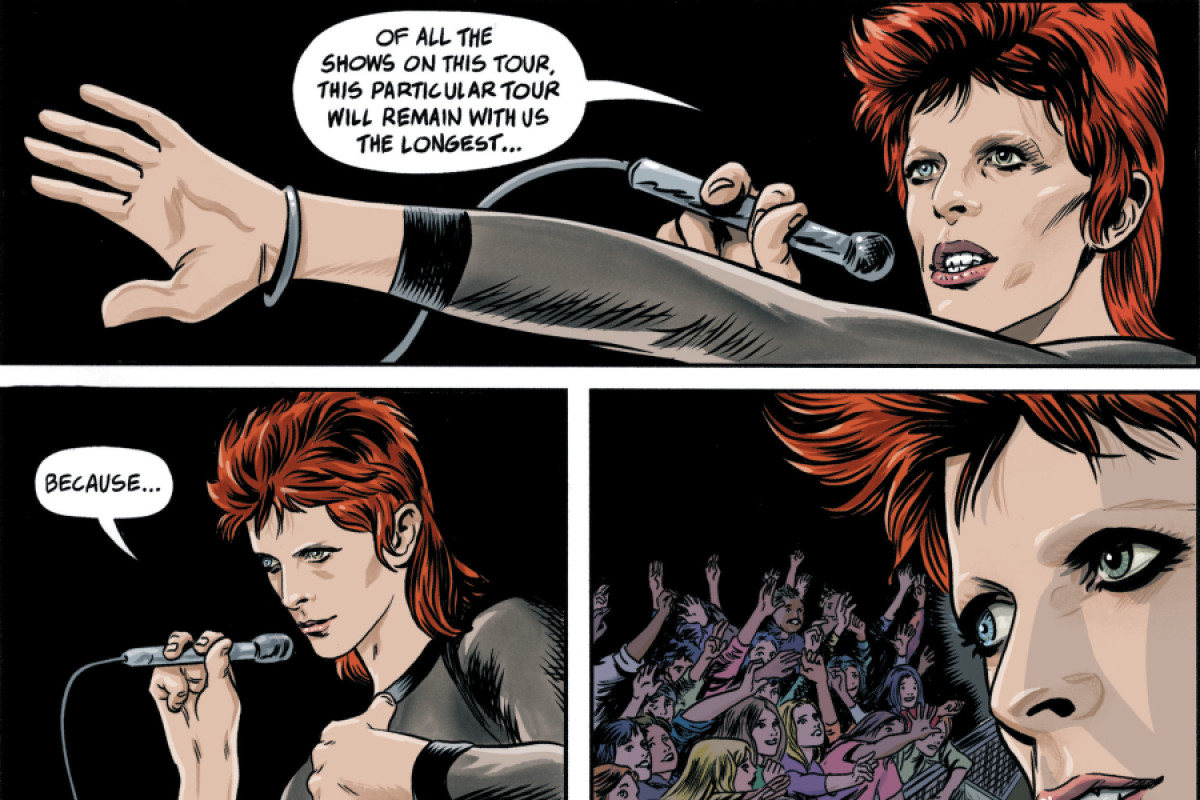
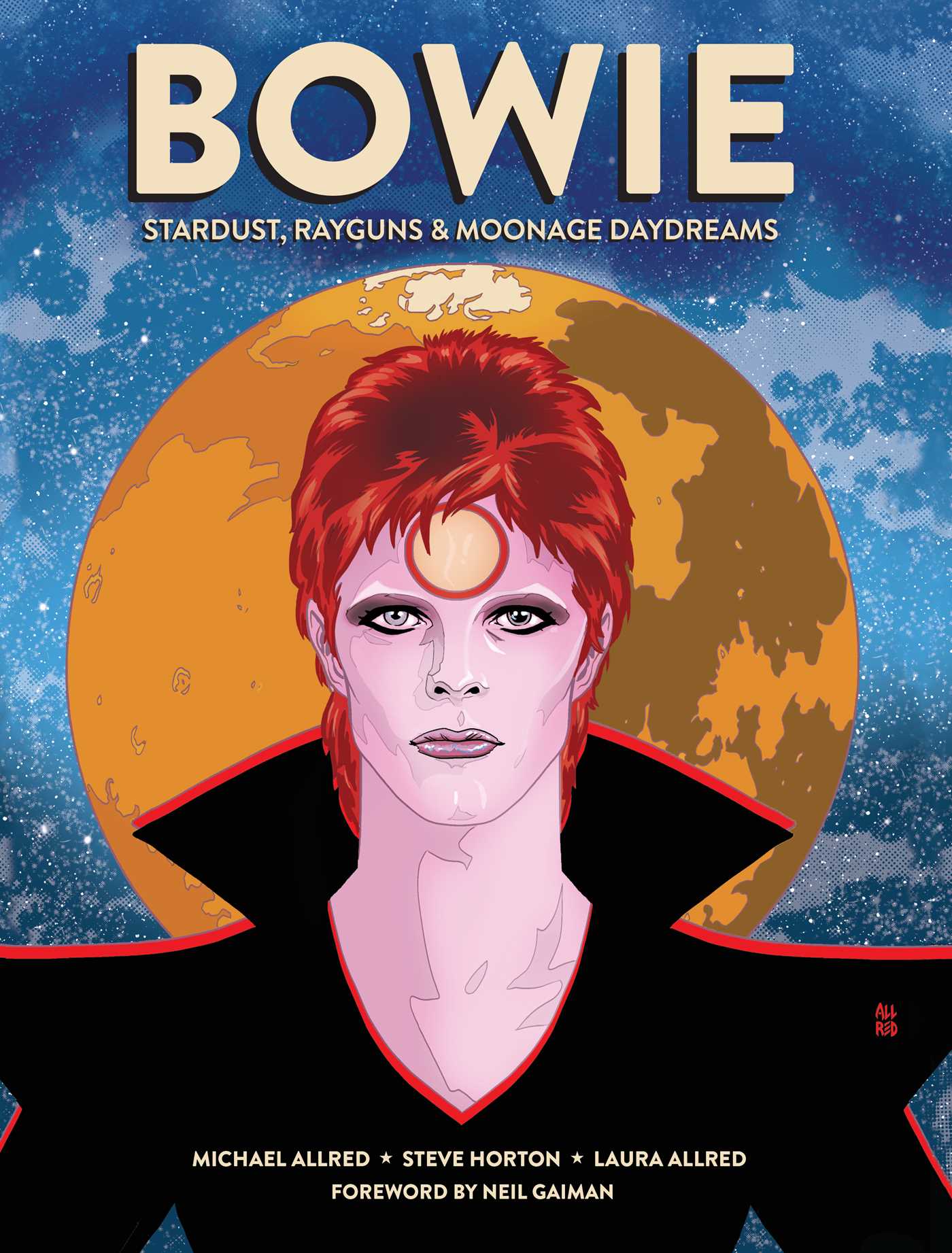
Bowie embodied the future when he appeared on the scene as Ziggy in 1972, after years of laboring in obscurity and a few fleeting brushes with fame. “The incarnations of David Bowie were, in themselves, science fictional, “writes Neil Gaiman in the forward to a new graphic novel, BOWIE: Stardust, Rayguns, & Moonage Daydreams, which tells the story of Bowie’s rise as Ziggy. “All I was missing was a Bowie comic,” says Gaiman of his own fandom. “And, missing it, I would draw bad Bowie comics myself.” Ziggy Stardust especially called for such treatment.
Bowie wore the glam rock Martian mask with such commitment no one doubted that he meant it—only what, exactly, he meant by it. “He defied classification,” notes Simon & Schuster, “with his psychedelic aesthetics, his larger-than-life image, and his way of hovering on the border of the surreal.” Fittingly, the comic is drawn by an artist who realized a psychedelic, surrealist creative vision of Neil Gaiman’s: Michael Allred, who worked on the Sandman series.
The story, “part biography and part imagination,” reports Rolling Stone, is written by Steve Horton and colored by Laura Allred. You can order a copy here.
via Rolling Stone
Related Content:
96 Drawings of David Bowie by the “World’s Best Comic Artists”: Michel Gondry, Kate Beaton & More
Freddie Mercury Reimagined as Comic Book Heroes
Josh Jones is a writer and musician based in Durham, NC. Follow him at @jdmagness
Read More...Meet Viola Smith, the World’s Oldest Drummer: Her Career Started in the 1930s, and She Played Until She Was 107
Update: Viola Smith sadly passed away this past week. You can read her obituary at The Guardian.
She may be the most famous jazz drummer you’ve never heard of.
Viola Smith played with the NBC Symphony Orchestra, performed for Harry Truman’s inauguration in 1949, and played in the Kit-Kat Band (see them below on I’ve Got a Secret), in the first Broadway run of Cabaret from 1966–70. These mark only a handful of her career highlights. She’s still thriving—and still playing—at the age of 106. While a fall has forced her to rely on a walker, she “looks like a seventy-five-year-old in terrific shape!” writes Dan Barrett at The Syncopated Times.
Born Viola Schmitz in Mount Calvary, Wisconsin in 1912, Smith started playing in the 1920s with her family band, the Schmitz Sisters Family Orchestra (later the Smith Sisters Orchestra). Consisting of Viola, seven of her sisters, and one of her two brothers, they played the vaudeville and movie theater circuit on weekends. Their father managed, directed, and booked the band. An appearance on America’s Got Talent, “the 1930s radio version,” notes Barrett, gave Viola and her sisters the confidence to form the Coquettes, who garnered a considerable amount of fame after their debut in 1938.
In 1942, Viola wrote an article for Down Beat magazine titled “Give Girl Musicians a Break!,” suggesting that bands who lost musicians to WWII should hire women. Later that year, when Mildred, Viola’s last remaining sister in the Coquettes, got married, Viola moved to New York, “where I always wanted to be,” she tells Barrett. She earned a summer scholarship to Julliard, Benny Goodman asked her to join his band (she turned him down), and she played with Ella Fitzgerald and many other greats. She recorded film music and played with the National Symphony Orchestra. She appeared on The Ed Sullivan Show five times.
Though often compared to Gene Krupa, whom she considers a “lovely person” and an influence, Smith had a very distinctive style all her own, characterized by a twelve-drum kit with two 16-inch toms mounted on either side of her head, as you can see in the clip at the top of the post, in a 1939 performance with the Coquettes. This was no mere gimmick. Smith had studied tympani at Julliard and imported classical training into her big band sound. (She claims drummer Louis Bellson’s use of two bass drums was due to her influence.)
Why isn’t Viola Smith better known? It may have something to do with patronizing coverage in the press, where she was described as “the girl Gene Krupa,” the “fastest girl drummer,” “the famous girl drummer” etc. Other female instrumentalists were similarly belittled as “girl” novelty acts, or ignored, even when they played with bandleaders like Benny Goodman, whose orchestra featured trumpet players Billie Rogers and Laurie Frink. (Smith herself frowns on women playing brass instruments, for some odd reason.) In her Down Beat article, Viola named a number of other top female players of the day who deserved more work and recognition.
She may forget things here and here, but Smith still has a steel-trap memory for a 106-year old who has lived such a rich life. Her interview with Barrett is full of detailed reminisces (she briefly dated Frank Sinatra, for example). She gives us a picture of a musician at the top of her game and in full command of her career during the golden age of big band swing. We can credit Smith’s lifetime as a professional musician with much of this confidence. Like all of her siblings she learned to play piano and read music from a young age, and she honed her skills as part of a hard-working family “pit band,” as she says. But she was also driven to succeed above all else, leaving behind the conventional life each of her sibling bandmates eventually chose.
Smith did it her way—reportedly turning down offers to play in Sinatra’s band and refusing bandleader Woody Herman in order keep playing with the Coquettes. She played for the radio show Hour of Charm until she was 63, and has played concerts recently in Costa Mesa, California, where she now lives, tended to by the staff of a quilting supply shop called Piecemakers. Smith talks easily about the sources of her musical longevity—her family band, education, and the tight-knit community of musicians who embraced her.
As for her physical vigor and stamina, this she chalks up to the rigor of playing the drums, and to relaxing with a drink or two on occasion—a lifetime of activity and moderation that has helped keep her sharp and healthy after all of her contemporaries have passed away. See Smith in interviews at 100, further up, and 102, just above, and read her recent interview at 106 at The Syncopated Times here.
Related Content:
Women of Jazz: Stream a Playlist of 91 Recordings by Great Female Jazz Musicians
New Web Project Immortalizes the Overlooked Women Who Helped Create Rock and Roll in the 1950s
Josh Jones is a writer and musician based in Durham, NC. Follow him at @jdmagness
Read More...Support Us
We're hoping to rely on loyal readers, rather than erratic ads. Please click the Donate button and support Open Culture. You can use Paypal, Venmo, Patreon, even Crypto! We thank you!

About Us

Open Culture scours the web for the best educational media. We find the free courses and audio books you need, the language lessons & educational videos you want, and plenty of enlightenment in between.
Advertise With Us

FREE UPDATES!
GET OUR DAILY EMAIL
Get the best cultural and educational resources on the web curated for you in a daily email. We never spam. Unsubscribe at any time.
FOLLOW ON SOCIAL MEDIA

Open Culture editor Dan Colman scours the web for the best educational media. He finds the free courses and audio books you need, the language lessons & movies you want, and plenty of enlightenment in between.
Advertise With Us

