Lemony Snicket Reveals His Edward Gorey Obsession in an Upcoming Animated Documentary
Had the gloom-haunted Edward Gorey found a way to have a love child with Dorothy Parker, their issue might well have been Lemony Snicket, the pseudonymous author of a multivolume family chronicle brought out under the genteel appellation A Series of Unfortunate Events.
- Gregory Maguire, The New York Times
Author Daniel Handler—aka Lemony Snicket—was but a child when he fortuitously stumbled onto the curious oeuvre of Edward Gorey.
The little books were illustrated, hand-lettered, and mysterious. They alluded to terrible things befalling innocents in a way that made young Handler laugh and want more, though he shied from making such a request of his parents, lest the books constitute pornography.
(His fear strikes this writer as wholly reasonable—my father kept a copy of The Curious Sofa: A Pornographic Work by Ogdred Weary—aka Edward Gorey—stashed in the bathroom of my childhood home. Its perversions were many, though far from explicit and utterly befuddling to a third grade bookworm. The exceedingly economical text hinted at a multitude of unfamiliar taboos, and Gorey the illustrator understood the value of a well-placed ornamental urn.)
Interviewed above for Christopher Seufert’s upcoming feature-length Gorey documentary, Handler is effusive about the depth of this early influence:
The gothic setting. (Handler always fancied that an in-person meeting with Gorey would resemble the first 20 minutes of a Hammer horror movie.)
The dark, unwinking humor arising from a plot as grim as that of The Hapless Child, or The Blue Aspic, the first title young Handler purchased with his own money.
An intentionally murky pseudonym geared to ignite all manner of wildly readerly speculation as to the author’s lifestyle and/or true identity. (Gorey attributed various of his works to Dogear Wryde, Ms. Regera Dowdy, Eduard Blutig, O. Müde and the aforementioned Ogdred Weary, among others.)
Even Lemony Snickett’s website carries a strong whiff of Gorey.
In acknowledgment of this debt, Handler sent copies of the first two Snickett books to the reclusive author, along with a fan letter that apologized for ripping him off. Gorey died in April 2000, a couple of weeks after the package was posted, leaving Handler doubtful that it was even opened.
Handler namechecks other artists who operate in Gorey’s thrall: filmmakers Tim Burton and Michel Gondry, musicians Amanda Palmer and Trent Reznor, and novelist Neil Gaiman.
Perhaps owing to the spectacular popularity of Snickett’s Series of Unfortunate Events, Gorey has lately become a bit more of an above-ground discovery for young readers. Scholastic has a free Edward Gorey lesson plan, geared to grades 6–12.
More information about Christopher Seufert’s Gorey documentary, with animations by Ben Wickey and the active participation of its subject during his final four years of life, can be found here.
Related Content:
Edward Gorey Talks About His Love Cats & More in the Animated Series, “Goreytelling”
Edward Gorey Illustrates H.G. Wells’ The War of the Worlds in His Inimitable Gothic Style (1960)
The First American Picture Book, Wanda Gág’s Millions of Cats (1928)
Ayun Halliday is an author, illustrator, theater maker and Chief Primatologist of the East Village Inkyzine. Join her in NYC on Monday, September 9 for another season of her book-based variety show, Necromancers of the Public Domain. Follow her @AyunHalliday.
Read More...Watch the Completely Unsafe, Vertigo-Inducing Footage of Workers Building New York’s Iconic Skyscrapers
Would anyone in their right mind sign up for a job that had a high risk of mortality/disability? Or a job where red hot metal is being hurled directly at your face? Back in the 1920s this was the lot of the men who built New York’s skyline, the men who constructed the Chrysler Building and the Empire State, giant phallic symbols of America’s burgeoning wealth and power.
In this short clip (remastered and quite decently colorized) from the Smithsonian Channel, we get a brief glimpse of the perils encountered daily on the building site. Nicknamed “roughnecks,” the narrator points out that they work without harnesses, safety ropes, or hard hats. Red hot rivets are thrown at men on the metal beams higher up and they are meant to catch them with what looks like a tin funnel. You can see the thinnest of ropes used to lift the now-iconic stainless steel art-deco eagles into place by men weary felt hats and no gloves.
The workers came from Europe, many who had trained on ships. Some came from Montreal’s Kahnawake reservation. The latter, known as Iron Walkers, were Mohawk, known for working fearlessly at great heights.
“A lot of people think Mohawks aren’t afraid of heights; that’s not true,” Kyle Karonhiaktatie Beauvais said in 2002. “We have as much fear as the next guy. The difference is that we deal with it better.”
Much of this work was documented by photographer Lewis Hine, who captured a mix of brute strength and gravity defying courage along with private moments of rest, catching a smoke or taking lunch. You can see many of his famous photos in this clip:
The Chrysler Building was completed in 1930, and reached a height of 1,046 feet (319 m), featuring 77 floors. It held its fame as the world’s tallest building for only 11 months. In 1931 workers completed the Empire State Building, standing at 1,454 feet (443.2 m) and housing 102 floors. (That’s dinky compared to the current record-holder: Dubai’s Burj Khalifa, which stands at 2,722 feet (829.8 m)).
Heads up: The Smithsonian Channel clip has some of the worst examples of YouTube comments among the videos we’ve highlighted over the year, as if people still don’t work in terrible and unsafe conditions in order to feed their families and pay rent. And look! Here’s a guy who walks out onto the Chrysler eagle just for fun. Don’t say we didn’t warn you:
Related Content:
Paris, New York & Havana Come to Life in Colorized Films Shot Between 1890 and 1931
Famous Architects Dress as Their Famous New York City Buildings (1931)
Ted Mills is a freelance writer on the arts who currently hosts the artist interview-based FunkZone Podcast and is the producer of KCRW’s Curious Coast. You can also follow him on Twitter at @tedmills, read his other arts writing at tedmills.com and/or watch his films here.
Read More...Ray Harryhausen’s Creepy War of the Worlds Sketches and Stop-Motion Test Footage
Most of us know The War of the Worlds because of Orson Welles’ slightly-too-realistic radio adaptation, first broadcast on Halloween 1938. But its source material, H.G. Wells’ 1898 science-fiction novel, still fires up the imagination. Its many adaptations since have taken the form of comic books, video games, television series, and more besides. Several films have used The War of the Worlds as their basis, including a high-profile one in 2005 directed by Steven Spielberg and starring Tom Cruise, and more than half a century before that, George Pal’s first 1953 adaptation in all its Technicolor glory.
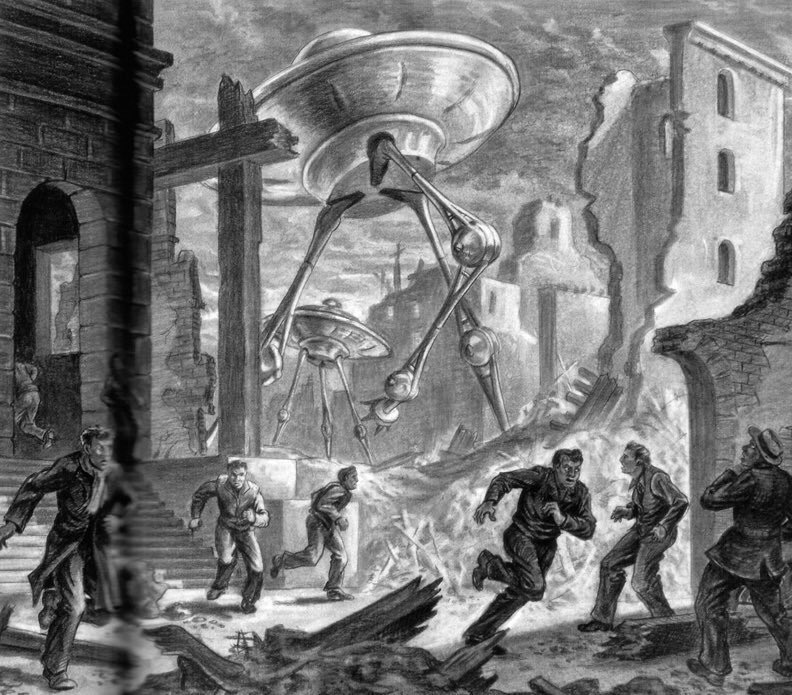
In recent years materials have surfaced showing us the midcentury War of the Worlds picture that could have been, one featuring the stop-motion creature-creation of Ray Harryhausen.
“Well before CGI technology beamed extraterrestrials onto the big screen, stop-motion animation master Harryhausen brought to life Wells’ vision of a slimy Martian with enormous bulging eyes, a slobbering beaked mouth and ‘Gorgon groups of tentacles’ in a 16 mm test reel,” writes Den of Geek’s Elizabeth Rayne.
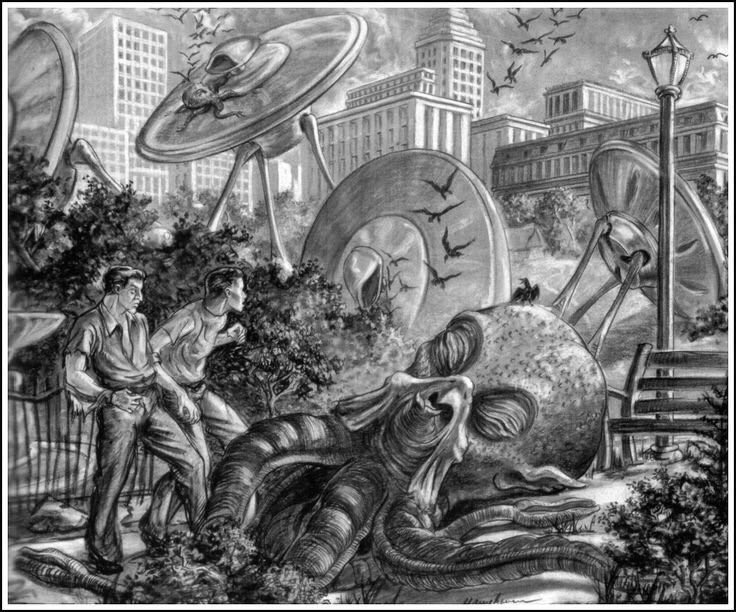
“The result is something that looks like a twisted mashup of a Muppet and an octopus.” Harryhausen had long dreamed of bringing The War of the Worlds to the big screen, and anyone who has seen Harryhausen’s work of the 1950s and 60s, as it appears in such films as The 7th Voyage of Sinbad and Jason and the Argonauts, knows that he was surely the man for this job. He certainly had the right spirit: as his own words put it at the beginning of the test-footage clip, “ANY imaginative creature or thing can be built and animated convincingly.”
“I actually built a Martian based on H.G. Wells description,” Harryhausen says in the interview clip above. “He described the creature that came from the space ship a sort of an octopus-like type of creature.” Harryhausen’s also presented his vision with included sketches of the tripod invaders laying waste to America both urban and rural. “I took it all around Hollywood,” he says, but alas, it never quite convinced those who kept the gates of the Industry in the 1940s.
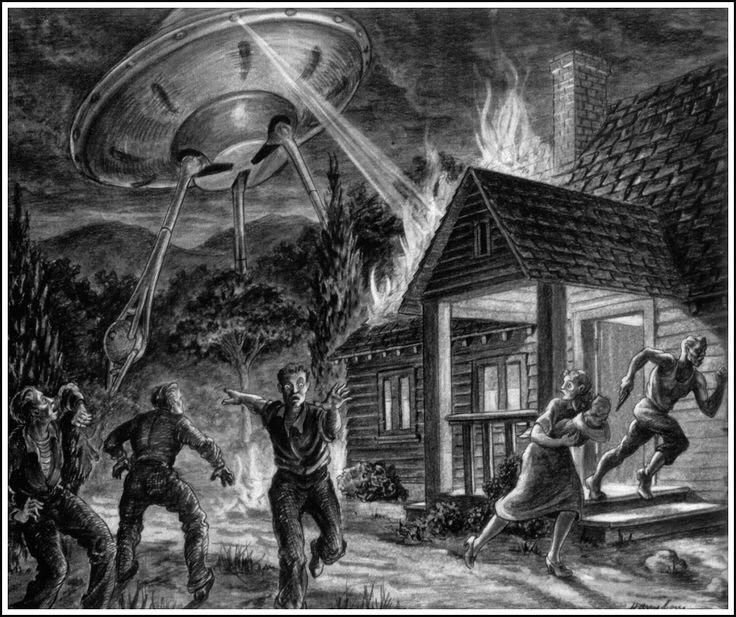
“We couldn’t raise money. People weren’t that interested in science fiction at that time.” Times have changed; the public has long since developed an unquenchable appetite for stories of human beings and advanced, hostile space invaders locked in mortal combat. But now such a spectacle would almost certainly be realized with the intensive use of computer-generated imagery, a technology impressive in its own way, but one that may never equal the personality, physicality, and sheer creepiness of the creatures that Ray Harryhausen brought painstakingly to life, one frame at a time, all by hand.
Related Content:
The Very First Illustrations of H.G. Wells’ The War of the Worlds (1897)
Edward Gorey Illustrates H.G. Wells’ The War of the Worlds in His Inimitable Gothic Style (1960)
Hear Orson Welles’ Iconic War of the Worlds Broadcast (1938)
The Mascot, a Pioneering Stop Animation Film by Wladyslaw Starewicz
Based in Seoul, Colin Marshall writes and broadcasts on cities, language, and culture. His projects include the book The Stateless City: a Walk through 21st-Century Los Angeles and the video series The City in Cinema. Follow him on Twitter at @colinmarshall or on Facebook.
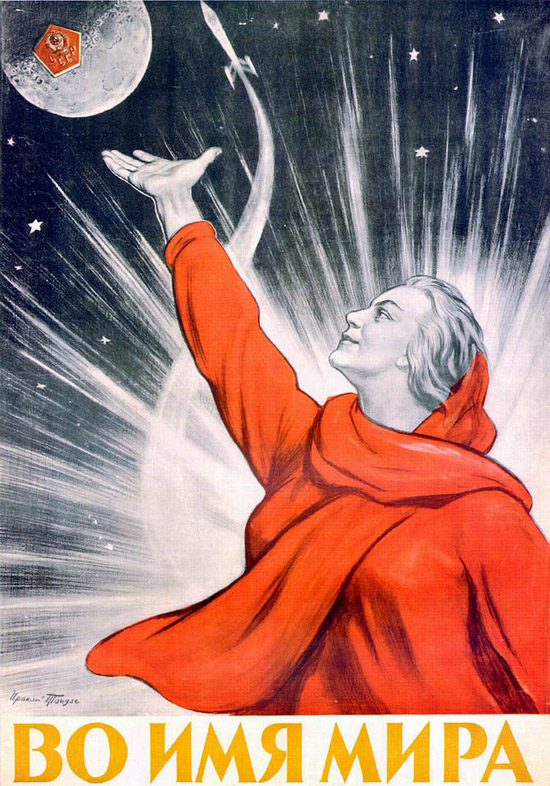
Read More...The Glorious Poster Art of the Soviet Space Program in Its Golden Age (1958–1963)

How do you sell a government program that spends tens of millions of dollars on research and development for space travel? While the average taxpayer may love the idea of braving new frontiers, far fewer are apt to vote for funding scientific research, the space program’s ostensible reason for being.
During the Cold War, however, when the biggest breakthroughs in space flight occurred, selling the program didn’t involve sophisticated methods, only the broadest themes of heroism, patriotism, futurism, and, in more or less subtle ways, militarism. The appeal to science always went hand-in-hand with an appeal to the sublimely austere beauty of the heavens (which we’d hate to lose to the other guys.)
All of these were strategies NASA utilized, and then some. In addition to planting a U.S. flag on the moon, they delivered the first color image of Earth from space. On the ground, they enlisted artists like Andy Warhol, Norman Rockwell, and Laurie Anderson and actors like Star Trek’s Nichelle Nichols to sell the program.
Recently, NASA has seemed to be in a reflective mood, from its antiquarian preparations for the 50th anniversary of the moon landing to its ad campaign of retro posters that resemble not only vintage sci-fi book jackets and movie ads, but also the futuristic social realism of their former Soviet rivals.
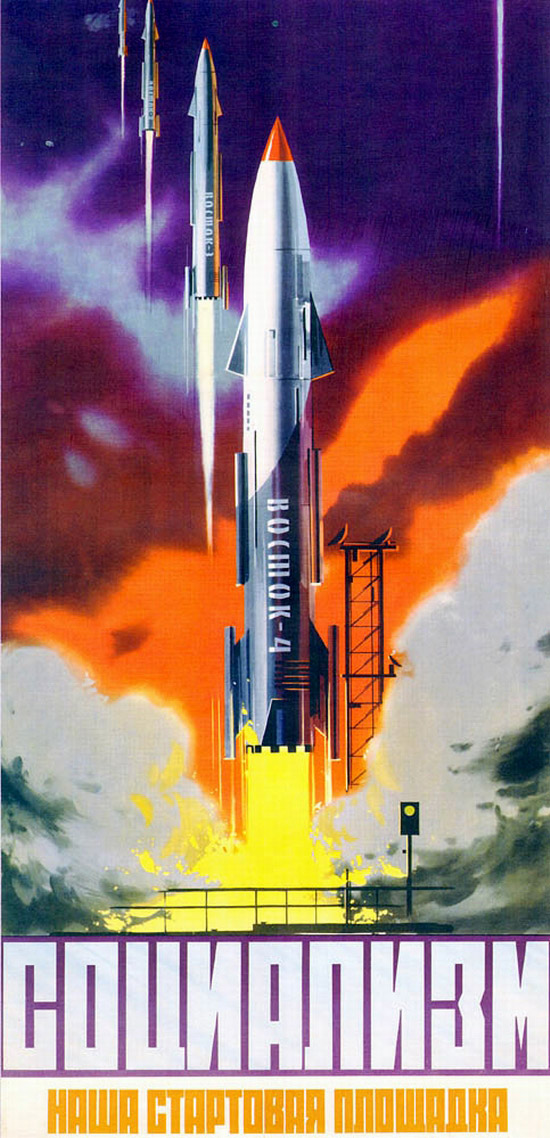
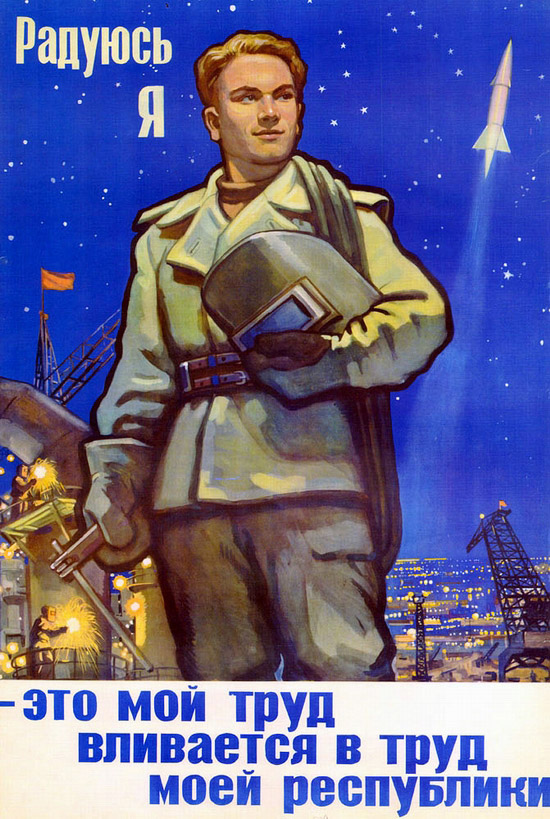
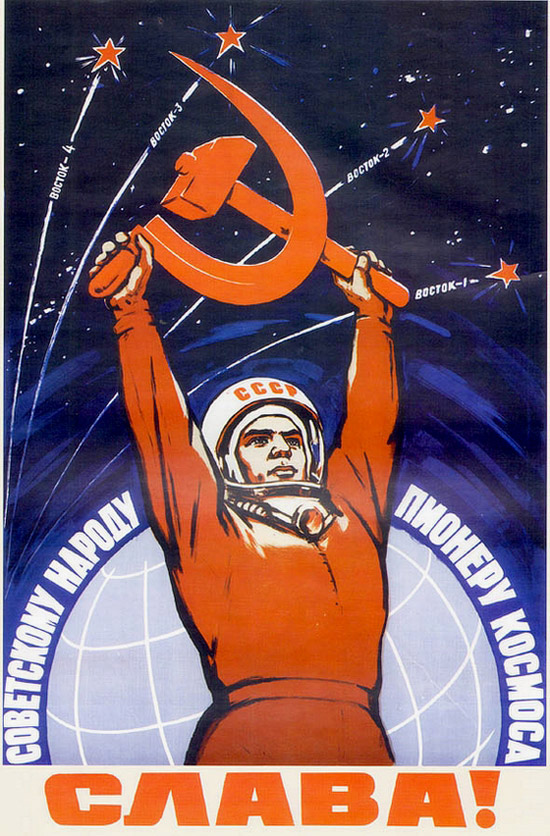
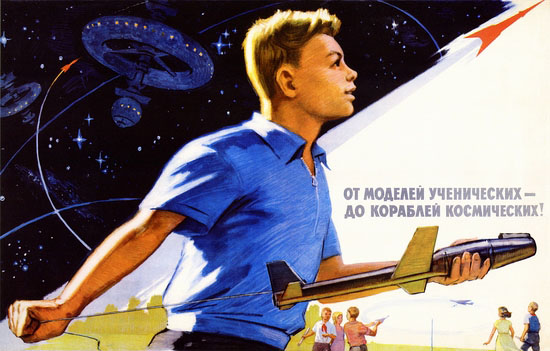
There’s almost something of an admission in NASA’s retro posters: we may have won the “space race,” but it wasn’t winner take all. There were some things the Soviets just did better—and when it came to making space travel look like the most monumentally heroic and exciting thing ever, they excelled, as you can see in this early collection of Soviet space posters from 1958–1963.
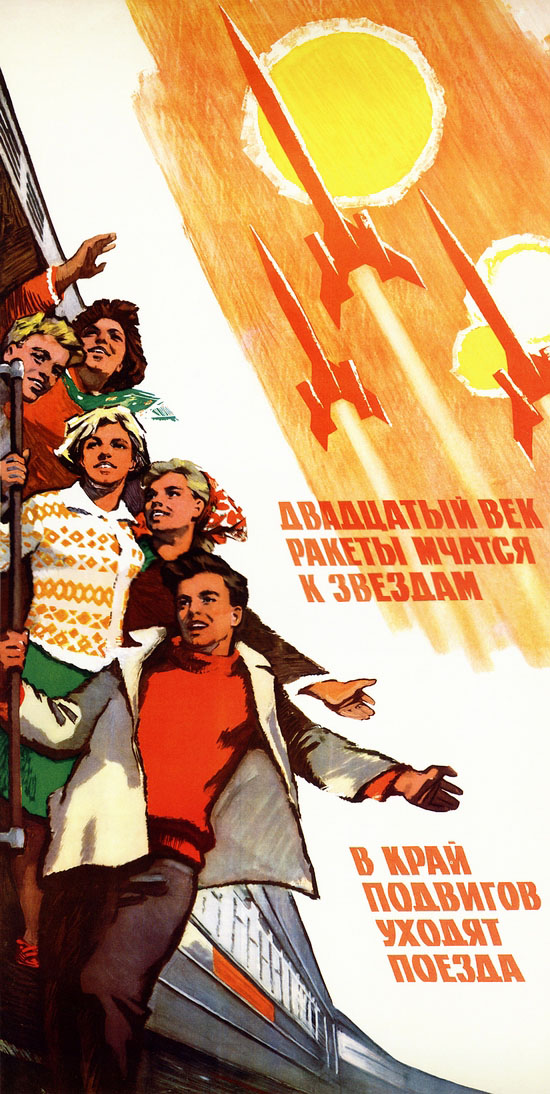
There’s something for, well, not everyone, but for men, women, young, old, young adults. Sci-fi geeks and model builders, people celebrating the new year, children celebrating the new year, a gaggle of young students who somehow all look just like Mary Tyler Moore. The artists are not celebrities, they’re fellow workers who “foresaw a Utopia in space,” writes Flashbak.
The Communists would bring peace and prosperity not only to the people of Earth but also to the technology-enabled, God-free Great Beyond. The artists created Soviet Space posters, vivid, energising and inspiring visions of the rosy-fingered dawn of tomorrow. They’re terrific.
They’re maybe even more terrific when we consider that ordinary citizens didn’t have much say, at all, in the funding and direction of the U.S.S.R.’s space program. (Whether American citizens did is another question.) It was important that Soviets know, however, that “We will open the distant worlds!” as one poster reads, and, as the sixties teenage cigarette ad on a train above proclaims, “In the 20th century, the rockets race to the stars, the trains are going to the lands of achievements!”
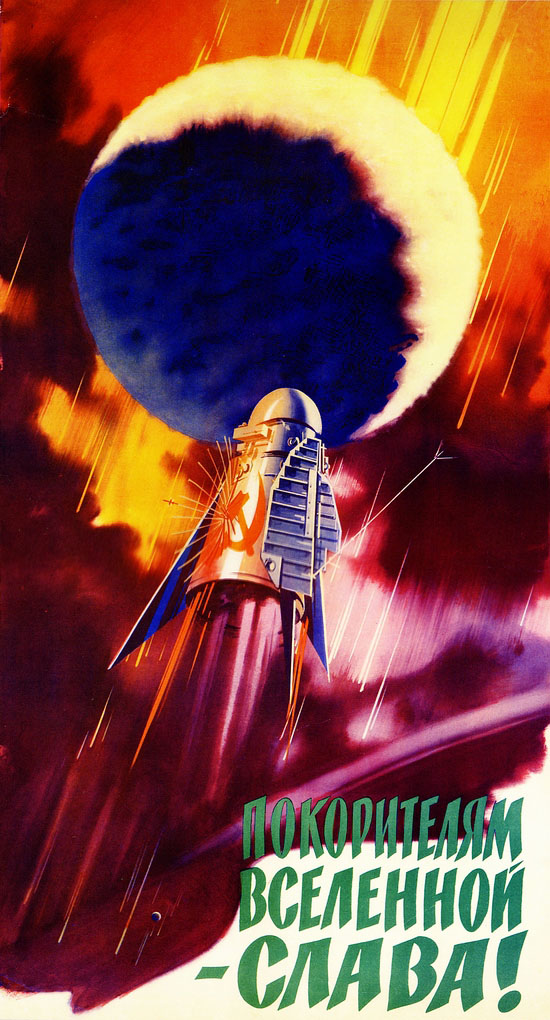
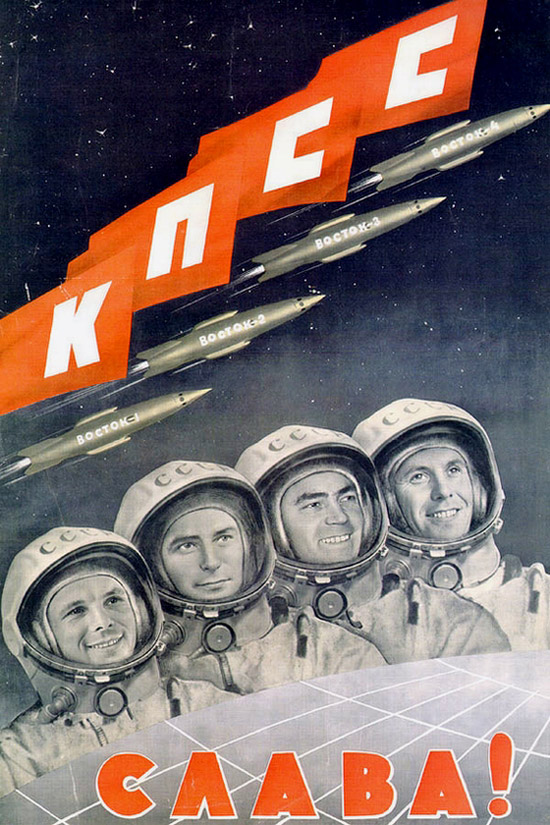
The number of posters here is but a smattering of those posted on All about Russia (here and here) and Flashbak. Each poster has its own enchanting quality: emulating the propaganda of the 1930s; turning industrial laborers into anonymous towering heroes; and reaching some very heavy metal heights of bombast, as in the ad above, which declares, “Glory to the conquerors of the universe!”
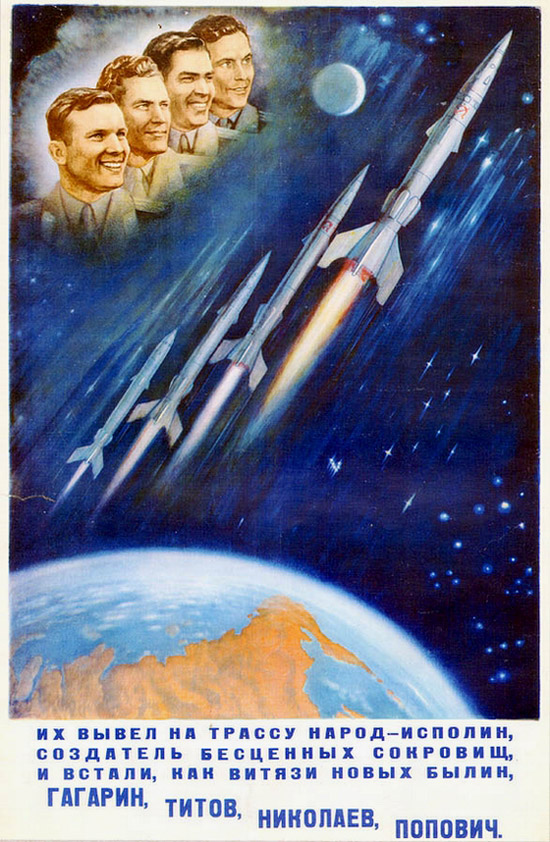
One poster superimposes the beaming faces of four cosmonauts, lined up like Kraftwerk, over a scene of four rockets leaving the earth. “Gagarin, Titov, Nikolaev, Popoviich—the mighty knights of our days.” (I’m not sure how that pun works in Russian.) The Soviets could also proclaim “Glory to the first woman cosmonaut!,” Valentina Tereshkova, who became the first woman to fly in space in 1963.

The Soviet space program deserves plenty of recognition for its many historic firsts, and also for the wildly enthusiastic optimism of its ad campaigns. They sold grand ideas about the exploration and, yes, conquest of space (and “the universe”) with the same verve and populist appeal as U.S. companies sold cars, cigarettes, and washing machines. Glory to the unsung Mad Men of the Soviet space poster!
Related Content:
Soviet Artists Envision a Communist Utopia in Outer Space
Josh Jones is a writer and musician based in Durham, NC. Follow him at @jdmagness
Read More...A Digital Animation Compares the Size of Trees: From the 3‑Inch Bonsai, to the 300-Foot Sequoia
It took about 110 days to put together. A digital animation comparing the size of trees, from a miniature 3‑inch bonsai, to a sequoia soaring more than 300 feet high. Some trees are smaller than blades of grass. Others bigger than the Statue of Liberty. A lot fall somewhere between.
If you would like to support the mission of Open Culture, consider making a donation to our site. It’s hard to rely 100% on ads, and your contributions will help us continue providing the best free cultural and educational materials to learners everywhere. You can contribute through PayPal, Patreon, and Venmo (@openculture). Thanks!
Related Content:
3,000-Year-Old Olive Tree on the Island of Crete Still Produces Olives Today
Read More...David Byrne Launches Reasons to Be Cheerful, an Online Magazine Featuring Articles by Byrne, Brian Eno & More
Happiness, we know, is hard to come by, even in the best times. And if we agree on nothing else, we might agree that these are not the best of times. An air of gloomy dread and outraged alarm prevails for good reason. There have been many other times in history to justifiably feel this way. In 1944, German Jewish philosopher Theodor Adorno—exiled for ten years from his home and sojourning through a U.S. he found increasingly fascist in character—resigned himself to quiet despair.
“There is no way out of entanglement,” he wrote in his trenchant, gloomy collection of aphorisms, Minima Moralia. “The only responsible course is to… conduct oneself privately as modestly, unobtrusively and unpretentiously as is required, no longer by good upbringing, but by the shame of still having air to breathe, in hell.”
Adorno’s absurdist melancholia came from many places: his assessment of capitalism’s inescapability, his survivor’s guilt, his generally morose temperament…. He rarely confessed to having happy thoughts even when things were going well. Another thinker of the period, philosopher of the absurd and a writer for the French Resistance during World War II, had a very different take on the question of happiness in dark times.
Albert Camus reminded us that all times are dark times for someone. Speaking after the war in 1959, he castigated the idea that we should be shamed into misery. “Today happiness is like a crime,” Camus sneered, “never admit it. Don’t say ‘I’m happy’ otherwise you will hear condemnation all around.” One pertinent question both of these very different perspectives address is whether happiness is morally responsible.
Former Talking Heads frontman, record label maven, and frequent cultural critic David Byrne has answered the question in the affirmative with his project, Reasons to Be Cheerful, first an online compendium of news stories, now a curated online magazine designed to be a “tonic for tumultuous times.” Reasons to Be Cheerful starts with the premise that we are subjected daily to “amplified negativity” that wildly skews our view of events around the world.
It’s an old complaint; we’ve all heard, or voiced, a version of why don’t they ever show any good news? Byrne put his creative energy and resources behind the criticism to do something about it, “collecting good news,” he says, “not schmaltzy, feel-good news, but stuff that reminded me, ‘Hey, there’s positive stuff going on! People are solving problems and it’s making a difference!’”
In their blurb for the introductory video at the top, the Reasons to Be Cheerful team describe the site as “an online editorial project” that is “part magazine, part therapy session, part blueprint for a better world.” The site’s “stories of hope” don’t shy away from sentiment, but they are “rooted in evidence” and purport to show “smart, proven, replicable solutions to the world’s most pressing problems.”
A sampling of articles currently on the site gives us a story about how lawyers might “end up saving the world” by taking on polluters the way they took on the tobacco industry; a piece about how cheap solar in China has “fueled the world’s green-energy revolution”; and essays about education in prison and the creation of a public waterfront from donated private property on Lake Erie. This being a David Byrne project, there is also, of course, a story about “the way to a two-wheeled utopia.” The current edition features several articles by Byrne himself, and another by Brian Eno.
Byrne and the editors and writing staff make no explicitly political statements, but they clearly value things like quality public education, clean air and water, a sustainable climate, and the creation of more public space—all areas that are now vastly under threat. Whether or not you find your own reasons to be cheerful in this commitment to positive journalism may depend on who and where you are, and whether you tend to see the world more like Adorno or Camus.
Related Content:
Josh Jones is a writer and musician based in Durham, NC. Follow him at @jdmagness
Read More...Public Library Receipt Shows How Much Money You’ve Saved by Borrowing Books, Instead of Buying Them

Wichita Public Library has a neat system. They write on their blog: “Every time materials are borrowed from the Wichita Public Library (WPL) customers receive a receipt showing how much they have saved in that visit, the year to date, and their lifetime savings. The information is displayed on the receipt similar to the ways that retail stores show savings to club members or coupon users.” They then go on to add: “So far this year, the highest dollar amount saved by a customer’s account is $64,734.12. And the highest dollar amount saved by a customer’s account since this feature was implemented is $196,076.21.” Every book adds up…
If you would like to support the mission of Open Culture, consider making a donation to our site. It’s hard to rely 100% on ads, and your contributions will help us continue providing the best free cultural and educational materials to learners everywhere. You can contribute through PayPal, Patreon, and Venmo (@openculture). Thanks!
via Reddit/Boing Boing
Read More...Werner Herzog Narrates the Existential Journey of a Plastic Bag: Watch a Short Film by Acclaimed Filmmaker Ramin Bahrani
“It’s not what a movie is about,” Roger Ebert famously wrote, “it’s how it is about it.” Subject matter, we might say, separates the weak filmmakers from the strong: those who require a striking “high concept” (killer doll, body switch, Snakes on a Plane) fall into the former group, while those who can make a film about absolutely anything fall into the latter. It’s safe to say that not everyone is moved by the scene in American Beauty where the camcorder-toting teenager waxes poetic about his footage of a plastic bag in the wind. But what would similar material look like in the hands of a more assured director?
For an example, have a look at Plastic Bag, the eighteen-minute short above. Every cinephile with an interest in American film knows the name of Plastic Bag’s director, Ramin Bahrani. Over the past decade and a half he has emerged as the maker of unusually powerful and realistic glimpses of life in his homeland, focusing on characters like a Pakistani immigrant running a New York bagel cart, an orphan working at a chop shop, and a Senegalese cab driver in North Carolina.

In its own way, the protagonist and title character of Plastic Bag is also at once an outsider to American life and a figure inseparable from it — and voiced by an insider-outsider of another kind, the German filmmaker Werner Herzog. (Their collaboration has continued: you may remember Herzog’s appearance in a Bahrani-directed episode of Morgan Spurlock’s series We the Economy about a lemonade stand.)
Beginning his journey at a grocery-store checkout counter, he spends his first few happy days at the home of his purchaser. But not long after this idyll of service — carrying tennis balls, being filled with ice to numb a sprain — comes to its inevitable end, he finds himself deposited into a landfill. But the wind comes to his rescue, carrying him across a series of suburban, post-industrial, and finally rural landscapes as he looks desperately for his owner.
Ultimately the bag makes it into places seldom seen by human eyes, with a combination of gravitas and wonder imbued by both Herzog’s diction and the music of Sigur Rós’ Kjartan Sveinsson. Watched today, Plastic Bag feels more elegiac than it did when it debuted a decade ago, since which time plastic-bag bans have continued to spread unabated across the world. How long before not just the hero of Bahrani’s film, but all his polyethylene kind fade from existence — forgotten, if not quite decomposed?
Plastic Bag has been added to our collection, 4,000+ Free Movies Online: Great Classics, Indies, Noir, Westerns, Documentaries & More.
Related Content:
Werner Herzog, Morgan Spurlock & Other Stars Explain Economic Theory in 20 Short Films
Werner Herzog Reads From Cormac McCarthy’s All the Pretty Horses
Werner Herzog Creates Required Reading & Movie Viewing Lists for Enrolling in His Film School
Watch Werner Herzog’s Very First Film, Herakles, Made When He Was Only 19-Years-Old (1962)
Start Your Day with Werner Herzog Inspirational Posters
Based in Seoul, Colin Marshall writes and broadcasts on cities, language, and culture. His projects include the book The Stateless City: a Walk through 21st-Century Los Angeles and the video series The City in Cinema. Follow him on Twitter at @colinmarshall or on Facebook.
Read More...Pretty Much Pop: A Culture Podcast #8 Discusses Spider-Man: Far From Home and the Function of Super-Hero Films

Mark Linsenmayer, Erica Spyres, and Brian Hirt finally cover a current film, and of course use it as an entry point in discussing the social function of super-hero films more generally, how much realism or grittiness is needed in such stories, whether to repeat or bypass the origin story, everlasting franchises, the use of multi-verses as a storytelling device, exaggerating the potential in a story of new technologies that the audience doesn’t really understand, and more.
We touch on other bits of the Marvel Universe and the other Spider-Man films, the original Amazing Spider-Man #13 comic that introduced Mysterio, The Lion King, Watchmen, The Boys, Star Trek, Electric Dreams, the Rob Lowe “John Smith’s Bachelor Party” scene in Austin Powers, the recurring henchman in Spider-Man (actually Peter Billingsley, i.e. Ralphie in A Christmas Story), and the Exiles comic (a Marvel team that travels between multi-verses).
Some articles we looked at for this episode include:
- “Jake Gyllenhaal Thinks Far From Home‘s Post-Credits Scene Is Part of Spider-Man’s Evolution” by Charles Pulliam-Moore
- “‘Spider-Man: Far From Home’ Gives Fans What They Want — But Asks Some Tough Questions, Too” by Noah Berlatsky
- “Review: ‘Spider-Man: Far From Home’ Is the Latest Iron Man Movie” by A.O. Scott.
This episode includes bonus content that you can only hear by supporting the podcast at patreon.com/prettymuchpop. This podcast is part of the Partially Examined Life podcast network.
Pretty Much Pop is the first podcast curated by Open Culture. Browse all Pretty Much Pop posts or start with the first episode.
Read More...David Gilmour Invites a Street Performer to Play Wine Glasses Onstage With Him In Venice: Hear Them Play “Shine On You Crazy Diamond”
It’s one of the ironies of the mid-seventies that Pink Floyd became identified with the worst excesses of popular rock and roll. They were dismissed by punk and New Wave bands as too slick and bombastic, but while they may have turned into a stadium act after Dark Side of the Moon, they also deserved credit for pioneering the kind of avant-art-rock theater punk eventually normalized. One early performance, for example, involved “sawing wood and boiling kettles on stage,” writes Mark Blake, of the album that was meant to be the follow-up to Dark Side of the Moon—an album called Household Objects, consisting entirely of sounds made on… household objects.
The band was totally engrossed in this radically anti-commercial DIY project until 1974, “making chords up from the tapping of beer bottles,” remembers producer John Leckie, then a tape operator at Abbey Road, “tearing newspapers for rhythm, and letting off aerosol cans to get a hi-hat sound.” Given the incredible expense of spending hours a day—over a period of years—recording rubber bands and pencils at Abbey Road studios, one can see the merit in charges of meaningless excess.
But as we’ve seen from Jimi Hendrix, Brian Wilson, The Beatles, and the maddening recording process of Steely Dan, when talented musicians have the luxury to use the studio as an instrument, the results can very well justify the costly means. What did Household Objects yield? The haunting crystalline sound of the wine glass harp in “Shine One You Crazy Diamond Part 1.” Maybe not much else. Was it worth it? I think so. But how can anyone measure such things?
Better to “go with the flow,” as David Gilmour’s wife Polly Samson tells him in the video at the top—do whatever seems like the intuitive next thing and see what happens. This is not a trivial statement. It was the guiding creative principle of Pink Floyd’s most inspired work. Gilmour takes her advice, and invites wine glass player Igor Sklyarov, whom he met that day on the streets of Venice, to perform on “Shine on You Crazy Diamond” in St. Mark’s Square that very night. (You’ll see some footage of the show in the short clip.)
Of course, the wine glasses have made it into many live performances of the song—see a trio of players rehearse the part above, and play it live below. Sklyarov’s turn on the glasses is just one notable demonstration of Floydian spontaneity. Gilmour’s version of “go with the flow” might always be more rarified than ours, but the lesson he and his erstwhile Pink Floyd bandmates imparted remains relevant and accessible to every artist.
Related Content:
An Hour-Long Collection of Live Footage Documents the Early Days of Pink Floyd (1967–1972)
Josh Jones is a writer and musician based in Durham, NC. Follow him at @jdmagness
Read More...Support Us
We're hoping to rely on loyal readers, rather than erratic ads. Please click the Donate button and support Open Culture. You can use Paypal, Venmo, Patreon, even Crypto! We thank you!

About Us

Open Culture scours the web for the best educational media. We find the free courses and audio books you need, the language lessons & educational videos you want, and plenty of enlightenment in between.
Advertise With Us

FREE UPDATES!
GET OUR DAILY EMAIL
Get the best cultural and educational resources on the web curated for you in a daily email. We never spam. Unsubscribe at any time.
FOLLOW ON SOCIAL MEDIA

Open Culture editor Dan Colman scours the web for the best educational media. He finds the free courses and audio books you need, the language lessons & movies you want, and plenty of enlightenment in between.
Advertise With Us

