Donald Barthelme Read His Story “I Bought a Little City”
Above, hear Donald Barthelme read his story “I Bought a Little City,” which was originally published in The New Yorker back on November 11, 1974. The reading will be added to our collection, 1,000 Free Audio Books: Download Great Books for Free.
If you would like to support the mission of Open Culture, consider making a donation to our site. It’s hard to rely 100% on ads, and your contributions will help us continue providing the best free cultural and educational materials to learners everywhere. You can contribute through PayPal, Patreon, and Venmo (@openculture). Thanks!
Read More...Hear “The Daughters of the Moon” by Italo Calvino, Read by Novelist Robert Coover

Image by Marie Maye, via Wikimedia Commons
Below, you can hear “The Daughters of the Moon,” a story by Italo Calvino, read by novelist Robert Coover. You can read the accompanying text over at The New Yorker. This story will be added to our collection, 1,000 Free Audio Books: Download Great Books for Free.
If you would like to support the mission of Open Culture, consider making a donation to our site. It’s hard to rely 100% on ads, and your contributions will help us continue providing the best free cultural and educational materials to learners everywhere. You can contribute through PayPal, Patreon, and Venmo (@openculture). Thanks!
Read More...Holocaust in Film and Literature: A Free Online Course from UCLA
Holocaust in Film and Literature is a course that provides insight into the History of Holocaust and its present memory through examination of challenges and problems encountered in trying to imagine its horror through media of literature and film.
About the Professor: Todd Presner is Associate Professor of Germanic Languages, Comparative Literature, and Jewish Studies. His research focuses on German-Jewish intellectual and cultural history, the history of media, visual culture, digital humanities, and cultural geography. He is the author of two books: The first, Mobile Modernity: Germans, Jews, Trains (Columbia University Press, 2007), maps German-Jewish intellectual history onto the development of the railway system; the second, Muscular Judaism: The Jewish Body and the Politics of Regeneration (Routledge, 2007), analyzes the aesthetic dimensions of the strong Jewish body.
You can view all 18 video lectures above, or find them on YouTube here.
Note: Some clips and images may have been blurred or removed to avoid copyright infringement.
Read More...Hear “The Gospel According to Mark” by Jorge Luis Borges, Read by Paul Theroux

“Jorge Luis Borges 1951, by Grete Stern” via Wikimedia Commons.
Below hear Paul Theroux join the New Yorker’s Deborah Treisman to read and discuss “The Gospel According to Mark” by Jorge Luis Borges. The story comes from a 1971 issue of the magazine. This reading will be added to our collection, 1,000 Free Audio Books: Download Great Books for Free.
If you would like to support the mission of Open Culture, consider making a donation to our site. It’s hard to rely 100% on ads, and your contributions will help us continue providing the best free cultural and educational materials to learners everywhere. You can contribute through PayPal, Patreon, and Venmo (@openculture). Thanks!
Read More...Listen to Last Seen, a True-Crime Podcast That Takes You Inside an Unsolved, $500 Million Art Heist
In the early morning of March 18, 1990, two thieves entered the Isabella Stewart Gardner Museum in Boston and stole 13 pieces of precious art, including paintings by Vermeer and Rembrandt. To this day, those paintings, valued at $500 million dollars, have never been recovered.
The story of the bold heist and the various attempts to recover the paintings–they get told in a 10-part series of podcasts called Last Seen. Created by WBUR and The Boston Globe, the true-crime podcast “takes us inside the ongoing effort to bring back the jewels of the Gardner collection.” You can listen to the engrossing episodes online, or via iTunes, Stitcher and Spotify. Or simply stream the episodes below. And if you know anything that cracks the case, there’s a $5 million dollar reward.
Episode 1
Episode 2
Episode 3
Episode 4
Episode 5
Episode 6
Episode 7
Episode 8
Episode 9
Episode 10
To delve deeper, you can also read two books on the mystery: Master Thieves: The Boston Gangsters Who Pulled Off the World’s Greatest Art Heist and The Gardner Heist: The True Story of the World’s Largest Unsolved Art Theft.
If you would like to support the mission of Open Culture, consider making a donation to our site. It’s hard to rely 100% on ads, and your contributions will help us continue providing the best free cultural and educational materials to learners everywhere. You can contribute through PayPal, Patreon, and Venmo (@openculture). Thanks!
Related Content:
Take a Virtual Reality Tour of the World’s Stolen Art
Read More...Animated Maps Reveal the True Size of Countries (and Show How Traditional Maps Distort Our World)

The world maps we know all misrepresent the world itself: we’ve all heard it many times before, but how well do we understand the nature of that misrepresentation? “For many people, the Earth as they know it is heavily informed by the Mercator projection – a tool used for nautical navigation that eventually became the world’s most widely recognized map,” writes Visual Capitalist’s Nick Routley. But the Mercator projection dates to 1569, and “the vast majority of us aren’t using paper maps to chart our course across the ocean anymore, so critics of the Mercator projection argue that the continued use of this style of map gives users a warped sense of the true size of countries.”
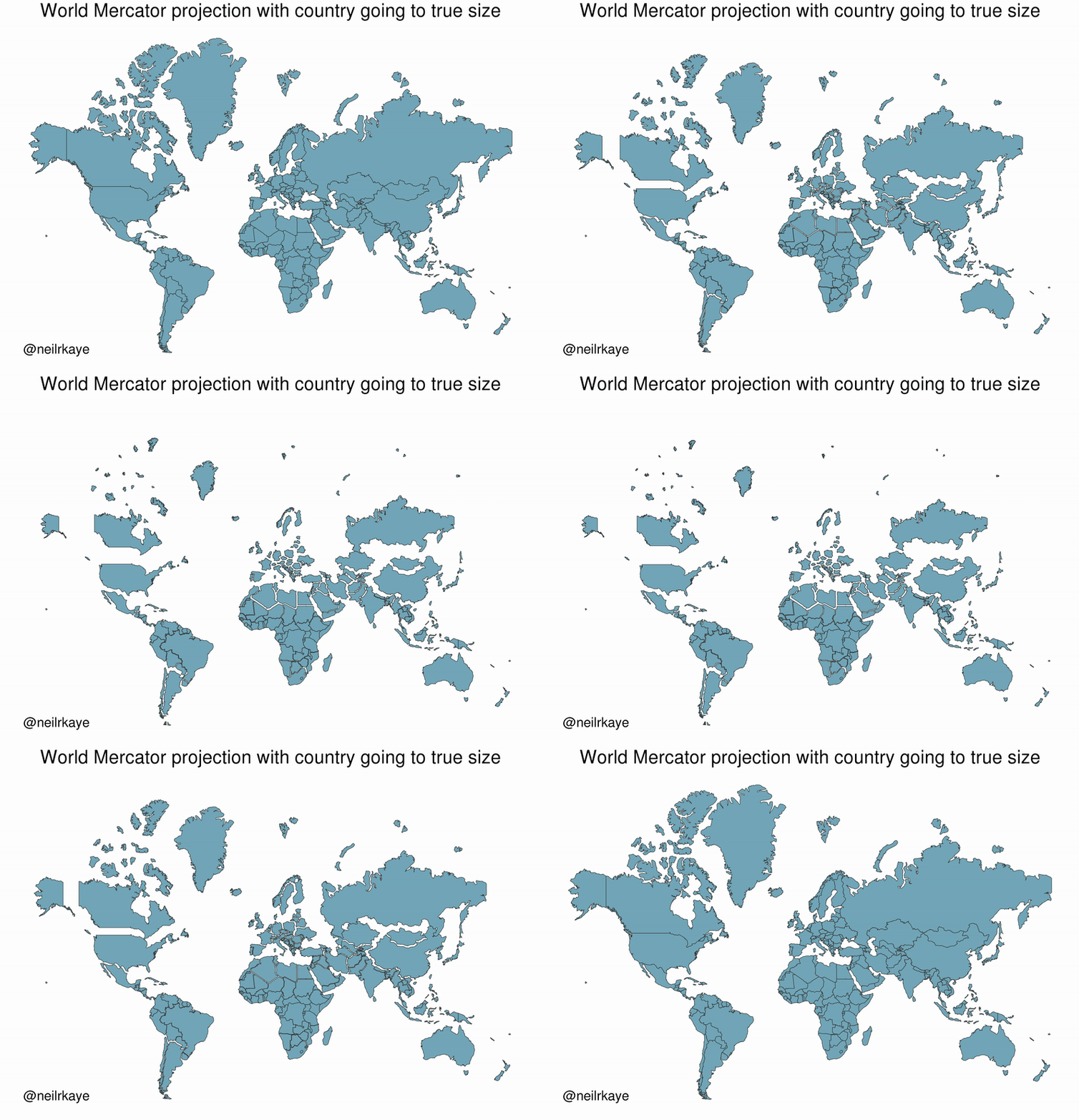
Some of the geographical misconceptions Gerardus Mercator inadvertently instilled in humanity to this day include exaggerations of the size of Europe and North America. “Visually speaking, Canada and Russia appear to take up approximately 25% of the Earth’s surface” on a Mercator map, “when in reality they occupy a mere 5%.”
Figures are one thing, but a fair few 21st century cartography enthusiasts have also used technology unavailable and indeed unimaginable in Mercator’s day to show us in a more immediately legible way exactly how his projection distorts land masses. Recently, a climate data scientist named Neil Kaye has used the form of the animated GIF to show what happens when countries shrink to their actual size on a Mercator map, and when Mexico and Greenland trade places.
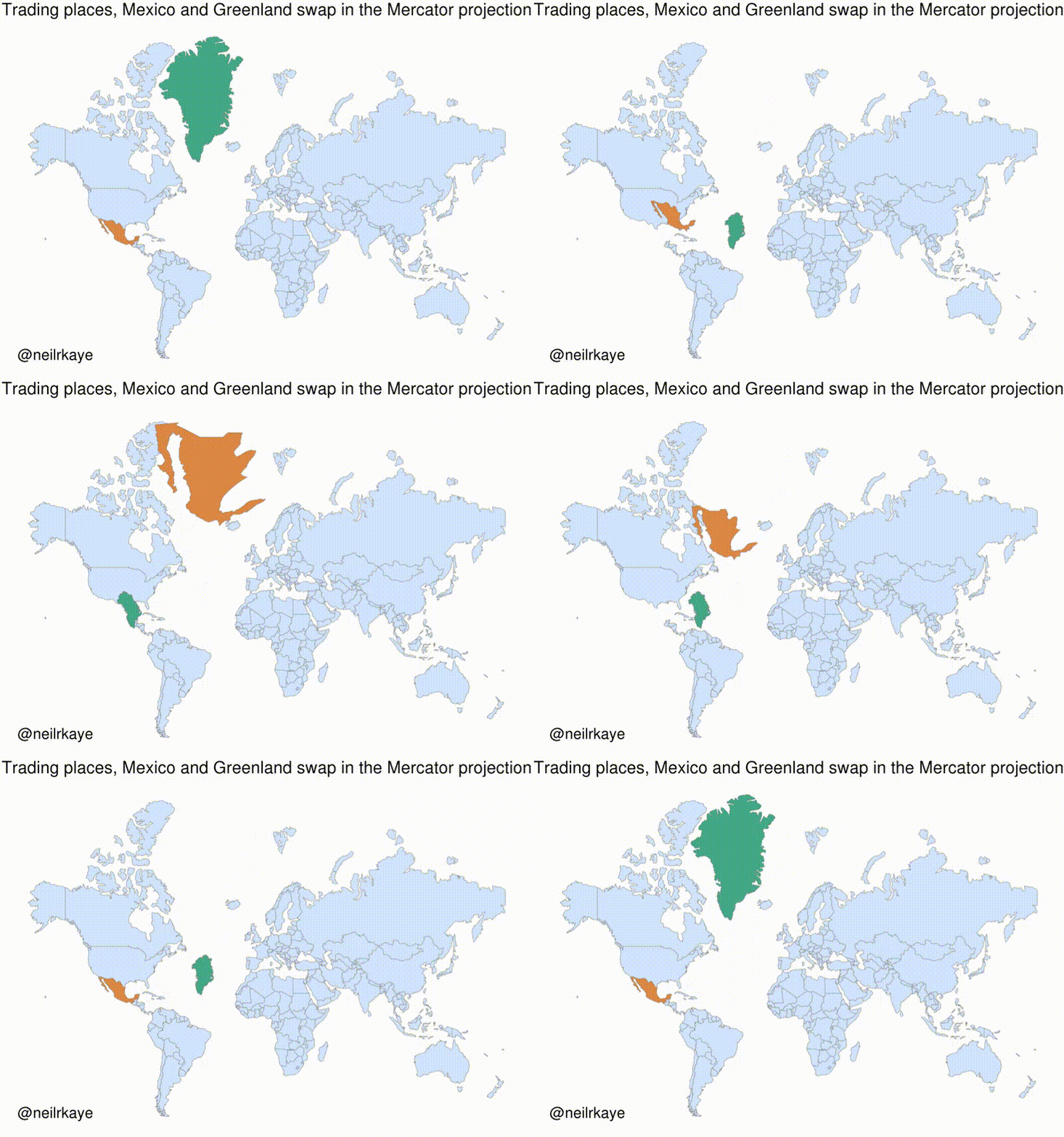
As soon as Mexico goes north and Greenland goes south, it becomes obvious that both are really of a similar size, though we might have assumed the latter to be much larger than the former. And in fact, Mercator projection makes all countries farther from the equator look larger in relation to all countries nearer to the equator. We’ve pointed out the impossibility of making a perfectly faithful two-dimensional world map before here before on Open Culture, an impossibility that hasn’t stopped cartographers from trying to come up with more and more accurate projections. But even they can’t substitute for an acute awareness of how even the most popular maps can be wrong, an awareness you can develop even more intensively by viewing the many other cartographic creations Kaye has posted to the “Map Porn” subreddit — another technological development Mercator surely couldn’t have foreseen.
Related Content:
Japanese Designers May Have Created the Most Accurate Map of Our World: See the AuthaGraph
The History of Cartography, the “Most Ambitious Overview of Map Making Ever,” Now Free Online
New York Public Library Puts 20,000 Hi-Res Maps Online & Makes Them Free to Download and Use
A Radical Map Puts the Oceans – Not Land – at the Center of Planet Earth (1942)
Why Making Accurate World Maps Is Mathematically Impossible
Based in Seoul, Colin Marshall writes and broadcasts on cities, language, and culture. His projects include the book The Stateless City: a Walk through 21st-Century Los Angeles and the video series The City in Cinema. Follow him on Twitter at @colinmarshall or on Facebook.
Read More...An Animated Introduction to H.P. Lovecraft and How He Invented a New Gothic Horror
Howard Phillips Lovecraft died in obscurity at the age of 46, but he left behind a body of work formidable enough that even today’s readers approach it only with great trepidation. They do so not so much because of its size, though Lovecraft did manage to write a fair bit, but because of what it dares to contemplate — or rather, because of its deep roots in the things mere humans dare not contemplate. Born in 1890, Lovecraft grew up on horror of the Gothic variety. But by the time he began writing his own in the year 1919, “World War I had cast a long shadow over the arts. People had seen real horrors, and were no longer frightened of fantastical folklore. Lovecraft sought to invent a new kind of terror, one that responded to the rapid scientific progress of the era.”
Those words come from the TED-Ed lesson above, “Titan of Terror: the Dark Imagination of H.P. Lovecraft.” Written and narrated by Silvia Moreno-García, a writer of science fiction and editor of several books on Lovecraft’s work, the video offers a four-minute primer on how this “weird fiction” permanently upped the ante for all writers who sought to instill fear and dread into the hearts of their readers.
“Like then-recent discoveries of subatomic particles or X‑rays,” Moreno-García says, “the forces in Lovecraft’s fiction were powerful, yet often invisible and indescribable. Rather than recognizable monsters, graphic violence, or startling shocks, the terror or ‘Lovecraftian’ horror lies in what’s not directly portrayed — but instead left to the dark depths of our imagination.”
Hence the cast of unspeakable “dark masters” beneath the placid New England surface of Lovecraft’s stories. Yog-Sothoth, “who froths as primal slime in nuclear chaos beyond the nethermost outposts of space and time”; “the blind, idiot god Azathoth, whose destructive impulses are stalled only by the ‘maddening beating of vile drums and the thin monotonous whine of accursed flutes’ ”; and of course Lovecraft’s “infamous blend of dragon and octopus, Cthulhu”: even those who have never read Lovecraft may well have heard of them. And as anyone who has read Lovecraft knows, we who have only heard of them, these beings “who exist beyond our conceptions of reality, their true forms as inscrutable as their motives,” should count themselves lucky — far luckier, certainly, than the humans Lovecraft puts face-to-face with them.
Related Content:
H.P. Lovecraft’s Classic Horror Stories Free Online: Download Audio Books, eBooks & More
H.P. Lovecraft Gives Five Tips for Writing a Horror Story, or Any Piece of “Weird Fiction”
H.P. Lovecraft Highlights the 20 “Types of Mistakes” Young Writers Make
Lovecraft: Fear of the Unknown (Free Documentary)
Based in Seoul, Colin Marshall writes and broadcasts on cities, language, and culture. His projects include the book The Stateless City: a Walk through 21st-Century Los Angeles and the video series The City in Cinema. Follow him on Twitter at @colinmarshall or on Facebook.
Read More...A Short Animated Film Explores the Fluidity of Gender in the Thought of Simone de Beauvoir and Judith Butler
In hindsight, it seems like a very different world when I first read Judith Butler’s Gender Trouble in college in the 90s. (Mash together all your stereotypes about college campuses in the 90s and you’ve pretty much got the picture.) For one thing, columnists in major national newspapers and magazines weren’t writing controversial, or simply explanatory, articles about gender fluidity. The concept did not exist in the mainstream press. It seemed both hip and rarified, confined to theory discussion groups, academic seminars, and punk zines.
As radical as Butler’s ideas about gender seemed, she acknowledged that she did not originate the critique. She found it first articulated in Simone de Beauvoir’s The Second Sex, in which the French existentialist feminist wrote, “one is not born a woman, but rather becomes one.”
In the short film above, Devenir (To Become), by French filmmaker Géraldine Charpentier-Basille, Butler describes her reaction to reading the passage. “I wrote something about this problem of becoming. And I wanted to know: does one ever become one? Or is that to be a woman is a mode of becoming… that has no goal…. You could say the same of gender more generally.”
As the images illustrating this extract from a 2006 interview with Butler show, the goalposts of feminine and masculine identities move all the time, from year to year, from culture to culture. Gender is a pastiche of representations we inhabit. It is produced, performative, Butler thought, but we can never get it “right” because there is no true referent. The idea descends from the existentialist insights of de Beauvoir, who wrote about and dramatized similar problems of the personal and social self.
De Beauvoir extended Sartre’s claim that “existence precedes essence” in her pioneering feminist work—we come into the world, then acquire identities through acculturation, social conditioning, and coercion. Butler extended the argument further. “For her, writes Aeon’s Will Fraker, “gender wasn’t predetermined by nature or biology, nor was it simply ‘made up’ by culture. Rather, Butler insisted that gender resides in repeated words and actions, words and actions that both shape and are shaped by the bodies of real, flesh-and-blood human beings. And crucially, such repetitions are rarely performed freely.”
From our earliest years, we are trained how to behave as a gender, just as we are taught to perform other identities—trained by the expectations of parents, teachers, religious leaders, advertisers, and the bullying and social pressure of our peers. Hear Butler explain further how gender, in her theory, functions as “a phenomenon that is produced and is being reproduced all the time…. Nobody really is a gender from the start. I know it’s controversial,” she says. “But that’s my claim.” It is one that poses complicated questions more broadly, notes Aeon, about “the pursuit of the ‘authentic’ self” as a meaningful idea—questions Western philosophers have been asking for well over half a century.
via Aeon
Related Content:
Simone de Beauvoir Explains “Why I’m a Feminist” in a Rare TV Interview (1975)
Josh Jones is a writer and musician based in Durham, NC. Follow him at @jdmagness
Read More...Hear “Ibn Hakkan Al-Bokhari, Dead in his Labyrinth” by Jorge Luis Borges, Read by Orhan Pamuk
“Jorge Luis Borges 1951, by Grete Stern” via Wikimedia Commons.
Below hear Orhan Pamuk join the New Yorker’s Deborah Treisman to read and discuss “Ibn Hakkan Al-Bokhari, Dead in his Labyrinth,” by Jorge Luis Borges. The story comes from a 1970 issue of the magazine. Pamuk received the Nobel Prize in Literature in 2006. This reading will be added to our collection, 1,000 Free Audio Books: Download Great Books for Free.
If you would like to support the mission of Open Culture, consider making a donation to our site. It’s hard to rely 100% on ads, and your contributions will help us continue providing the best free cultural and educational materials to learners everywhere. You can contribute through PayPal, Patreon, and Venmo (@openculture). Thanks!
Read More...“On Exactitude in Science” by Jorge Luis Borges, Read by Author Will Self
“Jorge Luis Borges 1951, by Grete Stern” via Wikimedia Commons.
“On Exactitude in Science” is “a one-paragraph short story written in 1946 by Jorge Luis Borges, about the map–territory relation, written in the form of a literary forgery.” Below you can hear the story read by author Will Self, in a recording created by The Guardian. This reading will be added to our collection, 1,000 Free Audio Books: Download Great Books for Free.
If you would like to support the mission of Open Culture, consider making a donation to our site. It’s hard to rely 100% on ads, and your contributions will help us continue providing the best free cultural and educational materials to learners everywhere. You can contribute through PayPal, Patreon, and Venmo (@openculture). Thanks!
Read More...Support Us
We're hoping to rely on loyal readers, rather than erratic ads. Please click the Donate button and support Open Culture. You can use Paypal, Venmo, Patreon, even Crypto! We thank you!

About Us

Open Culture scours the web for the best educational media. We find the free courses and audio books you need, the language lessons & educational videos you want, and plenty of enlightenment in between.
Advertise With Us

FREE UPDATES!
GET OUR DAILY EMAIL
Get the best cultural and educational resources on the web curated for you in a daily email. We never spam. Unsubscribe at any time.
FOLLOW ON SOCIAL MEDIA

Open Culture editor Dan Colman scours the web for the best educational media. He finds the free courses and audio books you need, the language lessons & movies you want, and plenty of enlightenment in between.
Advertise With Us


