Hear Margaret Atwood’s Story “Stone Mattress,” Read by Author A. M. Homes

Image byFoire du Livre de Francfort, via Wikimedia Commons
Below hear author A. M. Homes join the New Yorker’s Deborah Treisman to read and discuss “Stone Mattress” by Margaret Atwood. The story appeared in a 2011 issue of the magazine. And it comes from a larger short story collection called, Stone Mattress: Nine Wicked Tales.
This story will be added to our ever-growing collection, 1,000 Free Audio Books: Download Great Books for Free.
If you would like to support the mission of Open Culture, consider making a donation to our site. It’s hard to rely 100% on ads, and your contributions will help us continue providing the best free cultural and educational materials to learners everywhere. You can contribute through PayPal, Patreon, and Venmo (@openculture). Thanks!
Read More...Creating Video Games: A Free Online Course from MIT
Taught by Philip B. Tan, Richard Eberhardt, Sara Verrilli and Andrew Grant, Creating Video Games is an MIT course that “introduces students to the complexities of working in small, multidisciplinary teams to develop video games. Students will learn creative design and production methods, working together in small teams to design, develop, and thoroughly test their own original digital games. Design iteration across all aspects of video game development (game design, audio design, visual aesthetics, fiction and programming) will be stressed. Students will also be required to focus test their games, and will need to support and challenge their game design decisions with appropriate focus testing and data analysis.”
You can watch the 27 video lectures in the playlist above, or find them on YouTube or MIT’s website. Find the syllabus for the course here.
Creating Video Games will be added to our list, 1,700 Free Online Courses from Top Universities.
If you would like to support the mission of Open Culture, consider making a donation to our site. It’s hard to rely 100% on ads, and your contributions will help us continue providing the best free cultural and educational materials to learners everywhere. You can contribute through PayPal, Patreon, and Venmo (@openculture). Thanks!
Read More...Freddie Mercury Reimagined as Comic Book Heroes
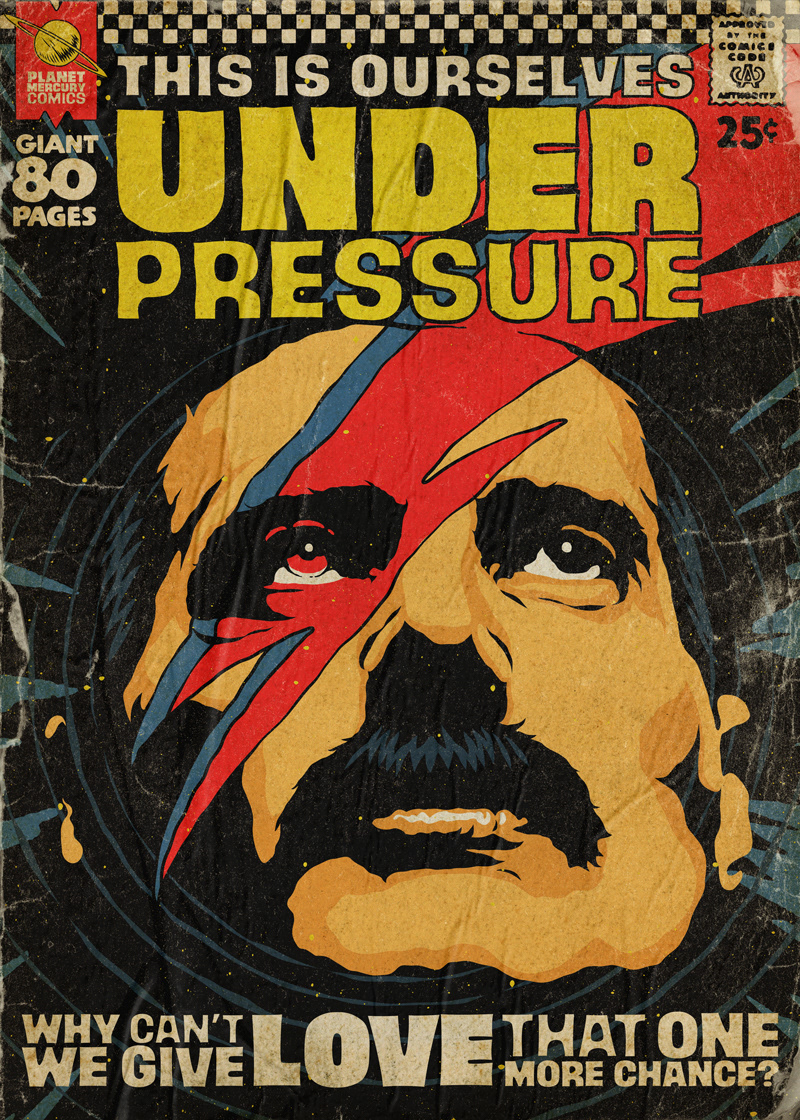
Pop culture thrives on superheroes, both fictional and real. This isn’t unique in human history. Read most any collection of ancient myth and literature and you’ll find the same. The demigods and chieftains beating their chests and talking trash in the Iliad, for example, remind me of macho professional wrestlers or characters in the Marvel and DC universes, cultural artifacts indebted in their various ways to classical legends. One thread runs through all of the epic tales of heroes and heroines: a seeming need to immortalize people who embody the qualities we most desire. Heroes may suffer for their tragic flaws, but that’s the price they pay for universal acclaim or an iron throne.
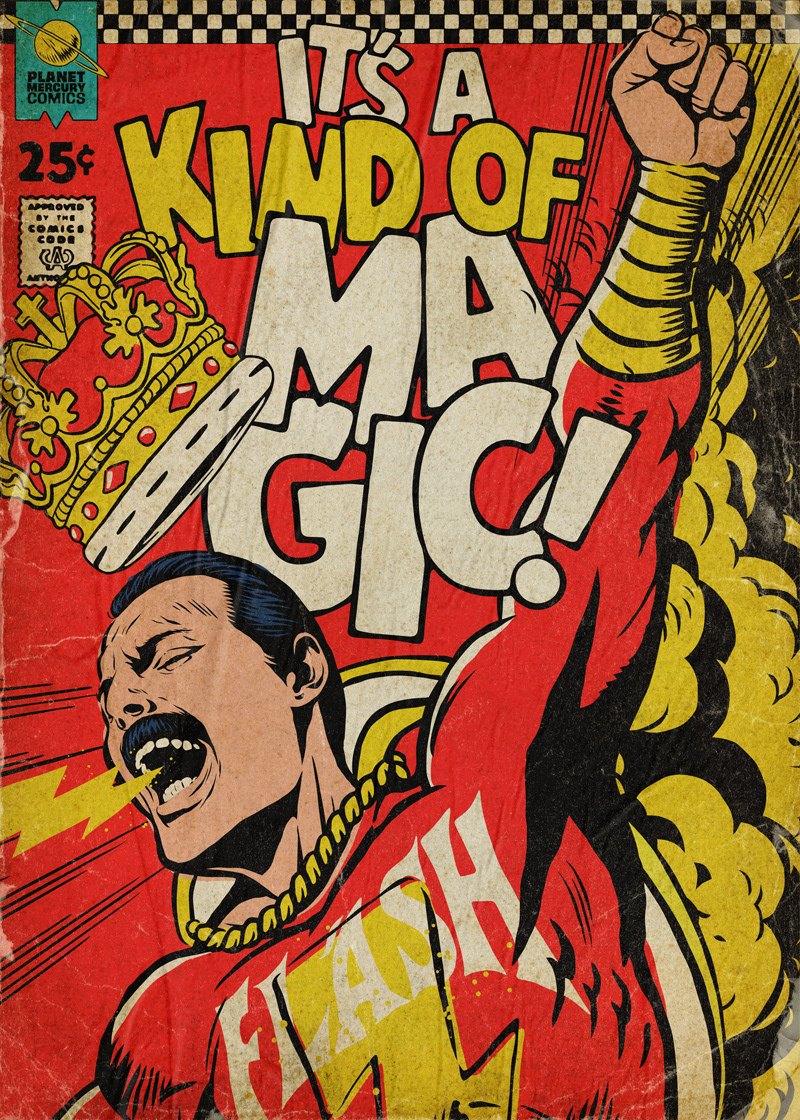
The traits ascribed to late modernity’s fictional heroes haven’t changed overmuch from the distant past—power, wit, agility, persistence, anger issues, spicy, complicated love lives…. But when it comes to the real people we admire—the celebrities who get the superhero treatment—creativity, style, and musical talent top the list. Why not?
David Bowie’s larger-than-life personas surely deserve to live on, transmitted not only via his music but by way of his posthumous transformation into a series of pulp and comic heroes as imagined by screenwriter and designer Todd Alcott, who has given the same treatment to beloved musical characters like Prince and Bob Dylan.
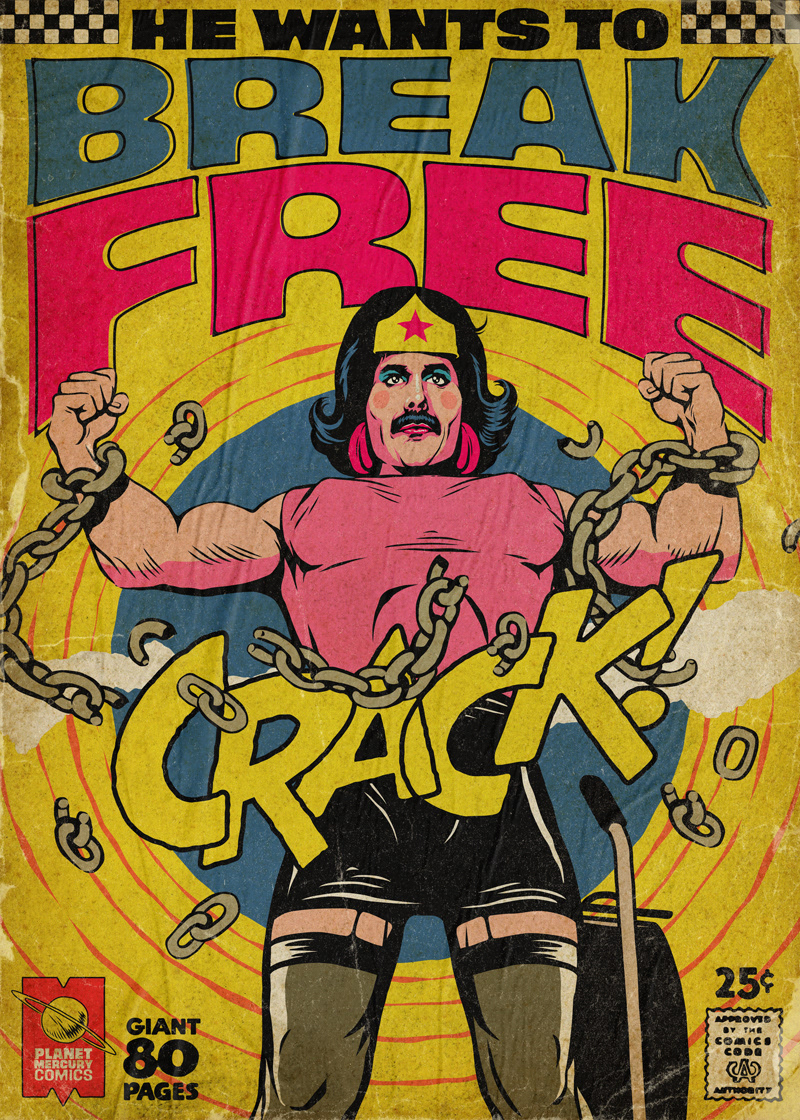
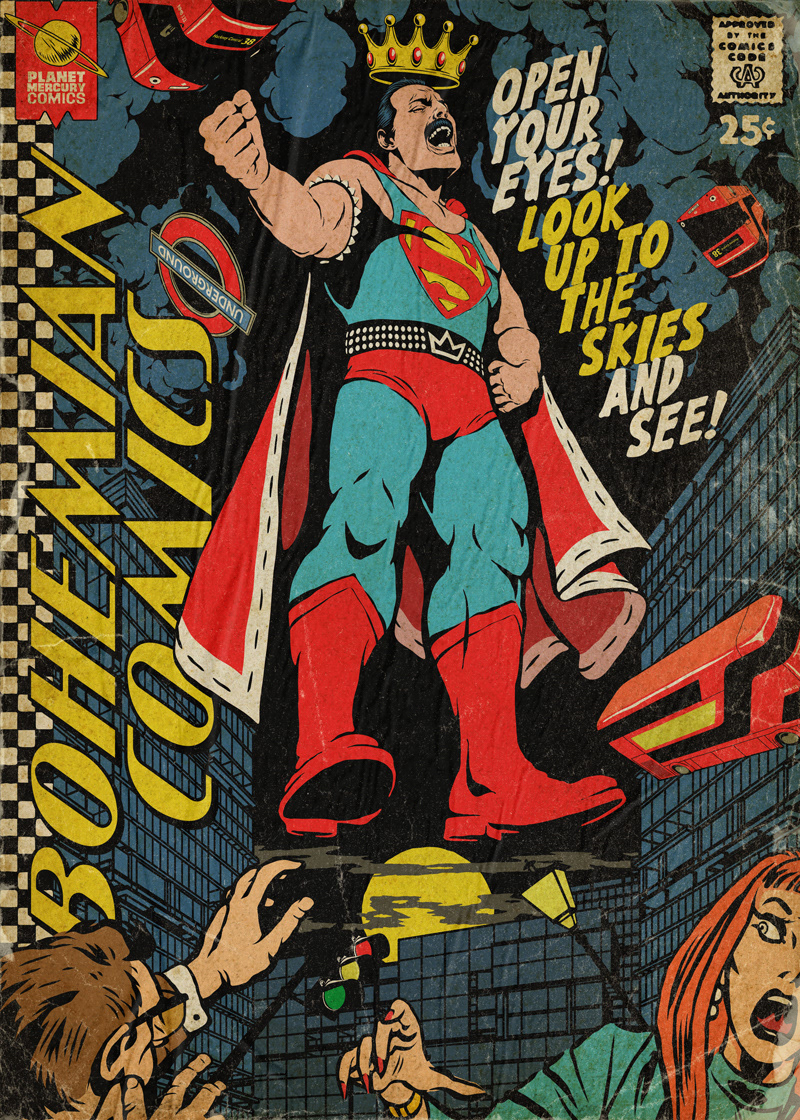
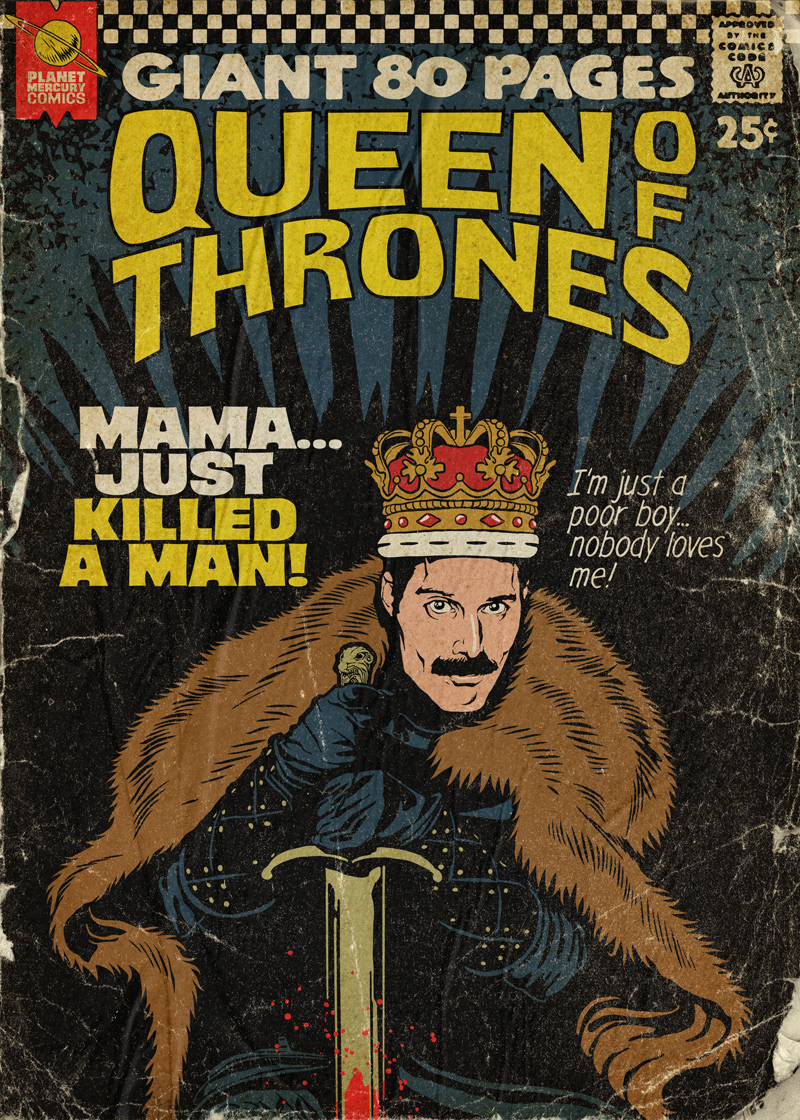
Performing a similar service for Freddie Mercury, Brazilian artist Butcher Billy satisfies the cultural craving for demigods in his immortalization of Freddie Mercury as various heroes like The Hulk, Superman, and Shazam (or “Flash”); a contender for the Iron Throne; and himself: riding on Darth Vader’s shoulders, breaking free in housewife drag, and sporting Bowie’s Aladdin Sane lightning bolt. What are the superpowers of these super-Freddies? The usual smashing, punching, and flying, it seems, but also the essentials of his real-life power—an impossibly big personality, huge stage presence, personal magnetism, and a godlike force of a voice.
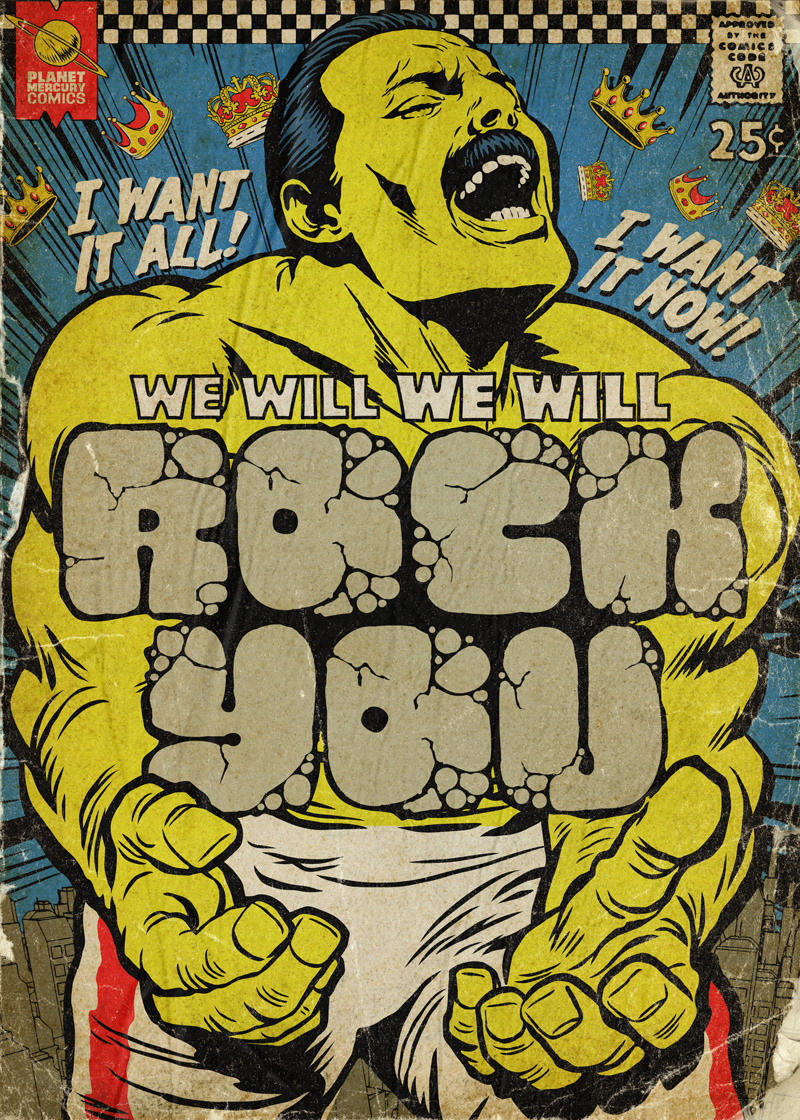
Add to these characteristics a unique talent for writing lyrics punchier than your favorite Twitter feed, and we have the makings of a modern epic giant with abilities that seemed to surpass those of mere mortals, with the swagger and ego to match. This tribute to Mercury is unabashed hero worship, turning the singer into an archetype. In the simple, bold, colorful lines of comic cover art we might just see that there’s a Freddie Mercury in all of us, wanting to break free, pump a fist in the air, and belt out our biggest feelings in capital letters and giant exclamation marks.
See more “Planet Mercury Comics” below and at Butcher Billy’s Behance site.

via Laughing Squid
Related Content:
David Bowie Songs Reimagined as Pulp Fiction Book Covers: Space Oddity, Heroes, Life on Mars & More
Scenes from Bohemian Rhapsody Compared to Real Life: A 21-Minute Compilation
Josh Jones is a writer and musician based in Durham, NC. Follow him at @jdmagness
Read More...The Medieval City Plan Generator: A Fun Way to Create Your Own Imaginary Medieval Cities
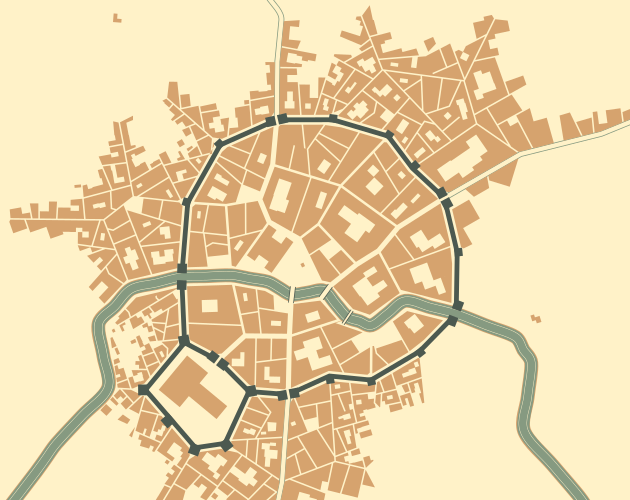
The Medieval City Plan Generator. It’s the free online tool you’ve always wanted. It doesn’t create maps of actual medieval cities–only nice looking maps of imaginary cities, with the ability to add plazas, castles, rivers, city walls, and even shanty towns. Enter the Medieval City Plan Generator here.
If you would like to support the mission of Open Culture, consider making a donation to our site. It’s hard to rely 100% on ads, and your contributions will help us continue providing the best free cultural and educational materials to learners everywhere. You can contribute through PayPal, Patreon, and Venmo (@openculture). Thanks!
Related Content:
How the Brilliant Colors of Medieval Illuminated Manuscripts Were Made with Alchemy
1,600-Year-Old Illuminated Manuscript of the Aeneid Digitized & Put Online by The Vatican
If you would like to support the mission of Open Culture, consider making a donation to our site. It’s hard to rely 100% on ads, and your contributions will help us continue providing the best free cultural and educational materials to learners everywhere. You can contribute through PayPal, Patreon, and Venmo (@openculture). Thanks!
Read More...The Daily Rituals of 143 Famous Female Creators: Octavia Butler, Edith Wharton, Coco Chanel & More
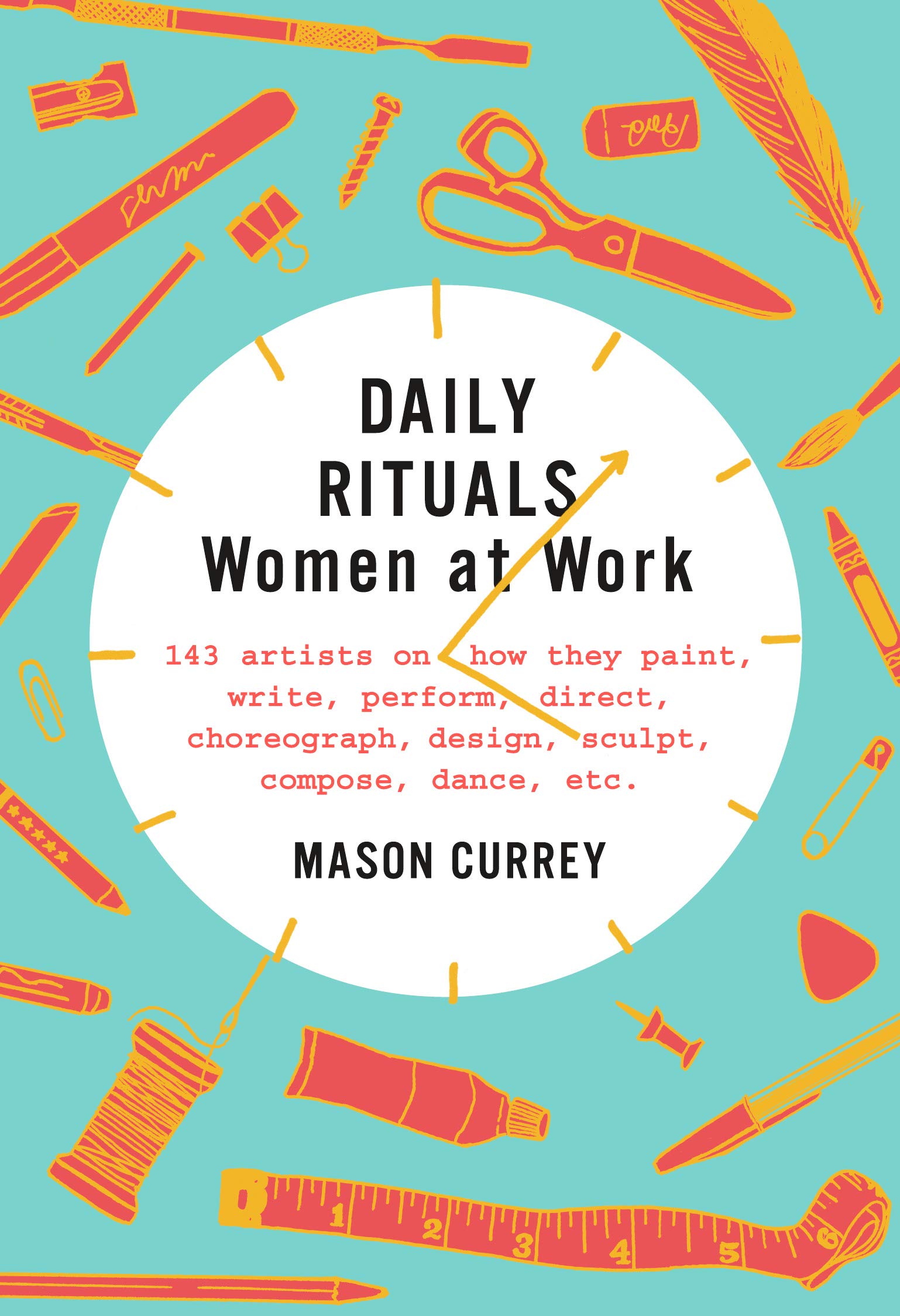
Certain kinds of content have flowered on the internet that we can’t seem to get enough of, and if you frequent Open Culture, you may well have a weakness for one kind in particular: the daily schedules of notable creators. When we know and respect someone’s work, we can’t help but wonder how they spend their finite time on this Earth in such a way that allows them to create that work in the first place. Mason Currey, creator of the blog Daily Rituals, knows this well: not only did all his posting about “how writers, artists, and other interesting people organize their days” lead to a book, Daily Rituals: How Great Minds Make Time, Find Inspiration, and Get to Work, it just last month produced a sequel, Daily Rituals: Women at Work.
“In the first Daily Rituals, I featured far more men than women,” writes Currey. “In this second volume, I correct the imbalance with profiles of the day-to-day working lives of 143 women writers, artists, and performers,” including Octavia Butler, “who wrote every day no matter what,” Isak Dinesen, “who subsisted on oysters and champagne but also amphetamines, which gave her the overdrive she required, Martha Graham, “who eschewed socializing in favor of long hours alone in her studio,” and Lillian Hellman, “who chain-smoked three packs of cigarettes and drank twenty cups of coffee a day (after milking the cow and cleaning the barn on her Hardscrabble Farm).”
You can read a few excerpts of the book at the publisher’s web site. Coco Chanel, we learn, usually arrived late to the office but “stayed until late in the evening, compelling her employees to hang around with her even after work had ceased, pouring wine and talking nonstop, avoiding for as long as possible the return to her room at the Ritz and to the boredom and loneliness that awaited her there.” Edith Wharton, by contrast, “always worked in the morning, and houseguests who stayed at the Mount — the 113-acre estate in Lenox, Massachusetts, where Wharton penned several novels, including The House of Mirth and Ethan Frome — were expected to entertain themselves until 11:00 a.m. or noon, when their hostess would emerge from her private quarters, ready to go for a walk or work in the garden.”
The other subjects of Daily Rituals: Women at Work, a full list of which you can read here, include everyone from Maya Angelou to Diane Arbus, Joan Didion to Marlene Dietrich, Dorothy Parker to Emily Post, and Agnès Varda to Alice Walker. Not only do no two of these creators have the same routines, their strategies for how best to use their time often conflict. “Screw inspiration,” said Octavia Butler, but her colleague in writing Zadie Smith takes quite a different tack: “I think you need to feel an urgency about the acts,” Currey quotes her as saying in an interview, “otherwise when you read it, you feel no urgency either. So, I don’t write unless I really feel I need to.” For all tips as you might pick up from these 143 women, as well as from the creators of both sexes in the previous book, the most important one might be a meta-tip: develop the set of daily rituals that suits your personality and no one else’s.
Related Content:
Ursula K. Le Guin’s Daily Routine: The Discipline That Fueled Her Imagination
The Daily Habits of Famous Writers: Franz Kafka, Haruki Murakami, Stephen King & More
The Daily Routines of Famous Creative People, Presented in an Interactive Infographic
74 Essential Books for Your Personal Library: A List Curated by Female Creatives
The Daily Habits of Highly Productive Philosophers: Nietzsche, Marx & Immanuel Kant
Based in Seoul, Colin Marshall writes and broadcasts on cities, language, and culture. His projects include the book The Stateless City: a Walk through 21st-Century Los Angeles and the video series The City in Cinema. Follow him on Twitter at @colinmarshall or on Facebook.
Read More...Here’s What Ancient Dogs Looked Like: A Forensic Reconstruction of a Dog That Lived 4,500 Years Ago

Images by Historic Environment Scotland
We’re pretty sure dogs aren’t obsessed with ancestry, despite the proliferation of canine DNA testing services.
That seems to be more of a human thing.
However, with very little digging, nearly every dog on earth could claim to be descended from a handsome specimen such as the one above.
This news must be gratifying to all those lapdogs who fancy themselves to be something more wolfish than their exteriors suggest.
This beast is no 21st-century pet, but rather, a reconstruction, forensic science’s best guess as to what the owner of a Neolithic skull discovered during a 1901 excavation of the 5,000-year-old Cuween Hill chambered cairn on Orkney, Scotland would have looked like in life.

About the size of a large collie, the “Cuween dog” has the face of a European grey wolf and the reasonable gaze of a family pet.
(Kudos to the project’s organizers for resisting the urge to bestow a nickname on their creation, or if they have, to resist sharing it publicly.)
Whether or not this good boy or girl had a name, it would’ve earned its keep, guarding a farm in the tomb’s vicinity.
Steve Farrar, Interpretation Manager at Historic Environment Scotland, the conservation organization that commissioned the reconstruction, believes that the farmers’ esteem for their dogs went beyond mere utilitarian appreciation:
Maybe dogs were their symbol or totem, perhaps they thought of themselves as the ‘dog people’.
Radiocarbon dating of this dog’s skull and 23 others found on the site point to ritual burial—the animals were placed within more than 500 years after the passage to the tomb was built. Historic Environment Scotland posits that the canine remains’ placement next to those of humans attest to the community’s belief in an afterlife for both species.
The model is presumably more relatable than the naked skull, which was scanned by Edinburgh University’s Royal (Dick) School of Veterinary Studies, enabling Historic Environment Scotland to make the 3D print that forensic artist Amy Thornton fleshed out with muscle, skin, and hair.
What a human genealogist wouldn’t give to trace their lineage back to 2000 BC, let alone have such a fetching picture.
Related Content:
40,000-Year-Old Symbols Found in Caves Worldwide May Be the Earliest Written Language
An Animated History of Dogs, Inspired by Keith Haring
Ayun Halliday is an author, illustrator, theater maker and Chief Primatologist of the East Village Inky zine. Join her in New York City this May for the next installment of her book-based variety show, Necromancers of the Public Domain. Follow her @AyunHalliday.
Read More...Enter, Explore, and Learn About Rembrandt’s The Anatomy Lesson with a New Augmented-Reality App
More than 350 years after he painted them, the paintings of Rembrandt van Rijn still look real enough to step right into. Now, thanks to a new augmented reality app from the Mauritshuis museum, you can do just that through the screen of your phone, starting with Rembrandt’s famed early canvas The Anatomy Lesson of Dr. Nicolaes Tulp. “The augmented reality experience, a first for a museum, allows the user to experience the anatomical theatre of 1632 digitally,” says the Mauritshuis’ press release, “and to observe Dr. Tulp and his fellow physicians, as well as the subject of their examination, the corpse of Aris Kindt.”
“I entered it and was surrounded by its enveloping darkness, its piecemeal illuminations,” writes Hyperallergic’s Seph Rodney on his augmented-reality experience of The Anatomy Lesson. “I walked in front of and sometimes faced each of the characters arrayed around a central figure, a corpse, with its left arm missing its skin below the elbow. One man, rather overdressed in a black doublet with a white shirt collar and white sleeves accenting his head and hands uses a pair of forceps to hold the corpse’s exposed arm muscles and tendons stretched away from the bones beneath.”
As Rodney approaches the figure, “a small text box pops out telling me precisely this: that he is gazing at the book to make sense of what the body beneath him is saying in all its vascular and muscular complexity.”
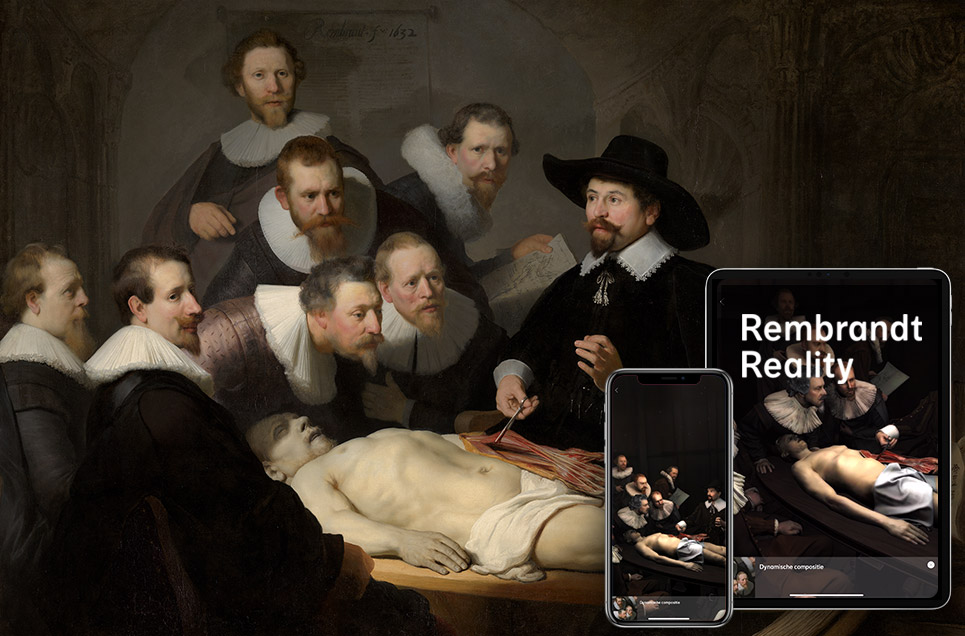
Sans text boxes, the scene will sound familiar to Rembrandt enthusiasts, but not even the most enthusiastic of them will have seen it in quite this way before. To build an augmented-reality version of the scene Rembrandt painted 387 years ago, “lookalikes of the main figures in the painting dressed up in seventeenth-century outfits and were then scanned with a 3D scanner made up of 600 reflex cameras. The original theatre in the Waag where Dr. Tulp gave his anatomy lesson in 1632 was then captured with the 3D scanner. These scans were then combined, after which 3D modelers gave the figures and the space the correct colors, textures and light.”
You can get a glimpse of the process in the short video at the top of the post, then download the Rembrandt Reality app in either its Google or Apple version and step into The Anatomy Lesson yourself. It may feel somewhat odd at first to simply stroll around the scene of an ongoing dissection of a human body, but in a way, the Mauritshuis’ digital opening of this immortal lesson to the world re-emphasizes the true nature of the original scene. When a physician of Tulp’s stature dissected a corpse, people from all around — medical professionals and otherwise — would come to watch the spectacle that could last for days. But could even Tulp, then Amsterdam’s city anatomist and later the city’s mayor, have imagined that this particular spectacle would last 387 years and counting?
via Hyperallergic
Related Content:
13 of Van Gogh’s Paintings Painstakingly Brought to Life with 3D Animation & Visual Mapping
Van Gogh’s 1888 Painting, “The Night Cafe,” Animated with Oculus Virtual Reality Software
Walk Inside a Surrealist Salvador Dalí Painting with This 360º Virtual Reality Video
Based in Seoul, Colin Marshall writes and broadcasts on cities, language, and culture. His projects include the book The Stateless City: a Walk through 21st-Century Los Angeles and the video series The City in Cinema. Follow him on Twitter at @colinmarshall or on Facebook.
Read More...What Is a Zen Koan? An Animated Introduction to Eastern Philosophical Thought Experiments
If you know anything at all about Zen, you know the famous question about the sound of one hand clapping. While the brain teaser did indeed originate with a Zen master, it does not fully represent the nature of the koan. Between the 9th and 13th centuries, when Chan Buddhism, as Zen was known in China, flourished, koans became widely-used, explains the TED-Ed animated video above, as objects of meditation. “A collection of roughly one thousand, seven hundred bewildering philosophical thought experiments,” koans were ostensibly tools to practice living with the unexplainable mysteries of existence.
The name, notes the lesson, “originally gong-an in Chinese, translates to ‘public record or case.’ But unlike real-world court cases, koans were intentionally incomprehensible.” Koans are “Surprising, surreal, and frequently contradicted themselves.” The lessons in ambiguity and paradox have their analogue, perhaps, in certain trains of thought in Medieval Catholic philosophy or the idealism of thinkers like George Berkeley, who might have first come up with the one about the tree falling in the forest.
But is the purpose of the koan simply to break the brain’s reliance on reason? It was certainly used this way. Zen Master Eihei Dogen, founder of Japanese Soto Zen traveled to China to study under the Chan Masters, and later criticized this kind of koan practice and other aspects of Chan, though he also collected 300 koans himself and they became integral to Soto tradition. Koans are not just absurdist zingers, they are, as the name says, cases—little stories, often about two monks in some kind of teacher and student relationship. Many of the students and teachers in these stories were patriarchs of Chan.
Like the sayings and doings of other religious patriarchs in other world religions, these “cases” have been collected with copious commentary in books like The Blue Cliff Record and The Book of Serenity. They show in snapshots the transmission of the teaching directly from teacher to student, rather than through sacred texts or rituals (hundreds of koans, rules, and rituals notwithstanding). That they are puzzling and ambiguous does not mean they are incomprehensible. Many seem more or less like fables, such as the oft-told story of the monk who carries a beautiful woman across a mud patch, then chastises his younger companion for bringing it up miles down the road.
Other koans are like Greek philosophical dialogues in miniature, such as the story in which two monks argue about the nature of a flag waving in the wind. A third steps in, Socrates-like, with a seemingly “right” answer that transcends both of their positions. The longevity of these vignettes lies in their subtlety—surface meanings only hint at what the stories are up to. Koans force those who take up their study to struggle with uncertainty and irresolution. They also frequently undermine the most common expectation that the teacher knows best.
Often posed as a kind of oblique verbal combat between teacher and student, koans include extremely harsh, even violent teachers, or teachers who seem to admit defeat, tacitly or otherwise, when a student gets the upper hand, or when both confront the speechless awe of not knowing. Attitudes of respect, reverence, humility, candor, and good humor prevail. Perhaps under all koan practice lies the idea of skillful means—the appropriate action to take in the moment, which can only be known in the moment.
In his short, humorous discussion of Zen koans above, Alan Watts tells the story of a Zen student who tricks his master and hits him with his own stick. The master responds with approval of the student’s tactics, but the koan does not suggest that everyone should do the same. That, as Dogen would argue, would be to have an idea about reality, rather than a wholly-engaged response to it. Whatever else koans show their students, they point again and again to this central human dilemma of thinking about living—in the past, present, or future—versus actually experiencing our lives.
Related Content:
The World’s Largest Collection of Tibetan Buddhist Literature Now Online
Josh Jones is a writer and musician based in Durham, NC. Follow him
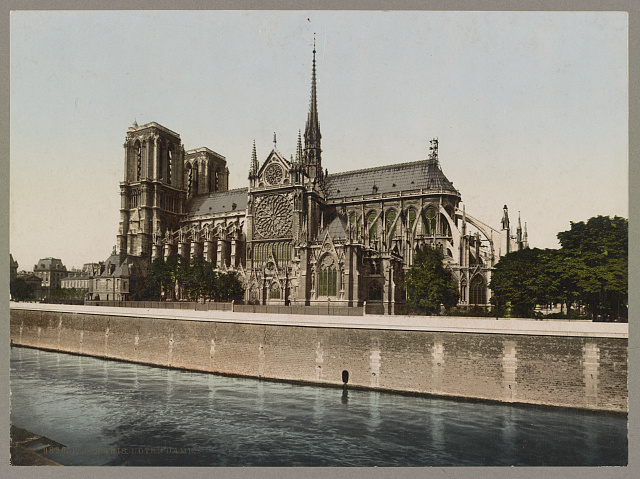
Read More...Paris in Beautiful Color Images from 1890: The Eiffel Tower, Notre Dame, The Panthéon, and More (1890)
The 17th and 18th centuries in England marked a period of ostentation for a growing, and increasingly wealthy, landowning class. These were also times of internal religious wars between Catholics and Protestants, a period that saw the regicide of Charles I, the restoration of Charles II to the throne, and William and Mary’s “Glorious Revolution,” deposing his successor, James II. All of this over the span of 28 years. Anti-Catholic sentiment ran high among the people, and it made a particularly convenient political tool.
But there are two groups you might not have found at anti-Catholic rallies during the most heated of political times, not, at least, during the final, formative years of their education. Both young scions of gentry and nobility on a gap year, and artists and poets seeking out the finest training, took the European Grand Tour, for several months or several years, a sojourn through the mostly-Catholic continent. No classical education was complete without a visit to Florence, Milan, Rome, Vienna, and, of course, Paris.
Here, gentleman picked up the latest fashions and dance steps, budding architects studied cathedrals and Catholic art, and everyone, Catholic and Protestant alike, gawked at the towering Notre Dame. The importance of the Grand Tour, remarked historian E.P. Thompson, “showed that ruling class control in the 18th century was located primarily in cultural hegemony.” Touring gentlemen wrote memoirs and guidebooks and commissioned paintings. Artists sent back drawings and poems, as both souvenirs and proof of their cultural mastery.
Through these aristocratic tourists the rest of the world came to see Europe as a succession of monuments, like the Greek and Roman cities of antiquity. At the same time, an imperialist craze for Neoclassical architecture began to make Europe’s biggest cities resemble classical models more and more.
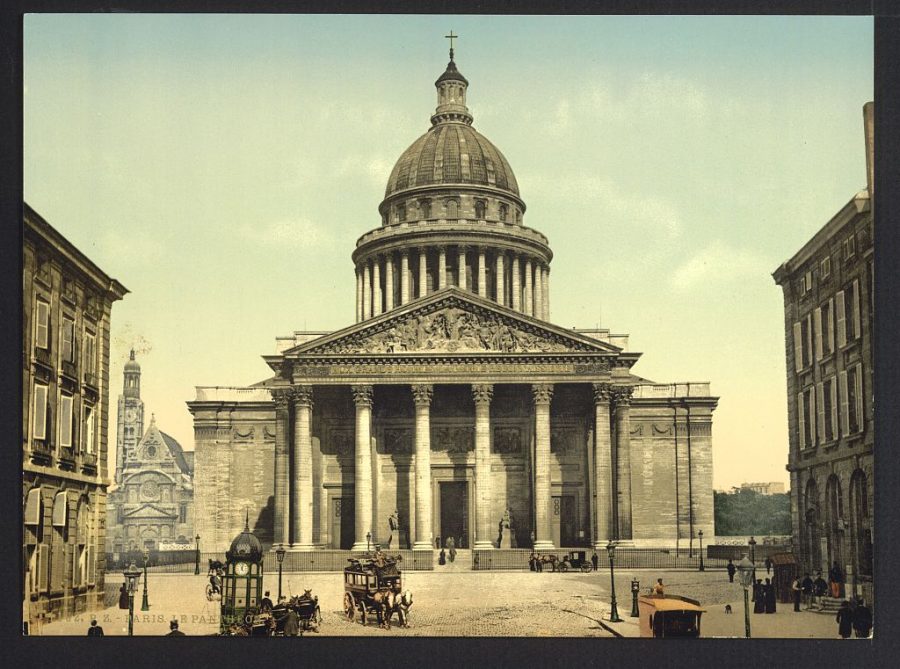
The last half of the 18th century saw the construction of the Panthéon, La Madeline—the Catholic church first dedicated as a temple to Napoleon—and the Louvre, all monuments to classical architecture.
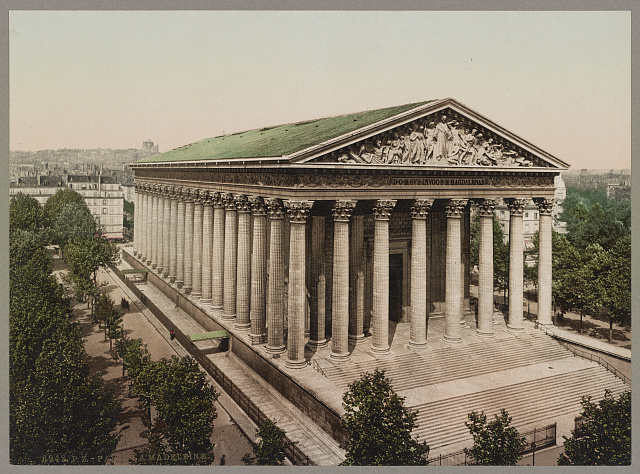
The Grand Tour approach to looking at cities and the corresponding Neoclassical wave of building came together in the age of photography, when prints of the great places could give their viewers a sense of having been there, or at least hit all the major entries in the guidebook. Wandering gentry and artists became entrepreneurs, using the new technology to not only simulate a Grand Tour, but to sell prints for postcards and the rare photographic book.
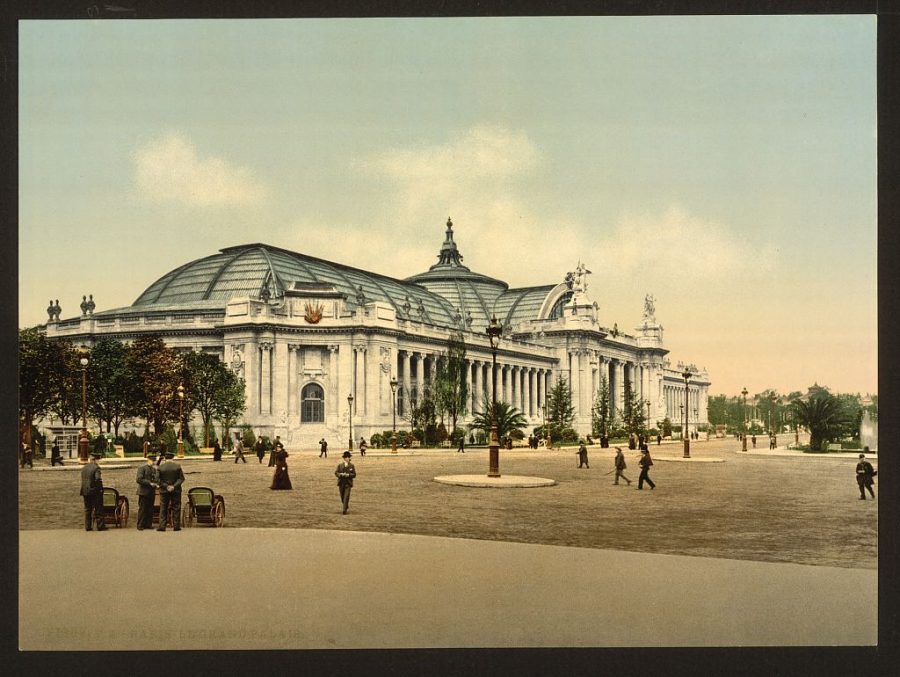
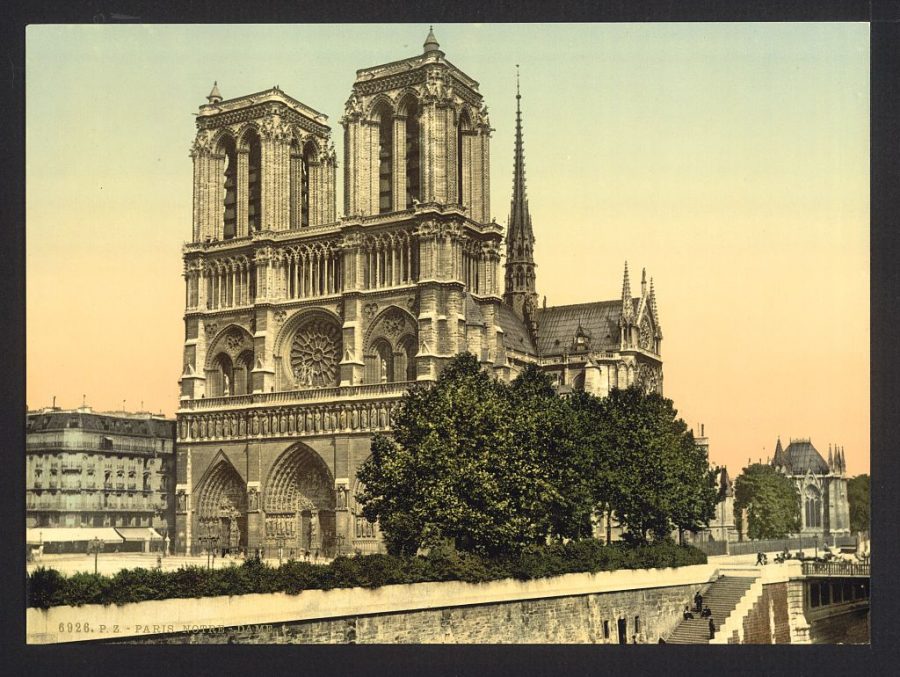
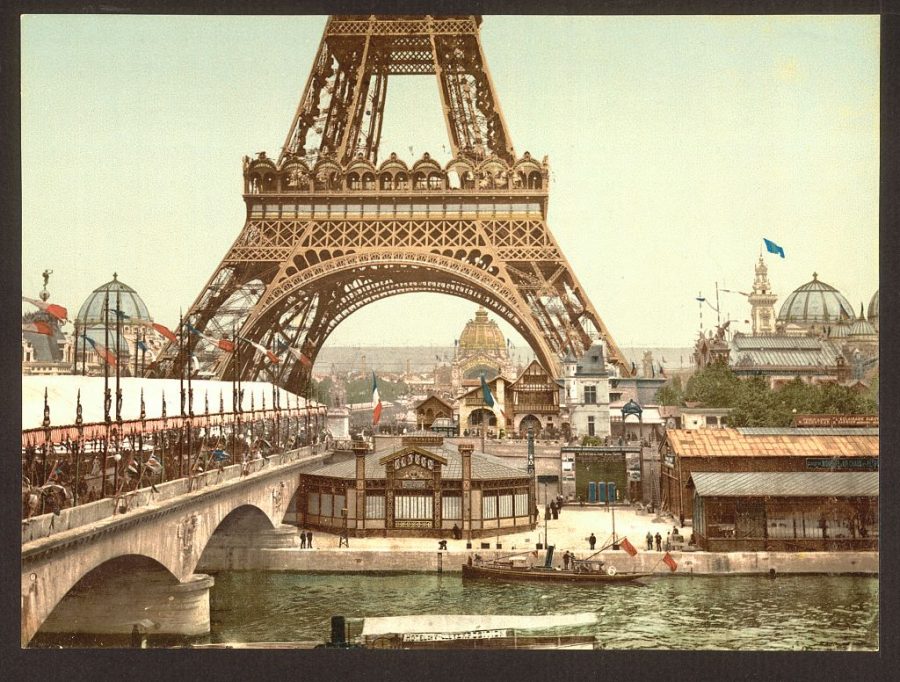
By 1890, when the photos of Paris here were taken, such prints were commonplace. They represented a democratization, in a way, of Europe’s great landmarks, and of the literary and fine arts techniques once primarily used to record them. No doubt some few people saw the development as a vulgar one, but art historians today can be grateful that Paris at the end of the 19th century was so well-documented. In this digital collection from the Library of Congress, Beaux-Arts masterpieces like the Paris Opera House sit beside the Gothic Notre Dame and Neo-Classical Panthéon.
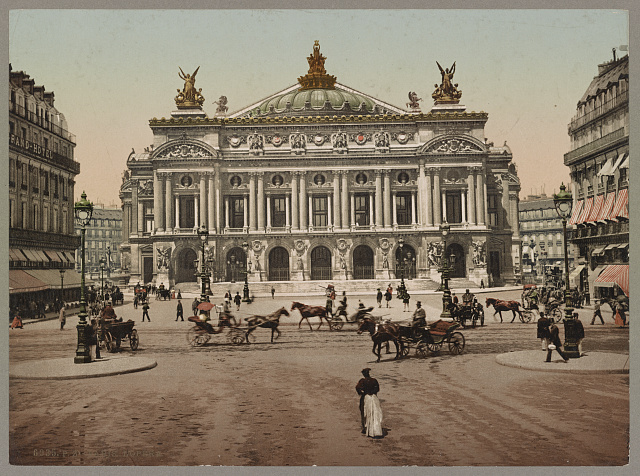
It is a shame these photos do not let viewers go inside to experience firsthand the buildings that inspired The Phantom of the Opera and The Hunchback of Notre Dame, and in which are buried such literary royalty as Voltaire, Jean-Jacques Rousseau, Emile Zola, and Victor Hugo himself. But this rich archive of early color photographs from just before the turn of the century does capture—for all time, perhaps, now that they are online—the greatest feats of architectural engineering from the old Medieval order, the Ancien Régime, the Republic, and the Empire.
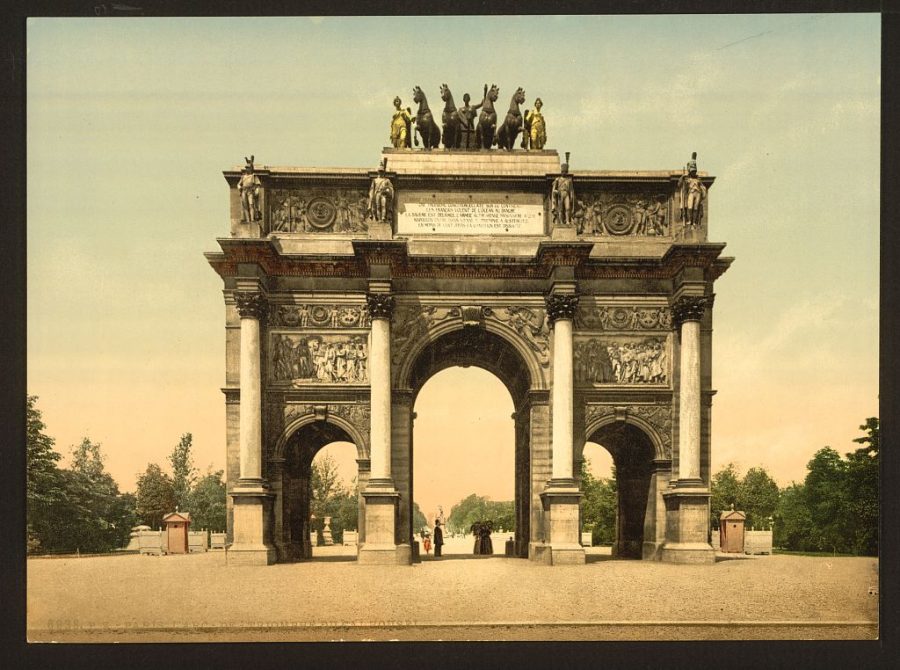
The collection represents yet another way of digitally preserving the memories of these grand buildings should they one day be lost, as Notre Dame nearly was just a few days ago. It also shows the state of photography at the dawn of the postcard boom, when Photochrom prints like these could be purchased cheaply and mailed for a few cents or centimes. See many more of these stunning photos at the Library of Congress Digital Collections here.
Related Content:
Tsarist Russia Comes to Life in Vivid Color Photographs Taken Circa 1905–1915
Josh Jones is a writer and musician based in Durham, NC. Follow him at @jdmagness
Read More...Cars: Past, Present & Future (A Free Course from Stanford)
Course Description: In F. Scott Fitzgerald’s novel The Great Gatsby, it was a murder weapon. In the movie The Graduate, it was a symbol of youthful rebellion. In countless songs it has served as a metaphor for everything from sexuality to social status. It has shaped our cities and changed our history. It has expanded our horizons and determined our politics. It is the automobile.
In this course (originally presented in Stanford’s Continuing Studies program) we will explore the past, present, and future of the automobile, bridging the humanities, social sciences, design, and engineering, and taking up the human experiences of designing, making, driving, being driven, living with, and dreaming of the automobile. Conversations with guest colleagues from Stanford and beyond will focus on a different theme each week and will be supported by readings and media: cars in the movies; the quest for speed and performance; the engineering challenges of automobility; the psychology of driving; automotive archaeology; the future of mobility; autonomous cars; the car as art; and cars and globalization. Overall the course is intended to offer a case study in the interdisciplinary understanding of human-centered design. Rooted in an appreciation of the richness of our human experience with the car, the course is informed by history, archaeology, ethnography, human-technology interaction, mechanical engineering, and cognitive science.
Guest speakers:
- Sven Beiker, Executive Director, CARS (Center for Automotive Research at Stanford)
- Reilly Brennan, Executive Director, Revs Program at Stanford
- Chris Gerdes, Associate Professor, School of Engineering; Director of CARS (Center for Automotive Research at Stanford) and the Revs Program at Stanford
- Joe Hustein, Lawyer; Lecturer in Mechanical Engineering — Design, Stanford
- David Kelley, Founder, IDEAO; Donald W. Whittier Professor in Mechanical Engineering; Director, Hasso Plattner Institute of Design and the Stanford Design Program
- Cliff Nass, Thomas More Storke Professor and Professor, by courtesy, of Sociology, of Computer Science, of Education and of Law; Director of CARS (Center for Automotive Research at Stanford) and The Revs Program at Stanford
- Jonathan Summers, Motoring Historian, Filmmaker
The lectures can be watched in the playlist above. Or see them on iTunes and YouTube.
Cars: Past, Present, and Future has been added to our collection, 1,700 Free Online Courses from Top Universities.
Read More...Support Us
We're hoping to rely on loyal readers, rather than erratic ads. Please click the Donate button and support Open Culture. You can use Paypal, Venmo, Patreon, even Crypto! We thank you!

About Us

Open Culture scours the web for the best educational media. We find the free courses and audio books you need, the language lessons & educational videos you want, and plenty of enlightenment in between.
Advertise With Us

FREE UPDATES!
GET OUR DAILY EMAIL
Get the best cultural and educational resources on the web curated for you in a daily email. We never spam. Unsubscribe at any time.
FOLLOW ON SOCIAL MEDIA

Open Culture editor Dan Colman scours the web for the best educational media. He finds the free courses and audio books you need, the language lessons & movies you want, and plenty of enlightenment in between.
Advertise With Us


