The Elements of Drawing: A Free Course from Oxford
In The Elements of Drawing, Stephen Farthing R.A. presents eight practical drawing classes using John Ruskin’s teaching collections to explain the basic principles of drawing.
1. Introduction to the Elements of Drawing
5. Making a Livelier Drawing
You can watch the lectures in the course above. Or find the lectures on iTunes or Oxford’s website.
The Elements of Drawing has been added to our collection, 1,700 Free Online Courses from Top Universities.
Read More...Journalistic Ethics: A Free Online Course from UCLA
Taught by Jim Newton, editor-at-large of the Los Angeles Times, this UCLA course–Journalistic Ethics–offers an intensive examination of ethical and policy issues arising from interaction of media institutions (print, film, broadcasting, and new technologies) and societal institutions (Congress, federal agencies, courts, Presidency, schools, churches, political action groups, advertisers, and audiences). The 14 lectures can all be streamed above, or here.
Journalistic Ethics has been added to our collection, 1,700 Free Online Courses from Top Universities.
If you would like to support the mission of Open Culture, consider making a donation to our site. It’s hard to rely 100% on ads, and your contributions will help us continue providing the best free cultural and educational materials to learners everywhere. You can contribute through PayPal, Patreon, and Venmo (@openculture). Thanks!
Read More...Experience the Majesty of Notre Dame by Getting a Free Download of the Video Game Assassin’s Creed Unity (Free for a Limited Time)
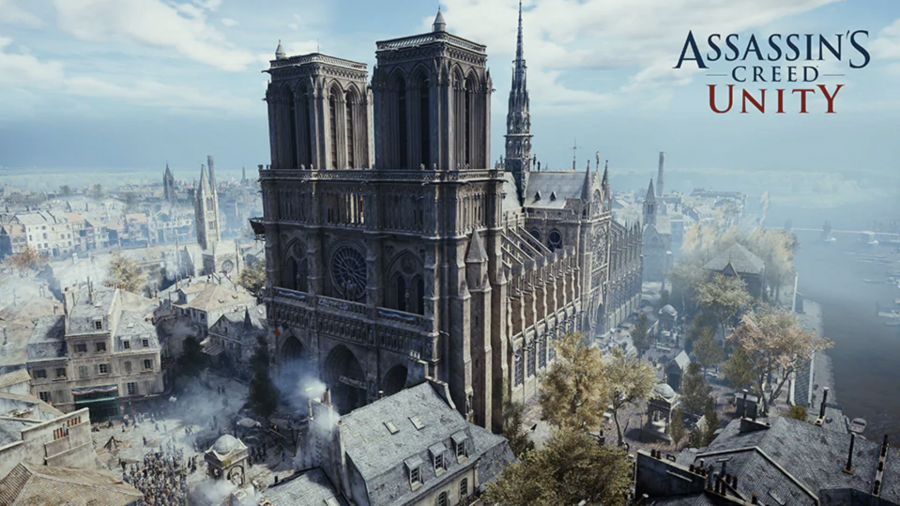
FYI: In the wake of the great Notre Dame fire, the French video game company Ubisoft has decided to make its popular video game Assassin’s Creed Unity free through April 25th, allowing gamers to “experience the majesty and beauty of the cathedral.” The gothic cathedral figures centrally in the game. Start your download (available only for PC users) here. Once you download the game, you’ll own it forever in your Uplay games library.
If you would like to support the mission of Open Culture, consider making a donation to our site. It’s hard to rely 100% on ads, and your contributions will help us continue providing the best free cultural and educational materials to learners everywhere. You can contribute through PayPal, Patreon, and Venmo (@openculture). Thanks!
Read More...Climate Change Gets Strikingly Visualized by a Scottish Art Installation
What does it accomplish to talk about climate change? Even those who talk about climate change professionally might find it hard to say. If you really want to make a point about rising sea levels — not to mention all the other changes predicted to afflict a warming Earth — you might do better to show, not tell. That reasoning seems to have motivated art projects like the giant hands reaching out from the waters of Venice previously featured here on Open Culture, and it looks even clearer in the more recent case of Lines (57° 59 ́N, 7° 16 ́W), an installation now on display on a Scottish island.

All images courtesy of Timo Aho and Pekka Niittyvirta
“At high tide, three synchronized lines of light activate in the Outer Hebrides off the west coast of Scotland,” writes Designboom’s Zach Andrews, and in the dark, “wrap around two structures and along the base of a mountain landscape.
Everything below these lines of light will one day be underwater.” Created by Finnish artists Pekka Niittyvirta and Timo Aho for Taigh Chearsabhagh Museum & Arts Centre, Lines (57° 59 ́N, 7° 16 ́W) offers a stark reminder of the future humanity faces if climate change goes on as projected.

But why put up an installation of such apparent urgency in such a thinly populated, out-of-the-way place? “Low lying archipelagos like this one are especially vulnerable to the catastrophic effects of climate change,” Andrews writes, adding that the Taigh Chearsabhagh Museum & Arts Centre itself “cannot even afford to develop on its existing site anymore due to the predicted rise of storm surge sea.” But though the effects of rising sea levels may be felt first on islands like these, few predictions have those effects stopping there; worst-case scenarios won’t spare our major metropolises, and certainly not the coastal ones.

You can get a sense of what Lines (57° 59 ́N, 7° 16 ́W) looks like in action from the photographs on Niittyvirta’s site a well as the time-lapse video at the top, which shows the lines of light activating when their sensors detect high tide, then only those lines of light remaining by the time the sun has gone completely down. To experience the full impact of the installation, however, requires seeing it in person in the context for which it was created. So if you’ve been putting off that trip to the Outer Hebrides, now might be the time to finally take it — not just because of Niittyvirta and Aho’s work, but because in a few years, it may not be quite the same place.
Related Content:
A Song of Our Warming Planet: Cellist Turns 130 Years of Climate Change Data into Music
A Century of Global Warming Visualized in a 35 Second Video
Based in Seoul, Colin Marshall writes and broadcasts on cities, language, and culture. His projects include the book The Stateless City: a Walk through 21st-Century Los Angeles and the video series The City in Cinema. Follow him on Twitter at @colinmarshall or on Facebook.
Read More...Billy Collins Teaches Poetry in a New Online Course
In its latest release, Masterclass has launched a new course, “Billy Collins Teaches Reading and Writing Poetry,” which they describe in the trailer above and the text below. You can sign up here. The cost is $90. Or pay $180 and get an annual pass to their entire catalogue of courses covering a wide range of subjects–everything from filmmaking (Werner Herzog, David Lynch, Martin Scorsese), to acting (Helen Mirren) and creative writing (Margaret Atwood), to taking photographs (Annie Leibovitz) and writing plays (David Mamet). Each course is taught by an eminent figure in their field.
Known for his wit, humor, and profound insight, Billy is one of the best-selling and most beloved contemporary poets in the United States. He regularly sells out poetry readings, frequently charms listeners on NPR’s A Prairie Home Companion, and his work has appeared in anthologies, textbooks, and periodicals around the world.
Called “America’s Favorite Poet” by the Wall Street Journal, Billy served two terms as U.S. Poet Laureate and is also a former New York State Poet Laureate. He’s been honored with the Mark Twain Prize for Humor in Poetry and a number of prestigious fellowships. He’s taught at Columbia University, Sarah Lawrence, and Lehman College, and he’s also a distinguished professor at the City University of New York. Now he’s teaching his first-ever MasterClass.
In his MasterClass on Reading and Writing Poetry, Billy teaches you the building blocks of poems and their unique power to connect reader and writer. From subject and form to rhyme and meter, learn to appreciate the pleasures of a well-turned poem. Discover Billy’s philosophy on the craft of poetry and learn how he creates a poet’s persona, incorporates humor, and lets imagination lead the way. By breaking down his own approach to composing poetry and enjoying the work of others, Billy invites students to explore the gifts poetry has to offer.
In this online poetry class, you’ll learn about:
• Using humor as a serious strategy
• The fundamental elements of poetry
• Billy’s writing process
• Turning a poem
• Exploring subjects
• Rhyme and meter
• Sound pleasures
• Finding your voice
• Using form to engage readers
• The visual distinctions of poetry
FYI: If you sign up for a MasterClass course by clicking on the affiliate links in this post, Open Culture will receive a small fee that helps support our operation.
Related Content:
The Animation of Billy Collins’ Poetry: Everyday Moments in Motion
Stream Billy Collins’ Album, The Best Cigarette, Free Online
Read More...
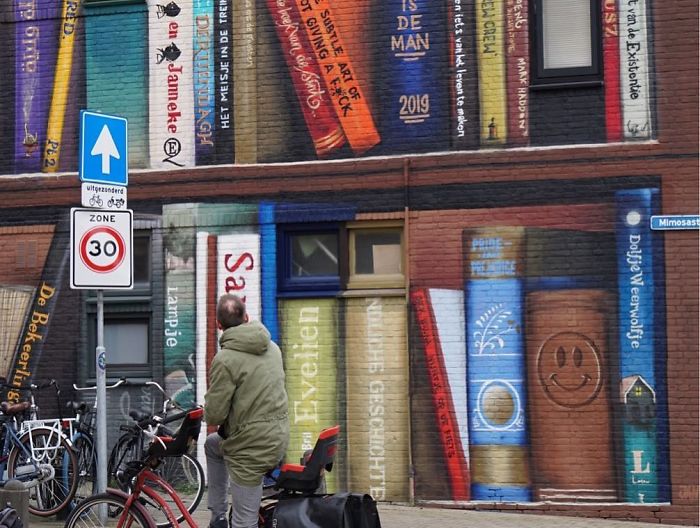
Street Art for Book Lovers: Dutch Artists Paint Massive Bookcase Mural on the Side of a Building
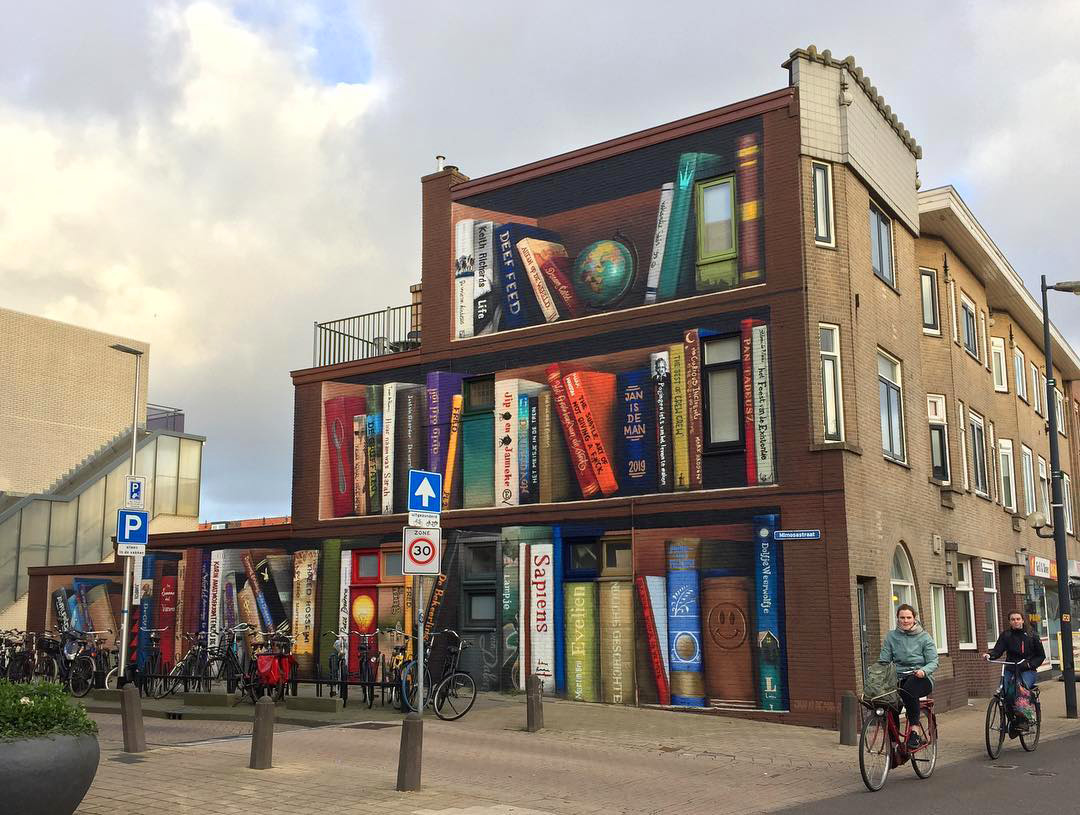
Bookcases are a great ice breaker for those who love to read.
What relief those shelves offer ill-at ease partygoers… even when you don’t know a soul in the room, there’s always a chance you’ll bond with a fellow guest over one of your hosts’ titles.
Occupy yourself with a good browse whilst waiting for someone to take the bait.
Now, with the aid of Dutch street artists Jan Is De Man and Deef Feed, some residents of Utrecht have turned their bookcases into street art, sparking conversation in their culturally diverse neighborhood.
De Man, whose close friends occupy the ground floor of a building on the corner of Mimosastraat and Amsterdam, had initially planned to render a giant smiley face on an exterior wall as a public morale booster, but the shape of the three-story structure suggested something a bit more literary.
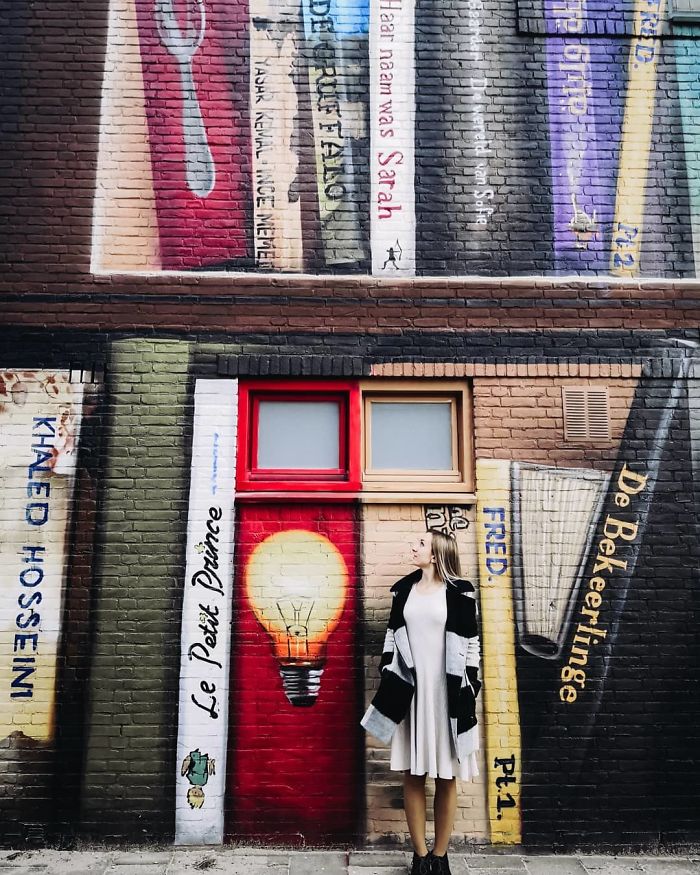
The trompe-l’oeil Boekenkast (or bookcase) took a week to create, and features titles in eight different languages.
Look closely and you’ll notice both artists’ names (and a smiley face) lurking among the spines.
Design mags may make an impression by ordering books according to size and color, but this communal 2‑D boekenkast looks to belong to an avid and omnivorous reader.
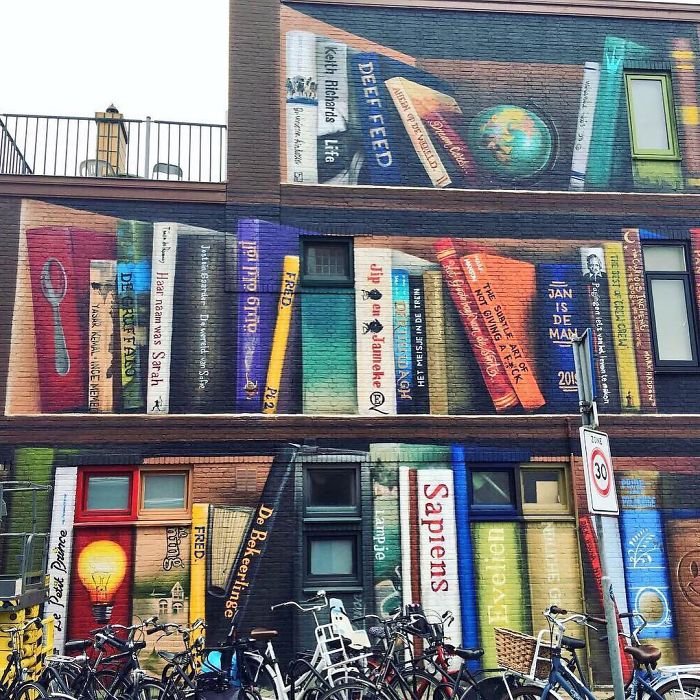
Some English titles that caught our eye:
The Subtle Art of Not Giving a F*ck
Keith Richards’ autobiography Life
The Curious Incident of the Dog in the Nighttime
And a classy-looking hardbound Playboy collection that may or may not exist in real life.
(Readers, can you spot the other fakes?)
Boekenkast is the latest of a number of global bookshelf murals tempting literary pilgrims to take a selfie on the way to the local indie bookshop.
via Bored Panda
Related Content:
157 Animated Minimalist Mid-Century Book Covers
Ayun Halliday is an author, illustrator, theater maker and Chief Primatologist of the East Village Inky zine. Join her in New York City this May for the next installment of her book-based variety show, Necromancers of the Public Domain. Follow her @AyunHalliday.
Read More...The Mueller Report Is #1, #2 and #3 on the Amazon Bestseller List: You Can Get It Free Online

Peruse the Amazon bestselling book list and you’ll find that the long-awaited Mueller Report is not just the #1 bestseller. It’s also the #2 bestseller and the #3 bestseller. Collusion and obstruction–it’s the stuff that makes for good book sales, it appears.
You can pre-order the Mueller Report in book, ebook and even audio book formats via the links above. But if you want to download the report for free, and start reading it asap, simply head to the Washington Post and New York Times. Or go straight to the source at the Justice Department web site. Politico has a searchable PDF version here.
If you would like to support the mission of Open Culture, consider making a donation to our site. It’s hard to rely 100% on ads, and your contributions will help us continue providing the best free cultural and educational materials to learners everywhere. You can contribute through PayPal, Patreon, and Venmo (@openculture). Thanks!
Read More...9 Science-Fiction Authors Predict the Future: How Jules Verne, Isaac Asimov, William Gibson, Philip K. Dick & More Imagined the World Ahead
Pressed to give a four-word definition of science fiction, one could do worse than “stories about the future.” That stark simplification does the complex and varied genre a disservice, as the defenders of science fiction against its critics won’t hesitate to claim. And those critics are many, including most recently the writer Ian McEwan, despite the fact that his new novel Machines Like Me is about the introduction of intelligent androids into human society. Sci-fi fans have taken him to task for distancing his latest book from a genre he sees as insufficiently concerned with the “human dilemmas” imagined technologies might cause, but he has a point: set in an alternate 1982, Machines Like Me isn’t about the future but the past.
Then again, perhaps McEwan’s novel is about the future, and the androids simply haven’t yet arrived on our own timeline — or perhaps, like most enduring works of science fiction, it’s ultimately about the present moment. The writers in the sci-fi pantheon all combine a heightened awareness of the concerns of their own eras with a certain genuine prescience about things to come.
Writing in the early 1860s, Jules Verne imagined a suburbanized 20th century with gas-powered cars, electronic surveillance, fax machines and a population at once both highly educated and crudely entertained. Verne also included a simple communication system that can’t help but remind us of the internet we use today — a system whose promise and peril Neuromancer author William Gibson described on television more than 130 years later.
In the list below we’ve rounded up Verne and Gibson’s predictions about the future of technology and humanity along with those of seven other science-fiction luminaries. Despite coming from different generations and possessing different sensibilities, these writers share not just a concern with the future but the ability to express that concern in a way that still interests us, the denizens of that future. Or rather, something like that future: when we hear Aldous Huxley predict in 1950 that “during the next fifty years mankind will face three great problems: the problem of avoiding war; the problem of feeding and clothing a population of two and a quarter billions which, by 2000 A.D., will have grown to upward of three billions, and the problem of supplying these billions without ruining the planet’s irreplaceable resources,” we can agree with the general picture even if he lowballed global population growth by half.
In 1964, Arthur C. Clarke predicted not just the internet but 3D printers and trained monkey servants. In 1977, the more dystopian-minded J.G. Ballard came up with something that sounds an awful lot like modern social media. Philip K. Dick’s timeline of the years 1983 through 2012 includes Soviet satellite weapons, the displacement of oil as an energy source by hydrogen, and colonies both lunar and Martian. Envisioning the world of 2063, Robert Heinlein included interplanetary travel, the complete curing of cancer, tooth decay, and the common cold, and a permanent end to housing shortages. Even Mark Twain, despite not normally being regarded as a sci-fi writer, imagined a “ ‘limitless-distance’ telephone” system introduced and “the daily doings of the globe made visible to everybody, and audibly discussable too, by witnesses separated by any number of leagues.”
As much as the hits impress, they tend to be outnumbered in even science fiction’s greatest minds by the misses. But as you’ll find while reading through the predictions of these nine writers, what separates science fiction’s greatest minds from the rest is the ability to come up with not just interesting hits but interesting misses as well. Considering why they got right what they got right and why they got wrong what they got wrong tells us something about the workings of their imaginations, but also about the eras they did their imagining in — and how their times led to our own, the future to which so many of them dedicated so much thought.
- Jules Verne
- Mark Twain
- Aldous Huxley
- Arthur C. Clarke
- Robert Heinlein
- J.G. Ballard
- William Gibson
- Philip K. Dick
- Isaac Asimov (1964)
- Isaac Asimov (1983)
If you would like to support the mission of Open Culture, consider making a donation to our site. It’s hard to rely 100% on ads, and your contributions will help us continue providing the best free cultural and educational materials to learners everywhere. You can contribute through PayPal, Patreon, and Venmo (@openculture). Thanks!
Related Content:
Read Hundreds of Free Sci-Fi Stories from Asimov, Lovecraft, Bradbury, Dick, Clarke & More
Free Science Fiction Classics on the Web: Huxley, Orwell, Asimov, Gaiman & Beyond
The Encyclopedia of Science Fiction: 17,500 Entries on All Things Sci-Fi Are Now Free Online
Isaac Asimov Recalls the Golden Age of Science Fiction (1937–1950)
The Art of Sci-Fi Book Covers: From the Fantastical 1920s to the Psychedelic 1960s & Beyond
Based in Seoul, Colin Marshall writes and broadcasts on cities, language, and culture. His projects include the book The Stateless City: a Walk through 21st-Century Los Angeles and the video series The City in Cinema. Follow him on Twitter at @colinmarshall or on Facebook.
Read More...150 Renowned Secular Academics & 20 Christian Thinkers Talking About the Existence of God
Of the many books released over the past couple decades about the existence or nonexistence of God (and there were a lot) one of the best comes from philosopher and novelist Rebecca Goldstein. Her 2010 36 Arguments for the Existence of God is not, however, a work of popular theology or anti-theology; it is fiction, a satire of academia, the publishing world, the Judaism she left behind, and the bubble of hype that once inflated around so-called “new atheism.”
In a book within the book, Goldstein’s hero, Cass Seltzer strikes it big with his own popular knockdown of religion, The Varieties of Religious Illusion, which ends with 36 refutations of arguments for God in the appendix, which itself provides the appendix for Goldstein’s book. If this sounds complicated, there’s no reason it shouldn’t be. Conversations about God, for hundreds of years the biggest topic in Western philosophy, should not be reduced to syllogisms and stereotypes.
Yet oversimplifying the big questions is what many pop atheist books do, Goldstein suggests. Seltzer’s book arrives when there is “a glut of godlessness” in bookstores. Such books “were selling well,” writes Goldstein, “sometimes edging out cookbooks and memoirs written by household pets to rise to the top of the best-seller list.” The two deep thinkers and religious critics Seltzer self-consciously draws on in his title make his project seem all the more ironically trivial:
First had come the book, which he had entitled The Varieties of Religious Illusion, a nod to both William James’s The Varieties of Religious Experience and to Sigmund Freud’s The Future of An Illusion. The book had brought Cass an indecent amount of attention. Time Magazine, in a cover story on the so-called new atheists, had ended by dubbing him “the atheist with a soul.”
By embedding arguments for the existence of God in each of the books 36 chapters, Goldstein implies “the joke—or sort of joke,” as Janet Maslin writes at The New York Times, “is that Cass’s conundrum-filled life illustrates and affirms thoughts of the divine even as his appendix repudiates them.” Dwelling persistently on an idea grants it the very validity one argues it should not have, perhaps.
This does seem to be an effect of certain hard-nosed atheist writing, as Nietzsche recognized very well. “I am afraid we are not rid of God,” he once lamented, “because we still have faith in grammar.” Religious ideas are embedded in the structure of the language; language itself seems to have metaphysical properties. It is like ectoplasm, slippery, opaque, made of metaphors both living and dead. It both enables and thwarts all attempts at certainty.
Goldstein’s creative approach to the God debate stands out for its ambivalence and humor. (See her discuss faith, fiction, and reason with her partner, Harvard psychologist Steven Pinker, in the video at the top of the post.) In the compilations here, Goldstein and 149 more renowned academics offer their agnostic or atheist thoughts on God. Some are less nuanced, some lean more heavily on statistics, physics, and math; many come from the theoretical sciences and from analytic and moral philosophy. Some are sympathetic to religion, some are contemptuous. A wide breadth of intellectual perspectives is represented here.
Yet other than Goldstein and a handful of other prominent women, the selections skew almost entirely male (rather like the characters in most religious scriptures), and skew almost entirely white European and North American. We can do what we like with this information. It should not prejudice us against the finest thinkers in the compilation, which includes several Nobel Prize winning scientists, famous philosophers, Richard Feynman, Oliver Sacks, and Noam Chomsky, as well as a few figures who have recently become infamous for alleged sexual harassment, racism, and far worse.
But we might wish the less engaging contributors to this discussion had given way to a greater diversity of perspectives, not only from other cultures, but from the arts and humanities. On the other side of the coin, we have a smaller list of 20 Christian academics addressing the question of God, below. These include respected scientists like Francis Collins and John Polkinghorne and many well-regarded (and some not so) Christian philosophers. The lineup is entirely male, and also includes an apologist accused of faking his academic credentials and an apologist turned right-wing propagandist who was convicted and jailed for fraud. At the very least, these details might call into question their intellectual honesty.
Here again, maybe some of these selections should have been better vetted in favor of the many women in philosophy, theology, science, etc. But there are voices worth hearing here, from professing intellectuals who can keep the questions open even while in a state of belief, a skill even rarer in the world than in this collection of Christian scientists, scholars, and apologists.
Related Content:
Atheism: A Rough History of Disbelief, with Jonathan Miller
Does God Exist? Christopher Hitchens Debates Christian Philosopher William Lane Craig
In His Latest Film, Slavoj Žižek Claims “The Only Way to Be an Atheist is Through Christianity”
Atheist Ira Glass Believes Christians Get the Short End of the Media Stick
Josh Jones is a writer and musician based in Durham, NC. Follow him at @jdmagness
Read More...
How Digital Scans of Notre Dame Can Help Architects Rebuild the Burned Cathedral
“Everyone helplessly watching something beautiful burn is 2019 in a nutshell,” wrote TV critic Ryan McGee on Twitter the day a significant portion of Notre Dame burned to the ground. He might have included 2018 in his metaphor, when Brazil’s National Museum was totally destroyed by fire. Before the Parisian monument caught flame, people watched helplessly as historic black churches burned in the U.S., and while the museum and cathedral fire were not the direct result of evil intent, in all of these events we witnessed the loss of sanctuaries, a word with both a religious meaning and a secular one, as columnist Jarvis DeBerry points out.
Sanctuaries are places where people, priceless artifacts, and knowledge should be “safe and protected,” supposedly institutional bulwarks against disorder and violence. They are both havens and potent symbols—and they are also physical spaces that can be rebuilt, if not replaced.
And 21st-century technology has made their rebuilding a far more collaborative and more precise affair. The reconstruction of churches in Louisiana can be funded through social media. The contents of the National Museum of Brazil can be recollected, virtually at least, through crowdsourcing and digital archives.
And the ravaged wood frame, roof, and spire of Notre Dame can be rebuilt, though never replaced, not only with millions in funding from Apple and fashion’s biggest houses, but with an exact 3D digital scan of the cathedral made in 2015 by Vassar art historian Andrew Tallon, who passed away last year from brain cancer. In the video at the top, see Tallon, then a professor at Vassar, describe his process, one driven by a lifelong passion for Gothic architecture, and especially for Notre Dame. A “former composer, would-be monk, and self-described gearhead,” wrote National Geographic in a 2015 profile of his work, Tallon brought a unique sensibility to the project.
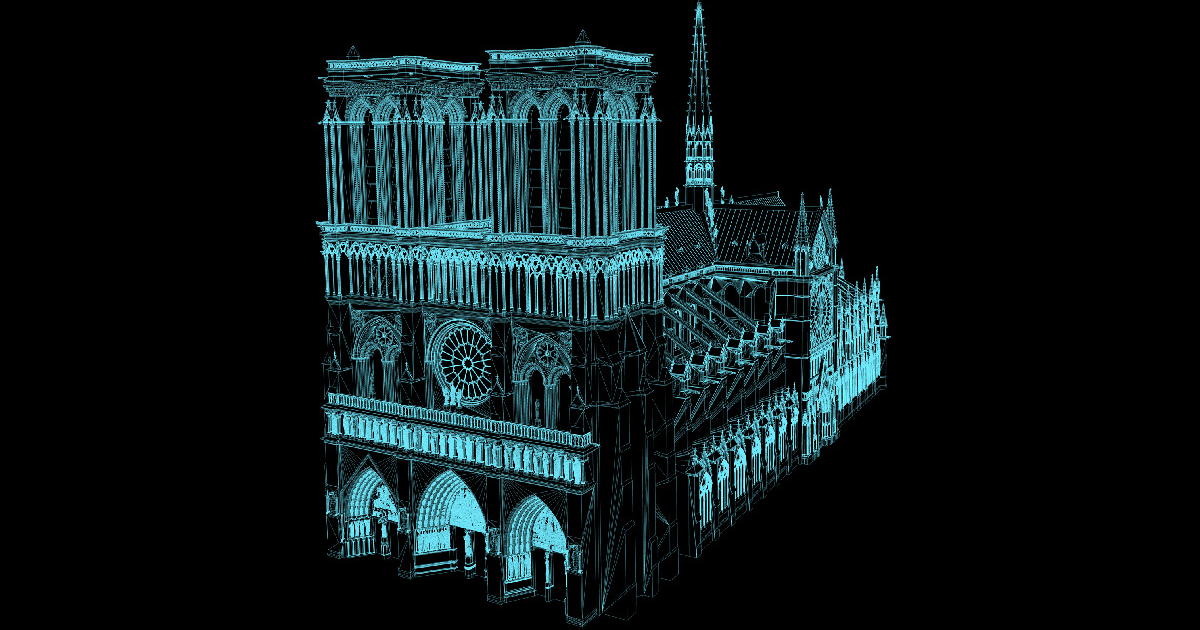
His fascination with the spaces of Gothic cathedrals began with an investigation into their acoustic properties. He developed the idea of using laser scanners to create a digital replica of Notre Dame after studying at Columbia under art historian Stephen Murray, who tried and failed in 2001 to make a laser scan of a cathedral north of Paris. Fourteen years later, the technology finally caught up with the idea, which Tallon also improved on by attempting to reconstruct not only the structure, but also the methods the builders used to build it yet did not record in writing.
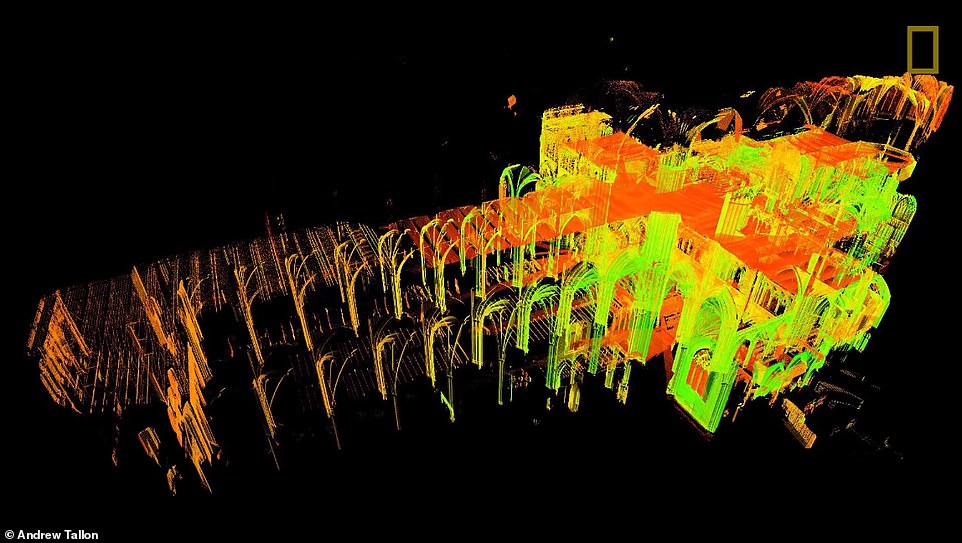
By examining how the cathedral moved when its foundations shifted or how it heated up or cooled down, Tallon could reveal “its original design and the choices that the master builder had to make when construction didn’t go as planned.” He took scans from “more than 50 locations around the cathedral—collecting more than one billion points of data.” All of the scans were knit together “to make them manageable and beautiful.” They are accurate to the millimeter, and as Wired reports, “architects now hope that Tallon’s scans may provide a map for keeping on track whatever rebuilding will have to take place.”
To learn even more about Tallon’s meticulous process than he reveals in the National Geographic video at the top, read his paper “Divining Proportions in the Information Age” in the open access journal Architectural Histories. We may not typically think of the digital world as much of a sanctuary, and maybe for good reason, but Tallon’s masterwork poignantly shows the importance of using its tools to record, document, and, if necessary, reconstruct the real-life spaces that meet our definitions of the term.
via the MIT Technology Review
Related Content:
Notre Dame Captured in an Early Photograph, 1838
A Virtual Time-Lapse Recreation of the Building of Notre Dame (1160)
Josh Jones is a writer and musician based in Durham, NC. Follow him at @jdmagness
Read More...Support Us
We're hoping to rely on loyal readers, rather than erratic ads. Please click the Donate button and support Open Culture. You can use Paypal, Venmo, Patreon, even Crypto! We thank you!

About Us

Open Culture scours the web for the best educational media. We find the free courses and audio books you need, the language lessons & educational videos you want, and plenty of enlightenment in between.
Advertise With Us

FREE UPDATES!
GET OUR DAILY EMAIL
Get the best cultural and educational resources on the web curated for you in a daily email. We never spam. Unsubscribe at any time.
FOLLOW ON SOCIAL MEDIA

Open Culture editor Dan Colman scours the web for the best educational media. He finds the free courses and audio books you need, the language lessons & movies you want, and plenty of enlightenment in between.
Advertise With Us