The Elegant Mathematics of Vitruvian Man, Leonardo da Vinci’s Most Famous Drawing: An Animated Introduction
Nearly 500 years after his death, we still admire Leonardo da Vinci’s many and varied accomplishments in painting, sculpture, architecture, science, and quite a few other fields besides, most of which would have begun with his putting down some part of the formidable contents of his head on to a piece of paper. (As we’ve seen, sometimes he needed to draw up a to-do list first.) Some of those works remained on paper, and even became famous in that humble form. If you’ve only seen one of Leonardo’s drawings, for instance, it’s almost certainly Vitruvian Man.
Leonardo’s circa-1490 study of the proportions of the human body — or to put it in more common terms, the picture of the naked fellow standing inside a square and a circle — stands at an intersection of art and mathematics, one at which Leonardo spent a great deal of time throughout his life. The Ted-ED lesson above, written by educator James Earle, gets into “the geometric, religious and philosophical significance of this deceptively simple drawing” whose title references the first-century BCE Roman architect and civil engineer Marcus Vitruvius Pollio, who claimed that “the navel is the center of the human body, and that if one takes a compass and places the fixed point on the navel, a circle can be drawn perfectly around the body.”
Vitruvius also realized that “arm span and height have a nearly perfect correspondence in the human body, thus placing the body perfectly inside a square as well.” Both he and Leonardo saw real implications in this alignment between anatomy and geography, beginning with the notion that buildings and other works of man should also take on these “perfect” proportions. All of this ties in with the problem, first proposed by ancient geometers, of “squaring the circle,” that is, finding a procedure to hand-draw a square and a circle both of equal area. Leonardo used Vitruvian Man to point toward one possible solution using the human body.
You can learn more about the importance and legacy of the drawing in the BBC documentary The Beauty of Diagrams, available on Youtube (part one, part two). “Although the diagram doesn’t represent some huge scientific breakthrough,” says its host, mathematician Marcus du Sautoy, “it captures an idea: that mathematics underpins both nature and the manmade world. It represents a synthesis of architecture, anatomy, and geometry. But it’s the perfection and elegance of Leonardo’s solution to this riddle of the square and the circle in Vitruvius which gives the diagram its power and its beauty.” And judging by the unabated popularity of Vitruvian Man parodies, it looks to have at least another half-millennium of relevance ahead.
Related Content:
Leonardo da Vinci’s Bizarre Caricatures & Monster Drawings
Leonardo da Vinci’s Visionary Notebooks Now Online: Browse 570 Digitized Pages
Ralph Steadman’s Wildly Illustrated Biography of Leonardo da Vinci (1983)
Based in Seoul, Colin Marshall writes and broadcasts on cities and culture. His projects include the book The Stateless City: a Walk through 21st-Century Los Angeles and the video series The City in Cinema. Follow him on Twitter at @colinmarshall or on Facebook.
Read More...What to Say When You Don’t Understand Contemporary Art? A New Short Film, “Masterpiece,” Has Helpful Suggestions
Masterpiece, Runyararo Mapfumo’s short film above, will feel very familiar to anyone who has struggled for words to share with a friend after his or her underwhelming Off-Off-Broadway solo show, open mic performance, or art installation…
Equally familiar, from the reverse angle, to any artist who’s ever invited a trusted friend to view his or her passion project, hoping for approval or at the very least, interest… something more robust than the paltry crumbs the friend manages to eek out under pressure.
A British Film Institute London Film Festival selected short, Masterpiece focuses on a tight group of male friends… one of whom has reached beyond the communal comfort zone in the service of his art. His earnestness confounds his old pals, who clown around outside the gallery where they’ve gathered for an after hours preview of his work, one staunchly asserting that he only showed up because his mum made him, and also, he was told there’d be free food.
Once inside the friends are left alone to puzzle out his masterpiece. What to say? Maybe they should draw parallels to the current socio-political situation? Perhaps they could tell their friend his work is reminiscent of German Expressionism?
Yoko Ono or Marcel Duchamp would have made a more apt comparison, as writer-director Mapfumo is surely aware. Masterpiece is notable for more than just its pitch-perfect take on artist vs. befuddled but still supportive friends. As Mapfumo told Directors Notes:
I’ve been told time and time again to “write what you want to see.” I started thinking about what that meant to me in a everyday context. These characters are black men that I recognize…I didn’t want the conflict to revolve around their identity but rather through their observations.
Related Content:
How to Look at Art: A Short Visual Guide by Cartoonist Lynda Barry
Your Brain on Art: The Emerging Science of Neuroaesthetics Probes What Art Does to Our Brains
Ayun Halliday is an author, illustrator, theater maker and Chief Primatologist of the East Village Inky zine. Her most recent artistic endeavor is Theater of the Apes Sub-Adult Division’s production of Animal Farm, opening next week in New York City. Follow her @AyunHalliday.
Read More...Meet Daryl Davis, the Black Blues Musician Who Befriended 200 Klan Members & Made Them See the Errors of Their Ways
Musician Daryl Davis is a great, lumbering bear of a man with a very, very long fuse.
His disposition and his race are equally critical components of his decades-long project—engaging, as a black man, with members of the KKK, the National Socialist Movement, and other groups espousing white supremacy.
Diplomacy seems to be the major lesson of his globetrotting childhood. His father was a State Department official, and wherever the family relocated, Davis went to school with the children of other foreign service workers, whatever their race. This happy, multicultural experience left him unprepared for his return to his country of origin, when he was one of just two black pupils at his Belmont, Massachusetts elementary school, and the only black Cub Scout in his troop.
When Belmont’s Cub Scouts were invited to participate in a 1968 march to commemorate Paul Revere’s ride, his troop leaders tapped the 10-year-old Davis to carry the flag, provoking a furious reaction from many white spectators along the route.
His prior experience was such that he assumed their bile was directed toward scouting, even after his parents sat him down to tell him the truth.
Now, as the subject of Matt Ornstein’s documentary, Accidental Courtesy (watch it on Netflix here), Davis muses that the unusual circumstances of his early childhood equipped him to instigate and maintain an open dialogue with the enemy. He listens carefully to their opinions in the expectation that they will return the courtesy. It’s a long game approach that Davis refuses to play over social media or email. Only face-to-face.
Over time, his even-keeled manner has caused 200 card-carrying racists, according to NPR, to renounce their former path, presenting their cast-off hoods and robes to their new friend, Davis, as a rite of passage.
One of the most fascinating parts of the documentary is the tour of his klan memorabilia—patches, jewelry, pocket knives and belt buckles. He is able to explain the colors, insignia and provenance of the robes as methodically as he discusses musical history.
Presumably, some of this knowledge was handed down from the former owners—one of whom volunteers that Davis is far more knowledgable than he ever was about the ins and outs of klan hierarchies.
Davis doesn’t wait for an outspoken racist to renounce his beliefs before claiming him as a friend.
It’s fairly easy to feel clemency toward those Davis has nudged toward a whole new set of values, such as soft-spoken former-Grand-Dragon-turned-anti-racist activist, Scott Shepherd, or Tina Puig, a mother of two who was taken aback by Davis’ offer of a ride to the far away federal penitentiary where her white supremacist husband was serving a ten-year sentence.
It’s queasier to watch Davis posing with a smile in front of Confederate flags at a klan rally, or staunchly refraining from comment as jacked up supremacists spew vile, provocative remarks in his presence.
Not everyone has—or wants to have—the stomach for this sort of work. The most heated encounter in the film is the one between Davis and Baltimore-based Black Lives Matter activists Kwame Rose, Tariq Touré, and JC Faulk.
As director Ornstein told PBS’ Independent Lens:
Daryl operates under the principle that if you aren’t hearing viewpoints that are distasteful to you, that they are also not hearing yours. I think there’s wisdom in that. We saw this last election cycle how not doing that ended in not only disaster for this country, but a lot of infighting and yelling into echo chambers and news that serves to reinforce what you already believe. The economic arguments that Tariq and Kwame present in the film have a tremendous amount of validity, but in no way does this diminish the importance of what someone like Daryl does. If we all took the time to speak to even one or two people we disagree with and both really hear them and be heard that alone would begin to make a difference.
You can watch Accidental Courtesy on Netflix here. (If you don’t have a subscription, you could always sign up for a 30-day free trial.) We have also added an NPR profile of Davis above.
Below you can watch a fascinating interview with Davis recent recorded on the Jordan Harbinger Show.
Related Content:
How Superman Defeated the KKK (in Real Life): Hear the World-Changing 1946 Radio Drama
Ayun Halliday is an author, illustrator, theater maker and Chief Primatologist of the East Village Inky zine. Her current project is Theater of the Apes’ Sub-Adult Division’s production of Animal Farm, opening this week in New York City. Follow her @AyunHalliday.
Read More...The Thoth Tarot Deck Designed by Famed Occultist Aleister Crowley

Back in 2014 we featured a short primer and documentary on the life and work of Aleister Crowley, also known — at least to the British press of the time — as “the wickedest man in the world.” The name rings a bell to just about everyone, and for many of us summons up vague notions of a life dedicated to the promotion of alternative morality or paganism or trickery or some kind of relished evil, but how many of us can name one of Crowley’s works? The best-known occultist-artist-mountaineer of the early 20th century left behind a rich and colorful legacy, and here we have one of its most tangible products: the Thoth tarot deck.
Crowley worked on the deck, says Learntarot.com (itself drawing from Stuart Kaplan’s Encyclopedia of Tarot), from 1938 to 1943, according to principles laid out in his Book of Thoth. The artist, Lady Frieda Harris, “worked with Crowley’s rough sketches to produce images that would be faithful to his interpretations and her own vision.” You can purchase copies of the Thoth Tarot Deck here.
Raven’s Tarot Site offers a piece of correspondence from Harris to Crowley dating from 1940, around the middle of the project. “I do not pretend to apprehend it, only it is like music, and the only kind of writing I want to read,” she writes of his famously difficult-to-comprehend but (under the right circumstances) entertaining writing on the occult, “only it makes me feel as if I lived in a desert and I am mighty thirsty.”
Crowley had — and nearly 70 years after his death, still has — that effect on some people. He inspired Harris, who would become one of the standout disciples, to produce a work of divinatory art whose aesthetics reflect as much his own as those of the Austrian esotericist Rudolf Steiner. Now best known for his role in developing the Waldorf system of childhood education, Steiner also came up with a philosophical system called anthroposophy that posits the human ability to contact the spiritual realm. It may lack the same dangerous and flamboyant black-magic (or rather, black-magick) appeal of Crowley’s visions, but both men, in their own way, spent a lifetime striving for ways to tap into a world hidden beneath the surface of existence. For those with an interest in that sort of thing, turning over a few tarot cards remains one of the easiest ways to knock on its door.
Related Content:
Alejandro Jodorowsky Explains How Tarot Cards Can Give You Creative Inspiration
The Tarot Card Deck Designed by Salvador Dalí
Based in Seoul, Colin Marshall writes and broadcasts on cities and culture. His projects include the book The Stateless City: a Walk through 21st-Century Los Angeles and the video series The City in Cinema. Follow him on Twitter at @colinmarshall or on Facebook.
Read More...MIT Is Digitizing a Huge Archive of Noam Chomsky’s Lectures, Papers and Other Documents & Will Put Them Online

Image by Andrew Rusk, via Wikimedia Commons
If you’re a linguist, you’ve read Noam Chomsky—no way of getting around that. There may be reasons to disagree with Chomsky’s linguistic theories but—as Newton’s theories do in physics—his breakthroughs represent a paradigmatic shift in the study of language, an implicit or explicit reference point for nearly every linguistic analysis in the past few decades.
If you’re on the political left, you’ve read Chomsky, or you should. Even if there are significant reasons to disagree with whatever controversial stance he’s taken over the years, few political theorists have approached their subject with the degree of doggedness, intellectual integrity, and erudition as he has. Chomsky began his second career as a political activist and philosopher in the late sixties, speaking out in opposition to the Vietnam war. Since then, he’s written majorly influential works on mass media propaganda, Cold War politics and interventionist war, economic imperialism, anarchism, etc.
Now an emeritus professor from MIT, where he began teaching in 1955, and a laureate professor at the University of Arizona, Chomsky has reached that stage in every public intellectual’s career when archivists and curators begin consolidating a documentary legacy. Librarians at MIT started doing so a few years ago when, in 2012, the MIT Libraries Institute Archives received over 260 boxes of Chomsky’s personal papers. You can hear the man himself discuss the archive’s importance in the short interview at the top. And at the MIT Library site unBox Chomsky Archive, you’ll find slideshow previews of its contents.
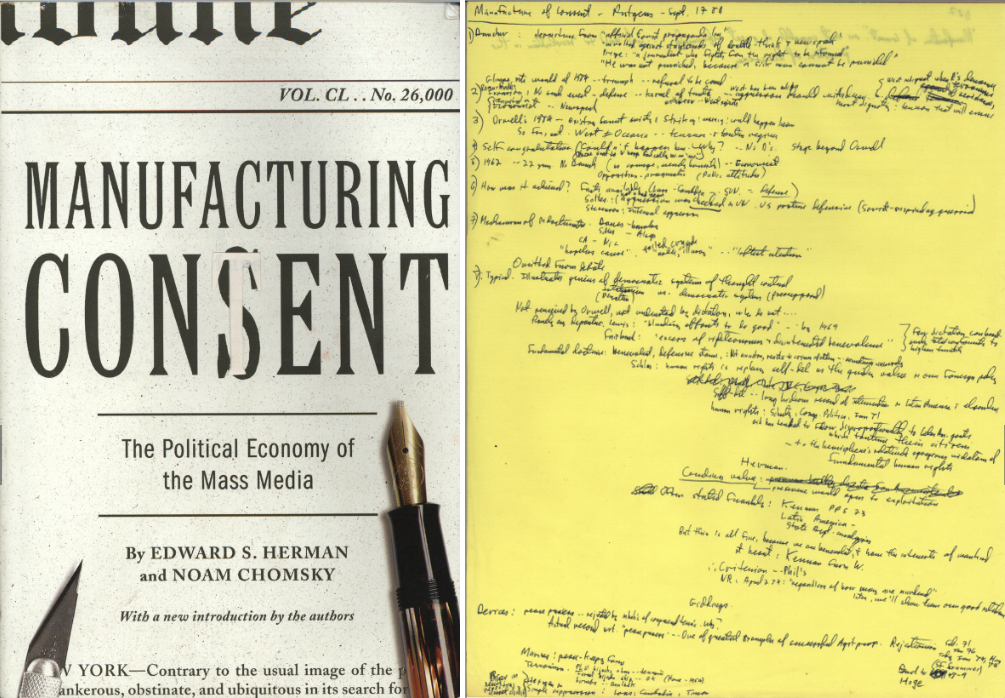
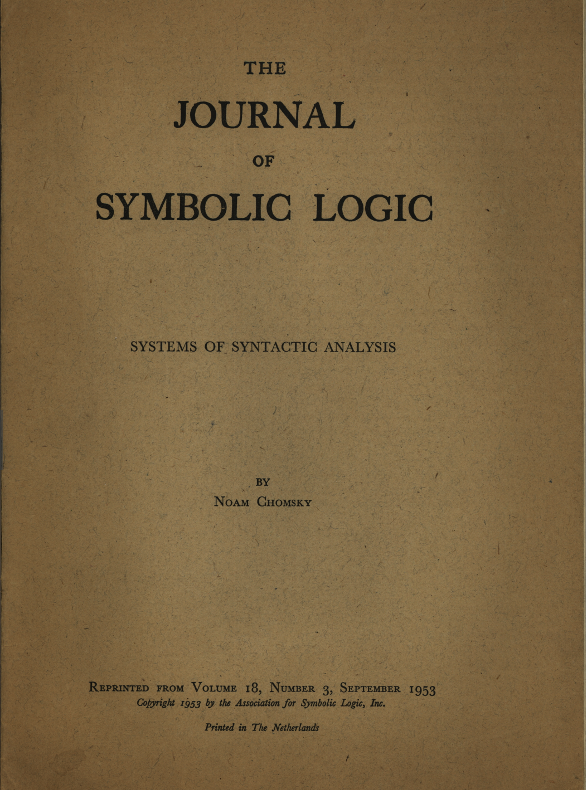
Those contents include the 1953 paper “Systems of Syntactic Analysis,” which “appears to be Chomsky’s first foray in print of what would become transformational generative grammar.” Also archived are notes from a 1984 talk on “Manufacturing Consent” given at Rutgers University, outlining the ideas Chomsky and Edward S. Herman would fully explore in the 1988 book of the same name on “the political economy of the mass media.” And in the category of “activism,” we find materials like the newsletter below, published by an anti-war organization Chomsky co-founded in the 60s called RESIST.

MIT hopes to “digitize the hundreds of thousands of pieces” in the collection, “to make it accessible to the public.” Such a massive undertaking exceeds the library’s budget, so they have asked for financial support. At unBoxing the Chomsky Archive, you can make a donation, or just peruse the slideshow previews and consider the legacy of one of the U.S.’s most formidable living scientific and political thinkers.
Related Content:
Read 9 Free Books By Noam Chomsky Online
Josh Jones is a writer and musician based in Durham, NC. Follow him at @jdmagness
Read More...The Edvard Munch Scream Action Figure

“I was out walking with two friends – the sun began to set – suddenly the sky turned blood red – I paused, feeling exhausted, and leaned on the fence – there was blood and tongues of fire above the blue-black fjord and the city – my friends walked on, and I stood there trembling with anxiety – and I sensed an endless scream passing through nature.”― Edvard Munch
That’s how painter Edvard Munch described the dread-filled scene that led him to paint “The Scream” in 1910. As Dr. Noelle Paulson notes over at Smarthistory, except for da Vinci’s Mona Lisa, Munch’s painting “may be the most iconic human figure in the history of Western art. Its androgynous, skull-shaped head, elongated hands, wide eyes, flaring nostrils and ovoid mouth have been engrained in our collective cultural consciousness.”
“The Scream” might also be one of the more fetishized and commodified paintings we’ve seen to date. These days, you’ll find “The Scream” on t‑shirts, jigsaw puzzles, and non-slip jar grippers. And, thanks to a Japanese company called Good Smile, you can now buy The Scream Action figure. It has posable joints, allowing you to put the figure into different poses (witness above). Or you can stand it alongside the other art history figures in Good Smile’s collection–da Vinci’s Vitruvian Man, Rodin’s The Thinker, and The Venus de Milo. Oh, the fun you could have this weekend.
If you would like to support the mission of Open Culture, consider making a donation to our site. It’s hard to rely 100% on ads, and your contributions will help us continue providing the best free cultural and educational materials to learners everywhere. You can contribute through PayPal, Patreon, and Venmo (@openculture). Thanks!
Related Content:
Edvard Munch’s Famous Painting “The Scream” Animated to the Sound of Pink Floyd’s Primal Music
30,000 Works of Art by Edvard Munch & Other Artists Put Online by Norway’s National Museum of Art
Salvador Dalí’s 1973 Cookbook Gets Reissued: Surrealist Art Meets Haute Cuisine
The Tarot Card Deck Designed by Salvador Dalí
Salvador Dalí Figurines Let You Bring the Artist’s Surreal Paintings Into Your Home
Read More...The Philosophy of Rick and Morty: What Everyone’s New Favorite Cartoon Has in Common with Albert Camus
“Nobody exists on purpose, nobody belongs anywhere, everybody’s gonna die.” So, in one episode of Rick and Morty, says the fourteen-year-old Morty Smith, one of the show’s titular co-protagonists. With the other, a mad scientist by the name of Rick Sanchez, who also happens to be Morty’s grandfather, he constitutes the animated team that has entertained thousands and thousands of viewers — and made insatiable fans of seemingly all of them — over the past four years. To those few who haven’t yet seen the show, it may just look like a silly cartoon, but the true fans understand that underneath all of the memorable gags and quotable lines lies an unusual philosophical depth.
“The human desire to fulfill some special existential purpose has existed throughout history,” says video essayist Will Schoder in his analysis of the philosophy of Rick and Morty. But the titular duo’s adventures through all possible realities of the “multiverse” ensure that they experience firsthand the utter meaninglessness of each individual reality.
When Morty breaks that bleak-sounding news to his sister Summer with the now oft-quoted line above, he actually delivers a “comforting message”: once you confront the randomness of the universe, as Rick and Morty constantly do, “the only option is to find importance in the stuff right in front of you,” and their adventures show that “friends, family, and doing what we enjoy are far more important than any unsolvable questions about existence.”
Schoder, also the author of a video essay on Rick and Morty co-creator Dan Harmon’s mythological storytelling technique as well as one we’ve previously featured about David Foster Wallace’s critique of postmodernism, makes the clear philosophical connection to Albert Camus. The philosopher and author of The Stranger wrote and thought a great deal about the “contradiction between humans’ desire to find meaning in life and the meaninglessness of the universe,” and the absurdity that results, a notion the cartoon has dramatized over and over again, with an ever-heightening absurdity. We must, like Sisyphus eternally pushing his rock uphill, recognize the true nature of our situation yet defiantly continue “to explore and search for meaning.” Morty, as any fan well knows, offers Summer another solution to her despair: “Come watch TV.”
Related Content:
David Foster Wallace on What’s Wrong with Postmodernism: A Video Essay
The Philosophy of The Matrix: From Plato and Descartes, to Eastern Philosophy
The Philosophy of Bill Murray: The Intellectual Foundations of His Comedic Persona
Based in Seoul, Colin Marshall writes and broadcasts on cities and culture. His projects include the book The Stateless City: a Walk through 21st-Century Los Angeles and the video series The City in Cinema. Follow him on Twitter at @colinmarshall or on Facebook.
Read More...See Mozart Played on Mozart’s Own Fortepiano, the Instrument That Most Authentically Captures the Sound of His Music
I’ve been a fan of the Academy of Ancient Music since I picked up its performance of Vivaldi’s The Four Seasons as a teenager in the UK. Though into rock and prog at the time, I was always trying to expand my learning and would occasionally turn the dial from BBC Radio One (for John Peel, late at night) to Radio Four where I tried to make my way in the heady world of classical music. It was how the album was promoted and sold: you’ve never heard Vivaldi until you’ve heard it on the original instruments! I mean, this tied right in at the time to the advent of CDs (“hear it as the musicians did in the control room!”) and the beginning of “from the original master tapes!” turning up on recordings. I was all in, and it’s a thrilling recording.
That thrill never goes away, as demonstrated with the above video of Robert Levin, recently announced as the first Hogwood Fellow of the Academy, playing Mozart on Mozart’s own piano. Or rather, Mozart’s fortepiano, a smaller and much lighter version of the piano. It is two octaves shorter, and only seven feet long.
Mozart used this fortepiano for both composing and performing from 1785 until his death in 1791. He wrote over 50 works on it. The instrument dates to 1782, built by Anton Walter, one of the best-known piano makers in Vienna at that time. In 2012 it finally returned to Mozart’s Salzburg home (now a museum), having been in the possession of the Cathedral Music Association and Mozarteum for the majority of the years since the composer’s death.
“One writes for acoustical and aesthetic properties of the instruments at hand,” Levin says, explaining the Academy’s mission and ideology. Naturally it follows that Mozart sounds the best on Mozart’s instrument. The fortepiano is brighter and jauntier, and can be a revelation for those with the talent and fortune to play it. Levin says:
“So sitting down at Mozart’s piano, sitting down at an organ which Bach played himself, you understand things about the weight of the keys going down and the repetition and the balance in sound. And all of these things bring you very, very close to the music and make you say ‘A‑ha, that’s why it’s written that way’, which is not the kind of thing you’re going to get if you’re playing on the standard instruments that are being manufactured today”
Levin is currently recording Mozart’s piano sonatas on this very fortepiano. The piece he plays in the video is Mozart’s Sonata No. 17 in B flat major KV 570 (3rd movement).
Related Content:
Hear the Pieces Mozart Composed When He Was Only Five Years Old
Watch a Musician Improvise on a 500-Year-Old Music Instrument, The Carillon
Ted Mills is a freelance writer on the arts who currently hosts the artist interview-based FunkZone Podcast and is the producer of KCRW’s Curious Coast. You can also follow him on Twitter at @tedmills, read his other arts writing at tedmills.com and/or watch his films here.
Read More...Pop Art Posters Celebrate Pioneering Women Scientists: Download Free Posters of Marie Curie, Ada Lovelace & More
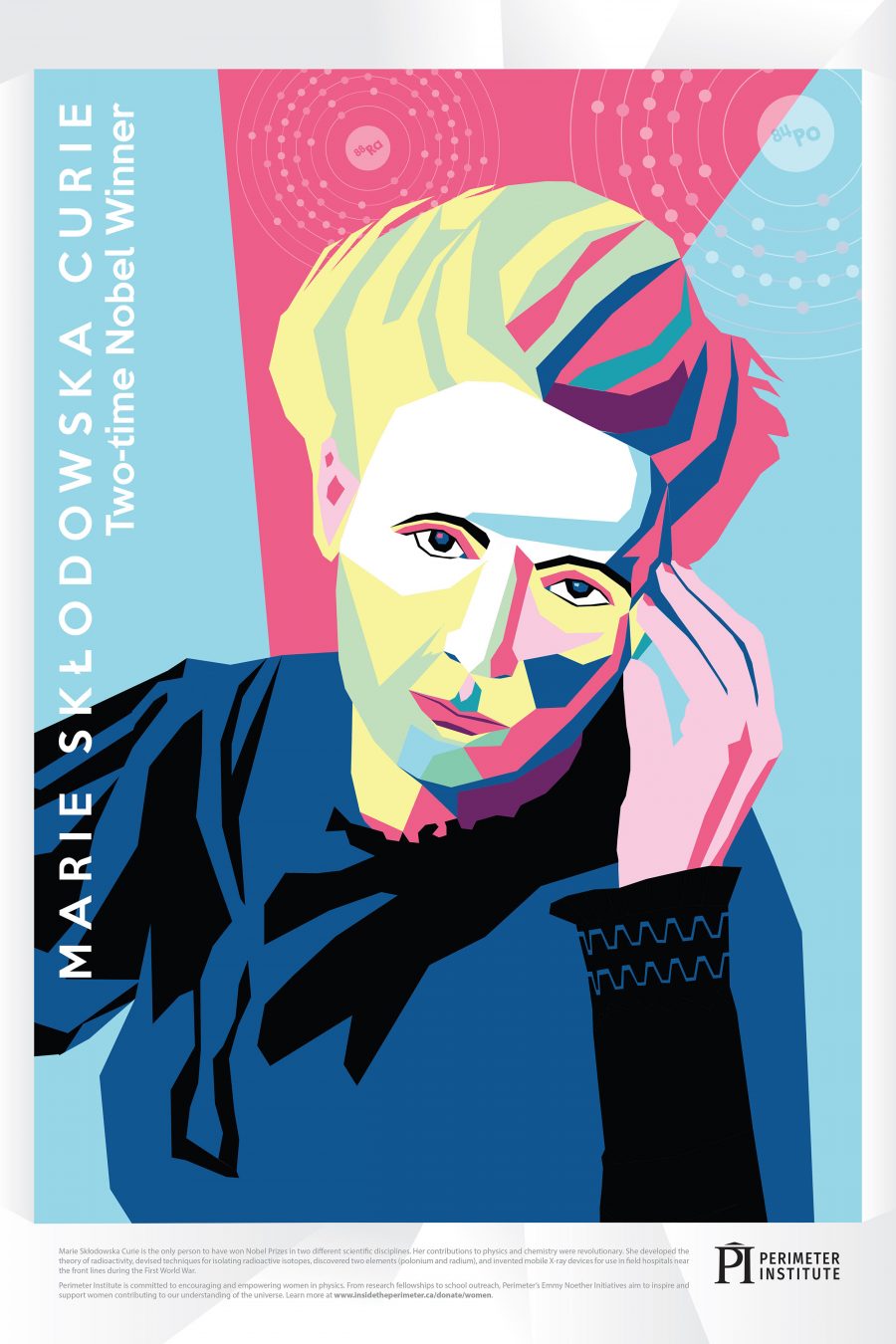
We all know the name Marie Curie—or at least I hope we do. But for far too many people, that’s where their knowledge of women in science ends. Which means that thousands of young boys and girls who read about Isaac Newton and Louis Pasteur never also learn the story of Caroline Herschel (1750–1848), the first woman to discover a comet, publish with the Royal Society, and receive a salary for scientific work—as the assistant to the king’s astronomer, her brother, in 19th century England. Herschel discovered and catalogued new nebulae and star clusters; received a gold medal from the Royal Astronomical Society; and she and her brother William “increased the number of known star clusters,” writes the Smithsonian, “from 100 to 2,500.” And yet, she remains almost totally obscure.
Open a math or physics textbook and you may not come across the name Emmy Noether (1882–1935), either, despite the fact that she “proved two theorems,” the San Diego Supercomputer Center (SDSC) notes, “that were basic for both general relativity and elementary particle physics. One is still known as ‘Noether’s Theorem.’”
Noether fought hard for recognition in life. She received her Ph.D. in mathematics from the University of Göttingen in 1907, and she eventually surpassed her scientist father and brothers. But at first, she could only secure work at the Mathematical Institute of Erlangen in a position without title or pay. And despite her brilliance, she was only allowed to teach at Göttingen University as the assistant to David Hilbert, also without a salary.
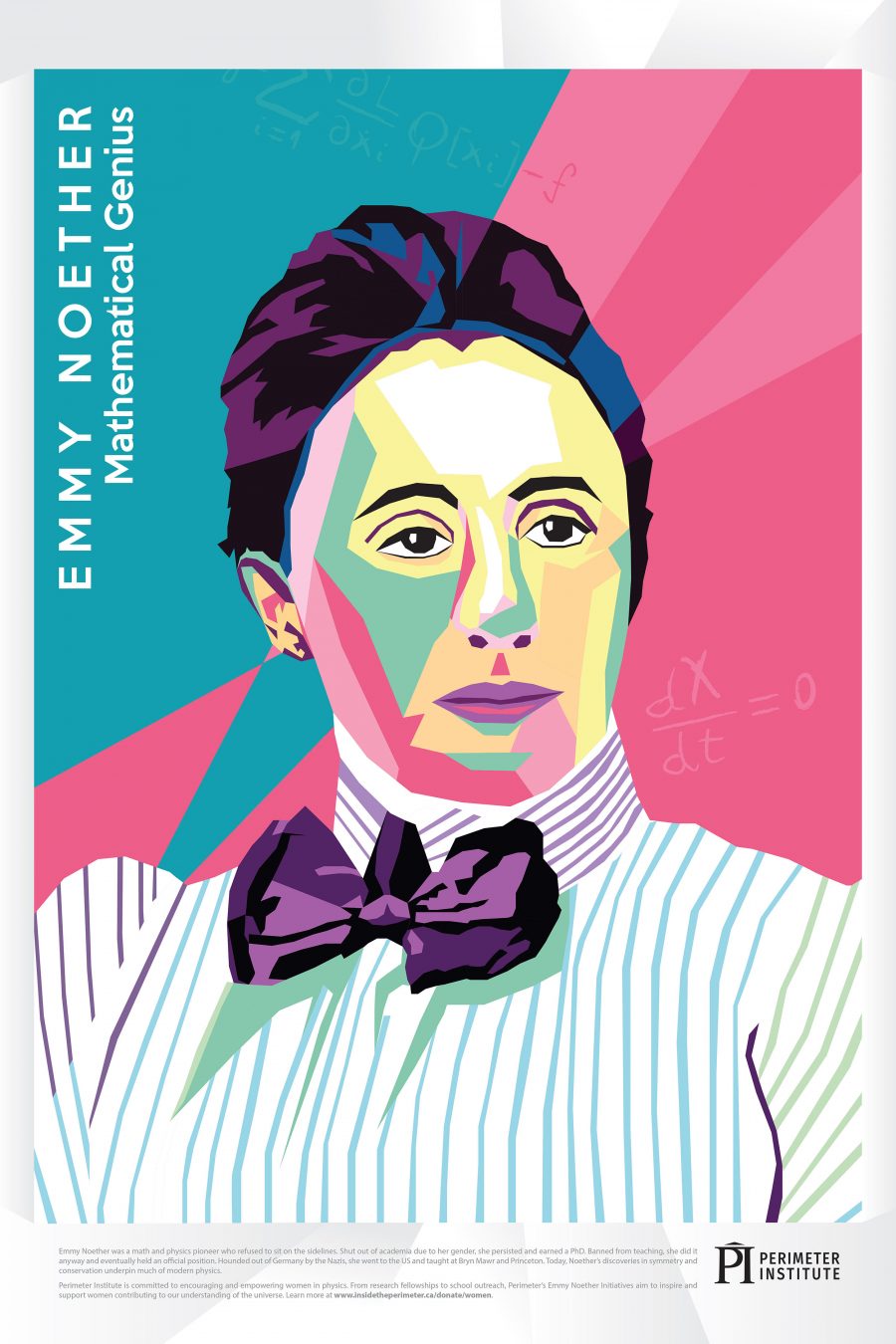
Noether suffered discrimination in Germany “owing not only to prejudices against women, but also because she was a Jew, a Social Democrat, and a pacifist.” Other prominent women in scientific history have encountered similarly intersecting forms of discrimination, and continue to do so. Much has changed since the times of Herschel and of Noether, but “there is much work to be done,” writes Eamon O’Flynn of the Perimeter Institute for Theoretical Physics. “Part of making positive change includes celebrating the contributions women have made to science, especially those women overlooked in their time.” For this reason, the Perimeter Institute has created a poster series, called “Forces of Nature,” for “classrooms, dorm rooms, living rooms, offices, and physics departments.”

The posters feature Curie, Noether, computing pioneer Ada Lovelace, stellar astronomer Annie Jump Cannon, and “first lady of physics” Chien-Shiung Wu. Should you want one or all of these as high-resolution images printable up to 24”x36”, visit the Perimeter Institute’s site and follow the links to fill out a short form. Whether you’re a parent, teacher, or mentor—these striking pop art posters seem like an excellent way to get a conversation about women in science started. Follow up with the Smithsonian’s “Ten Historic Female Scientists You Should Know,” SDSC’s Women in Science project, Rachel Ignotofsky’s Women in Science: 50 Fearless Pioneers Who Changed the World, and—for a contemporary view of women working in every possible STEM field—the Association for Women in Science.
Related Content:
Josh Jones is a writer and musician based in Durham, NC. Follow him at @jdmagness
Read More...The Art of the Japanese Teapot: Watch a Master Craftsman at Work, from the Beginning Until the Startling End
People all over the world enjoy Japanese tea, but few of them have witnessed a proper Japanese tea ceremony — and seeing as a proper Japanese tea ceremony can last up to four hours, many probably imagine they don’t have the endurance. But Japanese tea culture holds up meticulousness as a high virtue for the preparer, the drinker, and even more so the craftsman who makes the tea ware both of them use. In the video above, you can see one such master named Shimizu Genji at work in his studio in Tokoname, a city known as a ceramics center for hundreds and hundreds of years.
Shimizu, writes the proprietor of pottery site Artisticnippon.com about a visit to his workshop, “throws a block of clay onto the wheel, creating the teapot’s body, handle, spout and lid one after another, all from the same block. It really is quite mesmerising and awe-inspiring to watch.”
Once he assembles these formidably solid-looking but deceptively light pieces, he dries them out over three days, a process that offers “just one example of the time and care invested in the crafting of exquisite Tokoname teapots.” Finally comes the seaweed, of which certain pieces get a layer applied before firing. Afterward, the traces left by the seaweed create a “charred” patterning called mogake.
We would surely welcome any of Shimizu’s products, or those by the other respected practitioners of his tradition, into our home. But as with all Japanese crafts honed over countless generations, the process counts for just as much as the product, or even more so. Take, for instance, Shimizu’s process as captured by this video: we appreciate the concentration, deliberation, and sensitivity shown at each and every stage, and the pieces of the teapot as they come into existence don’t look half bad either. But if we become too attached to the final result we’ve been anticipating over these fourteen minutes — well, suffice it to say that the master craftsman has a lesson in impermanence in store for us.
Related Content:
Japanese Craftsman Spends His Life Trying to Recreate a Thousand-Year-Old Sword
The Making of Japanese Handmade Paper: A Short Film Documents an 800-Year-Old Tradition
Watch a Japanese Craftsman Lovingly Bring a Tattered Old Book Back to Near Mint Condition
Based in Seoul, Colin Marshall writes and broadcasts on cities and culture. His projects include the book The Stateless City: a Walk through 21st-Century Los Angeles and the video series The City in Cinema. Follow him on Twitter at @colinmarshall or on Facebook.
Read More...Support Us
We're hoping to rely on loyal readers, rather than erratic ads. Please click the Donate button and support Open Culture. You can use Paypal, Venmo, Patreon, even Crypto! We thank you!

About Us

Open Culture scours the web for the best educational media. We find the free courses and audio books you need, the language lessons & educational videos you want, and plenty of enlightenment in between.
Advertise With Us

FREE UPDATES!
GET OUR DAILY EMAIL
Get the best cultural and educational resources on the web curated for you in a daily email. We never spam. Unsubscribe at any time.
FOLLOW ON SOCIAL MEDIA

Open Culture editor Dan Colman scours the web for the best educational media. He finds the free courses and audio books you need, the language lessons & movies you want, and plenty of enlightenment in between.
Advertise With Us


