A Japanese Zen Monk Explains What Zen Is Really About
Despite developing in Asia, as the Chinese form of a religion originally brought over from India and later refined in Japan, Zen Buddhism has long appealed to Westerners as well. Some of that owes to the spare, elegant aesthetics with which popular culture associates it, and more to the promise it holds out: freedom from stress, anxiety, and indeed suffering of all kinds. In theory, the Zen practitioner attains that freedom not through mastering a body of knowledge or ascending a hierarchy, but through direct experience of reality, unmediated by thoughts, unwarped by desires, and undivided by the classification schemes that separate one thing from another. That’s easier said than done, of course, and for some, not even a lifetime of meditation does the trick.
In the interview clip above, Rinzai zen monk Yodo Kono explains how he arrived in the world of Zen. Having come from a line of monks, he inherited the role after the deaths of his grandfather and his father. Already in his late twenties, he’d been working as a physics teacher, an occupation that — however fashionable the supposed concordances between advanced physical and Buddhist truths — hardly prepared him for the rigors of the temple.
“I entered a role completely opposite to logic,” he remembers, “a world where logic doesn’t exist.” Think of the Zen kōans we’ve all heard, which demand seemingly impossible answers about the sound of one hand clapping, or the appearance of your face before your parents were born.
Advised by his master to stop trying to gain knowledge, skills, and understanding, the frustrated Yodo Kono began to realize that “Zen is everything,” the key question being “how to live without worries within Zen.” That can’t be learned from any amount of study, but experience alone. Only directly can one feel how we create our own suffering in our minds, and also that we can’t help but do so. This leaves us no choice but to relinquish our notions of control over reality. In daily life, he explains in the clip just above (also from the documentary Freedom From Suffering, about the varieties of Buddhism), one must be able to move freely between “the undivided Zen world and the divided world,” the latter being where nearly all of us already spend our days: not without our pleasures, of course, but also not without wondering, every so often, if we can ever know permanent satisfaction.
Related content:
A 6‑Step Guide to Zen Buddhism, Presented by Psychiatrist-Zen Master Robert Waldinger
What Is a Zen Koan? An Animated Introduction to Eastern Philosophical Thought Experiments
Exercise Extreme Mindfulness with These Calming Zen Rock Garden Videos
A Beatboxing Buddhist Monk Creates Music for Meditation
Buddhism 101: A Short Introductory Lecture by Jorge Luis Borges
Based in Seoul, Colin Marshall writes and broadcasts on cities, language, and culture. His projects include the Substack newsletter Books on Cities and the book The Stateless City: a Walk through 21st-Century Los Angeles. Follow him on the social network formerly known as Twitter at @colinmarshall.
Read More...The Hobo Ethical Code of 1889: 15 Rules for Living a Self-Reliant, Honest & Compassionate Life
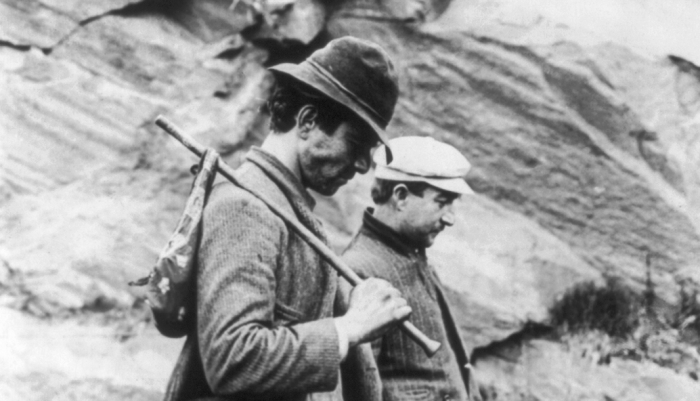
Who wants to be a billionaire?
A few years ago, Forbes published author Roberta Chinsky Matuson’s sensible advice to businesspeople seeking to shoot up that golden ladder. These lawful tips espoused such familiar virtues as hard work and community involvement, and as such, were easily adaptable to the rabble—artists, teachers, anyone in the service industry or non-profit sector…
It must pain her that so many billionaires have been behaving so badly of late. Let’s hope so, anyway.
While there’s nothing inherently wrong with aspiring to amass lots of money, the next generation of billionaires is playing fast and loose with their souls if their primary role models are the ones dominating today’s headlines.
Wouldn’t it be grand if they looked instead to the Hobo Ethical Code, a serious standard of behavior established at the Hobo National Convention of 1889?
Given the peripatetic lifestyle of these migratory workers, it was up to the individual to hold himself or herself to this knightly standard. Hoboes prided themselves on their self-reliance and honesty, as well as their compassion for their fellow humans.
The environment and the most vulnerable members of our society stand to benefit if tomorrow’s billionaires take it to heart.
The Hobo Ethical Code
1. Decide your own life; don’t let another person run or rule you.
2. When in town, always respect the local law and officials, and try to be a gentleman at all times.
3. Don’t take advantage of someone who is in a vulnerable situation, locals or other hobos.
4. Always try to find work, even if temporary, and always seek out jobs nobody wants. By doing so you not only help a business along, but ensure employment should you return to that town again.
5. When no employment is available, make your own work by using your added talents at crafts.
6. Do not allow yourself to become a stupid drunk and set a bad example for locals’ treatment of other hobos.
7. When jungling in town, respect handouts, do not wear them out, another hobo will be coming along who will need them as badly, if not worse than you.
8. Always respect nature, do not leave garbage where you are jungling.
9. If in a community jungle, always pitch in and help.
10. Try to stay clean, and boil up wherever possible.
11. When traveling, ride your train respectfully, take no personal chances, cause no problems with the operating crew or host railroad, act like an extra crew member.
12. Do not cause problems in a train yard, another hobo will be coming along who will need passage through that yard.
13. Do not allow other hobos to molest children; expose all molesters to authorities…they are the worst garbage to infest any society.
14. Help all runaway children, and try to induce them to return home.
15. Help your fellow hobos whenever and wherever needed, you may need their help someday.
Note: An earlier version of this post appeared on our site in 2016.
Related Content:
The Hobo Code: An Introduction to the Hieroglyphic Language of Early 1900s Train-Hoppers
The Power of Empathy: A Quick Animated Lesson That Can Make You a Better Person
Ayun Halliday is an author, illustrator, theater maker and Chief Primatologist of the East Village Inky zine. Her play Zamboni Godot is opening in New York City in March 2017. Follow her @AyunHalliday.
Read More...Hear the First Recording of the Human Voice (1860)
When inventor Édouard-Léon Scott de Martinville sang a nursery rhyme into his phonoautogram in 1860, he had no plans to ever play back this recording. A precursor to the wax cylinder, the phonoautogram took inputs for the study of sound waves, but could not be turned into an output device. How amazing then, that 150 or so years later, we can hear the voice of Scott in what is now considered the first ever recording of human sound.
What you will hear in the above video are the various stages of reconstructing and reverse engineering the voice that sang on that April day in 1860, until, like wiping away decades of dirt and soot, the original art is revealed.
Scott had looked to the invention of photography and wondered if something similar could be done with sound waves, focused as he was on improving stenography. And so the phonoautogram took in sound vibrations through a diaphragm, which moved a stylus against a rotating cylinder covered in lampblack. What was left was a wiggly line in a concentric circle.
But how to play them back? That was the problem. Scott’s invention never turned a profit and he went back to bookselling. The invention and some of the paper cylinders went into museums.
In 2008, American audio historians discovered the scribbles and turned to the Lawrence Berkeley National Laboratory and a software called IRENE. The software was designed to extract sounds from wax cylinders without touching the delicate surfaces, and the first pass revealed what they thought at first was a young woman or child singing “Au Clair de la lune,” the French nursery rhyme (not the Debussy piano work).
However, a further examination of Scott’s notes revealed that the recording was at a much slower speed, and it was a man—most probably Scott—singing the lullaby.
The video shows the stages that brought Scott back to life: Denoising a lot of extraneous sound; stretching the recording back to natural time; “tuning and quantizing”–correcting for imperfections in the human-turned cylinder; cleaning up harmonics; and finally adding further harmonics, reverb and a stereo effect.
The result is less an unrecognizable ghost signal and more a touching sound of humanity, desiring somehow to have their voice live on.
Note: An earlier version of this post appeared on our site in 2019.
Related Content:
Hear Singers from the Metropolitan Opera Record Their Voices on Traditional Wax Cylinders
400,000+ Sound Recordings Made Before 1923 Have Entered the Public Domain
Ted Mills is a freelance writer on the arts. You can read his other arts writing at tedmills.com and/or watch his films here.
Read More...
Was William Shakespeare’s Marriage Closer—and Less Estranged—Than We Thought?: A 17th-Century Letter Changes What We Know About the Bard’s Life.
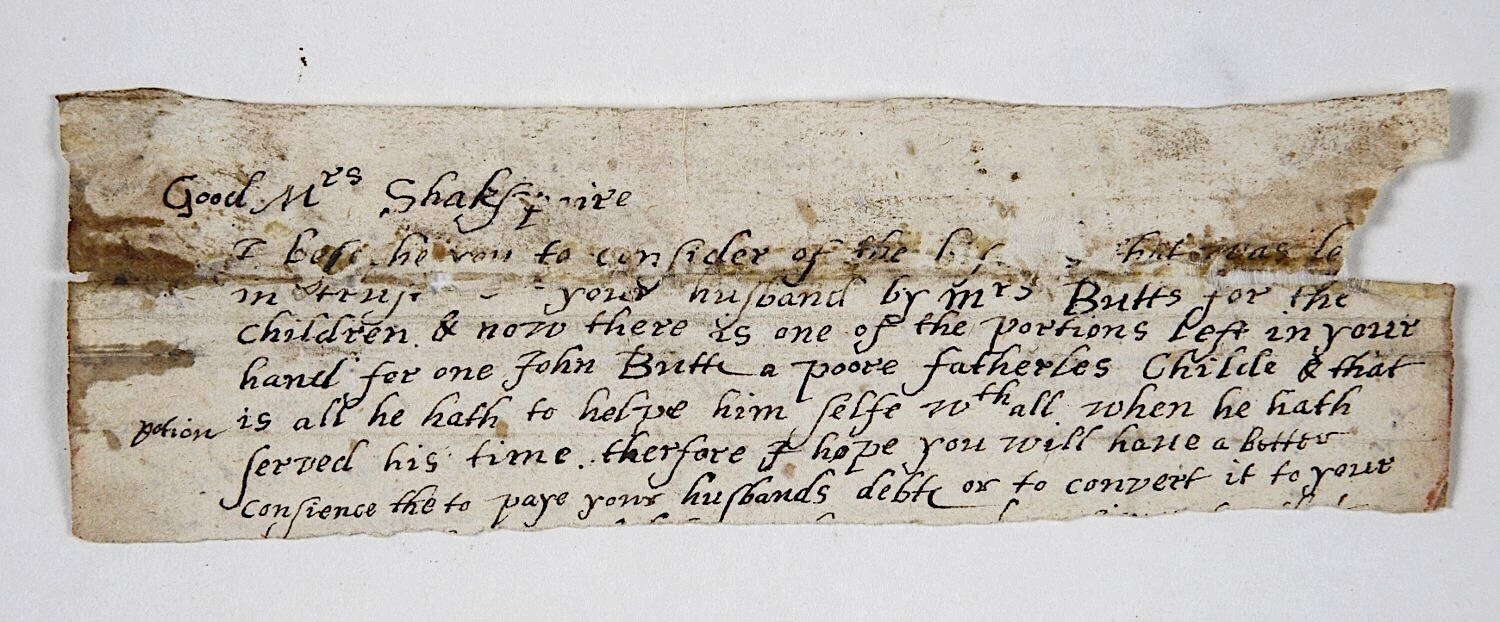
Image via Hereford Cathedral and Hereford Mappa Mundi Trust
At this point, every aspect of William Shakespeare’s life has produced more speculation than any of us could digest in a lifetime. That goes for his professional life, of course, but also his even more scantily documented personal life. As far as his marriage is concerned, the known facts are these: on November 27th, 1582 a marriage license was issued in Worcester to the 18-year-old William Shakespeare and the approximately 26-year-old Anne Hathaway. Six months later came the first of their three children, Susanna. For most of his professional life, William lived in London, while Anne — willed only her husband’s “second-best bed” — remained in his hometown of Stratford-upon-Avon.
According to one common interpretation, the Shakespeares’ was a shotgun wedding avant la lettre, motivated less by romance than expediency. That would certainly explain their apparent choice to live apart, though William’s career would probably have brought him to London anyway, and without a good reason to be in the city, it wasn’t a bad idea to keep the kids out of plague range. (As for his best bed, it would customarily have been reserved for guests.) But according to a new interpretation of an old document by the University of Bristol professor Matthew Steggle, the couple could not only have remained in communication, but also lived together in the capital for a time.
“Hereford Cathedral Library holds a fragmentary seventeenth-century letter addressed to a ‘Mrs Shakspaire,’ concerning her husband’s dealings with a fatherless apprentice,” writes Steggle in his research paper recently published in the journal Shakespeare. “Of the Shakespeares recorded in London, William Shakespeare is the only viable candidate to fit with the letter’s details.” In Steggle’s analysis, it “paints a picture of William and Anne Shakespeare together in London, and living, perhaps around 1599–1603, in Trinity Lane. It further suggests an Anne Shakespeare who is not absent from her husband’s London life, but present and engaged in his financial and social networks.”
The New York Times’ Ephrat Livni quotes Steggle as saying that “this letter, if it belongs to them, offers a glimpse of the Shakespeares together in London, both involved in social networks and business matters, and, on the occasion of this request, presenting a united front against importunate requests to help poor orphans.” This, Livni adds, would “lend some heft to feminist readings of Shakespeare’s life,” as well as to the pop-culture trend of “rethinking the marriage and Hathaway’s role in it.” Each era thus continues to create the Shakespeare for whom it feels the need — and the Mrs. Shakespeare as well.
Related content:
Free Course: A Survey of Shakespeare’s Plays
Why Should We Read William Shakespeare? Four Animated Videos Make the Case
The Only Surviving Script Written by Shakespeare Is Now Online
Did Shakespeare Write Pulp Fiction? (No, But If He Did, It’d Sound Like This)
Did Bach’s Wife Compose Some of “His” Masterpieces? A New Documentary Says Yes
Based in Seoul, Colin Marshall writes and broadcasts on cities, language, and culture. His projects include the Substack newsletter Books on Cities and the book The Stateless City: a Walk through 21st-Century Los Angeles. Follow him on the social network formerly known as Twitter at @colinmarshall.
Read More...How Eyes Evolved: A Fascinating Tour Through the Animal Kingdom
Above, Lars Schmitz, a professor at Claremont McKenna College, guides us “through a giant tree of life mapping the evolution of eyes in the animal kingdom: how they work, why they’ve taken the form they have, and the evolutionary advantages they’ve unlocked across species.” The video comes courtesy of Wired. It’s 36 minutes and downright fascinating.
If you would like to support the mission of Open Culture, consider making a donation to our site. It’s hard to rely 100% on ads, and your contributions will help us continue providing the best free cultural and educational materials to learners everywhere. You can contribute through PayPal, Patreon, and Venmo (@openculture). Thanks!
Related Content
Animals Laugh Too: UCLA Study Finds Laughter in 65 Species, from Rats to Cows
16,000 Pages of Charles Darwin’s Writing on Evolution Now Digitized and Available Online
Carl Sagan Explains Evolution in an 8‑Minute Animation
Free Online Biology Courses
Read More...Marvin Gaye’s Classic Vocals on ‘I Heard It Through the Grapevine’: The A Cappella Version
It’s hard to believe, but Marvin Gaye’s classic 1967 recording of “I Heard It Through the Grapevine” was originally rejected by his record label.
The song, about a man’s grief over hearing rumors of his lover’s infidelity, was written by the legendary Motown Records producer Norman Whitfield and singer Barrett Strong. Smokey Robinson and the Miracles first recorded the track in 1966, but that version got nixed by Motown founder Berry Gordy during a weekly quality control meeting. Then, Whitfield recorded the song with Gaye in early 1967, but for some reason Gordy didn’t like that version either. So Whitfield changed the lyrics a bit and recorded it with Gladys Knight and the Pips. The fast-tempo arrangement, influenced by Aretha Franklin’s “Respect,” was released as a single in September of 1967 and rose to number one on the Billboard R&B chart.
Gaye’s version might have been forgotten had it not been included in his 1968 album, In the Groove, where it soon became noticed. “The DJs played it so much off the album,” Gordy said later, “that we had to release it as a single.”
Gaye’s recording of the song became a crossover hit. It rose not only to the top of the R&B charts, but also spent seven weeks at the top of the Billboard Pop Singles chart. It was Motown’s biggest-selling single up to that time, and the In the Groove album name was soon changed to I Heard It Through the Grapevine.
Gaye was known for his sweet-sounding tenor voice, which he could modulate from a baritone to a silky high falsetto. During the “Grapevine” sessions, the singer reportedly quarreled with Whitfield over the producer’s insistence that he sing the song in a high rasp. Whitfield prevailed, and Gaye’s performance is one of the greatest of the Motown era. You can hear his classic vocals “a cappella” in the video above. And for a reminder of Whitfield’s classic arrangement, with its pulsing electric piano introduction and shimmering strings, see the video below. The Funk Brothers, the legendary Motown backing group, played on the track, as did the backing vocal group The Andantes and the Detroit Symphony Orchestra.
Note: An earlier version of this post appeared on our site in 2013.
Related Content
Zoo Hires Marvin Gaye Impersonator to Help Endangered Monkeys “Get It On”
Hear Grace Slick’s Hair-Raising Vocals in the Isolated Track for “White Rabbit” (1967)
Freddie Mercury & David Bowie’s Isolated Vocals for Queen’s “Under Pressure” (1981)
Read More...The Heavy-Metal Band Disturbed Covered Simon & Garfunkel’s “The Sound of Silence” Ten Years Ago, and It’s Still Topping the Charts
“The Sound of Silence” Is the Most Metal Song of the Past Decade”: imagine that headline, and the contrarian culture piece practically writes itself. Not so long ago, Slate was notorious for publishing that kind of thing, but it seems they’ve now put that sensibility behind them — or at least mostly behind them. “If you’re in the mood for an underdog story,” writes that site’s Luke Winkie, “I recommend perusing Billboard’s Hard Rock Digital Song Sales chart. It is home to, genuinely, one of the most substantial feats of endurance in the history of popular music, and it shows no sign of slowing down anytime soon. I speak, of course, of Disturbed’s cover of the Simon & Garfunkel classic ‘The Sound of Silence,’ which has been at, or near, the apex of that chart since 2015.”
While you almost certainly know Simon & Garfunkel, you may not know Disturbed, who’ve been steadily popular in the metal world since the release of their debut album The Sickness in 2000. Listen to that album’s big single “Down with the Sickness,” and you’re instantly transported back to the turn of the millennium, when the exaggeratedly rhythmic and aggressive subgenre of “nu metal” reigned supreme.
Entertaining though the sheer incongruity of a nu-metal version of “The Sound of Silence” would be, that movement had long since flamed out by 2015, when Disturbed recorded their cover of Simon & Garfunkel’s signature song. Instead, they take the haunting austerity of the original in a grandly mournful direction, driven by piano, strings, and the kind of cavernous sensitivity in which metal acts occasionally indulge.
“Simon & Garfunkel’s version is best suited for The Graduate,” writes Winkie, “while Disturbed’s take seems tuned for the end-credits scroll of a Transformers flick.” Inclusion in a Hollywood blockbuster might have explained the song’s decade-long dominance of the aforementioned Hard Rock Digital Song Sales chart: a minor arena in itself, but one in which this perpetual victory reflects a wider cultural phenomenon. Though young people may never have heard Disturbed’s “The Sound of Silence” — or indeed Simon & Garfunkel’s — it’s drawn intense and abiding enthusiasm from listeners in their sixties, seventies, and eighties, for whose approval metal bands haven’t conventionally angled. Nevertheless, it had to mark a high point in Disturbed’s career when, after performing the song on Conan, they received high praise from one particularly distinguished member of that demographic: a certain Paul Simon.
Related content:
Paul Simon Tells the Story of How He Wrote “Bridge Over Troubled Water” (1970)
Paul Simon Deconstructs “Mrs. Robinson” (1970)
Fred Armisen & Bill Hader’s Comedic Take on the History of Simon and Garfunkel
Who Invented Heavy Metal Music?: A Search for Origins
Based in Seoul, Colin Marshall writes and broadcasts on cities, language, and culture. His projects include the Substack newsletter Books on Cities and the book The Stateless City: a Walk through 21st-Century Los Angeles. Follow him on the social network formerly known as Twitter at @colinmarshall.
Read More...A Stylish 2,000-Year-Old Roman Shoe Found in a Well

When the Romans pushed their way north into the German provinces, they built (circa 90 AD) the Saalburg, a fort that protected the boundary between the Roman Empire and the Germanic tribal territories. At its peak, 2,000 people lived in the fort and the attached village, and it remained active until around 260 AD.
Sometime during the 19th century, the Saalburg was rediscovered and excavated, then later fully reconstructed. It’s now a UNESCO World Heritage site and houses the Saalburg Museum, which contains many Roman relics, including a 2,000-year-old shoe, apparently found in a local well.
If you think the Italians have mastered the craft of making shoes, well, they don’t have much on their ancestors. According to the site Romans Across Europe, the Romans “were the originators of the entire-foot-encasing shoe.” The site continues:
There was a wide variety of shoes and sandals for men and women. Most were constructed like military caligae, with a one-piece upper nailed between layers of the sole. Many had large open-work areas made by cutting or punching circles, triangles, squares, ovals, etc. in rows or grid-like patterns. Others were more enclosed, having only holes for the laces. Some very dainty women’s and children’s shoes still had thick nailed soles.
The image above, which puts all of the Romans’ shoe-making skill on display, comes to us via Reddit and imgur.
Note: An earlier version of this post appeared on our site in 2016.
If you would like to support the mission of Open Culture, consider making a donation to our site. It’s hard to rely 100% on ads, and your contributions will help us continue providing the best free cultural and educational materials to learners everywhere. You can contribute through PayPal, Patreon, and Venmo (@openculture). Thanks!
Related Content:
Archaeologists Discover an Ancient Roman Sandal with Nails Used for Tread
How Wearing Ridiculously Long Pointed Shoes Became a Medieval Fashion Trend
A Huge Scale Model Showing Ancient Rome at Its Architectural Peak (Built Between 1933 and 1937)
Exquisite 2300-Year-Old Scythian Woman’s Boot Preserved in the Frozen Ground of Siberia
Read More...The Simple, Ingenious Design of the Ancient Roman Javelin: How the Romans Engineered a Remarkably Effective Weapon
As Mike Tyson once put it, with characteristic straightforwardness, “Everybody has a plan until they get punched in the mouth.” Back in the time of the Roman Republic and the early Roman Empire, all of Rome’s enemies must have had a plan until pila punched through their shields. A kind of javelin with a wooden shaft and a sharp iron shank, the pilum came in both long and short lengths. Short pila had the advantage of distance, but long pila had the advantage of power, as well as the convenient feature — whether deliberately or accidentally implemented at first — that their shanks would more readily bend after impact, making them impractical to remove from the shields they’d penetrated.
With his shield thus made unwieldy by one or more pila, an advancing combatant would thus be forced to discard it entirely — assuming he was still in the condition to do so. As you can see vividly demonstrated in the Smithsonian Channel video above, a pilum landing in the center of a shield could easily skewer anyone standing behind it.
History has it that Roman soldiers were also trained to throw their pila where enemy shields overlapped, pinning them together and thus rendering twice as much of their defense useless. After a victory, pila could be gathered from the battlefield for refurbishment, an example of quasi-industrial production undergirded by Roman military might.
Like all weaponry — indeed, like all technology — the pilum had its heyday. Polybius’ Histories credits it as an important factor in the Roman victory at the Battle of Telamon in 225 BC. But by the third century AD, it was phased out, having become an obsolete anti-infantry weapon in the face of the evolving equipment and tactics of Germanic tribes and Persian cavalry. Nevertheless, similar javelin-like tools of war evolved into other forms, outlasting the Roman Empire itself and even persisting into the early age of gunpowder. Now, when very few of us face the threat of impalement by pila or their successors, we can appreciate the skill it takes to throw them — as Philip Roth described, in his final novel, with an eloquence very different from Tyson’s — in the realm of sport.
Related Content:
Archaeologists Discover an Ancient Roman Sandal with Nails Used for Tread
Ancient Greek Armor Gets Tested in an 11-Hour Battle Simulation Inspired by the Iliad
A Close Look at Beowulf-Era Helmets & Swords, Courtesy of the British Museum
How Many U.S. Marines Could Bring Down the Roman Empire?
Based in Seoul, Colin Marshall writes and broadcasts on cities, language, and culture. His projects include the Substack newsletter Books on Cities and the book The Stateless City: a Walk through 21st-Century Los Angeles. Follow him on the social network formerly known as Twitter at @colinmarshall.
Read More...Tom Jones Performs “Long Time Gone” with Crosby, Stills, Nash & Young–and Blows the Band & Audience Away (1969)
Welsh crooner Tom Jones made an unlikely comeback in the late 80s, covering Prince’s “Kiss” with Art of Noise. Then in the mid-90s, he showed up on The Fresh Prince of Bel Air to sing the mid-60s hit “It’s Not Unusual” for superfan Carlton Banks. This was a time of 60s comebacks all around, but Jones’ resurgence was a little odd (though perfectly in character for Carlton Banks). Tom Jones had been a big star in the mid to late 60s, with his own TV show and a string of international hits. But Tom Jones was never exactly cool in the way that, say, Neil Young was cool in 1969, the year he and Jimi Hendrix stole a truck to get to Woodstock.
“Tom Jones and his show might’ve been seen as somewhat ‘square’ by the rockstar standards of CSNY,” writes Dangerous Minds,” but when the foursome agreed to appear in September of that year, just weeks after the massive festival in upstate New York, it turned into a memorable television event, with Jones taking lead vocals on “Long Time Gone” and blowing the audience and the band away.
“The man’s mighty lungs inspire the rest of them to keep up, it must be said,” even Young, whose “face goes from one of disdain/’What am I doing here?’ to ‘This fucking rocks’ about halfway through.”
Even stranger than this combination is the fact that Young agreed to do it at all. He had become notoriously averse to doing television, even turning down The Tonight Show with Johnny Carson and citing his hatred of TV as a reason for leaving Buffalo Springfield two years earlier. Though he may have been caught up in the moment, he later regretted it, as his longtime manager Eliot Roberts told biographer Jimmy McDonough: “Neil went, ‘The Tom Jones show! What possessed you? It’s that shit.’ He always used to say ‘that shit.’ Crosby had this weed of doom… Neil never forgave me for that. He ripped me about it for a very, very long time. Years.”
“It was highly rated,” says Roberts, “sold a lotta records, but in retrospect it was embarrassing.” Young probably shouldn’t have worried. Weed of doom or no, it didn’t seem to hurt his credibility as much as his bewildering (though critically re-appraised) 1982 New Wave record, Trans. Jones has done just fine, reinventing himself in the 80s and 90s in good-humored self-parodies, then becoming a bona fide pop star once more. He has yet to appear again with Neil Young.
Note: An earlier version of this post appeared on our site in 2020.
Related Content:
Janis Joplin & Tom Jones Bring the House Down in an Unlikely Duet of “Raise Your Hand” (1969)
Tom Jones Covers Talking Heads “Burning Down the House”–and Burns Down the House (1999)
Tom Jones & Chuck Berry Perform Together, Singing “Roll Over Beethoven” & “Memphis” (1974)
The Time Neil Young Met Charles Manson, Liked His Music, and Tried to Score Him a Record Deal
Josh Jones is a writer and musician based in Durham, NC. Follow him at @jdmagness
Read More...Support Us
We're hoping to rely on loyal readers, rather than erratic ads. Please click the Donate button and support Open Culture. You can use Paypal, Venmo, Patreon, even Crypto! We thank you!

About Us

Open Culture scours the web for the best educational media. We find the free courses and audio books you need, the language lessons & educational videos you want, and plenty of enlightenment in between.
Advertise With Us

FREE UPDATES!
GET OUR DAILY EMAIL
Get the best cultural and educational resources on the web curated for you in a daily email. We never spam. Unsubscribe at any time.
FOLLOW ON SOCIAL MEDIA

Open Culture editor Dan Colman scours the web for the best educational media. He finds the free courses and audio books you need, the language lessons & movies you want, and plenty of enlightenment in between.
Advertise With Us


