How Civilizations Built on Top of Each Other: Discover What Lies Beneath Rome, Troy & Other Cities
The idea of discovering a lost ancient city underground has long captured the human imagination. But why are the abandoned built environments of those fantasies always buried? The answer, in large part, is that such places do indeed exist under our feet, at least in certain parts of the world. When archaeologists started digging under the Roman Forum, says the narration of the new Primal Space video above, “they uncovered an entire world of ruins deep underground that hadn’t been seen for centuries.” The even older city of Troy “was rebuilt ten times, forming ten distinct layers, all built directly on top of each other.” A geological dig is always a journey back in time, but there even more so.
Each civilization has its own reasons for this kind of physical accretion. “After the great fire of Rome in the first century, most of the city had to be rebuilt. But instead of clearing away the rubble, it was quicker and easier to simply flatten it out and build on top.” Thereafter, periodic disasters continued to necessitate periodic raising of the streets, a process that would eventually bury older structures completely.
In the case of Troy, which began as a settlement built of mud bricks in 3,000 BC, nine civilizations grew and dissolved (often literally) on the very same mound, “going from the Persians to Alexander the Great, and eventually the Romans.” Something similar continues to happen in certain parts of the world today: Shanghai, for instance, which is now sinking at a rate of one centimeter per year.
Having grown up around Seattle, I had more than one occasion to take its “underground tour,” which takes place amid the remains of a late-nineteenth-century townscape preserved just below the modern streets. “In 1889, a devastating fire ripped through the newly formed city, and just like Rome, almost everything had to be rebuilt,” the video explains. The aftermath brought an opportunity to re-design the flood-prone city with streets elevated above a system of drains. This put underground not just the lower floors of the existing buildings, but also their surrounding sidewalks. At elementary-school age, one is somehow both fascinated and not particularly surprised by the existence of a lost city beneath one’s hometown. For me and my classmates, nothing was more memorable than the fact that there are still toilets down there.
Related content:
The Lost Neighborhood Buried Under New York City’s Central Park
What’s Under London? Discover London’s Forbidden Underworld
How the “Lost Cities” of the Amazon Were Finally Discovered
Undercity: Exploring the Underbelly of New York City
Explore the Ruins of Timgad, the “African Pompeii” Excavated from the Sands of Algeria
Based in Seoul, Colin Marshall writes and broadcasts on cities, language, and culture. His projects include the Substack newsletter Books on Cities and the book The Stateless City: a Walk through 21st-Century Los Angeles. Follow him on the social network formerly known as Twitter at @colinmarshall.
Read More...The Cleanest Recordings of 1920s Louis Armstrong Songs You Will Ever Hear
On Youtube, jazz enthusiast Jonathan Holmes declares: “I can guarantee this is the cleanest sounding Louis Armstrong record you’ll ever hear! With the original transfer supplied by Nick Dellow, here is the mother record which was shipped by Okeh to Germany for their Odeon pressings. The sound is wonderfully immediate, and crystal clear.” No crackle and pop. That’s how Holmes describes the pristine recording you can hear above of the Louis Armstrong classic, “Ain’t Misbehavin’.” Below, hear another “mother metal” recording of another Armstrong song, “Knee Drops.” Enjoy the early Satchmo in all of its wonderful clarity.
If you would like to support the mission of Open Culture, consider making a donation to our site. It’s hard to rely 100% on ads, and your contributions will help us continue providing the best free cultural and educational materials to learners everywhere. You can contribute through PayPal, Patreon, and Venmo (@openculture). Thanks!
Note: An earlier version of this post appeared on our site in 2016.
Related Content:
Louis Armstrong Remembers How He Survived the 1918 Flu Epidemic in New Orleans
Read More...How Frank Lloyd Wright’s Architecture Evolved Over 70 Years and Changed America
In the new Architectural Digest video above, Michael Wyetzner talks about a fair few buildings we’ve featured over the years here on Open Culture: the Imperial Hotel, the Ennis House, Taliesin, Fallingwater. These are all, of course, the work of Frank Lloyd Wright, who still stands as the embodiment of American architecture more than 65 years after his death. That’s a fairly long stretch by modern standards, but nevertheless a shorter one than Wright’s career, which ran over 70 years. During his long life, Wyetzner explains, Wright witnessed the introduction of indoor plumbing, electricity, the telephone, the automobile, the airplane, the radio, television, and space travel — and even given that, his architecture shows a dramatic evolution.
Beginning with Wright’s apprenticeship in Chicago under Louis Sullivan, “the father of modernism,” Wyetzner continues on to his development of the horizontal indoor-outdoor “Prairie Style” house; his Japanese commissions and subsequent much-photographed Los Angeles houses; the emergence of his philosophy of “organic architecture” meant to unify the building with its site and natural environment; his discovery of the desert; and his Depression-era conception of the “Usonian house,” which adapted his refined spatial sensibility for American-style mass production. This would be more than enough for even the most distinguished architect’s career. Yet it doesn’t even get around to such projects as the Unity Temple, Johnson Wax Headquarters, the R. W. Lindholm Service Station, the Solomon R. Guggenheim Museum, or his first and last doghouse.
No matter which period of Wright’s career you examine, you can find evidence for his belief in the inspiration of place, in organic aesthetics, in structural expressiveness, and even in indirect moral instruction. Yet it’s also possible to imagine that, in some sense, a series of different Frank Lloyd Wrights existed, repeatedly destroyed and recreated by professional setback, personal disaster, foreign sojourn, immersion in a new landscape, or even acquaintance with a new technology. Surely no one could remain productive to the end of his 92 years without a little re-invention. During that time, he designed more than 1,000 projects, only about half of which were ever built. Young architects who idolize Frank Lloyd Wright would do well to remember that he, too, knew full well the sting of never making it to construction.
Related Content:
How Frank Lloyd Wright Became Frank Lloyd Wright: A Video Introduction
Frank Lloyd Wright Creates a List of the 10 Traits Every Aspiring Artist Needs
That Far Corner: Frank Lloyd Wright in Los Angeles – A Free Online Documentary
Frank Lloyd Wright: America’s Greatest Architect? – A Free Streaming Documentary
What Frank Lloyd Wright’s Unusual Windows Tell Us About His Architectural Genius
What It’s Like to Work in Frank Lloyd Wright’s Iconic Office Building
Based in Seoul, Colin Marshall writes and broadcasts on cities, language, and culture. His projects include the Substack newsletter Books on Cities and the book The Stateless City: a Walk through 21st-Century Los Angeles. Follow him on the social network formerly known as Twitter at @colinmarshall.
Read More...David Bowie/Nirvana’s “The Man Who Sold The World” Played on the Gayageum, a Korean Instrument from the 6th Century
East meets West, and the Ancient, the Modern. That’s what happens every time Luna Lee plays one of your favorites on the Gayageum, a Korean instrument that dates back to the 6th century. We’ve featured her work in years past (see the Relateds below). Above, watch one of her standout performances—a cover of “The Man Who Sold The World,” the song first written by David Bowie in 1970, then famously performed by Nirvana on MTV Unplugged in 1993. An alternate video features Luna on vocals here. Enjoy!
If you would like to support the mission of Open Culture, consider making a donation to our site. It’s hard to rely 100% on ads, and your contributions will help us continue providing the best free cultural and educational materials to learners everywhere. You can contribute through PayPal, Patreon, and Venmo (@openculture). Thanks!
Related Content:
David Bowie and Klaus Nomi’s Hypnotic Performance on SNL (1979)
Watch Jimi Hendrix’s ‘Voodoo Chile’ Performed on a Gayageum, a Traditional Korean Instrument
Read More...How Our Depiction of Jesus Changed Over 2,000 Years and What He May Have Actually Looked Like
Whether or not you believe Jesus Christ is the son of God, you probably envision him (or, if you prefer, Him) in much the same way as most everyone else does. The long hair and beard, the robe, the sandals, the beatific gaze: these traits have all manifested across two millennia of Christian art. “However, these depictions don’t exactly match the profile of a first-century Jewish carpenter from the Middle East,” says Hochelaga host Tommie Trelawny in the new video above, an investigation into how our modern concept of how Jesus looked came to be — and into what we can know about his real appearance.
First, we must turn to the Bible. In the King James Version, Revelation describes Jesus thus: “His head and his hairs were white like wool, as white as snow; and his eyes were as a flame of fire; and his feet like unto fine brass, as if they burned in a furnace; and his voice as the sound of many waters. He had in His right hand seven stars, out of His mouth went a sharp two-edged sword, and His countenance was like the sun shining in its strength.” That’s it for the New Testament. As for the Old Testament, Isaiah describes a figure that could possibly be Jesus by crediting him with “no form nor comeliness; and when we shall see him, there is no beauty that we should desire him.”
This scant Biblical evidence hardly aligns with the high-profile depictions of Jesus we’ve all seen. For many around the world today, the “default representation” is the downright glamorous 1940 portrait Head of Christ by the American painter Warner Sallman (a Chicagoan, incidentally, much like the newly elected Pope Leo XIV). One could see that artwork as the culmination of a fairly long history of visual depictions of Jesus, which first became abundant in the Roman Empire of the fourth century under Constantine. According to Greco-Roman mythology, “having long hair and a beard were symbols of divine power.” Early Christians thus “wanted to present their god using similar artistic conventions,” placing Jesus in a league with the likes of Zeus.
That’s the basic look Jesus has in most representations, from the botched Spanish fresco that became a meme to the crucified Mr. Universe in South Korea, where I live, to Andy Warhol’s Christ $9.98. And yet, according to the dictates of Leviticus, “you shall not round the corners of your heads, neither shalt thou mar the corners of thy beard.” Trelawny takes this into account when attempting to reconstruct the historical Jesus, also noting that, since Jesus could only be identified by Judas’ kiss of betrayal, he must have looked much like all the other men around him. The result, when all of this is fed into an artificial-intelligence image generator, is very much an everyman, which may be as historically accurate as we can get. But then, each time and place creates its own Jesus — and now, with AI, each of us can do the same for ourselves.
Related content:
What Makes Caravaggio’s The Taking of Christ a Timeless, Great Painting?
How Leonardo da Vinci Painted The Last Supper: A Deep Dive Into a Masterpiece
Introduction to New Testament History and Literature: A Free Yale Course
Based in Seoul, Colin Marshall writes and broadcasts on cities, language, and culture. His projects include the Substack newsletter Books on Cities and the book The Stateless City: a Walk through 21st-Century Los Angeles. Follow him on the social network formerly known as Twitter at @colinmarshall.
Read More...John Nash’s Super Short PhD Thesis: 26 Pages & Two Citations
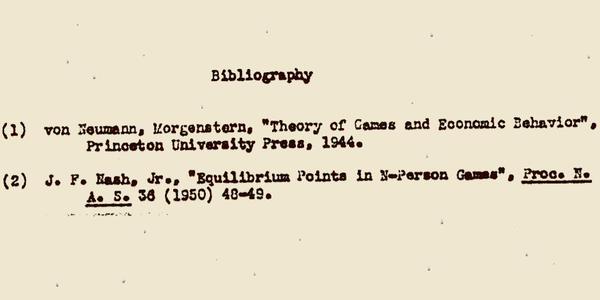
When John Nash wrote “Non-Cooperative Games,” his Ph.D. dissertation at Princeton in 1950, the text of his thesis (read it online) was brief. It ran only 26 pages. And more particularly, it was light on citations. Nash’s diss cited two texts: John von Neumann and Oskar Morgenstern’s Theory of Games and Economic Behavior (1944), which essentially created game theory and revolutionized the field of economics; the other cited text, “Equilibrium Points in n‑Person Games,” was an article written by Nash himself. And it laid the foundation for his dissertation, another seminal work in the development of game theory, for which Nash was awarded the Nobel Prize in Economic Sciences in 1994.
The reward of inventing a new field is having a slim bibliography.
If you would like to support the mission of Open Culture, consider making a donation to our site. It’s hard to rely 100% on ads, and your contributions will help us continue providing the best free cultural and educational materials to learners everywhere. You can contribute through PayPal, Patreon, and Venmo (@openculture). Thanks!
Note: An earlier version of this post appeared on our site in June, 2015.
Related Content:
The Shortest-Known Paper Published in a Serious Math Journal: Two Succinct Sentences
The World Record for the Shortest Math Article: 2 Words
How to Dance Your Dissertation: See the Winning Video in the 2014 “Dance Your PhD” Contest
Read More...How a Student’s Phone Call Averted a Skyscraper Collapse: The Tale of the Citicorp Center
The Citigroup Center in Midtown Manhattan is also known by its address, 601 Lexington Avenue, at which it’s been standing for 47 years, longer than the median New Yorker has been alive. Though still a fairly handsome building, in a seventies-corporate sort of way, it now pops out only mildly on the skyline. At street level, though, the building continues to turn heads, placed as it is on a series of stilt-looking columns placed not at the corners, but in the middle of the walls. A visitor with no knowledge of structural engineering passing the Citigroup Center for the first time may wonder why it doesn’t fall down — which, for a few months in 1978, was a genuinely serious concern.
This story, told with a special explanatory vividness in the new Veritasium video above, usually begins with a phone call. An unidentified architecture student got ahold of William LeMessurier, the structural engineer of the Citicorp Center, as it was then known, to relay concerns he’d heard a professor express about the still-new skyscraper’s ability to withstand “quartering winds,” which blow diagonally at its corners. LeMessurier took the time to walk the student through the elements of his then-groundbreaking lightweight design, which included chevron-shaped braces that directed tension loads down to the columns and a 400-ton concrete tuned mass damper (or “great block of cheese,” as it got to be called) meant to counteract oscillation movements.
LeMessurier was a proud professional, but his professionalism outweighed his pride. When he went back to check the Citicorp Center’s plans, he received an unpleasant surprise: the construction company had swapped out the welded joints in those chevron braces for cheaper bolted ones. His office had approved the change, which made sense at the time, and had also taken into account only perpendicular winds, not quartering winds, as was then standard industry practice. Performing the relevant calculations himself, he determined that the whole tower could be brought down — and much in the surrounding area destroyed with it — by the kind of winds that have a one-in-sixteen chance of blowing in any given year.
It didn’t take LeMessurier long to realize that he had no choice but to reveal what he’d discovered to Citicorp, whose leadership cooperated with the accelerated, semi-clandestine project of shoring up their gleaming emblem’s structural joints by night. The work could hardly fail to draw the attention of the New York press, of course, but it received scant coverage thanks to an impeccably timed newspaper strike, and on its completion made the skyscraper perhaps the safest in the city. In fact, the story of the Citicorp Center disaster that wasn’t only came out publicly in a 1995 New Yorker piece by Joseph Morgenstern, which made LeMessurier a kind of hero among structural engineers. But it was the students who’d identified the building’s faults, not just one but two of whom came forward thereafter, who personified the life-saving power of asking the right questions.
Related content:
Why the Leaning Tower of Pisa Still Hasn’t Fallen Over, Even After 650 Years
The Story of the Flatiron Building, “New York’s Strangest Tower”
How This Chicago Skyscraper Barely Touches the Ground
New York’s Lost Skyscraper: The Rise and Fall of the Singer Tower
Based in Seoul, Colin Marshall writes and broadcasts on cities, language, and culture. His projects include the Substack newsletter Books on Cities and the book The Stateless City: a Walk through 21st-Century Los Angeles. Follow him on the social network formerly known as Twitter at @colinmarshall.
Read More...How Charlie Chaplin, Buster Keaton & Harold Lloyd Pulled Off Their Spectacular Stunts During Silent Film’s Golden Age
It can be tempting to view the box office’s domination by visual-effects-laden Hollywood spectacle as a recent phenomenon. And indeed, there have been periods during which that wasn’t the case: the “New Hollywood” that began in the late nineteen sixties, for instance, when the old studio system handed the reins to inventive young guns like Peter Bogdanovich, Francis Ford Coppola, and Martin Scorsese. But lest we forget, that movement met its end in the face of competition from late-1970s blockbusters like Jaws and Star Wars, a new kind of blockbuster that signaled a return to the simple thrills of silent cinema.
Even a century ago, many moviegoers expected two experiences above all: to be wowed, and to be made to laugh. No wonder that era saw visual comedians like Harold Lloyd, Buster Keaton, and Charlie Chaplin become not just the most famous actors in the world, but some of the most famous human beings in the world.
Staying on top required not just serious performative skill, but also equally serious technical ingenuity, as explained in the new Lost in Time video above. It breaks down just how Lloyd, Keaton, and Chaplin pulled off some of their career-defining stunts on film, putting the actual clips alongside CGI reconstructions of the sets as they would have looked during shooting.
When Lloyd hangs from the arms of a clock high above downtown Los Angeles in Safety Last! (1923), he’s really hanging high above downtown Los Angeles — albeit on a set constructed atop a building, shot from a carefully chosen angle. When the entire façade of a house falls around Keaton in Steamboat Bill, Jr. (1928), leaving him standing unharmed in a window frame, the façade actually fell around him — in a precisely choreographed manner, but with only a couple of inches of clearance on each side. When a blindfolded Chaplin skates perilously close to a multistory drop in Modern Times (1936), he’s perfectly safe, the edge of the floor being nothing more than a matte painting: one of those analog technologies of movie magic whose obsolescence is still bemoaned by classic-film enthusiasts, from whom CGI, no matter how expensive, never quite thrills or amuses in the same way.
Related content:
The Art of Creating Special Effects in Silent Movies: Ingenuity Before the Age of CGI
Watch the Only Time Charlie Chaplin & Buster Keaton Performed Together On-Screen (1952)
Charlie Chaplin Does Cocaine and Saves the Day in Modern Times (1936)
Based in Seoul, Colin Marshall writes and broadcasts on cities, language, and culture. His projects include the Substack newsletter Books on Cities and the book The Stateless City: a Walk through 21st-Century Los Angeles. Follow him on the social network formerly known as Twitter at @colinmarshall.
Read More...Take a 3D Virtual Tour of the Sistine Chapel & Explore Michelangelo’s Masterpieces Up Close
Today, 133 cardinals from around the world enter the conclave to determine the next pope, during which they’ll cast their votes in the Sistine Chapel. Despite being one of the most famous tourist attractions in Europe, the Sistine Chapel still serves as a venue for such important official functions, just as it has since its completion in 1481. When its namesake Pope Sixtus IV commissioned it, he also ordered its walls covered in frescoes by some of the finest artists of that period of the Renaissance, including Sandro Botticelli, Domenico Ghirlandaio, and Cosimo Rosselli. He also made the unusual choice of having the cross-vault ceiling covered by a blue-and-gold painting of the night sky, ably executed by Piermatteo Lauro de’ Manfredi da Amelia.
No longer do the cardinals vote for their next leader under the stars, nor have they for about half a millennium. Even if you’ve never set foot in the Sistine Chapel, you surely know it as the building whose ceiling was painted by Michelangelo, lying flat on a scaffold all the while (a pleasing but highly doubtful image in the collective cultural memory).
In fact, that master of Renaissance masters didn’t touch his brush to the place until 1508. He’d been brought in by a later pope, Julius II, after having first resisted the commission, insisting that he was a sculptor first, not a painter. Fortunately for Renaissance art enthusiasts, not only did Julius II prevail upon Michelangelo, so, nearly thirty years later, did Paul III, who had him paint over the altar the work that turned out to be the Last Judgment.
In the video at the top of the post, history-and-architecture YouTuber Manuel Bravo (previously featured here on Open Culture for his explanations of historic places like Venice, Pompeii, the Cathedral of Santa Maria del Fiore, and St. Peter’s Basilica, which was also touched by the hand of Michelangelo) narrates a 3D virtual tour of the Sistine Chapel. That format makes it possible to see not only its numerous works of Biblical art, by Michelangelo and a host of other painters besides, from every possible angle, but also the building itself just as it would have looked in eras past, even before Michelangelo made his contribution. The more you understand each individual element, the better you can appreciate this “veritable Divina Commedia of the Renaissance,” as Bravo calls it, when next you can see it in person. That, of course, will only be after the conclave finishes up: in a few hours, or days, or weeks, or maybe — a phenomenon not unexampled in the history of the church — a few years.
Related content:
Michelangelo’s David: The Fascinating Story Behind the Renaissance Marble Creation
A Secret Room with Drawings Attributed to Michelangelo Opens to Visitors in Florence
Michelangelo’s Illustrated Grocery List
Based in Seoul, Colin Marshall writes and broadcasts on cities, language, and culture. His projects include the Substack newsletter Books on Cities and the book The Stateless City: a Walk through 21st-Century Los Angeles. Follow him on the social network formerly known as Twitter at @colinmarshall.
Read More...George Orwell’s Rules for Making the Perfect Cup of Tea: A Short Animation
Several years back, Colin Marshall highlighted George Orwell’s essay, “A Nice Cup of Tea,” which first ran in the Evening Standard on January 12, 1946. In that article, Orwell weighed in on a subject the English take seriously–how to make the perfect cup of tea. (According to Orwell, “tea is one of the mainstays of civilization.”) And he proceeded to offer 11 rules for making that perfect cup. Above, Luís Sá condenses Orwell’s suggestions into a short animation, made with kinetic typography. Below, you can read the first three of Orwell’s 11 rules, and find the remaining eight here.
- First of all, one should use Indian or Ceylonese tea. China tea has virtues which are not to be despised nowadays — it is economical, and one can drink it without milk — but there is not much stimulation in it.…
- Secondly, tea should be made in small quantities — that is, in a teapot.… The teapot should be made of china or earthenware. Silver or Britanniaware teapots produce inferior tea and enamel pots are worse.…
- Thirdly, the pot should be warmed beforehand. This is better done by placing it on the hob than by the usual method of swilling it out with hot water.
Enjoy!
If you would like to support the mission of Open Culture, consider making a donation to our site. It’s hard to rely 100% on ads, and your contributions will help us continue providing the best free cultural and educational materials to learners everywhere. You can contribute through PayPal, Patreon, and Venmo (@openculture). Thanks!
Related Content:
George Orwell and Christopher Hitchens’ Ironclad Rules for Making a Good Cup of Tea
An Animated History of Tea
10 Golden Rules for Making the Perfect Cup of Tea (1941)
“The Virtues of Coffee” Explained in 1690 Ad: The Cure for Lethargy, Scurvy, Dropsy, Gout & More
Read More...Support Us
We're hoping to rely on loyal readers, rather than erratic ads. Please click the Donate button and support Open Culture. You can use Paypal, Venmo, Patreon, even Crypto! We thank you!

About Us

Open Culture scours the web for the best educational media. We find the free courses and audio books you need, the language lessons & educational videos you want, and plenty of enlightenment in between.
Advertise With Us

FREE UPDATES!
GET OUR DAILY EMAIL
Get the best cultural and educational resources on the web curated for you in a daily email. We never spam. Unsubscribe at any time.
FOLLOW ON SOCIAL MEDIA

Open Culture editor Dan Colman scours the web for the best educational media. He finds the free courses and audio books you need, the language lessons & movies you want, and plenty of enlightenment in between.
Advertise With Us


