They Study Authoritarianism. And They’re Leaving the U.S.: Why Three Yale Professors Have Moved to U. Toronto
Three Yale professors—Timothy Snyder, Jason Stanley and Marci Shore–have spent their careers studying fascism and authoritarianism. They know the signs of emerging authoritarianism when they see it. Now, they’re seeing those signs here in the United States, and they’re not sitting by idly. They’ve moved to the University of Toronto where they can speak freely, without fearing personal or institutional retribution. Above, they share their views in the NYTimes Op-Doc. It comes prefaced with the text below:
Legal residents of the United States sent to foreign prisons without due process. Students detained after voicing their opinions. Federal judges threatened with impeachment for ruling against the administration’s priorities.
In this Opinion video, Marci Shore, Timothy Snyder and Jason Stanley, all professors at Yale and experts in authoritarianism, explain why America is especially vulnerable to a democratic backsliding — and why they are leaving the United States to take up positions at the University of Toronto.
Professor Stanley is leaving the United States as an act of protest against the Trump administration’s attacks on civil liberties. “I want Americans to realize that this is a democratic emergency,” he said.
Professor Shore, who has spent two decades writing about the history of authoritarianism in Central and Eastern Europe, is leaving because of what she sees as the sharp regression of American democracy. “We’re like people on the Titanic saying our ship can’t sink,” she said. “And what you know as a historian is that there is no such thing as a ship that can’t sink.”
She borrows from political and apolitical Slavic motifs and expressions, arguing that the English language does not fully capture the democratic regression in this American moment.
Professor Snyder’s reasons are more complicated. Primarily, he’s leaving to support his wife, Professor Shore, and their children, and to teach at a large public university in Toronto, a place he says can host conversations about freedom. At the same time, he shares the concerns expressed by his colleagues and worries that those kinds of conversations will become ever harder to have in the United States.
“I did not leave Yale because of Donald Trump or because of Columbia or because of threats to Yale — but that would be a reasonable thing to do, and that is a decision that people will make,” he wrote in a Yale Daily News article explaining his decision to leave.
Their motives differ but their analysis is the same: ignoring or downplaying attacks on the rule of law, the courts and universities spells trouble for our democracy.
To delve deeper into their work, see Stanley and Snyder’s respective works: How Fascism Works: The Politics of Us and Them and On Tyranny: Twenty Lessons from the Twentieth Century.
Related Content
Actor John Lithgow Reads 20 Lessons on Tyranny, Penned by Historian Timothy Snyder
Umberto Eco’s List of the 14 Common Features of Fascism
Toni Morrison Lists the 10 Steps That Lead Countries to Fascism (1995)
Read More...How Bob Dylan Kept Reinventing His Songwriting Process, Breathing New Life Into His Music
On his 84th birthday this past Saturday, Bob Dylan played a show. That was in keeping with not only his still-serious touring schedule, but also his apparently irrepressible instinct to work: on music, on writing, on painting, on sculpture. Even his occasional tweeting draws an appreciative audience every time. The Bob Dylan of 2025 is not, of course, the Bob Dylan of 1965, but then, the Bob Dylan of 1965 wasn’t the Bob Dylan of 1964. This constant artistic change is just what his fans appreciate, not that they don’t still put on his early stuff with regularity.
In the earliest of that early stuff, as music YouTuber David Hartley explains in the new video above, Dylan “wrote songs by reinventing tradition.” Using nothing but his voice, guitar, and harmonica, the young Dylan “imitated some of the most well-known folk melodies,” placing himself in that long American tradition of borrowing and reinterpretation. But as dramatized in the recent film A Complete Unknown, he soon “went electric,” and with the change in instrumentation came a change in songwriting method: “He would just come up with endless pages of lyrics, something he once called ‘the long piece of vomit.’ ”
The advice to “puke it out now and clean it up later” has long been given, in various forms, to aspiring artists everywhere. One aspect worth highlighting about the way Dylan did it was that, despite writing popular songs, he drew a great deal of inspiration from more traditional literature, to the point that his notes hardly appear to contain anything resembling verses or choruses at all. Only in the studio, with a band behind him, could Dylan give these ideas their final musical shape — or rather, their final shape on that particular album, often to be modified endlessly, and sometimes radically, over decades of live performances to come.
Hartley tells of more dramatic changes to Dylan’s music and his process of creating. The motorcycle crash, the Basement Tapes, the open E tuning, Blood on the Tracks: all of these now lie half a century or more in the past. To go over all the ways Dylan has approached music since then would require more hours than all but the most rabid enthusiasts (though there are many) would watch. The video does include a 60 Minutes clip from 2004 in which Dylan says that “those early songs were almost magically written,” and that he wouldn’t be able to create them anymore. But then, nor could the Dylan of Highway 61 Revisited have recorded Time Out of Mind, and nor, for that matter, could the Dylan of Time Out of Mind have recorded any of Dylan’s albums from this decade — or those that could, quite possibly, be still to come.
Related content:
A Massive 55-Hour Chronological Playlist of Bob Dylan Songs: Stream 763 Tracks
How Bob Dylan Created a Musical & Literary World All His Own: Four Video Essays
Watch Bob Dylan Make His Debut at the Newport Folk Festival in Colorized 1963 Footage
Hear Bob Dylan’s Newly Released Nobel Lecture: A Meditation on Music, Literature & Lyrics
Bob Dylan Explains Why Music Has Been Getting Worse
Based in Seoul, Colin Marshall writes and broadcasts on cities, language, and culture. His projects include the Substack newsletter Books on Cities and the book The Stateless City: a Walk through 21st-Century Los Angeles. Follow him on the social network formerly known as Twitter at @colinmarshall.
Read More...George Orwell Reviews Salvador Dali’s Autobiography: “Dali is a Good Draughtsman and a Disgusting Human Being” (1944)
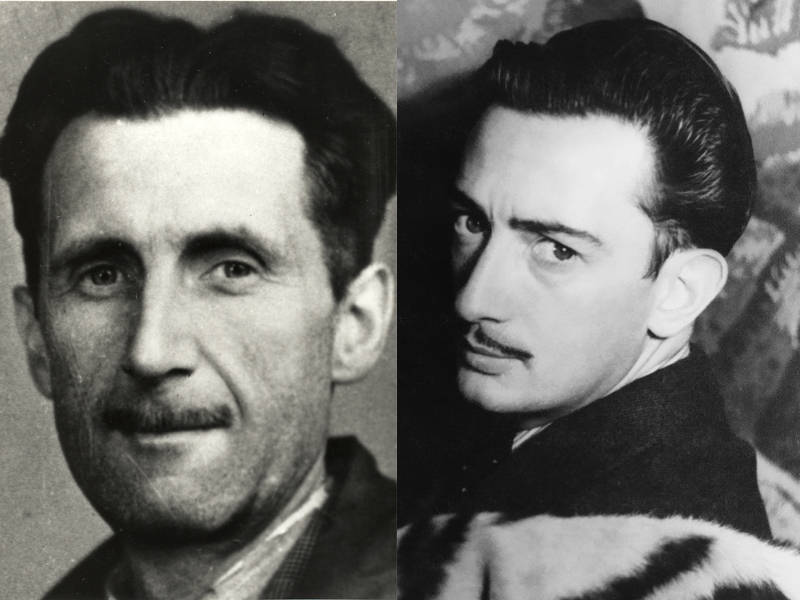
Images or Orwell and Dali via Wikimedia Commons
Should we hold artists to the same standards of human decency that we expect of everyone else? Should talented people be exempt from ordinary morality? Should artists of questionable character have their work consigned to the trash along with their personal reputations? These questions, for all their timeliness in the present, seemed no less thorny and compelling 81 years ago when George Orwell confronted the strange case of Salvador Dali, an undeniably extraordinary talent, and—Orwell writes in his 1944 essay “Benefit of Clergy”—a “disgusting human being.”
The judgment may seem overly harsh except that any honest person would say the same given the episodes Dali describes in his autobiography, which Orwell finds utterly revolting. “If it were possible for a book to give a physical stink off its pages,” he writes, “this one would.” The episodes he refers to include, at six years old, Dali kicking his three-year-old sister in the head, “as though it had been a ball,” the artist writes, then running away “with a ‘delirious joy’ induced by this savage act.” They include throwing a boy from a suspension bridge, and, at 29 years old, trampling a young girl “until they had to tear her, bleeding, out of my reach.” And many more such violent and disturbing descriptions.
Dali’s litany of cruelty to humans and animals constitutes what we expect in the early life of serial killers rather than famous artists. Surely he is putting his readers on, wildly exaggerating for the sake of shock value, like the Marquis de Sade’s autobiographical fantasies. Orwell allows as much. Yet which of the stories are true, he writes, “and which are imaginary hardly matters: the point is that this is the kind of thing that Dali would have liked to do.” Moreover, Orwell is as repulsed by Dali’s work as he is by the artist’s character, informed as it is by misogyny, a confessed necrophilia and an obsession with excrement and rotting corpses.
But against this has to be set the fact that Dali is a draughtsman of very exceptional gifts. He is also, to judge by the minuteness and the sureness of his drawings, a very hard worker. He is an exhibitionist and a careerist, but he is not a fraud. He has fifty times more talent than most of the people who would denounce his morals and jeer at his paintings. And these two sets of facts, taken together, raise a question which for lack of any basis of agreement seldom gets a real discussion.
Orwell is unwilling to dismiss the value of Dali’s art, and distances himself from those who would do so on moralistic grounds. “Such people,” he writes, are “unable to admit that what is morally degraded can be aesthetically right,” a “dangerous” position adopted not only by conservatives and religious zealots but by fascists and authoritarians who burn books and lead campaigns against “degenerate” art. “Their impulse is not only to crush every new talent as it appears, but to castrate the past as well.” (“Witness,” he notes, the outcry in America “against Joyce, Proust and Lawrence.”) “In an age like our own,” writes Orwell, in a particularly jarring sentence, “when the artist is an exceptional person, he must be allowed a certain amount of irresponsibility, just as a pregnant woman is.”
At the very same time, Orwell argues, to ignore or excuse Dali’s amorality is itself grossly irresponsible and totally inexcusable. Orwell’s is an “understandable” response, writes Jonathan Jones at The Guardian, given that he had fought fascism in Spain and had seen the horror of war, and that Dali, in 1944, “was already flirting with pro-Franco views.” But to fully illustrate his point, Orwell imagines a scenario with a much less controversial figure than Dali: “If Shakespeare returned to the earth to-morrow, and if it were found that his favourite recreation was raping little girls in railway carriages, we should not tell him to go ahead with it on the ground that he might write another King Lear.”
Draw your own parallels to more contemporary figures whose criminal, predatory, or violently abusive acts have been ignored for decades for the sake of their art, or whose work has been tossed out with the toxic bathwater of their behavior. Orwell seeks what he calls a “middle position” between moral condemnation and aesthetic license—a “fascinating and laudable” critical threading of the needle, Jones writes, that avoids the extremes of “conservative philistines who condemn the avant garde, and its promoters who indulge everything that someone like Dali does and refuse to see it in a moral or political context.”
This ethical critique, writes Charlie Finch at Artnet, attacks the assumption in the art world that an appreciation of artists with Dali’s peculiar tastes “is automatically enlightened, progressive.” Such an attitude extends from the artists themselves to the society that nurtures them, and that “allows us to welcome diamond-mine owners who fund biennales, Gazprom billionaires who purchase diamond skulls, and real-estate moguls who dominate temples of modernism.” Again, you may draw your own comparisons.
Note: An earlier version of this post appeared on our site in 2018.
Related Content:
George Orwell Reviews Mein Kampf: “He Envisages a Horrible Brainless Empire” (1940)
How the Nazis Waged War on Modern Art: Inside the “Degenerate Art” Exhibition of 1937
Josh Jones is a writer and musician based in Durham, NC. Follow him at @jdmagness
Read More...The “Dark Relics” of Christianity: Preserved Skulls, Blood & Other Grim Artifacts
Christianity often manifests in popular culture through celebrations like Christmas and Easter, or icons like lambs and fish. Less often do you see it associated with vials of blood and disembodied heads. Yet as the new Hochelaga video above reveals, the most famed Christian artifacts do tend toward the gruesome. Take one particularly renowned example, the Shroud of Turin: hear the name, and you imagine a cloth bearing the image of Jesus Christ. But think about it a moment, and you remember that it’s the bloodstained wrapping of a crucified body — that is, if the tales told about it are true in the first place.
As with any religious relics, you have to decide for yourself what to believe about all of these. If you pay a visit to the Basilica of St. Anthony in Padua, you’ll see on display the preserved jaw of that holy figure — which does, at least, look like a real human jaw. In southeastern France, at the basilica of Saint-Maximin-la-Sainte-Baume, you’ll find a skull purported to be that of Mary Magdalene.
And we certainly can’t rule out that it really is, speculative though the evidence may be. The situation grows somewhat more complicated with the head of John the Baptist — or rather, the heads of John the Baptist, four of which have been claimed in different places so far.
“During the Middle Ages, relics were in high demand, and there were always people willing to supply them,” explains Hochelaga creator Tommie Trelawny. “It’s often joked that, if you gathered all the alleged fragments of the true cross, you’d have enough wood to build a small forest.” Even the Shroud of Turin has come under unforgiving scrutiny. Radiocarbon dating has placed it in the mid-fourteenth century, implying a forgery, but more recent X‑ray tests suggest that its linen was made in the first century, between the years 55 and 74: close enough to what we understand as the time of Jesus’ burial. Debates over the authenticity of all these artifacts will continue for centuries — and quite possibly millennia — to come, but their powerful embodiment of both “the deeply disturbing and the hauntingly beautiful” won’t fade away any time soon.
Related content:
How Our Depiction of Jesus Changed Over 2,000 Years and What He May Have Actually Looked Like
The British Museum is Full of Looted Artifacts
Europe’s Oldest Intact Book Was Preserved and Found in the Coffin of a Saint
Did Psychedelic Mushrooms Appear in Medieval Christian Art?: A Video Essay
Based in Seoul, Colin Marshall writes and broadcasts on cities, language, and culture. His projects include the Substack newsletter Books on Cities and the book The Stateless City: a Walk through 21st-Century Los Angeles. Follow him on the social network formerly known as Twitter at @colinmarshall.
Read More...How Led Zeppelin, Pink Floyd & Jethro Tull Financed the Making Monty Python and the Holy Grail
Monty Python and the Holy Grail isn’t a big-budget spectacle, and nobody knew that better than the Pythons themselves. Necessity being the mother of invention, they turned the project’s financial constraints into one of its many sources of humor, fashioning memorable gags out of everything from coconut shells substituting for horses to the sudden shutdown of filming that ends the “story.” But, as explained in the Canned History video above, putting together even the modest sum with which they had to work was hardly a straightforward endeavor. Turned down by studios, the Pythons sought out the only financiers likely to possess both sufficient wealth and sufficient belief in an absurdist TV comedy troupe making their first proper film: rock stars.
This was the mid-nineteen-seventies, recall, when a group with a few hit albums could find themselves making, quite literally, more money than they knew what to do with. Such was the case with Pink Floyd, for example, after releasing The Dark Side of the Moon in 1973.
Monty Python, for their part, had put out not only three seasons of their BBC series Monty Python’s Flying Circus, but also a variety of purchasable goods like books and LPs. The latter made them the music-industry connections that they could use to enlist the likes of not just the Floyd, but also Led Zeppelin, Jethro Tull, as well as record labels like Island, Charisma, and Chrysalis. As Eric Idle tweeted much later, Zeppelin contributed £31,500, Pink Floyd’s company £21,000, and Jethro Tull’s Ian Anderson £6,300: £627,000 in more recent value, or nearly $850,000 in U.S. dollars.
Altogether, Monty Python and the Holy Grail’s budget came to £282,035 in 1974 pounds: by no means a king’s ransom, but just enough to put together a comic take on Arthurian legend. No more conventional investors than the Pythons were conventional filmmakers, the rock stars and other music-industry figures involved made no visits to the set, nor offered any “notes” on the work in progress. One suspects that they were happy just to support a Monty Python project, and even more so to receive the tax break offered for films produced in the U.K. In the event, of course, they all made their money back many times over, with a cut of the Broadway musical adaptation Spamalot to boot. The film’s immediate and outsized success can’t have been far from the mind of George Harrison — that great enemy of the taxman — when Idle called him up a few years later, asking for the money to make Life of Brian.
Related Content:
Stream Online Monty Python and the Holy Grail Free on Its 50th Anniversary
Terry Gilliam’s Lost Animations from Monty Python and the Holy Grail Are Now Online
Monty Python’s Eric Idle Breaks Down His Most Iconic Characters
Monty Python and the Holy Grail Re-Imagined as an Epic, Mainstream Hollywood Film
Based in Seoul, Colin Marshall writes and broadcasts on cities, language, and culture. His projects include the Substack newsletter Books on Cities and the book The Stateless City: a Walk through 21st-Century Los Angeles. Follow him on the social network formerly known as Twitter at @colinmarshall.
Read More...60 Free Film Noir Movies You Can Watch Online, Including Classics by John Huston, Orson Welles & Fritz Lang
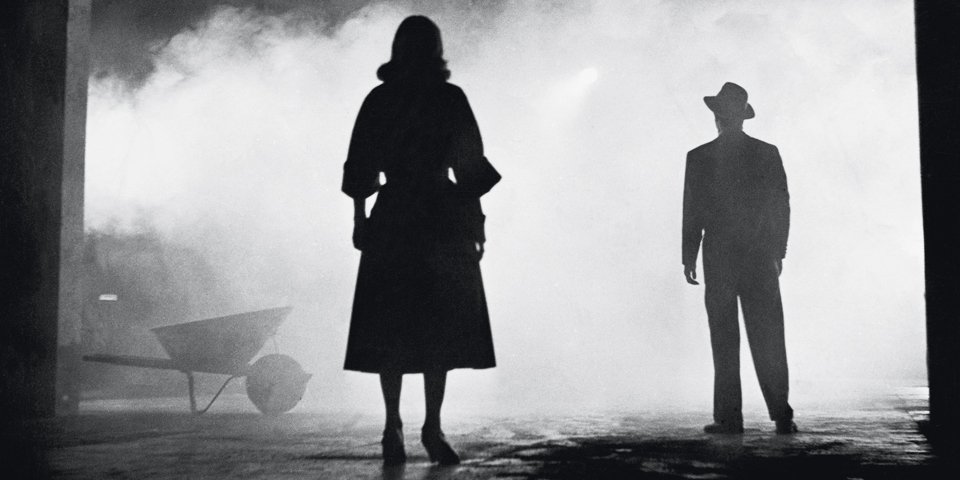
During the 1940s and 50s, Hollywood entered a “noir” period, producing riveting films based on hard-boiled fiction. These films were set in dark locations and shot in a black & white aesthetic that fit like a glove. Hardened men wore fedoras and forever smoked cigarettes. Women played the femme fatale role brilliantly. Love was the surest way to death. All of these elements figured into what Roger Ebert calls “the most American film genre” in his short Guide to Film Noir.
If you head over to this list of Noir Films, you can find 60 films from the noir genre, including some classics by John Huston, Orson Welles, Fritz Lang and Ida Lupino. The list also features some cinematic legends like Humphrey Bogart, Peter Lorre, Barbara Stanwyck, Edward G. Robinson, and even Frank Sinatra. Hope the collection helps you put some noir entertainment into 2025!
If you would like to support the mission of Open Culture, consider making a donation to our site. It’s hard to rely 100% on ads, and your contributions will help us continue providing the best free cultural and educational materials to learners everywhere. You can contribute through PayPal, Patreon, and Venmo (@openculture). Thanks!
Related Content
The 5 Essential Rules of Film Noir
The Essential Elements of Film Noir Explained in One Grand Infographic
Roger Ebert Lists the 10 Essential Characteristics of Noir Films
Read More...1980s Metalhead Kids Are Alright: Scientific Study Shows That They Became Well-Adjusted Adults
In the 1980s, The Parents Music Resource Center (PMRC), an organization co-founded by Tipper Gore and the wives of several other Washington power brokers, launched a political campaign against pop music, hoping to put warning labels on records that promoted Sex, Violence, Drug and Alcohol Use. Along the way, the PMRC issued “the Filthy Fifteen,” a list of 15 particularly objectionable songs. Hits by Madonna, Prince and Cyndi Lauper made the list. But the list really took aim at heavy metal bands from the 80s — namely, Judas Priest, Mötley Crüe, Twisted Sister, W.A.S.P., Def Leppard, Black Sabbath, and Venom. (Interesting footnote: the Soviets separately created a list of blackballed rock bands, and it looked pretty much the same.)
Above, you can watch Twisted Sister’s Dee Snider appear before Congress in 1985 and accuse the PMRC of misinterpreting his band’s lyrics and waging a false war against metal music. The evidence 40 years later suggests that Snider perhaps had a point.
A study by psychology researchers at Humboldt State, Ohio State, UC Riverside and UT Austin “examined 1980s heavy metal groupies, musicians, and fans at middle age” — 377 participants in total — and found that, although metal enthusiasts certainly lived riskier lives as kids, they were nonetheless “significantly happier in their youth and better adjusted currently than either middle-aged or current college-age youth comparison groups.” This left the researchers to contemplate one possible conclusion: “participation in fringe style cultures may enhance identity development in troubled youth.” Not to mention that heavy metal lyrics don’t easily turn kids into damaged goods.
You can read the report, Three Decades Later: The Life Experiences and Mid-Life Functioning of 1980s Heavy Metal Groupies here. And, right above, listen to an interview with one of the researchers, Tasha Howe, a former headbanger herself, who spoke yesterday with Michael Krasny on KQED radio in San Francisco.
Note: An earlier version of this post appeared on our site in July 2015.
If you would like to support the mission of Open Culture, consider making a donation to our site. It’s hard to rely 100% on ads, and your contributions will help us continue providing the best free cultural and educational materials to learners everywhere. You can contribute through PayPal, Patreon, and Venmo (@openculture). Thanks!
Related Content:
A Bluegrass Version of Metallica’s Heavy Metal Hit, “Enter Sandman”
Read More...Watch Pablo Picasso’s Creative Process Unfold in Real-Time: Rare Footage Shows Him Creating Drawings of Faces, Bulls & Chickens
Pablo Picasso was born not long before the invention of the motion picture. With a different set of inclinations, he might have become one of the most daring pioneers of that medium. Instead, as we know, he mastered and then practically reinvented the much older art form of painting. That said, cinema did seem to have been fascinated by both Picasso’s work and the man himself. He made a cameo appearance in Jean Cocteau’s Testament of Orpheus in 1960, a few years after playing the title role in Henri-Georges Clouzot’s documentary Le Mystère Picasso. The short clip from the latter above shows how Picasso could create an expressive face with just a few strokes of a pen.
By the time he made Le Mystère Picasso, Clouzot was already well established as a director of elevated genre films, having just made Le salaire de la peur or (The Wages of Fear) and Les diaboliques (or Diabolique), which would turn out to be one of his defining works.
To filmgoers following his career, it may have come as a surprise to see him follow those up with a documentary about a painter: a genius, yes, but one whose work had already seemed familiar. But Clouzot took as his task not telling the story of Les Demoiselles d’Avignon or Three Musicians or Guernica, but capturing Picasso (whom he’d known since his teenage years) in the act of creating new works of art — works never to be seen except on film.
That was the idea, in any case; though most of the 20 paintings and drawings created just for Le Mystère Picasso were destroyed, some weren’t. One such survivor, a chicken-turned-devilish-visage that emerges in one of the film’s more tense sequences (an intersection of Clouzot and Picasso’s artistic instincts), was actually restored a few years ago for inclusion in the Royal Academy of Arts’ exhibition Picasso and Paper. He could also work on glass, as evidenced by the clip just above from Visit to Picasso, a 1949 documentary short by the Belgian filmmaker Paul Haesaerts. In it he paints — in less than 30 seconds, with the camera running just on the other side of the pane — an evocative image of a bull, demonstrating that, no matter how fully he was embraced by the Francophone world, a Spaniard he remained.
Related Content:
Thousands of Pablo Picasso’s Works Now Available in a New Digital Archive
Pablo Picasso Poses as Popeye (1957)
Based in Seoul, Colin Marshall writes and broadcasts on cities, language, and culture. His projects include the Substack newsletter Books on Cities and the book The Stateless City: a Walk through 21st-Century Los Angeles. Follow him on the social network formerly known as Twitter at @colinmarshall.
Read More...The PhD Theses of Richard Feynman, Marie Curie, Albert Einstein & Others, Explained with Illustrations
Raise your children with a love of science, and there’s a decent chance they’ll grow up wanting to be like Richard Feynman, Marie Curie, Albert Einstein, or any number of other famous scientists from history. Luckily for them, they won’t yet have learned that the pursuit of such a career will almost certainly entail grinding out a PhD thesis. But it’s also lucky for you that they consequently won’t ask you to explain the subjects of their idols’ theses. Maybe you tell them about quantum electrodynamics, radiation, and even the theory of relativity, but what can you recall of “The Principle of Least Action in Quantum Mechanics,” “Research on Radioactive Substances,” or “Eine neue Bestimmung der Moleküldimensionen”?
Perhaps “recall” isn’t quite the word. But if you want to get a handle on these papers, which constitute important parts of the foundation of the research that would ultimately make their authors famous, you could do much worse than beginning with the explanations of science YouTuber Toby Hendy. In recent years, while building up an ever-larger audience with her channel Tibees, she’s occasionally reached into the archives and pulled out a notable scientist’s PhD thesis.
We’ve assembled all of her videos in that series into the playlist above, which also includes Hendy explanations of theses written by figures not primarily known to the public for their research: Carl Sagan and Neil DeGrasse Tyson, and Brian Cox (the physicist, not the Succession star), whose media work has inspired generations of fans to go into science.
Though a young woman, Hendy has mastered old-school teaching techniques, such as drawing on a transparency placed on an overhead projector, that may trigger Proustian memories of science class, at least in those of us of a certain age. With her calmness and clarity (not to mention her willingness to admit when she herself struggles with the material) she’d surely have ranked among any of our favorite teachers, and if you introduce her channel to your kids, she’ll probably become one of theirs. Whether they go on to earn a science PhD is, of course, down to their own inclination and efforts. Like so many young people these days, they may ultimately come away with a stronger desire to become a YouTuber — which, after all, is what Hendy quit her own PhD to do.
Related content:
John Nash’s Super Short PhD Thesis: 26 Pages & Two Citations
Queen Guitarist Brian May Is Also an Astrophysicist: Read His PhD Thesis Online
Albert Einstein’s Grades: A Fascinating Look at His Report Cards
This Is What an 1869 MIT Entrance Exam Looks Like: Could You Have Passed the Test?
Based in Seoul, Colin Marshall writes and broadcasts on cities, language, and culture. His projects include the Substack newsletter Books on Cities and the book The Stateless City: a Walk through 21st-Century Los Angeles. Follow him on the social network formerly known as Twitter at @colinmarshall.
Read More...The Secret Link Between Jazz and Physics: How Einstein & Coltrane Shared Improvisation and Intuition in Common
Scientists need hobbies. The grueling work of navigating complex theory and the politics of academia can get to a person, even one as laid back as Brown University professor and astrophysicist Stephon Alexander. So Alexander plays the saxophone, though at this point it may not be accurate to call his avocation a spare time pursuit, since John Coltrane has become as important to him as Einstein, Kepler, and Newton.
Coltrane, he says in a 7‑minute TED talk above, “changed my whole research direction… led to basically a discovery in physics.” Alexander then proceeds to play the familiar opening bars of “Giant Steps.” He’s no Coltrane, but he is a very creative thinker whose love of jazz has given him a unique perspective on theoretical physics, one he shares, it turns out, with both Einstein and Coltrane, both of whom saw music and physics as intuitive, improvisatory pursuits.
Alexander describes his jazz epiphany as occasioned by a complex diagram Coltrane gave legendary jazz musician and University of Massachusetts professor Yusef Lateef in 1967. “I thought the diagram was related to another and seemingly unrelated field of study—quantum gravity,” he writes in a Business Insider essay on his discovery, “What I had realized… was that the same geometric principle that motivated Einstein’s theory was reflected in Coltrane’s diagram.”
The theory might “immediately sound like untestable pop-philosophy,” writes the Creators Project, which showcases Alexander’s physics-inspired musical collaboration with experimental producer Rioux (sample below). But his ideas are much more substantive, “a compelling cross-disciplinary investigation,” published in a book titled The Jazz of Physics: The Secret Link Between Music and the Structure of the Universe.
Alexander describes the links between jazz and physics in his TED talk, as well as in the brief Wired video further up. “One connection,” he says, is “the mysterious way that quantum particles move.… According to the rules of quantum mechanics,” they “will actually traverse all possible paths.” This, Alexander says, parallels the way jazz musicians improvise, playing with all possible notes in a scale. His own improvisational playing, he says, is greatly enhanced by thinking about physics. And in this, he’s only following in the giant steps of both of his idols.
It turns out that Coltrane himself used Einstein’s theoretical physics to inform his understanding of jazz composition. As Ben Ratliff reports in Coltrane: The Story of a Sound, the brilliant saxophonist once delivered to French horn player David Amram an “incredible discourse about the symmetry of the solar system, talking about black holes in space, and constellations, and the whole structure of the solar system, and how Einstein was able to reduce all of that complexity into something very simple.” Says Amram:
Then he explained to me that he was trying to do something like that in music, something that came from natural sources, the traditions of the blues and jazz. But there was a whole different way of looking at what was natural in music.
This may all sound rather vague and mysterious, but Alexander assures us Coltrane’s method is very much like Einstein’s in a way: “Einstein is famous for what is perhaps his greatest gift: the ability to transcend mathematical limitations with physical intuition. He would improvise using what he called gedankenexperiments (German for thought experiments), which provided him with a mental picture of the outcome of experiments no one could perform.”
Einstein was also a musician—as we’ve noted before—who played the violin and piano and whose admiration for Mozart inspired his theoretical work. “Einstein used mathematical rigor,” writes Alexander, as much as he used “creativity and intuition. He was an improviser at heart, just like his hero, Mozart.” Alexander has followed suit, seeing in the 1967 “Coltrane Mandala” the idea that “improvisation is a characteristic of both music and physics.” Coltrane “was a musical innovator, with physics at his fingertips,” and “Einstein was an innovator in physics, with music at his fingertips.”
Alexander gets into a few more specifics in his longer TEDx talk above, beginning with some personal background on how he first came to understand physics as an intuitive discipline closely linked with music. For the real meat of his argument, you’ll likely want to read his book, highly praised by Nobel-winning physicist Leon Cooper, futuristic composer Brian Eno, and many more brilliant minds in both music and science.
Note: An earlier version of this post appeared on our site in 2016.
Related Content:
The Musical Mind of Albert Einstein: Great Physicist, Amateur Violinist and Devotee of Mozart
CERN’s Cosmic Piano and Jazz Pianist Jam Together at The Montreux Jazz Festival
Bohemian Gravity: String Theory Explored With an A Cappella Version of Bohemian Rhapsody
Josh Jones is a writer and musician based in Durham, NC. Follow him at @jdmagness
Read More...Support Us
We're hoping to rely on loyal readers, rather than erratic ads. Please click the Donate button and support Open Culture. You can use Paypal, Venmo, Patreon, even Crypto! We thank you!

About Us

Open Culture scours the web for the best educational media. We find the free courses and audio books you need, the language lessons & educational videos you want, and plenty of enlightenment in between.
Advertise With Us

FREE UPDATES!
GET OUR DAILY EMAIL
Get the best cultural and educational resources on the web curated for you in a daily email. We never spam. Unsubscribe at any time.
FOLLOW ON SOCIAL MEDIA

Open Culture editor Dan Colman scours the web for the best educational media. He finds the free courses and audio books you need, the language lessons & movies you want, and plenty of enlightenment in between.
Advertise With Us


