Theory of City Form: A Free Course from MIT
From MIT’s Julian Beinart comes “Theory of City Form,” which covers the following:
This course covers theories about the form that settlements should take and attempts a distinction between descriptive and normative theory by examining examples of various theories of city form over time. Case studies will highlight the origins of the modern city and theories about its emerging form, including the transformation of the nineteenth-century city and its organization. Through examples and historical context, current issues of city form in relation to city-making, social structure, and physical design will also be discussed and analyzed.
Over at MIT’s website, you can find a syllabus for the course, along with lecture notes and readings. The video lectures–26 in total–can be viewed above, or on YouTube.
“Theory of City Form” will be permanently housed in our collection, 1,700 Free Online Courses from Top Universities.
If you would like to support the mission of Open Culture, consider making a donation to our site. It’s hard to rely 100% on ads, and your contributions will help us continue providing the best free cultural and educational materials to learners everywhere. You can contribute through PayPal, Patreon, and Venmo (@openculture). Thanks!
Read More...Stanford University Launches Free Course on Developing Apps with iOS 10

Whenever Apple releases a new version of iOS, Stanford University eventually releases a course telling you how to develop apps in that environment. iOS 10 came out last fall, and now the iOS 10 app development course is getting rolled out this quarter. It’s free online, of course, on iTunes.
You can now find “Developing iOS Apps with Swift” housed in our collection of Free Computer Science Courses, which currently features 117 courses in total, including some basic Harvard courses that will teach you how to code in 12 weeks.
As always, courses from other disciplines can be found on our larger list, 1,700 Free Online Courses from Top Universities.
Follow us on Facebook, Twitter and Google Plus and share intelligent media with your friends. Or better yet, sign up for our daily email and get a daily dose of Open Culture in your inbox.
Read More...
Cormac McCarthy Explains Why He Worked Hard at Not Working: How 9‑to‑5 Jobs Limit Your Creative Potential
Last summer, a rumor circulated that Cormac McCarthy, one of America’s most beloved living writers, had passed away. In the midst of a devastating year for famous artists and their fans, the announcement appeared on Twitter, but it “was, in fact, a hoax.” As McCarthy’s publisher—recently merged juggernaut Penguin Random House—confirmed, the author of such modern classics as Blood Meridian, All the Pretty Horses, and No Country for Old Men “is alive and well and still doesn’t care about Twitter.” The literary community is better off not only for McCarthy’s good health, but for his disregard of what may be the most fiendishly distracting social media platform of them all. He is still hard at work, on a novel called The Passenger, tentatively slated for release this year.
You can hear excerpts of The Passenger read in the dim, shaky video below, from an event in 2015 at the Santa Fe Institute, an independent scientific think tank where McCarthy keeps an office and where he has plied a secondary trade as a copy-editor for science-themed books, including Quantum Man, physicist Lawrence Krauss’s biography of Richard Feynman. (McCarthy’s “knowledge of physics and maths,” writes Alison Flood at The Guardian, is said to exceed “that of many professionals in the field.”) McCarthy’s latest work seems like a departure for him.
His earlier novels mined the richness of Southern Gothic and Western traditions, and “have subtly woven in science,” writes Babak Dowlatshahi at Newsweek. But The Passenger “will place science in the foreground.” Santa Fe Institute president David Krakauer calls it “full-blown Cormac 3.0—a mathematical [and] analytical novel.”
So we know Cormac McCarthy is a genius, but how is it that he found the time to become a Pulitzer Prize, National Book Award, and Guggenheim and MacArthur Fellowship-winning novelist and, on the side, a student of theoretical physics and math? His secret involves more than staying off Twitter. As McCarthy tells Oprah Winfrey in the video at the top of the post, excerpted from his first television interview ever in 2007, he has made his work the central focus of his life, to the exclusion of everything else, including money and public adulation from fans and admirers. For example, he answers a question about why he turned down lucrative speaking engagements with, “I was busy. I had other things to do.”
It’s not that I don’t like things, I mean some things are very nice, but they certainly take a distant second place to being able to live your life and being able to do what you want to do. I always knew that I didn’t want to work.
How did he pull off not working? “You have to be dedicated… I thought, ‘you’re just here once, life is brief and to have to spend every day of it doing what somebody else wants you to do is not the way to live it.’” McCarthy doesn’t “have any advice for anybody” about how to avoid the daily grind, except, he says, “if you’re really dedicated, you can probably do it.” As Oprah puts it, “you have worked at not working?” To which he replies, “absolutely, it’s the number one priority.”
Lest we immediately dismiss McCarthy’s philosophy as cluelessness or privilege, we should bear in mind that he willingly endured extreme and “truly, truly bleak” poverty to keep working at not working—or working, rather, on the work he wanted to do. There’s a bit more to becoming a multiple award-winning novelist and MacArthur “Genius” than simply avoiding the 9‑to‑5. But McCarthy suggests that unless artists make their own work their first priority, and material comfort and economic security a “distant second,” they may never truly find out what they’re capable of.
Related Content:
Charles Bukowski Rails Against 9‑to‑5 Jobs in a Brutally Honest Letter (1986)
The Employment: A Prize-Winning Animation About Why We’re So Disenchanted with Work Today
Cormac McCarthy’s Three Punctuation Rules, and How They All Go Back to James Joyce
Werner Herzog and Cormac McCarthy Talk Science and Culture
Werner Herzog Reads From Cormac McCarthy’s All the Pretty Horses
Josh Jones is a writer and musician based in Durham, NC. Follow him at @jdmagness
Read More...Petite Planète: Discover Chris Marker’s Influential 1950s Travel Photobook Series
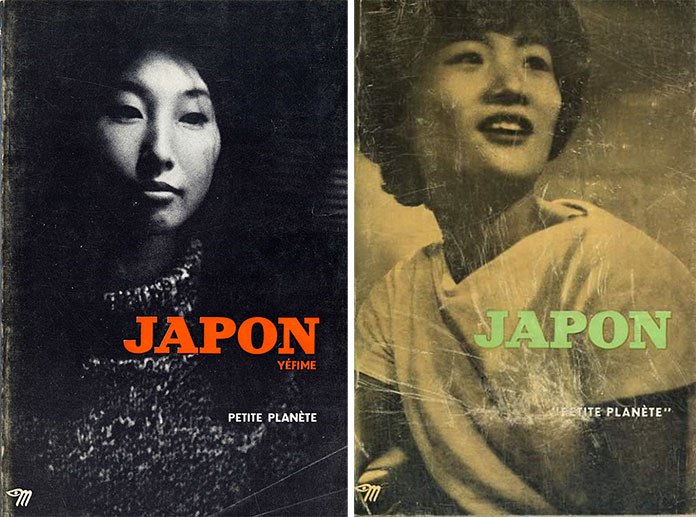
“In another time I guess I would have been content with filming girls and cats,” said Chris Marker. “But you don’t choose your time.” Though the inimitable filmmaker, writer, and media artist couldn’t choose his time, he did enjoy a decently sized slice of it, passing away in 2012 on his 91st birthday. His six-decade career’s best-known achievements include the innovative science-fiction short La Jetée and the semi-fictional travelogue essay-film masterpiece Sans Soleil, but Marker’s vast body of work, most all of it deeply concerned with the combination of words and images, covers a much wider territory — aesthetic territory, of course, but given Marker’s peripatetic tendencies, also physical territory, scattered all across the globe.
Perhaps that sensibility landed Marker, 33 years old and with his most famous work ahead of him, a job as an editor at Paris’ Editions de Seuil, where he conceived and designed a series of travel guides called Petite Planète. He considered each volume “not a guidebook, not a history book, not a propaganda brochure, not a traveller’s impressions, but instead equivalent to the conversation we would like to have with someone intelligent and well versed in the country that interests us.” Launched “nearly a decade after World War II,” writes Isabel Stevens at Aperture,” the first time when “foreign locales seemed tantalizingly within reach, Éditions du Seuil introduced the books rather charmingly as ‘the world for everyone.’ ”

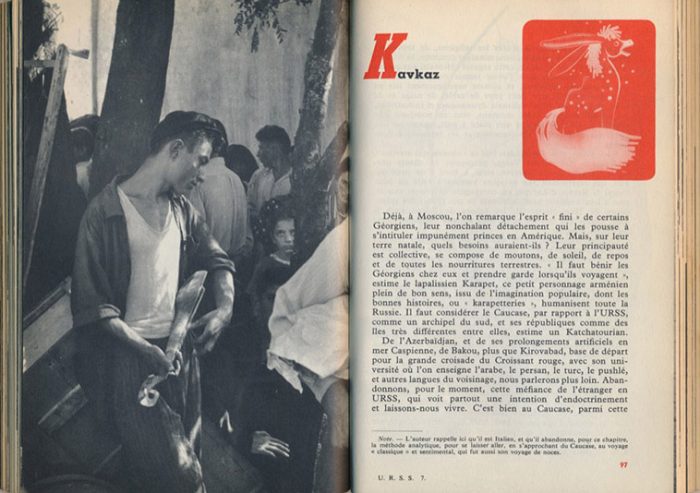
“Apart from the ambition to provide something different from run-of-the-mill guidebooks, histories, or travelers’ tales,” writes Catherine Lupton in Chris Marker: Memories of the Future, “the most innovative aspect of the Petite Planète guides was their lavish use of illustrations, which were displayed not merely as support to the text but in dynamic layouts that established an unprecedented visual and cognitive relay between text and images.” Though Marker contributed some of his own photographs (as did his French New Wave colleague Agnès Varda), his chief creative contribution came in blending these and a variety of “engravings, miniatures, popular graphic illustrations, picture postcards, maps, cartoons, postage stamps, posters, and advertisements” into “a heady and heterogenous mix of high cultural and mass-market scenes,” all arranged with the words in “a manner that engages knowingly and playfully with the parameters of the book.”
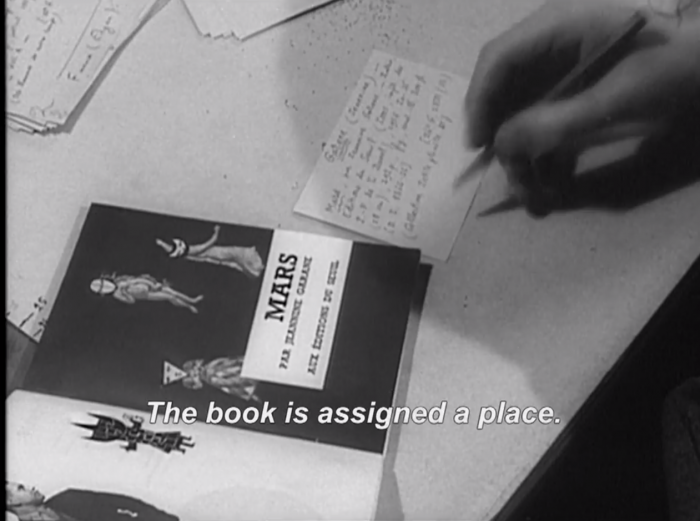
True Marker exegetes will find plenty of connections between Petite Planète and the rest of his oeuvre. Though no cats ever made the covers, plenty of girls did — or rather, plenty of women did, since a local female face fronted every title he oversaw. One of those faces, gazing statue-like from one volume on Japan, will look awfully familiar to anyone who’s seen Le mystère Koumiko, Marker’s documentary on a young lady he met in the street while in Tokyo for the 1964 Olympics. And in Toute la mémoire du monde, Alain Resnais’ short on France’s Bibliothèque Nationale made in collaboration with a certain “Chris and Magic Marker,” we witness the cataloging and shelving of a Petite Planète never written — and one that actually departs from the planet at that.
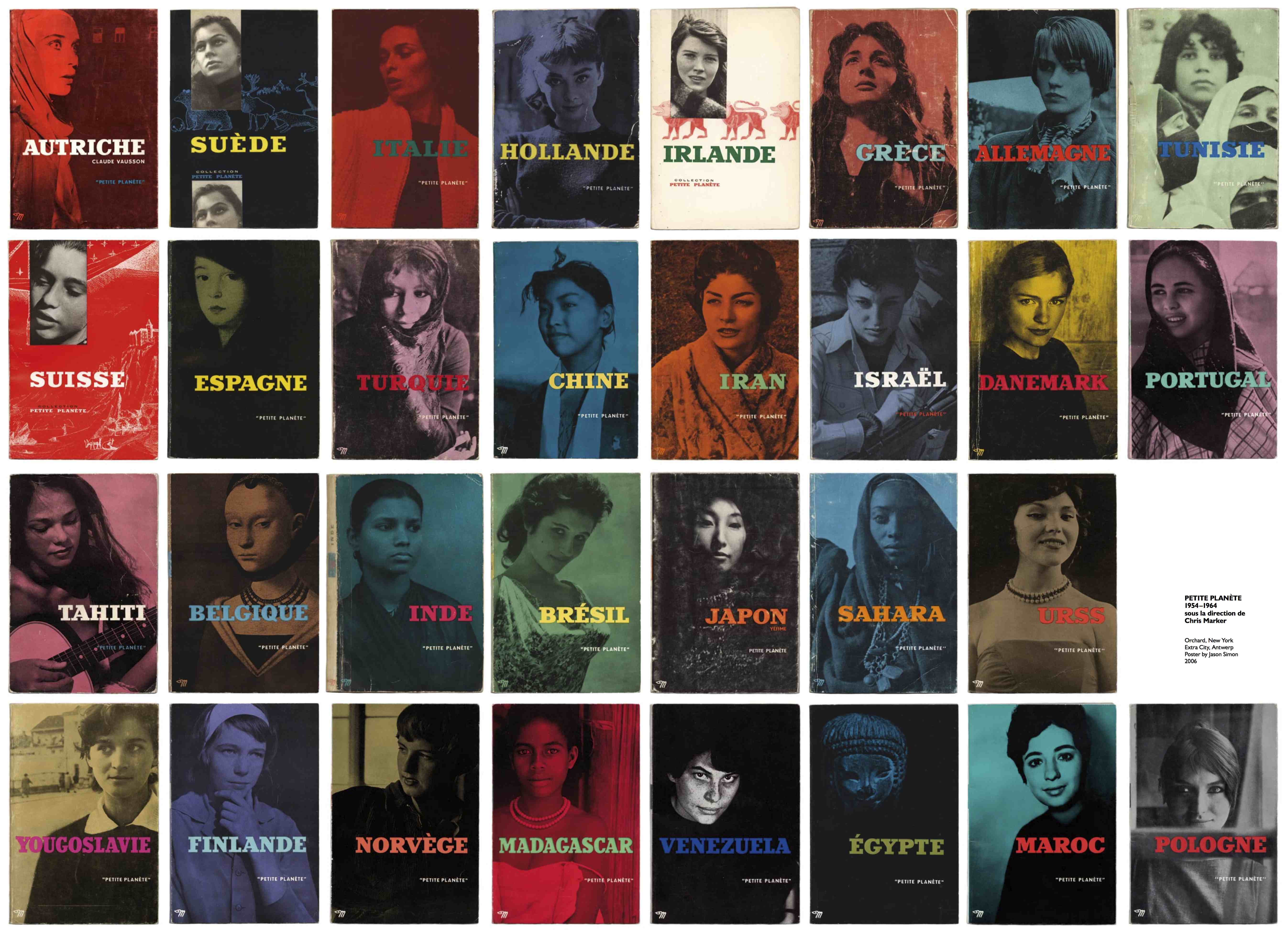
Around the same time, Marker published Coréennes, a highly Markeresque visual travelogue of war-torn North Korea. I recently wrote about its Korean edition for the Los Angeles Review of Books, though the long-out-of-print English version remains hard to come by. The same goes for the Marker-designed Petite Planète books, translations of which London’s Vista Books put out in the 1950s and 60s, and about which Adam Davis at Division Leap has begun a series of posts with a look at Germany. You can examine more of the originals at Let’s Get Lost, Index Grafix, SÜRKRÜT, and this slide show from The Ressiabator. Our hyperconnected era, at a distance of sixty years, places us well to understand the meaning of Marker’s statement on his travel-guide project: “We see the world escape us at the same time as we become more aware of our links with it.”
Related Content:
Vintage 1930s Japanese Posters Artistically Market the Wonders of Travel
Based in Seoul, Colin Marshall writes and broadcasts on cities and culture. He’s at work on a book about Los Angeles, A Los Angeles Primer, the video series The City in Cinema, the crowdfunded journalism project Where Is the City of the Future?, and the Los Angeles Review of Books’ Korea Blog. Follow him on Twitter at @colinmarshall or on Facebook.
Read More...Kurt Vonnegut Gives a Sermon on the Foolishness of Nuclear Arms: It’s Timely Again (Cathedral of St. John the Divine, 1982)
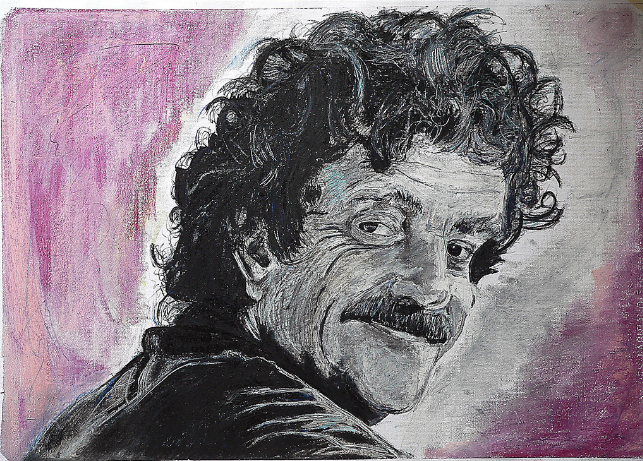
Image by Daniele Prati, via Flickr Commons
Many writers recoil at the notion of discussing where they get their ideas, but Kurt Vonnegut spoke on the subject willingly. “I get my ideas from dreams,” he announced early in one speech, adding, “the wildest dream I have had so far is about The New Yorker magazine.” In this dream, “the magazine has published a three-part essay by Jonathan Schell which proves that life on Earth is about to end. I am supposed to go to the largest Gothic cathedral in the world, where all the people are waiting, and say something wonderful — right before a hydrogen bomb is dropped on the Empire State Building.”
It stands to reason that a such a vivid, frightening, and somehow funny scenario would unfold in the unconscious mind of a man who wrote such vivid, frightening, and somehow funny novels. (Vonnegut’s own interpretation? “I consider myself an important writer, and I think The New Yorker should be ashamed that it has never published me.”) As it happens, he did deliver these words in a cathedral, namely New York City’s Cathedral of St. John the Divine in the spring of 1982.
This was just months after Schell’s three-part essay “The Fate of the Earth” (all three parts of it still available online) really ran in The New Yorker, and Cold War fears about the probability of a hydrogen bomb really dropping on America ran high. Vonnegut’s speech was one of a series of Sunday sermons the Cathedral had lined up on the subject of nuclear disarmament, assembling the rest of the roster from military, scientific, and activist fields. The author of Cat’s Cradle, Slaughterhouse-Five, and Breakfast of Champions—fresh off a trip to the Galapagos Islands with the St. John the Divine’s Bishop Paul Moore—presumably represented the realm of letters.
“At the time, NYPR Archives Director Andy Lanset covered the Vonnegut sermon as a volunteer for the WNYC News Department,” wrote WNYC’s William Rodney Allen in 2014 on the rediscovery and posting of Lanset’s recording. (The same public radio station, incidentally, would fifteen or so years later commission Vonnegut for a series of reports from the afterlife.) Now we can not only read but also hear Vonnegut, in his own voice, trying to imagine aloud a series of “fates worse than death.” Why? Not simply to indulge his famous sense of gallows humor, but in order to put the nuclear threat, and the anxieties it generated, into the proper context.
“I am sure you are sick and tired of hearing how all living things sizzle and pop inside a radioactive fireball,” Vonnegut says, going on to assure his audience that “scientists, for all their creativity, will never discover a method for making people deader than dead. So if some of you are worried about being hydrogen-bombed, you are merely fearing death. There is nothing new in that. If there weren’t any hydrogen bombs, death would still be after you.”
In any event, despite having shuffled through several candidates (“Life without petroleum?”), Vonnegut can come up with no fate believably worse than death besides crucifixion. But given that non-crucified human beings nearly always and everywhere prefer life to death, perhaps “we might pray to be rescued from our inventiveness” which gave us the ability to destroy all life on Earth. But “the inventiveness which we so regret now may also be giving us, along with the rockets and warheads, the means to achieve what has hitherto been an impossibility, the unity of mankind.”
Vonnegut sees this promise mainly in television, whose terribly realistic sounds and images ensure that “the people of every industrialized nation are nauseated by war by the time they are ten years old.” A veteran of the Second World War, he himself remembers a very different time, back when “it used to be necessary for a young soldier to get into fighting before he became disillusioned about war,” back when “it was unusual for an American, or a person of any nationality, for that matter, to know much about foreigners.”
Even before the 1980s, “thanks to modern communications, we have seen sights and heard sounds from virtually every square mile of the land mass on this planet,” and so “know for certain that there are no potential human enemies anywhere who are anything but human beings almost exactly like ourselves. They need food. How amazing. They love their children. How amazing. They obey their leaders. How amazing. They think like their neighbors. How amazing.”
Modern communications have, of course, come astonishingly far in the 35 years since Vonnegut’s Sunday sermon, but our fears about nuclear annihilation have had a way of resurfacing. In recent months, the American people have even heard talk of a reinvigorated nuclear arms race from their new president, a man whose rise detractors partly blame on modern communication technology — not a lack of it, but an excess.
“The global village that was once the internet has been replaced by digital islands of isolation that are drifting further apart each day,” writes Mostafa M. El-Bermawy in a Wired piece on the threat social-media “filter bubbles” pose to democracy. “We need to remind ourselves that there are humans on the other side of the screen who want to be heard and can think and feel like us while at the same time reaching different conclusions.” Recent developments would probably disappoint Vonnegut (not that they would surprise him), but he’d surely get a kick, as he always did, out of the irony of it all.
Related Content:
Kurt Vonnegut: Where Do I Get My Ideas From? My Disgust with Civilization
In 1988, Kurt Vonnegut Writes a Letter to People Living in 2088, Giving 7 Pieces of Advice
22-Year-Old P.O.W. Kurt Vonnegut Writes Home from World War II: “I’ll Be Damned If It Was Worth It”
Based in Seoul, Colin Marshall writes and broadcasts on cities and culture. He’s at work on a book about Los Angeles, A Los Angeles Primer, the video series The City in Cinema, the crowdfunded journalism project Where Is the City of the Future?, and the Los Angeles Review of Books’ Korea Blog. Follow him on Twitter at @colinmarshall or on Facebook.
Read More...W.B. Yeats’ Classic Poem “When You Are Old” Gets Adapted Into a Beautiful Short Film
W.B. Yeats’ 1891 poem “When You Are Old” is widely considered a commentary on his unrequited lifelong passion for actress, Irish Republican and suffragette Maud Gonne.
Yeats first met Gonne in 1889 (a meeting which Yeats was later to describe in his memoirs as the day ‘the troubling of my life began’) and he remained in love with her for much of his life, proposing marriage at least four times. Gonne became his muse, and he drew on his tortured love for her, albeit unnamed, as the inspiration for many of his works, including most notably the poem, “When You Are Old.”
Freely based on a sonnet by Pierre de Ronsard, which first appeared in Le Second Livre Des Sonnets Pour Hélène in 1578, “When You Are Old” enjoins the object of an unreturned love to reflect–in years to come–on a love rejected, to remember one who ‘loved your moments of glad grace’, and who ‘loved the pilgrim soul in you, And loved the sorrows of your changing face.’
Although Yeats’s poetry is often very dense and rich in allusion to mythology, the occult and history, in “When You Are Old” the pain and bittersweet nature of a spurned love is all too apparent.
Australian playwright Jessica Bellamy drew on the poem and her love of W.B. Yeats’ work when writing the theatre monologue “Little Love,” which she then adapted with director Damien Power to create the short film Bat Eyes. Watch it above.
In Bat Eyes, Adam and Jenny (‘Bat Eyes’) Barrett are brought together through an incident of classroom bullying. Through the metaphor of visual impairment and an eye examination undergone by an adult Adam, Bellamy and Power explore the poem’s themes of longing, insight, revelation and regret, and poetry’s capacity to provide solace and awaken empathy in everyday life. The script of this beautiful short film consists principally of the text of the poem, with the film’s two young leads repeating Yeats’ words back and forth to each other, as the story flips back and forth in time, the meaning of the lines becoming more tangible and resonant with each recitation.
Says Jessica Bellamy:
‘Yeats writes about ancient mythology and the history of his time, but you don’t have to understand all that to get the feeling of what he has to say. There are lines, there are moments that, as a reader, you just get and you think: I’m not alone in this world and that someone else has felt these things as well. I hope viewers will hear the truth of what this poem is saying, and that they’ll see the film as an ode to love, relationships and to poetry itself.
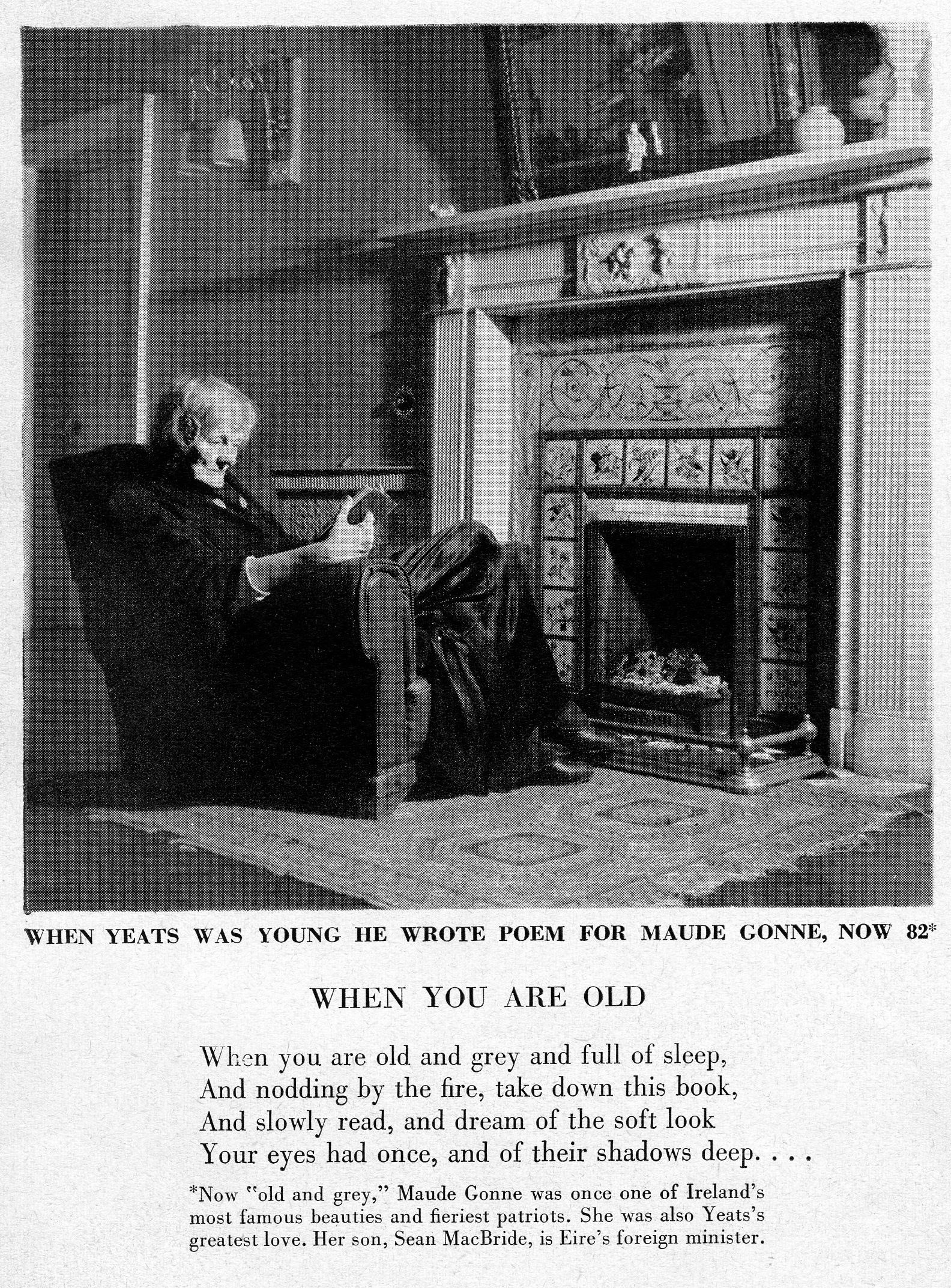
Gonne, who died in 1953, outlived Yeats by 14 years. She was photographed by Life magazine in October 1948, old and grey, sitting by a fire and reading Yeats poetry.
You can watch the original monologue, “Little Love,” here:
And read and listen to the text of “When You Are Old” here. There’s also a version read by Colin Farrell. Find it below.
Dan Prichard is an online film and webseries producer, based in Sydney, whose work explores identity, place, and the space between film and performance in the digital arena. Visit his website here.
Related Content:
Rare 1930s Audio: W.B. Yeats Reads Four of His Poems
Read More...Watch the Dutch Paint “the Largest Mondrian Painting in the World”
Earlier this month, the Dutch unveiled “the largest Mondrian painting in the world.” Above, you can watch the City Hall building in The Hague (sometimes known as “The Ice Palace”) get painted Mondrian-style, with those iconic red, yellow and blue surfaces and straight lines.
It was 100 years ago, in 1917, that the Dutch art movement called “De Stijl” (The Style) took flight. Led by the artists Theo van Doesburg and Piet Mondrian, “De Stijl” embraced, notes The Art Story, “an abstract, pared-down aesthetic centered in basic visual elements such as geometric forms and primary colors.” To mark the centenary of “De Stijl,” the Hague is now staging a celebration, which includes 300 Mondrian works, all brought together for the first time, in an exhibition called “The Discovery of Mondrian.” It runs from 3 June to 24 September.
If you would like to support the mission of Open Culture, consider making a donation to our site. It’s hard to rely 100% on ads, and your contributions will help us continue providing the best free cultural and educational materials to learners everywhere. You can contribute through PayPal, Patreon, and Venmo (@openculture). Thanks!
Related Content:
The Guggenheim Puts Online 1600 Great Works of Modern Art from 575 Artists
Rijksmuseum Digitizes & Makes Free Online 210,000 Works of Art, Masterpieces Included!
Download 100,000 Free Art Images in High-Resolution from The Getty
The National Gallery Makes 25,000 Images of Artwork Freely Available Online
Download 448 Free Art Books from The Metropolitan Museum of Art
Read More...Maya Angelou Reads Her Poem “On the Pulse of Morning” (1993)
The footage above features Maya Angelou reciting her poem “On the Pulse of Morning” at President Bill Clinton’s Inauguration. It was recorded on January 20, 1993. You can read the text of the poem at The Poetry Foundation. Angelou’s reading permanently lives in our collection of 900+ Free Audio Books.
Looking for free, professionally-read audio books from Audible.com? Here’s a great, no-strings-attached deal. If you start a 30 day free trial with Audible.com, you can download two free audio books of your choice. Get more details on the offer here.
Read More...Marcel Proust Plays Air Guitar on a Tennis Racket (1891)
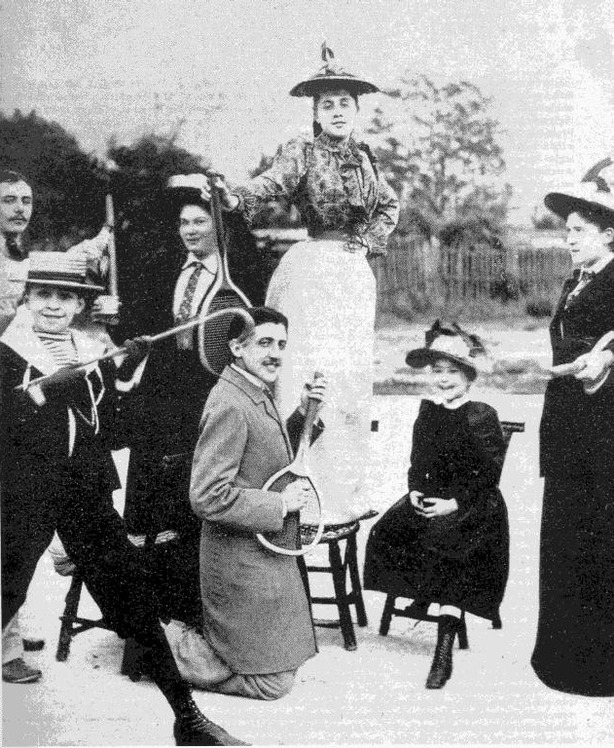
Was “air guitar” a thing back in 1891, when a photographer captured young Marcel Proust in this playful photograph? Probably not. Maybe it’s anachronistic to read the photograph this way. But you have to admit, it’s worth suspending disbelief for a moment and imagining what song Marcel was playing. Any clever guesses?
Related Content:
The First Known Footage of Marcel Proust Discovered: Watch It Online
When James Joyce & Marcel Proust Met in 1922, and Totally Bored Each Other
Marcel Proust Fills Out a Questionnaire in 1890: The Manuscript of the ‘Proust Questionnaire’
Read More...Walt Disney Creates a Frank Animation That Teaches High School Kids All About VD (1973)
The comically plainspoken, tough-guy sergeant is a heaven sent assignment for character actors.
Think R. Lee Ermey in Full Metal Jacket…
Louis Gosset Jr. in An Officer and a Gentleman…
Even Stripes’ Warren Oates.
Keenan Wynn, who strove to keep America safe from “deviated preverts” in 1964’s Dr. Strangelove, was awarded the role of a lifetime nine years later, when Disney Studios was seeking vocal talent for VD Attack Plan, above, a 16-minute animation intended to teach high schoolers about the scourge of venereal disease.
Wynn (son of Ed) threw himself into the part with gusto, imbuing his badly-complected, Kaiser-helmeted germ commander with the sort of straight-talking charisma rarely seen in high school Health class.


A risky maneuver, given that Vietnam-era teens did not share their parent’s generation’s respect for military authority and VD Attack Plan was the first educational short specifically aimed at the high school audience. Prior to that, such films were geared toward soldiers. (Disney waded into those waters in 1944, with the training film, A Few Quick Facts No. 7—Venereal Disease, the same year Mickey Mouse appeared in LOOK magazine, waging war on gonorrhea with sulfa drugs.
Gonorrhea was well represented in the Wynn’s Contagion Corps. The ranks were further swelled by Syphilis. Both platoons were outfitted with paramilitary style berets.
The Sarge pumped them up for the coming sneak attack by urging them to maim or better yet, kill their human enemy. Shaky recruits were reassured that Ignorance, Fear, and Shame would have their backs.
Scriptwriter Bill Bosche had quite the knack for identifying what sort of sugar would make the medicine go down. The Sarge intimates that only a few of the afflicted are “man enough” to inform their partners, and while Ignorance and Shame cause the majority to put their faith in ineffectual folk remedies, the “smart ones” seek treatment.
Elementary psychology, but effectual nonetheless.
Today’s viewers can’t help but note that HIV and AIDS had yet to assert their fearsome hold.
On the other hand, the Sarge’s matter of fact delivery regarding the potential for same sex transmission comes as a pleasant surprise. His primary objective is to set the record straight. No, birth control pills won’t protect you from contracting the clap. But don’t waste time worrying about picking it up from public toilet seats, either.
A word of caution to those planning to watch the film over breakfast, there are some truly gnarly graphic photos of rashes, sores, and skin eruptions. Helpful to teens seeking straight dope on their worrisome symptoms. Less so for anyone trying to enjoy their breakfast links sans the specter of burning urination.
So here’s to the sergeants of the silver screen, and the hardworking actors who embodied them, even those whose creations resembled Pillsbury’s Funny Face drink mix mascots. Let’s do as the Sarge says, and make every day V‑D Day!
VD Attack Plan will be added to the animation section of our collection, 4,000+ Free Movies Online: Great Classics, Indies, Noir, Westerns, Documentaries & More.
Related Content:
Watch Family Planning, Walt Disney’s 1967 Sex Ed Production, Starring Donald Duck
The Story Of Menstruation: Watch Walt Disney’s Sex Ed Film from 1946
Salvador Dalí Creates a Chilling Anti-Venereal Disease Poster During World War II
Ayun Halliday is an author, illustrator, theater maker and Chief Primatologist of the East Village Inky zine. Her play Zamboni Godot is opening in New York City next week. Follow her @AyunHalliday.
Read More...Support Us
We're hoping to rely on loyal readers, rather than erratic ads. Please click the Donate button and support Open Culture. You can use Paypal, Venmo, Patreon, even Crypto! We thank you!

About Us

Open Culture scours the web for the best educational media. We find the free courses and audio books you need, the language lessons & educational videos you want, and plenty of enlightenment in between.
Advertise With Us

FREE UPDATES!
GET OUR DAILY EMAIL
Get the best cultural and educational resources on the web curated for you in a daily email. We never spam. Unsubscribe at any time.
FOLLOW ON SOCIAL MEDIA

Open Culture editor Dan Colman scours the web for the best educational media. He finds the free courses and audio books you need, the language lessons & movies you want, and plenty of enlightenment in between.
Advertise With Us