What Makes a Good Horror Movie? The Answer Revealed with a Journey Through Classic Horror Films Clips
A few minutes with Lewis Bond’s first video essay, “Let’s Discuss Horror,” above, was all it took to scupper my careful avoidance of certain film franchises—Saw, Hostel, The Human Centipede…
Bond’s cinematic preoccupations usually come with far fewer exploding heads. Later entries on his Channel Criswell Youtube channel explore such Criterion Collection-worthy topics as “Colour in Storytelling,” “The French New Wave,” and “Stanley Kubrick.”
Clearly, he cares about the horror genre, as well as the more rarified stuff. He opines that horror movies have lost their capacity to scare. The industry’s quest for ever more transgressive shocks and gore (many of which are on display above) has left viewers desensitized. Bond likens the phenomenon to hitting a brick wall and “trying to break it down by adding more bricks.”
Part of the problem, Bond suggests, is an industry onus to deliver wall-to-wall depravity, the grosser, the better. Torture porn may have cornered a sizable piece of the market, but lack of foreplay is killing the suspense. Slow builds such as Danny Torrence’s endless Big Wheel rides past Room 237 or Rosemary’s uneasy pregnancy are a thing of the past. Today’s filmmakers have the meat hooks out from the get go.
When audiences become inured to the non-stop buffet of bursting entrails and the rotting zombies who feast on them, filmmakers grow even more reliant on jump scares. These pop-go-the-weasel moments invariably get a rise out of me, but Bond, like most horror purists, views them with disdain. Too easy.
“Let’s Discuss Horror” contains a plethora of them, but they seem silly, divorced from the narrative and the requisite scary music.
(Speaking of which, “Tubular Bells” underscores a good portion of Bond’s breezy narration.)
Whenever Bond makes a point with a longer scene from more celebrated fare such as JAWS, Don’t Look Now, or Audition, he includes a clickable link that will deposit viewers on the other side of spoilers. Depending on your saturation point, you may find yourself wishing those links would drop you off in Linus’ pumpkin patch.
Happy Halloween!
Related Content:
The First Horror Film, George Méliès’ The Manor of the Devil (1896)
Watch the Cult Classic Horror Film Carnival of Souls (1962)
Martin Scorsese Names the 11 Scariest Horror Films: Kubrick, Hitchcock, Tourneur & More
Ayun Halliday is an author, illustrator, theater maker and Chief Primatologist of the East Village Inky zine. Her play Zamboni Godot is opening in New York City in March 2017. Follow her @AyunHalliday.
Read More...Isaac Newton’s Recipe for the Mythical ‘Philosopher’s Stone’ Is Being Digitized & Put Online (Along with His Other Alchemy Manuscripts)
In his 1686 Principia Mathematica, Isaac Newton elaborated not only his famous Law of Gravity, but also his Three Laws of Motion, setting a centuries-long trend for scientific three-law sets. Newton’s third law has by far proven his most popular: “every action has an equal and opposite reaction.” In Arthur C. Clarke’s 20th century Three Laws, the third has also attained wide cultural significance. No doubt you’ve heard it: “Any sufficiently advanced technology is indistinguishable from magic.”
Clarke’s third law gets invoked in discussions of the so-called “demarcation problem,” that is, of the boundaries between science and pseudoscience. It also comes up, of course, in science fiction forums, where people refer to Ted Chiang’s succinct interpretation: “If you can mass-produce it, it’s science, and if you can’t, it’s magic.” This makes sense, given the central importance the sciences place on reproducibility. But in Newton’s pre-industrial age, the distinctions between science and magic were much blurrier than they are now.
Newton was an early fellow of the British Royal Society, which codified repeatable experiment and demonstration with their motto, “Nothing in words,” and published the Principia. He later served as the Society’s president for over twenty years. But even as the foremost representative of early modern physics—what Edward Dolnick called “the clockwork universe”—Newton held some very strange religious and magical beliefs that we would point to today as examples of superstition and pseudoscience.
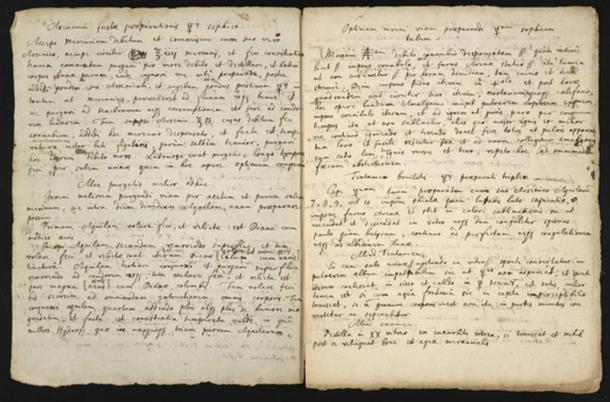
In 1704, for example, the year after he became Royal Society president, Newton used certain esoteric formulae to calculate the end of the world, in keeping with his long-standing study of apocalyptic prophecy. What’s more, the revered mathematician and physicist practiced the medieval art of alchemy, the attempt to turn base metals into gold by means of an occult object called the “Philosopher’s stone.” By Newton’s time, many alchemists believed the stone to be a magical substance composed in part of “sophick mercury.” In the late 1600s, Newton copied out a recipe for such stuff from a text by American-born alchemist George Starkey, writing his own notes on the back of the document.
You can see the “sophick mercury” formula in Newton’s hand at the top. The recipe contains, in part, “Fiery Dragon, some Doves of Diana, and at least seven Eagles of mercury,” notes Michael Greshko at National Geographic. Newton’s alchemical texts detail what has long been “dismissed as mystical pseudoscience full of fanciful, discredited processes.” This is why Cambridge University refused to archive Newton’s alchemical papers in 1888, and why his 1855 biographer wondered how he could be taken in by “the obvious production of a fool and a knave.” Newton’s alchemy documents passed quietly through many private collectors’ hands until 1936, when “the world of Isaac Newton scholarship received a rude shock,” writes Indiana University’s online project, The Chymistry of Isaac Newton:
In that year the venerable auction house of Sotheby’s released a catalogue describing three hundred twenty-nine lots of Newton’s manuscripts, mostly in his own handwriting, of which over a third were filled with content that was undeniably alchemical.
Marked “not to be printed” upon his death in 1727, the alchemical works “raised a host of interesting questions in 1936 as they do even today.” Those questions include whether or not Newton practiced alchemy as an early scientific pursuit or whether he believed in a “secret theological meaning in alchemical texts, which often describe the transmutational secret as a special gift revealed by God to his chosen sons.” The important distinction comes into play in Ted Chiang’s discussion of Clarke’s Third Law:
Suppose someone says she can transform lead into gold. If we can use her technique to build factories that turn lead into gold by the ton, then she’s made an incredible scientific discovery. If on the other hand it’s something that only she can do… then she’s a magician.
Did Newton think of himself as a magician? Or, more properly given his religiosity, as God’s chosen vessel for alchemical transformation? It’s not entirely clear what he believed about alchemy. But he did take the practice of what was then called “chymistry” as seriously as he did his mathematics. James Voelkel, curator of the Chemical Heritage Foundation—who recently purchased the Philosophers’ stone recipe—tells Livescience that its author, Starkey, was “probably American’s first renowned, published scientist,” as well as an alchemist. While Newton may not have tried to make the mercury, he did correct Starkey’s text and write his own experiments for distilling lead ore on the back.
Indiana University science historian William Newman “and other historians,” notes National Geographic, “now view alchemists as thoughtful technicians who labored over their equipment and took copious notes, often encoding their recipes with mythological symbols to protect their hard-won knowledge.” The occult weirdness of alchemy, and the strange pseudonyms its practitioners adopted, often constituted a means to “hide their methods from the unlearned and ‘unworthy,’” writes Danny Lewis at Smithsonian. Like his fellow alchemists, Newton “diligently documented his lab techniques” and kept a careful record of his reading.
“Alchemists were the first to realize that compounds could be broken down into their constituent parts and then recombined,” says Newman, a principle that influenced Newton’s work on optics. It is now acknowledged that—while still considered a mystical pseudoscience—alchemy is an important “precursor to modern chemistry” and, indeed, as Indiana University notes, it contributed significantly to early modern pharmacology” and “iatrochemistry… one of the important new fields of early modern science.” The sufficiently advanced technology of chemistry has its origins in the magic of “chymistry,” and Newton was “involved in all three of chymistry’s major branches in varying degrees.”
Newton’s alchemical manuscript papers, such as “Artephius his secret Book” and “Hermes” sound nothing like what we would expect of the discoverer of a “clockwork universe.” You can read transcriptions of these manuscripts and several dozen more at The Chymistry of Isaac Newton, where you’ll also find an Alchemical Glossary, Symbol Guide, several educational resources, and more. The manuscripts not only show Newton’s alchemy pursuits, but also his correspondence with other early modern alchemical scientists like Robert Boyle and Starkey, whose recipe—titled “Preparation of the [Socphick] Mercury for the [Philosophers’] stone by the Antinomial Stellate Regulus of Mars and Luna from the Manuscripts of the American Philosopher”—will be added to the Indiana University online archive soon.
Related Content:
In 1704, Isaac Newton Predicts the World Will End in 2060
Sir Isaac Newton’s Papers & Annotated Principia Go Digital
Isaac Newton Creates a List of His 57 Sins (Circa 1662)
Josh Jones is a writer and musician based in Durham, NC. Follow him at @jdmagness
Read More...The 14-Hour Epic Film, Dune, That Alejandro Jodorowsky, Pink Floyd, Salvador Dalí, Moebius, Orson Welles & Mick Jagger Never Made
Frank Herbert, David Lynch, and Alejandro Jodorowsky surely all rank among the most imaginative creators of the second half of the twentieth century. It made sense to film producers to turn Herbert’s Dune into a movie, but they had a devil of a time finding the right director to bring that epic novel of the feudal interstellar future to the screen. Lynch, as all his fans know and most regret, wound up with the job, and soon after the botched result hit theaters in 1984, it made history as one of the all-time classic mismatches between filmmaker and project, and at $40 million, one of the most expensive. Lesson learned: don’t hire the director of Eraserhead to helm your big-budget sci-fi blockbuster.
But what about the director of the even stranger and more ambitious The Holy Mountain? In 1975, almost a decade before Lynch’s Dune, Jodorowsky announced his own adaptation of Dune, funded by a French consortium and made in collaboration with artists like Chris Foss, H.R. Giger, and Moebius, writer and special effects designer Dan O’Bannon (who’d just made the low-budget space comedy Dark Star with John Carpenter), and actors like Orson Welles, Gloria Swanson, and David Carradine.
He also cast such icons not known primarily for acting as Mick Jagger and Salvador Dalí. “Jodorowsky’s midnight audiences were notorious for being high,” writes The Hollywood Reporter’s Chris O’Falt, “but with Dune the director set out to make a film that fabricated the effects of LSD for a sober audience, complete with a soundtrack by Pink Floyd.”
Or as Dalí once declared, “I don’t do drugs. I am drugs.” This cinematic experience of expanded consciousness would have run approximately fourteen hours, as Herbert discovered when he checked in on the pre-production to find $2 million of the film’s $9.5 million budget already spent and a script “the size of a phone book.” Unable to find a studio to bankroll the Dune he and his collaborators had envisioned, Jodorowsky ultimately dropped the project, but its materials — and the staggering breadth as well as depth of its vision — provided the basis for the 2014 documentary Jodorowsky’s Dune, whose trailer you can watch above.
“Almost all the battles were won, but the war was lost,“Jodorowsky writes in an essay on his experience with the project. “The project was sabotaged in Hollywood. It was French and not American. Its message was not ‘enough Hollywood.’ There were intrigues, plundering. The story-board circulated among all the large studios. Later, the visual aspect of Star Wars resembled our style. To make Alien, they invited Moebius, Foss, Giger, O’Bannon, etc.,” to say nothing of its traces visible in Blade Runner and The Matrix. While the 87-year-old Jodorowsky has made a return to filmmaking in recent years, his Dune will most likely remain on the lists of the greatest movies never made. But its influence, if not its scale, will no doubt continue to manifest in generations of sci-fi cinema to come.
Related Content:
Moebius’ Storyboards & Concept Art for Jodorowsky’s Dune
The Glossary Universal Studios Gave Out to the First Audiences of David Lynch’s Dune (1984)
Napoleon: The Greatest Movie Stanley Kubrick Never Made
Based in Seoul, Colin Marshall writes and broadcasts on cities and culture. He’s at work on a book about Los Angeles, A Los Angeles Primer, the video series The City in Cinema, the crowdfunded journalism project Where Is the City of the Future?, and the Los Angeles Review of Books’ Korea Blog. Follow him on Twitter at @colinmarshall or on Facebook.
Read More...Huge Archive of American Films–From Casablanca to Gigli–Are Protected & Preserved in a Nuclear Bunker
We’ve been given to understand how important it is that our top elected officials disappear into bunkers if the country is attacked. But in the event of a catastrophic nuclear bombing, what happens to the country’s culture, its shared literary and artistic artifacts? What happens to novels like Riddley Walker (a favorite of Anthony Burgess) or films like the Mad Max series, both of which describe post-apocalyptic landscapes nearly wiped clean of the traces of hundreds of years of human civilization? Maybe it’s a depressing question, but in the case of American cinema—as campy as Mad Max Beyond Thunderdome or as classically smooth as Casablanca—learning the answer will not bum you out.
You’ll likely find yourself riveted by the video above from Great Big Story, a quick tour of the Library of Congress’ Packard Campus. The Culpeper, Virginia compound, originally designed to preserve gold and maybe the President, is now pressed into service as a bomb-proof film archive.
You may be relieved to learn from film archivist George Willeman that a post-catastrophe U.S. will not have to rebuild without classic Bogart performances to draw from. Perhaps that new society could do without copies of Gigli or the films of Adam Sandler, but that’s an opinion the future is free to disregard, should such terrible things ever come to pass.
But be not bummed, the Packard Campus does much more than prepare for the worst. Archivists and technicians there spend their days saving the best of film history, “preserving and restoring film reels,” reports Indiewire: “The bunker has a suite where technicians do nothing but repair films, it also has specialized rooms for printing, film processing DataCine transfers and cylinder recording. There are also video players that can play any sort of format that they need.” The compound will also hold particular appeal for fans of Brutalist architecture that appears to be abandoned to the elements. Having driven by the bunker many times—and only recently learning what it was—I can testify to the imposing bulk and seeming ruination of its above-ground floors, which we only get a glimpse of in the first few minutes of the video. Inside, it’s a film historian and archivist’s dream.
For more films that would hopefully survive an apocalypse, see our collection: 4,000+ Free Movies Online: Great Classics, Indies, Noir, Westerns, Documentaries & More
via Indiewire
Related Content:
The History of Stop-Motion Films: 39 Films, Spanning 116 Years, Revisited in a 3‑Minute Video
Free: British Pathé Puts Over 85,000 Historical Films on YouTube
Josh Jones is a writer and musician based in Durham, NC. Follow him at @jdmagness
Read More...Hear Marilyn Monroe’s Acting Teacher, Lee Strasberg, Deliver a Moving Eulogy at Her Funeral (1962)
Goodbye, Norma Jean…
Marilyn Monroe’s stardom is truly legendary. Her image generates millions of dollars annually. From high-end memorabilia to lunchboxes, fridge magnets, and other cheap trinkets, the world still can’t get enough of her, nearly fifty-five years after her death.
Her acting talent was considerable, but by and large that is not what she’s celebrated for. Speaking at her funeral, her mentor Lee Strasberg, the Artistic Director of the Actors Studio, lamented that “the public who loved her did not have the opportunity to see her as we did, in many of the roles that foreshadowed what she would have become.” In his opinion, the movie star’s true destiny pegged her to become “one of the finest American stage actresses of all time.”
Actor Martin Landau remembered Monroe steeling herself to get up in front of her Actors Studio classmates for the first time, in a scene from Eugene O’Neill’s Anna Christie with Maureen Stapleton.
Alas, this is not the sort of Monroe moment posterity preserves on a beach tote or sequined t‑shirt.
Strasberg’s moving 1962 eulogy, above, acknowledged both the 31 intimates invited to her final send off, and the crowds outside the gate. Frank Sinatra, Ella Fitzgerald, and Sammy Davis, Jr. were among the luminaries denied entry. Monroe’s former husband, baseball great Joe DiMaggio banned a whole pantheon of Hollywood movers and shakers, along with the public.
“If it wasn’t for them, she’d still be here,” he told her lawyer, Mickey Rudin.
Studio execs had little regard for the actress’ wellbeing, but Strasberg was both teacher and father figure, allowing her beyond the usual professional boundaries to become a de facto, if problematic, member of the family. As his daughter, Monroe’s friend, actress Susan Strasberg wrote:
Marilyn broke all the rules I was expected to follow. She was unpredictable, but he didn’t yell at her. He constantly validated her. With her, Pop was vulnerable, paternal, permissive. With me he was impersonal, critical, forbidding. What was I doing wrong? Why didn’t he give me permission to be myself as he did her?”
DiMaggio had originally hoped that poet Carl Sandburg might be available to orate at Monroe’s funeral. When Sandburg declined due to ill health, the sad duty fell to Strasberg, who turned out to be uniquely prepared to fulfill this role.
The complete text of Lee Strasberg’s eulogy for Marilyn Monroe is below, as is a short documentary on her involvement with the Actors Studio.
Marilyn Monroe was a legend.
In her own lifetime she created a myth of what a poor girl from a deprived background could attain. For the entire world she became a symbol of the eternal feminine.
But I have no words to describe the myth and the legend. I did not know this Marilyn Monroe. We gathered here today, knew only Marilyn – a warm human being, impulsive and shy, sensitive and in fear of rejection, yet ever avid for life and reaching out for fulfillment. I will not insult the privacy of your memory of her – a privacy she sought and treasured – by trying to describe her whom you knew to you who knew her. In our memories of her she remains alive, not only a shadow on the screen or a glamorous personality.
For us Marilyn was a devoted and loyal friend, a colleague constantly reaching for perfection. We shared her pain and difficulties and some of her joys. She was a member of our family. It is difficult to accept the fact that her zest for life has been ended by this dreadful accident.
Despite the heights and brilliance she attained on the screen, she was planning for the future; she was looking forward to participating in the many exciting things which she planned. In her eyes and in mine her career was just beginning.
The dream of her talent, which she had nurtured as a child, was not a mirage. When she first came to me I was amazed at the startling sensitivity which she possessed and which had remained fresh and undimmed, struggling to express itself despite the life to which she had been subjected.
Others were as physically beautiful as she was, but there was obviously something more in her, something that people saw and recognized in her performances and with which they identified. She had a luminous quality – a combination of wistfulness, radiance, yearning – to set her apart and yet make everyone wish to be a part of it, to share in the childish naïveté which was so shy and yet so vibrant.
This quality was even more evident when she was in the stage. I am truly sorry that the public who loved her did not have the opportunity to see her as we did, in many of the roles that foreshadowed what she would have become. Without a doubt she would have been one of the really great actresses of the stage.
Now it is at an end. I hope her death will stir sympathy and understanding for a sensitive artist and a woman who brought joy and pleasure to the world.
I cannot say goodbye. Marilyn never liked goodbyes, but in the peculiar way she had of turning things around so that they faced reality – I will say au revoir. For the country to which she has gone, we must all someday visit.
Related Content:
Marilyn Monroe Recounts Her Harrowing Experience in a Psychiatric Ward in a 1961 Letter
A Look Inside Marilyn Monroe’s Personal Library
Marilyn Monroe Explains Relativity to Albert Einstein (in a Nicolas Roeg Movie)
Ayun Halliday is an author, illustrator, theater maker and Chief Primatologist of the East Village Inky zine. Her play Zamboni Godot is opening in New York City in March 2017. Follow her @AyunHalliday.
Read More...Hear Marshall McLuhan’s The Medium is the Massage (1967)
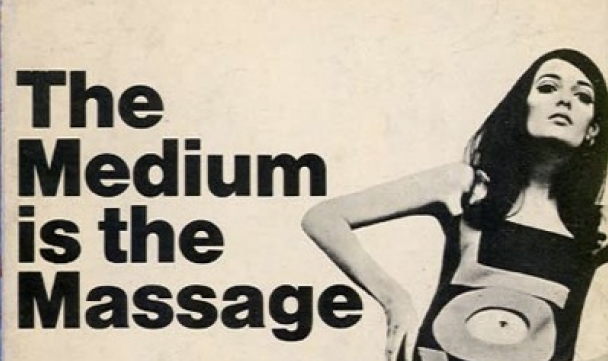
Image via Wikimedia Commons
Briefly noted: In 1967, Marshall McLuhan teamed up with graphic designer Quentin Fiore to write The Medium is the Massage, a short 160-page book that offers a condensed, effective presentation of his ideas on the nature of media, communication and technology. The book was soon accompanied by an album bearing the same name, which Wikipedia describes like this:
An audio recording based on the book was made by Columbia Records in the late 1960s, produced by John Simon but otherwise keeping the same credits as the book. The recording consists of a pastiche of statements made by McLuhan interrupted by other speakers, including people speaking in various phonations and falsettos, discordant sounds and 1960s incidental music in what could be considered a deliberate attempt to translate the disconnected images seen on TV into an audio format, resulting in the prevention of a connected stream of conscious thought. Various audio recording techniques and statements are used to illustrate the relationship between spoken, literary speech and the characteristics of electronic audio media. McLuhan biographer Philip Marchand called the recording “the 1967 equivalent of a McLuhan video.
One reviewer on Amazon describes it as “more of a performance piece than a treatise.” And thanks to Spotify, you can hear it below, in full. Also find it on YouTube.
The Medium is the Massage–yes, it was originally spelled that way–will be added to our list: 1,000 Free Audio Books: Download Great Books for Free
Related Content:
Marshall McLuhan on the Stupidest Debate in the History of Debating (1976)
The Visionary Thought of Marshall McLuhan, Introduced and Demystified by Tom Wolfe
McLuhan Said “The Medium Is The Message”; Two Pieces Of Media Decode the Famous Phrase
Read More...What Does Jorge Luis Borges’ “Library of Babel” Look Like? An Accurate Illustration Created with 3D Modeling Software

Sketchup renderings of the Library of Babel. Images courtesy of Jamie Zawinski.
Fulfilling the maxim “write what you know,” Argentine fabulist Jorge Luis Borges penned one of his most extraordinary and bewildering stories, “The Library of Babel,” while employed as an assistant librarian. Borges, it has been noted—by Borges himself in his 1970 New Yorker essay “Autobiographical Notes”—found the work dreary and unfulfilling: “nine years of solid unhappiness,” as he put it plainly. “Sometimes in the evening, as I walked the ten blocks to the tramline, my eyes would be filled with tears.”

And yet, for all of its tedium, his library position suited his needs as a writer like none other could. “I would do all my library work in the first hour,” he remembers, “and then steal away to the basement and pass the other five hours in reading or writing.” During those stolen hours, Borges dreamed up a library the size of the universe, “composed of an indefinite and perhaps infinite number of hexagonal galleries, with vast air shafts between, surrounded by very low railings.” Like so many of the objects and places in Borges’ stories, this fantastic structure, Escher-like, is both vividly described and impossible to imagine.

Many have tried their hand at visually rendering the Library of Babel, but according to programmer Jamie Zawinski, “past attempts,” writes Carey Dunne at Hyperallergic, “aren’t faithful to the text,” omitting crucial structures like the “sleep chamber, lavatory, and hallway” and screwing up “the placement of the spiral stairway.” You can see Zawinski’s various critiques of these supposed failures on his blog, JWZ. And you may wonder how it’s even possible to construct an accurate model of a structure that may have no finite boundaries and whose internal architecture the story itself calls into question. Nonetheless, Zawinski has boldly given it a try.

Using the 3D modeling program Sketchup, he has designed what he believes to be a model superior to the rest, though he admits “I don’t think this is quite right either.” If you’re wondering “Why is he doing this?” Zawinski writes, “you and I have that in common.” The Borgesian task, like that of the librarian, is an endless one, pursued with scholastic rigor for its own sake rather than for some great reward. And once one enters the labyrinth of his twisting designs, there may be no way out but eternally through. “The possibility of a man’s finding his Vindication,” writes Borges wearily of certain librarians’ attempts to solve the library’s riddles, “or some treacherous variation thereof, can be computed as zero.”

So Zawinski trudges on. His “wrestling with the details of his rendering,” writes Dunne, “his obsessive analysis of the wording of Borges’ description, recalls the library inhabitants’ futile quests to decipher the mysteries of the library.” The programmer’s admirable attention to the physics of the space may at times sound like a rather leaden way to approach what is essentially an elaborate metaphor: “I can’t help but think about the weight and pressure of a column of air that high,” he muses in his initial explorations, “and what is it sitting on, and how to route the plumbing from all of those toilets, and that toilets imply digestion, so where does the food come from?”
Such questions take him far afield of Borges’ theo-philosophical parable: “Is there a section of the library devoted to farming, and metallurgy?” Nonetheless, Zawinski’s detailed analysis has produced a visualization of the space like none other, and he admits to “overthinking a sub-infinite but nearly boundless hill of beans.” Borges’ imaginary librarian has abandoned trying to solve the library’s mysteries. Humbled by the failures of those who came before him, he persists in the “elegant hope” that the library “is unlimited and cyclical… repeated in the same disorder… which, thus repeated, would be an order: the Order.” He wisely leaves the ultimate metaphysical discovery, however, to “an eternal traveler” with infinite time on their hands.
You can view Zawinski’s commentary here, and see his designs here. On the bottom of this page, he lets you download his Sketchup file.
via Hyperallergic
Related Content:
Jorge Luis Borges Selects 74 Books for Your Personal Library
Jorge Luis Borges’ Favorite Short Stories (Read 7 Free Online)
Josh Jones is a writer and musician based in Durham, NC. Follow him at @jdmagness
Read More...The 20 CDs Curated by Steve Jobs and Placed on Prototype iPods (2001)
On October 23, 2001, almost exactly 15 years ago, Steve Jobs introduced the very first iPod–an mp3 player, capable of “putting 1,000 songs in your pocket” and playing cd-quality music. A novel concept back then. A product we take for granted today.
Above, you can watch Jobs make the first iPod pitch. And below find a list of the 20 cds that came loaded onto iPod prototypes given to journalists attending the launch event. What better way for them to demo the gadget?
The list comes from Nobuyuki Hayashi, a Japanese reporter, who was there that day. If you know something about Jobs’ musical tastes, you’ll see that he had a strong hand in the curation:
- Classic Yo-Yo by Yo-Yo Ma
- Mozart:Symphonies Nos.35–41 by Karl Böhm
- Goldberg Variations by Glenn Gould
- Bridge Over Troubled Water by Simon & Garfunkel
- Bookends by Simon & Garfunkel
- The Bootleg Series, Vol. 4: Live 1966 — The “Royal Albert Hall” Concert by Bob Dylan
- A Hard Day’s Night by The Beatles
- Abbey Road by The Beatles
- Live In Cook County Jail by B.B. King
- The Cole Porter Songbook, Vol 1 by Ella Fitzgerald
- Kind of Blue by Miles Davis
- Time Out by The Dave Brubeck Quartet
- Jagged Little Pill by Alanis Morissette
- Surfacing by Sarah McLachlan
- Never mind by Nirvana
- Bob Marley & The Wailers by Legend
- Breathe by Faith Hill
- Crash by Dave Matthews Band
- Play & Play: B Sides by Moby
- O Brother, Where Art Thou? (Music from the Motion Picture)
h/t Eli
Related Content:
Conformity Isn’t a Recipe for Excellence: Wisdom from George Carlin & Steve Jobs (NSFW)
Steve Jobs on Life: “Stay Hungry, Stay Foolish”
Read More...Green Day Fan Joins Band On Stage, Takes Over on Guitar, and Acts Like He’s Been There Many Times Before
At a Green Day concert in Chicago, a fan held up a sign, “I can play every song on Dookie.” So Billie Joe Armstrong let him pop on stage to play “When I Come Around.” And the fan didn’t disappoint, from the moment he climbed on the amp and kicked things off, to his stage dive back into the crowd. The footage was recorded on October 23rd. Enjoy.
h/t Robin — via SFGate
Related Content:
Keith Moon, Drummer of The Who, Passes Out at 1973 Concert; 19-Year-Old Fan Takes Over
Blind Guitarist Lives Out Dream at U2 Show
A Paul Simon Feelin’-Very-Groovy Moment
Read More...What Happens When Blade Runner & A Scanner Darkly Get Remade with an Artificial Neural Network
Philip K. Dick, titling the 1968 novel that would provide the basis for Blade Runner, asked whether androids dream of electric sheep. But what goes on in the “mind” of an artificial intelligence designed specifically to watch movies? Terence Broad, a computing researcher at Goldsmiths, University of London, took on a form of that question for his master’s dissertation, using “artificial neural networks to reconstruct films — by training them to reconstruct individual frames from films, and then getting them to reconstruct every frame in a given film and resequencing it.”
“Neural networks” sounds like a term straight out of one of Dick’s influential science-fiction novels, but you’ve almost certainly heard quite a bit about them in recent years of real life. A neural network, in the words of neurocomputer pioneer Dr. Robert Hecht-Nielsen, “is a computing system made up of a number of simple, highly interconnected processing elements, which process information by their dynamic state response to external inputs.” These systems, in other words, imitate the problem-solving methods of the human brain as we currently understand them, and can, when provided with suitable data, “learn” from it.
One thinks less of the Replicants, Blade Runner’s lethally engineered superhumans, than of Number 5, the artificially intelligent robot star of Short Circuit (co-designed, incidentally, by Blade Runner’s “visual futurist” Syd Mead), with his constant demands for “input.” When it came out in the mid-1980s, that goofy comedy once looked like by far the more successful film, but over the intervening three decades Ridley Scott’s one-time bomb has become perhaps the most respected work of its kind. “The first ever film remade by a neural network had to be Blade Runner,” Terence Broad told Vox, pointing in his explanation of his project to the movie’s prescient treatment of the theme “that the task of determining what is and isn’t human is becoming increasingly difficult, with the ever-increasing technological developments.”
Dick, as his generations of readers know, had deep concerns about the difference between the real and the unreal, and how human beings can ever tell one from the other. He tackled that issue again, from a very different angle, in his 1977 novel A Scanner Darkly. Richard Linklater turned that book into a movie almost thirty years later, one which Broad also fed as input into his neural network, which then attempted to reconstruct it. Though still thematically appropriate, its colorful rotoscoped animation posed more of a challenge, and “the results are less temporally coherent than the Blade Runner model.” But “on the other hand, the images are incredibly unusual and complex, once again producing video with a rich unpredictability.”
At the top of the post, you can watch Broad’s Blade Runner-trained neural network reconstruct Blade Runner’s trailer, and below that his A Scanner Darkly-trained neural network reconstruct A Scanner Darkly’s trailer. Curiosity demanded, of course, that Broad let a neural network trained to watch one film have a go at reconstructing the other, and just above we have the A Scanner Darkly-trained neural network’s reconstruction of Blade Runner. He’s also given Scott’s famous 1984-themed Super Bowl Apple ad and Godfrey Reggio’s Koyaanisqatsi the neural-network treatment. We read so often, these days, about artificial intelligence’s growing ability to out-think, out-work, and one day even out-create us. What on Earth, the Philip K. Dicks of our day must wonder, will the neural networks come up with when they can finally out-watch us?
Related Content:
Watch an Animated Version of Ridley Scott’s Blade Runner Made of 12,597 Watercolor Paintings
Artificial Intelligence Program Tries to Write a Beatles Song: Listen to “Daddy’s Car”
Based in Seoul, Colin Marshall writes and broadcasts on cities and culture. He’s at work on a book about Los Angeles, A Los Angeles Primer, the video series The City in Cinema, the crowdfunded journalism project Where Is the City of the Future?, and the Los Angeles Review of Books’ Korea Blog. Follow him on Twitter at @colinmarshall or on Facebook.
Read More...Support Us
We're hoping to rely on loyal readers, rather than erratic ads. Please click the Donate button and support Open Culture. You can use Paypal, Venmo, Patreon, even Crypto! We thank you!

About Us

Open Culture scours the web for the best educational media. We find the free courses and audio books you need, the language lessons & educational videos you want, and plenty of enlightenment in between.
Advertise With Us

FREE UPDATES!
GET OUR DAILY EMAIL
Get the best cultural and educational resources on the web curated for you in a daily email. We never spam. Unsubscribe at any time.
FOLLOW ON SOCIAL MEDIA

Open Culture editor Dan Colman scours the web for the best educational media. He finds the free courses and audio books you need, the language lessons & movies you want, and plenty of enlightenment in between.
Advertise With Us


