Sal Khan & the Muppets’ Grover Explain the Electoral College
Grover, the more intellectually-aspirant of Sesame Street’s two blue monsters, is a self-appointed expert on anatomy (“the head is covered with this long stringy stuff”), hygiene, and Spanish, but the workings of the United States Electoral College eluded him, until Salman Khan, founder of the Khan Academy wandered into the frame.
The pairing’s not as odd as you might think. The Khan Academy’s mission is in many ways quite similar to that of Sesame Street—free education for the people, distributed on a global scale. Both are non-profit. The Khan Academy uses whiteboard screencasting where Sesame Street uses Muppets, but the goal is the same.
The energetic and highly distractible Grover would be a challenging pupil in any setting. Khan, whose teacher-student interactions are rarely so face-to-face, handles him like a pro, wisely paring down a standard issue Khan Academy lesson on the Electoral College to an easily digestible three-and-a-half minutes.
The takeaway?
The United States is an indirect democracy.
Each state awards its electoral votes to the candidate who wins the popular vote in that state.
The number of electoral votes in any given state is equal to its number of congresspeople plus its two Senators.
There are a total of 538 electoral votes. In order to win the presidential election, a candidate must win at least 270 of those votes.
Simple enough, but this measured explanation does not compute with Grover.
So Khan employs an educational Ninja technique. “How can I explain it in a way that you might understand?” he asks.
It turns out Grover is something of a visual learner, who’s not at all shy about the workings of his own personal brain. He’s probably not ready for 8th grade algebra, but the Khan Academy substitution method provides a watershed moment, when Khan replaces electoral votes with chickens.
(If your fragile grasp of the Electoral College process would be muddled by the introduction of chickens, stop watching at the two minute mark. As the proliferating comments on the Khan Academy’s fifth American Civics lesson prove, sometimes the simple approach creates more questions than it answers.)
Related Content:
Free Online Political Science Courses
Morgan Freeman Teaches Kids to Read in Vintage Electric Company Footage from 1971
Election 2012: Your Free Ticket to a Popular Stanford Course
Ayun Halliday is an author, illustrator, theater maker and Chief Primatologist of the East Village Inky zine. Her play Zamboni Godot is opening in New York City in March 2017. Follow her @AyunHalliday.
Read More...The Graceful Movements of Kung Fu & Modern Dance Revealed in Stunning Motion Visualizations
When I first saw what was then the height of motion capture in 1999—The Matrix’s “bullet time” and kung fu sequences—I was suitably impressed, and yet… the extreme manipulation of the real (which couldn’t have happened in a more appropriate film, granted) also seemed a little like a cheat. In the days before computers rendered 99% of special effects, part of the fun of watching an effects film was spotting the seams. The short “Kung Fu Visualization” above, from German digital artist Tobias Gremmler, deftly combines both of these aesthetic inclinations—the love of artifice and the awe of liquid-smooth digital motion—in rustling, swirling, shimmering animated art that paradoxically shows us the seams of fluid movement.
Recalling Marcel Duchamp’s famous nude or the dynamic sculpture of Umberto Boccioni, Gremmler animates these modernist dreams using graceful motions captured from two Kung Fu masters. Each sinuous martial arts routine is rendered with a different material texture, with accompanying sound effects and dramatic music. “Visualizing the invisible is always fascinating,” writes Gremmler, “and motion visualizations have been created even in pre-digital times with light, photography, costumes or paintings.” (Norman McLaren’s 1968 “Pas de deux” offers a striking historical example.) Gremmler’s stunning animation was commissioned for a Hong Kong Kung Fu exhibition and “focuses on the legacy of Hakka martial arts in Hong Kong.”
Gremmler’s film may show us process in motion, but he remains coy about his own technological means (unless, presumably, you buy his book.) Another motion capture masterpiece, “Asphyxia,” above, uses humble, yet highly advanced methods unimaginable in 1999, “two inexpensive Xbox One Kinect sensors,” writes This is Colossal, “to capture the movements of dancer Shiho Tanaka.” Filmmakers Maria Takeuchi and Frederico Phillips then “rendered the data inside a near photo-realistic environment,” making creative use of lower-res tics and glitches. Combined with a lovely electronic score from Takeuchi, the resulting video’s visual poetry is impossible to adequately convey in words.
What “Asphyxia” does show us is a scaling back of technical wizardry that reveals a deep level of gestural sophistication underneath. “The project,” write the filmmakers, “is an effort to explore new ways to use and/or combine technologies… without many of the commercial limitations. The performance is centered in an eloquent choreography that stresses the desire to be expressive without bounds.” Although “Asphyxia” is obviously a lower-quality—digitally speaking—work than Gremmler’s Kung Fu Visualization, it is none the worse for it. Both use motion capture technology in innovative ways that foreground the artistry, rather than the mimicry, of digital animation. (Somewhat like the much-praised digital stop-motion Kubo and the Two Strings.) If you want to see how the makers of “Asphyxia” created their experiment, watch their making-of film below.
Related Content:
Software Used by Hayao Miyazaki’s Animation Studio Becomes Open Source & Free to Download
13 Van Gogh’s Paintings Painstakingly Brought to Life with 3D Animation & Visual Mapping
Take a Free Online Course on Making Animations from Pixar & Khan Academy
Josh Jones is a writer and musician based in Durham, NC. Follow him at @jdmagness
Read More...215 Hours of Free Foreign Language Lessons on Spotify: French, Chinese, German, Russian & More

In September, we highlighted for you 75 free audio books available on Spotify–books written by the likes of Jane Austen, James Joyce, Charles Bukowski, Franz Kafka, Kurt Vonnegut, Edgar Allan Poe, Jack Kerouac, Sylvia Plath, William Shakespeare & more. Peruse the complete list here.
This month, we’re here to tell you that Spotify makes free language lessons available on its service. If you go to Spotify (download its software here), click “Browse” (in the left hand nav), then scroll way down and click “Word,” you will find collections of free languages in the following languages. You can also click the links below to access 215 hours of free language lessons:
- Arabic (12 hours of audio lessons)
- Chinese (27 hours)
- French (45 hours)
- German (42 hours)
- Irish (4 hours)
- Italian (53 hours)
- Portuguese (8 hours)
- Russian (18 hours)
- Swedish (6 hours)
You can find many more lessons, covering many more languages, in our collection: Learn 45+ Languages Online for Free: Spanish, Chinese, English & More. Our list covers everything from Ancient Greek and Dutch, to Thai and Yiddish.
Related Content:
Read More...Organized Religion Got You Down? Discover The Church Of Saint John Coltrane
Organized religion got you down? Feel like giving up on it altogether? You are not by any stretch alone. Religiosity is in grave decline in Europe and the U.S., prompting panic in some quarters and satisfaction in others (that young adults, for example, agree more with Karl Marx than with the Bible). The list of reasons for religion’s growing unpopularity is long and rather predictable, and you won’t find a case for the contrary here—unless, that is, it’s for the St. John Coltrane Church. If there’s any religion that deserves an upswing, so to speak, perhaps it’s one based on the genuinely ecstatic, consciousness-expanding music of one of America’s most spiritually-minded jazz composers.
Founded in San Francisco by Bishop Franzo King and his wife Reverend Mother Marina King in 1971 as the Saint John Coltrane African Orthodox Church, the small body of worshippers has since become something a little more radical: The Saint John Will-I-Am Coltrane Church, whose vibe, writes Aeon, “is a rapturous out-of-your-head-ness, where instead of the choir and the hymn book there is the sinuous, transcendent music of the jazz saint.” We get a powerful immersion in that vibe in the course of the 30-minute documentary, The Church Of Saint Coltrane. (Watch it above, or find it on Aeon’s YouTube channel). The church band, with Bishop King himself on the soprano saxophone, gets deep into Coltrane’s music, in funky performances of cuts from Coltrane’s groundbreaking 1964 A Love Supreme especially.
That career-defining album of religious music changed the course of Coltrane’s career at the very end of his short life. (He died three years later at the age of 40.) He wasn’t always such a mystic. Before he discovered the idiosyncratic God of his recovery from heroin addiction in 1957, he was a rapidly rising star in an increasingly precarious place. After his “spiritual awakening,” as he describes it in the liner notes to A Love Supreme, Coltrane became a musical evangelist. And Bishop King heard the call. King’s “sound baptism” took place when he saw Coltrane in 1965 at the Jazz Workshop in San Francisco, a Pentecostal experience for him. “I am the first son born out of sound,” he says.
Other worshippers identify with Coltrane on a more biographical level. Saxophonist Father Robert Haven is also a former addict and alcoholic, who got sober “under Coltrane’s spell.” At the church, he found both a spiritual and musical home. As the documentary progresses, you’ll see the experiences of non-musician church-members are equally profound, but the common thread, of course, is that they all love Coltrane. That would appear to be the most important criterion for joining the Saint John Coltrane Church, where one can ostensibly come for the music and stay for the music. At least that seems to be the pitch, and it’s quite a compelling one for people who love Coltrane, though Bishop King’s services do get preachy at times. But the resident church iconographer tells us that King converted him with one simple phrase, repeated with confidence over and over: “It’s all in the music.”
The Church Of Saint Coltrane will be added to our collection, 4,000+ Free Movies Online: Great Classics, Indies, Noir, Westerns, Documentaries & More.
For more background on the church, see our 2014 post: The Church of St. John Coltrane, Founded on the Divine Music of A Love Supreme
via Aeon
Related Content:
The Story of John Coltrane’s A Love Supreme, Released 50 Years Ago This Month
John Coltrane’s Handwritten Outline for His Masterpiece A Love Supreme
Josh Jones is a writer and musician based in Durham, NC. Follow him at @jdmagness
Read More...When Akira Kurosawa Watched Solaris with Andrei Tarkovsky: I Was “Very Happy to Find Myself Living on Earth”
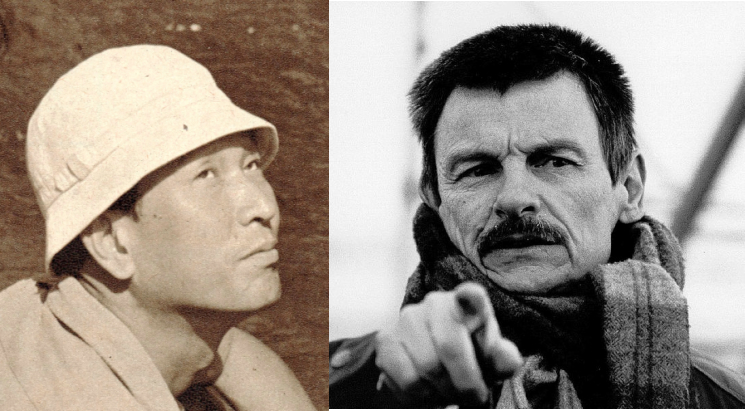
Image of Kurosawa and Tarkovsky via NPR
Though Akira Kurosawa and Andrei Tarkovsky occupy the same plane in the pantheon of auteurs — the highest one — neither their lives nor their films had much obviously in common. The older, longer-lived Kurosawa started his career earlier and ended it later, but during those cinematically glorious decades of the 1960s and 70s, the two brought into the world such pictures as Yojimbo, Ivan’s Childhood, High and Low, Red Beard, Andrei Rublev, Dodesukaden, Solaris, The Mirror, Dersu Uzala (Kurosawa’s sole Japanese-Soviet co-production, though Tarkovsky wasn’t involved), and Stalker.
They actually met around the middle of that period, when Kurosawa came to visit the set of Solaris (watch Solaris online along with many other major Tarkovsky films). “Tarkovsky guided me around the set, explaining to me as cheerfully as a young boy who is given a golden opportunity to show someone his favorite toybox,” Kurosawa writes in an essay originally run in the Asahi Shinbun in 1977 and republished at Cinephilia & Beyond.
“[Director Sergei] Bondarchuk, who came with me, asked him about the cost of the set, and left his eyes wide open when Tarkovsky answered it. The cost was so huge: about six hundred million yen as to make Bondarchuk, who directed that grand spectacle of a movie War and Peace, agape in wonder.”
But the work, as Kurosawa soon found out, merited the cost and then some:
Marvelous progress in science we have been enjoying, but where will it lead humanity after all? Sheer fearful emotion this film succeeds in conjuring up in our soul. Without it, a science fiction movie would be nothing more than a petty fancy.
These thoughts came and went while I was gazing at the screen.
Tarkovsky was together with me then. He was at the corner of the studio. When the film was over, he stood up, looking at me as if he felt timid. I said to him, “Very good. It makes me feel real fear.” Tarkovsky smiled shyly, but happily. And we toasted vodka at the restaurant in the Film Institute. Tarkovsky, who didn’t drink usually, drank a lot of vodka, and went so far as to turn off the speaker from which music had floated into the restaurant, and began to sing the theme of samurai from Seven Samurai at the top of his voice.
As if to rival him, I joined in.
For I was at that moment very happy to find myself living on Earth.
Solaris makes a viewer feel this, and even this single fact shows us that Solaris is no ordinary SF film. It truly somehow provokes pure horror in our soul. And it is under the total grip of the deep insights of Tarkovsky.
Kurosawa pays special attention to the sequence, which you can watch above analyzed by film scholars Vida Johnson and Graham Petrie, filmed in his own homeland: “What makes us shudder is the shot of the location of Akasakamitsuke, Tokyo, Japan. By a skillful use of mirrors, he turned flows of head lights and tail lamps of cars, multiplied and amplified, into a vintage image of the future city. Every shot of Solaris bears witness to the almost dazzling talents inherent in Tarkovsky.”
Like all of Tarkovsky’s features, Solaris only holds up more firmly with time and thus still enjoys revival screenings all over the world, but you can also watch it free online right now. Just get ready, when you descend to Earth afterward, to feel your own gratitude at finding yourself back here.
Related Content:
Watch Solaris (1972), Andrei Tarkovsky’s Haunting Vision of the Future
Andrei Tarkovsky’s Solaris Shot by Shot: A 22-Minute Breakdown of the Director’s Filmmaking
Based in Seoul, Colin Marshall writes and broadcasts on cities and culture. He’s at work on a book about Los Angeles, A Los Angeles Primer, the video series The City in Cinema, the crowdfunded journalism project Where Is the City of the Future?, and the Los Angeles Review of Books’ Korea Blog. Follow him on Twitter at @colinmarshall or on Facebook.
Read More...Cook Up Aleister Crowley’s Rice Recipe: Perfect for Eating with Curry
Before visiting a Gnostic Mass at one of Aleister Crowley’s Ordo Templi Orientis chapters in the UK, Dangerous Minds’ Thomas McGrath was warned by a friend in no uncertain all caps, “DO NOT EAT THE CAKE OF LIGHT.” I’ll let you find out for yourself why the excess caution against this Crowley confabulated piece of anti-Catholic sacramental bread. Suffice it to say, the British occultist who called himself the Great Beast 666 shared other ceremonial recipes in his copious writings on ritual practices. Many of them involved bodily fluids as a matter of course.
In addition to the Magick for which he’s commonly known in countercultural circles, Crowley was an artist, avid mountain climber, world traveler, and aspiring chef of more or less edible foods, who often cooked for his traveling companions. Dangerous Minds draws our attention to one dish Crowley described in his “autohagiography,” The Confessions of Aleister Crowley. Called “glacier curry,” the stuff was apparently so spicy it made hardened mountaineers “dash out of the tent after one mouthful and wallow in the snow, snapping at it like mad dogs.”
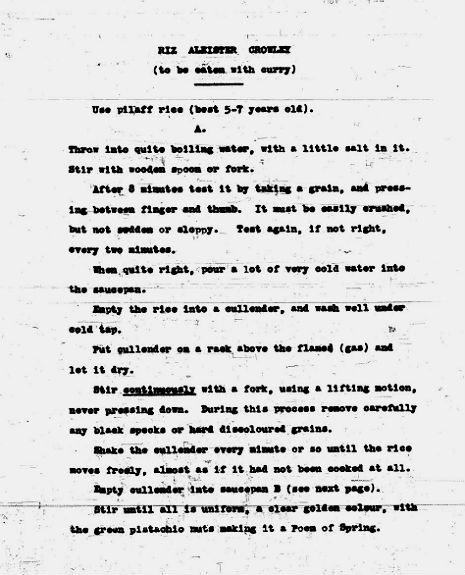
Crowley neglected to list the ingredients and means of preparation for the unbearable “glacier curry,” but he did leave another recipe among his papers for a much cooler accompaniment. (Discovered, writes Coilhouse, by a “Professor Jack” in the Crowley Archives at Bird Library, Syracuse University.) Called “Riz Aleister Crowley,” and meant “to be eaten with curry,” you can find it below. The proportions have been estimated by writer Nico Mara McKay, who has made the rice with delicious results.
Ingredients
- 1 cup brown basmati rice
- sea salt
- 1/4 cup sultanas
- 1/4 cup slivered almonds(1)
- 1/4 cup pistachio nuts
- powdered clove
- powdered cardamoms
- turmeric powder (enough to colour the rice to a clear golden tint)
- 2 tblsp. butter
Steps
Bring two cups of salted water to a bowl. Throw in in the rice, stirring regularly.
Test the rice after about ten minutes “by taking a grain, and pressing between finger and thumb. It must be easily crushed, but not sodden or sloppy. Test again, if not right, every two minutes.”
When ready, pour cold water into the saucepan.
Empty the rice into a colander, and rinse under cold tap.
Put colander on a rack above the flames, if you have a gas stove, and let it dry. If, like me, your stove is electric, the rice can be dried by placing large sheets of paper towel over and under the rice, soaking up the water. Preferably the rice should seem very loose, almost as if it it has not been cooked at all. When you’ve removed as much water as you can, remove the paper towel.
Place the rice back into the pot on a much lower temperature.
Stirring continuously, add the butter, sultanas, almonds, pistachio nuts, a dash or two of cloves and a dash of cardamom.
Add enough turmeric that the rice, after stirring, is “uniform, a clear golden colour, with the green pistachio nuts making it a Poem of Spring.”
In addition to the estimated proportions, the version above has been modified somewhat to fit our contemporary recipe expectations, but the folks at food blog Happy Vegetable Cow have an exact transcription of Crowley’s typescript (top). They note Crowley’s continuity with free-form recipe traditions of antiquity and celebrate the bit of “creative narrative” at the end. For an even more creatively phrased grain recipe than Crowley’s aromatic rice, see David Lynch’s surreal quinoa instructions.
Related Content:
Aleister Crowley Reads Occult Poetry in the Only Known Recordings of His Voice (1920)
Josh Jones is a writer and musician based in Durham, NC. Follow him at @jdmagness
Read More...Videos Recreate Isaac Newton’s Neat Alchemy Experiments: Watch Silver Get Turned Into Gold
Yesterday we featured an online archive of “chymical” manuscripts from the hand of Isaac Newton, who, in addition to modern physics and mathematics, practiced the magical, medieval art of alchemy. Found among his alchemical papers was a recipe for “sophick mercury,” a chemical believed to create the “Philosopher’s stone,” the occult substance that supposedly turns base metals like lead into pure gold. Did such magic ever rise to the level of repeatable science or was it pure mythological fantasy?
For well over two hundred years after Newton’s death in 1727, nearly everyone believed the latter. However, when the physicist and mathematician’s alchemical papers went on auction at Sotheby’s in 1936, “the world of Isaac Newton scholarship received a rude shock,” writes Indiana University’s archive project The Chymistry of Isaac Newton. Hundreds of alchemy manuscripts that had been quietly suppressed by Newton’s relatives and hidden away in private collections came to light all at once.
In the intervening years, Newton scholars and science historians have had to reassess his considerable level of investment in occult arts. And they’ve come to see alchemy as an important precursor to modern chemistry. As IU science historian William Newman “points out,” io9 tells us, “alchemy wasn’t always the laughable idea it is today.”
Although his alchemical manuscripts were in constant conversation with ancient and mystical sources, “Newton’s chymistry was in many cases fully operational and explicable in modern chemical terminology,” writes Newman, who has done much of the work to recover the chemical science amidst Newton’s alchemical pseudoscience.
In the videos you see here, Indiana University seeks to “drive this point home” with lessons that can “be employed in schools as an integral part of their science education curricula.” We begin at the top with a classical alchemical experiment, the “transmutation” of silver into gold. In this case the medallion is already composed of a silver-gold alloy. It’s an experiment in which “alchemists’ knowledge of chemistry actually helped them con their contemporaries into believing they could transform silver into gold,” notes Newman. Once the medallion is dipped in nitric acid, much of the silver dissolves, giving the impression of it having been changed into pure gold.
Further up, we have other “chymical” experiments from Newton’s alchemy, like the “transmutation”—or plating—of iron into copper and the creation of a silica garden, illustrating so-called mineral “vegetation.” In experiments like the one below it, the creation of the “Tree of Diana”—in which a crystalline growth emerges from an amalgam of silver and mercury—we see how alchemists were inspired to create alternate terminology for the products of their experiment that sound to modern ears like unscientific nonsense. This mystical jargon often served to confuse or ward off the uninitiated, who would be unable to make a “Tree of Diana” even if they had the ingredients on hand, unless they already knew the procedure and the product.
The last two modules, further up and just above, demonstrate copper and iron shot dissolving in solutions of silver nitrate and copper nitrate, respectively. Educators and the generally curious should download Indiana University’s lesson plan on “Newton’s ‘Chymistry’ of Metal Solubilities.” Therein, you learn that “Newton spent more time on his alchemy than he did on his physics and math combined!” though most of his alchemical work remains unpublished. The few, more respectably-worded, experiments Newton did publish in his lifetime come from “Query 31” of his masterpiece, the Opticks. It is from these procedures that the lessons derive.
But even as we see the ostensibly straightforward chemical instructions Newton published, we should remember that these came from decades of research in the much murkier, occult field of alchemy. You’ll find more information on Newton’s chemistry here and here, as well as at these many related websites.
via io9
Related Content:
In 1704, Isaac Newton Predicts the World Will End in 2060
Sir Isaac Newton’s Papers & Annotated Principia Go Digital
Josh Jones is a writer and musician based in Durham, NC. Follow him at @jdmagness
Read More...Father Writes a Great Letter About Censorship When Son Brings Home Permission Slip to Read Ray Bradbury’s Censored Book, Fahrenheit 451
How does censorship come about in advanced, ostensibly democratic societies? In some cases, through institutions colluding in ways that go unnoticed by the general public. As Noam Chomsky has argued for decades, state agencies often collude with the press to spread certain narratives and suppress others. And as we see during Banned Books Week, legislatures, courts, and educational institutions often collude with publishers, teachers, and parents to suppress literature they view as threatening. One such case remains particularly ironic given the book in question: Ray Bradbury’s Fahrenheit 451, the story of a dystopian society in which all books are banned, and fire departments burn contraband copies.
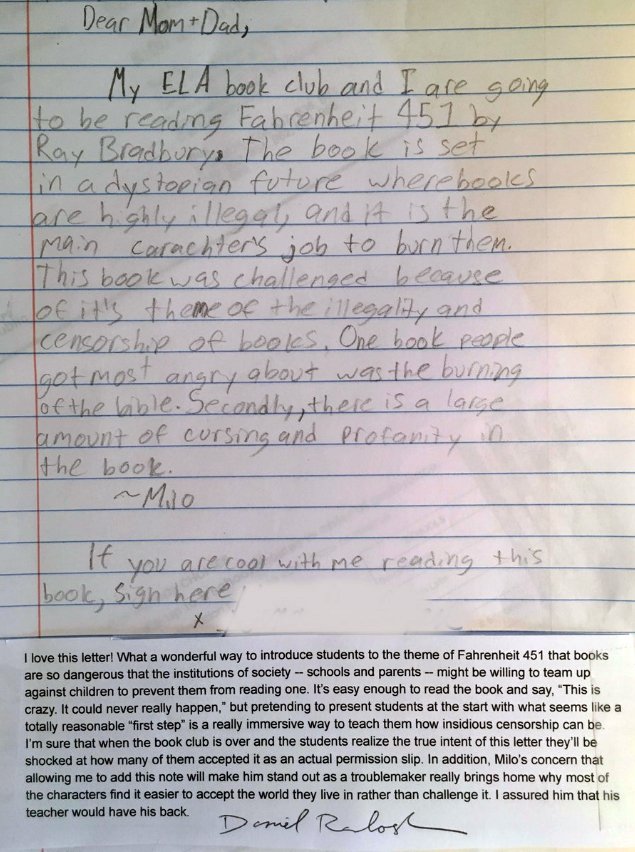
Between the years 1967 and 1979, Ballantine published an expurgated version of the novel for use in high schools, removing content deemed objectionable. Bradbury was completely unaware. For six of those years, the bowdlerized version was the only one sold by the publisher. We can remember this case when we read the response of writer Daniel Radosh to a permission slip his son Milo brought home from his 8th grade teacher for a book club reading of Fahrenheit 451. Written in Milo’s own hand, the initial note, at the top, informs Mr. Radosh that the novel “was challenged because of it’s [sic] theme of the illegality and censorship of books. One book people got most angry about was the burning of the bible. Secondly, there is a large amount of cursing and profanity in the book.”
After this confession, Milo’s note asks for a parental signature in a postscript. Addressing the letter’s true writer, Milo’s teacher, Daniel Radosh responded thus, in the typed note attached to his son’s letter.
I love this letter! What a wonderful way to introduce students to the theme of Fahrenheit 451 that books are so dangerous that the institutions of society – schools and parents – might be willing to team up against children to prevent them from reading one.
It’s easy enough to read the book and say, ‘This is crazy. It could never really happen,’ but pretending to present students at the start with what seems like a totally reasonable ‘first step’ is a really immersive way to teach them how insidious censorship can be.
I’m sure that when the book club is over and the students realise the true intent of this letter they’ll be shocked at how many of them accepted it as an actual permission slip.
In addition, Milo’s concern that allowing me to add to this note will make him stand out as a troublemaker really brings home why most of the characters find it easier to accept the world they live in rather than challenge it.
I assured him that his teacher would have his back.
Radosh’s insinuation that the letter his son was induced to write is not an “actual permission slip” underscores his claim that the exercise is really a means of controlling children by means of collusion, even though, he jests, such a thing must be part of the lesson itself. Should he be allowed to read the novel, the signing and delivery of the permission slip, Radosh devastatingly suggests, completes Milo’s humiliation, bringing home to him “why most of the characters” in the book remain passive, and “find it easier to accept the world they live in rather than challenge it.”
In short, Radosh’s response, for all its pithy irony, digs deeply into the mechanisms that suppress speech deemed so “dangerous that the institutions of society—schools and parents—might be willing to team up against children to prevent them” from reading it.
See Metro UK for a complete transcription of both letters.
via Vintage Anchor
Related Content:
Hear Ray Bradbury’s Classic Sci-Fi Story Fahrenheit 451 as a Radio Drama
The Cover of George Orwell’s 1984 Becomes Less Censored with Wear and Tear
Frank Zappa Debates Censorship on CNN’s Crossfire (1986)
Josh Jones is a writer and musician based in Durham, NC. Follow him at @jdmagness
Read More...Hear 20 Minutes of Mark Frost’s New Secret History of Twin Peaks, the Book Fans Have Waited 25 Years to Read
We live in a good time to be a Twin Peaks fan. Amid the buzz of a third season of David Lynch and Mark Frost’s innovatively surreal primetime drama premiering on Showtime next year, we’ve enjoyed the emergence of contemporary Twin Peaks-related materials (David Lynch’s hand-drawn map of the titular small-town setting, the Japanese coffee commercials he set there) as well as newer Twin Peaks-themed projects from other creators (an Atari game, an elementary school play). And now we can read Frost’s novel The Secret History of Twin Peaks, billed by its publisher as “the story millions of fans have been waiting to get their hands on for 25 long years.”
The novel’s “362 pages cover what happened to some of the people of that iconic fictional town since we last saw them 25 years ago, but the timeline starts as early as the 1800s with the journals of Lewis and Clark,” says fan site Welcome to Twin Peaks. It also “also offers a deeper glimpse into the central mystery that was only touched on by the original series, and will include over 100 four-color illustrations and photographs.” The nearly ten-hour audiobook version features the voices of original cast members like Michael Horse as Deputy Hawk, Russ Tamblyn as Dr. Lawrence Jacoby, and most Twin Peaks of all, Kyle MacLachlan as FBI Special Agent Dale Cooper.
In the video and audio clips at the top of the post, you can sample The Secret History of Twin Peaks’ audiobook experience and get a sense of how it differs from that of a normal audiobook — and how the text itself differs from that of a standard novel. It takes the form not of a straight-ahead narrative but a thorough FBI dossier, the print version of which Meredith Borders of Birth.Movies.Death. describes as “an attractive multi-media hodgepodge, with Xeroxed manila folders and sticky notes, arrest reports, book covers, photos and sketches and maps and newspaper clippings.” The longer excerpt here delves into the story of Josie Packard, the widowed owner of Packard Sawmill and a particularly mysterious character in a cast of mysterious characters. Not to give too much away, but her past involves a fashion empire, a Hong Kong drug triad, and a “legendarily beautiful prostitute.”
As always in Twin Peaks, the more you learn, the stranger things get. But a true fan wants just that, and they can have it and then some by picking up their own copy of the book or audiobook, the latter of which they can get for free if they take audiobook provider Audible up on their 30-day trial offer.
Related Content:
David Lynch Draws a Map of Twin Peaks (to Help Pitch the Show to ABC)
David Lynch Directs a Mini-Season of Twin Peaks in the Form of Japanese Coffee Commercials
Play the Twin Peaks Video Game: Retro Fun for David Lynch Fans
Elementary School Students Perform in a Play Inspired by David Lynch’s Twin Peaks
David Lynch’s Twin Peaks Title Sequence, Recreated in an Adorable Paper Animation
Based in Seoul, Colin Marshall writes and broadcasts on cities and culture. He’s at work on a book about Los Angeles, A Los Angeles Primer, the video series The City in Cinema, the crowdfunded journalism project Where Is the City of the Future?, and the Los Angeles Review of Books’ Korea Blog. Follow him on Twitter at @colinmarshall or on Facebook.
Read More...Hear Vincent Price, Horror Film Legend, Read 8+ Hours of Scary Stories
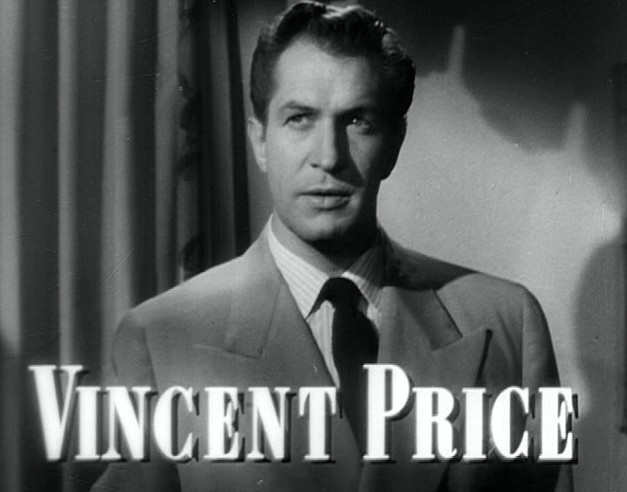
Image via Wikimedia Commons
Here’s a good way to inject a little fright into your Halloween celebration. Below, we’ve pulled together a playlist featuring Vincent Price, the icon of so many classic horror films, reading 8+ hours of scary stories. The readings, available for free on Spotify, come from albums recorded decades ago. The collection includes:
- Tales of Witches, Ghosts and Goblins (1972)
- Witchcraft — Magic: An Adventure In Demonology (1969)
- A Hornbook For Witches, Stories And Poems For Halloween (1976)
- Vincent Price and Basil Rathbone Read Edgar Allan Poe Stories & Poems (1954)
If you don’t have Spotify’s software, download it here. This Vincent Price playlist will be added to our collection, 1,000 Free Audio Books: Download Great Books for Free.
Related Content:
Watch Vincent, Tim Burton’s Animated Tribute to Vincent Price & Edgar Allan Poe (1982)
Watch Vincent Price Turn Into Edgar Allan Poe & Read Four Classic Poe Stories (1970)
5 Hours of Edgar Allan Poe Stories Read by Vincent Price & Basil Rathbone
Read More...Support Us
We're hoping to rely on loyal readers, rather than erratic ads. Please click the Donate button and support Open Culture. You can use Paypal, Venmo, Patreon, even Crypto! We thank you!

About Us

Open Culture scours the web for the best educational media. We find the free courses and audio books you need, the language lessons & educational videos you want, and plenty of enlightenment in between.
Advertise With Us

FREE UPDATES!
GET OUR DAILY EMAIL
Get the best cultural and educational resources on the web curated for you in a daily email. We never spam. Unsubscribe at any time.
FOLLOW ON SOCIAL MEDIA

Open Culture editor Dan Colman scours the web for the best educational media. He finds the free courses and audio books you need, the language lessons & movies you want, and plenty of enlightenment in between.
Advertise With Us


