Jorge Luis Borges Creates a List of 16 Ironic Rules for Writing Fiction

“Jorge Luis Borges 1951, by Grete Stern” via Wikimedia Commons.
When we first read the work of Jorge Luis Borges, we may wish to write like him. When we soon discover that nobody but Borges can write like Borges, we may wish instead that we could have collaborated with him. Once, he and his luminary-of-Argentine-literature colleagues, friend and frequent collaborator Adolfo Bioy Casares and Bioy Casares’ wife Silvina Ocampo, got together to compose a story about a writer from the French countryside. Though they never did finish it, one piece of its content survives: a list of sixteen rules, drawn up by Borges, for the writing of fiction.
Or at least that’s how Bioy Casares told it to the French magazine L’Herne, which reprinted the list. Instead of sixteen recommendations for what a writer of fiction should do, Borges playfully provided a list of sixteen prohibitions–things writers of fiction should never let slip into their work.
- Non-conformist interpretations of famous personalities. For example, describing Don Juan’s misogyny, etc.
- Grossly dissimilar or contradictory twosomes like, for example, Don Quixote and Sancho Panza, Sherlock Holmes and Watson.
- The habit of defining characters by their obsessions; like Dickens does, for example.
- In developing the plot, resorting to extravagant games with time and space in the manner of Faulkner, Borges, and Bioy Casares.
- In poetry, characters or situations with which the reader can identify.
- Characters prone to becoming myths.
- Phrases, scenes intentionally linked to a specific time or a specific epoch; in other words, local flavor.
- Chaotic enumeration.
- Metaphors in general, and visual metaphors in particular. Even more concretely, agricultural, naval or banking metaphors. Absolutely un-advisable example: Proust.
- Anthropomorphism
- The tailoring of novels with plots that are reminiscent of another book. For example, Ulysses by Joyce and Homer’s Odyssey.
- Writing books that resemble menus, albums, itineraries, or concerts.
- Anything that can be illustrated. Anything that may suggest the idea that it can be made into a movie.
- Critical essays, any historical or biographical reference. Always avoid allusions to authors’ personalities or private lives. Above all, avoid psychoanalysis.
- Domestic scenes in police novels; dramatic scenes in philosophical dialogues. And, finally:
- Avoid vanity, modesty, pederasty, lack of pederasty, suicide.
The astute reader will find much more of the counterintuitive about this list than its focus on what not to do. Didn’t Borges himself specialize in non-conformist interpretations, especially of existing literature? Don’t some of his most memorable characters obsess over things, like imagining a human being into existence or creating a map the size of the territory, to the exclusion of all other characteristics? Couldn’t he conjure up the most exotic settings — even when drawing upon memories of his native Buenos Aires — in the fewest words? And who else better used myths, metaphors, and games with time and space for his own, idiosyncratic literary purposes?
But those who’ve spent real time reading Borges know that he also always wrote with a strong, if subtle, sense of humor. He had just the kind of sensibility that would produce an ironic, self-parodying list such as this, though history hasn’t recorded whether his, Bioy Casares’, and Ocampo’s young provincial writer would have perceived it in that way or piously honored its dictates. Borges does, however, seem to have followed the bit about never writing “anything that may suggest the idea that it can be made into a movie” to the letter. I yield to none in my appreciation for Alex Cox’s cinematic interpretation of Death and the Compass, but I enjoy even more the fact that Borges’ imagination has kept Hollywood stumped.
Related Content:
Jorge Luis Borges’ Favorite Short Stories (Read 7 Free Online)
Jorge Luis Borges Selects 74 Books for Your Personal Library
Jorge Luis Borges’ 1967–8 Norton Lectures On Poetry (And Everything Else Literary)
Buddhism 101: A Short Introductory Lecture by Jorge Luis Borges
7 Tips from Edgar Allan Poe on How to Write Vivid Stories and Poems
Kurt Vonnegut’s 8 Tips on How to Write a Good Short Story
Based in Seoul, Colin Marshall writes and broadcasts on cities and culture. He’s at work on a book about Los Angeles, A Los Angeles Primer, the video series The City in Cinema, the crowdfunded journalism project Where Is the City of the Future?, and the Los Angeles Review of Books’ Korea Blog. Follow him on Twitter at @colinmarshall or on Facebook.
Read More...Every Exhibition Held at the Museum of Modern Art (MoMA) Presented in a New Web Site: 1929 to Present
Images courtesy of MoMA
We all hate it when we hear of an exciting exhibition, only to find out that it closed last week — or 80 years ago. New York’s Museum of Modern Art has made great strides toward taking the sting out of such narrowly or widely-missed cultural opportunities with their new digital exhibition archive. The archive offers, in the words of Chief of Archives Michelle Elligott, “free and unprecedented access to The Museum of Modern Art’s ever-evolving exhibition history” in the form of “thousands of unique and vital materials including installation photographs, out-of-print exhibition catalogues, and more, beginning with MoMA’s very first exhibition in 1929,” a show of post-Impressionist paintings by Cézanne, Gauguin, Seurat, and Van Gogh.
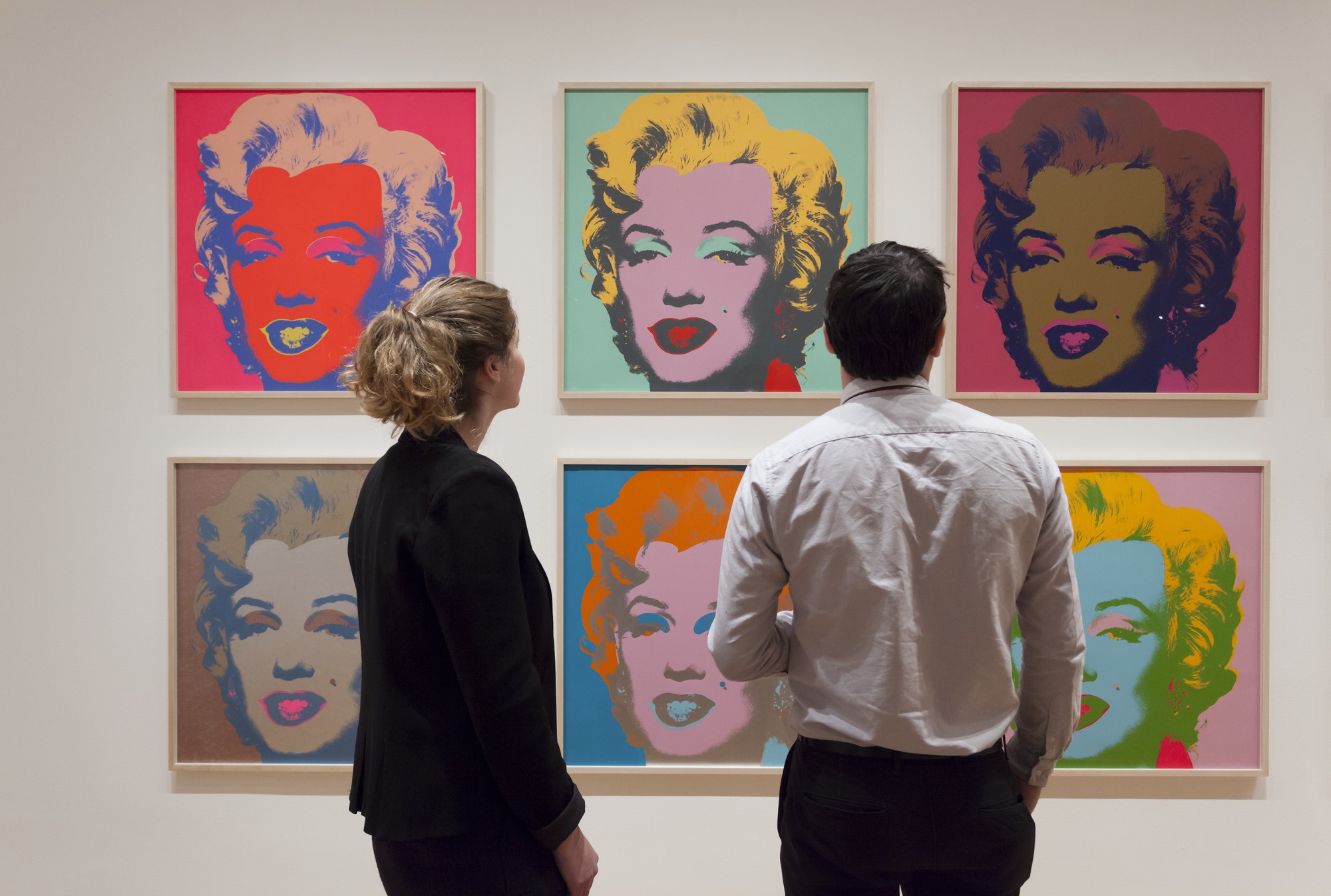
The photograph of Andy Warhol’s Marilyn Monroe portraits at the top of the post comes from a much more recent exhibition, 2015’s Andy Warhol: Campbell’s Soup Cans and Other Works, 1953–1967. But MoMA, of course, didn’t just just discover the king of pop art last year: search by his name and you’ll find no fewer than 128 shows that have included his work, starting with Recent Drawings U.S.A. in 1956.
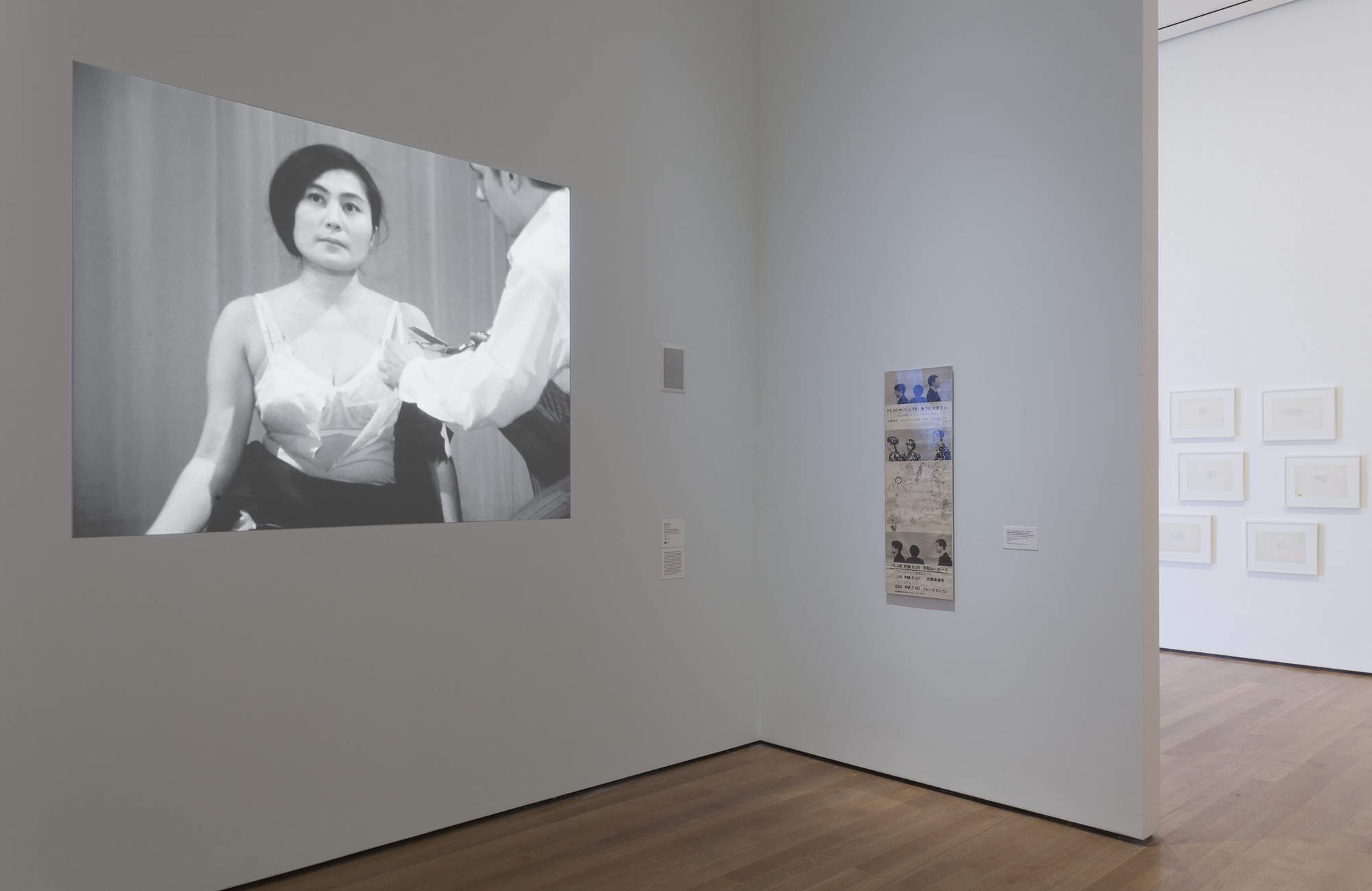
You can track any number of other cultural icons through the museum’s history: Yoko Ono, for instance, a view of whose One Woman Show, 1960–1971, which also opened in 2015, appears above, but whose work you can see in eleven different exhibitions archived online.
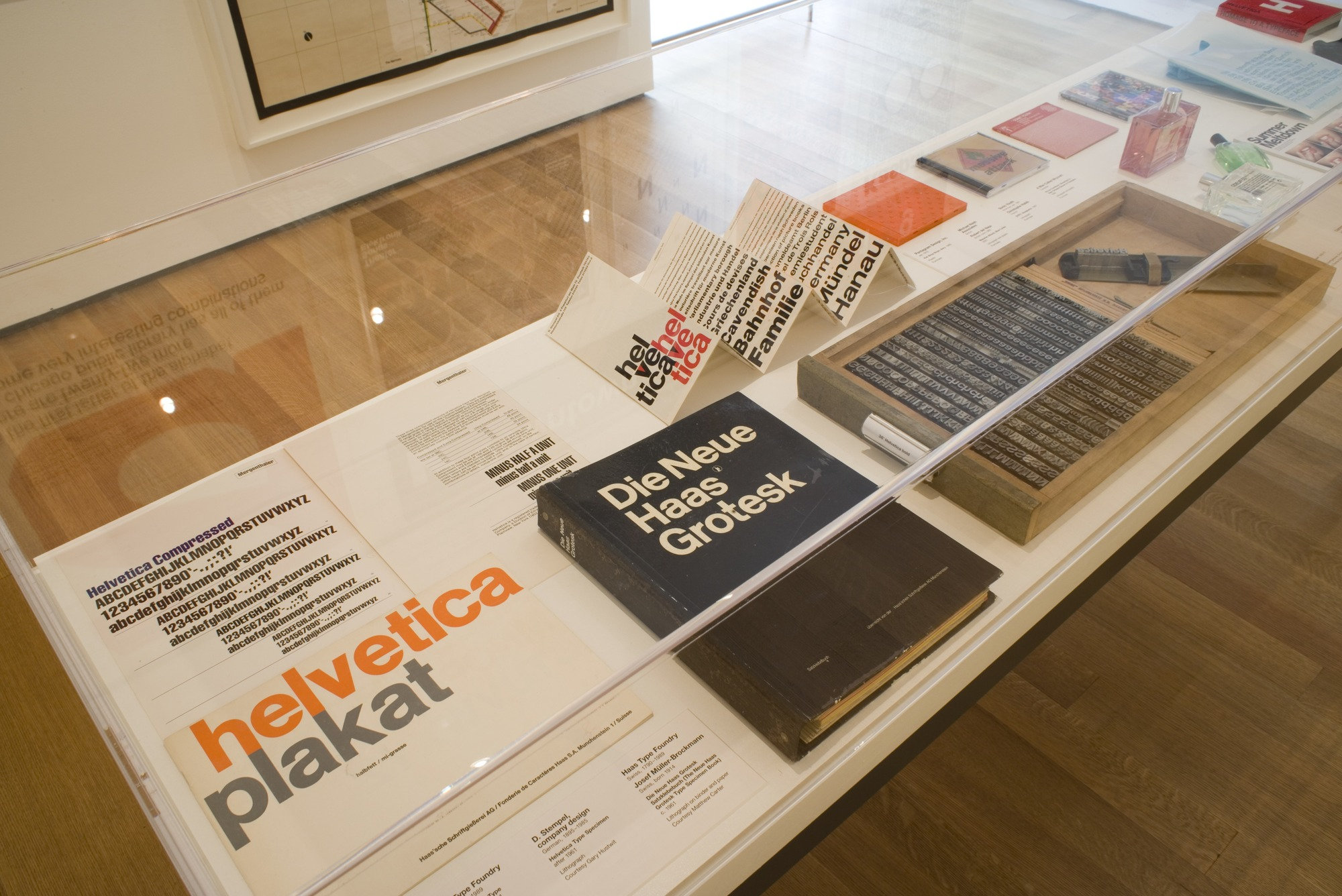
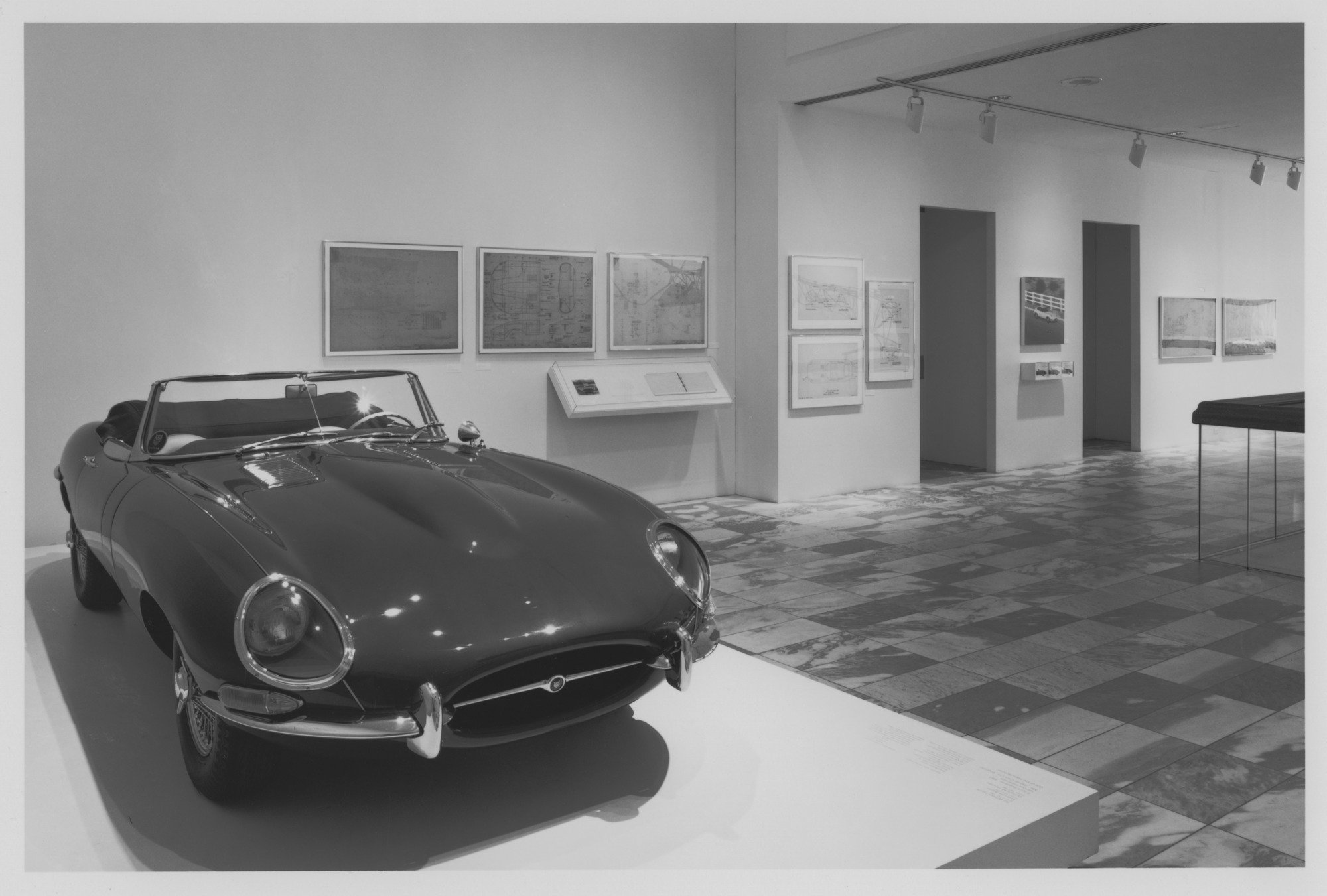
A look through even a fraction of the 3,500 shows whose materials MoMA has so far made available (and public-domain) reveals a thematic variety throughout the museum’s entire existence: not just individual artists or groups of them, but fast cars (the idea of a “rational automobile” in general in the 1960s and the Jaguar E‑Type in particular in the 90s), travel posters, Japanese architecture (featuring an entire traditional Japanese house built in and shipped from Nagoya for the occasion), and the font Helvetica. You can also have a look at the materials archived from the various film series and performance programs they’ve put on over the years.
This sort of technological innovation demonstrates that MoMA has, since that moment in the late 1920s when “a small group of enterprising patrons of the arts joined forces to create a new museum devoted exclusively to modern art,” remained as exciting an institution as ever. But nothing can replace the experience of actually going there and seeing its exhibitions in person, which is why, whenever I pay a visit to its digital archive, I’ll also click over to its calendar of upcoming shows. For 86 years, it has given the public the chance to experience the thrill of the modern, but as a trip through the digital archive reveals, the thrill of the modern goes much deeper than the shock of the new.
Related Content:
The Museum of Modern Art (MoMA) Puts Online 65,000 Works of Modern Art
Kids Record Audio Tours of NY’s Museum of Modern Art (with Some Silly Results)
Museum of Modern Art (MoMA) Launches Free Course on Looking at Photographs as Art
The Guggenheim Puts Online 1600 Great Works of Modern Art from 575 Artists
Free: The Metropolitan Museum of Art and the Guggenheim Offer 474 Free Art Books Online
Download Over 300+ Free Art Books From the Getty Museum
The History of Modern Art Visualized in a Massive 130-Foot Timeline
Art Critic Robert Hughes Demystifies Modern Art in The Shock of the New
Based in Seoul, Colin Marshall writes and broadcasts on cities and culture. He’s at work on a book about Los Angeles, A Los Angeles Primer, the video series The City in Cinema, the crowdfunded journalism project Where Is the City of the Future?, and the Los Angeles Review of Books’ Korea Blog. Follow him on Twitter at @colinmarshall or on Facebook.
Read More...John Austen’s Haunting Illustrations of Shakespeare’s Hamlet: A Masterpiece of the Aesthetic Movement (1922)
We’ve popularly come to think of the Victorian era as one in which a prudish, sentimental conservatism ruled with imperial force over the arts and culture. But that broad picture ignores the strong countercurrent of weird eroticism in the work of aesthetes like Dante Rossetti, Oscar Wilde, and Aubrey Beardsley.
Beardsley’s elegant, bawdy illustrations of Wilde’s erotic play Salome scandalized British society, as did the play itself. His penchant for occult subjects and a wickedly sensuous style resonated well into the 20th century. Salome was a highlight of the Aesthetic movement,” writes the Met, “and an early manifestation of Art Nouveau in England.” By the 1920s, Beardsley was perhaps one of the most influential of literary illustrators.
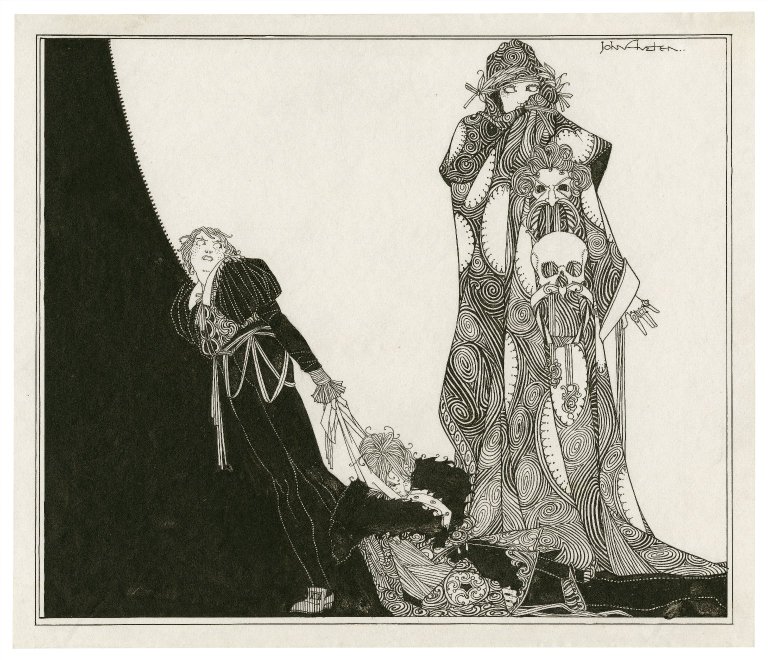
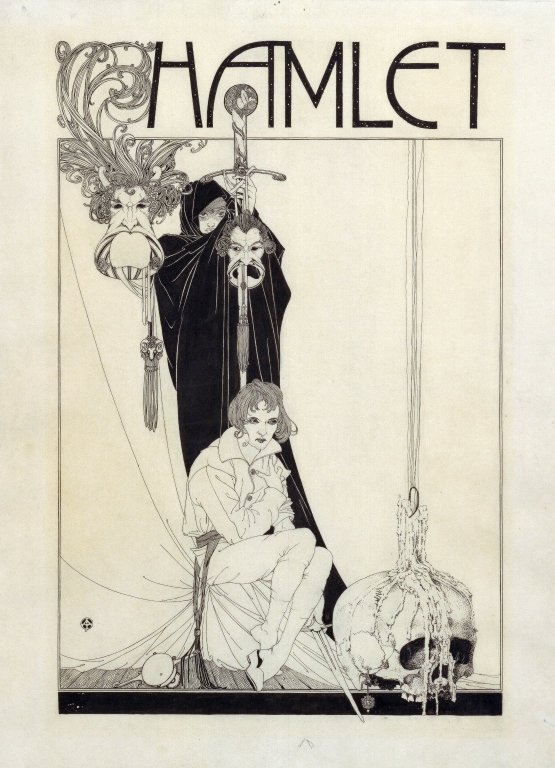
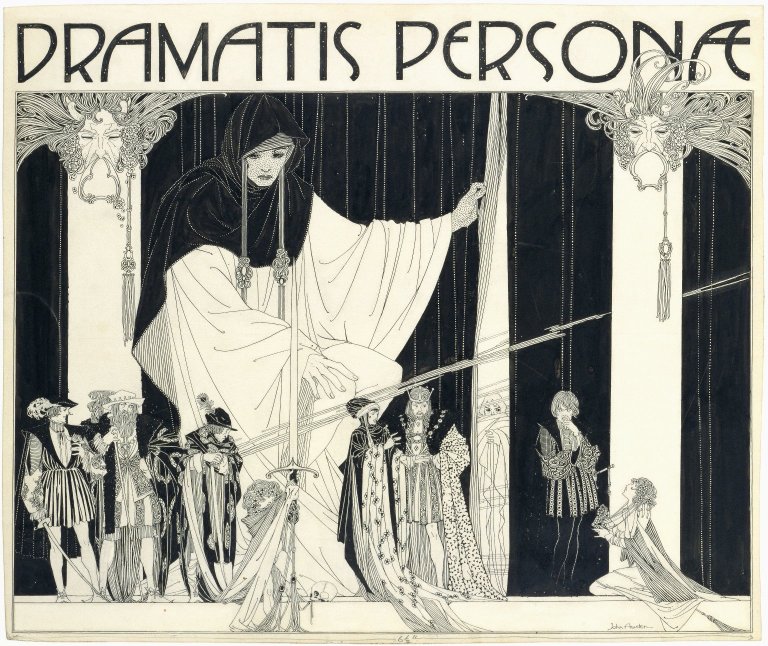
Irish artist Harry Clarke took directly from Beardsley in work like his richly-detailed 1926 edition of Goethe’s Faust. And in 1922, British artist John Austen modernized Hamlet by drawing on Clarke’s earlier work, as well as, quite clearly, on Beardsley. As artist John Coulthart remarks, “If you’re going to borrow a style then you may as well take from the best.” Like Beardsley’s Salome and Clarke’s Faust, Austen’s Hamlet “is often rated as his chef d’oeuvre, and with good reason, he manages to lend some visual splendor to a play whose concerns are a lot more introspective than the usual illustration standards of The Tempest and A Midsummer Night’s Dream” (just as T.S. Eliot had critically argued two years earlier).
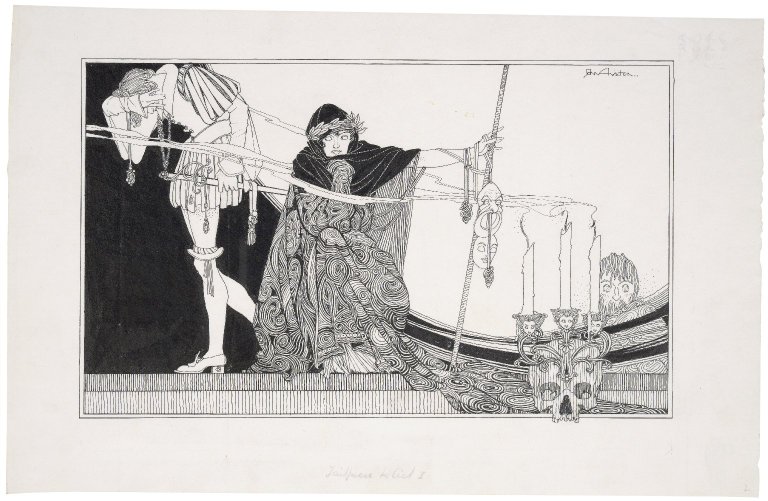
Published by Dover’s Calla Editions (and recently back in print), Austen’s illustrated Hamlet takes the fine, spare lines of Beardsley—well represented in his Poe edition—and clothes them, so to speak, with Clarke’s “manga faces, spiny fingers and swathes of black.” Each of the three artists has a different take on the macabre: Beardsley’s subtle symbolism giving way to Clarke’s surrealism and the heavy iconography in Austen’s Hamlet, permeated by the play’s archetypal images of “masks, swords and skulls.” Austen would soon leave behind the influence of both artists, adopting a much blockier style for literary illustrations later in the decade. In many ways, he represents a bridge between the elegant Art Nouveau aesthetics of Beardsley and the modernism of Art Deco, by way of Clarke’s unique gothic style.
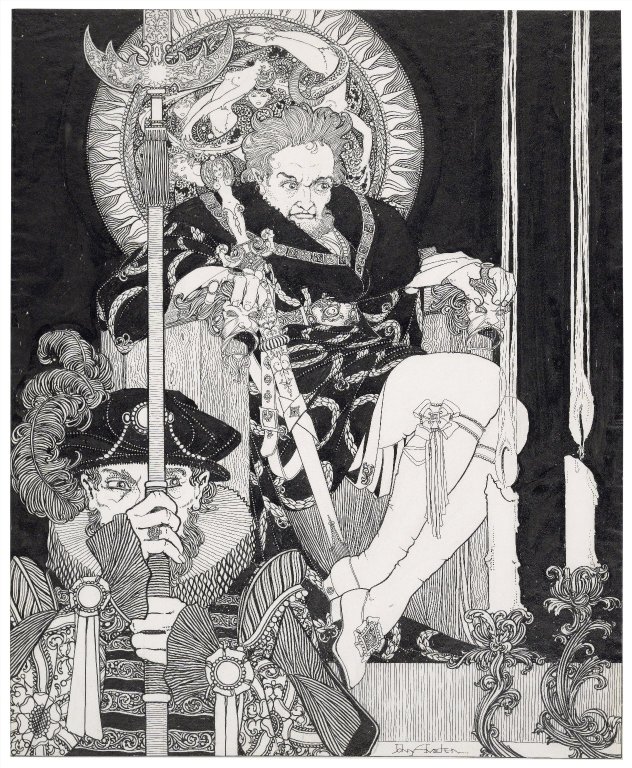
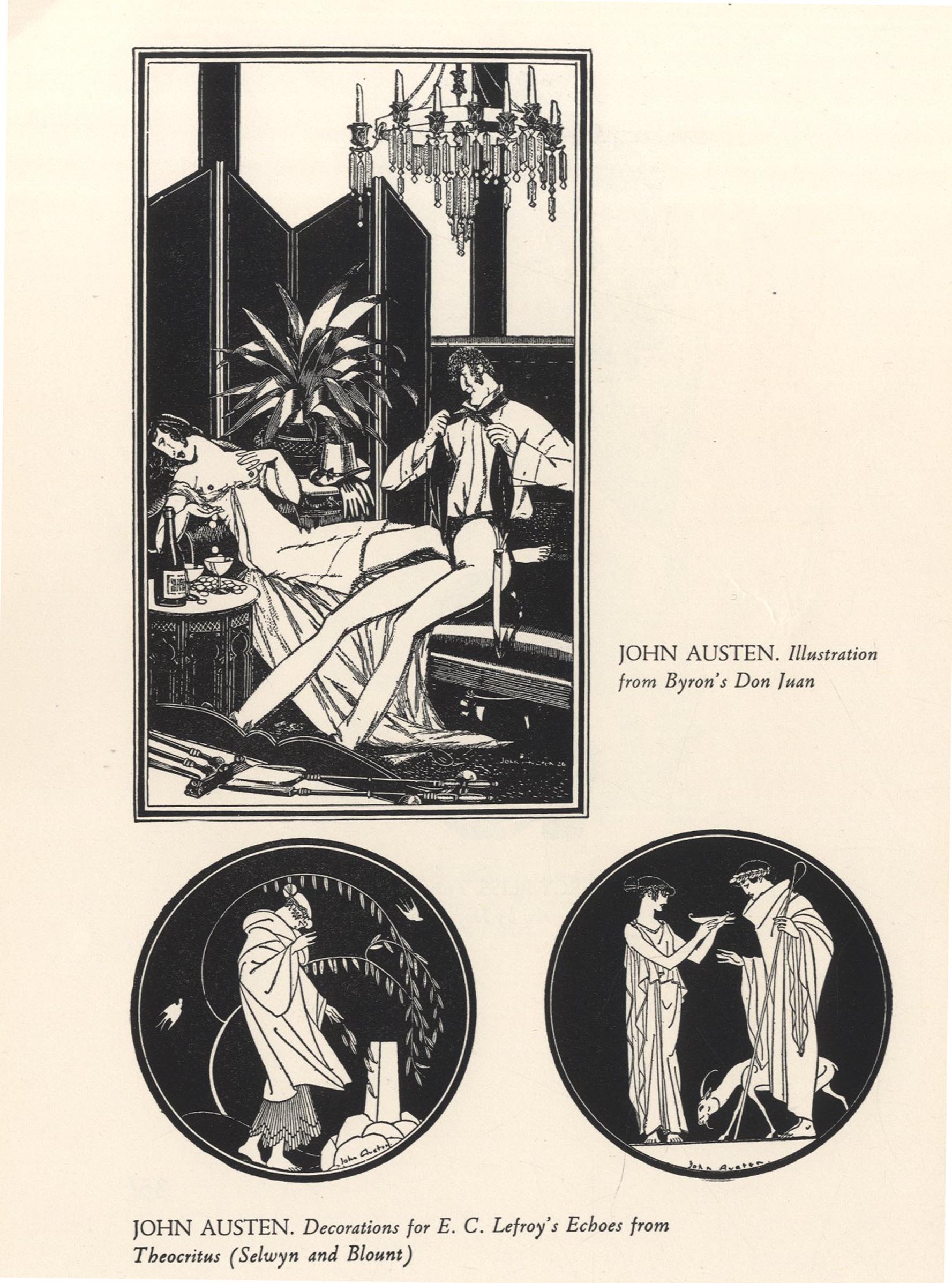
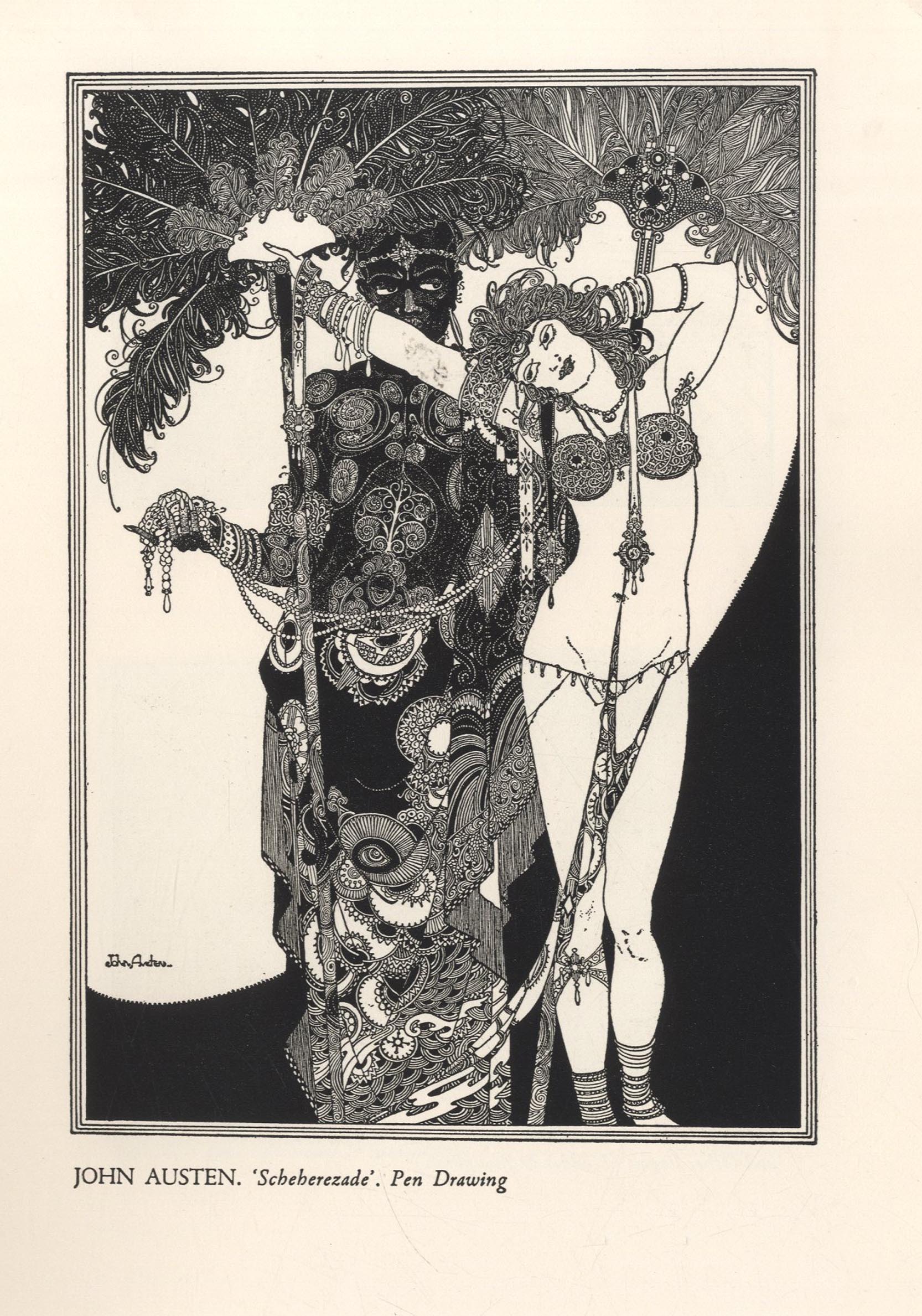
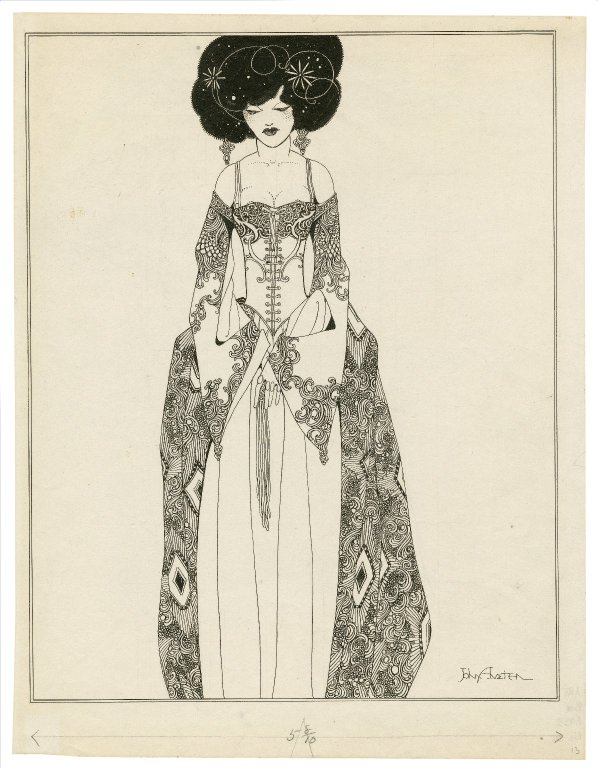
You can view and download all of the Austen illustrations online: The Folger Shakespeare Library hosts all 121 original drawings in high resolution scans, each of which is downloadable in resolutions up to 3072px. Coulthart excerpts several of these images at his blog {feuilleton}. And at fulltable.com, you can see the Austen illustrations in context with the play’s text in high resolution scans. There, you’ll also find more modernist illustrations Austen contributed to editions of Tristram Shandy, Byron’s Don Juan and E.C. Lefroy’s Echoes from Theocritus, and a 1937 instructional book on pen and ink drawing. In at least one other instance, however, Austen retained the stylized, Symbolist Clarke and Beardsley approach—an erotic pen drawing of Sheherezade that pays full homage to Beardsley’s sensual Salome illustrations.
Related Content:
Harry Clarke’s 1926 Illustrations of Goethe’s Faust: Art That Inspired the Psychedelic 60s
Aubrey Beardsley’s Macabre Illustrations of Edgar Allan Poe’s Short Stories (1894)
Josh Jones is a writer and musician based in Durham, NC. Follow him at @jdmagness
Read More...How Literature Can Improve Mental Health: Take a Free Course Featuring Stephen Fry, Ian McKellen, Melvyn Bragg & More
The great 18th century writer Dr. Samuel Johnson, who suffered from severe bouts of depression, said “the only end of writing is to enable the reader better to enjoy life or better to endure it.”
So…is it true? Can a poem help you cope with grief? Can a sonnet stir your soul to hope?
The University of Warwick have teamed up with some famous faces, and a team of doctors to tackle these questions and others like them, in a free online course on FutureLearn.
Poets, writers and actors like Stephen Fry, Ian McKellen, Melvyn Bragg, Mark Haddon (The Curious Incident of the Dog in the Night Time), Ben Okri (The Famished Road), Rachel Kelly (Black Rainbow) and others, will discuss their own work and the work of famous writers like Austen, Shakespeare and Wordsworth — exploring how they can impact mental health and why works of writing are so often turned to in times of crisis.
Here’s Stephen Fry on the pleasure of poetry:
Plus throughout the 6‑week course doctors will offer a medical perspective, giving an insight into different mental health conditions.
The course is offered through FutureLearn which means it’s broken into chunks — so you can do it step by step. FutureLearn also features lots of discussion so you can share your ideas with other learners, which often can be as beneficial as the course material (as one previous learner put it “a really wonderful experience and I’ve loved the feedback and comments from fellow course members”).
Here’s a runthrough of what’s on the syllabus. The course focuses on six themes:
- Stress: In poetry, the word “stress” refers to the emphasis of certain syllables in a poem’s metre. How might the metrical “stresses” of poetry help us to cope with the mental and emotional stresses of modern life?
- Heartbreak: Is heartbreak a medical condition? What can Sidney’s sonnets and Austen’s Sense and Sensibility teach us about suffering and recovering from a broken heart?
- Bereavement: The psychologist Elisabeth Kübler-Ross famously proposed that there are five stages of grief. How might Shakespeare’s Hamlet and poems by Wordsworth and Hardy help us to think differently about the process of grieving?
- Trauma: PTSD or “shellshock” has long been associated with the traumatic experiences of soldiers in World War 1. How is the condition depicted in war poetry of the era? Can poems and plays offer us an insight into other sources of trauma, including miscarriage and assault?
- Depression and Bipolar: The writer Rachel Kelly subtitles her memoir Black Rainbow “how words healed me – my journey through depression”. Which texts have people turned to during periods of depression, and why? What can we learn from literature about the links between bipolar disorder and creativity?
- Ageing and Dementia: One of the greatest studies of ageing in English Literature is Shakespeare’s King Lear. Is it helpful to think about this play in the context of dementia? Why are sufferers of age-related memory loss often still able to recall the poems they have learned “by heart”?
Start the course for free today.
Jess Weeks is a copywriter at FutureLearn. The one poem which helps her endure is The Orange by Wendy Cope.
Related Content:
Book Readers Live Longer Lives, According to New Study from Yale University
Read More...Hear Jane Austen’s Pride and Prejudice as a Free Audio Book
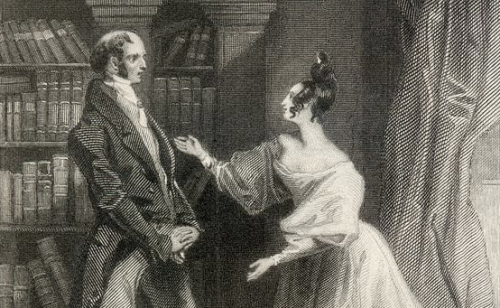
First published in 1813, Jane Austen’s Pride and Prejudice has become one of the most widely read books in English literature. When the BBC conducted a massive poll in 2003, trying to determine the “UK’s Best-Loved Book,” Pride and Prejudice came in second, right behind The Lord of the Rings. And all told, some 20 million copies of the book have been sold. Through the links below, you can download free audiobook (and ebook) versions of Pride and Prejudice.
Audio Book: Librivox version – Free iTunes – Free MP3
Audio Book: Spotify version read by Wendy Ellison Mullen — Spotify
eBook: iPad/iPhone – Kindle + Other Formats – Read Online Now
Looking for free, professionally-read audio books from Audible.com? Here’s a great, no-strings-attached deal. If you start a 30 day free trial with Audible.com, you can download two free audio books of your choice. Get more details on the offer here.
Related Content:
As Pride and Prejudice Turns 200, Read Jane Austen’s Manuscripts Online
This Is Your Brain on Jane Austen: The Neuroscience of Reading Great Literature
700 Free Audio Books: Download Great Books for Free
Jane Austen Used Pins to Edit Her Abandoned Manuscript, The Watsons
800 Free eBooks for iPad, Kindle & Other Devices
Read More...Free AudioBook: Hamlet Starring John Gielgud (1951)

Hear a radio drama starring John Gielgud as Hamlet, Dorothy McGuire as Ophelia, and Pamela Brown as Queen. This episode of the radio anthology series ‘Theatre Guild on the Air’ was broadcast on 4 March 1951. Stream it below, or find it on Spotify or in our collection of Free Audio Books. Another version lives on Archive.org.
If you would like to support the mission of Open Culture, consider making a donation to our site. It’s hard to rely 100% on ads, and your contributions will help us continue providing the best free cultural and educational materials to learners everywhere. You can contribute through PayPal, Patreon, and Venmo (@openculture). Thanks!
Read More...Free AudioBook: The Scarlet Letter by Nathaniel Hawthorne

“When Hester Prynne bears an illegitimate child she is introduced to the ugliness, complexity, and ultimately the strength of the human spirit. Though set in Puritan community centuries ago, the moral dilemmas of personal responsibility, and consuming emotions of guilt, anger, loyalty and revenge are timeless.” That’s the gist of Nathaniel Hawthorne’s The Scarlet Letter, as described by Bartleby.
Text copies of The Scarlet Letter can be found in our collection of Free eBooks. And below you can stream a reading of the classic American text. It’s available on Spotify, and if you need a copy of their free software, download it here. An alternative version can be found on Librivox. Both editions can be found in our collection, 1,000 Free Audio Books: Download Great Books for Free.
If you would like to support the mission of Open Culture, consider making a donation to our site. It’s hard to rely 100% on ads, and your contributions will help us continue providing the best free cultural and educational materials to learners everywhere. You can contribute through PayPal, Patreon, and Venmo (@openculture). Thanks!
Read More...Watch 222 Great Films in the Public Domain: Alfred Hitchcock, Fritz Lang, Buster Keaton & More
Want to learn about film history? You can take a class on the subject, where you’ll likely need a copy of Kristin Thompson and David Bordwell’s standard text Film History: An Introduction, and possibly the companion book, Film Art: An Introduction. These are phenomenal resources written by two top-notch scholars who have spent their lives watching and analyzing films, and should you have the time and money to study their comprehensive introductions, by all means do so. But of course, there’s no substitute for actually watching the hundreds of films they reference, from the early days of the medium through its many re-visions and innovations in the 20th century.
But why, ask Thompson and Bordwell, “should anybody care about old movies?” The obvious answer is that they “offer intense artistic experiences or penetrating visions of human life in other times and places.” Another key scholarly thesis these theorists advance is that in studying narrative film history, we see the development of film (and later, by extension, television, video games, and other visual media) as an international visual language—one nearly everyone on the planet learns to read from a very young age.
In films like The Great Train Robbery (1903) and the technically groundbreaking, if narratively deplorable, Birth of a Nation (1915), we see the creation and refinement of cross-cutting as an essential cinematic technique used in every visual storytelling medium. In Georges Méliès’ brilliant fantasies A Trip to the Moon (1902) and The Impossible Voyage (1904), we see the joyful origins of the special effects film. In Sergei Eisenstein’s Battleship Potemkin (1925), we see montage theory brought to life onscreen. And in the many films of Alfred Hitchcock, we see the ingenious camera and editing moves that define horror and suspense.
All of these films, and many hundreds more, are in the public domain and free to view online as many times as you like, whether you do so as part of a formal course of study or simply for sheer enjoyment. Nathan Heigert at MUBI has compiled a list of 222 “Public Domain Greats” that represents a wide spectrum of film history, “from the silents of Griffith, Keaton and Chaplin, to neglected noirs and the low-budget bliss of Roger Corman, plus nearly all of Hitchcock’s British films—all free for download or streaming (though, naturally, not in Criterion quality)” from the Internet Archive. Heigert’s itemized list offers a tremendous range and breadth, and contains a great many of the essential films referenced in most film history texts.
- A Man with a Movie Camera (Dziga Vertov, 1929)
- Scarlet Street (Fritz Lang, 1945)
- M (Fritz Lang, 1931)
- D.O.A. (Rudolph Mate, 1950)
- Nanook of the North (Robert Flaherty, 1922)
- Nosferatu (F.W. Murnau, 1922)
- The Cabinet of Dr. Caligari (Robert Wiene, 1920)
- Night of the Living Dead (George Romero, 1968)
- His Girl Friday (Howard Hawks, 1940)
- The 39 Steps (Alfred Hitchcock, 1935)
- The Lodger (Alfred Hitchcock, 1927)
- Sabotage (Alfred Hitchcock, 1936—find many more Hitchcock films at our Hitchcock list)
- Intolerance (D.W. Griffith, 1915)
- The General (Buster Keaton, 1926)
- Carnival of Souls (Herk Harvey, 1962)
- Little Shop of Horrors (Roger Corman, 1960)
Most of the films on Heigert’s list can also be found in Open Culture’s collection, 4,000+ Free Movies Online: Great Classics, Indies, Noir, Westerns, Documentaries & More. That includes 16 films above that we’ve previously featured with helpful context on our site. So start watching!
Note: You can find a list with links to all 222 films on Archive.org here.
Related Content:
The History of Stop-Motion Films: 39 Films, Spanning 116 Years, Revisited in a 3‑Minute Video
Hollywood, Epic Documentary Chronicles the Early History of Cinema
A Trip to the Moon (and Five Other Free Films) by Georges Méliès, the Father of Special Effects
The 5 Essential Rules of Film Noir
Thomas Edison & His Trusty Kinetoscope Create the First Movie Filmed In The US (c. 1889)
Free: British Pathé Puts Over 85,000 Historical Films on YouTube
Josh Jones is a writer and musician based in Durham, NC. Follow him at @jdmagness
Read More...Watch Bacteria Become Resistant to Antibiotics in a Matter of Days: A Quick, Stop-Motion Film
The video above should terrify you a little. Recorded at Harvard Medical School (HMS), the time-motion film lets you see “bacteria [Escherichia coli] develop resistance to increasingly higher doses of antibiotics in a matter of days.” And it amounts, says Harvard, to “the first large-scale glimpse of the maneuvers of bacteria as they encounter increasingly higher doses of antibiotics and adapt to survive—and thrive—in them.” You can learn more about the experiment itself, and the video techniques used to make the stop motion, over at HMS. The experiment is also described in the September 9 issue of Science.
If you would like to support the mission of Open Culture, consider making a donation to our site. It’s hard to rely 100% on ads, and your contributions will help us continue providing the best free cultural and educational materials to learners everywhere. You can contribute through PayPal, Patreon, and Venmo (@openculture). Thanks!
Related Content
An Artistic Portrait of Stephen Fry Made From His Own Bacteria
Carl Sagan Explains Evolution in an Eight-Minute Animation
Harvard Thinks Big 4 Offers TED-Style Talks on Stats, Milk, and Traffic-Directing Mimes
Free Online Biology Courses
Read More...400 Ways to Make a Sandwich: A 1909 Cookbook Full of Creative Recipes
Good news for anyone looking to escape the tired old sardine sandwich rut — The Up-To-Date Sandwich Book: 400 Ways to Make a Sandwich, above, boasts no fewer than ten variations, plus a handful of canapés.
The omega-3-rich fishes may be swimming their way back onto trendy 21st-century lunch menus, but back in 1909, when The Up-To-Date Sandwich Book was published, convincing diners to order them wasn’t such an uphill battle.
Other popular ingredients of the period include tongue, English walnuts, flowers, and of course, cheese, with nary an avocado in sight.
Author Eva Greene Fuller had a clear preference for spreadable consistencies, an insistence on “perfect bread in suitable condition” and an eye for detail, evident in such suggested garnishes as smilax and maidenhair fern.
Naturally, there are some misfires amid the 400, at least as far as modern palates and sensibilities are concerned.
The Mexican Sandwich calls for a spoonful of baked beans mixed with catsup and butter, served atop a large square cracker.
The Oriental Sandwich features a spread made of cream cheese, maple syrup, and sliced maraschino cherries.
The Dyspeptic Sandwich is the only one to use gluten-free bread… sprinkled with brown bread crumbs.
The Popcorn Sandwich sounds quite tasty except for the titular ingredient, which is passed through a meat chopper and combined with sardines, prior to being spread with Parmesan and slid under the broiler.
As for peanut butter, it’s a mix-your-own affair, using chopped peanuts and the cook’s choice of mayonnaise, sweetened whipped cream, sherry or port wine.
And children are sure to approve of the School Sandwich, a simple concoction of buttered white bread and brown sugar.
Below is a taste to get you started, though all 400 recipes can be browsed above. The initiated may also be interested in the etymology of the word “sandwich” on the Public Domain Review, who brought this cookbook to our attention,
Cannibal Sandwich
Chop raw beef and onions very fine, season with salt and pepper and spread on lightly buttered brown bread.
Bummers Custard Sandwich
Take a cake of Roquefort cheese and divide in thirds; moisten one third with brandy, another third with olive oil and the other third with Worcestershire sauce. mix all together and place between split water biscuits toasted. Good for a stag lunch.
Aspic Jelly Sandwich
Soak one box (two ounces) of gelatin in one cup of chicken liquor until softened; add three cupfuls of chicken stock seasoned with a little parsley, celery, three cloves, a blade of mace and a dash of salt and pepper. Strain into a dish and add a little shredded breast of chicken; set in a cold place to harden; when cold, slice in fancy shaped and place on slightly butter whole wheat bread. Garnish with a stick of celery.
Violet Sandwich
Cover the butter with violets over night; slice white bread thin and spread with the butter. Put slices together and cover with the petals of the violets.
Related Content:
An Archive of 3,000 Vintage Cookbooks Lets You Travel Back Through Culinary Time
Foodie Alert: New York Public Library Presents an Archive of 17,000 Restaurant Menus (1851–2008)
Ayun Halliday is an author, illustrator, theater maker and Chief Primatologist of the East Village Inky zine. She will serving as both emcee and referee in this weekend’s Brooklyn Book Festival Illustrator Smackdown. Follow her @AyunHalliday.
Read More...Support Us
We're hoping to rely on loyal readers, rather than erratic ads. Please click the Donate button and support Open Culture. You can use Paypal, Venmo, Patreon, even Crypto! We thank you!

About Us

Open Culture scours the web for the best educational media. We find the free courses and audio books you need, the language lessons & educational videos you want, and plenty of enlightenment in between.
Advertise With Us

FREE UPDATES!
GET OUR DAILY EMAIL
Get the best cultural and educational resources on the web curated for you in a daily email. We never spam. Unsubscribe at any time.
FOLLOW ON SOCIAL MEDIA

Open Culture editor Dan Colman scours the web for the best educational media. He finds the free courses and audio books you need, the language lessons & movies you want, and plenty of enlightenment in between.
Advertise With Us