400 Ways to Make a Sandwich: A 1909 Cookbook Full of Creative Recipes
Good news for anyone looking to escape the tired old sardine sandwich rut — The Up-To-Date Sandwich Book: 400 Ways to Make a Sandwich, above, boasts no fewer than ten variations, plus a handful of canapés.
The omega-3-rich fishes may be swimming their way back onto trendy 21st-century lunch menus, but back in 1909, when The Up-To-Date Sandwich Book was published, convincing diners to order them wasn’t such an uphill battle.
Other popular ingredients of the period include tongue, English walnuts, flowers, and of course, cheese, with nary an avocado in sight.
Author Eva Greene Fuller had a clear preference for spreadable consistencies, an insistence on “perfect bread in suitable condition” and an eye for detail, evident in such suggested garnishes as smilax and maidenhair fern.
Naturally, there are some misfires amid the 400, at least as far as modern palates and sensibilities are concerned.
The Mexican Sandwich calls for a spoonful of baked beans mixed with catsup and butter, served atop a large square cracker.
The Oriental Sandwich features a spread made of cream cheese, maple syrup, and sliced maraschino cherries.
The Dyspeptic Sandwich is the only one to use gluten-free bread… sprinkled with brown bread crumbs.
The Popcorn Sandwich sounds quite tasty except for the titular ingredient, which is passed through a meat chopper and combined with sardines, prior to being spread with Parmesan and slid under the broiler.
As for peanut butter, it’s a mix-your-own affair, using chopped peanuts and the cook’s choice of mayonnaise, sweetened whipped cream, sherry or port wine.
And children are sure to approve of the School Sandwich, a simple concoction of buttered white bread and brown sugar.
Below is a taste to get you started, though all 400 recipes can be browsed above. The initiated may also be interested in the etymology of the word “sandwich” on the Public Domain Review, who brought this cookbook to our attention,
Cannibal Sandwich
Chop raw beef and onions very fine, season with salt and pepper and spread on lightly buttered brown bread.
Bummers Custard Sandwich
Take a cake of Roquefort cheese and divide in thirds; moisten one third with brandy, another third with olive oil and the other third with Worcestershire sauce. mix all together and place between split water biscuits toasted. Good for a stag lunch.
Aspic Jelly Sandwich
Soak one box (two ounces) of gelatin in one cup of chicken liquor until softened; add three cupfuls of chicken stock seasoned with a little parsley, celery, three cloves, a blade of mace and a dash of salt and pepper. Strain into a dish and add a little shredded breast of chicken; set in a cold place to harden; when cold, slice in fancy shaped and place on slightly butter whole wheat bread. Garnish with a stick of celery.
Violet Sandwich
Cover the butter with violets over night; slice white bread thin and spread with the butter. Put slices together and cover with the petals of the violets.
Related Content:
An Archive of 3,000 Vintage Cookbooks Lets You Travel Back Through Culinary Time
Foodie Alert: New York Public Library Presents an Archive of 17,000 Restaurant Menus (1851–2008)
Ayun Halliday is an author, illustrator, theater maker and Chief Primatologist of the East Village Inky zine. She will serving as both emcee and referee in this weekend’s Brooklyn Book Festival Illustrator Smackdown. Follow her @AyunHalliday.
Read More...Hear Waiting for Godot, the Acclaimed 1956 Production Starring The Wizard of Oz’s Bert Lahr
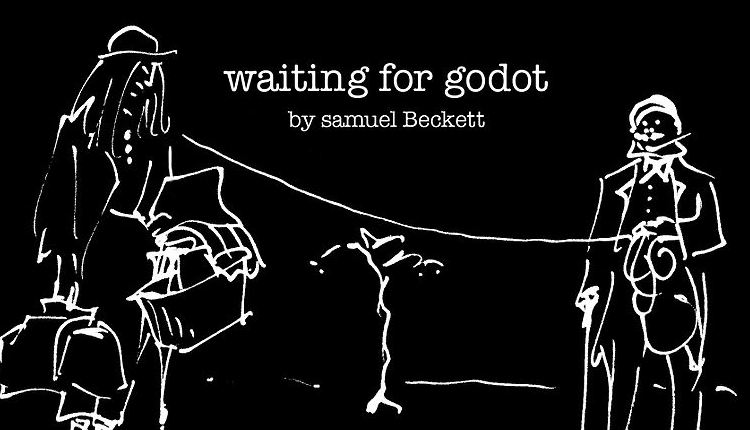
Image by Fewskulchor, via Wikimedia Commons
You may not know the name Bert Lahr, but you know his most beloved role: the Cowardly Lion in The Wizard of Oz. And while you may not have an intimate familiarity with Waiting for Godot, either Samuel Beckett’s script or any of the countless subtle variations in its productions on stage, you certainly know that it has challenged many an actor looking to shore up his avant-garde credentials. Lahr turns out to have stood at the vanguard of this phenomenon in America: seventeen years after his success in Oz but well before word of Godot had spread far beyond Europe, he played Estragon at Miami’s Coconut Grove Playhouse. It billed this piece of minimalist existentialism as “the laugh sensation of two continents” — a bit of absurdity itself somehow actually worthy of Beckett.
“The play was not so much a laugh riot as a revolution in theatrical storytelling; inevitably, it was met with militant incomprehension,” writes Lahr’s son, New Yorker drama critic John Lahr. “On opening night, half the audience walked out after the first act; the next day, there was a line at the box office—to return tickets.” He remembers his father’s struggle with the next, “the curious contradiction between his colossal insecurity about the meaning of the words that he struggled to learn and his adamant conviction of the emotional truth of the comedy contained in those perplexing words.” He also remembers what came after that disastrous Miami premiere: “the thrill of the re-staged Broadway production later that year, and Dad’s profound satisfaction at his succès d’estime in New York.”
You can hear a recording of this triumphant version of the Lahr-starring Godot, with television star E.G. Marshall as Vladimir and famed Viennese theater director Herbert Berghof at the helm) on Spotify. If you don’t have Spotify’s free software, you can download it here, or you can listen to the play at the Internet Archive. (It’s also streamable above.) “The 1956 production of Godot was Mr. Lahr’s show all the way,” writes Terry Teachout, listening again to the recording, “and to hear it now is to boggle at his seemingly infinite comic resourcefulness. He whines, he whimpers, he chortles, he grunts, giving each line precisely the right flavor. Yet never for a moment does his clowning conceal the play’s underlying pathos, and whenever he opens his mouth, it’s always Beckett, not Bert Lahr, that you hear.”
This recording will be added to our collection, 1,000 Free Audio Books: Download Great Books for Free.
Related Content:
Samuel Beckett Directs His Absurdist Play Waiting for Godot (1985)
Comics Inspired by Waiting For Godot, Featuring Tintin, Roz Chast, and Beavis & Butthead
Monsterpiece Theater Presents Waiting for Elmo, Calls BS on Samuel Beckett
The Great Gatsby and Waiting for Godot: The Video Game Editions
Based in Seoul, Colin Marshall writes and broadcasts on cities and culture. He’s at work on a book about Los Angeles, A Los Angeles Primer, the video series The City in Cinema, the crowdfunded journalism project Where Is the City of the Future?, and the Los Angeles Review of Books’ Korea Blog. Follow him on Twitter at @colinmarshall or on Facebook.
Read More...Watch Akira Kurosawa & Francis Ford Coppola in Japanese Whiskey Ads from 1979: The Inspiration for Lost in Translation
Francis Ford Coppola wasn’t the first or last Western celebrity to hawk booze in a Japanese commercial, but if you’re looking for the seed that sprouted into the funniest scene in his daughter Sophia’s Lost in Translation, here are the series of five ads in all their glory, in which the director shares a glass with one of his idols, Akira Kurosawa.
The year is 1979, and Coppola is deep in post-production for Apocalypse Now. While he is struggling with reels and reels from a troubled production, Akira Kurosawa, despite his stature in the world of cinema, is struggling with finances. His two films of the 1970s, Dodeskaden and Dersu Uzala, had been flops, despite some critical acclaim. At some point he had been so despondent wondering if he’d ever direct again, he had attempted suicide and was a heavy drinker.
But George Lucas and Coppola, learning of the director’s sad condition, convinced 20th Century Fox to put up the money for Kagemusha: The Shadow Warrior, Kurosawa’s return to the samurai films of his classic period. At the same time, Coppola agreed to be in a commercial for Suntory Whiskey alongside Kurosawa–who had shot some ads for them in 1976–just to get the director some more money. (Kurosawa’s fee was $30,000. And Coppola didn’t drink.)
For Suntory, the oldest distilling company in Japan, this meeting of East and West was a metaphor for their desire to break into the Western whiskey market. Using American celebrities like Sammy Davis Jr. established authenticity in the mind of the Japanese consumer, but this was a new level of prestige.
The series of ads above also show glimpses of Kurosawa in the midst of filming Kagemusha, shooting epic battles featuring samurai on horseback. The voice over is unsurprisingly (for this sophisticated market) pretentious:
“The world’s gaze is fixed on these two men right now as on nobody else. There’s no stronger friendship than that between these two men.” (The impact of that translation, you could say, is lost.)
Unlike Bill Murray’s character in Sophia Coppola’s film, Francis Ford Coppola really didn’t have to do much except show up, but no doubt the experience was re-told many times to his daughter over the years. And after the comeback of Kagemusha, Kurosawa went on to direct one of his best films, the King Lear-inspired Ran.
We’ll raise a glass to that.
Related Content:
The Best Japanese Commercial Ever? James Brown Sells Miso Soup
David Lynch Directs a Mini-Season of Twin Peaks in the Form of Japanese Coffee Commercials
Ted Mills is a freelance writer on the arts who currently hosts the artist interview-based FunkZone Podcast. You can also follow him on Twitter at @tedmills, read his other arts writing at tedmills.com and/or watch his films here.
Read More...“The Wonderground Map of London Town,” the Iconic 1914 Map That Saved the World’s First Subway System
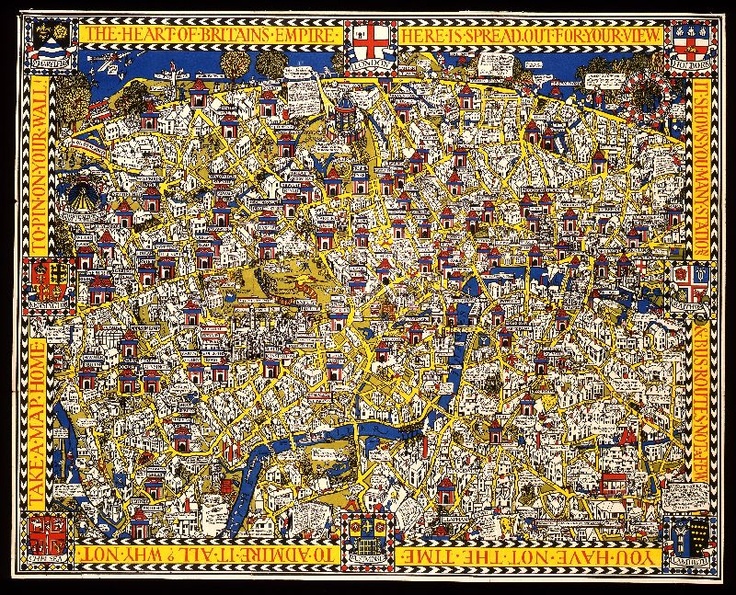
Most major world cities now boast far-reaching and convenient subway systems, but London will always have the original from which all the rest descend. It will also, arguably, always have, in the Tube, by far the most iconic. The Metropolitan Railway, the first underground train line to open in London and thus the first in the world, entered service in 1863. Other lines followed, run by several different companies, until, says Make Big Plans, all the operators “agreed on a joint marketing strategy in 1908 that featured the now familiar logo with a red disk and the word ‘Underground.’ ”
But by 1913, writes the BBC’s Emma Jane Kirby, “passengers are moaning about unpunctuality, about overcrowding, about confusion and dirt. The Tube, crammed on workdays (some 400,000 people now work in the heart of the city) is virtually empty at weekends and holidays and the company is fast losing money and public support. What we need, thinks [London Underground commercial director Frank] Pick, is stronger branding.” In addition to the immortal logo, he wanted “some eye-catching posters, distinct from general advertisement bills, that will make Londoners of all social classes proud to journey around their city and visit its attractions.”
But a transit system, even the formidable London Underground, is only as good as its maps. Eric Gill, the Arts and Crafts movement luminary who helped design the Tube’s typeface, asked his architect-cartographer-graphic designer brother MacDonald to come up with an eye-catching one. In the result, writes the Antiquarian Booksellers’ Association of America’s Elisabeth Burdon, “all the attractions and amenities of London are laid before the viewer in a manner which is both visually exciting and yet within a comprehensible structure; the city is presented in the manner of a medieval walled town, the curved horizon recalling the medieval world map’s enclosing circle, all bounded by a decorative border in which coats of arms evoke a sense of stability and tradition.”
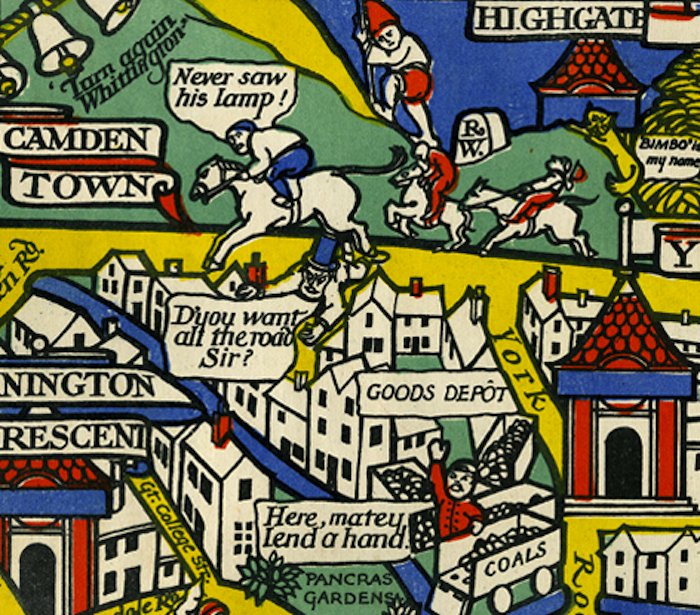
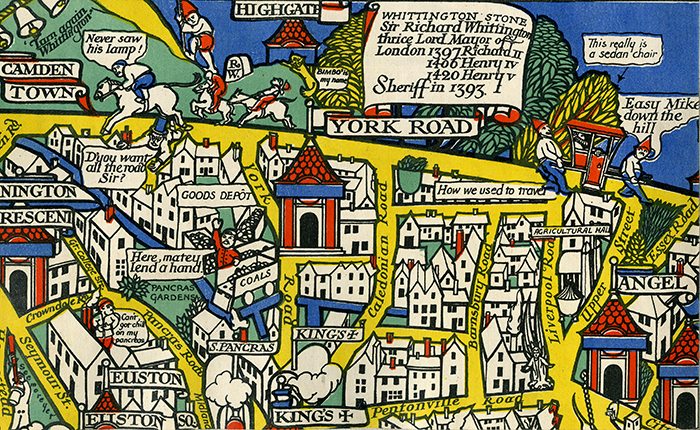
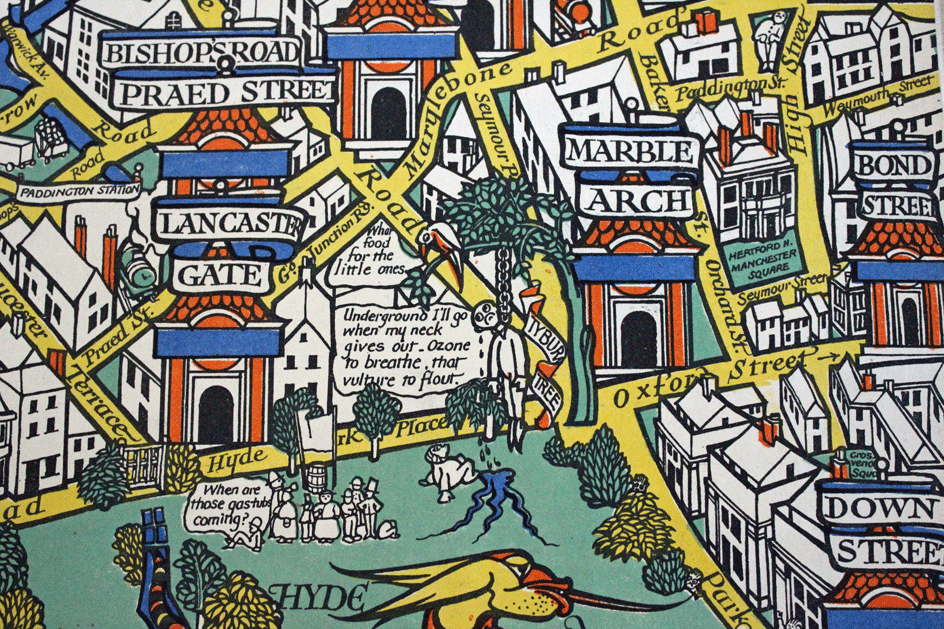
Apart from its degree of historical astuteness and cartographical soundness, Gill’s “Wonderground Map,” as Londoners came to call it, contained enough humor that some of the passengers who consulted it missed their trains due to sheer amusement. Kirby points out that, “on the Harrow Road, a farm worker tilling the soil cries ‘Harrowing work, this!’ an exclamation which is countered by the query ‘What is work, is it a herb?’ delivered by an effete gentleman nearby.” A sign placed at the map’s eastern edge points the way to “Victoria Park, Wanstead Flats, Harwich, Russia and other villages,” while “at Regent’s Park Zoo a prehistoric-looking bird eats a child through the bars of its cage as the child laments, ‘and I promised mother I’d be home for tea by five!’ ”
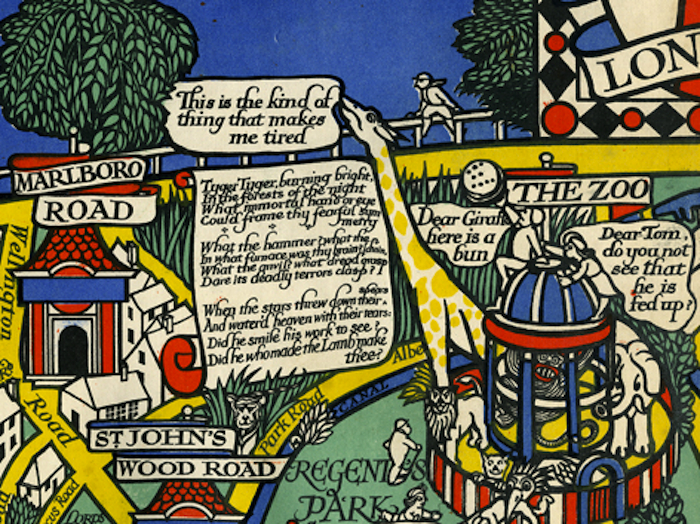
The Wonderground Map attained such popularity that it became the first London Underground poster sold commercially for homes and offices, and remains on sale more than a century later. You can view the whole thing online, and in zoomable detail, here; if you’d like a printable version, you can find one here. The history of London now credits it as having effectively “saved” the Tube, whose reputation for dysfunction and discomfort had reached a critical point. Newer subway systems elsewhere may have since made great technological leaps beyond the London Underground (as my ex-Londoner friends here in Seoul don’t hesitate to remind me), but we can safely say that none will ever inspire quite so beloved a work of cartography.
An alternative version of the map can be viewed and downloaded at the David Rumsey Map Collection.
Related Content:
A Wonderful Archive of Historic Transit Maps: Expressive Art Meets Precise Graphic Design
London Mashed Up: Footage of the City from 1924 Layered Onto Footage from 2013
1927 London Shown in Moving Color
2,000 Years of London’s Historical Development, Animated in 7 Minutes
Prize-Winning Animation Lets You Fly Through 17th Century London
The Curious Story of London’s First Coffeehouses (1650–1675)
The Birth of London’s 1950s Bohemian Coffee Bars Documented in a Vintage 1959 Newsreel
Based in Seoul, Colin Marshall writes and broadcasts on cities and culture. He’s at work on a book about Los Angeles, A Los Angeles Primer, the video series The City in Cinema, the crowdfunded journalism project Where Is the City of the Future?, and the Los Angeles Review of Books’ Korea Blog. Follow him on Twitter at @colinmarshall or on Facebook.
Read More...Carl Sagan & the Dalai Lama Meet in 1991 and Discuss When Science Can Answer Big Questions Better Than Religion
Images via Wikimedia Commons
In a 1997 essay in Natural History, Stephen Jay Gould (in)famously called the realms of religion and science “Nonoverlapping Magisteria”—a phrase that acknowledges both endeavors as equally powerful and important to human life. His theory entails “respectful discourse” and “constant input from both magisteria toward the common goal of wisdom.” Many partisans then and now have found the idea hopelessly naïve or misguided, and Gould did describe a rather specifically enlightened example of the position: a person seeking “a more spiritual view of nature” who also acknowledges “the factuality of evolution and other phenomena.” An educated skeptic, with mystical and poetic sensibilities.
The majority of religious believers do not fit this description. But some do. So too did Carl Sagan, to whom Gould dedicated his essay in a postscript. Sagan “shared my concern for fruitful cooperation between the different but vital realms of science and religion.” However, like Gould, Sagan gave the scientific method the override, and strenuously advocated that we all do likewise or become easily duped by charlatans or by our own flawed perceptions. Sagan acknowledged the cosmos as a great mystery—one he wanted to understand, not worship. And he spoke of the natural world with the kind of lyrical awe and reverence often reserved for the supernatural.
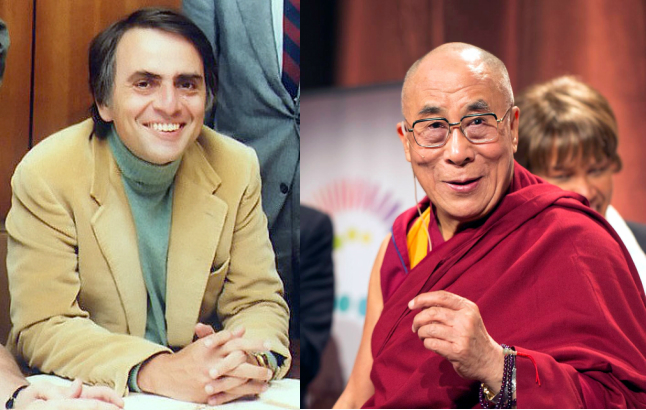
Sagan, in fact, organized and attended the meeting at the Vatican that occasioned Gould’s essay. He also found himself, in the early 1990s, connecting deeply with another world religious leader, the Dalai Lama. The exiled Tibetan Buddhist and the astrophysicist first met in Ithaca in 1991, sitting down for the discussion recorded in the video above. Unfortunately, the production quality renders this recording nearly unwatchable. Their conversion is audible but they both disappear into a pixelated blue blur. That said, the conversation merits preservation in any form (you can also read a transcript of their talk here).
Sagan puts to the Dalai Lama the question he asked every major religious leader he met with: “What happens if the doctrine of a religion—Buddhism let’s say—is contradicted by some finding, some discovery—in science, let’s say—what does a believer in Buddhism do in that case?” The answer below came very much as a surprise to Sagan, who later said the Dalai Lama “replied as no traditionalist or fundamentalist religious leaders do.”
DL: ‘For Buddhists that is not a problem. The Buddha himself made clear that the important thing is your own investigation. You should know the reality, no matter what the scripture says. In case you find a contradiction—opposite of the scriptures’ explanation—you should rely on that finding, rather than scripture.’
CS: ‘So, that is very much like science?’
DL: ‘Yes, that’s right. So I think that the basic Buddhist concept is that at the beginning it is worthwhile or better to remain skeptical. Then carry out experiments through external means as well as internal means. If through investigation things become clear and convincing, then it is time to accept or believe. If, through science, there is proof that after death there is no continuity of human mind, of life, then—theoretically speaking—Buddhists will have to accept that.’
Of course, many Buddhists may not find this surprising at all. The principles the Dalai Lama outlines are clearly outlined in the Kalama Sutta, a supposed discourse of the Buddha in which he issues a “Charter of Free Inquiry” as one interpretation has it. It is indeed a unique feature in world religions, though the Dalai Lama did add—“mischievously,” said Sagan—that “it will be hard to disprove reincarnation!” In such areas where a proposition cannot be falsified, religion and science may agree to disagree—civilly or otherwise—or change the subject. In the course of their acquaintance, Sagan and the Dalai Lama disagreed on very little.
When it comes to Buddhism, the Dalai Lama points out that the conversation between science and religion is hardly one-sided: “Some scientists also show a genuine and keen interest in Buddhist explanations…. One thing is quite clear: As far as mental sciences are concerned, Buddhism is very highly advanced.” The interest researchers and neuroscientists have shown in Buddhist psychology and meditative therapy has only increased in the past twenty-five years, such that entire departments devoted to mindfulness meditation have sprung up at venerable universities and respected medical schools.
And since Sagan’s death in 1996, the Dalai Lama has continued to reflect on the convergences between scientific discovery and Buddhism in his books and talks. And Sagan’s widow Ann Druyan has carried on Sagan’s legacy, sharing the awe and wonder of science with a popular audience through film, print, and television. In 2007, Druyan appeared at Cornell to talk about the affinities between Sagan and the Dalai Lama during their first and subsequent meetings. You can see her talk in full here.
Related Content:
Carl Sagan Presents His “Baloney Detection Kit”: 8 Tools for Skeptical Thinking
Carl Sagan Issues a Chilling Warning to America in His Final Interview (1996)
The Dalai Lama on the Neuroscience of Compassion
Josh Jones is a writer and musician based in Durham, NC. Follow him at @jdmagness
Read More...An Animated Aldous Huxley Identifies the Dystopian Threats to Our Freedom (1958)
20 years after Aldous Huxley published Brave New World (1931), he was still the media’s go-to futurist. Let me cite two examples:
In 1950, Redbook Magazine asked four experts (including Huxley) “what the world may look like fifty years hence?,” to which the author responded:
During the next fifty years mankind will face three great problems: the problem of avoiding war; the problem of feeding and clothing a population of two and a quarter billions which, by 2000 A.D., will have grown to upward of three billions, and the problem of supplying these billions without ruining the planet’s irreplaceable resources.
Then, in 1958, a young reporter named Mike Wallace had Huxley play prophet on a 30-minute TV show. Overpopulation gets discussed again. But then Huxley returns to some familiar dystopian themes, identifying some emerging threats to our freedoms.
- Overorganization: “Well another force which I think is very strongly operative in this country is the force of what may be called of overorganization. Er…As technology becomes more and more complicated, it becomes necessary to have more and more elaborate organizations, more hierarchical organizations, and incidentally the advance of technology is being accompanied by an advance in the science of organization.
It’s now possible to make organizations on a larger scale than it was ever possible before, and so that you have more and more people living their lives out as subordinates in these hierarchical systems controlled by bureaucracy, either the bureaucracies of big businesses or the bureaucracies of big government.”
- Abuse of new technologies: “There are certainly devices which can be used [to limit freedoms.] I mean, let us er…take after all, a piece of very recent and very painful history is the propaganda used by Hitler, which was incredibly effective.
I mean, what were Hitler’s methods? Hitler used terror on the one kind, brute force on the one hand, but he also used a very efficient form of propaganda, which er…he was using every modern device at that time. He didn’t have TV., but he had the radio which he used to the fullest extent, and was able to impose his will on an immense mass of people. I mean, the Germans were a highly educated people.
- Drugs: I mean, in this book that you mentioned, this book of mine, “Brave New World,” er…I postulated it a substance called ‘soma,’ which was a very versatile drug. It would make people feel happy in small doses, it would make them see visions in medium doses, and it would send them to sleep in large doses.…
If you want to preserve your power indefinitely, you have to get the consent of the ruled, and this they will do partly by drugs as I foresaw in “Brave New World,” partly by these new techniques of propaganda. They will do it by bypassing the sort of rational side of man and appealing to his subconscious and his deeper emotions, and his physiology even, and so, making him actually love his slavery.
Above, you can watch animated excerpts from Wallace’s interview with Huxley, courtesy of Blank on Blank. Find the complete original interview below, along with a transcript here.
Related Content:
Aldous Huxley Predicts in 1950 What the World Will Look Like in the Year 2000
Hear Aldous Huxley Read Brave New World
Huxley to Orwell: My Hellish Vision of the Future is Better Than Yours (1949)
Read More...Hear 9 Hours of Ennio Morricone’s Scores for Classic Western Films: From Sergio Leone’s Spaghetti Westerns to Tarantino’s The Hateful Eight
What goes into the making of a great film score? And how does a director/composer team like David Lynch and Angelo Badalamenti, or Sergio Leone and Ennio Morricone, form such a perfect partnership? Several days ago, we brought you video of Badalementi in a spirited, detailed recreation of how he and Lynch composed the unforgettable Twin Peaks’ themes, without which, I’d argue, there may have been no Twin Peaks.
Likewise, without the music of Morricone behind them, Leone’s spare, stylish, hard-boiled-yet-comic westerns may never have spearheaded the almost classical genre of the “Spaghetti Western,” known just as often for its music as for its visual language.
What does Morricone have to say about this? Precious little. Or so discovered Steely Dan’s Donald Fagen when he interviewed Morricone for Premiere magazine in August of 1989. Fagen is well known for his obsessive knowledge of culture high and low and his hip, theoretical bent. Morricone, we learn, works more intuitively. But the results are the same. We may equally find ourselves humming the refrain to “Peg” as the theme to The Good, the Bad & the Ugly.
And we may find ourselves pleasurably analyzing “Peg”’s ironic redeployment of soft rock tropes, just as we may approach Morricone’s inimitable style as critical theorists, as Fagen does when he asks the question below. Likely the most leading question in all of music journalism (with the exception of this Brian Eno interview):
But isn’t it true that the Leone films, with their elevation of mythic structures, their comic book visual style and extreme irony, are now perceived as signaling an aesthetic transmutation by a generation of artists and filmmakers? And isn’t it also true that your music for those films reflected and abetted Leone’s vision by drawing on the same eerie catalog of genres — Hollywood western, Japanese samurai, American pop, and Italian Opera? That your scores functioned both “inside” the film as a narrative voice and “outside” the film as the commentary of a winking jester? Put it all together and doesn’t it spell “postmodern,” in the sense that there has been a grotesque encroachment of the devices of art and, in fact, an establishment of a new narrative plane founded on the devices themselves? Isn’t that what’s attracting lower Manhattan?
Morricone: [shrugs]
Fagen quickly adapts, switches to rapid-fire questions to which Morricone gives a breezy one-word answer. “Bellissimo!” He’s a very busy man. He doesn’t live in the same world as those La Dolce Vita people, a “small group of people who got up at 11 P.M. and lived at night.” He wakes up at 5 in the morning. Morricone needn’t indulge us with stories or bore us with theoretical poses. His last words to Fagen, “I have always wanted to compose,” tell us what we need to know about him. Everything else is in the music.
Hear that music above in a five-hour playlist of some of Morricone best-known scores from his storied past—The Good, the Bad & the Ugly, A Fistful of Dollars, For a Few Dollars More, Once Upon a Time in the West, and non-Leone western, The Mercenary.
And Morricone’s still speaking through his western scores, as he did just recently in the work of another chatty, obsessive, heavily referential admirer—Quentin Tarantino’s The Hateful Eight, also in the playlist above. Bellissimo!
If you need Spotify’s free software, download it here.
Related Content:
The Classical Music in Stanley Kubrick’s Films: Listen to a Free, 4 Hour Playlist
Josh Jones is a writer and musician based in Durham, NC. Follow him at @jdmagness
Read More...Why Marvel and Other Hollywood Films Have Such Bland Music: Every Frame a Painting Explains the Perils of the “Temp Score”
Major motion pictures almost always have music, and that music usually comes composed especially for the movie. Every moviegoer knows this, of course, and most of them will by now be humming their favorite film-score music to themselves: themes from Star Wars, Jaws, The Godfather, the Indiana Jones or James Bond movies, and so on. But what about the music from more recent cinematic franchises? What about the music from the still-coming-out Marvel Comics movies, the most successful such franchise of all time? Why no memorable themes come to mind, much less hummable ones, constitutes the central question of the new video essay from Every Frame a Painting.
Its argument points to several different factors, including Marvel and other modern movies’ predictable use and overuse of music, as well as their tendency to put distracting layers of noise and dialogue on top of it. But the deeper problem, which has become systemic in the world of film scoring, has to do with something called “temp music,” which is what it sounds like: music temporarily used in a movie during editing before its real score gets composed. That sounds innocuous enough, but this video features a clip in which no less a prolific and respected composer than Danny Elfman describes temp music as “the bane of my existence,” and after watching it you’ll surely see — or rather, hear — why.
Temp music usually comes from the scores of other movies. With modern nonlinear editing technology, the director or editor can pick out tracks that approximate the envisioned tone of the work in progress and simply insert them into their scenes. But after hundreds upon hundreds of hours of watching the project scored with the temp music, the temp music starts to sound like the one true score, especially if the editor has cut tightly to it. “Make it sound like the temp music,” insist the orders too often given to the composer working on an “original” score for the film, which soon winds up as temp music itself on the next blockbuster-to-be in the editing room.
This musical ouroboros, which Every Frame a Painting demonstrates by playing a variety of scenes first with their temp music and then with their final score (with more such comparisons to watch in the supplementary video just above), has robbed even Hollywood’s highest-profile pictures — especially Hollywood’s highest-profile pictures — of an essential tool of evocation and emotion. But only a truly risk-taking filmmaker could break this cycle of blandness: a filmmaker like Stanley Kubrick who, working on 2001: A Space Odyssey, refused to use its commissioned score that (in Roger Ebert’s words) “like all scores, attempts to underline the action — to give us emotional cues.” Instead, he decided to score the movie with the likes of György Ligeti, Johann Strauss II, Aram Khachaturian and (speaking of memorable themes) Richard Strauss — all of which he had, of course, used as temp music.
via Metafilter
Related Content:
The Classical Music in Stanley Kubrick’s Films: Listen to a Free, 4 Hour Playlist
Jim Jarmusch: The Art of the Music in His Films
Quentin Tarantino Explains The Art of the Music in His Films
Moby Offers Up Free Music to Filmmakers
Based in Seoul, Colin Marshall writes and broadcasts on cities and culture. He’s at work on a book about Los Angeles, A Los Angeles Primer, the video series The City in Cinema, the crowdfunded journalism project Where Is the City of the Future?, and the Los Angeles Review of Books’ Korea Blog. Follow him on Twitter at @colinmarshall or on Facebook.
Read More...Frank Zappa Explains the Decline of the Music Business (1987)
“Remember the 60s?” says Frank Zappa in the interview above, “that era that a lot of people have these glorious memories of?… they really weren’t that great, those years.” Ever the grumpy uncle. But Zappa does get nostalgic for one thing, and it’s an unexpected one: the music business. “One thing that did happen in the 60s,” he says, “was some music of an unusual and experimental nature did get recorded, did get released.” The executives of the day were “cigar-chomping old guys who looked at the product and said, ‘I don’t know. Who knows what it is? Record it, stick it out. If it sells, alright!’”
“We were better off with those guys,” says Zappa, “than we are with the hip, young executives,” making decisions about what people should hear. The hippies are more conservative than the conservative “old guys” ever were. This Zappa of 1987 recommends getting back to the “who knows?” approach, “that entrepreneurial spirit” of the grand old industry barons of the 60s.
One can almost imagine Zappa—in the 60s—pining for the days of Edison, who refused to give up on the wax cylinder but would also record virtually anything. If both the time of Edison and the time of Zappa were bonanzas for makers of novelty records, so much the better. Zappa was novel.
Still it seems like a funny sentiment coming from a guy who built most of his career in opposition to the record industry. But it was in the period of alleged decay that Zappa broke with Warner Bros. and founded his own label in 1977, making a deal with Phonogram to distribute his releases in the U.S. When Phonogram refused to release his 1981 single “I Don’t Wanna Get Drafted,” Zappa created another label, Barking Pumpkin Records, making sure he got to make and sell the music he wanted to.
In many ways people like Zappa—or later Kate Bush or Prince—anticipated our current music industry, in which we have artists starting labels left and right, controlling their own production and output. But those artists are mostly a tiny handful of hugely successful stars with mogul-sized ambitions. Does this help or harm the music economy as a whole? Independent musicians very rarely get the smallest window on how things work at the level of Beyonce, Jay‑Z, or Taylor Swift (who “is the industry,” Bloomberg once breathlessly proclaimed). But as Zappa notes, “the person in the executive chair may not be the final arbiter of taste for the entire population.” Even if those executives are themselves artists, we may greatly benefit from a wider range of “unusual and experimental” sounds in popular culture. Zappa suggests the way to do that is to get the “cigar-chomping old guys” (and they were all guys) back in charge.
The rest of Zappa’s interview concerns the bogeyman of 80s and 90s music, the PMRC, and his very strong feelings about censorship, social control, and sex. It’s classic Zappa and won’t raise any eyebrows now, but it is interesting to hear his take on the decline of the music business since the 60s. We use different criteria to measure the apex of the industry—often depending on whether the labels or the artists made more money. Whichever period we lionize, for whatever reason, within a hundred-year window a tiny handful of musicians and record executives made enormous, dynasty-making fortunes. It just so happens that these days it’s an even tinier handful of musicians and executives at the top, making even huger fortunes. And there’s a lot more synergy between them.
Related Content:
Hear the Musical Evolution of Frank Zappa in 401 Songs
Brian Eno Explains the Loss of Humanity in Modern Music
Josh Jones is a writer and musician based in Durham, NC. Follow him at @jdmagness
Read More...Deconstructing Saving Private Ryan’s Epic Opening Battle Scene: How Spielberg Captures Chaos with Clarity
Not long after Saving Private Ryan came out, the buzz had it that, had nothing but a two-hour blank screen followed its opening sequence depicting the Omaha Beach assault of June 6, 1944, Steven Spielberg would still win an Oscar. The genre of war movies, which goes almost as far back as the medium of cinema itself, falls into periodic exhaustion, but the director of blockbusters like Jaws and E.T. had managed to revitalize it. How did he and his collaborators pull it off, starting with the harrowing World War II battle scene to end all harrowing World War II battle scenes?
Spielberg and company faced one challenge above all others: “the sequence had to be chaotic and coherent at the same time,” says video essayist Evan Puschak, better known as the Nerdwriter, in his examination of Saving Private Ryan’s first 28 minutes. All battle scenes try, in one way or another and to varying degrees of success, to depict the near-incomprehensible unpredictability and violence of military combat in a comprehensible manner, but this one accomplishes that goal to an extent many astonished viewers may never have thought possible.
A dozen years earlier, Tony Scott’s Top Gun did something similar with its unusually non-disorienting depiction of aerial dogfighting, but no two films could have a more different attitude to war itself. In Saving Private Ryan, Spielberg set the glory to one side and showed all the (often literally) gory details that even avid viewers of World War II movies don’t usually see. Borrowing the visual style from the historical newsreel footage shot on the ground at Omaha Beach and elsewhere, Spielberg also deliberately fills every frame with as much detail of the action as possible, which those real-life cameramen had to shoot on the fly.
“The Omaha Beach scene might seem like the craziest, fastest, most intense scene in all of film,” says Puschak, but he calculates an “incredibly high” average shot length of 7.2 seconds. Instead of cutting, cutting, and cutting some more, Spielberg uses his signature purposeful camera movement and (relatively) long takes to place, and keep, the viewer in the midst of this harrowing event. The scene came out feeling so real that it actually triggered post-traumatic stress disorder symptoms in some of the veterans who went to see it — surely not Spielberg’s intention, but proof positive of his ability to “capture chaos with clarity.”
Related Content:
Great “Filmumentaries” Take You Inside the Making of Spielberg’s Raiders of the Lost Ark & Jaws
Learn the Elements of Cinema: Spielberg’s Long Takes, Scorsese’s Silence & Michael Bay’s Shots
Resurrecting the Sounds of Abraham Lincoln in Steven Spielberg’s New Biopic
Based in Seoul, Colin Marshall writes and broadcasts on cities and culture. He’s at work on a book about Los Angeles, A Los Angeles Primer, the video series The City in Cinema, the crowdfunded journalism project Where Is the City of the Future?, and the Los Angeles Review of Books’ Korea Blog. Follow him on Twitter at @colinmarshall or on Facebook.
Read More...Support Us
We're hoping to rely on loyal readers, rather than erratic ads. Please click the Donate button and support Open Culture. You can use Paypal, Venmo, Patreon, even Crypto! We thank you!

About Us

Open Culture scours the web for the best educational media. We find the free courses and audio books you need, the language lessons & educational videos you want, and plenty of enlightenment in between.
Advertise With Us

FREE UPDATES!
GET OUR DAILY EMAIL
Get the best cultural and educational resources on the web curated for you in a daily email. We never spam. Unsubscribe at any time.
FOLLOW ON SOCIAL MEDIA

Open Culture editor Dan Colman scours the web for the best educational media. He finds the free courses and audio books you need, the language lessons & movies you want, and plenty of enlightenment in between.
Advertise With Us


