When 20,000 Americans Held a Pro-Nazi Rally in Madison Square Garden
Above, two-time Academy Award nominee Marshall Curry presents A Night at The Garden, a film that revisits a night in February 1939 when “20,000 Americans rallied in New York’s Madison Square Garden to celebrate the rise of Nazism — an event largely forgotten from U.S. history.” As we described it back in 2017, the film documents the following scene:
What you’re looking at is the 1939 “Pro-American Rally” (aka Pro-Nazi Rally) sponsored by the German American Bund at Madison Square Garden on George Washington’s 207th Birthday. Banners emblazoned with such slogans as “Stop Jewish Domination of Christian Americans,” “Wake Up America. Smash Jewish Communism,” and “1,000,000 Bund Members by 1940” decorated the great hall.
New York City Mayor Fiorello LaGuardia—an Episcopalian with a Jewish mother—considered canceling the event, but ultimately he, along with the American Jewish Committee and the American Civil Liberties Committee decreed that the Bund was exercising its right to free speech and free assembly.
A crowd of 20,000 filled the famous sports venue in mid-town Manhattan to capacity. 1,500 police officers were present to render the Garden “a fortress impregnable to anti-Nazis.” An estimated 100,000 counter-demonstrators were gathering outside.…
The most disturbing moment in the short film comes at the 3:50 mark, when another security force—the Bund’s Ordnungsdienst or “Order Service” pile on Isidore Greenbaum, a 26-year-old Jewish worker who rushed the podium where bundesführer Fritz Julius Kuhn was fanning the flames of hatred. Valentine’s men eventually pulled them off, just barely managing to save the “anti-Nazi” from the vicious beating he was undergoing.
Made entirely from archival footage filmed that night, A Night at The Garden “transports audiences to this chilling gathering and shines a light on the power of demagoguery and anti-Semitism in the United States.” You can learn more about the film and the 1939 rally at Marshall Curry’s web site.
Any similarity to actual persons, living or dead, or other xenophobic rallies being held this weekend in Madison Square Garden is purely coincidental, of course.
Trump rally speaker: “And these Latinos, they love making babies too. Just know that. They do. They do. There’s no pulling out. They don’t do that. They come inside. Just like they did to our country.” pic.twitter.com/ZV0Q3VtUJ8
— PatriotTakes 🇺🇸 (@patriottakes) October 27, 2024
not america first.
americans only.the opposite of everything i believe. but we’ll see what americans want. pic.twitter.com/kdvaky1ypq
— ian bremmer (@ianbremmer) October 28, 2024
Tucker Carlson calls VP Harris “a Samoan, Malaysian, low IQ former California prosecutor.” pic.twitter.com/IR9Qb7qXhu
— Republican Voters Against Trump (@AccountableGOP) October 27, 2024
To ALL Puerto Ricans, this is what this guy just said at Donald Trump’s fascist gathering in Madison Square Garden. And don’t forget that Trump forced Puerto Rico to wait TWO YEARS for full hurricane relief. Your vote counts. Make it for #HarrisWalz. pic.twitter.com/hNh3Ae06Iz
— rolandsmartin (@rolandsmartin) October 27, 2024
Related Content
Toni Morrison Lists the 10 Steps That Lead Countries to Fascism (1995)
Rick Steves Tells the Story of Fascism’s Rise & Fall in Germany
Read More...Hear 2.5 Hours of the Classical Music in Haruki Murakami’s Novels: Liszt, Beethoven, Janáček, and More
Haruki Murakami’s hit novel 1Q84 features a memorable scene in a taxicab on a gridlocked freeway whose radio is playing Leoš Janáček’s Sinfonietta. “It is, as the book suggests, truly the worst possible music for a traffic jam,” writes Sam Anderson in a New York Times Magazine profile of the novelist: “busy, upbeat, dramatic — like five normal songs fighting for supremacy inside an empty paint can.” Murakami tells Anderson that he “chose the Sinfonietta because that is not a popular music at all. But after I published this book, the music became popular in this country… Mr. Seiji Ozawa thanked me. His record has sold well.”
In addition to being a world-famous conductor, the late Ozawa was also, as it happens, a personal friend of Murakami’s; the two even published a book, Absolutely on Music, that transcribes a series of their conversations about the former’s vocation and the latter’s avocation, a distinction with an unclear boundary in Murakami’s case.
“I have lots of friends who love music, but Haruki takes it way beyond the bounds of sanity,” writes Ozawa, and indeed, Murakami has always made music a part of his work, both in his process of creating it and in its very content. His books offer numerous references to Western pop (especially of the nineteen-sixties), jazz, and also classical recordings — fifteen of which you can hear in the video from NTS radio above.
We’ve previously featured NTS, the London-based online radio station known for its deep dives on themes from spiritual jazz to Hunter S. Thompson, for its “Haruki Murakami Day” broadcast of music from his novels. Opening with Le mal du pays from Franz Liszt’s Années de pèlerinage, the NTS Guide to Classical Music from Murakami Novels continues on to “Vogel als Prophet” from Robert Schumann’s Waldszenen, and thereafter includes Beethoven’s Symphony No. 7 In A Major, Mendelssohn’s Cleveland Quartet, Wagner’s Der Fliegende Holländer, and much else besides. You may not be able to recall where you’ve seen all of these pieces mentioned in Murakami’s work right away, but you’ll surely recognize the Sinfonietta the moment it comes along.
Related content:
Haruki Murakami’s Passion for Jazz: Discover the Novelist’s Jazz Playlist, Jazz Essay & Jazz Bar
A 3,350-Song Playlist of Music from Haruki Murakami’s Personal Record Collection
A 26-Hour Playlist Featuring Music from Haruki Murakami’s Latest Novel, Killing Commendatore
Based in Seoul, Colin Marshall writes and broadcasts on cities, language, and culture. His projects include the Substack newsletter Books on Cities and the book The Stateless City: a Walk through 21st-Century Los Angeles. Follow him on Twitter at @colinmarshall or on Facebook.
Read More...A Short Visual History of America, According to the Irreverent Comic Artist R. Crumb
As a founder of the “underground comix” movement in the 1960s, R. Crumb is either revered as a pioneering satirist of American culture and its excesses or reviled as a juvenile purveyor of painfully outmoded sexist and racist stereotypes. Crumb doesn’t apologize. He keeps working, and his fans are grateful. He has parlayed his sexual obsessions and outsider relationship to black culture into an intriguing vision of the country that reflects its own fixations as much as those of the artist/author of comics like Zap and Weirdo.
But Crumb’s work—permeated by drug use, pop-culture references, skirt-chasing oversexed men, very specifically shaped (and always sexually available) women, and all sorts of creepy underground characters—has another side: an almost sentimental attachment to purist Americana from the late-nineteenth/early-twentieth century. Most notably Crumb is an antiquarian collector of old-time music—country, jazz, ragtime, the blues—as well as a musical interpreter of the same. One of my favorites of his books collects a series of trading cards he made into R. Crumb’s Heroes of Blues, Jazz & Country, a reverential set of illustrations of folk musicians, accompanied by a CD of Crumb-curated music.
Crumb’s love for simpler times is more than the passion of an aficionado. It is the flip side of his satire, a genre that cannot flourish as a critique of the present without a corresponding vision of a golden age. For Crumb, that age is pre-WWII, pre-industrial, rural—a time, as he has put it in an interview, when “people could still express themselves.” His experience with the slop of American popular culture was decidedly less idyllic. Ian Buruma writes in The New York Review of Books:
Crumb, like his brothers, soaked up the TV and comics culture of the 1950s: Howdy Doody, Donald Duck, Roy Rogers, Little Lulu, and the like. While on LSD, in the 1960s, Crumb thought of his mind as “a garbage receptacle of mass media images and input. I spent my whole childhood absorbing so much crap that my personality and mind are saturated with it. God only knows if that affects you physically!”
Crumb’s comic art—which he has described in almost therapeutic terms as an emptying of his “garbage receptacle” unconscious—is balanced by his more sober and nostalgic illustrations, the counterweight to the “crap” of his childhood media exposure. One might even think of Crumb’s consumption of old-time music and imagery as a kind of cultural health food diet. One of the most popular of his nostalgic works is “A Short History of America” (1979), a series of panels showing the shift from open countryside, to the town settlements brought by the railroads, to the gross overdevelopment of the late-twentieth century. The only text besides the title (and the burgeoning billboards and street signs) is a coda at the bottom-right-hand of the last panel asking, “What next?!!!” You can see the comic animated above (top), set to an old-time piano piece. Another fitting version of his vision of the country’s growth (or ruination) is above, in color, scored by Joni Mitchell’s “Big Yellow Taxi.” See the full series of images here and here, and be sure to check out Crumb’s three epilogue speculations on what’s next.
Note: An earlier version of this post originally appeared on our site in 2013.
Related Content:
R. Crumb Describes How He Dropped LSD in the 60s & Instantly Discovered His Artistic Style
Robert Crumb Illustrates Philip K. Dick’s Infamous, Hallucinatory Meeting with God (1974)
Josh Jones is a writer and musician based in Durham, NC. Follow him at @jdmagness
Read More...The Evolution of Cinema: Watch Nearly 140 Years of Film History Unfold in 80 Minutes
The video above from YouTuber Alex Day includes clips from about 500 movies, and you’ve almost certainly seen more than a few of them. Battleship Potemkin, Dumbo, Rear Window, Dr. No, The Godfather, E. T. the Extra-Terrestrial, Top Gun, Braveheart, Gladiator, Inception: we’re not talking about obscurities here. Whether or not you count them among your personal favorites, these motion pictures have all become near-universally known for good (and/or Oscar-related) reasons, some of which may come back to mind as you watch the history of cinema visually retold through a feature-length string of their especially recognizable scenes.
Though genre pictures dominate, “I have not selected those films that marked the development of a genre or film stream,” Day writes. “I have selected the most popular and better known ones by people. That’s why I’ve included so many American movies and less of other countries, because a lot of the most famous movies throughout history are from the U.S.” (Hence, for example, the absence of Hideo Nakata’s influential piece of “J‑horror” Ringu and the presence of Ringu, its Hollywood remake from a few years later.) No matter where in the world you happen to be, a reference to Rocky, Back to the Future, or Home Alone — or any work of Steven Spielberg, a major presence in the video — can go a surprisingly long way.
No matter how popular these movies are, it would be the rare viewer indeed who could claim familiarity with each and every one of them. Almost inevitably, the experience of watching this video turns into a game of seen-it-or-not, which sheds light on the most intensive periods of your life in filmgoing. For my part, I must have watched almost every movie included from around the turn of the millennium, when I was just coming of age as a cinephile (and when even mainstream cinema, coincidentally or otherwise, was in an especially inventive period). It recently gave me pause to hear that American Psycho is now being remade — but then, having come out nearly a quarter-century ago, it’s presumably settled into its place in cinema history.
Related content:
The Most Beautiful Shots in Cinema History: Scenes from 100+ Films
The History of the Movie Camera in Four Minutes: From the Lumiere Brothers to Google Glass
Hollywood: Epic Documentary Chronicles the Early History of Cinema
Cinema History by Titles & Numbers
Based in Seoul, Colin Marshall writes and broadcasts on cities, language, and culture. His projects include the Substack newsletter Books on Cities and the book The Stateless City: a Walk through 21st-Century Los Angeles. Follow him on Twitter at @colinmarshall or on Facebook.
Read More...B.B. King Changes a Broken Guitar String Mid-Song at Farm Aid, and Doesn’t Miss a Beat (1985)
The scene is Farm Aid, 1985, attended by a crowd of 80,000 people. The song is “How Blue Can You Get.” And the key moment comes at the 3:10 mark, when the blues legend B.B. King breaks a guitar string, then manages to replace it before the song finishes minutes later. All the while, he keeps the song going, never missing a beat and singing the blues. Enjoy.
If you would like to support the mission of Open Culture, consider making a donation to our site. It’s hard to rely 100% on ads, and your contributions will help us continue providing the best free cultural and educational materials to learners everywhere. You can contribute through PayPal, Patreon, and Venmo (@openculture). Thanks!
Related Content:
B.B. King Plays Live at Sing Sing Prison in One of His Greatest Performances (1972)
The Thrill is Gone: See B.B. King Play in Two Electric Live Performances
Chuck Berry Takes Keith Richards to School, Shows Him How to Rock (1987)
B.B. King Plays “The Thrill is Gone” with Slash, Ron Wood & Other Legends
Read More...
Spin the 17th-Century Death Roulette Wheel & Find Out What Would Have Killed You in 1665
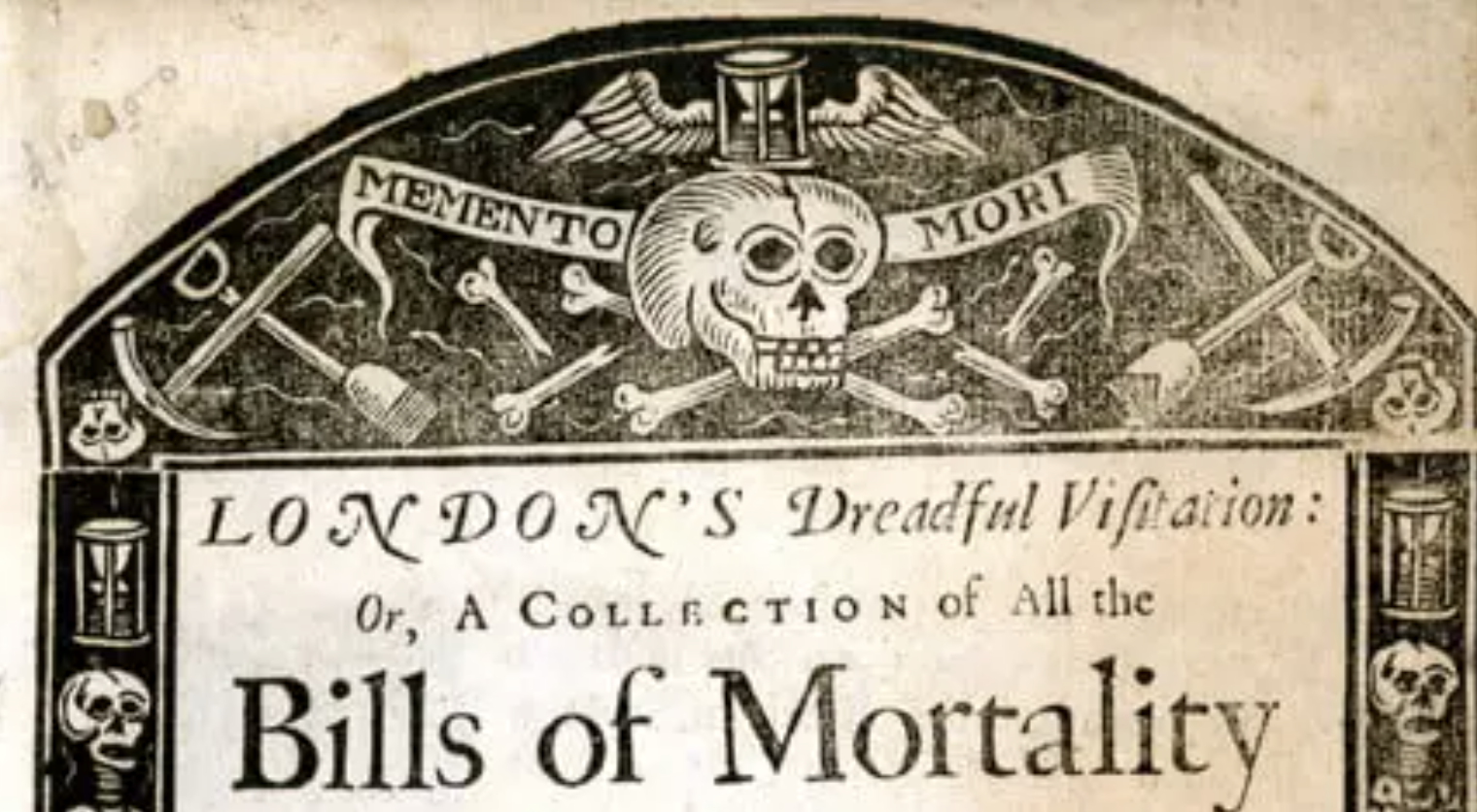
A common historical misconception holds that, up until a few centuries ago, everyone died when they were about 40. In fact, even in antiquity, one could well make it to what would be considered an advanced age today — assuming one survived the great mortal peril of childhood, and then all the dangers that could befall one in all the stages of life thereafter. In the mid-seventeenth century, with the Dark Ages past and the Industrial Revolution just ahead, these threats to life included consumption, dropsy, “griping in the guts,” sciatica, “stopping of the stomach,” and of course, plague.
This information comes from the London “mortality bill” seen below, which “represents the death tally of all city parishes for the week of Aug. 15–22, 1665, when the plague had infected 96 of the 130 parishes reporting.”
So writes Rebecca Onion at Slate, who cites Shakespeare’s Restless World author Neil MacGregor as saying that “the bills cost about a penny, and were published in large print runs.” But “if medicine was still somewhat uncertain about the causes of death, those in charge of toting up deaths for the bills of mortality were even more so,” resulting in vague categorizations like “bedridden,” “frightened,” “lethargy,” and “surfeit.”
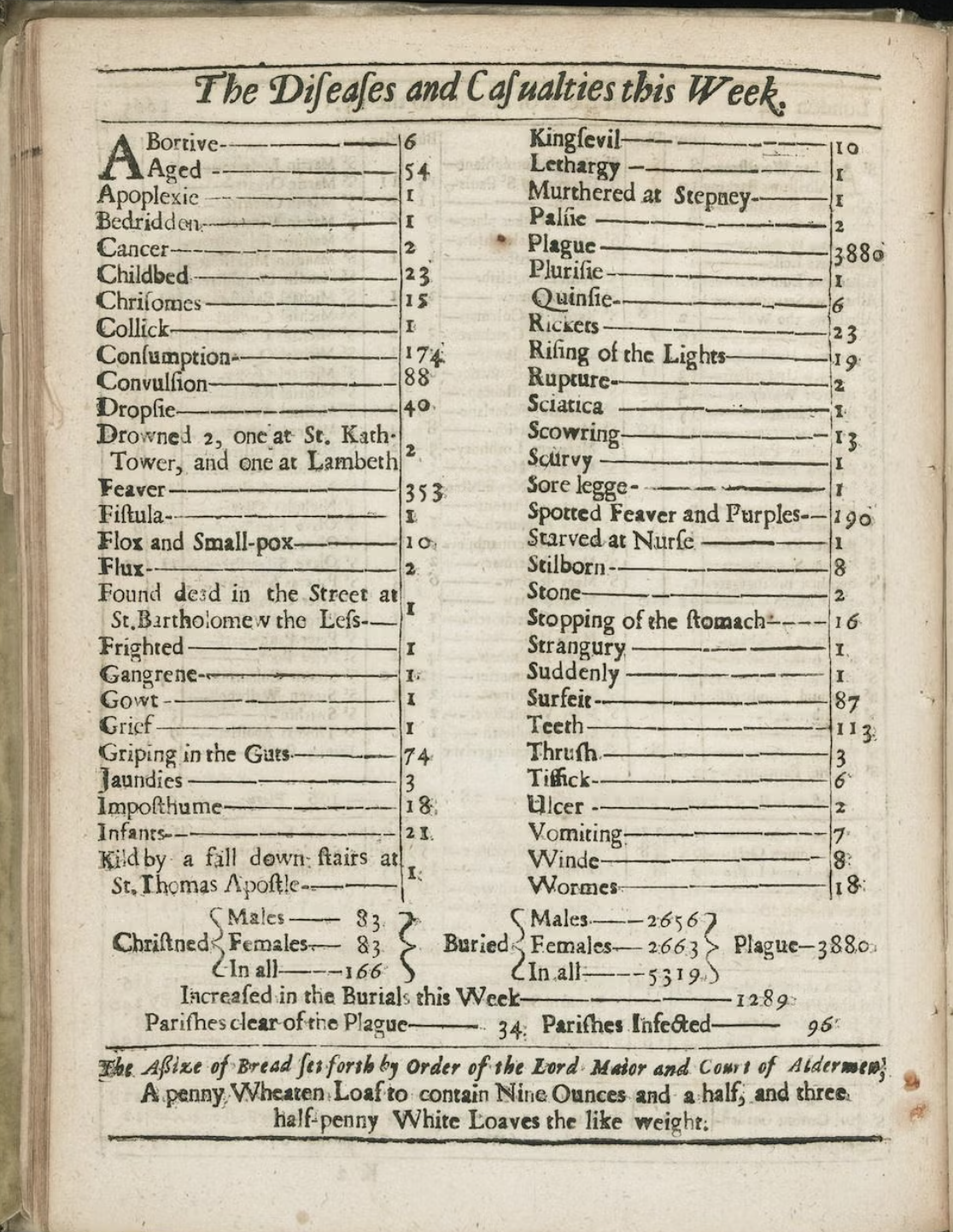
You may receive one of those fates when you spin the wheel of 17th-Century Death Roulette, a web application that cycles rapidly through mortality bills and the types of death listed therein. “In the week of July 11th, 1665 you died from Palsie.” “In the week of February 14th, 1665 you died from Kild accidentally with a Carbine, at St. Michael Wood Street.” “In the week of December 12th, 1665 you died from Winde.” Your results may not reflect the actuarial probability of what might have killed a given Londoner in that year, but all this death does, perhaps ironically, give a vivid impression of life at the time. Personally, I’m curious how dangerous those stairs at St Thomas the Apostle really were, but given that the whole church burned down in the Great Fire of the very next year, I suppose we’ll never know. Play the 17th-Century Death Roulette here.
via Metafilter
Related content:
The History of the Plague: Every Major Epidemic in an Animated Map
A 1665 Advertisement Promises a “Famous and Effectual” Cure for the Great Plague
Isaac Newton Conceived of His Most Groundbreaking Ideas During the Great Plague of 1665
Based in Seoul, Colin Marshall writes and broadcasts on cities, language, and culture. His projects include the Substack newsletter Books on Cities and the book The Stateless City: a Walk through 21st-Century Los Angeles. Follow him on Twitter at @colinmarshall or on Facebook.
Read More...Andy Warhol’s One Minute of Professional Wrestling Fame (1985)
Andy Warhol did for art what the World Wrestling Federation (WWF) did for wrestling. He made it a spectacle. He made it something the “everyman” could enjoy. He infused it with celebrity. And, some would say, he cheapened it too.
Looking back, it makes perfect sense that Warhol frequented wrestling shows at Madison Square Garden during the 1970s and 80s. And here we have him appearing on camera at The War to Settle the Score, a WWF event that aired on MTV in 1985. Hulk Hogan battled “Rowdy” Roddy Piper in the main event. But, the sideshow included (let’s get in the Hot Tub Time Machine) the likes of Cyndi Lauper, Mr. T, and Andy too.
If you’re familiar with the 1980s professional wrestling script, you know that Mean Gene Okerlund conducted backstage and ringside interviews with the wrestlers, giving them the chance to pound their chests and gas off. When Okerlund turned to Warhol and asked for his hot take on the Hogan/Piper match, Warhol couldn’t muster very much. “I’m speechless.” “I just don’t know what to say.” And, before you know it, his one minute of professional wrestling fame was over. Just like that.…
Related Content
When Andy Warhol Guest-Starred on The Love Boat (1985)
Read More...Built to Last: How Ancient Roman Bridges Can Still Withstand the Weight of Modern Cars & Trucks
A foreign traveler road-tripping across Europe might well feel a wave of trepidation before driving a fully loaded modern automobile over a more than 2,000-year-old bridge. But it might also be balanced out by the understanding that such a structure has, by definition, stood the test of time — and, for those with a grasp of the history of engineering, that its ancient designers would have ensured its capacity to bear a load far heavier than any that would have crossed it in reality. With no scientific means of modeling stresses, as classical-history Youtuber Garrett Ryan explains in the new Told in Stone video above, they just had to build it tough.
Key to that toughness were arches, “made of heavy blocks laid over a falsework frame until the keystone was slotted into place.” From the late first century, stonework was supplemented or replaced by brick and Roman concrete, a substance much-featured here on Open Culture.
We’ve also covered the Roman bridges you can still cross today: Spain’s Puente de Alcántara (from the Arabic al-qanţarah, meaning “arch”), for example, which, though crossed by a quarter-million vehicles every year, “shows no signs of failing”; or France’s Pont des Marchands, which “has supported a neighborhood of multi-story shops and houses since the Middle Ages.”
But the arches of the nearly 1,000 wholly or partially surviving Roman bridges haven’t done all the work by geometry alone. “The load-bearing capacity of a bridge depended both on the solidity of its abutments and the strength — ‘shearing point’ — of its voussoirs,” or the stones of its arches between the keystone at the top and the springers at the bottom. “Since Roman builders carved voussoirs from the strongest readily available stone, their bridges tended to be impressively solid.” You wouldn’t want to run a freight train across the Puente de Alcántara, but 40-ton trucks are no problem — to say nothing of a car filled with luggage, a few kids, and even a dog or two.
Related content:
The Roman Roads and Bridges You Can Still Travel Today
The Mystery Finally Solved: Why Has Roman Concrete Been So Durable?
The Roads of Ancient Rome Visualized in the Style of Modern Subway Maps
Roman Architecture: A Free Online Course from Yale
Based in Seoul, Colin Marshall writes and broadcasts on cities, language, and culture. His projects include the Substack newsletter Books on Cities and the book The Stateless City: a Walk through 21st-Century Los Angeles. Follow him on Twitter at @colinmarshall or on Facebook.
Read More...How Man Ray Reinvented Himself & Created One of the Most Iconic Works of Surrealist Photography
It would surprise none of us to encounter a young artist looking to cast off his past and make his mark on the culture in a place like Williamsburg. But in the case of Man Ray, Williamsburg was his past. One must remember that the Brooklyn of today bears little resemblance to the Brooklyn of the early twentieth century in which the famed avant-gardist grew up. Back then, he was known as Emmanuel Radnitzky, the son of immigrant garment workers. It was after he took up the art life in Manhattan that he met the gallerist Alfred Stieglitz, forming an association that would begin his transformation from aspiring painter into form-changing photographer.
Inspired by Marcel Duchamp’s Nude Descending a Staircase, No. 2 after seeing it at the epoch-making 1913 Armory Show, Ray befriended the artist himself. Despite its considerable language barrier, this relationship gave him a way into the liberating realms of surrealism in general and Dada in particular. “The movement’s refusal to be defined or codified gave Ray the rationale to leave his former life and head to Paris, where he could complete his reinvention unfettered by his past,” says James Payne in the new Great Art Explained video above. It was this relocation — almost as dramatic, in those days, as going from Brooklyn to Manhattan — that offered him the chance to become a major artistic figure.
Soon after settling in Montparnasse, Ray “made an accidental rediscovery of the camera-less photogram, which he called ‘Rayographs.’ ” This technique, which involved placing objects on photosensitive paper and then exposing the arrangement to light, produced images that were “dubbed pure Dada creations” and “played a significant role in redefining photography as a medium capable of abstraction and conceptual depth.” It was in that same part of town that he entered into an artistic and romantic partnership with Alice Prin, more widely known as Kiki de Montparnasse — and even more widely known, a century later, as Le Violon d’Ingres, which in 2022 became the most expensive photograph ever sold.
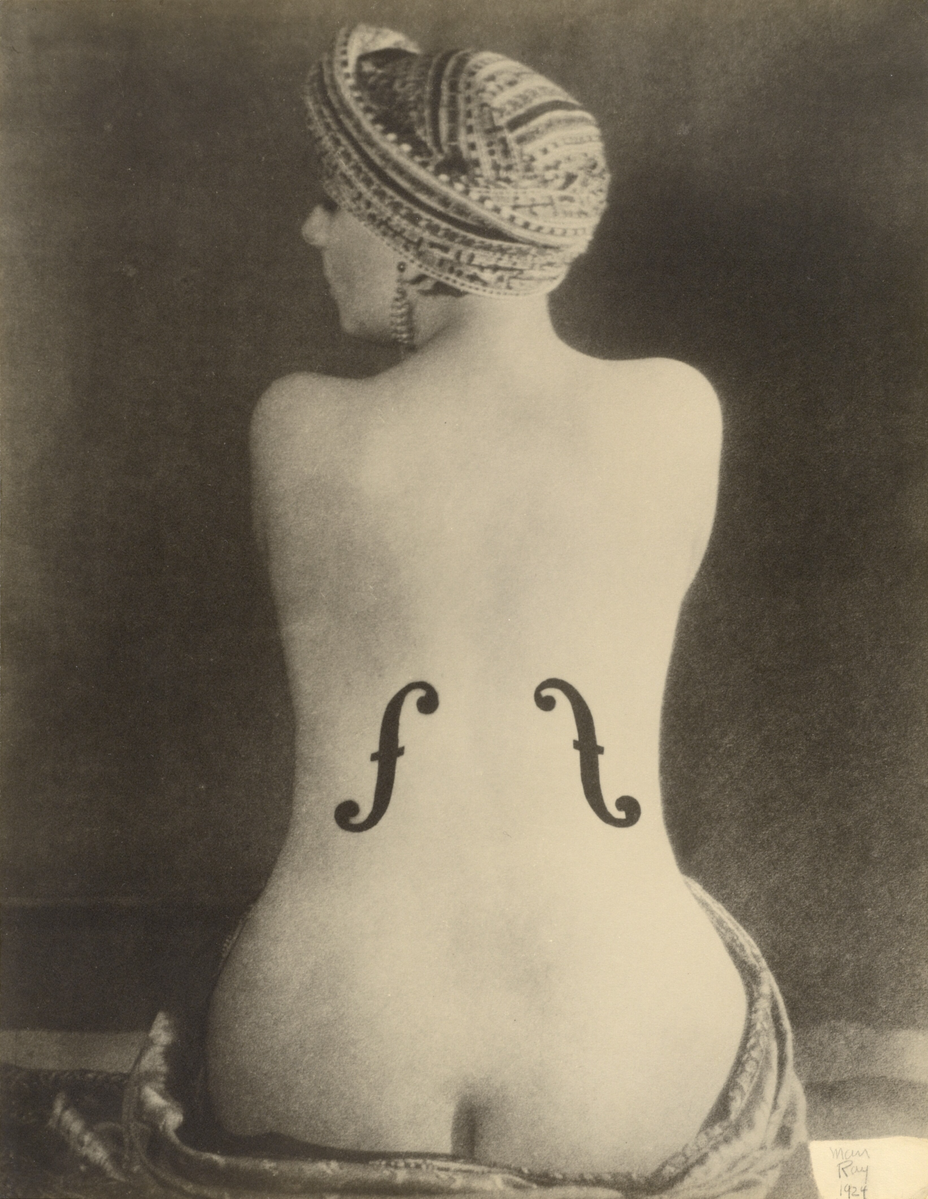
The $12.4 million sale price of Le Violon d’Ingres is rather less interesting than the story behind it, which involves not just Ray and Kiki’s life together, but also a process of technical experimentation whose result “perfectly embodies the surrealist interest in challenging traditional representations and blending everyday objects with the human form.” Tame though it may look in the era of Photoshop (to say nothing of AI-generated imagery), the picture’s convincing placement of violin-style sound holes on Kiki’s classically presented body suggested to its viewers that photography had non-documentary possibilities never before imagined — certainly not in Williamsburg, anyway.
Related content:
Man Ray and the Cinéma Pur: Watch Four Groundbreaking Surrealist Films From the 1920s
Man Ray’s Portraits of Ernest Hemingway, Ezra Pound, Marcel Duchamp & Many Other 1920s Icons
The Home Movies of Two Surrealists: Look Inside the Lives of Man Ray & René Magritte
Alfred Stieglitz: The Eloquent Eye, a Revealing Look at “The Father of Modern Photography”
Based in Seoul, Colin Marshall writes and broadcasts on cities, language, and culture. His projects include the Substack newsletter Books on Cities and the book The Stateless City: a Walk through 21st-Century Los Angeles. Follow him on Twitter at @colinmarshall or on Facebook.
Read More...Take The Near Impossible Literacy Test Louisiana Used to Suppress the Black Vote (1964)

In William Faulkner’s 1938 novel The Unvanquished, the implacable Colonel Sartoris takes drastic action to stop the election of a black Republican candidate to office after the Civil War, destroying the ballots of black voters and shooting two Northern carpetbaggers. While such dramatic means of voter suppression occurred often enough in the Reconstruction South, tactics of electoral exclusion refined over time, such that by the mid-twentieth century the Jim Crow South relied largely on nearly impossible-to-pass literacy tests to impede free and fair elections.
These tests, writes Rebecca Onion at Slate, were “supposedly applicable to both white and black prospective voters who couldn’t prove a certain level of education” (typically up to the fifth grade). Yet they were “in actuality disproportionately administered to black voters.”
Additionally, many of the tests were rigged so that registrars could give potential voters an easy or a difficult version, and could score them differently as well. For example, the Veterans of the Civil Rights Movement describes a test administered in Alabama that is so entirely subjective that it measures the registrar’s shrewdness and cunning more than anything else.

The test here from Louisiana consists of questions so ambiguous that no one, whatever their level of education, can divine a “right” or “wrong” answer to most of them. And yet, as the instructions state, “one wrong answer denotes failure of the test,” an impossible standard for even a legitimate exam. Even worse, voters had only ten minutes to complete the three-page, 30-question document. The Louisiana test dates from 1964, the year before the passage of the Voting Rights Act, which effectively put an end to these blatantly discriminatory practices.
Learn more about the history of Jim Crow voter suppression at Rebecca Onion’s original post here and an update here. And here you can watch video of Harvard students trying to take the test.

Note: Note: An earlier version of this post appeared on our site in 2014.
Related Content:
Philosopher Richard Rorty Chillingly Predicts the Results of the 2016 Election … Back in 1998
Josh Jones is a writer and musician based in Durham, NC. Follow him at @jdmagness
Read More...Support Us
We're hoping to rely on loyal readers, rather than erratic ads. Please click the Donate button and support Open Culture. You can use Paypal, Venmo, Patreon, even Crypto! We thank you!

About Us

Open Culture scours the web for the best educational media. We find the free courses and audio books you need, the language lessons & educational videos you want, and plenty of enlightenment in between.
Advertise With Us

FREE UPDATES!
GET OUR DAILY EMAIL
Get the best cultural and educational resources on the web curated for you in a daily email. We never spam. Unsubscribe at any time.
FOLLOW ON SOCIAL MEDIA

Open Culture editor Dan Colman scours the web for the best educational media. He finds the free courses and audio books you need, the language lessons & movies you want, and plenty of enlightenment in between.
Advertise With Us


