The Metropolitan Museum of Art Puts 490,000 High-Res Images Online & Makes Them Free to Use

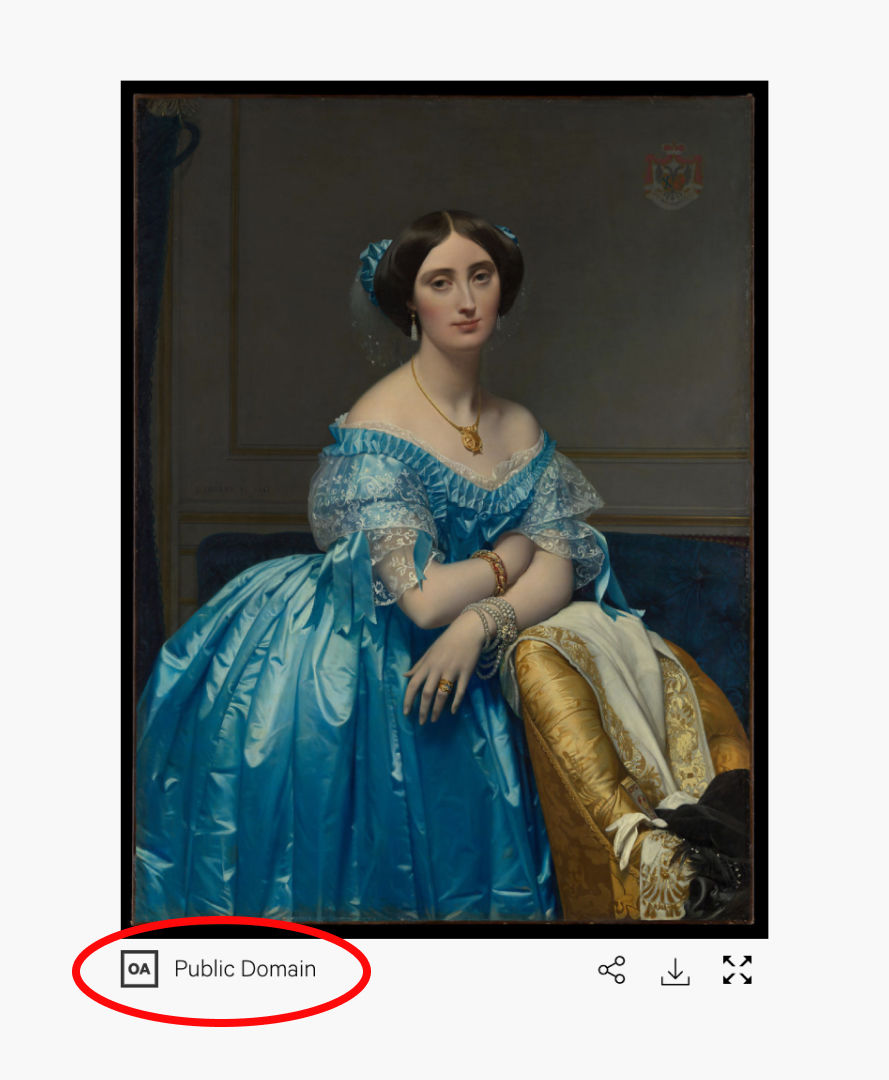
Update: The Metropolitan Museum of Art has put online 492,000 high-resolution images of artistic works. Even better, the museum has placed the vast majority of these images into the public domain, meaning they can be downloaded directly from the museum’s website for non-commercial use. When you browse the Met collection and find an image that you fancy, just look at the lower left-hand side of the image. If you see an “OA” icon and the words “public domain” (as shown in the example below), you’re free to use the image, provided that you abide by the Met’s terms.
In making this collection available online, the Met joined other world-class museums in putting large troves of digital art online. Witness the 88,000 images from the Getty in L.A., the 125,000 Dutch masterpieces from the Rijksmuseum, the 50,000 artistic images from the National Gallery, and the 1.9 million images from the British Museum.
It takes a little patience. But once you start surfing through the Met’s digital collections, you can find and download images of some wonderful masterpieces. We’ve embedded a few of our favorite picks. At the top, you will find the 1874 painting “Boating,” by Édouard Manet. In the middle, Rembrandt’s “Self-Portrait” from 1660. At the bottom, a 1907 photograph by Alfred Stieglitz called “The Steerage.” And that’s just starting to scratch the surface.
Happy rummaging. And, when you have some free time on your hands, you should also check out another open initiative from the Met. The museum has also put 500+ free art books online. You can learn about them here.

Note: An earlier version of this post appeared on our site in 2014. We have updated it to reflect some of the changes made in the Met collection over the past decade.
If you would like to support the mission of Open Culture, consider making a donation to our site. It’s hard to rely 100% on ads, and your contributions will help us continue providing the best free cultural and educational materials to learners everywhere. You can contribute through PayPal, Patreon, and Venmo (@openculture). Thanks!
Related Content:
The British Museum Puts 1.9 Million Works of Art Online
Read More...Umberto Eco’s List of the 14 Common Features of Fascism

Creative Commons image by Rob Bogaerts, via the National Archives in Holland
One of the key questions facing both journalists and loyal oppositions these days is how do we stay honest as euphemisms and trivializations take over the discourse? Can we use words like “fascism,” for example, with fidelity to the meaning of that word in world history? The term, after all, devolved decades after World War II into the trite expression fascist pig, writes Umberto Eco in his 1995 essay “Ur-Fascism,” “used by American radicals thirty years later to refer to a cop who did not approve of their smoking habits.” In the forties, on the other hand, the fight against fascism was a “moral duty for every good American.” (And every good Englishman and French partisan, he might have added.)
Eco grew up under Mussolini’s fascist regime, which “was certainly a dictatorship, but it was not totally totalitarian, not because of its mildness but rather because of the philosophical weakness of its ideology. Contrary to common opinion, fascism in Italy had no special philosophy.” It did, however, have style, “a way of dressing—far more influential, with its black shirts, than Armani, Benetton, or Versace would ever be.” The dark humor of the comment indicates a critical consensus about fascism. As a form of extreme nationalism, it ultimately takes on the contours of whatever national culture produces it.
It may seem to tax one word to make it account for so many different cultural manifestations of authoritarianism, across Europe and even South America. Italy may have been “the first right-wing dictatorship that took over a European country,” and got to name the political system. But Eco is perplexed “why the word fascism became a synecdoche, that is, a word that could be used for different totalitarian movements.” For one thing, he writes, fascism was “a fuzzy totalitarianism, a collage of different philosophical and political ideas, a beehive of contradictions.”
While Eco is firm in claiming “There was only one Nazism,” he says, “the fascist game can be played in many forms, and the name of the game does not change.” Eco reduces the qualities of what he calls “Ur-Fascism, or Eternal Fascism” down to 14 “typical” features. “These features,” writes the novelist and semiotician, “cannot be organized into a system; many of them contradict each other, and are also typical of other kinds of despotism or fanaticism. But it is enough that one of them be present to allow fascism to coagulate around it.”
- The cult of tradition. “One has only to look at the syllabus of every fascist movement to find the major traditionalist thinkers. The Nazi gnosis was nourished by traditionalist, syncretistic, occult elements.”
- The rejection of modernism. “The Enlightenment, the Age of Reason, is seen as the beginning of modern depravity. In this sense Ur-Fascism can be defined as irrationalism.”
- The cult of action for action’s sake. “Action being beautiful in itself, it must be taken before, or without, any previous reflection. Thinking is a form of emasculation.”
- Disagreement is treason. “The critical spirit makes distinctions, and to distinguish is a sign of modernism. In modern culture the scientific community praises disagreement as a way to improve knowledge.”
- Fear of difference. “The first appeal of a fascist or prematurely fascist movement is an appeal against the intruders. Thus Ur-Fascism is racist by definition.”
- Appeal to social frustration. “One of the most typical features of the historical fascism was the appeal to a frustrated middle class, a class suffering from an economic crisis or feelings of political humiliation, and frightened by the pressure of lower social groups.”
- The obsession with a plot. “Thus at the root of the Ur-Fascist psychology there is the obsession with a plot, possibly an international one. The followers must feel besieged.”
- The enemy is both strong and weak. “By a continuous shifting of rhetorical focus, the enemies are at the same time too strong and too weak.”
- Pacifism is trafficking with the enemy. “For Ur-Fascism there is no struggle for life but, rather, life is lived for struggle.”
- Contempt for the weak. “Elitism is a typical aspect of any reactionary ideology.”
- Everybody is educated to become a hero. “In Ur-Fascist ideology, heroism is the norm. This cult of heroism is strictly linked with the cult of death.”
- Machismo and weaponry. “Machismo implies both disdain for women and intolerance and condemnation of nonstandard sexual habits, from chastity to homosexuality.”
- Selective populism. “There is in our future a TV or Internet populism, in which the emotional response of a selected group of citizens can be presented and accepted as the Voice of the People.”
- Ur-Fascism speaks Newspeak. “All the Nazi or Fascist schoolbooks made use of an impoverished vocabulary, and an elementary syntax, in order to limit the instruments for complex and critical reasoning.”
One detail of Eco’s essay that often goes unremarked is his characterization of the Italian opposition movement’s unlikely coalitions. The Resistance included Communists who “exploited the Resistance as if it were their personal property,” and leaders like Eco’s childhood hero Franchi, “so strongly anti-Communist that after the war he joined very right-wing groups.” This itself may be a specific feature of an Italian resistance, one not observable across the number of nations that have resisted totalitarian governments. As for the seeming total lack of common interest between these parties, Eco simply says, “Who cares?… Liberation was a common deed for people of different colors.”
Read Eco’s essay at The New York Review of Books. There he elaborates on each element of fascism at greater length. And support NYRB by becoming a subscriber.
Note: This post originally appeared on our site in 2014.
Related Content:
George Orwell Reviews Mein Kampf: “He Envisages a Horrible Brainless Empire” (1940)
Walter Benjamin Explains How Fascism Uses Mass Media to Turn Politics Into Spectacle (1935)
Read More...How the Influential Time-Travel Movie La Jetée Was Made (Almost) Entirely out of Still Photographs
In a future where humanity has been driven underground by an apocalyptic event, a prisoner is haunted by the childhood memory of seeing a man gunned down at an airport. A group of scientists make him their time-traveling guinea pig, hoping that he’ll be able to find a way to restore the society they once knew. In one of his forced journeys into the past, he falls for a strangely familiar-looking woman who convinces him not to return to his own time period. Alas, things go wrong, culminating in the final realization that the death he had witnessed so long ago was, in fact, his own.
You may recognize this as the plot of Terry Gilliam’s 12 Monkeys, from 1995, and also as the plot of Chris Marker’s La Jeteé, from 1962. 12 Monkeys, a full-scale Hollywood picture starring the likes of Bruce Willis and Brad Pitt, attained critical acclaim and box-office success. But La Jeteé, which inspired it, stands as the more impressive cinematic achievement, despite — or perhaps owing to — its being a black-and-white short composed almost entirely of still photographs. That unusual (and unusually effective) form is the subject of the new video above from Evan Puschak, better known as the Nerdwriter.
“When you think about it, Terry Gilliam is using still images too,” says Puschak. “It’s just that he’s using 24 still images every second, while Marker uses, on average, one image every four seconds.” In La Jeteé, we’re “forced to sit with every frame,” and thus to notice that “they’re dead: all movement is gone, and we’re left with these lifeless fragments of time, an appropriate thing in a world obliterated by war.” Marker “shows us that the movement of moving pictures, even though it resembles life, is illusory; it’s really just another form of memory, and memory is always fragmentary and lifeless, re-animated only by the meaning we impose on it from the present.”
Yet this photo-roman, as Marker calls it, does contain one moving image, which depicts the lady with whom the protagonist gets involved waking up on one of their mornings together. Puschak describes it as “in the running for the most poignant bit of motion in all of cinema” and interprets it as saying that “love, human connection somehow transcends, somehow escapes the trap of time. It may be cliché to say that, but there is nothing cliché about the way Marker shows it.” Marker’s inventive nouvelle vague colleague Jean-Luc Godard once called cinema “truth 24 times per second” — a definition broken wide open, characteristically, by Marker himself.
Related content:
Petite Planète: Discover Chris Marker’s Influential 1950s Travel Photobook Series
A Concise Breakdown of How Time Travel Works in Popular Movies, Books & TV Shows
Based in Seoul, Colin Marshall writes and broadcasts on cities, language, and culture. His projects include the Substack newsletter Books on Cities and the book The Stateless City: a Walk through 21st-Century Los Angeles. Follow him on Twitter at @colinmarshall or on Facebook.
Read More...
Launch Your Project Management Career with Google’s AI-Enhanced Professional Certificate
?si=TMflasoogRfSD14h
Back in 2021, Google released a series of certificate programs, including one focused on Project Management. Designed to give students “an immersive understanding of the practices and skills needed to succeed in an entry-level project management role,” the certificate program features six courses overall, including:
- Foundations of Project Management
- Project Initiation: Starting a Successful Project
- Project Planning: Putting It All Together
- Project Execution: Running the Project
- Agile Project Management
- Capstone: Applying Project Management in the Real World
More than 1.7 million people have since enrolled in the course sequence. And Google has now updated the courses with 6 new videos on how to use AI in project management. The videos will teach students how to boost project management skills with AI, identify potential project risks with gen AI, use AI to improve project communications, and more.
The Project Management program takes about six months to complete (assuming you put in 10 hours per week), and it should cost about $300 in total. Following a 7‑day free trial, students will be charged $49 per month until they complete the program.
All Google career courses are hosted on the Coursera platform. Finally, it’s worth mentioning that anyone who enrolls in this certificate before November 30, 2024 will get access to Google AI Essentials at no cost.
Note: Open Culture has a partnership with Coursera. If readers enroll in certain Coursera courses and programs, it helps support Open Culture.
Read More...Hear Edgar Allan Poe’s Horror Stories Read by Vincent Price, Christopher Lee, James Earl Jones, William S. Burroughs & Others
Here on Halloween of 2024, we have a greater variety of scary stories — and arguably, a much scarier variety of scarier stories — to choose from than ever before. But whatever their relevance to the specific lives we may live and the specific dreads we may feel today, how many such current works stand a chance of being read a couple of centuries from now, with not just historical interest but genuine chills? With each Halloween that brings us nearer to the 200th anniversary of Edgar Allan Poe’s literary debut, the works of that American pioneer of the grotesque and the macabre grow only more deeply troubling.
“The word that recurs most crucially in Poe’s fictions is horror,” writes Marilynne Robinson in the New York Review of Books. “His stories are often shaped to bring the narrator and the reader to a place where the use of the word is justified, where the word and the experience it evokes are explored or by implication defined. So crypts and entombments and physical morbidity figure in Poe’s writing with a prominence that is not characteristic of major literature in general. Clearly Poe was fascinated by popular obsessions, with crime, with premature burial” — obsessions that haven’t lost much popularity since his day.
Examined more closely, “the horror that fascinated him and gave such dreadful unity to his tales is often the inescapable confrontation of the self by a perfect justice, the exposure of a guilty act in a form that makes its revelation a recoil of the mind against itself.” This is true, Robinson writes, of such still-widely-read works as “The Fall of the House of Usher,” “The Masque of the Red Death,” “The Black Cat,” and “The Tell-Tale Heart.”
You can hear all of those stories and more in the Youtube playlist above, narrated by a variety of performers immediately recognizable by voice alone: Christopher Lee, Vincent Price, William S. Burroughs, Orson Welles, Bela Lugosi, Basil Rathbone, and the late James Earl Jones.
Whether read aloud or on the page, Robinson notes, Poe “has always been reviled or celebrated for the absence of moral content in his work, despite the fact that these tales are all straightforward moral parables. For a writer so intrigued by the operations of the mind as Poe was, an interest in conscience leads to an interest in concealment and self-deception, things that are secretive and highly individual and at the same time so universal that they shape civilizations.” While there are civilizations, there will be tell-tale hearts; and while there are tell-tale hearts, there will be an audience responsive to Edgar Allan Poe’s brand of horror, on Halloween or any other night.
Related content:
Download The Complete Works of Edgar Allan Poe: Macabre Stories as Free eBooks & Audio Books
Why Should You Read Edgar Allan Poe? An Animated Video Explains
7 Tips from Edgar Allan Poe on How to Write Vivid Stories and Poems
Based in Seoul, Colin Marshall writes and broadcasts on cities, language, and culture. His projects include the Substack newsletter Books on Cities and the book The Stateless City: a Walk through 21st-Century Los Angeles. Follow him on Twitter at @colinmarshall or on Facebook.
Read More...Watch The Cabinet of Dr. Caligari, the Influential German Expressionist Horror Film (1920)
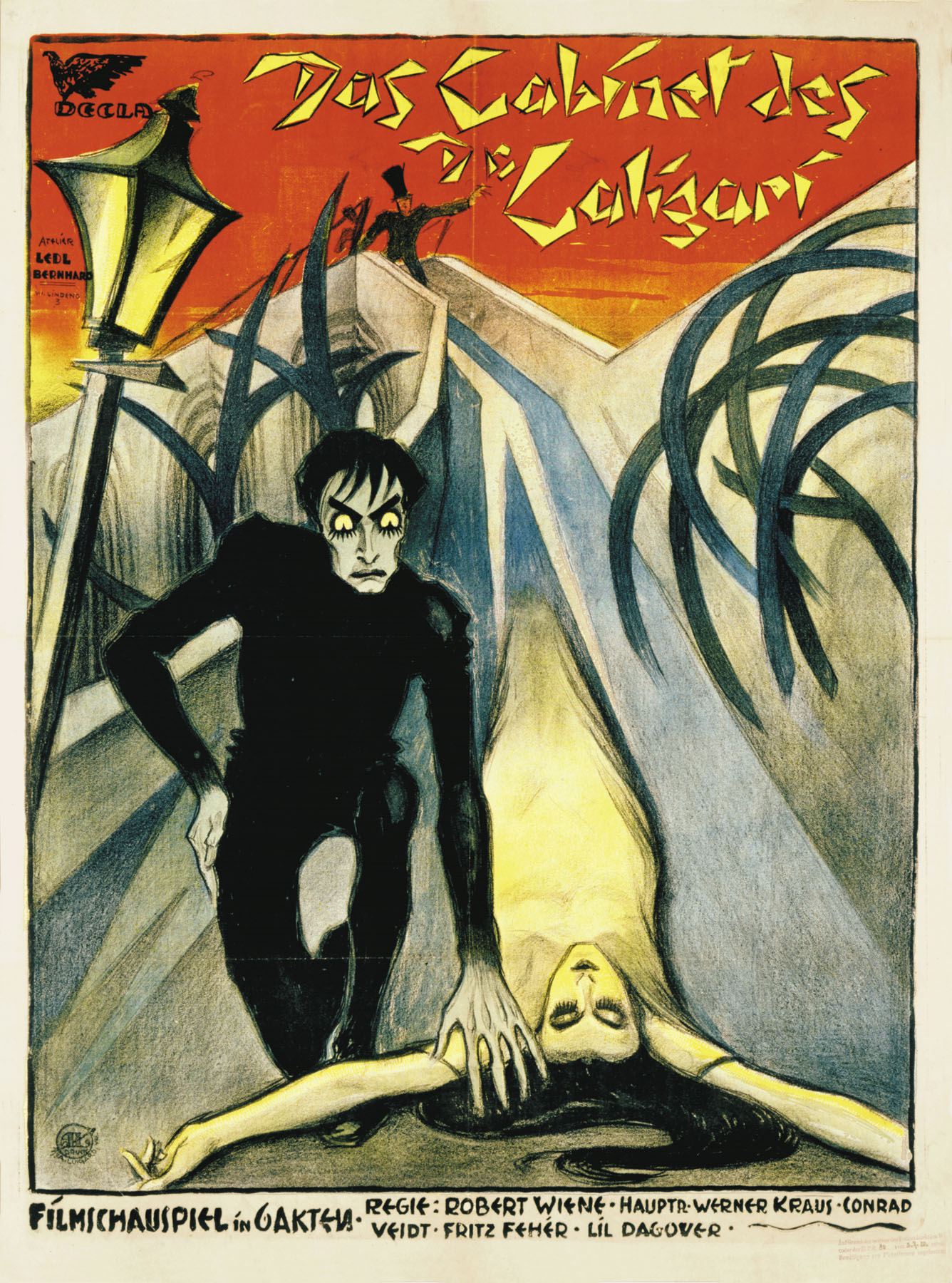
In early 1920, posters began appearing all over Berlin with a hypnotic spiral and the mysterious command Du musst Caligari werden — “You must become Caligari.”
The posters were part of an innovative advertising campaign for an upcoming movie by Robert Wiene called The Cabinet of Dr. Caligari. When the film appeared, audiences were mesmerized by Wiene’s surreal tale of mystery and horror. Almost a century later, The Cabinet of Dr. Caligari is still celebrated for its rare blending of lowbrow entertainment and avant-garde art. It is frequently cited as the quintessential cinematic example of German Expressionism, with its distorted perspectives and pervasive sense of dread.
Like many nightmares, Caligari had its origin in real-life events. Screenwriter Hans Janowitz had been walking late one night through a fair in Hamburg’s red-light district when he heard laughter. Turning, he saw an attractive young woman disappear behind some bushes in a park. A short time later a man emerged from the shadows and walked away. The next morning, Janowitz read in the newspapers that a young woman matching the description of the one he had seen had been murdered overnight at that very location.
Haunted by the incident, Janowitz told the story to fellow writer Carl Mayer. Together they set to work writing a screenplay based on the incident, drawing also on Mayer’s unsettling experience with a psychiatrist. They imagined a strange, bespectacled man named Dr. Caligari who arrives in a small town to demonstrate his powers of hypnotism over Cesare, a sleepwalker, at the local fair. A series of mysterious murders follows.
Janowitz and Mayer sold their screenplay to Erich Pommer at Decla-Film. Pommer at first wanted Fritz Lang to direct the film, but Lang was busy with another project, so he gave the job to Wiene. One of the most critical decisions Pommer made was to hire Expressionist art director Hermann Warm to design the production, along with painters Walter Reimann and Walter Röhrig. As R. Barton Palmer writes at Film Reference:
The principle of Warm’s conception is the Expressionist notion of Ballung, that crystallization of the inner reality of objects, concepts, and people through an artistic expression that cuts through and discards a false exterior. Warm’s sets for the film correspondingly evoke the twists and turnings of a small German medieval town, but in a patently unrealistic fashion (e.g., streets cut across one another at impossible angles and paths are impossibly steep). The roofs that Cesare the somnambulist crosses during his nighttime depredations rise at unlikely angles to one another, yet still afford him passage so that he can reach his victims. In other words, the world of Caligari remains “real” in the sense that it is not offered as an alternative one to what actually exists. On the contrary, Warm’s design is meant to evoke the essence of German social life, offering a penetrating critique of semiofficial authority (the psychiatrist) that is softened by the addition of a framing story. As a practicing artist with a deep commitment to the political and intellectual program of Expressionism, Warm was the ideal technician to do the art design for the film, which bears out Warm’s famous manifesto that “the cinema image must become an engraving.”
The screenwriters were disappointed with Wiene’s decision to frame the story as a flashback told by a patient in a psychiatric hospital. Janowitz, in particular, had meant Caligari to be an indictment of the German government that had recently sent millions of men to kill or be killed in the trenches of World War I. “While the original story exposed authority,” writes Siegfried Kracauer in From Caligari to Hitler: A Psychological History of the German Film, “Wiene’s Caligari glorified authority and convicted its antagonist of madness. A revolutionary film was thus turned into a conformist one — following the much-used pattern of declaring some normal but troublesome individual insane and sending him to a lunatic asylum.”
In a purely cinematic sense, of course, The Cabinet of Dr. Caligari remains a revolutionary work. You can watch the complete film above. Or find it listed in our collection, 4,000+ Free Movies Online: Great Classics, Indies, Noir, Westerns, Documentaries & More.
Related content:
Watch the First Horror Film, George Méliès’ The Haunted Castle (1896)
Watch the Quintessential Vampire Film Nosferatu
Watch the Cult Classic Horror Film Carnival of Souls (1962)
Martin Scorsese Names the 11 Scariest Horror Films: Kubrick, Hitchcock, Tourneur & More
Read More...Mythology Expert Reviews Depictions of Greek & Roman Myths in Popular Movies and TV Shows
It’s safe to say that we no longer believe in the gods of the ancient world — or rather, that most of us no longer believe in their literal existence, but some of us have faith in their box-office potential. This two-part video series from Vanity Fair examines a variety of movies and television shows that have drawn on Greek and Roman myth since the mid-twentieth-century, including Jason and the Argonauts, Clash of the Titans, Troy, and Disney’s Hercules. Offering commentary on their faithfulness to the source material is Peter Meineck, Professor of Classics in the Modern World at New York University.
Not that he insists on holding these entertainments to rigorous standards of accuracy. “I would not use the term ‘accuracy’ at any point in Xena: Warrior Princess, because it’s fantastic,” he says at one point. But then, when it comes to the stories told by ancient Greeks and Romans, we’re dealing with rather fantasy-rich material from the start.
Heightened, augmented, refined, and syncretized over many generations, they’ve come down to us in forms that reflect more or less eternally human notions about the forces that govern reality and its vicissitudes — ready made, in some cases, to incorporate into the latest twenty-first-century superhero spectacle.
Possessed of distinctive physical traits, temperaments, superhuman powers, and even grudges, the many gods of the polytheistic antiquity were, in their way, the comic-book heroes of their time. And just as we have different “universes” of characters to choose from, different eras and cultures had their own lineups of deities, none quite the same as any other. “At the pinnacle of this teeming numinous universe were the Olympians, the twelve gods headed by Zeus and Hera,” says ancient-history Youtuber Garrett Ryan in the Told in Stone video above. “The Greeks influenced Roman religion virtually from the beginning. By the time Rome emerged into the full light of history, the Roman gods had been assimilated to their Greek counterparts.”
Hence our recognizing Greek Olympians like Poseidon, Artemis, Athena, and Dionysus, but also their Roman equivalents Neptune, Diana, Minerva, and Bacchus. “There seems to have been little doubt in Romans’ minds that their chief gods were the same as those of the Greeks,” Ryan says. “The Greeks, for their part, generally accepted that the Romans worshipped their gods under different names — while also being “eager collectors of exotic deities,” many of which could be found within their own vast empire. The result was a bewildering profusion of gods for every occasion, Greek-inspired or otherwise: an omen of the more-is-better ethos that the Hollywood blockbuster would embrace a couple of millennia later.
Related content:
How Arabic Translators Helped Preserve Greek Philosophy … and the Classical Tradition
How Rome Began: The History As Told by Ancient Historians
A Virtual Tour of Ancient Athens: Fly Over Classical Greek Civilization in All Its Glory
Behold Ancient Egyptian, Greek & Roman Sculptures in Their Original Color
Based in Seoul, Colin Marshall writes and broadcasts on cities, language, and culture. His projects include the Substack newsletter Books on Cities and the book The Stateless City: a Walk through 21st-Century Los Angeles. Follow him on Twitter at @colinmarshall or on Facebook.
Read More...The Story of Fascism: Rick Steves’ Documentary Helps Us Learn from the Painful Lessons of the 20th Century
From Rick Steves comes a thought-provoking documentary that revisits the rise of fascism in Europe, reminding us of how charismatic figures like Benito Mussolini and Adolf Hitler came to power by promising to create a better future for their frustrated, economically depressed countries–a future that recaptured the glory of some mythologized past. Once in power, these fascist leaders replaced democracy with a cult of personality, steadily eroded democratic norms and truth, ratcheted up violence, and found scapegoats to victimize–something facilitated by the spread of conspiracy theories and propaganda through modern media. They would lead their nations into war, and ultimately ruin, but not before creating a playbook for other charismatic autocrats who entice voters with simplistic solutions to complex problems.
Originally aired on television, Steves has released the documentary on YouTube, hoping that 21st-century citizens can “learn from the hard lessons of 20th-century Europe.” The text accompanying his documentary reads as follows:
In this one-hour special, Rick travels back a century to learn how fascism rose and then fell in Europe — taking millions of people with it. We’ll trace fascism’s history from its roots in the turbulent aftermath of World War I, when masses of angry people rose up, to the rise of charismatic leaders who manipulated that anger, the totalitarian societies they built, and the brutal measures they used to enforce their ideology. We’ll see the horrific consequences: genocide and total war. And we’ll be inspired by the stories of those who resisted. Along the way, we’ll visit poignant sights throughout Europe relating to fascism, and talk with Europeans whose families lived through those times. Our goal: to learn from the hard lessons of 20th-century Europe, and to recognize that ideology in the 21st century.
The Story of Fascism (which will be added to our list of Free Documentaries) is recommended for students and adults alike. With World War II fading from living memory, we could use a good reminder, says Steves, of how “nationalism can be channeled into evil, and how our freedoms and democracies are not indestructible…in fact, they are fragile.”
If you would like to support the mission of Open Culture, consider making a donation to our site. It’s hard to rely 100% on ads, and your contributions will help us continue providing the best free cultural and educational materials to learners everywhere. You can contribute through PayPal, Patreon, and Venmo (@openculture). Thanks!
Related Content:
Rick Steves’ Europe: Binge Watch 9 Seasons of America’s Favorite Traveler Free Online
Free Online History Courses
Walter Benjamin Explains How Fascism Uses Mass Media to Turn Politics Into Spectacle (1935)
Read More...Marcus Aurelius’ 9 Rules for Living a Stoic Life
This week, the Guardian’s Zoe Williams profiled Ryan Holiday, a one-time public-relations whiz-kid who’s reinvented himself over the past decade as a speaker for the dead: specifically Epictetus, Seneca, and above all Marcus Aurelius, the figureheads of the ancient school of philosophy we now know as Stoicism. It “centers on four virtues: courage, temperance, justice and wisdom,” Williams writes. “Marshaling these will give you complete self-control, enabling you to react with equanimity to all outside stimuli, and not whine about stuff.” Wealth “should mean nothing to the stoic, which makes it ironic that some of the richest people on Earth claim to live by stoicism.”
That last line comes as an obvious jab at Holiday’s popularity among not just sports stars and celebrities but big money-makers in Silicon Valley as well. But then, Stoicism was meant to work for anyone, no matter their socioeconomic status: Epictetus was a slave, after all, while Marcus Aurelius ruled over the Roman Empire. And it is Marcus’ collected writings the Meditations (available free as an eBook or audiobook) that inspired Holiday’s video above from his Youtube channel Daily Stoic. In it, he presents “nine Stoic rules for a better life,” opening with an exhortation that “life is short: do everything as if it was the thought or action of a dying person.”
The rules begin with “put people first,” which Marcus once demonstrated as a leader by selling off the imperial palace’s finery during the economic hardships of the Antonine Plague. Second, “another path is always open” — or, as expressed in the title of Holiday’s first book about Stoicism, “the obstacle is the way.” Even if you feel stuck, “you always have the opportunity to practice virtue, practice excellence, to change in some form or another based on what’s happening.” Third, “take it step by step”: familiar advice, perhaps, but a welcome reminder that what stops us from beginning a project or process of change is never a lack of information, but a simple lack of action.
Fourth, “discard your anxiety,” which may feel caused by outside circumstances, but in Marcus’ view, comes wholly from inside ourselves; Holiday speaks of Marcus’ declaration that he “discarded anxiety because it was within me.” Fifth, “well begun is half done” — or as they put it in Korea, where I live, “the start is half.” No matter where in the world you happen to be, you can put into practice Holiday’s practical interpretation of this rule: get up early in the morning so as to “own the day from the beginning,” just as Marcus did. Sixth, “be strict with yourself,” even as you remain tolerant with others: “leave everyone else and their mistakes and their way of doing things to them.”
Seventh, “don’t resent people,” even if, like Marcus, you don’t particularly like them. Your enemies offer you a hidden opportunity to “be good in spite of other people, to be just in the face of injustice, to be temperate in the face of intemperance that’s being rewarded. Eighth, “ask yourself, ‘Is this essential?’ ” Whether you’re a Roman emperor or a twenty-first century “knowledge worker,” life tends to fill up with pressing but not ultimately important tasks, at least without constant vigilance about how much they really matter. Ninth, keep these three mantras in mind: “Amor fati,” or “embrace your fate”; “It’s about what you do for other people”; and “Memento mori,” or “remember that death is inevitable.” The original Stoics have been gone for coming on two millennia now, but they still set an example for us today. How many of us can foresee the same for ourselves?
Related content:
The Stoic Wisdom of Roman Emperor Marcus Aurelius: An Introduction in Six Short Videos
How to Be a Stoic in Your Everyday Life: Philosophy Professor Massimo Pigliucci Explains
Three Huge Volumes of Stoic Writings by Seneca Now Free Online, Thanks to Tim Ferriss
Based in Seoul, Colin Marshall writes and broadcasts on cities, language, and culture. His projects include the Substack newsletter Books on Cities and the book The Stateless City: a Walk through 21st-Century Los Angeles. Follow him on Twitter at @colinmarshall or on Facebook.
Read More...The Isolated Bass Grooves of The Grateful Dead’s Phil Lesh (RIP)
This past Friday, the bassist of The Grateful Dead, Phil Lesh, passed away at age 84. Almost immediately the tributes poured in, most recognizing that Lesh wasn’t your ordinary bassist. As Jon Pareles wrote in the New York Times, Phil Lesh held songs “aloft.” His “bass lines hopped and bubbled and constantly conversed with the guitars of Jerry Garcia and Bob Weir. His tone was rounded and unassertive while he eased his way into the counterpoint, almost as if he were thinking aloud. [His] playing was essential to the Dead’s particular gravity-defying lilt, sharing a collective mode of rock momentum that was teasing and probing, never bluntly coercive.”
My first encounter with the Grateful Dead came when I was 16 years old. I vividly remember the guy who played bongos on my friend’s head when we arrived at the show. I also remember the spinners tripping on acid, dancing down the halls and short-circuiting my little mind. But the concert itself remains only a hazy memory. And certainly the artistry of Lesh, Garcia, Weir, and the drummers was lost on me. Only years later, did it all start to click. That’s when I dialed into the Barton Hall concert at Cornell (May 8, 1977) and encountered Lesh’s bass lines at the start of “Scarlet Begonias.” Once you hear them, they’re hard to shake. The video above zooms into that performance, exploring the development of Lesh’s bass playing throughout the spring of ’77. The next video down lets you hear the complete Barton Hall performance of “Scarlet Begonias” in all of its glory.
When others try to capture what made Phil, Phil, they’ll feature another beloved show–Veneta, OR (6/27/72). Below, you can hear isolated tracks of Phil’s bass work on “Bertha” and “China Cat Sunflower/I Know You Rider.” (Click the links in the prior sentence to hear Lesh and the band performing the songs together–so you can hear how the bass ties in.) Trained in free jazz and avant-garde classical music, Lesh infused rock with the influences of Coltrane, Mingus, and Stravinsky–not to mention others. And, with that, the bass was never the same.
For anyone wanting to get further into the Phil Zone, read his excellent memoir Searching for the Sound: My Life with the Grateful Dead.
Bertha
China Cat Sunflower/I Know You Rider
Related Content
When the Grateful Dead Played at the Egyptian Pyramids, in the Shadow of the Sphinx (1978)
Read More...
Support Us
We're hoping to rely on loyal readers, rather than erratic ads. Please click the Donate button and support Open Culture. You can use Paypal, Venmo, Patreon, even Crypto! We thank you!

About Us

Open Culture scours the web for the best educational media. We find the free courses and audio books you need, the language lessons & educational videos you want, and plenty of enlightenment in between.
Advertise With Us

FREE UPDATES!
GET OUR DAILY EMAIL
Get the best cultural and educational resources on the web curated for you in a daily email. We never spam. Unsubscribe at any time.
FOLLOW ON SOCIAL MEDIA

Open Culture editor Dan Colman scours the web for the best educational media. He finds the free courses and audio books you need, the language lessons & movies you want, and plenty of enlightenment in between.
Advertise With Us

