Orson Welles Narrates an Animated Parable About How Xenophobia & Greed Will Put America Into Decline (1971)
More than 50 years and 10 presidential administrations have passed since Orson Welles narrated Freedom River (1971). And while it shows signs of age, the animated film, a parable about the role of immigration, race, and wealth in America, still resonates today. Actually, given the cynical exploitation of xenophobia during this most unpresidential of presidential campaigns, you could say that Freedom River strikes a bigger chord than it has in years. That’s why we’re featuring the animation once again on Open Culture.
The backstory behind the film deserves a little mention. According to Joseph Cavella, a writer for the film, it took a little cajoling and perseverance to get Orson Welles involved in the film.
For several years, Bosustow Productions had asked Orson Welles, then living in Paris, to narrate one of their films. He never responded. When I finished the Freedom River script, we sent it to him together with a portable reel to reel tape recorder and a sizable check and crossed our fingers. He was either desperate for money or (I would rather believe) something in it touched him because two weeks later we got the reel back with the narration word for word and we were on our way.
Indeed, they were.
Directed by Sam Weiss, Freedom River tells the story of decline–of a once-great nation lapsing into ugliness. Despite the comforting myths we like to tell ourselves here in America, that ugliness has always been there. Xenophobia, greed, racism (you could add a few more traits to the list) are nothing new. They just tend to surface when demagogues make it permissible, which is precisely what we’re seeing right now. Fortunately, Welles’s narration leaves us with room to hope, with room to believe that our citizens will rise above what our worst leaders have to offer.
If you would like to support the mission of Open Culture, consider making a donation to our site. It’s hard to rely 100% on ads, and your contributions will help us continue providing the best free cultural and educational materials to learners everywhere. You can contribute through PayPal, Patreon, and Venmo (@openculture). Thanks!
Related Content
Future Shock: Orson Welles Narrates a 1972 Film About the Perils of Technological Change
An Animation of Orson Welles’ Famous Frozen Peas Rant
Read More...Learn Data Analytics & AI with Google, and Fast-Track Your Career
?si=azZbGLEr_9EFWypL
We’re living in the age of data and artificial intelligence (AI). Every second, vast amounts of data are being generated, processed, and analyzed. And increasingly AI plays a central role in how that data gets managed. For companies, governments, and individuals alike, understanding data is essential. This makes Data Analytics—especially when accompanied by AI skills—a valuable asset for most professionals.
Enter Google, which recently launched a professional certificate in Data Analytics–one that will “have you job-ready in less than 6 months.” Offered on the Coursera platform, the Data Analytics Professional Certificate consists of eight courses, including “Foundations: Data, Data, Everywhere,” “Prepare Data for Exploration,” “Data Analysis with R Programming,” and “Share Data Through the Art of Visualization.” And now the course sequence has incorporated videos exploring how to leverage artificial intelligence when working with data. Overall this program “includes over 180 hours of instruction and hundreds of practice-based assessments, which will help you simulate real-world data analytics scenarios that are critical for success in the workplace.”
Upon completion, students–even those who haven’t pursued a college degree–can directly apply for jobs (e.g., junior or associate data analyst, database administrator, etc.) with Google and over 150 U.S. employers, including Deloitte, Target, and Verizon. You can start a 7‑day free trial and explore the courses here. If you continue beyond the free trial, Google/Coursera will charge $49 per month. That translates to about $300 after 6 months, the time estimated to complete the certificate.
Finally, it’s worth mentioning that anyone who enrolls in this certificate before November 30, 2024 will get access to Google AI Essentials at no cost.
Explore the Data Analytics Certificate by watching the video above. Learn more about the overall Google career certificate initiative here. And find other Google professional certificates here.
Note: Open Culture has a partnership with Coursera. If readers enroll in certain Coursera courses and programs, it helps support Open Culture.
Read More...The Night When Luciano Pavarotti & James Brown Sang “It’s a Man’s World” Together (2002)
Luciano Pavarotti and James Brown are remembered as larger-than-life performers with an almost mythical-seeming presence and distinctiveness. But it wasn’t so very long ago that both of them were active — and even active onstage together. In the video above, the King of the High Cs and the Godfather of Soul get together on “It’s a Man’s World” in 2002. It happened at the penultimate Pavarotti & Friends concert, one of a series of yearly benefit shows that ran between 1992 and 2003, and also featured the likes of Andrea Bocelli, Grace Jones, Sting, and Lou Reed.
“It’s a remarkable performance on so many levels,” writes Tom Teicholz at Forbes.com. “James Brown is in top form, his voice strong and pure. He commands the stage, and he dominates — he is in every sense an equal to Pavarotti, who sings in Italian with great subtlety, finesse, and emotion. The video is filled with moments of grace — such as when Brown, with a magisterial wave of his arm cedes the stage to Pavarotti to sing his solo, or when Brown says ‘my Bible says Noah made the Ark’ as if it was truly HIS Bible.”
What’s more, this is hardly the James Brown only slightly exaggerated by Eddie Murphy in those Saturday Night Live hot tub sketches a couple of decades earlier. “Brown’s performance is not about his staged theatrics, not about his dancing, not even really about Brown’s trademark grunts and growls,” Teicholz writes. “This is about singing and getting the song across,” a mission certainly not hindered by the kind of of orchestral backing they have. “It’s a Man’s World” might seem like the kind of song you “couldn’t sing today,” at least if you take its title at face value. But in any case, how many singers today would want to be subject to comparison with this particular rendition if they did so?
Related content:
Pavarotti Sings with Lou Reed, Sting, James Brown and Other Friends
Two Legends: Weird Al Yankovic “Interviews” James Brown (1986)
The Best Commercial Ever? James Brown Sells Miso Soup (1992)
Is Opera Part of Pop Culture? Pretty Much Pop #15 with Sean Spyres
Based in Seoul, Colin Marshall writes and broadcasts on cities, language, and culture. His projects include the Substack newsletter Books on Cities and the book The Stateless City: a Walk through 21st-Century Los Angeles. Follow him on Twitter at @colinmarshall or on Facebook.
Read More...George Harrison Explains Why Everyone Should Play the Ukulele
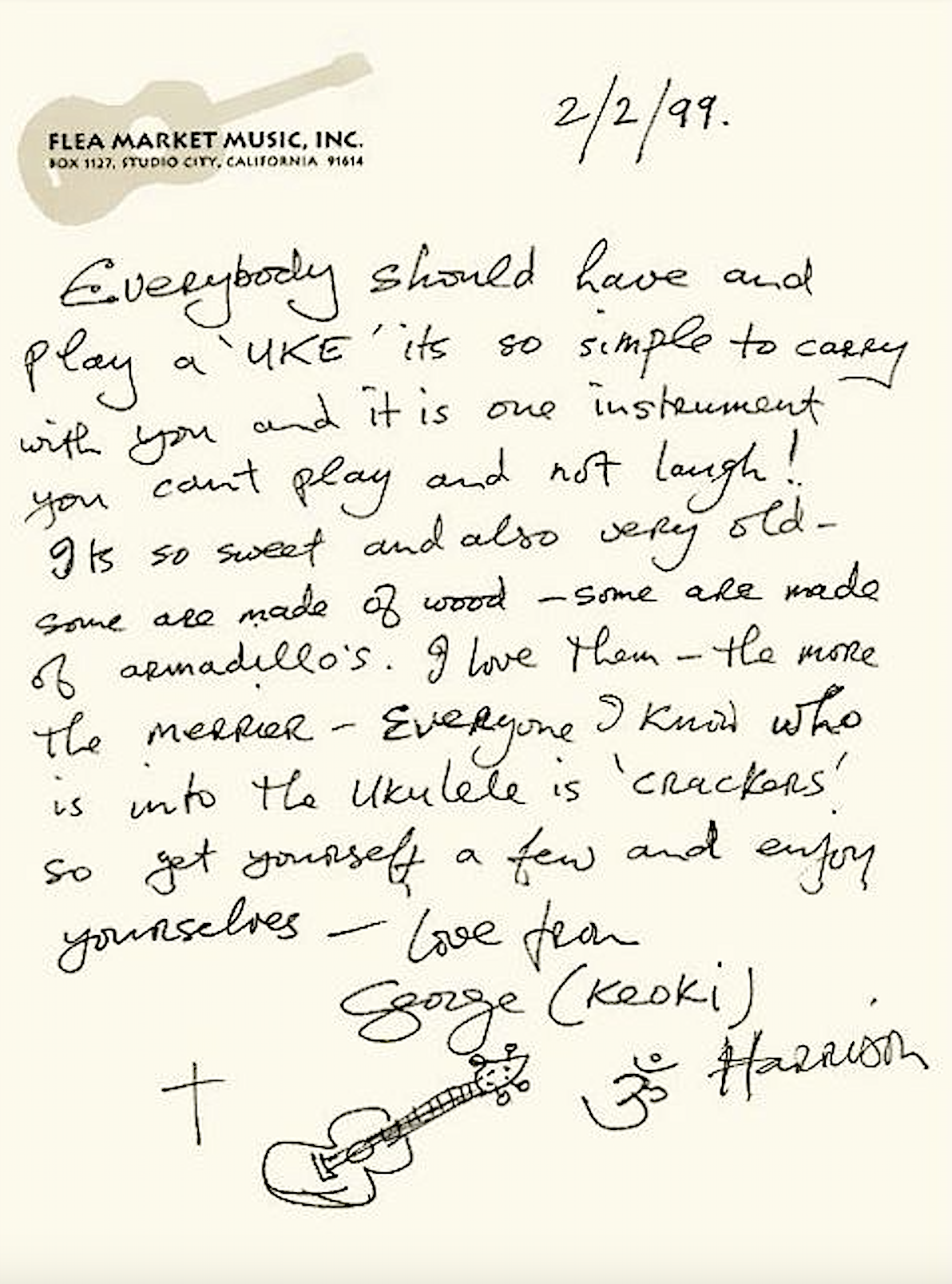
George Harrison loved the ukulele, and really, what’s not to love? For its dainty size, the uke can make a powerfully cheerful sound, and it’s an instrument both beginners and expert players can learn and easily carry around. As Harrison’s old friend Joe Brown remarked, “You can pick up a ukulele and anybody can learn to play a couple of tunes in a day or even a few hours. And if you want to get good at it, there’s no end to what you can do.” Brown, once a star in his own right, met Harrison and the Beatles in 1962 and remembers being impressed with the fellow uke-lover Harrison’s range of musical tastes: “He loved music, not just rock and roll…. He’d go crackers, he’d phone me up and say ‘I’ve got this great record!’ and it would be Hoagy Carmichael and all this Hawaiian stuff he used to like. George was not a musical snob.”
“Crackers” may be the perfect word for Harrison’s uke-philia; he used it himself in the adorable note above from 1999. “Everyone I know who is into the ukulele is ‘crackers,’” writes George, “you can’t play it and not laugh!” Harrison remained upbeat, even during his first cancer scare in 1997, the knife attack at his home in 1999, and the cancer relapse that eventually took his life in 2001. The ukulele seemed a sweetly genuine expression of his hopeful attitude. And after Harrison’s death, it seemed to his friends the perfect way to memorialize him. Joe Brown closed the Harrison tribute concert at Royal Albert Hall with a uke version of “I’ll See You In My Dreams,” and Paul McCartney remembered his friend in 2009 by strumming “Something” on a ukulele at New York’s Citi Field.
In his remarks, McCartney fondly reminisced: “Whenever you went round George’s house, after dinner the ukuleles would come out and you’d inevitably find yourself singing all these old numbers.” Just above, see Harrison and an old-time acoustic jazz ensemble (including Jools Holland on piano) play one of those “old numbers”—“Between The Devil and Deep Blue Sea”—in 1988. The song eventually wound up on his last album, the posthumously released Brainwashed. Just below, see Harrison, McCartney, and Ringo Starr sing a casually harmonious rendition of the 1927 tune “Ain’t She Sweet” while lounging picnic-style in a park.
In Hawaii, where Harrison owned a 150-acre retreat, and where he was known as Keoki, it’s said he bought ukuleles in batches and gave them away. The story may be legend, but it certainly sounds in character. He was a generous soul to the end. Just below, see Harrison strumming and whistling away in a home video made shortly before his death. You can hear the hoarseness in his voice from his throat cancer, but you won’t hear much sadness there, I think.
And for good measure:
Related Content:
Musicians Re-Imagine the Complete Songbook of the Beatles on the Ukulele
Watch George Harrison’s Final Interview and Performance (1997)
George Harrison’s Mystical, Fisheye Self-Portraits Taken in India (1966)
The Ukulele Orchestra of Great Britain Performs The Clash’s “Should I Stay Or Should I Go”
Josh Jones is a writer and musician based in Durham, NC. Follow him at @jdmagness
Read More...The Fake Buildings of New York: What Happens Inside Their Mysterious Walls
You can’t go on a walk with a serious enthusiast of New York history without hearing the stories behind at least a few notable, beautiful, or downright strange buildings. Yet most longtime New Yorkers, famed for tuning out their surroundings to better strive for their goals of the day, tend not even to acknowledge the structures liable to catch the attention of out-of-towners. Take 58 Joralemon Street in Brooklyn Heights: “From the outside, it looks like your typical townhouse,” says urban explorer Cash Jordan in his video above — but then you notice its blacked-out windows, bunker-like metal cladding, and apparently un-openable door.
Though it was indeed a townhouse when first built in 1847, 58 Joralemon Street was hollowed out and converted into one subway-system vent back in 1907. But the buildings right on either side remain residences, one of which, as Jordan finds, sold not long ago for $6 million.
In a completely different, more isolated context stands the Strecker Memorial Laboratory on Roosevelt Island. Built in 1892 as a laboratory for City Hospital, it opened as “the first institution in the nation for pathological and bacteriological research,” an activity it makes sense to keep apart from a dense urban environment. Abandoned in the nineteen-fifties, it later became another subway facility, specifically a power conversion substation.
Jordan also visits a fake building well out on Pier 34, and one that also provides a function essential to New York transit: ventilating the smoke and exhaust out of the Holland Tunnel. Owned and operated by public agencies, these structures perform well-documented and entirely non-secret functions. The same can’t be said of the last and most striking fake building Jordan introduces, a windowless Brutalist tower constructed in 1969 at 33 Thomas Street in Lower Manhattan. Owned by AT&T, it seems once to have been a telephone switching station, but has lately been rumored to be a “huge doomsday bunker.” That’s one theory, anyway, and the building’s sinister appearance could inspire countless others. Not that many locals are imagining them, obeying as they do one of the central commandments of Manhattan: don’t look up.
Related content:
The Story of the Flatiron Building, “New York’s Strangest Tower”
New York’s Lost Skyscraper: The Rise and Fall of the Singer Tower
The Oldest House in New York City: Meet the Wyckoff House (1652)
Architect Breaks Down Five of the Most Iconic New York City Apartments
A 3D Animation Shows the Evolution of New York City (1524 — 2023)
Based in Seoul, Colin Marshall writes and broadcasts on cities, language, and culture. His projects include the Substack newsletter Books on Cities and the book The Stateless City: a Walk through 21st-Century Los Angeles. Follow him on Twitter at @colinmarshall or on Facebook.
Read More...
Peanuts Creator Charles Schulz Shares with a 10-Year-Old Kid the True Meaning of Good Citizenship
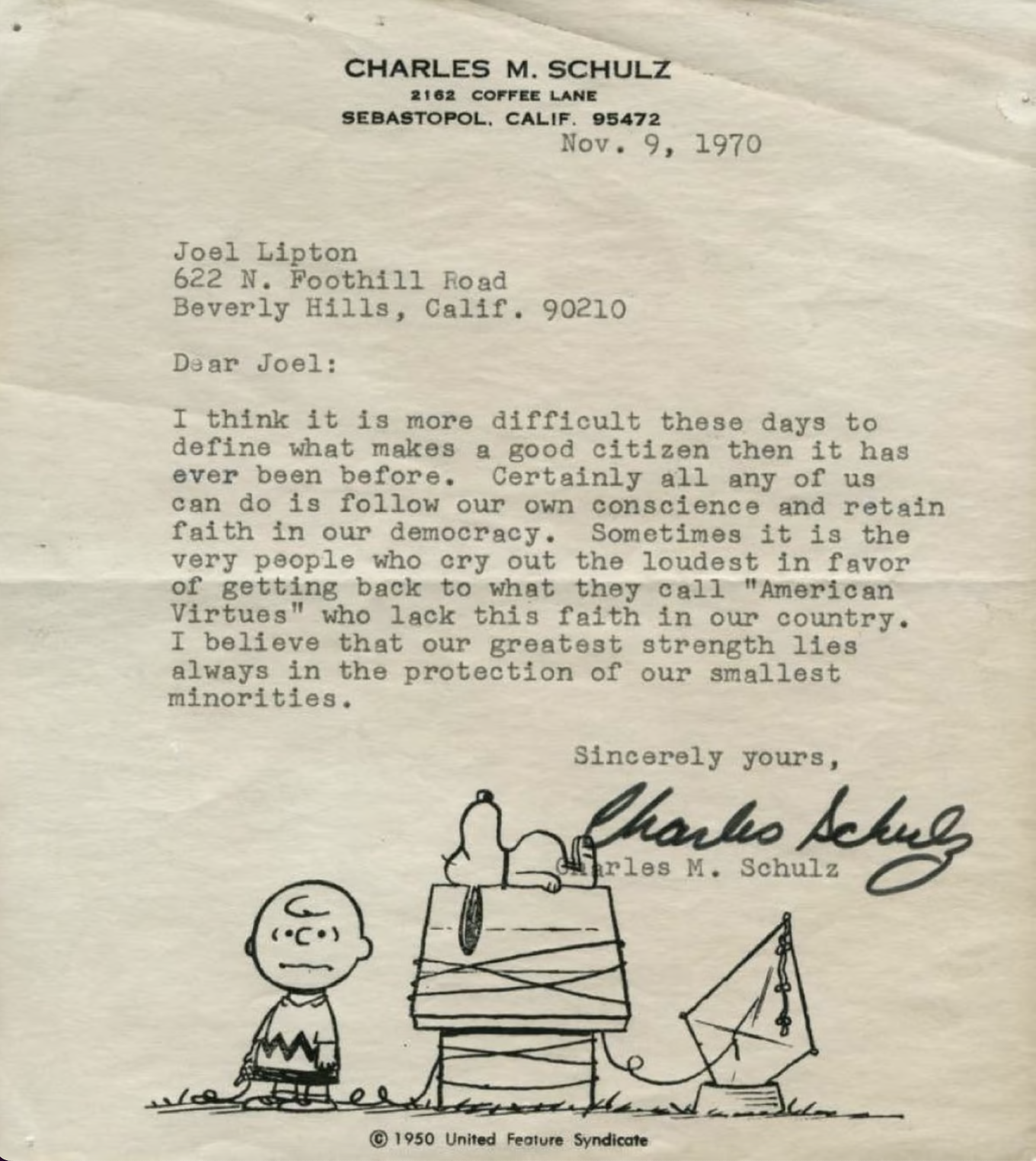
In 1970, when 10-year-old Joel Linton asked Charles Schulz, the creator of Peanuts, “What do you think makes a good citizen?” Schulz sent the youngster a short but pithy reply:
Dear Joel:
I think it is more difficult these days to define what makes a good citizen than it has ever been before. Certainly all any of us can do is follow our own conscience and retain faith in our democracy. Sometimes it is the very people who cry out the loudest in favor of getting back to what they call “American Virtues” who lack this faith in our country. I believe that our greatest strength lies always in the protection of our smallest minorities.
Sincerely yours,
Charles M. Schulz
When this letter surfaced in 2019, Schulz’s widow commented, “I continually find comic strips that could have been written for today’s audience.” “This says what needs to be said now.” Needless to say, the same message bears repeating in 2024.
Related Content
23 Minutes of Charles Schulz Drawing Peanuts
Umberto Eco Explains the Poetic Power of Charles Schulz’s Peanuts
How Franklin Became Peanuts’ First Black Character, Thanks to a Caring Schoolteacher (1968)
Read More...Take a Tour of Frank Lloyd Wright’s Ennis House, the Mansion That Has Appeared in Blade Runner, Twin Peaks & Countless Hollywood Films
There are more than a few of us who’d enjoy the opportunity to live in a house that appears in Blade Runner; there are rather few of us who would value that opportunity at $23 million, the asking price given in the 2019 Architectural Digest video on Frank Lloyd Wright’s 1924 Ennis House above. Yet even beyond the Wright pedigree and the Blade Runner prestige, the house has also appeared in a host of other films, a screen résumé that begins nine years after its construction, when it made its screen debut as the mansion of a lady auto tycoon in Michael Curtiz’s Female.
In the decades that followed, it went on to provide settings for pictures — usually genre pictures — like The House on Haunted Hill, The Day of the Locust, The Replacement Killers, and Rush Hour. “The Ennis house apparently transcends space and time,” says the narration of Thom Andersen’s documentary Los Angeles Plays Itself. ” It could be fictionally located in Washington or Osaka. It could play an ancient villa, a nineteenth-century haunted house, a contemporary mansion, a twenty-first-century apartment building, or a twenty-sixth-century science lab where Klaus Kinski invents time travel.”
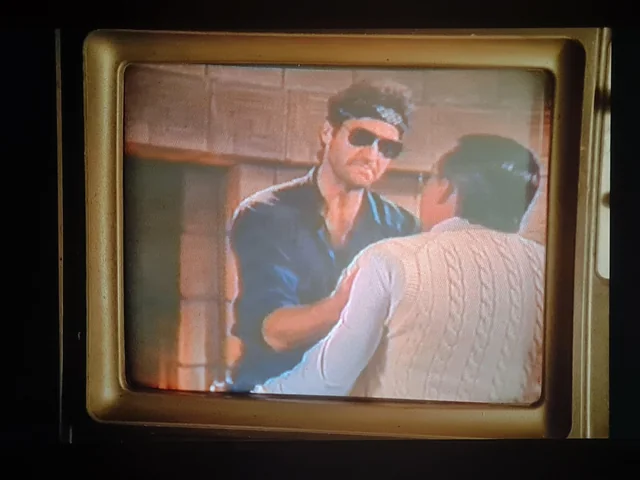
The Ennis House soon became visual shorthand for the home of wealthy, flamboyantly sinister B‑movie villains. That makes all the more notable its use in Blade Runner (a film that made several clichéd Los Angeles locations fresh again), which turns it into the tower where Deckard lives. Even the set-built interior of his apartment uses the same Mayan-motif tiles as the house’s famous concrete-block exterior. But the real rooms of the Ennis House have also received plenty of screen time, not just in the movies but also on television — and even television-within-television, in the case of Twin Peaks’ fictional soap opera Invitation to Love.
As the last of Wright’s Mayan Revival houses, the Ennis House marks the end of his attempt to break into southern California. The architect himself later admitted that it had exceeded reasonable scale: “That’s what you do, you know, after you get going, and get going so far, that you get out of bounds,” he said. “I think the Ennis House was out of bounds for a concrete-block house.” Like much of Wright’s work, it also proved better to photograph than inhabit; despite its most recent and ambitious renovation being completed just a few years earlier, it ended up selling for $5 million below asking price. I appreciate Blade Runner as much as anyone, but $18 million is still more than I’d pay for a 40-minute walk to the subway.
Related content:
That Far Corner: Frank Lloyd Wright in Los Angeles – A Free Online Documentary
A Beautiful Visual Tour of Tirranna, One of Frank Lloyd Wright’s Remarkable, Final Creations
Inside the Beautiful Home Frank Lloyd Wright Designed for His Son (1952)
When Frank Lloyd Wright Designed a Doghouse, His Smallest Architectural Creation (1956)
What Frank Lloyd Wright’s Unusual Windows Tell Us About His Architectural Genius
Based in Seoul, Colin Marshall writes and broadcasts on cities, language, and culture. His projects include the Substack newsletter Books on Cities and the book The Stateless City: a Walk through 21st-Century Los Angeles. Follow him on Twitter at @colinmarshall or on Facebook.
Read More...Johnny Cash & The Clash’s Joe Strummer Sing Bob Marley’s “Redemption Song” (2002)
In 1958, Merle Haggard saw Johnny Cash play in San Quentin, and went on to sing honest country songs for country outlaws. In 1982, future Rage Against the Machine guitarist Tom Morello saw Joe Strummer play with The Clash in Chicago and went on to play angry righteous rock for angry punks. Both Cash and Strummer, who died less than a year apart, were musical prophets in their way, inspiring others to pick up their message and carry it to the common fan. The same, of course, could be said of Bob Marley. And though those three would likely have different definitions of the word “redemption,” they shared a belief in music as a force for good.
Just above, hear Cash and Strummer sing Marley’s “Redemption Song,” with Morello on guitar. Recorded during the sessions for Cash’s last album, the Rick Rubin-produced American IV: The Man Comes Around, the duet happened more or less by chance.
Says Rubin, “Joe was coming every day, because he loved Johnny Cash, and he just happened to be in L.A. on vacation. And he actually extended his trip a week longer just to come every day and be around Johnny.” Rubin also recorded a solo take of Strummer singing “Redemption Song” (below), which appeared on Strummer’s final album, the posthumously released Streetcore.
“Originally, the song was supposed to be a duet, and we recorded it as a duet,” Rubin continues, “But, just in case, both Johnny and Joe sang the whole song several times” on their own. The duet version appears on the third disc, titled Redemption Songs, of the released Cash box set Unearthed, which features outtakes and alternates from the Rubin-produced American Recordings series of Cash cover songs. Seems fitting somehow that one of the last songs both Strummer and Cash would record would be this one, and that they would sing it together. As one site succinctly put it, the recording represents “the first true punk rock star and the last. Together forever.”
If you would like to support the mission of Open Culture, consider making a donation to our site. It’s hard to rely 100% on ads, and your contributions will help us continue providing the best free cultural and educational materials to learners everywhere. You can contribute through PayPal, Patreon, and Venmo (@openculture). Thanks!
Related Content:
Bob Marley’s “Redemption Song” Played by Musicians Around the World
Did Joe Strummer, Frontman of The Clash, Run the Paris and London Marathons?
“Joe Strummer’s London Calling”: All 8 Episodes of Strummer’s UK Radio Show Free Online
Josh Jones is a writer and musician based in Durham, NC. Follow him at @jdmagness
Read More...The Amazing Recording History of The Beatles’ “Here Comes the Sun”
The most streamed Beatles song isn’t “She Loves You,” “Hey Jude,” or “All You Need Is Love.” It isn’t even “Yesterday.” If you were about to guess “Something,” you’re on the right track, at least as far as the source album and songwriter. In fact, it’s George Harrison’s other signature song “Here Comes the Sun,” which has racked up 1,433,830,334 Spotify streams as of this writing, nearly a million more than “In My Life” right below it. The You Can’t Unhear This video above breaks down what makes “Here Comes the Sun” stand out even amid the formidable Beatles catalog, from its conception through its recording process.
Though it comes off as a simple song — whose inviting quality may well have something to do with its outsized popularity — “Here Comes the Sun” turns out to be the result of a technically complex and unconventional process fairly characteristic of the late Beatles. Starting with a melody crafted while playing an acoustic guitar in Eric Clapton’s garden (having recused himself from yet another business meeting), Harrison enriched it with such techniques as running his guitar through a revolving Leslie speaker meant for an organ and having his hulking Moog synthesizer transported to Abbey Road so he could add a layer of electronic sublimity.
At this point in the life of the Beatles, everyone involved could surely feel that the band’s end was near. Regardless, none of the Fab Four was quite working in isolation, and indeed, the “Here Comes the Sun” sessions — which, of course, ended up on Abbey Road, the final album they recorded — represent some of their last work as a unit. It’s not surprising that such a context would produce, say, John Lennon’s grimly descending “I Want You (She’s So Heavy),” which ends side one; what startles no matter how many times you hear it is the gentle optimism with which Harrison’s side two opens immediately thereafter, especially if you’re not turning an LP over in between.
Even in isolation, “Here Comes the Sun” has made such a cultural impact that Carl Sagan lobbied for its inclusion on the Voyager “Golden Records,” which were launched into outer space with the intent to give other forms of intelligent life a glimpse of human civilization. The Beatles also liked the idea, but they didn’t own the necessary rights; those belonged to the label EMI, who in the recollection of Sagan’s widow Ann Druyan demanded a prohibitive fee for the song’s use. Had it been included, perhaps it could’ve ended up the first intergalactic hit song — one enjoyed in the orbit of another sun entirely.
Related content:
The Beatles Release the First Ever Video for “Here Comes the Sun”
Hear The Beatles’ “Here Comes the Sun” With a Re-Discovered George Harrison Solo
Flashmob Performs The Beatles’ “Here Comes the Sun” in Madrid Unemployment Office
Watch George Harrison’s Final Interview and Performance (1997)
Based in Seoul, Colin Marshall writes and broadcasts on cities, language, and culture. His projects include the Substack newsletter Books on Cities and the book The Stateless City: a Walk through 21st-Century Los Angeles. Follow him on Twitter at @colinmarshall or on Facebook.
Read More...
When Leonard Cohen Guest Starred on Miami Vice (1986)
Leonard Cohen was Canada’s answer to Bob Dylan. While best known perhaps as a singer-songwriter who penned the tune “Hallelujah” — which was covered by Jeff Buckley, John Cale and just about everyone else under the sun — he was also at varying points in his colorful life a poet, a novelist, a law student and a Zen monk. Well, you can add to this list guest star on Miami Vice. Yes. Miami Vice, Michael Mann’s decade-defining crime series that somehow made stubble, pastel colors and Don Johnson cool.
Appearing on the episode “French Twist,” Cohen plays Francois Zolan, a French secret service agent who is up to no good. Though he’s in the episode for only a couple of minutes and almost all of it on the phone, Cohen just manages to ooze menace. You can see him and some truly breathtaking examples of ‘80s fashion in the clip above.
Miami Vice had a habit of casting music icons. Little Richard, Frank Zappa, Miles Davis, Willie Nelson, and Eartha Kitt also appeared in the series. But, unlike Cohen, they didn’t act in French.
Below you can see a montage of 20 rock stars who appeared on Miami Vice during its run.
If you would like to support the mission of Open Culture, consider making a donation to our site. It’s hard to rely 100% on ads, and your contributions will help us continue providing the best free cultural and educational materials to learners everywhere. You can contribute through PayPal, Patreon, and Venmo (@openculture). Thanks!
Related Content:
When Frank Zappa & Miles Davis Played a Drug Dealer and a Pimp on Miami Vice
The Poetry of Leonard Cohen Illustrated by Two Short Films
How Leonard Cohen & David Bowie Faced Death Through Their Art: A Look at Their Final Albums
Young Leonard Cohen Reads His Poetry in 1966 (Before His Days as a Musician Began)
Jonathan Crow is a writer and filmmaker whose work has appeared in Yahoo!, The Hollywood Reporter, and other publications. You can follow him at @jonccrow.
Read More...Support Us
We're hoping to rely on loyal readers, rather than erratic ads. Please click the Donate button and support Open Culture. You can use Paypal, Venmo, Patreon, even Crypto! We thank you!

About Us

Open Culture scours the web for the best educational media. We find the free courses and audio books you need, the language lessons & educational videos you want, and plenty of enlightenment in between.
Advertise With Us

FREE UPDATES!
GET OUR DAILY EMAIL
Get the best cultural and educational resources on the web curated for you in a daily email. We never spam. Unsubscribe at any time.
FOLLOW ON SOCIAL MEDIA

Open Culture editor Dan Colman scours the web for the best educational media. He finds the free courses and audio books you need, the language lessons & movies you want, and plenty of enlightenment in between.
Advertise With Us

