The Story of Francis Ford Coppola’s Four-Decade-Struggle to Make Megalopolis
This past summer, out came a trailer for Megalopolis, the movie Francis Ford Coppola has spent half of his life trying to make. It took the bold approach of opening with quotes from reviews of his previous pictures, and not positive ones: when it was first released, Rex Reed called Apocalypse Now “an epic piece of trash,” and even The Godfather was “diminished by its artsiness,” at least according to Pauline Kael. But film-criticism enthusiasts smelled something fishy right away, and it took only the barest degree of research to discover that not only had Reed and Kael (who liked The Godfather, as did most everyone else) never used those phrases, none of the quotes in the trailer were real.
All this evidence of critics perpetually failing to grasp Coppola’s visions seems to have been fabricated with an artificial-intelligence system. This was a piece of bad press Megalopolis could’ve done without, stories of its troubled production having been circulating for months. But then, Coppola has endured much worse in his long filmmaking career, like the hellish, enormously prolonged shooting of Apocalypse Now, or the fire-sale of Zoetrope, the studio he founded, after the box-office disaster of One From the Heart. That he was able to get Megalopolis into production, let alone complete it, counts as something of a triumph in itself.
The Be Kind Rewind video above recounts the story behind Megalopolis, in essence “a story about Coppola himself, informed by his own ambitions, setbacks, times of fortune, and times of loss.” When he completed the first full draft of the script in 1984, he could have had no idea of what lay in store for the project in the decades ahead, not least its numerous derailments by his own personal and professional crises as well as large-scale disasters like 9/11 and COVID-19. The result, at a cost of $120 million Coppola raised by selling off part of his winery, is a spectacle that meditates on civilization, modernity, and utopia that, even this early in its release, has drawn reactions of astonishment, derision, and — most commonly — flat-out mystification.
The film “alternates grandiose rhetoric about government and the modern city with borderline screwball comedy, quotes Marcus Aurelius and other ancient thinkers, papers over story gaps with sonorous narration by cast member Laurence Fishburne, and fills the screen with superimpositions, split-screen mosaics, and images that aren’t meant to be taken literally,” writes Rogerebert.com’s Matt Zoller-Seitz. “Movies like this only seem ‘indulgent’ because we’re so deep into the era where everything has to be unmitigated fan service, the cinematic equivalent of cooking the Whopper exactly how the customer dreamed about ordering it.” Megalopolis is, in Be Kind Rewind’s final analysis, “the apotheosis of auteurism, unrestrained spectacle that amplifies Coppola’s best and worst instincts on a massive scale.” Personally, I can’t wait to see it.
Related content:
Francis Ford Coppola Breaks Down His Most Iconic Films: The Godfather, Apocalypse Now & More
Francis Ford Coppola’s Handwritten Casting Notes for The Godfather
George Lucas Shoots a Cinema Verité-Style Documentary on Francis Ford Coppola (1969)
Dementia 13: The Film That Took Francis Ford Coppola From Schlockster to Auteur
Is America Declining Like Ancient Rome?
Based in Seoul, Colin Marshall writes and broadcasts on cities, language, and culture. His projects include the Substack newsletter Books on Cities and the book The Stateless City: a Walk through 21st-Century Los Angeles. Follow him on Twitter at @colinmarshall or on Facebook.
Read More...The Doctor Who Theme Reimagined as a Jacques Brel-esque Jazz Tune
Written by Ron Grainer, and then famously arranged and recorded by Delia Derbyshire in 1963, the Doctor Who theme song has been adapted and covered many times, and even referenced by Pink Floyd. In the hands of comedian Bill Bailey, the song comes out a little differently–a little like a Belgian Jacques Brel-esque jazz creation. This recording of “Docteur Qui” apparently comes from the DVD Bill Bailey’s Remarkable Guide to the Orchestra. Enjoy…
If you would like to support the mission of Open Culture, consider making a donation to our site. It’s hard to rely 100% on ads, and your contributions will help us continue providing the best free cultural and educational materials to learners everywhere. You can contribute through PayPal, Patreon, and Venmo (@openculture). Thanks!
Related Content
The Fascinating Story of How Delia Derbyshire Created the Original Doctor Who Theme
Two Documentaries Introduce Delia Derbyshire, the Pioneer in Electronic Music
How Doctor Who First Started as a Family Educational TV Program (1963)
A Detailed, Track-by-Track Analysis of the Doctor Who Theme Music
Read More...Kurt Vonnegut’s Lost Board Game Is Finally for Sale

Kurt Vonnegut’s life was not without its ironies. Fighting in World War II, that descendant of a long line of German immigrants in the United States found himself imprisoned in Dresden just when it was devastated by Allied firebombing. To understand the relevance of this experience to his literary work, one need only know that his captors made him live in a slaughterhouse. It’s not surprising that anti-war sentiments would surface again and again in the books he wrote after coming home. But one would hardly expect him to have spent his time away from the writing desk on a military-themed board game.
“After releasing his first novel, Player Piano, in 1952, to positive reviews and poor sales, he needed other streams of income to support his growing family,” writes the New York Times’ Julia Carmel of the young Vonnegut. Of all his endeavors — which included public relations, a car dealership and a very brief stint at Sports Illustrated — he was most passionate about designing a board game called General Headquarters.” Readers of Vonnegut’s novels might expect a sardonically didactic object lesson on the futility of war, but in fact, “GHQ is a fast-paced two-player battle game in which each player maneuvers military units — infantry, armored vehicles, artillery and an airborne regiment — to capture the other player’s headquarters.”
Vonnegut never did manage to sell the game, which has only just come available for purchase at Barnes & Noble stores. Its long-delayed production was the project of a tabletop game designer called Geoff Engelstein, who ran across a brief mention of GHQ that eventually inspired him to inquire about the game’s status with the writer’s estate. The 40 pages of notes amid Vonnegut’s papers include several revisions of its rules, but also pitch letters to board-game companies suggesting that GHQ could “become the third popular checkerboard game” — and even “be used to train cadets at the U.S. Military Academy at West Point.”
Despite probably having missed its chance to enter the standard military-academy curriculum, the game could nevertheless become a must-have among collectors of Vonnegutiana. According to the Kurt Vonnegut Museum & Library’s online store, “this first edition of GHQ features deluxe wooden pieces and a 24-page commentary booklet, showing Kurt Vonnegut’s actual design notes to give insight into his creative process.” It may “lack the signature dark sense of humor that runs through Mr. Vonnegut’s writing,” as Carmel puts it, but it surely couldn’t be without his less widely acknowledged — but no less characteristic — instinct for entertainment value.
Related content:
Kurt Vonnegut Diagrams the Shape of All Stories in a Master’s Thesis Rejected by U. Chicago
22-Year-Old P.O.W. Kurt Vonnegut Writes Home from World War II: “I’ll Be Damned If It Was Worth It”
A New Kurt Vonnegut Museum Opens in Indianapolis … Right in Time for Banned Books Week
The Fear and Loathing in Las Vegas Board Game, Inspired by Hunter S. Thompson’s Rollicking Novel
Jack Kerouac Was a Secret, Obsessive Fan of Fantasy Baseball
Based in Seoul, Colin Marshall writes and broadcasts on cities, language, and culture. His projects include the Substack newsletter Books on Cities and the book The Stateless City: a Walk through 21st-Century Los Angeles. Follow him on Twitter at @colinmarshall or on Facebook.
Read More...Thomas Edison’s Recordings of Leo Tolstoy: Hear the Voice of the Great Russian Novelist
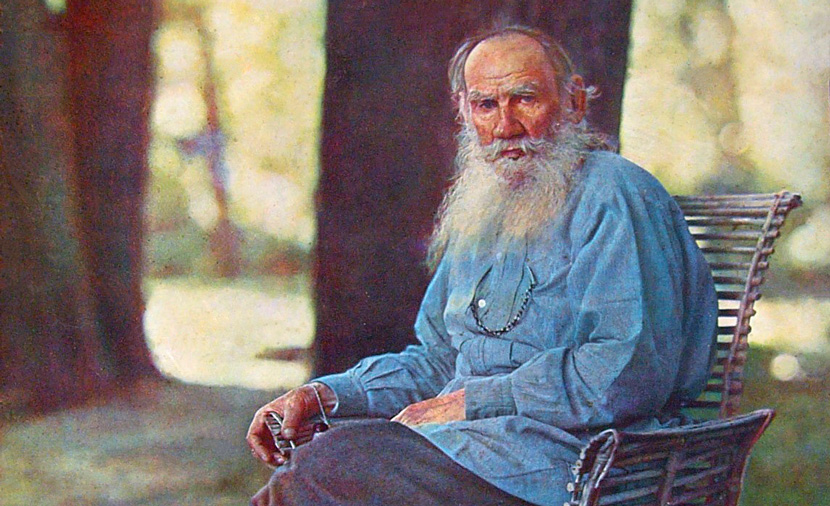
Born 196 years ago, Russian novelist Leo Tolstoy’s life (1828–1910) spanned a period of immense social, political, and technological change, paralleled in his own life by his radical shift from hedonistic nobleman to theologian, anarchist, and vegetarian pacifist. Though he did not live to see the Russian Revolution, the novelist did see Tsar Alexander II’s sweeping reforms, including the 1861 Emancipation order that changed the social character of the country. Near the end of his life, Tolstoy saw the coming of new recording technology that would revolutionize the direction of his own life’s work—telling stories.
In his later years Tolstoy appeared in the new medium of film, which captured his 80th birthday in 1908, and his funeral procession two years later. He was the subject of the first color photograph taken in Russia (top) also in 1908. And that same year, Tolstoy made several audio recordings of his voice, on a phonograph sent to him personally by Thomas Edison. You can hear one of those recordings, “The Power of Childhood,” made on April 19th, 1908, just above.
You’ll note, of course, that the great author reads in his native language. Most of the recordings he made, which he intended for the edification of his countrymen, are in Russian. Below, however, you can hear him read from his last book, Wise Thoughts For Every Day in English, German, French and Russian. The book collects Tolstoy’s favorite passages from thinkers as diverse as Lao-Tzu and Ralph Waldo Emerson. As Mike Springer wrote in a previous post on this recording, “Tolstoy rejected his great works of fiction” as an old man, “believing that it was more important to give moral and spiritual guidance to the common people.” To that end, he made a series of short recordings, which you can hear at this site, on such subjects as art, law, morality, poverty, nonviolence, and capital punishment.
The story of how Tolstoy came to make these recordings is a fascinating one. Interested in the new technology, Tolstoy made his first recording in 1895, when, writes The Moscow Times, “an Edison representative came to Yasnaya Polyana, Tolstoy’s estate, to record the author’s voice. Those recordings were taken over the border to Berlin, where they lay in an archive until they were brought back to the Soviet Union after World War II.” When Stephen Bonsal, editor of the New York Times learned of Tolstoy’s interest in recording technology in 1907, he promised to send the novelist an Edison phonograph of his own. Edison himself, hearing of this, refused to accept any payment, and personally sent his own machine to Tolstoy’s estate with the engraved message “A Gift to Count Leo Tolstoy from Thomas Alva Edison.”
Edison asked Tolstoy for many multi-lingual recordings, requesting “short messages” in English and French, “conveying to the people of the world some thoughts that would tend to their moral and social advancement.” Tolstoy diligently made several recordings, some of which were then shipped to Edison in 1908. On February 21 of that year, the New York Times published an article on the exchange titled “Tolstoy’s Gift to Edison. Will Send Record of His Voice—Edison Gave Him a Phonograph.” The world eagerly awaited the world-famous author’s message to its “civilized peoples.” It seems however, that the message never arrived. According to Sputnik News, the fate of that legendary recording “has yet to be found out.” Nevertheless, thanks to Edison, we have several other recordings of Tolstoy’s very well-preserved voice, the record of a life lived to the end with fierce conviction and curiosity.
Related Content:
Leo Tolstoy Reads From His Last Major Work in 4 Languages, 1909
Vintage Footage of Leo Tolstoy: Video Captures the Great Novelist During His Final Days
Josh Jones is a writer and musician based in Durham, NC. Follow him at @jdmagness
Read More...Twin Peaks Actually Explained: A 4‑Hour Video Essay Demystifies It All
I don’t know about you, but my YouTube algorithms can act like a nagging friend, suggesting a video for days until I finally give in. Such was the case with this video essay with the tantalizing title: “Twin Peaks ACTUALLY EXPLAINED (No, Really)”.
First of all, before, during, and after 2017’s Twin Peaks The Return, theories were as inescapable as the cat memes on the Twin Peaks Facebook groups. After the mind-blowing Episode 8, they went into overdrive, including the bonkers idea that the final two episodes were meant to be watched *overlaid* on each other. And I highlighted one in-depth journey through the entire three decades of the Lynch/Frost cultural event for this very site.
So when I finally clicked on the link I balked immediately: Four and a half hours? Are you kidding me? (You might be saying the very thing to yourself now.) But just like the narrator says, bear with me. Over the week, I watched the entire thing in 30-minute segments, not because it was grueling, but because time is precious and there is a lot to chew over. By the end, I was recommending the video to friends only to find some of them were already deep inside Twin Perfect’s analysis.
So here we are, with me highly encouraging you to invest the time (providing you have watched all three seasons of Twin Peaks and Fire Walk With Me), but also not wanting to ruin some of Twin Perfect’s theories, which he lays out like a prosecutor, walking us through a general theory of Lynch.
However, I will make a few points:
- In 2019, we posted a video in which Lynch explains both the Unified Field Theory and Transcendental Meditation. There are at least two major sequences that Twin Perfect suggests reflect the Unified Field.
- Lynch’s obsession with electricity and fire is essential to the theory.
- The One-Armed Man’s quote “I mean it as it is, as it sounds,” doubles as Lynch’s approach: Twin Perfect does a masterful job showing many, many examples where Lynch is directly explaining his use of metaphor and symbol to us. Sometimes that is straight into the camera.
- We now know why Season Three featured a three-minute shot of a man sweeping up peanuts from a bar floor.
- I’ve always felt that The Return was an exploration of the dangers of nostalgia, and this essay confirmed it for me. There was something missing at the center of the Third Season, indeed.
- Twin Perfect reads all quotes from the director in a mock-Lynch voice. For some this will grate; for me it was A BEAUTIFUL THING (wiggly finger gesture).
Twin Perfect puts much more effort into this than most graduate students:
I have been working on this video for two years, writing and researching and editing. I’ve been reading and watching and listening to every creator interview and AMA, every DVD extra and featurette, every TV special, every fan theory, blog, and podcast — any and all Twin Peaks-related posts I could find — trying to hone and polish my script to be the best I thought it could possibly be. I focus-grouped my video with people, challenging them to poke as many holes in my arguments as they could so that I could better illustrate my ideas. I tried my best to create something others would find of value, something that would add to the ongoing mystery and spark new discussions about my favorite series.
Are there some problems with the theory? Sure. But for every “I don’t know, man,” I said to myself, he immediately followed it up with something spot on. I think he deserves that MFA in Twin Peaks Studies.
So brew up some strong coffee and cut yourself a slice of cherry pie, and get stuck in.
Related Content:
David Lynch Directs a Mini-Season of Twin Peaks in the Form of Japanese Coffee Commercials
David Lynch Draws a Map of Twin Peaks (to Help Pitch the Show to ABC)
Watch an Epic, 4‑Hour Video Essay on the Making & Mythology of David Lynch’s Twin Peaks
Ted Mills is a freelance writer on the arts., You can also follow him on Twitter at @tedmills.
Read More...David Lynch Releases on YouTube Interview Project: 121 Stories of Real America Recorded on a 20,000-Mile Road Trip
Take a sufficiently long road trip across America, and you’re bound to encounter something or someone Lynchian. Whether or not that idea lay behind Interview Project, the undertaking had the endorsement of David Lynch himself. Not coincidentally, it was conceived by his son Austin, who along with filmmaker Jason S. (known for the documentary David Lynch: The Art Life), drove 20,000 miles through the U.S. in search of what it’s tempting to call the real America, a nation populated by colorful, sometimes desperate, often unconventionally eloquent characters, 121 of whom Interview Project finds passing the day in bars, working at stores, or just sitting on the roadside.
Profiling David Lynch in the nineties, David Foster Wallace observed that “a good 65 percent of the people in metropolitan bus terminals between the hours of midnight and 6 A.M. tend to qualify as Lynchian figures — grotesque, enfeebled, flamboyantly unappealing, freighted with a woe out of all proportion to evident circumstances.”
Interview Project sticks to small-town or rural settings — Camp Hill, Pennsylvania; Pigeon Forge, Tennessee; Tuba City, Arizona — but still encounters people who may at first glance strike viewers as disturbing, menacing, saddening, forbidding, or some combination thereof. But they all have compelling stories to tell, and can do so within five minutes.
Being the subject of an Interview Project video requires a degree of forthright openness that those who’ve spent their lives in the U.S. may not recognize as characteristically American. Though often beset by a host of crises, ailments, and grievances (imposed from without or within), they don’t hesitate to assert themselves and their worldviews. Though there’s obvious curiosity value in all these eccentric convictions, regional twangs, and sometimes harrowing misfortunes, what emerges above all from these interviews is an impressive resilience. Young or old, coherent or otherwise, with or without a place to live, these people all come off as survivors.
When Interview Project first went online in 2009, it wasn’t viewable on Youtube. Now, for its fifteenth anniversary, all of its videos have been uploaded to that platform, and in high definition at that. Seen in this new context, Interview Project looks like an antecedent to certain Youtube channels that have risen to popularity in the decade and a half since: Soft White Underbelly, for instance, which devotes itself to interviewees at the extreme margins of society. Extremity isn’t the signal characteristic of Interview Project’s subjects, depart dramatically though their experiences may from the modern middle-class template. One could pity how short their lives fall of the “American Dream” — or one could consider the possibility that they’re all living that dream in their own way.
Related Content:
A Brief History of the Great American Road Trip
Real Interviews with People Who Lived in the 1800s
What Makes a David Lynch Film Lynchian: A Video Essay
David Lynch Teaches You to Cook His Quinoa Recipe in a Strange, Surrealist Video
Based in Seoul, Colin Marshall writes and broadcasts on cities, language, and culture. His projects include the Substack newsletter Books on Cities and the book The Stateless City: a Walk through 21st-Century Los Angeles. Follow him on Twitter at @colinmarshall or on Facebook.
Read More...Private Snafu: The World War II Propaganda Cartoons Created by Dr. Seuss, Frank Capra & Mel Blanc
Private Snafu was the U.S. Army’s worst soldier. He was sloppy, lazy and prone to shooting off his mouth to Nazi agents. And he was hugely popular with his fellow GIs.
Private Snafu was, of course, an animated cartoon character designed for the military recruits. He was an adorable dolt who sounded like Bugs Bunny and looked a bit like Elmer Fudd. And in every episode, he taught soldiers what not to do, from blabbing about troop movements to not taking malaria medication.
The idea for the series reportedly came from Frank Capra — the Oscar-winning director of It’s a Wonderful Life and Mr. Smith Goes to Washington and, during WWII, the chairman of the U.S. Army Air Force First Motion Picture Unit. He wanted to create a cartoon series for new recruits, many of whom were young, unworldly and in some cases illiterate. Capra gave Disney first shot at developing the idea but Warner Bros’ Leon Schlesinger, a man who was as famous for his hard-driving business acumen as he was for wearing excessive cologne, offered a bid that was 2/3rds below that of Disney.
The talent behind this series was impressive, featuring a veritable who’s who of non-Disney animating talent, including Chuck Jones, Bob Clampett, and Friz Freleng. Snafu was voiced by Mel Blanc, who famously did Bunny Bugs, Daffy Duck and later Marvin the Martian. And one of the main writers was none other than Theodor “Dr. Seuss” Geisel.
As you can see in the first Snafu short Coming!! (1943), directed by Chuck Jones (see above), the movie displays a salty sensibility intended for an army camp rather than a Sunday matinee. The movie opens with a deadpan voiceover explaining that, in informal military parlance, SNAFU means “Situation Normal All…All Fouled Up,” hinting that the usual translation of the acronym includes a popular Anglo-Saxon word. Later, it shows Private Snafu daydreaming about a burlesque show – complete with a shapely exotic dancer doffing her duds – as he obliviously wrecks a plane.
Though there were no writing credits for each individual episode, just listen to the voiceover for Gripes (1943), directed by Friz Freleng. Dr. Seuss’s trademark singsong cadence is unmistakable including lines like:
“The moral, Snafu, is that the harder you work, the sooner we’re gonna beat Hitler, that jerk.”
Gas! (1944), directed by Chuck Jones, features a cameo from Bugs Bunny.
And finally, Going Home, directed by Chuck Jones, was slated to come out in 1944 but the War Department kiboshed it. The rationale was never explained but some think that the film’s reference to a massive, top-secret weapon that was to be deployed over Japan was just a little too close to the Manhattan Project.
You can watch a long list of Private Snafu episodes here.
Related Content:
Donald Duck’s Bad Nazi Dream and Four Other Disney Propaganda Cartoons from World War II
Dr. Seuss’ World War II Propaganda Films: Your Job in Germany (1945) and Our Job in Japan (1946)
Education for Death: The Making of the Nazi–Walt Disney’s 1943 Film Shows How Fascists Are Made
Dr. Seuss Draws Anti-Japanese Cartoons During WWII, Then Atones with Horton Hears a Who!
Jonathan Crow is a Los Angeles-based writer and filmmaker whose work has appeared in Yahoo!, The Hollywood Reporter, and other publications. You can follow him at @jonccrow.
Read More...The Greatest Shot in Television: Science Historian James Burke Had One Chance to Nail This Scene … and Nailed It
The 80-second clip above captures a rocket launch, something of which we’ve all seen footage at one time or another. What makes its viewers call it “the greatest shot in television” still today, 45 years after it first aired, may take more than one viewing to notice. In it, science historian James Burke speaks about how “certain gases ignite, and that the thermos flask permits you to store vast quantities of those gases safely, in their frozen liquid form, until you want to ignite them.” Use a sufficiently large flask filled with hydrogen and oxygen, design it to mix the gases and set light to them, and “you get that” — that is, you get the rocket that launches behind Burke just as soon as he points to it.
One can only admire Burke’s composure in discussing such technical matters in a shot that had to be perfectly timed on the first and only take. What you wouldn’t know unless you saw it in context is that it also comes as the final, culminating moment of a 50-minute explanatory journey that begins with credit cards, then makes its way through the invention of everything from a knight’s armor to canned food to air conditioning to the Saturn V rocket, which put man on the moon.
Formally speaking, this was a typical episode of Connections, Burke’s 1978 television series that traces the most important and surprising moves in the evolution of science and technology throughout human history.
Though not as widely remembered as Carl Sagan’s slightly later Cosmos, Connections bears repeat viewing here in the twenty-first century, not least for the intellectual and visual bravado typified by this “greatest shot in television,” now viewed nearly 18 million times on Youtube. Watch it enough times yourself, and you’ll notice that it also pulls off some minor sleight of hand by having Burke walk from a non-time-sensitive shot into another with the already-framed rocket ready for liftoff. But that hardly lessens the feeling of achievement when the launch comes off. “Destination: the moon, or Moscow,” says Burke, “the planets, or Peking” — a closing line that sounded considerably more dated a few years ago than it does today.
Related Content:
Endeavour’s Launch Viewed from Booster Cameras
The 100 Most Memorable Shots in Cinema Over the Past 100 Years
The Most Beautiful Shots in Cinema History: Scenes from 100+ Films
125 Great Science Videos: From Astronomy to Physics & Psychology
Based in Seoul, Colin Marshall writes and broadcasts on cities, language, and culture. His projects include the Substack newsletter Books on Cities and the book The Stateless City: a Walk through 21st-Century Los Angeles. Follow him on Twitter at @colinmarshall or on Facebook.
Read More...The Rocky Horror Picture Show Is Now a Retro Video Game
The Rocky Horror Picture Show–it started first as a musical stage production in 1973, then became a cult classic film in 1975. Now, a half-century later, it gets reborn as a retro video game. Scheduled to be released by Halloween, the game features “8‑bit chiptune renditions of Rocky Horror’s legendary songs,” including the “Time Warp” of course. According to The Wrap, it also boasts “8‑bit-styled graphics bringing the show’s sets and characters to life, combining ’80s nostalgia with the show’s ’70s retro vibes.” The game will be available for Sony Playstation, Xbox, Nintendo Switch and Steam. Enjoy.
Related Content
How Rocky Horror Became a Cult Phenomenon
1978 News Report on the Rocky Horror Craze Captures a Teenage Michael Stipe in Drag
Read More...Artificial Intelligence & Drones Uncover 303 New Nazca Lines in Peru
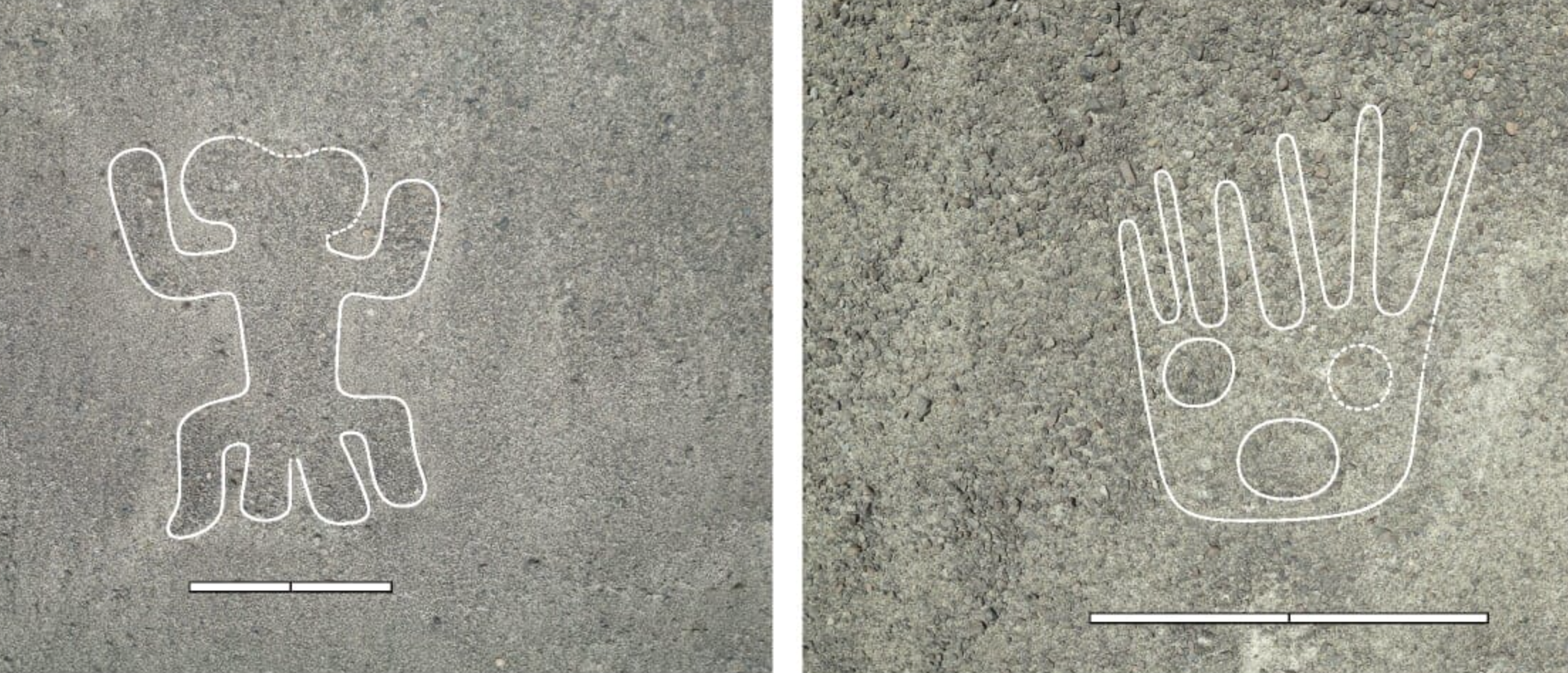
If you visit one tourist site in Peru, it will almost certainly be the ruined Incan city of Machu Picchu. If you visit another, it’ll probably be the Nazca Desert, home to many large-scale geoglyphs made by pre-Inca peoples between 500 BC and 500 AD. Many of these “Nazca lines” are literally that, running across the desert floor in an abstract fashion, but others are figurative, depicting human beings, flora, fauna, and various less easily categorizable chimeras. The preservative effects of the climate kept many of these designs identifiable by the time moderns discovered them in 1927, and thanks to artificial-intelligence technology, researchers are finding new ones still today.
“A team from the Japanese University of Yamagata’s Nazca Institute, in collaboration with IBM Research, discovered 303 previously unknown geoglyphs of humans and animals, all smaller in size than the vast geometric patterns that date from AD 200–700 and stretch across more than 400 sq km of the Nazca plateau,” writes the Guardian’s Dan Collyns.
“The use of AI combined with low-flying drones revolutionized the speed and rate at which the geoglyphs were discovered, according to a research paper published this week in the Proceedings of the National Academy of Sciences,” and many more Nazca lines could remain to be identified with these methods.
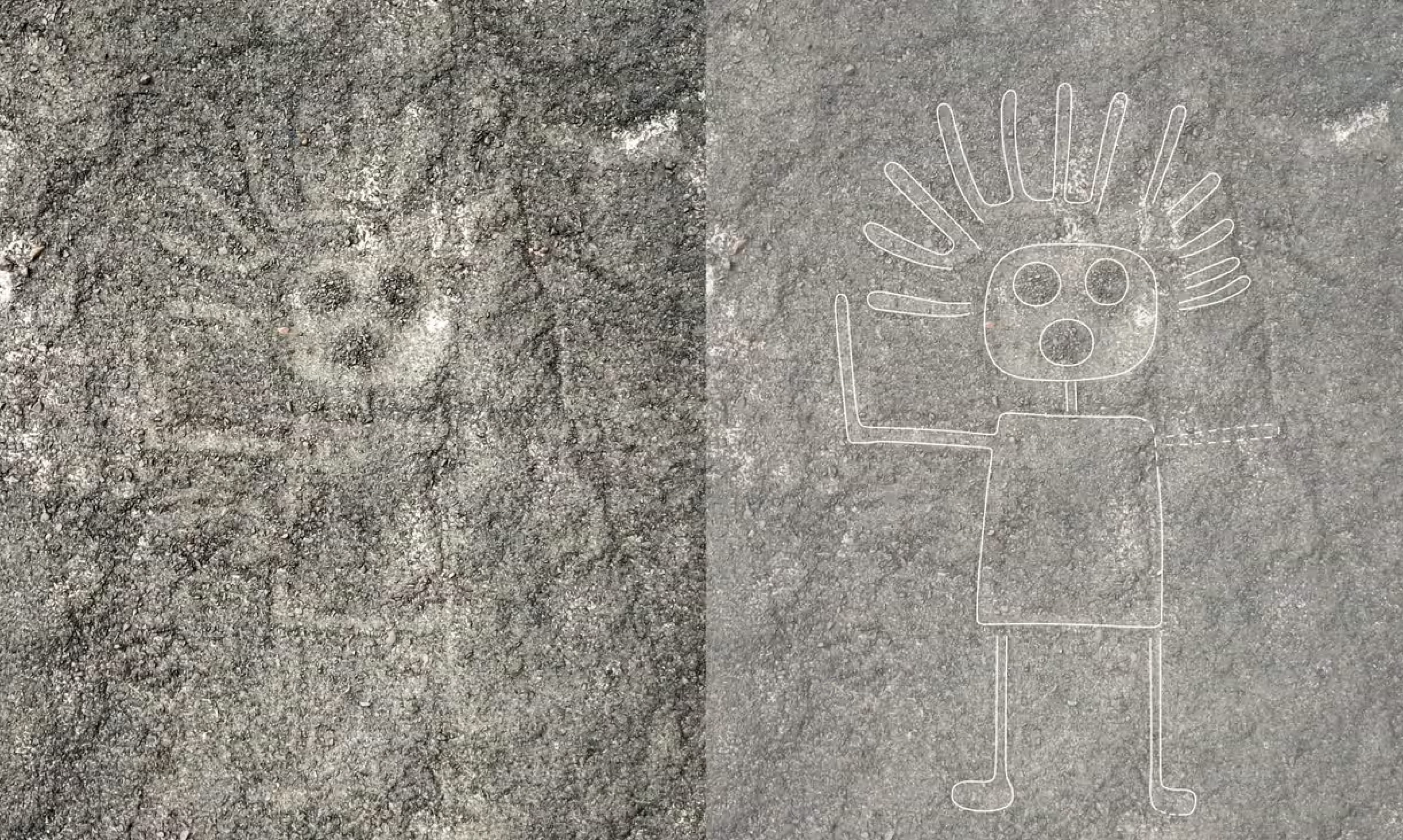
The newly identified geoglyphs “include birds, plants, spiders, humanlike figures with headdresses, decapitated heads and an orca wielding a knife,” writes CNN’s Katie Hunt. She also cites hypotheses about why the original creators of these figures did the painstaking work of displacing stone after stone to create images mostly invisible to the human eye: it’s possible that “they formed a sacred space that was perhaps a place of pilgrimage. Other theories propose they played a part in calendars, astronomy, irrigation or for movement, such as running or dancing, or communication.” Some of them, surely, were meant only for the eyes of the gods, and so it may stand to reason that only our modern gods of artificial intelligence have been able to reveal them.
via Colossal
Related content:
Take a Virtual Tour of Machu Picchu, One of the New 7 Wonders of the World
The Solar System Drawn Amazingly to Scale Across 7 Miles of Nevada’s Black Rock Desert
Peruvian Singer & Rapper, Renata Flores, Helps Preserve Quechua with Viral Hits on YouTube
Algerian Cave Paintings Suggest Humans Did Magic Mushrooms 9,000 Years Ago
A Mysterious Monolith Appears in the Utah Desert, Channeling Kubrick’s 2001: A Space Odyssey
Based in Seoul, Colin Marshall writes and broadcasts on cities, language, and culture. His projects include the Substack newsletter Books on Cities and the book The Stateless City: a Walk through 21st-Century Los Angeles. Follow him on Twitter at @colinmarshall or on Facebook.
Read More...Support Us
We're hoping to rely on loyal readers, rather than erratic ads. Please click the Donate button and support Open Culture. You can use Paypal, Venmo, Patreon, even Crypto! We thank you!

About Us

Open Culture scours the web for the best educational media. We find the free courses and audio books you need, the language lessons & educational videos you want, and plenty of enlightenment in between.
Advertise With Us

FREE UPDATES!
GET OUR DAILY EMAIL
Get the best cultural and educational resources on the web curated for you in a daily email. We never spam. Unsubscribe at any time.
FOLLOW ON SOCIAL MEDIA

Open Culture editor Dan Colman scours the web for the best educational media. He finds the free courses and audio books you need, the language lessons & movies you want, and plenty of enlightenment in between.
Advertise With Us

