How Henri Matisse Scandalized the Art Establishment with His Daring Use of Color
Even those of us not particularly well-versed in art history have heard of a painting style called fauvism — and probably have never considered what it has to do with fauve, the French word for a wild beast. In fact, the two have everything to do with one another, at least in the sense of how certain critics regarded certain artists in the early twentieth century. One of the most notable of those artists was Henri Matisse, who since the end of the nineteenth century had been exploring the possibilities of his decision to “lean into the dramatic power of color,” as Evan “Nerdwriter” Puschak puts it in the new video above.
It was Matisse’s unconventional use of color, emotionally powerful but not strictly realistic, that eventually got him labeled a wild beast. Even before that, in his famous 1904 Luxe, Calme et Volupté, which has its origins in a stay in St. Tropez, you can “feel Matisse forging his own path. His colors are rebelling against their subjects. The painting is anarchic, fantastical. It’s pulsing with wild energy.” He continued this work on a trip to the southern fishing village of Collioure, “and even after more than a century, the paintings that resulted “still retain their defiant power; the colors still sing with the daring, the creative recklessness of that summer.”
In essence, what shocked about Matisse and the other fauvists’ art was its substitution of objectivity with subjectivity, most noticeably in its colors, but in subtler elements as well. As the years went on — with support coming from not the establishment but far-sighted collectors — Matisse “learned how to use color to define form itself,” creating paintings that “expressed deep, primal feelings and rhythms.” This evolution culminated in La Danse, whose “shocking scarlet” used to render “naked, dancing, leaping, spinning figures who are less like people than mythological satyrs” drew harsher opprobrium than anything he’d shown before.
But then, “you can’t expect the instantaneous acceptance of something radically new. If it was accepted, it wouldn’t be radical.” Today, “knowing the directions that modern art went in, we now can appreciate the full significance of Matisse’s work. We can be shocked at it without being scandalized.” And we can recognize that he discovered a universally resonant aesthetic that most of his contemporaries didn’t understand — or at least it seems that way to me, more than a century later and on the other side of the world, where his art now enjoys such a wide appeal that it adorns the iced-coffee bottles at convenience stores.
Related content:
Henri Matisse Illustrates Baudelaire’s Censored Poetry Collection, Les Fleurs du Mal
Hear Gertrude Stein Read Works Inspired by Matisse, Picasso, and T.S. Eliot (1934)
Henri Matisse Illustrates James Joyce’s Ulysses (1935)
Based in Seoul, Colin Marshall writes and broadcasts on cities, language, and culture. His projects include the Substack newsletter Books on Cities and the book The Stateless City: a Walk through 21st-Century Los Angeles. Follow him on Twitter at @colinmarshall or on Facebook.
Read More...Revisit Episodes of Liquid Television, MTV’s 90s Showcase of Funny, Irreverent & Bizarre Animation
MTV stands for Music Television, and when the network launched in 1981, its almost entirely music video-based programming was true to its name. Within a decade, however, its mandate had widened to the point that it had become the natural home for practically any exciting development in American youth culture. And for many MTV viewers in the early nineteen-nineties, youthful or otherwise, nothing was quite so exciting as Liquid Television, whose every broadcast constituted a veritable festival of animation that pushed the medium’s boundaries of possibility — as well, every so often, as its boundaries of taste.
Liquid Television’s original three-season run began in the summer of 1991 and ended in early 1995. All throughout, its format remained consistent, rounding up ten or so shorts, each created by different artists. Their themes could vary wildly, and so could their aesthetics: any given broadcast might contain more or less conventional-looking cartoons, but also stickmen, puppets, early computer graphics, subverted nineteen-fifties imagery (that mainstay of the Gen‑X sensibility), Japanese anime, and even live action, as in the recurring drag-show sitcom “Art School Girls of Doom” or the multi-part adaptation of Charles Burns’ Dogboy.
Burns’ is hardly the the only name associated with Liquid Television that comics and animation fans will recognize. Others who gained exposure through it include Bill Plympton, John R. Dilworth, Richard Sala, and Mike Judge, whose series Beavis and Butthead and feature film Office Space both began as shorts seen on Liquid Television.
But no discussion of the show can exclude Peter Chung’s futuristic, quasi-mystical, dialogue-free Æon Flux, whose eponymous acrobatic assassin became a cultural phenomenon unto herself. The Æon Flux episodes have been cut out of this 22-video Liquid Television playlist, but you can also find a collection of uncut broadcasts at the Internet Archive.
The Tongal video above credits the show’s influence to the insight of the show’s creator Japhet Asher, who saw that “the attention span of your average TV viewer, particularly young people, was getting shorter and shorter.” Hence Liquid Television’s model: “If you didn’t like the current short, another one, which would be totally different, would be along in a few minutes. Furthermore, if a segment was so inexplicably bizarre and brain-tickling, perhaps an even more compelling one would come next.” At the time, this would have been taken by some observers — much like MTV itself — as a disturbing reflection of an addled, over-stimulated younger generation. But with Youtube still about a decade and a half away, it’s fair to say they hadn’t seen anything yet.
Related content:
Watch the First Two Hours of MTV’s Inaugural Broadcast (August 1, 1981)
All the Music Played on MTV’s 120 Minutes: A 2,500-Video Youtube Playlist
When a Young Sofia Coppola & Zoe Cassavetes Made Their Own TV Show: Revisit Hi-Octane (1994)
Based in Seoul, Colin Marshall writes and broadcasts on cities, language, and culture. His projects include the Substack newsletter Books on Cities and the book The Stateless City: a Walk through 21st-Century Los Angeles. Follow him on Twitter at @colinmarshall or on Facebook.
Read More...Free: Download Over 33,000 Sounds from the BBC Sound Effects Archive

There may be a few young people in Britain today who recognize the name Ludwig Koch, but in the nineteen-forties, he constituted something of a cultural phenomenon unto himself. He “started recording sounds and voices in the 1880s when he was still a child” in his native Germany, says the website of the BBC. After fleeing from the Nazis, he settled in England, which created the opportunity for the Beeb to acquire his collection of field recordings, using it to start building its own library of nature sounds. Soon, Koch “became a household name as a nature broadcaster,” and his “distinct German accent and eccentric location recordings became so well known that he was parodied by Peter Sellers.”
You can hear 168 of Koch’s field recordings at the online archive of BBC Sound Effects, whose digital holdings have in recent years grown to include over 33,000 different sounds from various sources, spanning more than a century.
“These include clips made by the BBC Radiophonic workshop, recordings from the Blitz in London, special effects made for BBC TV and Radio productions, as well as 15,000 recordings from the Natural History Unit archive,” says its About page. “You can explore sounds from every continent — from the college bells ringing in Oxford to a Patagonian waterfall — or listen to a submarine klaxon or the sound of a 1969 Ford Cortina door slamming shut.”
The BBC has made all these recordings free for your own non-commercial use, as long as you credit where they came from. To put them into a commercial project, you can license them by clicking “Show details,” and then the “Buy sound” button that appears right below. The archive also offers a “mixer mode,” which lets you “layer, edit and re-order clips from the archive to create your own sounds,” potentially mashing up a wide variety of times and places into a single soundscape. A chacma baboon wielding a laser in a Belgian café, for instance, or a laughing woman brewing a kettle of water at a bullfight in Spain: hardly the sort of aural scenes that would be introduced by Ludwig Koch, granted, but here in the twenty-first century, the only limit is your imagination. Enter the BBC Sound Effects Archive here.
Related content:
NASA Puts Online a Big Collection of Space Sounds, and They’re Free to Download and Use
How the Sound Effects on 1930s Radio Shows Were Made: An Inside Look
How the Sounds You Hear in Movies Are Really Made: Discover the Magic of “Foley Artists”
Based in Seoul, Colin Marshall writes and broadcasts on cities, language, and culture. His projects include the Substack newsletter Books on Cities and the book The Stateless City: a Walk through 21st-Century Los Angeles. Follow him on Twitter at @colinmarshall or on Facebook.
Read More...David Bowie’s Fashionable Mug Shot From His 1976 Marijuana Bust

David Bowie always managed to look cool, even when he was being booked for a felony.
In early 1976, Bowie was on his “Isolar” tour, performing as the Thin White Duke, a persona he would describe as “a very Aryan fascist type — a would-be romantic with no emotions at all.” Bowie invited his friend and sometime creative collaborator Iggy Pop to travel with him.
In the early morning hours of March 21, after a concert at the Community War Memorial arena in Rochester, New York, four local vice squad detectives and a state police investigator searched Bowie’s three-room suite at the Americana Rochester Hotel. According to reports in the Rochester Democrat and Chronicle, the cops found 182 grams (a little over 6.4 ounces) of marijuana there. Bowie and three others — Pop, a bodyguard named Dwain Voughns, and a young Rochester woman named Chiwah Soo — were charged with fifth-degree criminal possession of marijuana, a class C felony, punishable by up to 15 years in prison.
Bowie and Pop were booked under their real names, David Jones and James Osterberg Jr. The group spent the rest of the night in the Monroe County Jail and were released at about 7 a.m. on $2,000 bond each. They were supposed to be arraigned the next day, but Bowie left town to go to his next concert in Springfield, Massachusetts. His lawyer appeared and asked for the court’s indulgence, explaining the heavy penalties for breaking concert engagements. He promised the judge that Bowie would appear the following morning, March 23.
Bowie showed up for his arraignment looking dapper in his Thin White Duke clothing. It was then that his mug shot was taken — so we’ll never actually know what Bowie looked like when he was unexpectedly dragged into jail at 3 a.m. The police escorted the rock star in and out of the courtroom mostly through back corridors, shielding him from a crowd of fans who showed up at the courthouse. Reporter John Stewart describes the scene in the next day’s Democrat and Chronicle:
Bowie and his group ignored reporters’ shouted questions and fans’ yells as he walked in — except for one teenager who got his autograph as he stepped off the escalator.
His biggest greeting was the screams of about a half-dozen suspected prostitutes awaiting arraignment in the rear of the corridor outside the courtroom.
Asked for a plea by City Court Judge Alphonse Cassetti to the charge of fifth-degree criminal possession of a controlled substance, Bowie said, “not guilty, sir.” The court used his real name — David Jones.
He stood demurely in front of the bench with his attorneys. He wore a gray three-piece leisure suit and a pale brown shirt. He was holding a matching hat. His two companions were arraigned on the same charge.
The defense lawyer told the judge that Bowie and the others had never been arrested before. The judge allowed them to remain free on bond until a grand jury convened. Bowie and his entourage went on with their tour, and the grand jury eventually decided not to indict anyone. The incident was largely forgotten until an auction house employee named Gary Hess stumbled on Bowie’s mug shot while sorting through the estate of a retired Rochester police officer. Hess rescued the photo from the trash bin, according to an article in Rochester Subway, and in late 2007 his brother sold it on eBay for $2,700.
Related Content:
The Thin White Duke: A Close Study of David Bowie’s Darkest Character
John Coltrane’s Naval Reserve Enlistment Mugshot (1945)
Read More...Watch the First Performance of a Mozart Composition That Had Been Lost for Centuries
For most musicians, a long-lost song written in their teenage years would be of interest only to serious fans — and even then, probably more for biographical reasons than as a standalone piece of work. But that’s hardly the case for Wolfgang Amadeus Mozart, who was composing advanced music at the age of five, and indeed completed the first act of his short life by adolescence. Hence the guaranteed appreciative audience for Serenade in C, a hitherto unknown piece recently discovered in the holdings of Germany’s Leipzig Municipal Libraries and first performed for the public just last week.
“Library researchers were compiling an edition of the Köchel catalog, a comprehensive archive of Mozart’s work, when they stumbled across a mysterious bound manuscript containing a handwritten composition in brown ink,” writes Smithsonian.com’s Sonja Anderson.
Composed in the mid-to-late 1760s, Serenade in C “consists of seven miniature movements for a string trio (two violins and a bass).” According to researchers, it “fits stylistically” the work of that period, “when Mozart was between the ages of 10 and 13”; a few years later, he’d outgrown (or transcended) this style of chamber music entirely.
You can see and hear Serenade in C in the video at the top of the post, performed earlier this month, not long after its premiere, on the steps of the Leipzig Opera by Vincent Geer, David Geer, and Elisabeth Zimmermann of the Leipzig School of Music’s youth symphony orchestra. Renamed Ganz kleine Nachtmusik, this “new” Mozart piece has been included in the latest Köchel catalog with the number K. 648. If you listen to it in the context of Mozart’s artistic evolution, you’ll also notice the ways in which it stands out in a period when he wrote mainly arias, symphonies, and piano music. As for the extent to which it prefigures things to come, it’s early enough that we should probably leave that question to the Mozartologists.
via Smithsonian.com
Related content:
Hear All of Mozart in a Free 127-Hour Playlist
Hear the Pieces Mozart Composed When He Was Only Five Years Old
Read an 18th-Century Eyewitness Account of 8‑Year-Old Mozart’s Extraordinary Musical Skills
Mozart’s Diary Where He Composed His Final Masterpieces Is Now Digitized and Available Online
Hear the Evolution of Mozart’s Music, Composed from Ages 5 to 35
Newly Discovered Piece by Mozart Performed on His Own Fortepiano
Based in Seoul, Colin Marshall writes and broadcasts on cities, language, and culture. His projects include the Substack newsletter Books on Cities and the book The Stateless City: a Walk through 21st-Century Los Angeles. Follow him on Twitter at @colinmarshall or on Facebook.
Read More...Hear Moby Dick Read in Its Entirety by Benedict Cumberbatch, Tilda Swinton, John Waters, Stephen Fry & More
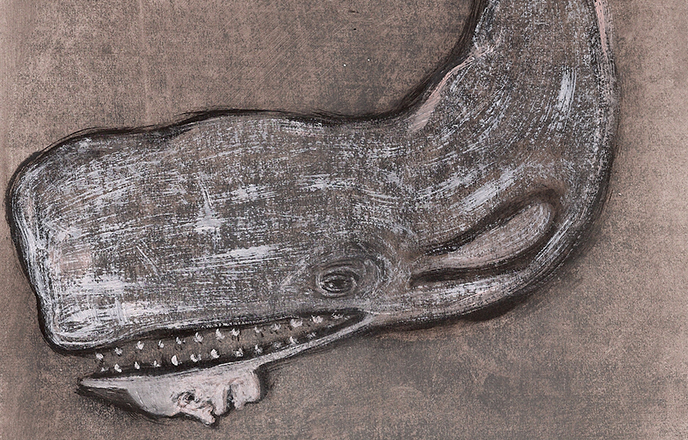
Image of Moby Dick by David Austen.
In 2013, Plymouth University kicked off Moby Dick The Big Read, promising a full audiobook of Herman Melville’s influential novel, with famous (and not so famous) voices taking on a chapter each. When we first wrote about it here, only six chapters had been unveiled, but boasted actors like Tilda Swinton (reading chapter one below), author Nigel Williams, and poet and journalist Musa Okwonga.
We’re glad to say the project reached its successful conclusion. And they certainly called on an impressive roster of celebrity readers: Stephen Fry, Neil Tennant, Fiona Shaw, Will Self, Benedict Cumberbatch, China Miéville, Tony Kushner, John Waters, Simon Callow, Sir David Attenborough, even former Prime Minister David Cameron. Pulitzer Prize winning poet Mary Oliver finishes off the whole project, reading the Epilogue.
All 135 chapters are available to be listened to in your browser, downloaded on iTunes, or streamed on SoundCloud. However, do check them out online, as each chapter comes with a work of art each created by 135 contemporary artists such as Matthew Barney, Oliver Clegg, and Matthew Benedict. (See David Austen’s work above.) The project is a mammoth undertaking befitting such a monumental book, and if you’ve never read it this just might be the way to go.
Copies of Moby Dick can be found in our collection of Free eBooks. Meanwhile, this big reading will be added to our collection of Free Audio Books.
If you would like to support the mission of Open Culture, consider making a donation to our site. It’s hard to rely 100% on ads, and your contributions will help us continue providing the best free cultural and educational materials to learners everywhere. You can contribute through PayPal, Patreon, and Venmo (@openculture). Thanks!
Related Content:
Why Should We Read Melville’s Moby-Dick? A TED-Ed Animation Makes the Case
An Illustration of Every Page of Herman Melville’s Moby Dick
How Ray Bradbury Wrote the Script for John Huston’s Moby Dick (1956)
Ted Mills is a freelance writer on the arts who currently hosts the artist interview-based FunkZone Podcast. You can also follow him on Twitter at @tedmills, read his other arts writing at tedmills.com and/or watch his films here.
Read More...Orson Welles Narrates Coleridge’s Rime of the Ancient Mariner in an Experimental Film Featuring the Art of Gustave Doré
Around here we subscribe to the theory that there’s no such thing as too much Orson Welles. In years past, we gave you Welles narrating Plato’s Cave Allegory and Kafka’s “Before the Law,” and, before that, the Welles-narrated parable Freedom River, and the list goes on.
Now, we present The Rime of the Ancient Mariner, a 1977 experimental film created by Larry Jordan, an independent filmmaker who tried to marry “the classic engravings of Gustave Doré to the classic poem by Samuel Taylor Coleridge through a classic narrator: Orson Welles.” As Jordan describes it, the film is “a long opium dream of the old Mariner (Welles) who wantonly killed the albatross and suffered the pains of the damned for it.” You can watch above.
If you would like to support the mission of Open Culture, consider making a donation to our site. It’s hard to rely 100% on ads, and your contributions will help us continue providing the best free cultural and educational materials to learners everywhere. You can contribute through PayPal, Patreon, and Venmo (@openculture). Thanks!
Related Content:
Hear Orson Welles’ Iconic War of the Worlds Broadcast (1938)
Read More...Watch James Earl Jones Read Kurt Vonnegut’s Letter Urging High-School Students to Create Art & “Make Your Soul Grow”
As cultural figures, the late James Earl Jones and Kurt Vonnegut would seem to have had little in common, but each could easily be recognized by his voice. Jones’ will come to mind as soon as you think of Darth Vader, Simba’s father, or “This is CNN.” Vonnegut’s distinction was the voice evident on any given page of novels like Cat’s Cradle, Breakfast of Champions, and of course Slaughterhouse-Five — a voice many of us have known since adolescence. They come together in the Letters Live video above with Jones reading a Vonnegut letter to the students of Ms. Lockwood’s English class at New York’s Xavier High School in 2006.
Vonnegut was writing in response to five such students, who’d chosen him when assigned to write to their favorite author. We’ve previously featured his letter here on Open Culture as read aloud by Sir Ian McKellen, but its message bears repeating by anyone who will speak it, beloved actor or otherwise. “Practice any art, music, singing, dancing, acting, drawing, painting, sculpting, poetry, fiction, essays, reportage, no matter how well or badly,” he writes. The idea is “not to get money and fame, but to experience becoming, to find out what’s inside you, to make your soul grow.”
The celebrated novelist even hands down an assignment to his teenage fans: “Write a six line poem, about anything, but rhymed. No fair tennis without a net. Make it as good as you possibly can. But don’t tell anybody what you’re doing. Don’t show it or recite it to anybody, not even your girlfriend or parents or whatever, or Ms. Lockwood.” After thoroughly disposing of this entirely private piece of art, know that “you have experienced becoming, learned a lot more about what’s inside you, and you have made your soul grow.”
None of this conflicts with the standard advice about writing, which tends to emphasize just getting started, working under restrictions, and not making an undue rush to publication. But they make a different kind of impact when recommended by Vonnegut in what would turn out to be the last year of life, and with his characteristic tendency to reach for the heavens while never departing from the mundane, even silly things of this earth. “Dance home after school, and sing in the shower and on and on,” he suggests. “Make a face in your mashed potatoes. Pretend you’re Count Dracula.” There writes a grand old man of American letters who knew how communicate across a distance of generations.
Related content:
James Earl Jones (RIP) Reads Edgar Allan Poe’s “The Raven” and Walt Whitman’s “Song of Myself”
James Earl Jones Reads Othello at White House Poetry Jam
Darth Vader’s Voice: The Original Voice Versus the Vocals of James Earl Jones
Kurt Vonnegut Urges Young People to Make Art and “Make Your Soul Grow”
Based in Seoul, Colin Marshall writes and broadcasts on cities, language, and culture. His projects include the Substack newsletter Books on Cities and the book The Stateless City: a Walk through 21st-Century Los Angeles. Follow him on Twitter at @colinmarshall or on Facebook.
Read More...David Bowie’s 100 Must Read Books

Image by Avro, via Wikimedia Commons
In 2013, the curators of the touring museum exhibit “David Bowie Is” released a list of David Bowie’s 100 favorite reads, providing us with deeper insights into his literary tastes. Covering fiction and non-fiction, the list spans six decades, moving from Richard Wright’s memoir Black Boy (1945) to Susan Jacoby’s The Age of American Unreason (2008). As we once noted in another post, “his list shows a lot of love to American writers, from … Truman Capote to … Hubert Selby, Jr., Saul Bellow, Junot Díaz, Jack Kerouac and many more. He’s also very fond of fellow Brits George Orwell, Ian McEwan, and Julian Barnes and loves Mishima and Bulgakov.” You can read the full list below, and, if you choose, also explore a related book from 2019–Bowie’s Bookshelf: The Hundred Books That Changed David Bowie’s Life.
- Interviews With Francis Bacon by David Sylvester
- Billy Liar by Keith Waterhouse
- Room At The Top by John Braine
- On Having No Head by Douglass Harding
- Kafka Was The Rage by Anatole Broyard
- A Clockwork Orange by Anthony Burgess
- City Of Night by John Rechy
- The Brief Wondrous Life Of Oscar Wao by Junot Diaz
- Madame Bovary by Gustave Flaubert
- Iliad by Homer
- As I Lay Dying by William Faulkner
- Tadanori Yokoo by Tadanori Yokoo
- Berlin Alexanderplatz by Alfred Döblin
- Inside The Whale And Other Essays by George Orwell
- Mr. Norris Changes Trains by Christopher Isherwood
- Halls Dictionary Of Subjects And Symbols In Art by James A. Hall
- David Bomberg by Richard Cork
- Blast by Wyndham Lewis
- Passing by Nella Larson
- Beyond The Brillo Box by Arthur C. Danto
- The Origin Of Consciousness In The Breakdown Of The Bicameral Mind by Julian Jaynes
- In Bluebeard’s Castle by George Steiner
- Hawksmoor by Peter Ackroyd
- The Divided Self by R. D. Laing
- The Stranger by Albert Camus
- Infants Of The Spring by Wallace Thurman
- The Quest For Christa T by Christa Wolf
- The Songlines by Bruce Chatwin
- Nights At The Circus by Angela Carter
- The Master And Margarita by Mikhail Bulgakov
- The Prime Of Miss Jean Brodie by Muriel Spark
- Lolita by Vladimir Nabokov
- Herzog by Saul Bellow
- Puckoon by Spike Milligan
- Black Boy by Richard Wright
- The Great Gatsby by F. Scott Fitzgerald
- The Sailor Who Fell From Grace With The Sea by Yukio Mishima
- Darkness At Noon by Arthur Koestler
- The Waste Land by T.S. Elliot
- McTeague by Frank Norris
- Money by Martin Amis
- The Outsider by Colin Wilson
- Strange People by Frank Edwards
- English Journey by J.B. Priestley
- A Confederacy Of Dunces by John Kennedy Toole
- The Day Of The Locust by Nathanael West
- 1984 by George Orwell
- The Life And Times Of Little Richard by Charles White
- Awopbopaloobop Alopbamboom: The Golden Age of Rock by Nik Cohn
- Mystery Train by Greil Marcus
- Beano (comic, ’50s)
- Raw (comic, ’80s)
- White Noise by Don DeLillo
- Sweet Soul Music: Rhythm And Blues And The Southern Dream Of Freedom by Peter Guralnick
- Silence: Lectures And Writing by John Cage
- Writers At Work: The Paris Review Interviews edited by Malcolm Cowley
- The Sound Of The City: The Rise Of Rock And Roll by Charlie Gillette
- Octobriana And The Russian Underground by Peter Sadecky
- The Street by Ann Petry
- Wonder Boys by Michael Chabon
- Last Exit To Brooklyn By Hubert Selby, Jr.
- A People’s History Of The United States by Howard Zinn
- The Age Of American Unreason by Susan Jacoby
- Metropolitan Life by Fran Lebowitz
- The Coast Of Utopia by Tom Stoppard
- The Bridge by Hart Crane
- All The Emperor’s Horses by David Kidd
- Fingersmith by Sarah Waters
- Earthly Powers by Anthony Burgess
- The 42nd Parallel by John Dos Passos
- Tales Of Beatnik Glory by Ed Saunders
- The Bird Artist by Howard Norman
- Nowhere To Run The Story Of Soul Music by Gerri Hirshey
- Before The Deluge by Otto Friedrich
- Sexual Personae: Art And Decadence From Nefertiti To Emily Dickinson by Camille Paglia
- The American Way Of Death by Jessica Mitford
- In Cold Blood by Truman Capote
- Lady Chatterly’s Lover by D.H. Lawrence
- Teenage by Jon Savage
- Vile Bodies by Evelyn Waugh
- The Hidden Persuaders by Vance Packard
- The Fire Next Time by James Baldwin
- Viz (comic, early ’80s)
- Private Eye (satirical magazine, ’60s – ’80s)
- Selected Poems by Frank O’Hara
- The Trial Of Henry Kissinger by Christopher Hitchens
- Flaubert’s Parrot by Julian Barnes
- Maldoror by Comte de Lautréamont
- On The Road by Jack Kerouac
- Mr. Wilson’s Cabinet of Wonder by Lawrence Weschler
- Zanoni by Edward Bulwer-Lytton
- Transcendental Magic, Its Doctrine and Ritual by Eliphas Lévi
- The Gnostic Gospels by Elaine Pagels
- The Leopard by Giuseppe Di Lampedusa
- Inferno by Dante Alighieri
- A Grave For A Dolphin by Alberto Denti di Pirajno
- The Insult by Rupert Thomson
- In Between The Sheets by Ian McEwan
- A People’s Tragedy by Orlando Figes
- Journey Into The Whirlwind by Eugenia Ginzburg
If you would like to support the mission of Open Culture, consider making a donation to our site. It’s hard to rely 100% on ads, and your contributions will help us continue providing the best free cultural and educational materials to learners everywhere. You can contribute through PayPal, Patreon, and Venmo (@openculture). Thanks!
Related Content:
Bowie’s Bookshelf: A New Essay Collection on The 100 Books That Changed David Bowie’s Life
Brian Eno Creates a List of 20 Books That Could Rebuild Civilization
Hayao Miyazaki Selects His 50 Favorite Children’s Books
Read More...Behold a Creative Animation of the Bayeux Tapestry
In previous centuries, unless you were a member of the nobility, a wealthy religious order, or a merchant guild, your chances of spending any significant amount of time with a Medieval tapestry were slim. Though “much production was relatively coarse, intended for decorative purposes,” writes the Metropolitan Museum of Art, the tapestry still commanded high prices, just as it commanded respect for its owner. And as other decorative arts of the time preserved historical memory—or certain political versions of it, at least—tapestry designs might embody “celebratory or propagandistic themes” in their weft and warp.
“Enriched with silk and gilt metallic thread,” writes the Met, “such tapestries were a central component of the ostentatious magnificence used by powerful secular and religious rulers to broadcast their wealth and might.” Such is one of the most famous of these works, the Bayeux Tapestry, which commemorates the 1066 victory of William the Conqueror at the Battle of Hastings. The famous wall hanging, housed at the Bayeux Museum in Normandy, was “probably commissioned in the 1070s” by Bishop Odo of Bayeux, William’s half-brother, making it a very early example of the form. So the site of a Victorian-era replica writes, and yet “nothing known is certain about the tapestry’s origins.” (The first written record of it dates from 1476.)
While the Bayeux Tapestry may have been inaccessible to most people for however many centuries it has existed, you can now stand before it in its home of Bayeux, or see the very convincing replica at Britain’s Reading Museum. (You’ll note in both cases that the Bayeux tapestry is not, in fact, a tapestry, woven on a loom, but a painstaking, hand-stitched embroidery.) Or, rather than traveling, you can watch the video above, an animated rendition of the tapestry’s story by filmmaker David Newton and sound designer Marc Sylvan.
During the years 1064 to the fateful 1066, a fierce rivalry took shape as the ailing King Edward the Confessor’s advisor Harold Godwinson and William the Conqueror vied for the crown. Once Edward died in 1066, Harold seized the throne, prompting William to invade and defeat him at the Battle of Hastings. The Tapestry gives us a graphic history of this bloody contest, “a story,” writes the Bayeux Museum, “broadly in keeping with the accounts of authors of the 11th century.” “The Tapestry’s depiction of the Battle of Hastings,” historian Robert Bartlett tells us, “is the fullest pictorial record of a medieval battle in existence”—and the animation above makes it come alive with sound and movement.
Note: The Animated Bayeux Tapestry above was originally created as a student project. David Newton provided the animation, and Marc Sylvan created the original music and sound effects. Enjoy!
Related Content:
Construct Your Own Bayeux Tapestry with This Free Online App
How the Ornate Tapestries from the Age of Louis XIV Were Made (and Are Still Made Today)
Josh Jones is a writer and musician based in Durham, NC. Follow him at @jdmagness
Read More...
Support Us
We're hoping to rely on loyal readers, rather than erratic ads. Please click the Donate button and support Open Culture. You can use Paypal, Venmo, Patreon, even Crypto! We thank you!

About Us

Open Culture scours the web for the best educational media. We find the free courses and audio books you need, the language lessons & educational videos you want, and plenty of enlightenment in between.
Advertise With Us

FREE UPDATES!
GET OUR DAILY EMAIL
Get the best cultural and educational resources on the web curated for you in a daily email. We never spam. Unsubscribe at any time.
FOLLOW ON SOCIAL MEDIA

Open Culture editor Dan Colman scours the web for the best educational media. He finds the free courses and audio books you need, the language lessons & movies you want, and plenty of enlightenment in between.
Advertise With Us


