Do All Roads Lead to Philosophy on Wikipedia?: They Do About 97.3% of the Time
Pull up the Wikipedia page for Mariya Takeuchi’s “Plastic Love,” the 1984 single now known for re-popularizing the genre of Japanese “city pop.” Then click the first of its links (not related to the language of the article itself), which leads to Takeuchi’s own page. If you keep following that same procedure, you’ll continue on to City Pop, then Japanese Pop Music, then Popular Music. Keep drilling down, and you’ll pass the very concepts of music and sound, then enter the realms of physics, the scientific method, logical propositions, and the philosophy of language. This is one example provided by the video above from YouTuber Not David, which investigates whether all roads on Wikipedia eventually lead to philosophy.
There is, of course, a Wikipedia page about this, called “Getting to Philosophy.” “Following the first hyperlink in the main text of an English Wikipedia article, and then repeating the process for subsequent articles, usually leads to the Philosophy article,” it says. “In February 2016, this was true for 97% of all articles on Wikipedia (including this one).” As for the rest, they “lead to an article without any outgoing wikilinks, to pages that do not exist, or get stuck in loops.” This is actually the case with the path starting from “Plastic Love,” after Philosophy of Language goes in circles around concepts, abstraction, and logic itself, never quite reaching Philosophy proper.
Or at least that’s what happened for me today; it could go differently tomorrow, or even a few seconds from now. Ever since Wikipedia went live in 2001, its main difference from other encyclopedias has been that it’s constantly changing, and the rate of that change has only increased over time. The “philosophy game,” as Not David calls it, is at all times subject to breakage, but also to un-breakage. At normal times, Orange Juice to Philosophy takes thirteen steps, Apple Juice to Philosophy takes fifteen steps; both the Calgary Flames and Edmonton Oilers lie sixteen steps from Philosophy. But things go haywire if someone goes and, say, re-orders the links on the Awareness article so Psychology comes first.
These things happen: Wikipedia is, after all, the encyclopedia that anyone can edit. And as you can see (at least as of this writing), Awareness now links first to Philosophy again. These changes play havoc with the efforts of anyone trying to map out the connections between one part of Wikipedia and another, as Not David does in this video. But they don’t alter the fundamental principles of network design, which his analysis illuminates. As with the corpus callosum, which connects the two hemispheres of the human brain, Philosophy is less important for what directly connects to it than for its own function as a connector. And indeed, haven’t philosophers always wanted to know how everything fits together?
Related content:
An Interactive Visualization of the Stanford Encyclopedia of Philosophy
A Data Visualization of Modern Philosophy, 1950–2018
Listen to Wikipedia: A Web Site That Turns Every Wikipedia Edit Into Ambient Music in Real Time
Introduction to Philosophy: A Free Course
Based in Seoul, Colin Marshall writes and broadcasts on cities, language, and culture. His projects include the Substack newsletter Books on Cities and the book The Stateless City: a Walk through 21st-Century Los Angeles. Follow him on Twitter at @colinmarshall or on Facebook.
Read More...Watch the Opening Credits of an Imaginary 70s Cop Show Starring Samuel Beckett
Samuel Beckett: avant-garde dramatist, brooding Nobel Prize winner, poet, and…gritty television detective?
Sadly, no, but he had the makings of a great one, at least as cut together by playwright Danny Thompson, cofounder of Chicago’s Theater Oobleck.
Some 35 years after Beckett’s death, Thompson—whose credits include the Complete Lost Works of Samuel Beckett as Found in a Dustbin in Paris in an Envelope (Partially Burned) Labeled: Never to Be Performed. Never. Ever. Ever! Or I’ll Sue! I’ll Sue From the Grave!!!-–repurposed Rosa Veim and Daniel Schmid’s footage of the moody genius wandering around 1969 Berlin into the opening credits of a nonexistent, 70s era Quinn Martin police procedural.
The title sequence hits all the right period notes, from the jazzy graphics to the presentation of its supporting cast: Andre the Giant, Jean-Paul Sartre, and Jean “Huggy Bear” Cocteau. (Did you know that Beckett drove a young Andre the Giant to school in real life?)
Thompson ups the verisimilitude by copping Pat Williams’ theme for The Streets of San Francisco and naming the imaginary pilot episode after a collection of Beckett’s short stories.
He also jokingly notes that a DVD release of the first, only and, again, entirely non-existent season has been held up by the Beckett estate. Alas.
Related Content:
Watch Samuel Beckett Walk the Streets of Berlin Like a Boss, 1969
The Books That Samuel Beckett Read and Really Liked (1941–1956)
Hear Samuel Beckett’s Avant-Garde Radio Plays: All That Fall, Embers, and More
An Animated Introduction to Samuel Beckett, Absurdist Playwright, Novelist & Poet
When Samuel Beckett Drove Young André the Giant to School: A True Story
Ayun Halliday is an author, illustrator, and Chief Primatologist of the East Village Inky zine. Follow her @AyunHalliday
Read More...The Longest Drivable Distance in the World: Discover the Ultimate Road Trip
No matter what country we live in, we’ve all fantasized about taking our own great American road trip, considering a variety of the infinitely many possible routes. The most obvious would be driving between Los Angeles and New York, a distance of 2,800 miles that would take a bit over 40 hours straight through. I myself once took a more southerly route, road-tripping from Los Angeles to Raleigh, North Carolina over a week or two; these days, I dream of an east-coast journey from Maine all the way down to Key West, a relatively manageable 1,900 miles. But if you take your road-tripping seriously, you’ve got to go to another continent entirely.
Such is the conclusion to be drawn from the Half as Interesting video above, which finds the longest drivable distance on Earth. “The North American road system goes as far as Prudhoe Bay in Canada’s Canada, Alaska, and as far south as Yaviza in Panama,” says the video’s creator Sam Denby, “but this only clocks in at 7,500 miles.”
That may require six straight days of driving, but it doesn’t set any records. A route from southern Africa and east Asia may seem promising, but they can’t be driven without passing through western Europe. That requires passage across the Mediterranean on a ferry, which — for the true road-tripper — taints the purity of the endeavor.
Starting in Europe, then, you should begin in Sagres, Portugal, “the most extreme point on the contiguous road network.” From there, you can drive as far east as “the banks of the Aldan River in Russia,” a distance of 8,437 miles. But wait, there’s longer: you could keep going to Khasan, “the only Russian town to border North Korea,” and bring the mileage up to 8,726, thus completing “the longest direct driving route in the world.” If you go pedal-to-the-metal (to the extent possible while observing local speed limits, anyway) it will take six days and 19 hours — bookended, ideally, by one meal of cataplana and another of Khasan oysters.
Related content:
Why Route 66 Became America’s Most Famous Road
12 Classic Literary Road Trips in One Handy Interactive Map
A Brief History of the Great American Road Trip
Based in Seoul, Colin Marshall writes and broadcasts on cities, language, and culture. His projects include the Substack newsletter Books on Cities and the book The Stateless City: a Walk through 21st-Century Los Angeles. Follow him on Twitter at @colinmarshall or on Facebook.
Read More...John Waters’ RISD Graduation Speech: Real Wealth Is Life Without A*Holes
John Waters’ rollicking commencement speech at The Rhode Island School of Design offered up some good one-liners and a few pearls of wisdom, though phrased, quite naturally, in an irreverent way. Ready for some sage advice on what really counts as wealth? And what career choices will make you truly wealthy? Mr. Waters has this to say:
Uh, don’t hate all rich people. They’re not all awful. Believe me, I know some evil poor people, too. We need some rich people: Who else is going to back our movies or buy our art? I’m rich! I don’t mean money-wise. I mean that I have figured out how to never be around assholes at any time in my personal and professional life. That’s rich. And not being around assholes should be the goal of every graduate here today.
It’s OK to hate the poor, too, but only the poor of spirit, not wealth. A poor person to me can have a big bank balance but is stupid by choice – uncurious, judgmental, isolated and unavailable to change.
I’m also sorry to report there’s no such thing as karma. So many of my talented great friends are dead and so many of the fools I’ve met and loathed are still alive. It’s not fair, and it never will be.
Like I said, irreverently phrased. But when stripped down to their basics, some very good principles to live by.
Watch the speech above; read the complete transcript here.
If you would like to support the mission of Open Culture, consider making a donation to our site. It’s hard to rely 100% on ads, and your contributions will help us continue providing the best free cultural and educational materials to learners everywhere. You can contribute through PayPal, Patreon, and Venmo (@openculture). Thanks!
Related Content:
John Waters Takes You on a Comical Tour of His Apartment (1986)
John Waters’ Hand-Made, Oddball Christmas Cards: 1964-Present
An Anti, Anti-Smoking Announcement from John Waters
John Waters’ Comical & Inspiring Commencement Speech: “You Too Can Fail Upwards” (2022)
Read More...How the Hugely Acclaimed Shōgun TV Series Makes Translation Interesting
Many of us grew up seeing hardback copies of Shōgun on various domestic bookshelves. Whether their owners ever actually got through James Clavell’s famously hefty novel of seventeenth-century Japan is open to question, but they may well have seen the first television adaptation, which aired on NBC in 1980. Starring Richard Chamberlain and Toshiro Mifune (and narrated by Orson Welles), that ten-hour miniseries offered an unprecedentedly cinematic experience to the home viewers of America, presenting them with things they’d never before seen on television — and things they’d never heard on television, not least numerous lines delivered in untranslated Japanese.
The idea, according to screenwriter Eric Bercovici, was to put the viewers in the shoes of Chamberlain’s protagonist John Blackthorne, an English ship pilot marooned in Japan with no knowledge of the local language. During the show’s run, newspapers printed glossaries of the Japanese words most important to the story. The second adaptation of Shōgun, which aired earlier this year on FX, does things differently. For one thing, it makes use of those helpful devices known as subtitles, which over the past four and a half decades have become not just accepted but demanded by Western audiences (even for productions in their own language).
This choice, as Evan “Nerdwriter” Puschak says in his video on the new Shōgun, “lets us into the minds and conversations of the Japanese characters,” much like the omniscient narration of Clavell’s novel. Puschak highlights how the series “uses the act of translation to explore the possibilities and limitations of communication across cultures and communication, period.” One notable example is its portrayal of the various bilingual characters who interpret for Blackthorne, each of whom does so differently according to his or her motivations. The 1980 Shōgun also had a few such scenes, but their dramatic irony was inaccessible to monolingual viewers.
Even if you speak both English and Japanese, you know how little protection that really offers against cultural misunderstandings. The new Shōgun’s dramatization of that truth has surely done its part to win the show more Emmy awards than any other single season of television. A comparison to the 1980 adaptation, which represented the height of dramatic television in its day, reveals the ways in which our expectations of the form have changed over time. Nevertheless, even the 2024 Shōgun takes its liberties, the most brazen being the use of English instead of Portuguese, the real language of first contact between Japan and the West. Clearly, Portugal has its work cut out: to raise a generation of actors ready to star in the next adaptation by the late twenty-sixties. がんば っ て and boa sorte.
Related content:
The 17th-Century Japanese Samurai Who Sailed to Europe, Met the Pope & Became a Roman Citizen
Meet Yasuke, Japan’s First Black Samurai Warrior
Let’s Learn Japanese: Two Classic Video Series to Get You Started in the Language
The Entire History of Japan in 9 Quirky Minutes
Based in Seoul, Colin Marshall writes and broadcasts on cities, language, and culture. His projects include the Substack newsletter Books on Cities and the book The Stateless City: a Walk through 21st-Century Los Angeles. Follow him on Twitter at @colinmarshall or on Facebook.
Read More...Moebius Gives 18 Wisdom-Filled Tips to Aspiring Artists
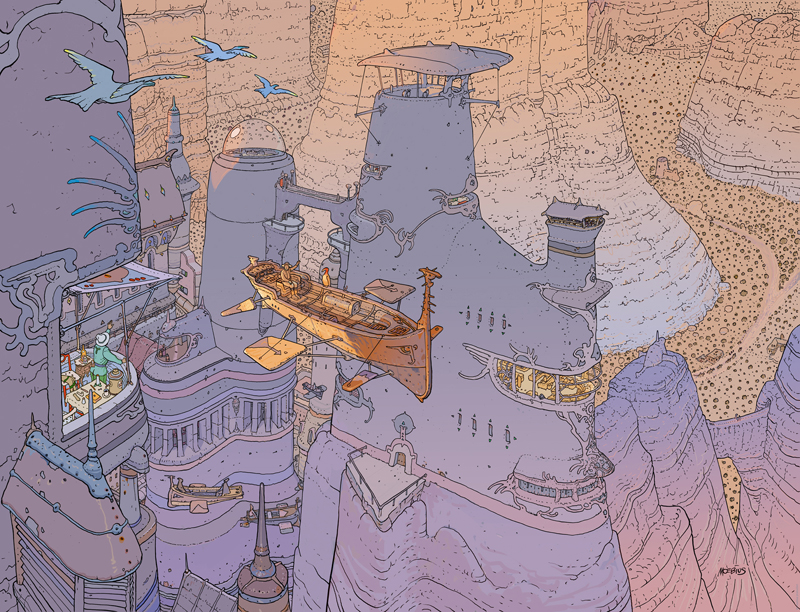
Jean Giraud, aka Moebius, was a comic book artist who combined blinding speed with boundless imagination. He shaped the look of Alien, Empire Strikes Back and The Fifth Element. He reimagined the Silver Surfer for Stan Lee. And he is an acknowledged influence on everyone from Japanese animating great Hayao Miyazaki to sci-fi writer William Gibson.
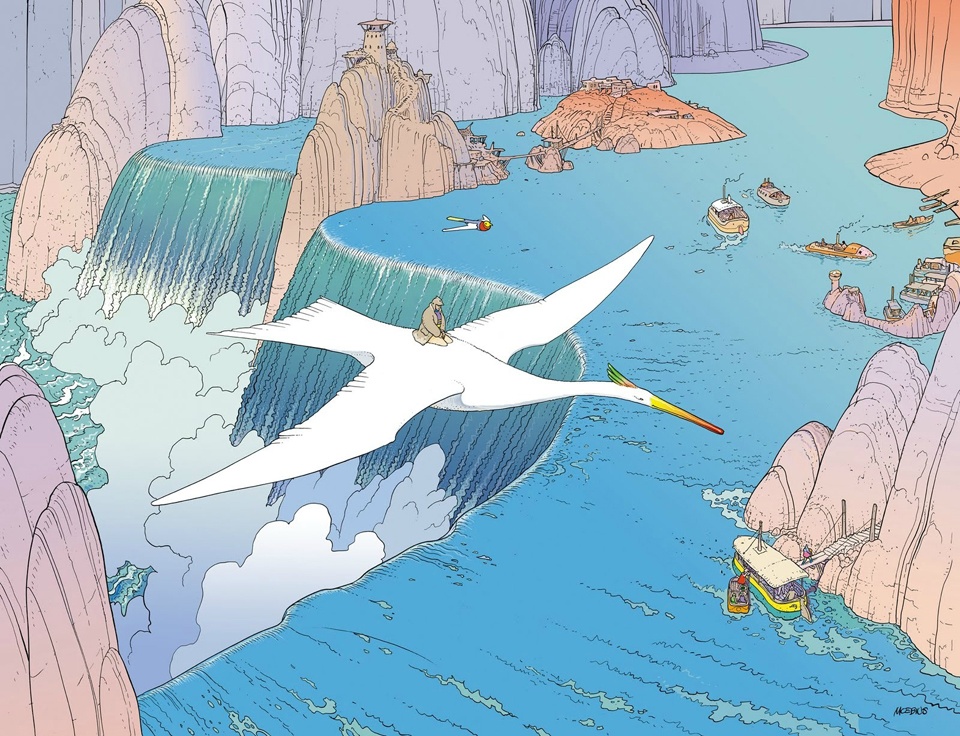
In 1996, the Mexican newspaper La Jornada published a lecture given by Moebius called “Breve manual para historietistas” – a brief manual for cartoonists – which consists of 18 tips for aspiring artists. If your Spanish isn’t up to snuff – mine certainly isn’t – then there are a couple translations out there. Someone called Xurxo g Penalta cranked out a direct version in English, but to get the true nuances of Moebius’ wise words, famed illustrator William Stout’s excellent annotated version is best.
For instance, Moebius’s first tip is “When you draw, you must first cleanse yourself of deep feelings, like hate, happiness, ambition, etc.”
Stout amplifies this with the following:
These feelings are typically emotional prejudices that function as a block to creativity.
This was something I learned from drawing and hanging out with another Frenchman, the brilliant cartoonist-illustrator (and regular Atlantic Monthly contributor) Guy Billout, when we were traveling together in Antarctica and Patagonia back in 1989. Until I spent time with Guy, I had no idea how many pre-conceived notions and assumptions I held within me regarding people and situations and what a block they were to the flow of my creativity.
Divorcing yourself from such emotionally blinding pre-conceptions allows you to see things with fresh eyes. Solutions and ideas then flow with much greater ease. I have noticed with all the creative geniuses I have met that they all share a childlike delight with whatever or whomever they encounter in life (they can even find amusement in life’s villains). For them, all creative barriers are down; life and creative problem solving for them is like constantly playing. They gush great ideas all day long like a fountain.
All of Stout’s annotations are like this. It should be required reading for anyone even vaguely interested in visual storytelling. Below are Moebius’ original observations. Stout’s thoughts on Moebius can be found here.
1) When you draw, you must first cleanse yourself of deep feelings, like hate, happiness, ambition, etc.
2) It’s very important to educate your hand. Make it achieve a level of high obedience so that it will be able to properly and fully express your ideas. But be very careful of trying to obtain too much perfection, as well as too much speed as an artist. Perfection and speed are dangerous — as are their opposites. When you produce drawings that are too quick or too loose, besides making mistakes, you run the risk of creating an entity without soul or spirit.
3) Knowledge of perspective is of supreme importance. Its laws provide a good, positive way to manipulate or hypnotize your readers.
4) Another thing to embrace with affection is the study of [the] human body — it’s anatomy, positions, body types, expressions, construction, and the differences between people.
Drawing a man is very different from drawing a woman. With males, you can be looser and less precise in their depiction; small imperfections can often add character. Your drawing of a woman, however, must be perfect; a single ill-placed line can dramatically age her or make her seem annoying or ugly. Then, no one buys your comic!
For the reader to believe your story, your characters must feel as if they have a life and personality of their own.
Their physical gestures should seem to emanate from their character’s strengths, weaknesses and infirmities. The body becomes transformed when it is brought to life; there is a message in its structure, in the distribution of its fat, in each muscle and in every wrinkle, crease or fold of the face and body. It becomes a study of life.
5) When you create a story, you can begin it without knowing everything, but you should make notes as you go along regarding the particulars of the world depicted in your story. Such detail will provide your readers with recognizable characteristics that will pique their interest.
When a character dies in a story, unless the character has had his personal story expressed some way in the drawing of his face, body and attire, the reader will not care; your reader won’t have any emotional connection.
Your publisher might say, “Your story has no value; there’s only one dead guy — I need twenty or thirty dead guys for this to work.” But that is not true; if the reader feels the dead guy or wounded guys or hurt guys or whomever you have in trouble have a real personality resulting from your own deep studies of human nature — with an artist’s capacity for such observation — emotions will surge.
By such studies you will develop and gain attention from others, as well as a compassion and a love for humanity.
This is very important for the development of an artist. If he wants to function as a mirror of society and humanity, this mirror of his must contain the consciousness of the entire world; it must be a mirror that sees everything.
6) Alejandro Jodorowsky says I don’t like drawing dead horses. Well, it is very difficult.
It’s also very difficult to draw a sleeping body or someone who has been abandoned, because in most comics it’s always action that is being studied. It’s much easier to draw people fighting — that’s why Americans nearly always draw superheroes. It’s much more difficult to draw people that are talking, because that’s a series of very small movements — small, yet with real significance.
His counts for more because of our human need for love or the attention of others. It’s these little things that speak of personality, of life. Most superheroes don’t have any personality; they all use the same gestures and movements.
7) Equally important is the clothing of your characters and the state of the material from which it was made.
These textures create a vision of your characters’ experiences, their lives, and their role in your adventure in a way where much can be said without words. In a dress there are a thousand folds; you need to choose just two or three — don’t draw them all. Just make sure you choose the two or three good ones.
8) The style, stylistic continuity of an artist and its public presentation are full of symbols; they can be read just like a Tarot deck. I chose my name “Moebius” as a joke when I was twenty-two years old — but, in truth, the name came to resonate with meaning. If you arrive wearing a T‑shirt of Don Quixote, that tells me who you are. In my case, making a drawing of relative simplicity and subtle indications is important to me.
9) When an artist, a real working artist, goes out on the street, he does not see things the same way as “normal” people. His unique vision is crucial to documenting a way of life and the people who live it.
10) Another important element is composition. The compositions in our stories should be studied because a page or a painting or a panel is a face that looks at the reader and speaks to him. A page is not just a succession of insignificant panels. There are panels that are full. Some that are empty. Others are vertical. Some horizontal. All are indications of the artist’s intentions. Vertical panels excite the reader. Horizontals calm him. For us in the Western world, motion in a panel that goes from left to right represents action heading toward the future. Moving from right to left directs action toward the past. The directions we indicate represent a dispersion of energy. An object or character placed in the center of a panel focuses and concentrates energy and attention. These are basic reading symbols and forms that evoke in the reader a fascination, a kind of hypnosis. You must be conscious of rhythm and set traps for the reader to fall into so that, when he falls, he gets lost, allowing you to manipulate and move him inside your world with greater ease and pleasure. That’s because what you have created is a sense of life. You must study the great painters, especially those who speak with their paintings. Their individual painting schools or genres or time periods should not matter. Their preoccupation with physical as well as emotional composition must be studied so that you learn how their combination of lines works to touch us directly within our hearts.
11) The narration must harmonize with the drawings. There must be a visual rhythm created by the placement of your text. The rhythm of your plot should be reflected in your visual cadence and the way you compress or expand time. Like a filmmaker, you must be very careful in how you cast your characters and in how you direct them. Use your characters or “actors” like a director, studying and then selecting from all of your characters’ different takes.
12) Beware of the devastating influence of North American comic books. The artists in Mexico seem to only study their surface effects: a little bit of anatomy mixed with dynamic compositions, monsters, fights, screaming and teeth. I like some of that stuff too, but there are many other possibilities and expressions that are also worthy of exploration.
13) There is a connection between music and drawing. The size of that connection depends upon your personality and what’s going on at that moment. For the last ten years I’ve been working in silence; for me, there is music in the rhythm of my lines. Drawing at times is a search for discoveries. A precise, beautifully executed line is like an orgasm!
14) Color is a language that the graphic artist uses to manipulate his reader’s attention as well as to create beauty. There is objective and subjective color. The emotional states of the characters can change or influence the color from one panel to the next, as can place and time of day. Special study and attention must be paid to the language of color.
15) At the beginning of an artist’s career, he should principally involve himself in the creation of very high quality short stories. He has a better chance (than with long format stories) of successfully completing them, while maintaining a high standard of quality. It will also be easier to place them in a book or sell them to a publisher.
16) There are times when we knowingly head down a path of failure, choosing the wrong theme or subject for our capabilities, or choosing a project that is too large, or an unsuitable technique. If this happens, you must not complain later.
17) When new work has been sent to an editor and it receives a rejection, you should always ask for and try to discover the reasons for the rejection. By studying the reasons for our failure, only then can we begin to learn. It is not about struggle with our limitations, with the public or with the publishers. One should treat it with more of an aikido approach. It is the very strength and power of our adversary that is used as the key to his defeat.
18) Now it is possible to expose our works to readers in every part of the planet. We must always keep aware of this. To begin with, drawing is a form of personal communication — but this does not mean that the artist should close himself off inside a bubble. His communication should be for those aesthetically, philosophically and geographically close to him, as well as for himself — but also for complete strangers. Drawing is a medium of communication for the great family we have not met, for the public and for the world.
Note: An earlier version of this post appeared on our site in March 2015.
If you would like to support the mission of Open Culture, consider making a donation to our site. It’s hard to rely 100% on ads, and your contributions will help us continue providing the best free cultural and educational materials to learners everywhere. You can contribute through PayPal, Patreon, and Venmo (@openculture). Thanks!
Related Content:
Behold Moebius’ Many Psychedelic Illustrations of Jimi Hendrix
Watch Groundbreaking Comic Artist Mœbius Draw His Characters in Real Time
Jonathan Crow is a writer and filmmaker whose work has appeared in Yahoo!, The Hollywood Reporter, and other publications. You can follow him at @jonccrow.
Read More...The Real Reason Why Music Is Getting Worse: Rick Beato Explains
Earlier this month, a North Carolina man was charged with generating songs using an artificial-intelligence system and configuring bots to stream them automatically, thus racking up some $10 million in illegal royalties. Though that amount no doubt startles many of us, in this age when legitimate musicians publicly lament the pittance they earn through streaming platforms, such a case probably comes as no surprise to Rick Beato. This past June, the prominent music YouTuber put out a video dealing with just that intersection of culture and technology, with the highly clickable title “The Real Reason Why Music Is Getting Worse.”
Consider the question of how we evoke one particular cultural era rather than another. We can use its fashions, its slang, or its interior decoration, to name just a few possibilities, but nothing works as powerfully or immediately as its music. Most of us grew up in a world where the sound of popular songs changed dramatically every decade or so. This happened for many reasons, practically all of them downstream of developments in technology. Bluesmen electrifying their guitars; Frank Sinatra singing into microphones sensitive enough to pick up his nuances; the Beatles creating complex, often strange miniature sound worlds in the studio; rappers telling their stories over looped fragments of disco records: all of it was made possible by feats of engineering.
Yet, in Beato’s view, technological progress has lately backfired on music, and both musicians and listeners are feeling it. The convergence of computers and music production is now complete, making any sound theoretically possible at virtually no cost. But “the creative dependence on technology limits the ability of people to innovate,” and “the overreliance on similar tools” brings about “a lack of diversity” and a persistence of formulaic trend-following. The ease of creation has caused “an oversaturation of music, making it harder to find really exceptional things.” This is taken to an extreme by the only-just-beginning avalanche of AI-generated songs (and the storm of lawsuits it has drawn).
Of course, if I’d known back when I was growing up in the nineteen-nineties that all the music I wanted to listen to would be made instantly available at little or no cost, I’d have regarded it as the imminent arrival of heaven on earth. Presumably, the prospect would also have excited the adolescent Beato, bagging groceries to save up the money to buy Led Zeppelin and Pat Metheny albums in the seventies. Today, by contrast, “music is not as valued by young people. There is no sweat equity put into obtaining it, having it be part of your collection, having it be a part of your identity, of who you are.”
Music, in short, has become both too easy to produce and too easy to consume. It would be easy for anyone under 30 to dismiss Beato’s argument as that of a middle-aged man reflexively insisting that things were better in his day, when we knew the value of an album. But even the youngest generation of music-lovers must, at times, feel a certain dissatisfaction amid this endless abundance. To them — and to all of us — Beato says this: “Vote with your attention” by trying to listen to music deliberately, without distraction. Personally, I recommend listening to not just full albums but complete discographies, which at the very least cultivates a certain discernment. And to cross the musical landscape ahead of us, we’ll need all the discernment we can get.
Related content:
Based in Seoul, Colin Marshall writes and broadcasts on cities, language, and culture. His projects include the Substack newsletter Books on Cities and the book The Stateless City: a Walk through 21st-Century Los Angeles. Follow him on Twitter at @colinmarshall or on Facebook.
Read More...David Bowie Songs Reimagined as Pulp Fiction Book Covers: Space Oddity, Heroes, Life on Mars & More
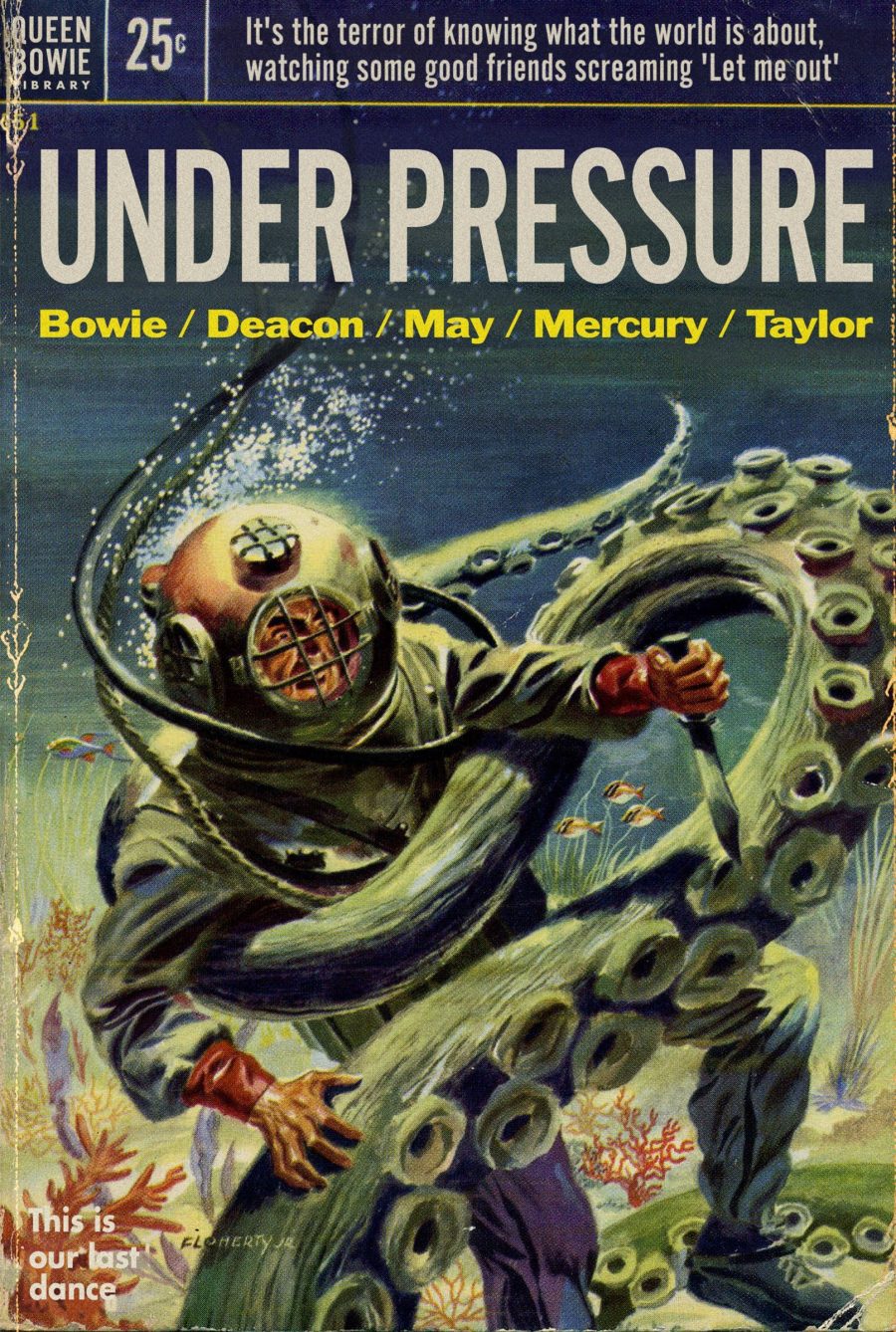
In the last year, screenwriter Todd Alcott’s hobby has blown up into a legit side career.
This Etsy seller isn’t peddling kombucha SCOBYs, letter pressing new baby announcements, or repurposing old barns for use as cutting boards.
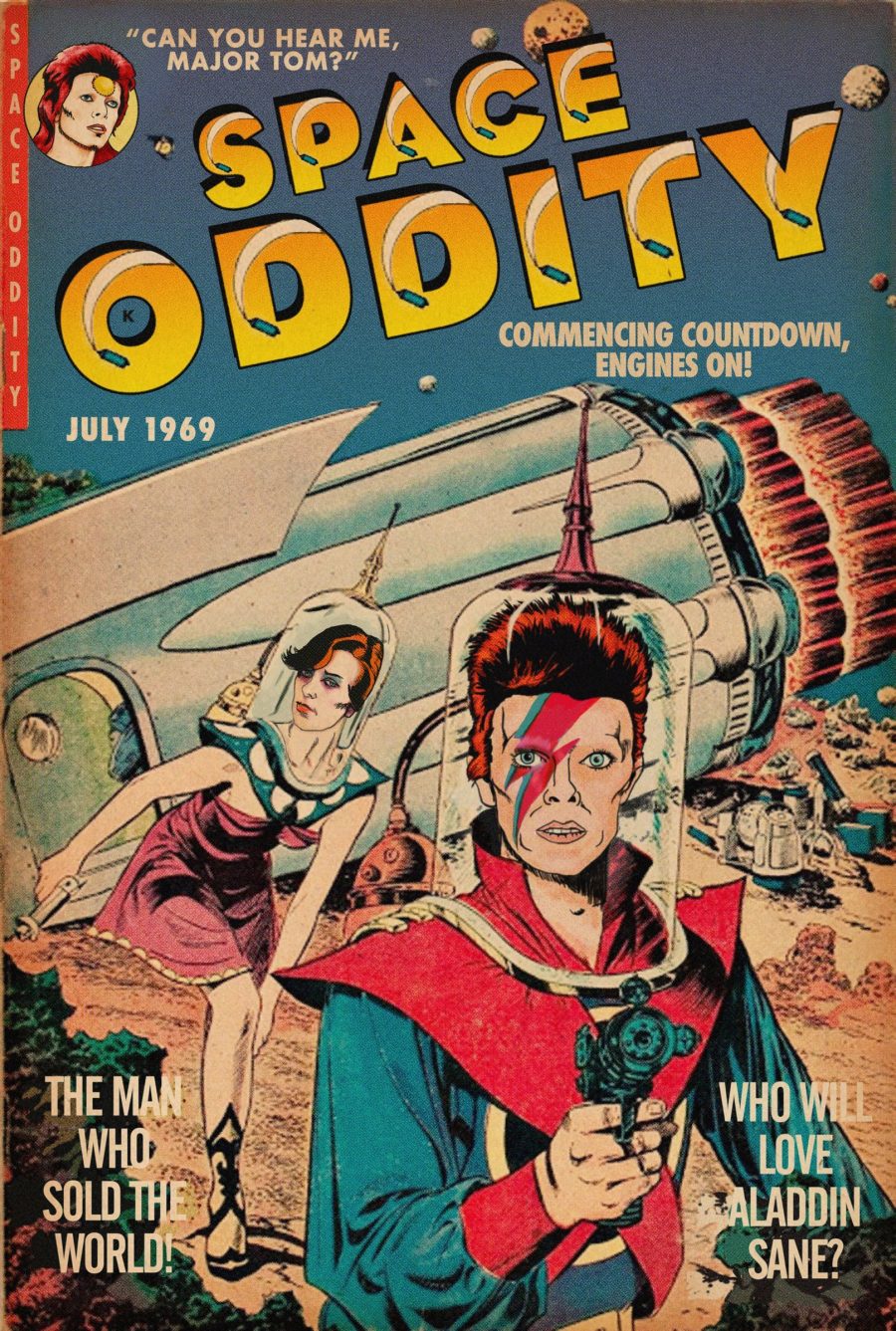
No, Alcott’s crafty fortunes fall squarely at the intersection of pulp fiction and rock and roll, with classic song titles, lyrics, and other cunning references replacing the cover text of pre-existing vintage paperbacks.
David Bowie’s lifelong fascination with space travel, tortured anti heroes, and outrageous fashion make him a natural fit with Alcott’s ongoing project, which has lavished similar attention on such luminaries as Bob Dylan, Radiohead, Talking Heads, and Elvis Costello.
As Alcott, who conceives of his mash ups as tributes to his long time musical favorites, told Open Culture:
Bowie dressed as an androgynous alien, went out onstage and told his audience “You’re not alone, give me your hands,” I can’t think of a more encompassing gesture to a misfit. No matter how weird you were in your community, you would always find someone like you at a Bowie concert. During a time of my life when I felt incredibly isolated and alone, (Bowie was one of) the key artists who made me feel like I was part of a bigger world, an artistic continuum.
Meanwhile, Alcott is tending to another continuum by posthumously pairing such late greats as Bowie and Queen’s Freddie Mercury (“co-author” of the deep sea-themed Under Pressure cover, above) with the sort of adventurous, occasionally steamy reading material that were among the hallmarks of their 1950s’ boyhoods.
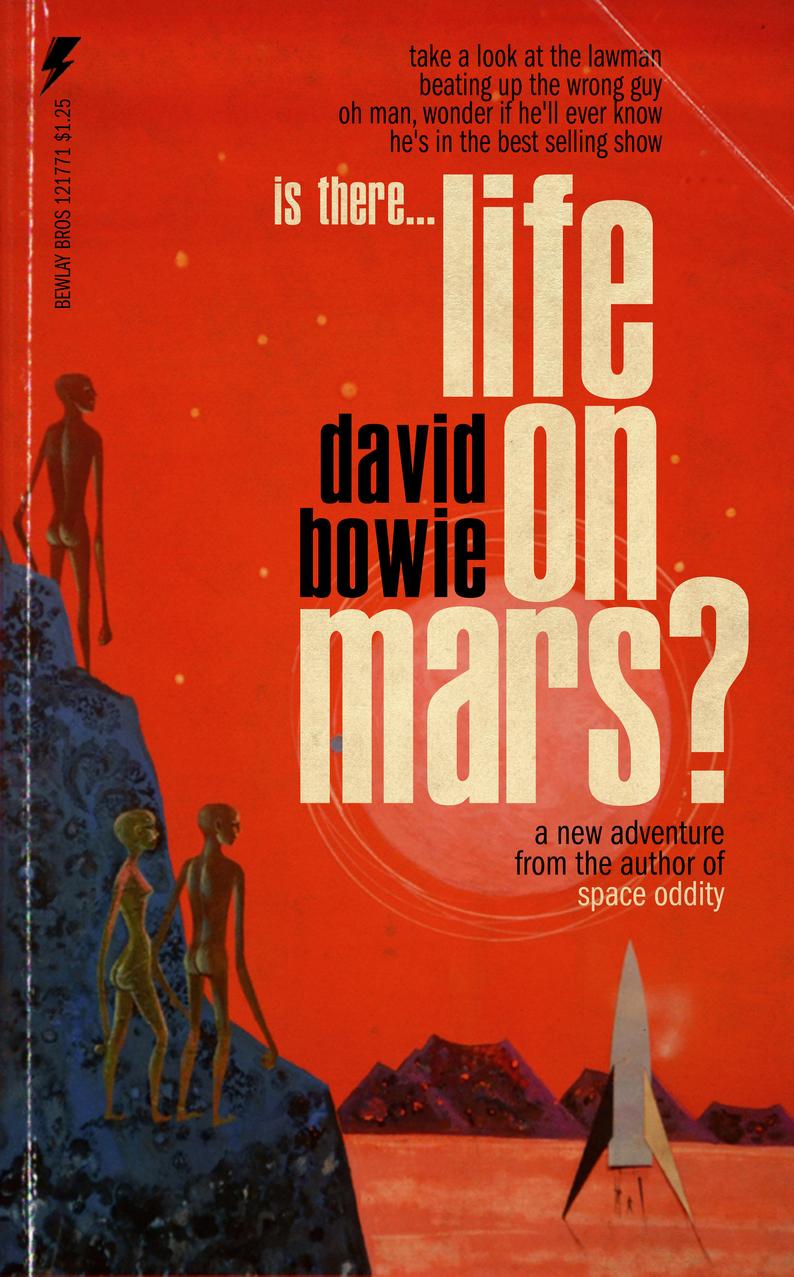
Many of these items have found their way to used book and thrift stores, where, tattered and worn, they provide a vast trove for someone like Alcott, who browses with his favorite acts’ catalogues deeply imprinted on his mental hard drive.
It must’ve been a grand day when he happened across the above 1970s sci fi cover. A few deft tweaks, and Life on Mars, a nonexistent “new adventure from the author of Space Oddity,” was born.
(Hardcore fans, take note of the doctored publisher in the upper left corner)
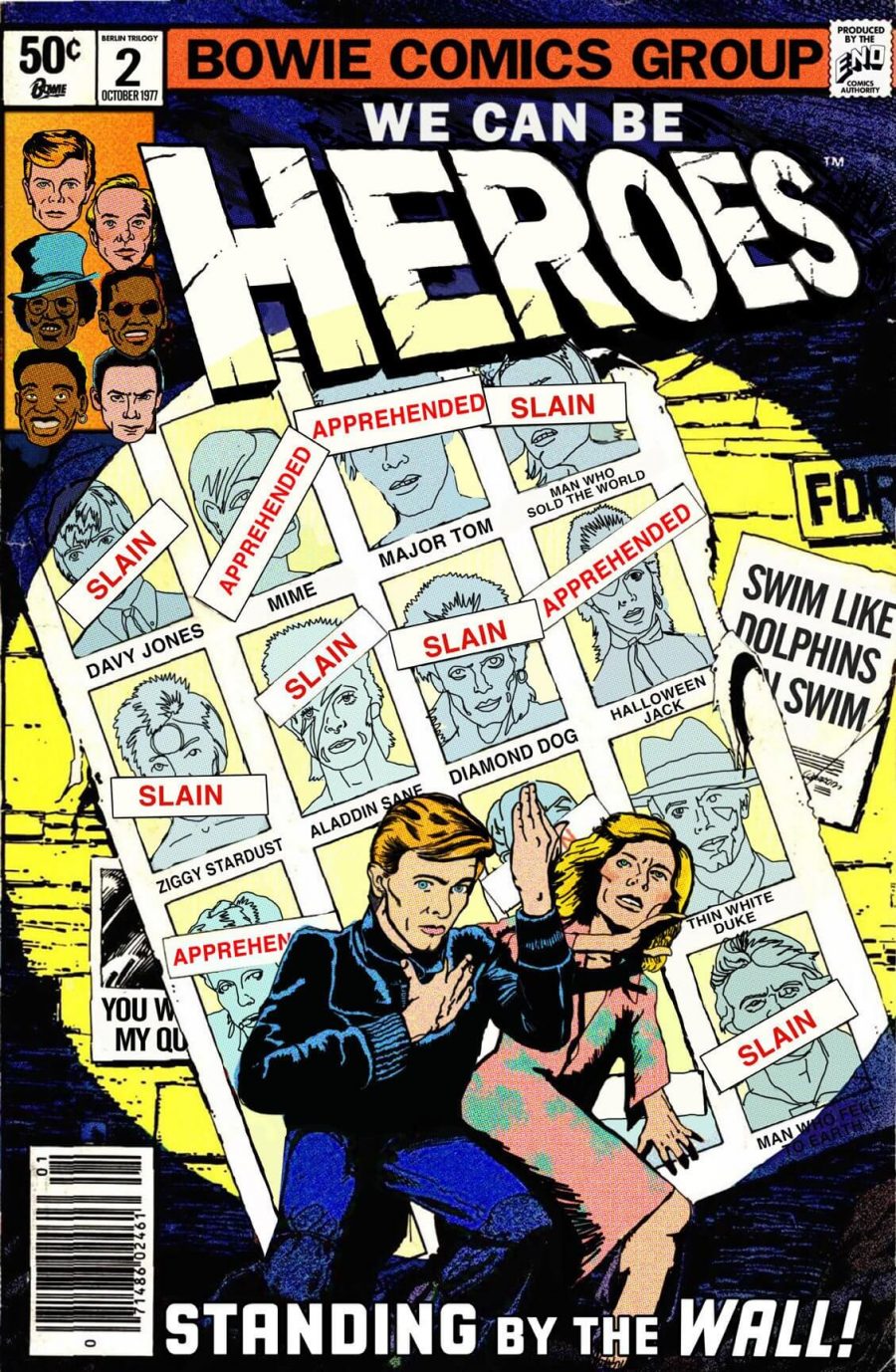
Heroes, which takes its inspiration from the 1981 X‑Men comic Days of Future Past, is crammed full of such Easter eggs. Can you spot them all?
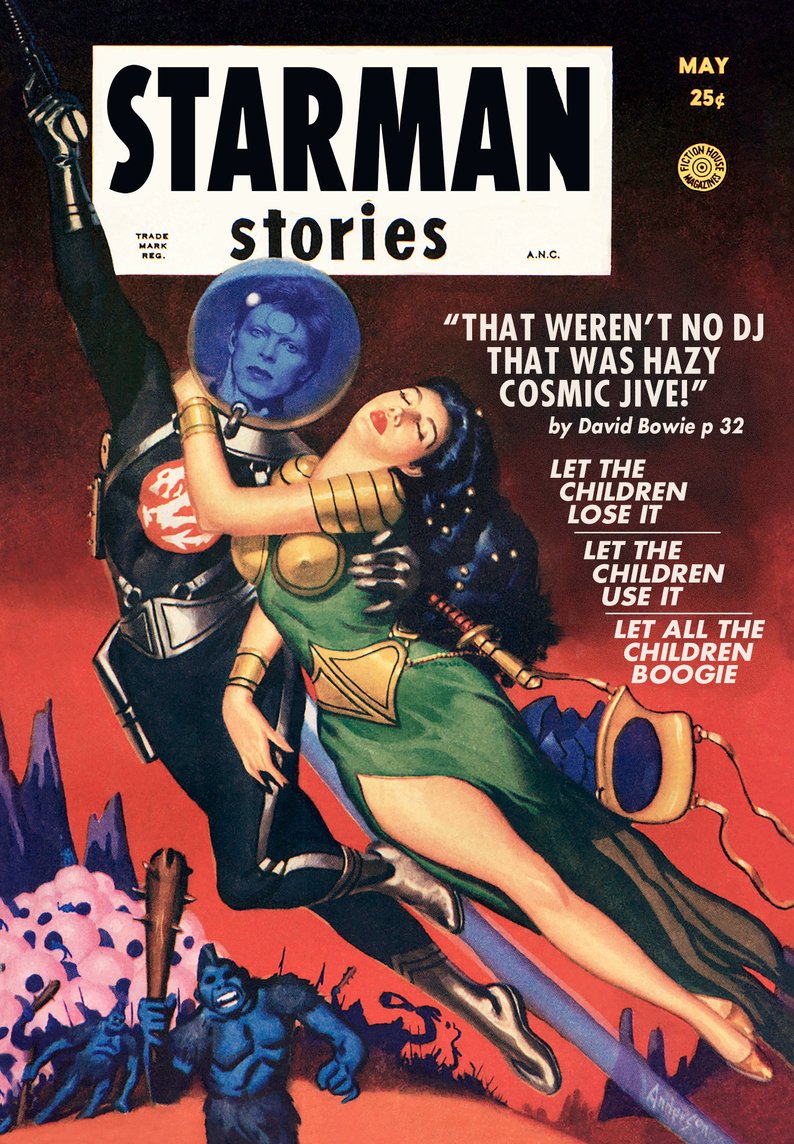
What a fitting tribute to the Starman’s enduring hold on the public’s imagination.
Browse Todd Alcott’s Bowie-themed pulp fiction collection in his Etsy shop.
Related Content:
The Art Collection of David Bowie: An Introduction
Read More...How a 16th-Century Explorer’s Sailing Ship Worked: An Animated Video Takes You on a Comprehensive Tour
These days, it feels as if you can’t go very long at all before scrolling past another announcement about some new technological development (realized or scheduled) related to space exploration. Some react to this by wondering what could possibly be out there in the universe to justify such enormously capital- and research-intensive projects. Centuries ago, similar sentiments were no doubt voiced about the more adventurous kinds of seafaring. In the new Animagraffs video above, you can see all that went into the construction and equipment of a sixteenth-century explorer’s sailing ship in great detail, from the keel to the fish davit.
The particular ship you see broken down into its constituent parts in this video never actually existed. But it may look familiar, especially if you’ve seen the reconstruction in London of Golden Hind, the galleon in which Francis Drake circumnavigated the world in the fifteen-seventies. The video’s creator Jacob O’Neal drew a good deal of inspiration from that particular ship, but also incorporated other characteristics borrowed from the Mary Rose, the Mayflower, Sweden’s Vassa, and various Spanish galleons of what we now regard as “the early age of sail, when ships began to cross the globe instead of merely following coastlines or crossing internal bodies of water.”
However advanced a model it would’ve been in its day, this ship could only make a long transoceanic journey so comfortable for its crew of 80 or so, most of whom would’ve been sleeping on mats, subsisting primarily on bread and beer (rationed at one gallon per man per day), and using rudimentary outdoor toilets. Presumably, few would have signed up for such a trial if not for the promise of bringing riches back from distant lands — supplemented, in the particular case of the Golden Hind, by “unofficially sanctioned piracy of Spanish galleons.” We have here, in other words, a variety of pirate ship, the vehicle for swashbuckling adventures fantasized about by generations upon generations of youngsters.
I myself never dreamed of piracy, but I do remember the rapturous giddiness with which my first-grade class reacted to learning about the sailing ship’s “poop deck.” O’Neal doesn’t neglect that component, but nor does he dwell on it, having many more important parts to explain and contextualize in 40 minutes. To get an idea of how dramatically ships evolved as the age of sail progressed, have a look at his hit video on the eighteenth-century HMS Victory just above. Though the age of space exploration seems to have yet to begin in earnest, some of us are no doubt already psyching ourselves up to climb into the modern equivalent of the Golden Hind for the 34-month trip to Mars.
Related Content:
See the Well-Preserved Wreckage of Ernest Shackleton’s Ship Endurance Found in Antarctica
Watch the Sinking of the Lusitania Animated in Real Time (1915)
How an Ancient Roman Shipwreck Could Explain the Universe
Based in Seoul, Colin Marshall writes and broadcasts on cities, language, and culture. His projects include the Substack newsletter Books on Cities and the book The Stateless City: a Walk through 21st-Century Los Angeles. Follow him on Twitter at @colinmarshall or on Facebook.
Read More...
Stanford Continuing Studies Offering an Online Course Exploring the Music of the Grateful Dead
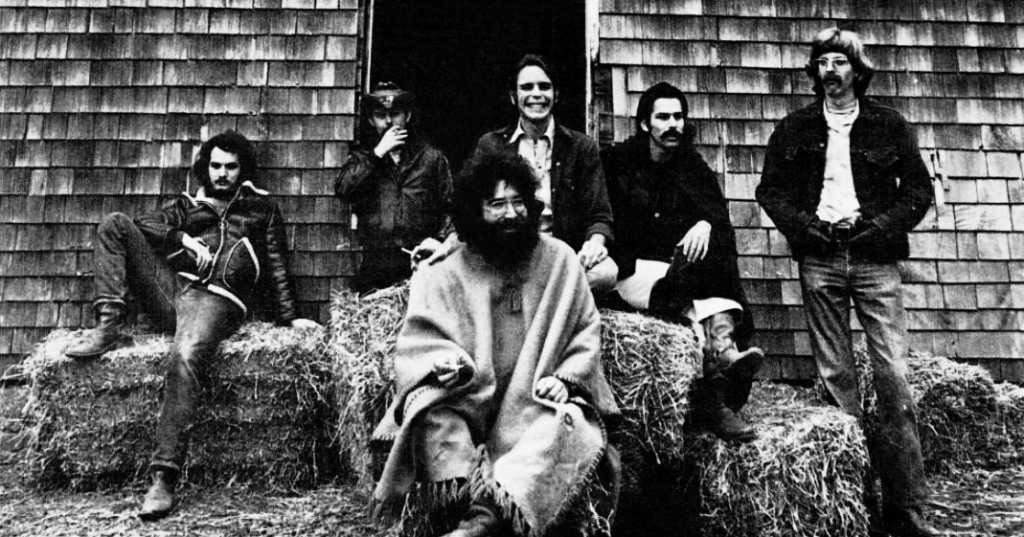
Image via Wikimedia Commons
A quick heads up: On October 3rd, Stanford Continuing Studies will kick off an 8‑week online course called Did It Matter? Does It Now? The Music and Culture of the Grateful Dead. Led by David Gans (author of Playing in the Band: An Oral and Visual Portrait of the Grateful Dead), the course will feature a number of special guests, including Jesse Jarnow (host of The Good Ol’ Grateful Deadcast), Dennis McNally (author of A Long Strange Trip: The Inside History of the Grateful Dead) and David Lemieux (Grateful Dead Archivist). Open to any adult, the course description reads:
The Grateful Dead’s groundbreaking fusion of music, counterculture, and community engagement forged an enduring legacy that transcends generations while shaping the evolution of music and cultural expression. Nearly 30 years after the band played its last show, Grateful Dead music is more popular than ever—in both live and recorded form. This course invites students to delve into the phenomenon that is the Grateful Dead through a captivating exploration of the band’s history, music, and cultural impact.
The course will feature a collection of stories and conversations with scholars and historians, each offering facts and personal perspectives illuminating every aspect of the Grateful Dead culture. Together, we will take a guided tour of the music in the form of focused excerpts from live and studio performances to learn what makes the Dead’s music-making unique and explore the broad musical universe the band created in its 30-year history.
Finally, we’ll examine the Dead’s impact on society, diving into the band’s influence on art, literature, and social change, as well as its unique fan culture and the phenomenon of the Deadhead. By the end of the course, students will have a well-rounded appreciation for the roots, struggles, and milestones that shaped the Grateful Dead’s trajectory, an understanding of their profound impact on music and culture, and insight into a legacy that still resonates deeply today.
Again, the course starts on Thursday, October 3rd. Tuition is $465. You can enroll here.
Stanford Continuing Studies also offers many other courses online, across many disciplines, at a reasonable price. Check out the catalogue here.
Related Content
Stream a Massive Archive of Grateful Dead Concerts from 1965–1995
When the Grateful Dead Played at the Egyptian Pyramids, in the Shadow of the Sphinx (1978)
The Grateful Dead Movie: Watch It Free Online
Read More...Support Us
We're hoping to rely on loyal readers, rather than erratic ads. Please click the Donate button and support Open Culture. You can use Paypal, Venmo, Patreon, even Crypto! We thank you!

About Us

Open Culture scours the web for the best educational media. We find the free courses and audio books you need, the language lessons & educational videos you want, and plenty of enlightenment in between.
Advertise With Us

FREE UPDATES!
GET OUR DAILY EMAIL
Get the best cultural and educational resources on the web curated for you in a daily email. We never spam. Unsubscribe at any time.
FOLLOW ON SOCIAL MEDIA

Open Culture editor Dan Colman scours the web for the best educational media. He finds the free courses and audio books you need, the language lessons & movies you want, and plenty of enlightenment in between.
Advertise With Us


