20-Year-Old Louis CK Performs Stand Up (1987)
Ever been taken aback by a vintage photo of a Facebook friend? “Look how young he was! An infant!” If you’re a member of comedian Louis CK’s generation, it’s likely that at some point, the person in the photo was you.
Louis model 1987, above, is close to unrecognizable, with a full head of red hair and a trim belly. His joke-based routine isn’t howlingly funny, but neither is it shameful. He’s confident, at his ease with the audience, but the life experience that would inform his later work was not yet a thing.
A few years further along, above, one can see that comic persona coming into focus. The sad sack physicality that gives it weight came later. Suffice to say, that hairbrush joke is no longer a present tense proposition.
What struck me were the familiar back walls of those little comedy club stages. Louis has been working those crummy little stages for such a long time. No wonder he’s on familiar terms with the door guys at the Comedy Cellar, the club he’s most often shown frequenting in his character-driven, self-produced, largely autobiographical TV show.
As he generously advised an 18-year-old aspirant on the Google newsgroup “alt.comedy.standup”:
Go on stage as often as possible. Any stage anywhere. Don’t listen to anyone about anything. Just keep getting up there and try to be funny, honest and original.
Know that it’s not going to be easy. Know that it’s going to take a long time to be good or great. Don’t focus on the career climbing. Focus on the getting funnier. The second you are bitching about what another comic is getting you are going in the completely wrong direction. No one is getting your gig or your money.
Keep in mind that you are in for a looooong haul of ups and downs and nothing and something. It takes at least 15 years, usually more, to make a great comic. Most flame out before they get there.
And yes, be polite and courteous to every single person you deal with. Not because that will make you a better comedian, but because you’re supposed to do that.
- Ayun Halliday is the author of seven books, including No Touch Monkey! And Other Travel Lessons Learned Too Late. Follow her @AyunHalliday
Related Content:
The Surreal Short Films of Louis C.K., 1993–1999
Seinfeld, Louis C.K., Chris Rock, and Ricky Gervais Dissect the Craft of Comedy (NSFW)
How the Great George Carlin Showed Louis CK the Way to Success (NSFW)
Read More...
Free Textbooks: Computer Science
Free textbooks (aka open textbooks) written by knowledgable scholars are a relatively new phenomenon. Below, find a meta list of Free Computer Science Textbooks, part of our larger collection 200 Free Textbooks: A Meta Collection. Also see our online collection, 1,700 Free Online Courses from Top Universities.
- A Byte of Python, by Swaroop C H
- A First Course in Electrical and Computer Engineering by Louis Scharf, Colorado State
- Artificial Intelligence: Foundations of Computational Agents by David Poole and Alan Mackworth, University of British Columbia
- Bits, Signals, and Packets: An Introduction to Digital Communications and Networks by Hari Balakrishnan, Christopher Terman, and George Verghese, MIT
- Code Like a Pythonista: Idiomatic Python, by David Goodger
- Computational Geometry by Nicholas M. Patrikalakis, Takashi Maekawa, MIT
- Digital Circuit Projects: An Overview of Digital Circuits Through Implementing Integrated Circuits by Charles W. Kann, Gettysburg College
- Dive into Python, by Mark Pilgrim
- Foundations of Computer Science by Al Aho (Columbia) and Jeff Ullman (Stanford)
- High Performance Computing by Charles Severance, University of Michigan
- How to Design Programs: An Introduction to Computing and Programming, Multiple Authors
- How to Think Like a Computer Scientist: C ++ ( PDF) by Allen B. Downey, Olin College
- How to Think Like a Computer Scientist: Java by Allen B. Downey, Olin College
- How to Think Like a Computer Scientist: Python by Allen B. Downey, Olin College
- Implementing a One Address CPU in Logisim by Charles W. Kann III, Gettysburg College
- Information Technology and the Networked Economy by Patrick McKeown, University of Georgia
- Information Theory, Inference, and Learning Algorithms by David MacKay, Cambridge
- Introduction To MIPS Assembly Language Programming by Charles W. Kann III, Gettysburg College
- Neural Networks and Deep Learning, by Michael Nielsen, Research Fellow at the Recurse Center
- Patterns for Beginning Programmers (with Examples in Java), by David Bernstein, James Madison University
- Philosophy of Computer Science by William J. Rapaport, University at Buffalo, The State University of New York
- Principles of Computer System Design: An Introduction (Part II) by Jerome Saltzer and M. Frans Kaashoek.
- Principles of Programming Languages by Grad Students, Johns Hopkins
- Programming Languages: Application and Interpretation by Dr. Shriram Krishnamurthi, Brown University.
- Prolog and Natural-Language Analysis by Fernando C. N. Pereira and Stuart M. Shieber, U Penn & Harvard
- Python for Informatics: Exploring Information by Charles Severance, University of Michigan
- Structure and Interpretation of Computer Programs by Jerry Sussman & Julie Sussman
- Teach Yourself WordPerfect Mac by John Rethorst
- The Princeton Bitcoin Textbook by Arvind Narayanan (Princeton) and colleagues
David Gilmour & David Bowie Sing “Comfortably Numb” Live (2006)
David Bowie and David Gilmour singing “Comfortably Numb” together? Yes, thank you. Filmed at the Royal Albert Hall, the clip above shows the two performing at the end of Gilmour’s 2006 European solo tour in support of his solo album On an Island. During two other nights in the same venue, Gilmour was joined by David Crosby, Graham Nash, and Robert Wyatt, and the footage saw release as a DVD titled Remember That Night: “It goes without saying,” writes Allmusic of the disc, “that it is stunning, both visually and aurally; how could any Pink Floyd-related project fail to be? […] but it is Gilmour’s show, and no star can outshine him.” Maybe, but Bowie’s pretty riveting singing what may be the most spellbinding of Gilmour and Roger Waters’ collaborations on Pink Floyd’s The Wall.
Gilmour played several Floyd classics during the Royal Albert Hall stint. Gilmour and band play Pink Floyd’s “Breathe,” “Time,” and “Shine on You Crazy Diamond” in addition to songs from On an Island, “a mostly laid-back, utterly elegant English record,” writes Thom Jurek. Laid-back and elegant might also describe the stage show—its star and his guests somewhat less animated than in their heyday—but Gilmour’s solos soar, and the light show, true to form, is a dramatic complement to an equally dramatic set in which classic Floyd seems to mix seamlessly with the first collection of original songs Gilmour had released in 22 years.
If you would like to support the mission of Open Culture, consider making a donation to our site. It’s hard to rely 100% on ads, and your contributions will help us continue providing the best free cultural and educational materials to learners everywhere. You can contribute through PayPal, Patreon, and Venmo (@openculture). Thanks!
Related Content:
Pink Floyd Plays With Their Brand New Singer & Guitarist David Gilmour on French TV (1968)
Watch Documentaries on the Making of Pink Floyd’s Dark Side of the Moon and Wish You Were Here
Watch Pink Floyd Play Live in the Ruins of Pompeii (1972)
Josh Jones is a writer and musician based in Durham, NC. Follow him at @jdmagness.
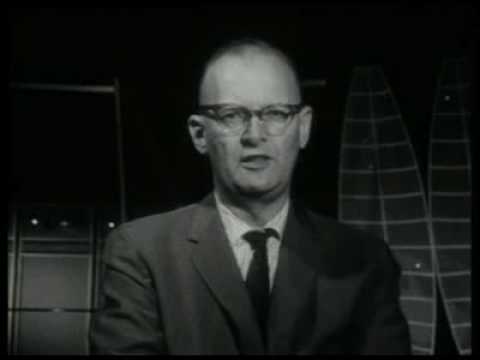
Read More...In 1964, Arthur C. Clarke Predicts the Internet, 3D Printers and Trained Monkey Servants
“If by some miracle some prophet could describe the future exactly as it was going to take place, his predictions would sound so absurd, so far-fetched that everyone would laugh him to scorn.”
That was Sir Arthur C. Clarke, science fiction author best known for 2001: A Space Odyssey, describing the inherent folly of predicting the future in a 1964 BBC documentary. Of course, he then goes on to do exactly that – with remarkable, unnerving accuracy. Part one of the documentary is above. Part two is below.
The piece opens with a generic narration that describes a diorama of future society at the GM pavilion at the 1964 World Fair. Perhaps because it was a more innocent time or maybe because it was sponsored by an automaker, this vision of the future is touchingly oblivious to anything related to climate change. Machines with laser guns will clear jungles in hours flat and people will live in domed communities on the ice caps. (Ice caps in the future. Hilarious.)
Then the reedy, bespectacled author appears and starts to describe how he thinks the world in fifty years (i.e. 2014) will look. And this is where the movie starts to feel uncanny. He talks about how the advancement of transistors and satellites will radically alter our understanding of physical space.
These things will make possible a world in which we can be in instant contact wherever we may be. Where we can contact our friends anywhere on earth, even if we don’t know their actual physical location. It will be possible in that age, possibly 50 years from now, for a man to conduct his business from Tahiti or Bali just as well as he could from London.
For the record, I’m writing this post in a coffee shop in Los Angeles, hundreds of miles from the massive Open Culture headquarters in Palo Alto, but I could just as easily be writing this on a beach in Sri Lanka or a hotel room in Dubrovnik. Clarke sounds here less like some pie-in-the-sky futurist than an aspirational lifestyle guru like Tim Ferris.
Clarke then describes how medicine might change. “One day, we might have brain surgeons in Edinburgh operating on patients in New Zealand.” The long-distance virtual surgery first was pioneered back in 2001 and it continues to improve as internet speeds increase.
And he predicts that at some point science will invent a “replicating device” that would create an exact copy of anything. That sounds an awful lot like a 3D printer. Clarke warns that this invention might cause massive societal disruption. “Confronted by such a device, our present society would probably sink into a kind of gluttonous barbarism. Since everyone would want unlimited quantities of everything.” In other words, 3D printers might turn the world into Black Friday at Walmart.
Some of his other ideas are just weird. Clarke proposes to tame and train armies of chimpanzees to cook, clean and do society’s grunt work. “We can certainly solve our servant problem with the help of the monkey kingdom. “ Planet of the Apes wouldn’t come out for another four years so Clarke could be forgiven for not realizing that that is one terrible idea. On the other hand, it’s hard to see how hiring monkeys could possibly make the customer service at Time Warner Cable any worse than it already is.
Related Content:
Arthur C. Clarke Narrates Film on Mandelbrot’s Fractals; David Gilmour Provides the Soundtrack
Isaac Asimov Predicts in 1964 What the World Will Look Like Today — in 2014
Free Science Fiction Classics on the Web: Huxley, Orwell, Asimov, Gaiman & Beyond
Jonathan Crow is a Los Angeles-based writer and filmmaker whose work has appeared in Yahoo!, The Hollywood Reporter, and other publications. You can follow him at @jonccrow.
Read More...
The 5 Essential Rules of Film Noir
“That’s life. Whichever way you turn, Fate sticks out a foot to trip you.” – Al Robert (Tom Neal), Detour
Film Noir. When you think that phrase, the mind is immediately drawn to images of leggy ice queens, rumbled losers in fedoras, guns, neon and certain deadpan cynicism. Film Noir wasn’t a self conscious movement in the way the French New Wave was. It wasn’t a brand name like a Marvel superhero epic. But it did tap into something dark in the American postwar zeitgeist and became for a spell hugely popular. It also created some of the most unforgettable images in film history.
Film Noir hit its zenith in the late ‘40s, a time when veterans were returning home in droves after having witnessed unimaginable horrors. Under the weight of war trauma, men felt the brittle veneer of traditional masculinity – strong, stoic and dominant — crack and crumble. Film Noir tapped into this anxiety. It’s no accident that film scholars have called Film Noir the male weepy.
Above is a BBC documentary about the genre that lays out its rules. The movie features interviews with director Paul Schrader, cinematographer Roger Deakins and George Pelecanos who both wrote and produced The Wire. Check it out.
Rule #1: Choose a Dame with a Past and a Hero with No Future
The noir protagonist is inevitably some hapless schmuck who is doomed, suckered to death or ignominy by lust, greed or some darker subterranean self-destructive urge. And inevitably the catalyst for this fall is a dame. Usually blonde. Always gorgeous. The femme fatale is inevitably the center of the movie and frequently its antagonist. Film Noir bluntly lays bare what wasn’t discussed in polite society; that the way for a woman to get power in American society was through sex. The gender dynamics in this genre are the stuff that has launched hundreds of PhD dissertations.
Rule #2: Use No Fiction But Pulp Fiction
Studios rushed to adapt the pulp works of Raymond Chandler, James M. Cain and particularly Dashiell Hammett, the first true hardboiled writer. Hammett’s novels like Red Harvest and The Maltese Falcon are terse, violent and cynical; they contain the DNA of the Film Noir.
Rule #3: See America Through a Stranger’s Eyes
The rise of Nazism in Germany forced hundreds of writers, filmmakers and composers like Fritz Lang, Robert Siodmak and Billy Wilder to the sun-dappled shores of Los Angeles. With them, they brought the aesthetics of German Expressionism — canted camera angles, stark lighting and grotesque shadows. It was a look that merged seamlessly with the bleak, elemental stories of Noir. They also brought with them a war-weary foreigner’s sense of the country, one that saw the brutality and corruption of America beneath the patriotic bunting.
Rule #4: Make It Any Color As Long As It’s Black
They wouldn’t call it Film Noir if the movies didn’t use a lot of black.
Rule #5: It Ain’t What You say It’s the Way That you Say it
The Hayes code limited how bawdy and violent Film Noir could get. So filmmakers got creative, using off-screen space and lots and lots of euphemisms. Check out what Lauren Bacall says to Humphrey Bogart in The Big Sleep.
Speaking of horses, I like to play them myself. But I like to see them work out a little first, see if they’re front runners or come from behind, find out what their hole card is, what makes them run.
It’s pretty obvious she isn’t talking about horses. And if you want to see just how lascivious her delivery is, watch the film above.
And if you want to watch more Film Noirs, don’t miss our collection of 36 Free Film Noir Movies, which features classic movies by John Huston, Orson Welles, Fritz Lang, Ida Lupino and many others. It’s part of our bigger collection, 4,000+ Free Movies Online: Great Classics, Indies, Noir, Westerns, Documentaries & More.
Related Content:
Detour: The Cheap, Rushed Piece of 1940s Film Noir Nobody Ever Forgets
Watch D.O.A., Rudolph Maté’s “Innovative and Downright Twisted” Noir Film (1950)
The Third Man: Film Noir Classic on YouTube
Jonathan Crow is a Los Angeles-based writer and filmmaker whose work has appeared in Yahoo!, The Hollywood Reporter, and other publications. You can follow him at @jonccrow.
Read More...David Foster Wallace Subscribes to the The Believer Magazine with a Little Humor & Snark (2003)
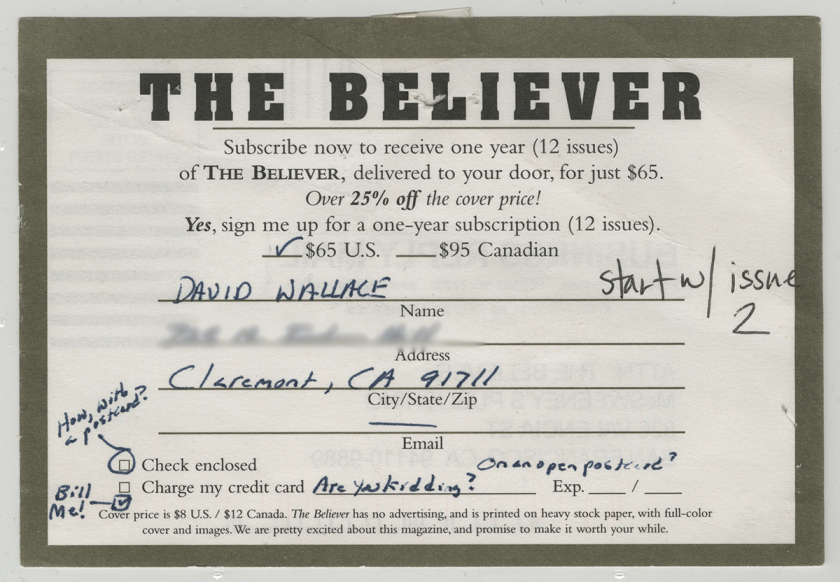
Founded by Dave Eggers in 1998, McSweeney’s initally began as a literary journal that published only works rejected by other magazines. But, almost immediately, the journal started publishing, it likes to say, “pieces primarily written with McSweeney’s in mind.” Since then, McSweeney’s has also launched McSweeney’s Quarterly and The Believer, not to mention lots of fiction, nonfiction, poetry, and children’s books.
Created in 2003, The Believer, writes the Harry Ransom Center blog, “has become a monthly art and culture magazine featuring content unimpeded by arbitrary word limits and highlighting schematic drawings, illustrations by Tony Millionaire, and regular columns by Nick Hornby, Greil Marcus, and Jack Pendarvis.” “The Believer attracts remarkable writers and remarkable readers. David Foster Wallace’s subscription postcard for The Believer is evidence that they’re sometimes both.” Foster Wallace sat down for a long interview with the magazine, and personally subscribed to the journal, filling out the subscription postcard by hand. It’s believed that the humorous postcard — click the image to view it in a larger format — once hung on the wall of The Believer’s editor Andrew Leland. It now resides in the newly-opened McSweeney’s archive at the Ransom Center in Austin, Texas. There, visitors can also find a David Foster Wallace archive, with lots of interesting DFW material that we’ve highlighted in years past. For your convenience, we’ve highlighted a few of our favorite items right below:
David Foster Wallace’s 1994 Syllabus: How to Teach Serious Literature with Lightweight Books
Read Two Poems David Foster Wallace Wrote During His Elementary School Days
David Foster Wallace Breaks Down Five Common Word Usage Mistakes in English
David Foster Wallace’s Love of Language Revealed by the Books in His Personal Library
via Biblioklept/Dangerous Minds
Read More...Introducing Ergo, the New Open Philosophy Journal
 The new open philosophy journal, Ergo, was “created in response to a need for general philosophy journals that are efficient, open access, inclusive, and transparent.” Traditional philosophy journals move slowly, taking somewhere between 5 and 9 months to tell scholars whether their submissions will be accepted or not. They overwhelmingly favor work written by white men. And they cater to metaphysics and epistemology, while giving less attention to the philosophy of mind, ethics, and political theory.
Enter Ergo, the new open journal created by The University of Michigan, which just published its first issue online. The average time-to-decision was 21 days, with the journal rejecting 93% of the submissions. The first five accepted articles covered Epistemology (twice), History of Modern Philosophy, Philosophy of Biology, and Philosophy of Mind. And, as the editors seem acutely aware, the first submissions were still dominated by men. (Get more background on the journal here.)
All of the articles are free to readers (while authors retain copyright under a Creative Commons license.) You can find more free publications by the University of Michigan in our previous post: 15 Free eBooks on New Media Studies & the Digital Humanities.
Related Content:
110 Free Online Philosophy Courses
Walter Kaufmann’s Classic Lectures on Nietzsche, Kierkegaard and Sartre (1960)
Read More...Illustrations of The Lord of the Rings in Russian Iconography Style (1993)
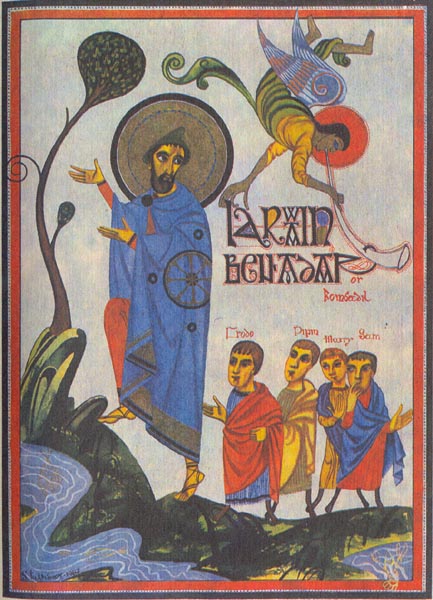
Given the detail with which J.R.R. Tolkien describes his fantastical yet earthily grounded characters and landscapes, you’d think illustrators would have an easy time putting pictures to the words. You might even assume that any artist who tried his or her hand at the job would produce more or less the same visual interpretation. And yet the history of illustrated editions of The Hobbit and the Lord of the Rings trilogy hasn’t gone that way at all. Different publishers at different times and different places have commissioned very stylistically different things. We have shown you examples of Tolkien’s Personal Book Cover Designs for The Lord of the Rings Trilogy as well as what Where the Wild Things Are author Maurice Sendak could come up with. And, in March, we featured a playfully visualized Soviet LOTR edition from 1976. Now, take a look at the large set of images here, pulled from a 1993 edition illustrated by Sergey Yuhimov (more information, albeit in Russian, here and here), and you’ll get the sense that the Russians may have a knack for visualizing the goings-on of Middle-Earth.
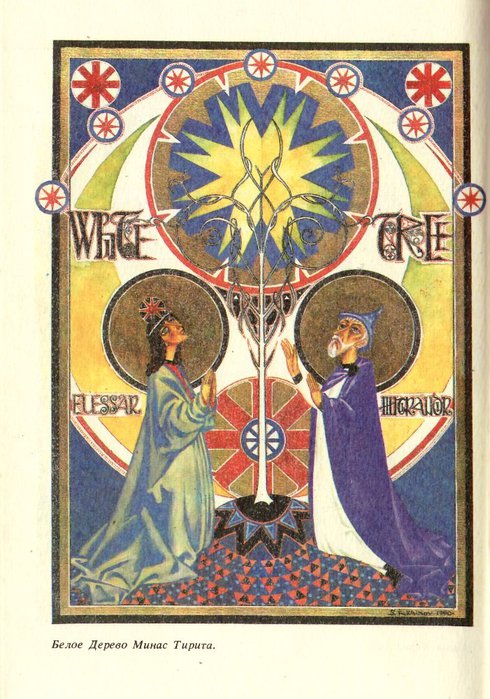
Still, the illustrations from Russia’s Hobbit and almost 30-years-newer Lord of the Rings could hardly share less of a sensibility. A Metafilter post on the latter draw a number of attempted descriptions by Tolkien fans: “LOTR translated almost as Christian iconography.” “They leap around about 1000 years of art history.” “Mad, but also charming.” “They would make great tarot cards.”

You can see a gallery of images in four parts: Part 1 — Part 2, Part 3, Part 4.
Our thanks go to @zeljka8 for helping find background information for these illustrations.

Related content:
Soviet-Era Illustrations Of J. R. R. Tolkien’s The Hobbit (1976)
Discover J.R.R. Tolkien’s Personal Book Cover Designs for The Lord of the Rings Trilogy
The Only Drawing from Maurice Sendak’s Short-Lived Attempt to Illustrate The Hobbit
Colin Marshall hosts and produces Notebook on Cities and Culture and writes essays on cities, language, Asia, and men’s style. He’s at work on a book about Los Angeles, A Los Angeles Primer. Follow him on Twitter at @colinmarshall or on Facebook.
Read More...Philip Seymour Hoffman Contemplates Happiness in New Animated Video
The animated video series Blank on Blank returns with a previously unaired interview with Philip Seymour Hoffman, the talented actor who died of a heroin overdose earlier this year. The audio, recorded at the Rubin Museum of Art in December, 2012, features Hoffman in conversation with philosopher Simon Critchley. The topic is happiness — something that Hoffman is careful to distinguish from hedonistic pleasure. “I would definitely say pleasure is not happiness, because I kill pleasure.” “I take too much of it and make it unpleasurable. Like too much coffee and you are miserable.” “There is no pleasure that I haven’t actually made myself sick on.” Wrestling with the concept, the actor tells Critchely that he found happiness in one thing — the time he spent with his children, “When I see them enjoy each other in front of me, and then they let me enjoy them in turn, that brings a feeling which I would say is happiness.” But that feeling, as powerful as it is, proves ephemeral. It doesn’t last. So when it comes around, don’t miss it.
You can watch the complete unanimated interview below:
Related Content:
A Guide to Happiness: Alain de Botton Shows How Six Great Philosophers Can Change Your Life
Read More...Free: Download 30,000 Images from The Museum of New Zealand (All in High Resolution)

Last month, The Metropolitan Museum of Art announced something we all welcomed. They made more than 400,000 images of art in the Museum’s collection free to download. Before that, we also witnessed other major art museums launching their own open art initiatives: 87,000 images from the Getty in L.A., 125,000 Dutch masterpieces from the Rijksmuseum in the Netherlands, 35,000 artistic images from the National Gallery in Washington, D.C., and 57,000 works of art put on virtual display by Google Art Project.

Now comes another 30,000 images from the Museum of New Zealand. On their blog, they write: “Today we are extremely happy to let you know about our latest development; over 30,000 images downloadable, for free, in the highest resolution we have them.” “Over 14,000 images are available under a Creative Commons licence CC BY-NC-ND,” (which means you can make non-commercial use of these images, so long as you give attribution to the artist.) “But even better are the 17,000 images that are downloadable for any use, any use at all. These images have no known copyright restrictions.” Find more information on this open art initiative here. Or enter the collections right here.
Up top, you will find the photograph called “Cleopatra in Domain Cricket Ground,” taken in Auckland, by Robert Walrond, in 1914.
The second image is from a series called “Five cats,” made in China during the late 18th century, by an unknown artist.
Related Content:
Free: The Guggenheim Puts 99 Modern Art Books Online
Download Hundreds of Free Art Catalogs from The Metropolitan Museum of Art
LA County Museum Makes 20,000 Artistic Images Available for Free Download
Read More...Support Us
We're hoping to rely on loyal readers, rather than erratic ads. Please click the Donate button and support Open Culture. You can use Paypal, Venmo, Patreon, even Crypto! We thank you!

About Us

Open Culture scours the web for the best educational media. We find the free courses and audio books you need, the language lessons & educational videos you want, and plenty of enlightenment in between.
Advertise With Us

FREE UPDATES!
GET OUR DAILY EMAIL
Get the best cultural and educational resources on the web curated for you in a daily email. We never spam. Unsubscribe at any time.
FOLLOW ON SOCIAL MEDIA

Open Culture editor Dan Colman scours the web for the best educational media. He finds the free courses and audio books you need, the language lessons & movies you want, and plenty of enlightenment in between.
Advertise With Us