Eudora Welty Writes a Quirky Letter Applying for a Job at The New Yorker (1933)
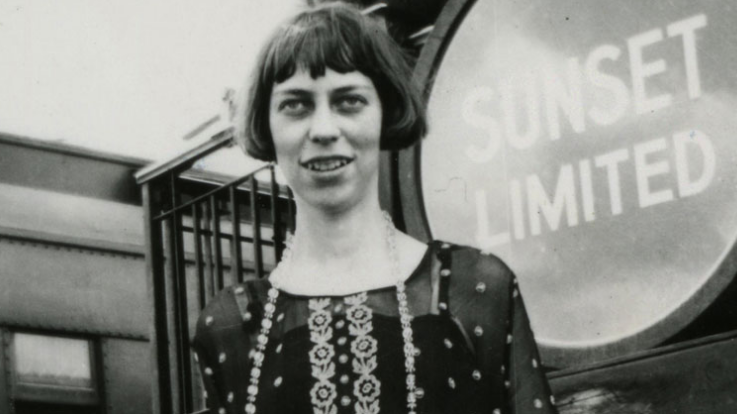
“Eudora Welty is one of the reasons that you thank God you know how to read,” writes an online reviewer of her autobiography One Writer’s Beginnings. It’s a sentiment with which I could not agree more. Whether in memoir, short story, or novel, Welty—winner of nearly every literary prize save the Nobel—speaks with the most highly individual of voices. (Welty once told a Paris Review interviewer that she doesn’t read anyone for “kindredness.”) Her prose, so attuned to its own rhythms, so confidently venturing into new realms of thought, seems to surprise even her. Indeed, teachers of writing could hardly do better than assign Welty to illustrate the elusive concept of “voice”—it’s a writerly quality she mastered early, or perhaps always possessed.
Take the 1933 letter below in which she introduces herself, a young postgraduate of 23, to The New Yorker in hopes of securing a position doing… well, whatever. She proposes “drum[ming] up opinions” on books and film, but only at the rate of “a little paragraph each morning—a little paragraph each night” (though she would “work like a slave” if asked). She also offers to replace cartoonist (and author of “The Secret Life of Walter Mitty”) James Thurber “in case he goes off the deep end.” The letter brims with winsome self-confidence and breezy optimism, as well as the unselfconscious self-awareness she makes look so easy: “That shows you how my mind works,” she writes, “quick, and away from the point.” The magazine staff, points out Shane Parrish of Farnam Street, “ignored her plea […] missing the obvious talent,” though of course they would begin publishing her stories just a few years later.
Read the letter in full below and marvel at how anyone could reject such a delightfully enthusiastic candidate (she would do just fine as a junior “publicity agent” for the WPA).
March 15, 1933
Gentlemen,
I suppose you’d be more interested in even a sleight‑o’-hand trick than you’d be in an application for a position with your magazine, but as usual you can’t have the thing you want most.
I am 23 years old, six weeks on the loose in N.Y. However, I was a New Yorker for a whole year in 1930–31 while attending advertising classes in Columbia’s School of Business. Actually I am a southerner, from Mississippi, the nation’s most backward state. Ramifications include Walter H. Page, who, unluckily for me, is no longer connected with Doubleday-Page, which is no longer Doubleday-Page, even. I have a B.A. (’29) from the University of Wisconsin, where I majored in English without a care in the world. For the last eighteen months I was languishing in my own office in a radio station in Jackson, Miss., writing continuities, dramas, mule feed advertisements, santa claus talks, and life insurance playlets; now I have given that up.
As to what I might do for you — I have seen an untoward amount of picture galleries and 15¢ movies lately, and could review them with my old prosperous detachment, I think; in fact, I recently coined a general word for Matisse’s pictures after seeing his latest at the Marie Harriman: concubineapple. That shows you how my mind works — quick, and away from the point. I read simply voraciously, and can drum up an opinion afterwards.
Since I have bought an India print, and a large number of phonograph records from a Mr. Nussbaum who picks them up, and a Cezanne Bathers one inch long (that shows you I read e. e. cummings I hope), I am anxious to have an apartment, not to mention a small portable phonograph. How I would like to work for you! A little paragraph each morning — a little paragraph each night, if you can’t hire me from daylight to dark, although I would work like a slave. I can also draw like Mr. Thurber, in case he goes off the deep end. I have studied flower painting.
There is no telling where I may apply, if you turn me down; I realize this will not phase you, but consider my other alternative: the U of N.C. offers for $12.00 to let me dance in Vachel Lindsay’s Congo. I congo on. I rest my case, repeating that I am a hard worker.
Truly yours,
Eudora Welty
Welty’s letter appears alongside dozens more remarkable missives in the beautiful new book, Letters of Note: An Eclectic Collection of Correspondence Deserving of a Wider Audience.
via Farnam Street/Brain Pickings
Related Content:
Ralph Waldo Emerson Writes a Job Recommendation for Walt Whitman (1863)
Read Rejection Letters Sent to Three Famous Artists: Sylvia Plath, Kurt Vonnegut & Andy Warhol
Gertrude Stein Gets a Snarky Rejection Letter from Publisher (1912)
Josh Jones is a writer and musician based in Durham, NC. Follow him at @jdmagness.
Read More...John Cheever Reads “The Swimmer,” His Famous Short Story, in Its Entirety (1977)
The Stories of John Cheever, a collection of 61 stories chronicling the lives of “the greatest generation,” was first published in 1978 with much fanfare. The critics liked it. The weighty, 700-page book won the Pulitzer Prize for Fiction in 1979. The people liked it too. The Stories of John Cheever, Michiko Kakutani wrote in Cheever’s 1982 obit, was “one of the few collections of short fiction ever to make The New York Times best-seller list.”
The collection features some of Cheever’s best-known stories: “The Enormous Radio,” “Goodbye, My Brother,” “The Five-Forty-Eight,” and “The Country Husband.” And also perhaps his most famous short piece of fiction, “The Swimmer.”
First published in The New Yorker in July, 1964, “The Swimmer” was originally conceived as a novel and ran over some 150 pages, before the author pared it down to a taut eleven pages. Those eleven pages apparently take some 25 minutes to read. Above, you can hear Cheever reading “The Swimmer,” in its entirety, at New York’s 92nd St. Y. The audio was recorded on December 19, 1977, and it’s otherwise housed in our collection, 1,000 Free Audio Books: Download Great Books for Free.
Bonus: you can also hear author Anne Enright read “The Swimmer” over at The New Yorker. This version was recorded in 2011.
via The Paris Review
Related Content:
The New Yorker’s Fiction Podcast: Where Great Writers Read Stories by Great Writers
Famous Authors Read Other Famous Authors
Stephen Fry Reads Oscar Wilde’s Children’s Story “The Happy Prince”
Read More...2 Hour Annotated Star Wars Film Reveals the Cinematic Influences Behind George Lucas’ Classic Film
Last week we brought to your attention a short video detailing the ways George Lucas’ classic Star Wars draws from the samurai films of Akira Kurosawa, borrowing costuming and directorial nods. But like any great artist, Lucas stole from more than one source. His groundbreaking space epic incorporates influences as diverse as John Ford’s classic western The Searchers and the comparative mythology of Joseph Campbell’s The Hero With a Thousand Faces, among many, many others. How on earth did Lucas synthesize such a variety of different genres into the unified whole that is Star Wars? To begin to answer that question, Michael Heilemann has put together the annotated Star Wars you see above, “a work-in-progress mashup of Star Wars with many of its sources of inspiration, playing as a feature-length presentation.” As The Onion’s A.V. Club describes it, “the video illuminates the astounding breadth of material that was banging around in Lucas’ head as he assembled Star Wars. It’s the kind of thing that ought to be on a special-edition Blu-Ray release but never will be because of copyright issues.”
Heilemann, Interface Director at Squarespace, edited the film as part of his research process for an ebook called Kitbashed, an exhaustive study of “how George Lucas and his artists perfected the process of transforming existing books, comics, movies and ideas into the fantasy spectacular that is Star Wars.” The title of Heilemann’s project comes from a word that means “using existing model-kits to detail spaceship models for films,” with some connotations of both the “mashup” and the “hack.” Lucas’ achievement, however, is much more than either of those words suggest, according to Heilemann, whose journey into the films revealed to him their “underlying complexity and seemingly infinite depth.” Far from attempting to “reveal how Star Wars is in reality completely unoriginal,” Heilemann hopes to show readers, and viewers, that “the creative process that brought forth Star Wars is nothing short of amazing.”
Read more about Kitbashed at its official site.
Via AV Club
Related Content:
How Star Wars Borrowed From Akira Kurosawa’s Great Samurai Films
Watch the Very First Trailers for Star Wars, The Empire Strikes Back & Return of the Jedi (1976–83)
Joseph Campbell and Bill Moyers Break Down Star Wars as an Epic, Universal Myth
Hundreds of Fans Collectively Remade Star Wars; Now They Remake The Empire Strikes Back
Josh Jones is a writer and musician based in Durham, NC. Follow him at @jdmagness.
Read More...James Joyce’s Dirty Love Letters Read Aloud by Martin Starr, Paget Brewster & Other TV Comedy Actors (NSFW)
(Be warned, these videos are Not Safe for Work. And unless you can deal with strong language, you should skip watching these clips.)
Last year we featured James Joyce’s “dirty letters” to his wife, originally written in 1909 but not discovered in all their cerebrally erotic glory until this century. For Valentine’s Day, the sketch comedy video site Funny or Die capitalized on the availability of these highly detailed, fantasy-saturated Joycean mash notes by having them read dramatically. For this task the producers rounded up five well-known actors, such as Martin Starr from such comedically respected television shows as Freaks and Geeks and Party Down. You can watch his reading above. “I would like you to wear drawers with three or four frills, one over the other at the knees and up the thighs, and great crimson bows in them, so that when I bend down over you to open them and” — but you don’t just want to read it. You want to hear such a masterpiece performed.
Off raising the children in Trieste, Joyce’s wife Nora wrote replies of a presumably similar ardor-saturated nature. Alas, these remain undiscovered, but that unfortunate fact doesn’t stop actresses as well as actors from providing oral renditions of their own. Just above, we have Paget Brewster from Friends and Criminal Minds reading aloud another of Joyce’s love letters, one which moves with surprising swiftness from evoking “the spirit of eternal beauty” to evoking “a hog riding a sow.” This series of readings also includes contributions from The Middleman’s Natalie Morales, The Kids in the Hall’s Dave Foley, and Saturday Night Live’s Michaela Watkins. They all reveal that, with his textual creativity as well as his close acquaintance with those places where the romantic meets the repulsive, James Joyce would have made quite a sexter today. You can have that idea for free, literate sketch comedy video producers of the internet.
PS Apologies for the lengthy ads that precede the videos. They come from Funny or Die and we have no control over them.
Related Content:
James Joyce’s “Dirty Letters” to His Wife (1909)
James Joyce Plays the Guitar, 1915
On Bloomsday, Hear James Joyce Read From his Epic Ulysses, 1924
James Joyce, With His Eyesight Failing, Draws a Sketch of Leopold Bloom (1926)
James Joyce’s Ulysses: Download the Free Audio Book
Colin Marshall hosts and produces Notebook on Cities and Culture and writes essays on cities, language, Asia, and men’s style. He’s at work on a book about Los Angeles, A Los Angeles Primer. Follow him on Twitter at @colinmarshall or on Facebook.
Read More...Free NASA eBook Theorizes How We Will Communicate with Aliens
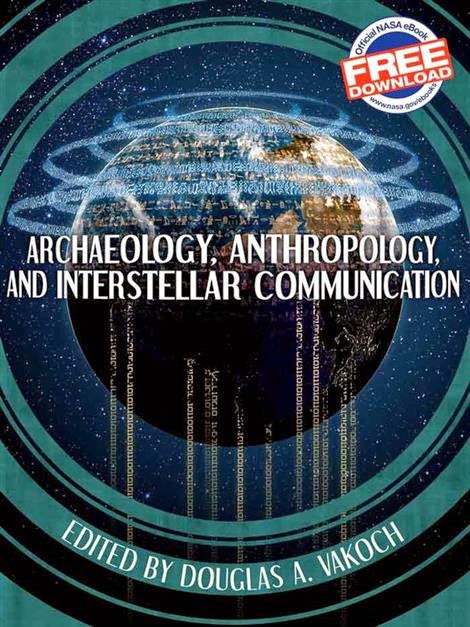
During the past few years, NASA has released a series of free ebooks, including NASA Earth As Art and various interactive texts focusing on the Webb and Hubble space telescopes. Last week, they added a new, curious book to the collection, Archaeology, Anthropology, and Interstellar Communication. Edited by Douglas A. Vakoch (the Director of Interstellar Message Composition at the SETI Institute), the text contemplates how we’ll go about “establishing meaningful communication with an extraterrestrial intelligence.” The scholars contributing to the volume “grappl[e] with some of the enormous challenges that will face humanity if an information-rich signal emanating from another world is detected.” And to make sure that we’re “prepared for contact with an extraterrestrial civilization, should that day ever come,” they draw on “issues at the core of contemporary archaeology and anthropology.” Why archaeology and anthropology? Because, says Vackoch, communication with intelligent life probably won’t be through sound, but through images. We will need to read/understand the civilization we encounter based on what we observe. Vakoch says:
[D]on’t think of “sound worlds” or music or speech as the domains, vehicles, or contents of ETI [extra terrestrial intelligence] messages. Regardless of semiotic concerns, the accessibility of acoustic messaging must remain doubtful. Furthermore, there will be intended and unintended aspects of performance, which elaborate the difficulties of using sound. In my view avoidance of the sound world need not be controversial.
On the other hand, vision and the use of images would appear to be at least plausible. Although spectral details cannot be considered universal, the physical arrangement of objects on a habitable planet’s surface will be shaped in part by gravity (the notion of a horizon might well be universal) and thus multispectral images might plausibly be considered worthwhile for messages. More generally, the implications for considering SETI/CETI as some sort of anthropological challenge need teasing out.
The 300-page book, Archaeology, Anthropology, and Interstellar Communication, has been made available in three formats, and added to our own collection, 800 Free eBooks for iPad, Kindle & Other Devices:
› Kindle readers: MOBI [2.8 MB]
› All other eBook readers: EPUB [3.8 MB]
› Fixed layout: PDF [1.7 MB]
Below you can watch Vakoch give a TEDX talk called,“What Would You Say to an Extraterrestrial?”
via Gizmodo/Kim Komand0
Read More...Thank You, Mask Man: Lenny Bruce’s Lone Ranger Comedy Routine Becomes a NSFW Animated Film (1968)
If you ever really wanted to know what was the deal between The Lone Ranger and Tonto, the above video of Thank You, Mask Man might answer a few questions. Warning: it’s seriously NSFW.
The audio for Thank You, Mask Man is taken from a stand up routine from Lenny Bruce, who ruthlessly, hilariously takes apart the legendary crime fighter. After years of getting saved by a masked hero on a white steed, the denizens of a small Western town corner him into accepting something, anything as a token of their gratitude. The hero points to a nearby Native American and says that he wants him. He proclaims that he wants “to perform an unnatural act.” The townspeople are horrified. “I’ve read a lot of exposes on how bad it is,” the Masked Man explains, “and I want to try it, just once.”
Jeff Hale, who later went on to animate that groovy Pinball Number Countdown bit on Sesame Street, made the short in 1968, two years after Bruce’s death. The movie had a hard time getting booked into theaters reportedly, in part, because Bruce ruffled more than a few feathers in the film industry. Ultimately though Thank You, Mask Man became a staple at gay and cult film festivals.
Bruce was, of course, the original bad boy comic. He laced his free form, lightning quick performances with frank discussions of sex, social issues and lots of swearing. Nowadays, F‑bombs are par for the course in a comedian club but, back during the Kennedy administration, they were shocking. And they got him thrown in jail on several occasions. You can listen to another (unanimated) Bruce routine below. It’s completely NSFW.
You can find Thank You, Mask Man in the Animation section of our collection, 4,000+ Free Movies Online: Great Classics, Indies, Noir, Westerns, Documentaries & More.
Related Content:
Lenny Bruce Riffs and Rants on Injustice and Hypocrisy in One of His Final Performances (NSFW)
George Carlin Performs His “Seven Dirty Words” Routine: Historic and Completely NSFW
Jonathan Crow is a Los Angeles-based writer and filmmaker whose work has appeared in Yahoo!, The Hollywood Reporter, and other publications. You can follow him at @jonccrow.
Read More...19th Century Caricatures of Charles Darwin, Mark Twain, H.M. Stanley & Other Famous Victorians (1873)
Students and lovers of Victoriana, we have a treat for you. The 1873 book above, Cartoon Portraits and Biographical Sketches of Men of the Day, offers caricatures of forty-nine prominent men, and one woman, of the 19th century, some of them less-than-famous now and some still veritable giants of their respective fields.
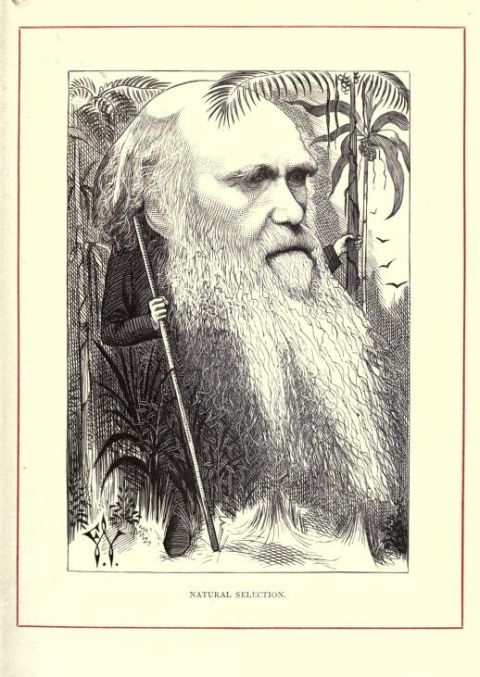
Accompanied by lively biographies, the portraits were all drawn by illustrator Frederick Waddy, who is perhaps best known for the drawing on page six of a white-bearded Charles Darwin (above) entitled “Natural Selection”—often reproduced in color and found hanging on the office walls of biology teachers. Darwin appears second in Cartoon Portraits, preceded only by Sir Edward Bulwer-Lytton of “It was a dark and stormy night” fame.
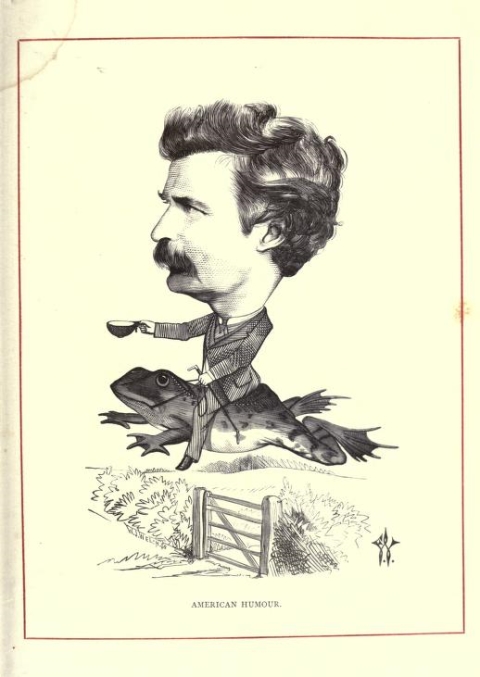
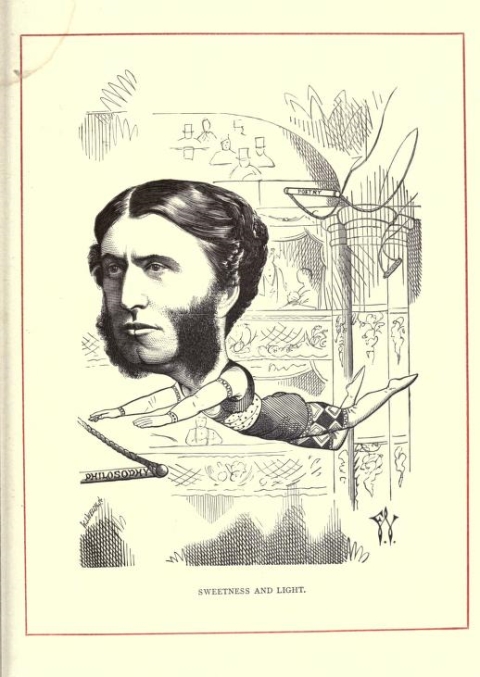
In addition to professor’s offices, you may also encounter some of Waddy’s work at the National Portrait Gallery in London. In his time, Waddy was one of the foremost caricaturists of the day—an important position in periodical publishing before the advent of cheaply mass-reproducible photography. All of the portraits originally appeared in a magazine called Once a Week, founded in a split between Charles Dickens and his publisher Bradbury and Evans, who started the journal with editor Samuel Lucas in 1859 to compete with Dickens’ All the Year Round. Once a Week ran until 1880, publishing pieces on history and current affairs and occasional poems by Tennyson, Swinburne, Dante Rossetti and others. Its popularity was buoyed by Waddy’s drawings and the detailed illustrations of several other graphic artists. Above, see Mark Twain riding his celebrated jumping frog, and just below, poet and critic Matthew Arnold does a high-wire act between two trapezes labelled “Poetry” and “Philosophy.” Twain’s portrait is titled “American Humour”— and he is the only American in the series—and Arnold’s is called “Sweetness and Light.”
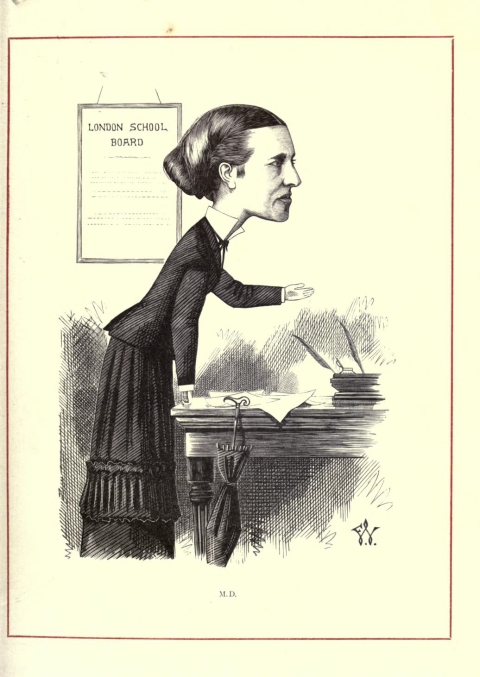
Though the book’s title promises only “Men of the Day,” it does include one woman, Dr. Elizabeth Garrett Anderson (below, simply titled “M.D.”), the first Englishwoman to officially work as a physician. Her biographical sketch begins with a long and somewhat tortuous historical defense for female doctors, stating that “social prejudices are almost as hard to eradicate as those of religion. It was not till quite lately that the feeling against woman’s rights as regard education was successfully combated.” Once a Week was a progressive-leaning magazine, its editor a noted abolitionist, and it regularly published the work of women writers like Harriet Martineau, Isabella Blagden, and Mary Elizabeth Braddon, though one wonders why they didn’t warrant caricatures as well.
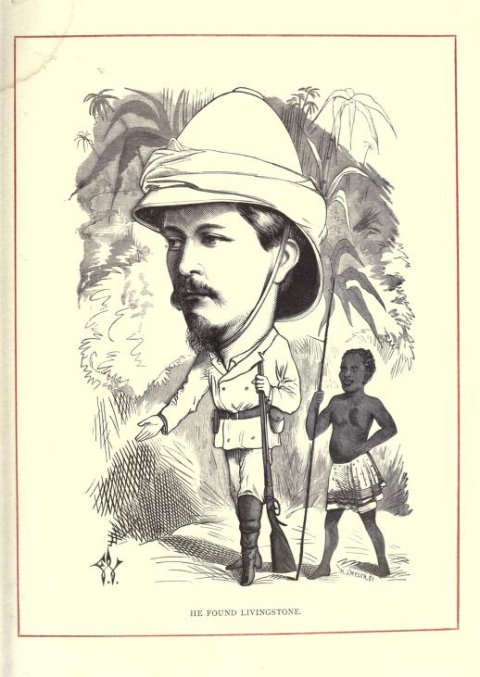
Below, see Waddy’s portrait of central African explorer Henry Morton Stanley, standing twice the height of the native African next to him. It’s a fitting image of colonial ego, though the scene may be drawn after a photo of Stanley with his adopted son Kalulu. The title refers to his search for—and famous exclamation upon discovering—Scottish missionary David Livingstone. All in all, Cartoon Portraits gives us a fascinating look at Victorian visual media and a representative sample of the most popular literary, scientific, and political figures in England during the middle of the century. While the names of Waddy and his fellow comic artists are hardly remembered now, the authors of The Smiling Muse: Victoriana in the Comic Press assert that in their day, “they were the ones who had their fingers on the pulse of what we now call the ‘popular culture’ of the time.” See The Public Domain Review for more highlights from the book.
Related Content:
Mark Twain Writes a Rapturous Letter to Walt Whitman on the Poet’s 70th Birthday (1889)
Josh Jones is a writer and musician based in Durham, NC. Follow him at @jdmagness.
Read More...Protect and Survive: 1970s British Instructional Films on How to Live Through a Nuclear Attack
In Walking in Ruins, novelist and adventurous pedestrian Geoff Nicholson’s book about the on-foot exploration of England and America’s disused places, the author devotes a fascinating section to an Essex “secret nuclear bunker.” Rendered un-secret, and indeed unnecessary, by the end of the Cold War, the whole underground complex underwent conversion into a forlorn tourist attraction. “In some of the bunker’s smaller, emptier rooms, videos were being shown on chunky old TV sets, documentaries related to nuclear war and its survival,” Nicholson writes. “They included the notorious public information series Protect and Survive, twenty short episodes, basic animation, strangely ahead-of-its-time electronic music, and a voice-over by Patrick Allen, deeply unsympathetic and unreassuring, though you imagine he was supposed to be both. The titles in the series included ‘What to Put in Your Fallout Room’ and ‘Sanitation Care and Casualties.’ ”
“ ‘Stay at Home,’ ” Nicholson tells us, “reminded us that fallout ‘can settle anywhere, so no place in the United Kingdom is safer than any other,’ and my favorite single sentence comes from the episode ‘Refuges’: ‘If you live in a caravan or other building of lightweight construction with very little protection against fallout, your local authority will be able to advise you on what to do’ — and there was a cartoon image of a tiny caravan that looked like it might be blown away by a good sneeze, never mind a nuclear explosion.” The compilation above collects 51 minutes of these and other episodes of Protect and Survive, originally commissioned by the British government in the 1970s and meant for transmission only in the case of an imminent nuclear attack on the country. But episodes leaked, and the BBC proceeded to broadcast them absent that immediate threat, thereby ensuring the legacy of this Cold War media artifact beloved of irony-loving Britons — that is to say, Britons — across the country.
These vintage films will be added to our collection, 4,000+ Free Movies Online: Great Classics, Indies, Noir, Westerns, Documentaries & More.
Related Content:
Duck and Cover, or: How I Learned to Elude the Bomb
How a Clean, Tidy Home Can Help You Survive the Atomic Bomb: A Cold War Film from 1954
Colin Marshall hosts and produces Notebook on Cities and Culture and writes essays on cities, language, Asia, and men’s style. He’s at work on a book about Los Angeles, A Los Angeles Primer. Follow him on Twitter at @colinmarshall or on Facebook.
Read More...Fear and Desire: Stanley Kubrick’s First and Least-Seen Feature Film (1953)
Ask filmgoers to name their favorite Stanley Kubrick pictures, and you’ll hear many of the same titles over and over again: Spartacus, Dr. Strangelove, 2001: A Space Odyssey, A Clockwork Orange. These and the five other feature films Kubrick directed between 1960 and his death in 1999 hold permanent pride of place as some of the most enduring and influential works in the history of the form. His fourth picture, 1957’s Kirk Douglas-starring, World War I‑set Paths of Glory, has drawn a good share of critical acclaim, but nothing before it in his body of work has yet commanded the level of respect associated with Kubrick and his cinematic legacy.
In 1956, he’d made the noir The Killing on the cheap; the previous year, he’d made the noir Killer’s Kiss on the cheaper. But before even those came Fear and Desire, Kubrick’s very first feature, an existential war movie produced in 1953 with money raised from his wealthy drugstore-owning uncle and proceeds from a job shooting second-unit on a documentary about the life of Abraham Lincoln. You can watch the whole film, which has fallen into the public domain, at the top of the post, or in a restored version, preceded by a brief 1966 interview with Kubrick, right here.
By the time of Fear and Desire, Kubrick had already logged a certain amount of filmmaking practice directing shorts. Still, he could never quite get over his own perception of the movie, which he made at age 24 fresh from his job as a photographer at Look magazine. He considered the film “a bumbling amateur film exercise” and “completely inept oddity.” He later, having burned the negative, sought to prevent its screening and distribution whenever possible. Yet it had its high-profile appreciators even at the time of release: “Its overall effect is entirely worthy of the sincere effort put into it,” said the New York Times; “Worth watching for those who want to discover high talent at the moment it appears,” said critic-scholar Mark Van Doren. Though far rougher than every film Kubrick would go on to make, Fear and Desire offers several moments that reveal him as the director we now know he would go on to become. Grantland’s Steven Hyden, in an article on the movie, quotes an attendee at one of its particularly disastrous preview screenings who remembers that “there were giggles in the wrong places, and it all seemed overdone and overwrought.” He also quotes Kubrick’s full reflection on the experience in a New York Times Magazine profile: “Pain is a good teacher.”
Find Fear and Desire listed in our collection, 4,000+ Free Movies Online: Great Classics, Indies, Noir, Westerns, Documentaries & More.
Related Content:
Stanley Kubrick’s Very First Films: Three Short Documentaries
Killer’s Kiss: Where Stanley Kubrick’s Filmmaking Career Really Begins
Stanley Kubrick’s Rare 1965 Interview with The New Yorker
Colin Marshall hosts and produces Notebook on Cities and Culture and writes essays on cities, language, Asia, and men’s style. He’s at work on a book about Los Angeles, A Los Angeles Primer. Follow him on Twitter at @colinmarshall or on Facebook.
Read More...Designer Massimo Vignelli Revisits and Defends His Iconic 1972 New York City Subway Map
Most every dweller of a city with a robust public transit system comes to identify their boundaries with the lines, angles, and colors of its subway map. This is true of my hometown, Washington, DC, at least since the popular adoption of its Metro system in the 80s. It’s many times truer of my adopted city for ten years, New York, whose more than 100-year-old subway system has given urban historians enough material for lifelong study. The history of the NYC subway maps offers a specialized area for students of design, who must surely know the name Massimo Vignelli, the modernist designer who named the DC Metro and created the notorious 1972 NYC Transit map that, writes the MTA (Metro Transit Authority), “reimagined the MTA New York City Transit subway system as a neat grid of colored lines surrounded by a beige ocean.” The map will be familiar, and perhaps even a token of nostalgia, to New Yorkers from the era, who may also recall the complaints the MTA received for the map’s “geographic inaccuracies” and “aesthetic confusion.” Nonetheless, “design fans […] celebrated the map and made it a coveted souvenir of trips to New York. It later became part of the postwar design collection at the Museum of Modern Art.” In the video above, excerpted from the 2007 design documentary Helvetica, Vignelli revisits his transit map design (below), which he adopted from the London Underground map.

Click here to view in a larger format.
Vignelli, who passed away Tuesday at the age of 83, worked closely with his wife Leila on a wide range of design projects—his motto, “if you can design one thing, you can design everything.” A great many of those subway riders in 1972 may have disagreed. While previous and subsequent maps, including the current design, provide a geographically precise rendering of the five boroughs, with details of major avenues and parks and waterways in simple greens and blues, Vignelli’s map is formal and abstract, more art object than guidepost. As a newcomer to the city, I used my pocket-sized MTA map to guide me around on foot as well as by train (this was before smartphones, mind you), but this would be quite difficult if not impossible with the ’72 version. Yet in his reassessment of the design, Vignelli says that he should have stripped away even the few geographical references he did include because “the people couldn’t relate the geography with the stations.” For Vignelli, “there is no reason why this geography has to be literal, it could be completely abstract.” How this would better help riders navigate the hugely extensive system isn’t at all clear, but what is apparent is Vignelli’s commitment to form over utilitarian function. It’s a commitment that served him very well as a designer, though not, it seems, as a cartographer. For more on Vignelli’s design philosophy, see his 2012 interview with Big Think.
Related Content:
Undercity: Exploring the Underbelly of New York City
Vintage Video: A New York City Subway Train Travels From 14th St. to 42nd Street (1905)
Bauhaus, Modernism & Other Design Movements Explained by New Animated Video Series
Josh Jones is a writer and musician based in Durham, NC. Follow him at @jdmagness.
Read More...Support Us
We're hoping to rely on loyal readers, rather than erratic ads. Please click the Donate button and support Open Culture. You can use Paypal, Venmo, Patreon, even Crypto! We thank you!

About Us

Open Culture scours the web for the best educational media. We find the free courses and audio books you need, the language lessons & educational videos you want, and plenty of enlightenment in between.
Advertise With Us

FREE UPDATES!
GET OUR DAILY EMAIL
Get the best cultural and educational resources on the web curated for you in a daily email. We never spam. Unsubscribe at any time.
FOLLOW ON SOCIAL MEDIA

Open Culture editor Dan Colman scours the web for the best educational media. He finds the free courses and audio books you need, the language lessons & movies you want, and plenty of enlightenment in between.
Advertise With Us


