How Marcel Duchamp Signed a Urinal in 1917 & Redefined Art
Marcel Duchamp didn’t sign his name on a urinal for lack of ability to create “real” art. In fact, as explained by gallerist-Youtuber James Payne in the new Great Art Explained video above, Duchamp’s grandfather was an artist, as were three of his siblings; he himself attained impressive technical proficiency in painting by his teen years. In 1912, when he was in his mid-twenties, he could transcend convention thoroughly enough to bewilder and even enrage the public by painting Nude Descending a Staircase, which also drew criticisms from his fellow Cubists for being “too Futurist.” From then on, his independent (and not entirely un-mischievous) streak became his entire way of life and art.
That same year, Duchamp, Constantin Brâncuși, and Ferdinand Léger went to the Paris Aviation Salon. Beholding a propeller, Duchamp declared painting “washed up”; what artist could outdo the apparent perfection of the form before him? Getting a job as a librarian, he indulged in a stretch of reading about mathematics and physics.
This got him thinking of the power of chance, one of the forces that moved him to put a bicycle wheel in his studio and spin it around whenever the spirit moved him. This he would later consider his first “readymade” piece, deliberately chosen for being “a functional, everyday item with a total absence of good or bad taste” that “defied the notion that art must be beautiful.”
The famous urinal, entitled Fountain, would come later, in 1917, after he had relocated from Paris to New York. Technically, he didn’t sign his name on it at all, but rather “R. MUTT,” for Richard Mutt, a name partially “inspired by the comic strip Mutt and Jeff, which Duchamp loved. And Richard is French slang for a rich showoff, or a moneybags.” Submitted by a “female friend” and hidden behind a curtain at the show at which it made its debut, the original signed urinal would never be seen again. But it provoked a sufficiently enduring curiosity that, nearly half a century later, a market had emerged for carefully crafted sculptural replicas for Fountain and the other readymades. The irony could hardly have been lost on anyone with a sense of humor — or a willingness to question the nature of art itself — like Duchamp’s.
Related Content:
What Made Marcel Duchamp’s Famous Urinal Art–and an Inventive Prank
Hear the Radical Musical Compositions of Marcel Duchamp (1912–1915)
Hear Marcel Duchamp Read “The Creative Act,” A Short Lecture on What Makes Great Art, Great
When Brian Eno & Other Artists Peed in Marcel Duchamp’s Famous Urinal
Based in Seoul, Colin Marshall writes and broadcasts on cities, language, and culture. His projects include the Substack newsletter Books on Cities and the book The Stateless City: a Walk through 21st-Century Los Angeles. Follow him on Twitter at @colinmarshall or on Facebook.
Read More...Richard Feynman Creates a Simple Method for Telling Science From Pseudoscience (1966)

Photo by Tamiko Thiel via Wikimedia Commons
How can we know whether a claim someone makes is scientific or not? The question is of the utmost consequence, as we are surrounded on all sides by claims that sound credible, that use the language of science—and often do so in attempts to refute scientific consensus. As we’ve seen in the case of the anti-vaccine crusade, falling victim to pseudoscientific arguments can have dire effects. So how can ordinary people, ordinary parents, and ordinary citizens evaluate such arguments?
The problem of demarcation, or what is and what is not science, has occupied philosophers for some time, and the most famous answer comes from philosopher of science Karl Popper, who proposed his theory of “falsifiability” in 1963. According to Popper, an idea is scientific if it can conceivably be proven wrong. Although Popper’s strict definition of science has had its uses over the years, it has also come in for its share of criticism, since so much accepted science was falsified in its day (Newton’s gravitational theory, Bohr’s theory of the atom), and so much current theoretical science cannot be falsified (string theory, for example). Whatever the case, the problem for lay people remains. If a scientific theory is beyond our comprehension, it’s unlikely we’ll be able to see how it might be disproven.
Physicist and science communicator Richard Feynman came up with another criterion, one that applies directly to the non-scientist likely to be bamboozled by fancy terminology that sounds scientific. Simon Oxenham at Big Think points to the example of Deepak Chopra, who is “infamous for making profound sounding yet entirely meaningless statements by abusing scientific language.” (What Daniel Dennett called “deepities.”) As a balm against such statements, Oxenham refers us to a speech Feynman gave in 1966 to a meeting of the National Science Teachers Association. Rather than asking lay people to confront scientific-sounding claims on their own terms, Feynman would have us translate them into ordinary language, thereby assuring that what the claim asserts is a logical concept, rather than just a collection of jargon.
The example Feynman gives comes from the most rudimentary source, a “first grade science textbook” which “begins in an unfortunate manner to teach science”: it shows its student a picture of a “windable toy dog,” then a picture of a real dog, then a motorbike. In each case the student is asked “What makes it move?” The answer, Feynman tells us “was in the teacher’s edition of the book… ‘energy makes it move.’” Few students would have intuited such an abstract concept, unless they had previously learned the word, which is all the lesson teaches them. The answer, Feynman points out, might as well have been “’God makes it move,’ or ‘Spirit makes it move,’ or, ‘Movability makes it move.’”
Instead, a good science lesson “should think about what an ordinary human being would answer.” Engaging with the concept of energy in ordinary language enables the student to explain it, and this, Feynman says, constitutes a test for “whether you have taught an idea or you have only taught a definition. Test it this way”:
Without using the new word which you have just learned, try to rephrase what you have just learned in your own language. Without using the word “energy,” tell me what you know now about the dog’s motion.
Feynman’s insistence on ordinary language recalls the statement attributed to Einstein about not really understanding something unless you can explain it to your grandmother. The method, Feynman says, guards against learning “a mystic formula for answering questions,” and Oxenham describes it as “a valuable way of testing ourselves on whether we have really learned something, or whether we just think we have learned something.”
It is equally useful for testing the claims of others. If someone cannot explain something in plain English, then we should question whether they really do themselves understand what they profess…. In the words of Feynman, “It is possible to follow form and call it science, but that is pseudoscience.”
Does Feynman’s ordinary language test solve the demarcation problem? No, but if we use it as a guide when confronted with plausible-sounding claims couched in scientific-sounding verbiage, it can help us either get clarity or suss out total nonsense. And if anyone would know how scientists can explain complicated ideas in plainly accessible ways, Feynman would.
Note: An earlier version of this post appeared on our site in 2016.
Related Content:
The Life & Work of Richard Feynman Explored in a Three-Part Freakonomics Radio Miniseries
How to Spot Bullshit: A Manual by Princeton Philosopher Harry Frankfurt (RIP)
Richard Feynman Presents Quantum Electrodynamics for the NonScientist
Josh Jones is a writer and musician based in Durham, NC. Follow him at @jdmagness
Read More...Hear the Evolution of the London Accent Over 660 Years: From 1346 to 2006
Read a novel by Charles Dickens, and you’ll still today feel transported back to the London of the eighteen-twenties. Some of that experience owes to his lavishly reportorial descriptive skills, but even more to his way with dialogue. Dickens faithfully captured the vocabulary of the times and places in which he set his stories, and for some particularly colorful characters, went as far as to render their distinctive accents phonetically: that of The Pickwick Papers’ beloved valet Sam Weller, for instance, with its swapping of “v” and “w” sounds that briefly overtook the East End. But it’s one thing to read the voice of a Londoner of that time, and quite another to hear it.
No audio recordings exist of Dickensian London, of course, but we have the next-best thing in the video above from Youtuber Simon Roper — and specifically the section that begins at about 11:30, when he performs the accent of a Londoner in the year 1826. Most everything he says should sound quite intelligible to any English-speaker today, though few, if any, will ever have encountered someone who speaks in quite the same way in real life.
In this era, Roper adds in the onscreen notes, “you can hear the start of glottal reinforcement, where a glottal stop is inserted between a vowel and a plosive consonant at the end of a word.” What’s more, “non-rhoticity (r‑loss in most positions) has caused vowels that were originally followed by ‘r’ to become centering diphthongs.”
Serious stuff, for a man who describes himself as “not a linguist.” Nevertheless, Roper has in this video assembled an impressive tour of London accents over 660 years, with “twelve recordings, all of men with suspiciously similar voices, and each one is set 60 years after the last one, and each one is the grandson of the previous one.” (When the video went viral, the New Statesman profiled him for his achievement.) The earliest, set in 1346, will sound more familiar in cadence than in content, at least to those who haven’t studied Middle English. Comprehension doesn’t become a much simpler matter for most of us moderns until about 1586, but Roper’s accent comes to sound veritably transatlantic by 1766. Perhaps not coincidentally, that was just before the Americans broke off decisively from the motherland to do things their own way — but also to preserve a few of the old ways, including ways of speech.
Related content:
A Brief Tour of British & Irish Accents: 14 Ways to Speak English in 84 Seconds
Peter Sellers Presents The Complete Guide To Accents of The British Isles
A Tour of U.S. Accents: Bostonian, Philadelphese, Gullah Creole & Other Intriguing Dialects
Based in Seoul, Colin Marshall writes and broadcasts on cities, language, and culture. His projects include the Substack newsletter Books on Cities and the book The Stateless City: a Walk through 21st-Century Los Angeles. Follow him on Twitter at @colinmarshall or on Facebook.
Read More...How the Oldest Company in the World, Japan’s Temple-Builder Kongō Gumi, Has Survived Nearly 1,500 Years
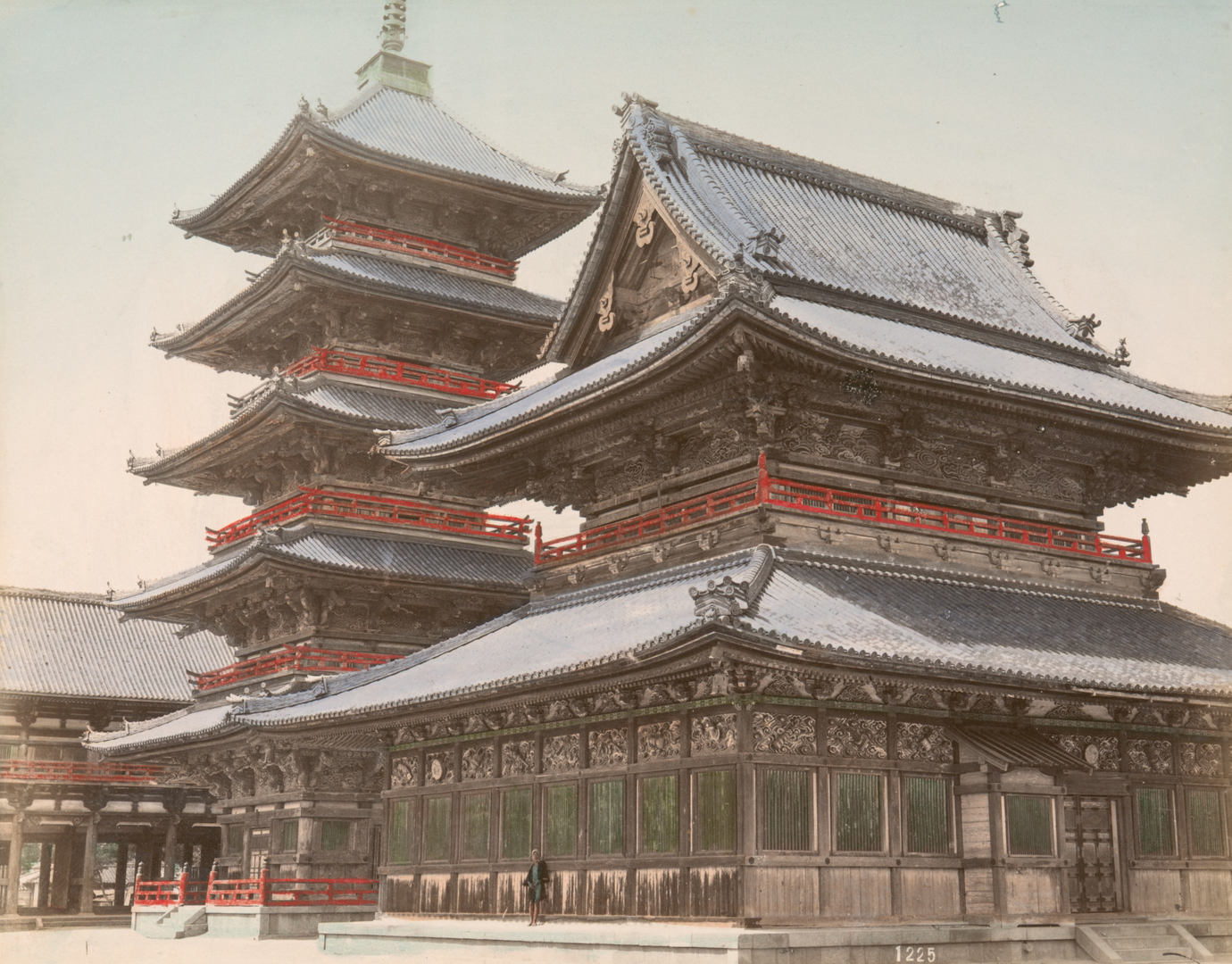
Image from New York Public Library, via Wikimedia Commons
If you visit Osaka, you’ll be urged to see two old buildings in particular: Osaka Castle and Shitennō-ji (above), Japan’s first Buddhist temple. In beholding both, you’ll behold the work of construction firm Kongō Gumi (金剛組), the oldest continuously run company in the world. It was with the building of Shitennō-ji, commissioned by Prince Shōtoku Taishi in the year 578, that brought it into existence in the first place. Back then, “Japan was predominantly Shinto and had no miyadaiku (carpenters trained in the art of building Buddhist temples),” writes Irene Herrera at Works that Work, “so the prince hired three skilled men from Baekje, a Buddhist state in what is now Korea,” among them a certain Kongō Shigetsu.
Thereafter, Kongō Gumi continued to operate independently for more than 1,400 years, run by 40 generations of Kongō Shigetsu’s descendants. By the time Toyotomi Hideyoshi had the company build Osaka Castle in 1583, it had been established for nearly a millennium. In the centuries since, “the castle has been destroyed repeatedly by fire and lightning,” Herrera writes. “Kongō Gumi prospered because of these major reconstructions, which provided them with plenty of work.” Throughout most of its long history, an even steadier business came from their specialty of building Buddhist temples, at least until serious challenges to that business model arose in the twentieth century.
“World War II brought significant changes to Japan, and the demand for temple construction waned,” says the tourism company Toki. “Sensing the shifting tides of the time, the company made a strategic decision to pivot its expertise towards a new endeavor: the crafting of coffins.” Governmental permission was arranged by the widow of Kongō Haruichi, Kongō Gumi’s 37th leader, who’d taken his own life out of financial despair inflicted by the Shōwa Depression of the nineteen-twenties. Here time at the head of the company illustrates its long-held willingness to grant leadership duties not just to first sons, but to family members best suited to do the job; for that reason, the history of the Kongō clan involves many sons-in-law deliberately sought out for that purpose.
The combined forces of the decline of Buddhism and the popping of Japan’s real-estate bubble in the nineties eventually forced Kongō Gumi to become a subsidiary of Takamatsu Construction Group in January 2006. “The current Kongō Gumi workforce has only one member of the Kongō family,” the Nikkei Asia reported in 2020, “a daughter of the 40th head of the family” who “now serves as the 41st head.” But its miyadaiku — distinctively organized into eight independent kumi, or groups — continue to do the work they always have, with ever-more-refined versions of the traditional tools and techniques they’ve been using for nearly a millennium and a half. Kongō Gumi continues to receive international attention for maintaining its high level of craftsmanship, but viewers of American TV drama in recent years will also appreciate its having solved the problem of succession.
Related Content:
Why Japan Has the Oldest Businesses in the World?: Hōshi, a 1300-Year-Old Hotel, Offers Clues
Building Without Nails: The Genius of Japanese Carpentry
A Visit to the World’s Oldest Hotel, Japan’s Nisiyama Onsen Keiunkan, Established in 705 AD
See How Traditional Japanese Carpenters Can Build a Whole Building Using No Nails or Screws
Based in Seoul, Colin Marshall writes and broadcasts on cities, language, and culture. His projects include the Substack newsletter Books on Cities and the book The Stateless City: a Walk through 21st-Century Los Angeles. Follow him on Twitter at @colinmarshall or on Facebook.
Read More...When Samuel Beckett Drove Young André the Giant to School
Are your idle moments spent inventing imaginary conversations between strange bedfellows? The sort of conversation that might transpire in a pickup truck belonging to Samuel Beckett, say, were the Irish playwright to chauffeur the child André Rene Roussimoff—aka pro wrestler André the Giant—to school?
Too silly, you say? Nonsense. This isn’t some wackadoo random pairing, but an actual historic meeting of the minds, as André’s Princess Bride co-star and soon-to-be-published film historian, Cary Elwes, attests above.
In 1958, when 12-year-old André’s acromegaly prevented him from taking the school bus, the author of Waiting for Godot, whom he knew as his dad’s card buddy and neighbor in rural Moulien, France, volunteered for transport duty. André recalled that they mostly talked about cricket, but surely they discussed other topics, too, right? Right!?
Even if they didn’t, it’s deliciously fun to speculate.
In the barebones entry above, Binghamton, New York’s Därkhorse Drämatists playwright Ron Burch has Beckett dispensing romantic advice in much the same way that he wrote dialogue, to create a dialectic. (“So I should embrace the negation of the act in order to get the opposite reaction?” André asks, re: a girl he’s eager to kiss.)
Burch is not the only dramatist to tackle these mystery rides. Chicago playwright Rory Jobst was inspired to write Samuel Beckett, Andre the Giant, and the Crickets after listening to They Might Be Giants’ John Flansburgh and John Linnell participating in a 3‑question André the Giant trivia quiz on NPR’s Wait Wait…Don’t Tell Me.
Cartoonist Box Brown is another to take a stab at the unlikely carpool buddies’ chit chat, with his graphic biography, Andre the Giant. In his version, Beckett asks André why he’s so big, André asks Beckett if he plays football, and Beckett gives him his first cigarette. (“Well, y’know, they stunt your growth so,” Beckett hesitates, “…eh, okay.”)
Related Content:
Andy Warhol’s One Minute of Professional Wrestling Fame (1985)
The Books That Samuel Beckett Read and Really Liked (1941–1956)
An Animated Introduction to Samuel Beckett, Absurdist Playwright, Novelist & Poet
Ayun Halliday is interested in hearing about unorthodox productions of Waiting for Godot @AyunHalliday.
Read More...How an Ancient Roman Shipwreck Could Explain the Universe
In a 1956 New Statesman piece, the British scientist-novelist C. P. Snow first sounded the alarm about the increasingly chasm-like divide between what he called the “scientific” and “traditional” cultures. We would today refer to them as the sciences and the humanities, while still wringing our hands over the inability of each side to learn from (or even coherently communicate with) the other. Nevertheless, recent history provides the occasional heartening example of sciences-humanities collaboration, few of them as dramatic as the story told in the SciShow video above, “An Ancient Roman Shipwreck May Explain the Universe.”
The shipwreck in question occurred two millennia ago, off the western coast of Sardinia. Having set sail from the mining center of Cartegena, Spain, it was carrying more than 30 metric tons of lead, processed into a thousand ingots. An important metal in the ancient Roman Empire, lead was used to make pipes (like the ones installed in aqueducts), water tanks, roofs, and weapons of war. While our civilization has grown justifiably wary of putting water through lead pipes (and has at its command much stronger metals in any case), it still has plenty of use for the stuff, especially in shields against X‑rays and other forms of activity.
No matter how little contact you have with the scientific culture, you can surely appreciate how researchers in need of radioactivity shields must have felt when this lead ingot-filled shipwreck was discovered in 1988. Having spent a couple thousand years at the bottom of the ocean, the Roman lead aboard had lost most of its radioactivity, making it ideal for use in the shield of the Cryogenic Underground Observatory for Rare Events (CUORE) at the Gran Sasso National Laboratory in Italy. Engineered for research into the mass of neutrinos, subatomic particles long thought to have no mass at all, CUORE held out the promise of data that could lead to insights into the origin of the universe.
Ultimately, the physicists and archaeologists struck a deal, allowing the former to melt down the least-well preserved ingots from the shipwreck (after first removing the historically valuable inscriptions from its manufacturer) and use it to shield the highly sensitive CUORE from outside radiation. The design worked, but as of last year, none of the experiments have produced conclusive results about the role of neutrinos in the emergence of life, the universe, and everything. Probing that question further will be a job for CUORE’s successor CUPID (CUORE Upgrade with Particle Identification), scheduled to come online later this year. Though C. P. Snow never lived to see these projects, he surely wouldn’t be surprised that, to find convergence between the sciences and the humanities, you’ve got to dive deep.
Related content:
See the Well-Preserved Wreckage of Ernest Shackleton’s Ship Endurance Found in Antarctica
“The Value of Culture” Revealed in a New BBC Radio Series by Melvyn Bragg
Based in Seoul, Colin Marshall writes and broadcasts on cities, language, and culture. His projects include the Substack newsletter Books on Cities and the book The Stateless City: a Walk through 21st-Century Los Angeles. Follow him on Twitter at @colinmarshall or on Facebook.
Read More...Jimi Hendrix Arrives in London in 1966, Asks to Get Onstage with Cream, and Blows Eric Clapton Away: “You Never Told Me He Was That F‑ing Good”
Jimi Hendrix arrived on the London scene like a ton of bricks in 1966, smashing every British blues guitarist to pieces the instant they saw him play. As vocalist Terry Reid tells it, when Hendrix played his first showcase at the Bag O’Nails, arranged by Animals’ bassist Chas Chandler, “there were guitar players weeping. They had to mop the floor up. He was piling it on, solo after solo. I could see everyone’s fillings falling out. When he finished, it was silence. Nobody knew what to do. Everybody was dumbstruck, completely in shock.”
He only exaggerates a little, by all accounts, and when Reid says “everybody,” he means everybody: Keith Richards, Mick Jagger, Brian Jones, Jeff Beck, Paul McCartney, The Who, Eric Burdon, John Mayall, and maybe Jimmy Page, though he denies it. Mayall recalls, “the buzz was out before Jimi had even been seen here, so people were anticipating his performance, and he more than lived up to what we were expecting.” In fact, even before this legendary event sent nearly every star classic rock guitarist back to the woodshed, Jimi had arrived unannounced at the Regent Street Polytechnic, and asked to sit in and jam with Cream, where he proceeded to dethrone the reigning British guitar god, Eric Clapton.
Nobody knew who he was, but “in those days anybody could get up with anybody,” Clapton says in a recent interview, “if you were convincing enough that you could play. He got up and blew everyone’s mind.” As Hendrix biographer Charles Cross tells it, “no one had ever asked to jam” with Cream before. “Most would have been too intimidated by their reputation as the best band in Britain.” To hear the story as it’s told in the clip above from the BBC documentary Seven Ages of Rock, no one else would have ever dared to get onstage with Eric Clapton. Clapton, as the famed graffiti in London announced, was God. “It was a very brave person who would do that,” says Jack Bruce.
Actually, it was Chandler who asked the band, and who also tried to prepare Clapton. Jimi got onstage, plugged into Bruce’s bass amp, and played a version of Howlin’ Wolf’s “Killin’ Floor.” Everyone was “completely gobsmacked,” Clapton writes in his autobiography. “I remember thinking that here was a force to be reckoned with. It scared me, because he was clearly going to be a huge star, and just as we are finding our own speed, here was the real thing.” Fear, envy, awe… all reasonable emotions when standing next to Jimi Hendrix as he tears through “Killin’ Floor” three times faster than anyone else played it (as you can see him play it in Stockholm above)—while doing the splits, lying on the floor, playing with his teeth and behind his head…
“It was amazing,” writes Clapton, “and it was musically great, too, not just pyrotechnics.” There’s no telling how Jimi might have remembered the event had he lived to write his memoirs, but he would have been pretty modest, as was his way. No one else who saw him felt any need to hold back. “It must have been difficult for Eric to handle,” says Bruce, “because [Eric] was ‘God,’” and this unknown person comes along, and burns.” He puts it slightly differently at the top: “Eric was a guitar player. Jimi was some sort of force of nature.”
Rock journalist Keith Altham has yet a third account, as Ed Vulliamy writes at The Guardian. He remembers “Chandler going backstage after Clapton left in the middle of the song ‘which he had yet to master himself’; Clapton was furiously puffing on a cigarette and telling Chas: ‘You never told me he was that fucking good.’” Who knows if Hendrix knew Clapton had struggled with “Killin’ Floor” and decided not to try it live. But as blues guitarist Stephen Dale Petit notes, “when Chas invited Jimi to London, Jimi did not ask about money or contracts. He asked if Chas would introduce him to Beck and Clapton.”
He had come to meet, and blow away, his rock heroes. “Two weeks after The Bag O’Nails,” writes Classic Rock’s Johnny Black, “when Cream appeared at The Marquee Club, Clapton was sporting a frizzy perm and he left his guitar feeding back against the amp, just as he’d seen Jimi do.”
Related Content:
Jimi Hendrix Unplugged: Two Great Recordings of Hendrix Playing Acoustic Guitar
23-Year-Old Eric Clapton Demonstrates the Elements of His Guitar Sound (1968)
Jimi Hendrix Opens for The Monkees on a 1967 Tour; Then Flips Off the Crowd and Quits
Jimi Hendrix’s Final Interview Animated (1970)
Josh Jones is a writer and musician based in Durham, NC. Follow him at @jdmagness
Read More...Soviet Inventor Léon Theremin Shows Off the Theremin, the Early Electronic Instrument That Could Be Played Without Being Touched (1954)
You know the sound of the theremin, that weird, warbly whine that signals mystery, danger, and otherworldly portent in many classic sci-fi films. It has the distinction of being not only the very first electronic instrument but also the only instrument in history one plays without ever touching any part of it. Instead, the theremin player makes hand motions, like the conductor of an invisible choir, and the device sings. You can see this yourself above, as the instrument’s inventor, Leon Theremin, demonstrates his thereminvox, as he called it at the time, in 1954. Speaking in Russian, with English subtitles, Theremin describes how the “instrument of a singing-voice kind” works “by means of influencing an electromagnetic field.”
Theremin originally invented the instrument in 1919 and called it the Aetherphone. He demonstrated it for Vladimir Lenin in 1922, and its futuristic sound and design made quite an impression on the ailing communist leader. Theremin then brought the device to Europe (see a silent newsreel demonstration here) and to the U.S. in 1927, where he debuted it at the Plaza Hotel and where classical violinist Clara Rockmore, soon to become the most devoted proponent and player of the theremin, first heard it.
Although many people thought of Theremin’s invention as a novelty, Rockmore insisted that it would be taken seriously. She apprenticed herself to Theremin, mastered the instrument, and adapted and recorded many a classical composition, like Tchaikovsky’s “Berceuse,” above. More than anyone else, Rockmore made the theremin sing as its inventor intended.
The origin story of the theremin, like so many invention stories, involves a happy accident in the laboratory. Just above, Albert Glinsky, author of the history Theremin: Ether Music and Espionage, describes how Theremin inadvertently created his new instrument while devising an audible technique for measuring the density of gases in a chemistry lab. The first iteration of the instrument had a foot pedal, but Theremin wisely decided, Glinsky says, that “it would be so much more intriguing to have the hands purely in the air,” manipulating the sound from seemingly nowhere. Although there are no frets or strings or keys, no bow, slide, or other physical means of changing the theremin’s pitch, its operation nonetheless requires training and precision just like any other musical instrument. If you’re interested in learning the basics, check out the tutorial below with thereminist Lydia Kavina, playing a ‘thereamini’ designed by synthesizer pioneer Moog.
In his day, Theremin lived on the cutting edge of scientific and musical innovation, and he hoped to see his instrument integrated into the world of dance. While working with the American Negro Ballet Company in the 1930s, the inventor fell in love with and married a young African-American dancer named Lavinia Williams. He was subsequently ostracized from his social circle, then he either abruptly picked up and left the U.S. for the Soviet Union in 1938 or, more likely, as Lavinia alleged, he was kidnapped from his studio and whisked away. Whatever the case, Theremin ended up in a Gulag laboratory called a sharaska, designing listening devices for the Soviet Union. Thereafter, he worked for the KGB, then became a professor of physics at Moscow State University.
Theremin never gave up on his electronic instruments, inventing an electronic cello and variations on his theremin during a 10-year stint at the Moscow Conservatory of Music. He gave his final theremin demonstration in the year of his death, 1993, at age 97. (See him playing above in 1987 with his third wife Natalia.) To learn much more about the inventor’s fascinating life story, be sure to see Steven M. Martin’s 1993 documentary Theremin: An Electronic Odyssey.
And if you’re intrigued enough, you can buy your very own Theremin made by Moog.
Related Content:
Learn How to Play the Theremin: A Free Short Video Course
Josh Jones is a writer and musician based in Durham, NC. Follow him at @jdmagness
Read More...
Jack Kerouac’s Hand-Drawn Cover for On the Road (1952)
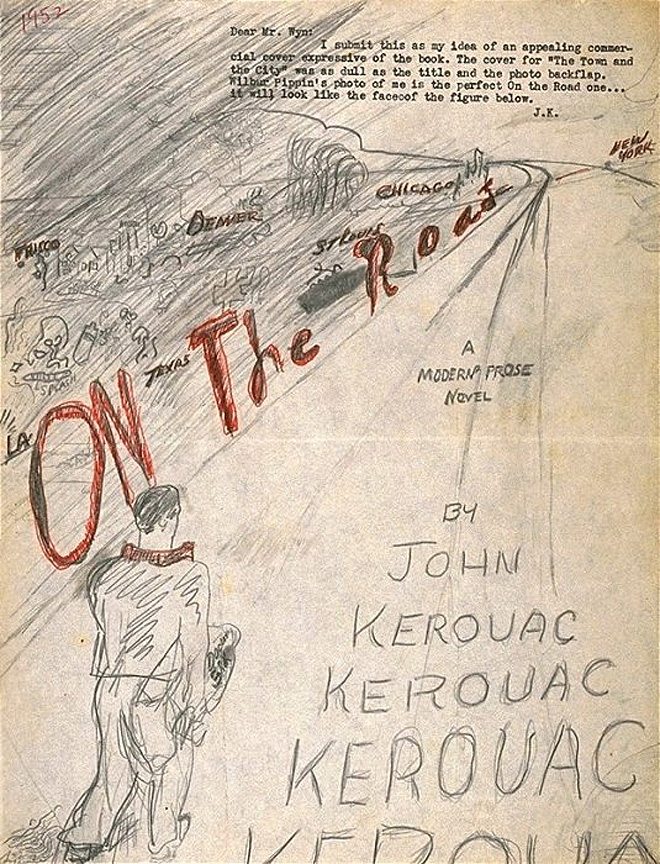
This falls under the category, “If you want it done right, you have to do it yourself.”
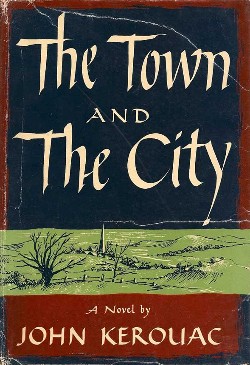
In 1950, when Jack Kerouac released his first novel, The Town and the City, he was less than impressed by the book cover produced by his publisher, Harcourt Brace. (Click here to see why.) So, in 1952, when he began shopping his second novel, the great beat classic On the Road, Kerouac went ahead and designed his own cover. He sent it to a potential publisher A.A. Wyn, with a little note typed at the very top:
Dear Mr. Wyn:
I submit this as my idea of an appealing commercial cover expressive of the book. The cover for “The Town and the City” was as dull as the title and the photo backflap. Wilbur Pippin’s photo of me is the perfect On the Road one … it will look like the face of the figure below.
J.K.
Wyn turned down the novel, and it wouldn’t get published until 1957. It would, however, become a bestseller and be published with many different covers through the years. They’re all on display here.
If you would like to support the mission of Open Culture, consider making a donation to our site. It’s hard to rely 100% on ads, and your contributions will help us continue providing the best free cultural and educational materials to learners everywhere. You can contribute through PayPal, Patreon, and Venmo (@openculture). Thanks!
Related Content:
Jack Kerouac’s Hand-Drawn Map of the Hitchhiking Trip Narrated in On the Road
Hear Jack Kerouac Read from On The Road on the 100th Anniversary of His Birth
Four Interactive Maps Immortalize the Road Trips That Inspired Jack Kerouac’s On the Road
Jack Kerouac Lists 9 Essentials for Writing Spontaneous Prose
Jack Kerouac’s “Beat Paintings:” Now Gathered in One Book and Exhibition for the First Time
Read More...An Architect Breaks Down the 5 Most Common Styles of College Campus
Every now and again on social media, the observation circulates that Americans look back so fondly on their college years because never again do they get to live in a well-designed walkable community. The organization of college campuses does much to shape that experience, but so do the buildings themselves. “People often say that college is the best four years of your life,” says architect Michael Wyetzner in the new Architectural Digest video above, “but it was also likely that it was some of the best architecture you’ve been around as well.” He goes on to identify, explain, and contextualize the five building styles most commonly seen on American college campuses: colonial, Collegiate Gothic, modernism, brutalism, and postmodernism.
For examples of colonial campus architecture, look no further than the Ivy League, only one of whose schools was built after the Declaration of Independence — whose author, Thomas Jefferson, later designed the University of Virginia, drawing much inspiration (if not always first-hand) from ancient Greece and Rome. “Ironically, after the US declared independence, newer schools wanted to look older,” says Wyetzner, a desire that spawned the enduring Collegiate Gothic style. Constructed out of masonry and brick, its earliest buildings tend to pick and choose features of genuine Gothic architecture while mixing and matching them with the design languages of other times and places. More recent examples have been strenuously faithful by comparison, incorporating gargoyles and all.
When they arise, architectural styles tend to align themselves with the old or the new, and it was the latter that overtook college campuses after the Second World War. Take the Illinois Institute of Technology, which was designed whole by no less a Bauhaus-credentialed modernist than Ludwig Mies van der Rohe. Modular, flat-roofed, and built with plenty of exposed brick, glass, and steel, its buildings proved influential enough that “nearly every high school in the United States that was built in the fifties and sixties” was designed in more or less the same way — albeit without the early utopian modernist spirit, which by that point had devolved into an industrial emphasis on “rationalism, functionality, and hygiene.”
After modernism came brutalism, the style of the least-beloved buildings on many a campus today. Coined by Le Corbusier, the style’s name comes from béton brut, or raw concrete, vast quantities of which were used to shape its hulking and, depending on how you feel about them, either dreary or awe-inspiring structures. The aesthetically promiscuous postmodernist buildings that began appearing in the sixties and multiplied in the seventies and eighties were more playful and historically aware — or all too playful and historically aware, as their detractors would put it. If you think back to your own college days, you can probably remember spending time in, or around, at least one example of each of these styles, because large US college campuses have, over time, become rich anthologies of architectural history. Would that most Americans could say the same about the places they live after graduation.
Related content:
Why People Hate Brutalist Buildings on American College Campuses
Architect Breaks Down Five of the Most Iconic New York City Apartments
An Architect Breaks Down the Design of New York City Subway Stations, from the Oldest to Newest
What Is Postmodern Architecture?: An Introduction in Three Videos
Based in Seoul, Colin Marshall writes and broadcasts on cities, language, and culture. His projects include the Substack newsletter Books on Cities and the book The Stateless City: a Walk through 21st-Century Los Angeles. Follow him on Twitter at @colinmarshall or on Facebook.
Support Us
We're hoping to rely on loyal readers, rather than erratic ads. Please click the Donate button and support Open Culture. You can use Paypal, Venmo, Patreon, even Crypto! We thank you!

About Us

Open Culture scours the web for the best educational media. We find the free courses and audio books you need, the language lessons & educational videos you want, and plenty of enlightenment in between.
Advertise With Us

FREE UPDATES!
GET OUR DAILY EMAIL
Get the best cultural and educational resources on the web curated for you in a daily email. We never spam. Unsubscribe at any time.
FOLLOW ON SOCIAL MEDIA

Open Culture editor Dan Colman scours the web for the best educational media. He finds the free courses and audio books you need, the language lessons & movies you want, and plenty of enlightenment in between.
Advertise With Us